
International Research Journal of Engineering and Technology (IRJET) e-ISSN: 2395-0056
Volume: 12 Issue: 09 | Sep 2025 www.irjet.net p-ISSN: 2395-0072
International Research Journal of Engineering and Technology (IRJET) e-ISSN: 2395-0056
Volume: 12 Issue: 09 | Sep 2025 www.irjet.net p-ISSN: 2395-0072
Shoaib Hurrira1 , Dr. Joshi Manisha S2
1Post Graduate Student, Department of Medical Electronics Engineering, BMS College of Engineering, Bengaluru, India
2Professor, Department of Medical Electronics Engineering, BMS College of Engineering, Bengaluru, India
Abstract - Effective management of hospital data and workflows is essential for enhancing patient care, administrative efficiency,andtheoverallqualityofhealthcare. Conventional hospital management systems frequently face challenges due to manual record-keeping, data duplication, and inefficiencies in scheduling and billing methods. This project introduces a desktop-based Hospital Information System (HIS) aimed at optimizing these processes through a single, cohesive platform. The system includes modules for patient registration, appointmentscheduling,billing,andstaff management, accompanied by integratedgraphical analytics to monitor hospital performance.ByutilizingPython(Tkinter) for the user interface and MySQL for the backend database, this application facilitates secure data storage, real-time CRUD operations, and interactive dashboards. A reporting module creates visual summaries and statistical charts to aid hospital administrators in their decision-making processes. This solution is 2lightweight, scalable, and ideal for small to mid-sized healthcare facilities. The goal is to close the gap between traditional hospital operations and contemporary digital healthcare by providing a cost-effective, user-friendly, and efficient management system.
Key Words: Hospital InformationSystem,Python,MySQL, Appointment Scheduling, Billing, Graphical Dashboard, HealthcareIT,DataVisualization
Effective hospital management is crucial for providing prompt and high-quality healthcare services. However, conventional hospital systems frequently experience disjointed workflows, manual record maintenance, redundant procedures, and ineffective scheduling. These issues are especially significant in small to mid-sized healthcareestablishments,wherethelackofunifieddigital platforms results in delays, data discrepancies, and suboptimalresourceuse.
Core hospital operations, including patient registration, appointmentscheduling,billing,andstaffcoordination,are essentialfordailyfunctioning.Manualmethodsofhandling thesetasksoftenleadtooverlappingappointments,delayed treatments, and inaccuracies in financial records. Furthermore, the absence of centralized data access and
visualization tools complicates hospital administrators’ ability to derive actionable insights regarding operational performance.
To tackle these issues, this paper introduces a secure and scalabledesktop-basedHospitalInformationSystem(HIS) built with Python (Tkinter) and MySQL. This system integrates key hospital processes such as patient registration, staff management, appointment scheduling, room assignment, and billing into a single platform. In addition, it features a graphical results module using Matplotlib to produce real-time analytics, allowing administrators to effectively track hospital trends and performancemetrics.
TheproposedHISfacilitatesstructureddatastorage,realtimeCRUDoperations,andfeaturesforgeneratingprintable reports. The modules are designed to be lightweight and modular,providingenhancedfunctionalitysuchasconflict resolutionforappointments,dynamicsearchfilters,anddata backup for compliance audits. The application also incorporates UI design best practices and data validation, ensuringaccessibilityforhospitalpersonnelwithminimal training.
Thekeycontributionsofthisworkinclude:
Designingandimplementingamodular,desktop-based HIS that unifies essential functions like patient registration, appointment scheduling, billing, staff, department,androommanagement
Ensuringsecureandrelationaldatamanagementusing MySQL,withestablishedschemas,validationrules,and consistencychecks.
Introducingavisualanalyticfeaturetomonitorpatient inflow,billingdetails,anddepartmentalstatisticsutilizing Matplotlib.
Offering a cost-effective and scalable solution for small and medium-sized hospitals without enterprise-level infrastructure.
Layingthefoundationforfutureimprovements,including RESTful API integration, cloud deployment, mobile application compatibility, and AI-powered healthcare analytics.
International Research Journal of Engineering and Technology (IRJET) e-ISSN: 2395-0056
Volume: 12 Issue: 09 | Sep 2025 www.irjet.net p-ISSN: 2395-0072
Thissystemillustrateshowopen-sourcetechnologiescanbe harnessedtoenhanceoperationaleffectivenessandfacilitate data-drivendecision-makinginhealthcaresettingsthrougha cohesiveanduser-friendlydigitalsolution.
The paper is structured as follows: Section II presents a review of related work in the field of hospital information systems and highlights key contributions from recent literature.SectionIIIprovidesanoverviewoftheproposed systemarchitectureanditscoreobjectives.SectionIVdetails the implementation of the system, including module-wise design,userinterfacecomponents,anddatabaseintegration.
SectionVdiscussesthetestingmethodologyusedtovalidate systemperformance,alongwiththeresultsobservedduring unit and integration testing. Section VI outlines the major challengesencounteredduringdevelopmentandthesolutions adopted to address them. Finally, Section VII concludes the paper by summarizing the outcomes of the project and suggesting future enhancements for improving scalability, accessibility,andfunctionality.
The continuous advancement of healthcare systems necessitates the adoption of robust, scalable, and secure technologies that cater to the growing complexities of patient care and hospital administration. Over the years, severalresearchershaveproposedinnovativeapproachesto improve healthcare interoperability, data security, operational efficiency, and user experience. The following literature review highlights key studies that have directly influencedthedesign,architecture,andtechnicaldirectionof thisproject.
Macriga et al. [1] proposed a blockchain-enabled hospital management system that leverages smart contracts and NFC-based wristbands for secure and real-time access to medical records. Their architecture demonstrated how decentralized prescription tracking could enhance the integrity and traceability of sensitive medical data. This concept formed the foundation of Phase 1 in the current project,focusingonsecuredataaccessandauthentication.
Mhamdietal.[2]developedablockchain-basedElectronic MedicalRecord(EMR)system,emphasizingsmartcontracts andcryptographicsecurityforinteroperabledataexchange. Their approach ensured compliance with healthcare regulations and patient consent control, offering valuable insight into how data privacy and integrity can be preserved an idea that aligns with the proposed future roadmapofthisHIS.
Ahmadetal.[3]presentedasecuredata-sharingframework fortelemedicineusingblockchaintocombatchallengessuch asinsurancefraudandphysicianidentityverification.Their workemphasizeddecentralizedconsentmanagement,which is particularly relevant for extending hospital services to
remote and rural populations. These strategies are considered for future implementations to expand the HIS beyondlocaldeployments.
Rizketal.[4]exploredtheconceptofSMARThospitalsusing IoT and cloud-based platforms to optimize hospital resources.Theirsystemusedreal-timedatafromsensorsto automatetaskslikebedallocation,environmentalcontrol, and patient tracking. Although this project focuses on a desktop-basedsolution,suchinsightscontributetothelongtermvisionofclouddeploymentandIoTintegration.
KumarandGupta[5]proposedastructuredimplementation of hospital management systems with a focus on modulewisefunctionalityandintegration.Theirstudysupportsthe approachusedinthisproject’sdesignandtheimportanceof havingareliablebackendthatsupportsscalablemodules.
Wang et al. [6] introduced a blockchain-integrated ehealthcare framework that communicates with Wireless BodyAreaNetworks(WBANs)tofacilitatesecuremedical dataexchange.Theirdecentralizedmethodologyreflectsthe system’sfuturepotentialtointegratewearableandremote devicesforenhancedmonitoring.
Aminetal.[7]proposedacognitivesmarthealthcaremodel thatintegratesIoTdevicesandAIalgorithmsforreal-time pathology detection and patient monitoring. While this projectdoesnotcurrentlyutilizeAI,thegraphicalreporting modules were designed to be AI-ready, making future integration of intelligent decision support and predictive analyticsfeasible.
Manogaran et al. [8] developed a Big Data and IoT-driven monitoringplatformforheartdiseasepredictionusingfog computing and the MapReduce model. Their architecture highlighted the importance of scalable data pipelines, predictive analysis, and cloud integration concepts that influencedthedatahandlingandscalabilityplanninginthis HISproject.
Koyuncu and Koyunc [9] created an intelligent front-desk hospitalmanagementsystemusingamenu-drivenBorland C++interfacethatautomatedappointmentschedulingand doctorrecommendationsbasedonsymptoms.Theirwork underscored the value of usability and decision support, directly informing the intuitive design of the current system'sgraphicalinterfaceandappointmentlogic.
In summary, these studies collectively underscore the critical role of blockchain, IoT, cloud computing, and intelligent interfaces in the modernization of healthcare systems. They offer compelling evidence that a secure, modular, and scalable Hospital Information System can bridge the gap between traditional manual methods and digitally automated workflows. The integration of such research into the current system’s design has guided the
International Research Journal of Engineering and Technology (IRJET) e-ISSN: 2395-0056
Volume: 12 Issue: 09 | Sep 2025 www.irjet.net p-ISSN: 2395-0072
architectural decisions, choice of technologies, and future scalabilityconsiderations.
TheproposedHospitalInformationSystem(HIS)isdesigned as a modular, desktop-based application aimed at streamlining hospital operations through secure data management,dynamicscheduling,andreal-timereporting. The system is built using Python (Tkinter) for the user interfaceandMySQL8.0forthebackendrelationaldatabase.
The architecture of the HIS follows a classic three-tier structure consisting of the Presentation Layer, Business LogicLayer,andDataLayer,asshowninFig.1
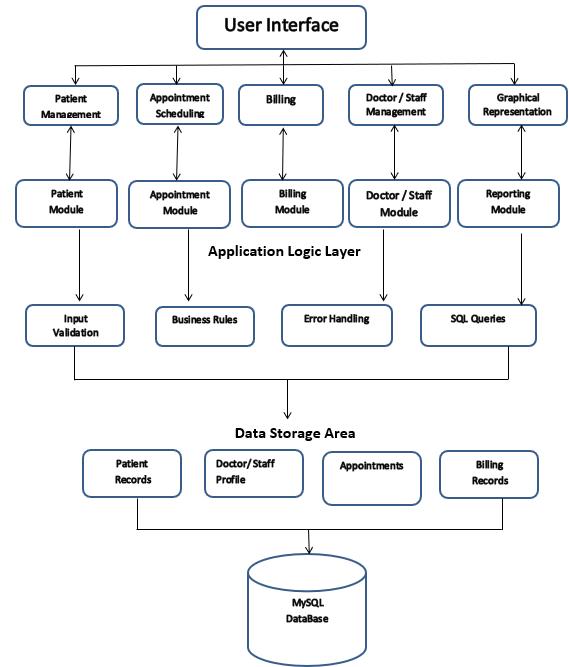
PresentationLayer:DevelopedusingPython'sTkinter library, this layer provides hospital staff with forms, tables, and dashboards to interact with system functionalitiessuchaspatientregistration,appointment booking,andbilling.
BusinessLogicLayer:Thisintermediarylayermanages operations such as appointment conflict detection, billing computation, user input validation, and intermodule data handling. Logic is implemented using modular Python functions to ensure code reusability andmaintainability.
DataLayer:Allrecords,includingpatientprofiles,staff information, appointments, billing, and room assignments,arestoredinastructuredMySQLdatabase. Relationalintegrityismaintainedthroughforeignkey constraintsandvalidationchecks.
This layered architecture ensures modularity, scalability, andeaseofmaintenancewhileenablingreal-timedataflow acrossallmodules.
Thesystemincludesthefollowingmodules:
Patient Management: Captures patient demographic details and medical history. Provides full CRUD operations with unique ID assignment and seamless integrationwithappointmentandbillingmodules.
Doctor/StaffManagement:Storesandmanagesdetails of hospital personnel, including specialization, department,andworkinghours.Staffprofilesareused during appointment scheduling and department assignments.
Appointment Scheduling: Enables real-time booking, rescheduling, and cancellation of appointments. Implements SQL-based conflict detection to prevent double-booking.Filtersbydoctor,date,ordepartment allowefficientscheduling.
BillingModule:Automaticallygeneratesitemizedbills bycomputingchargessuchasconsultation,treatment, and room fees. Billing data is linked to patient and appointmenttablesforaccuratefinancialrecords.
DepartmentandRoomAllocation:Managesallocationof patients to departments and rooms. Updates room occupancystatusinreal-timetoavoidoverbooking.
Graphical Results Visualization: Uses Matplotlib to produce bar charts, pie charts, and statistical summaries.Visualdashboardspresenttrendsinpatient visits,departmentalloads,andfinancialperformance.
SearchandFilteringEngine:Enableskeyword-anddatebaseddatafilteringacrossallmodules.OptimizedSQL queries improve speed and accuracy in retrieving relevantrecords.
Eachmoduleoperatesthroughasharedbackendschemain MySQL. Data from one module (e.g., patient records) is referenced in others (e.g., appointments or billing) using foreign key relationships. The business logic ensures that changes in one module propagate accurately through dependentmodules,ensuringconsistency.
International Research Journal of Engineering and Technology (IRJET) e-ISSN: 2395-0056
Volume: 12 Issue: 09 | Sep 2025 www.irjet.net p-ISSN: 2395-0072
Themodulararchitectureallowsfutureextensibilitysuchas cloud deployment, REST API integration, or mobile application support, without disrupting existing functionalities.
The GUI is developed using Tkinter’s widget system. It includesform-basedinputs,dropdowns,tables,anddialog boxes for user interaction. Each form is accompanied by input validation mechanisms, feedback prompts, and confirmationdialogstoenhanceusabilityandreducehuman error.
The design ensures ease of use for non-technical hospital staff and supports smooth transitions between modules. Visual outputs and reports can be printed or exported as PDFsforadministrativeuse.
TheimplementationoftheproposedHospitalInformation System (HIS) focused on developing a fully modular, scalable,anduser-friendlydesktopapplication.Pythonwas usedforfrontenddevelopmentviatheTkinterlibrary,while MySQL8.0servedasthebackendrelationaldatabase.The applicationfollowsamodularapproachwhereeachmodule independently handles a core hospital operation while sharingaunifieddataschema.
A.DevelopmentEnvironment
Thefollowingenvironmentandtoolswereused:
ProgrammingLanguage:Python3.10+
Libraries/Frameworks: Tkinter, Matplotlib, MySQL Connector
Database:MySQL8.0withrelationalschema
IDE:VisualStudioCode/PyCharm
OperatingSystem:Windows10
VersionControl:Git
B.Module-WiseImplementation
Eachfunctionalcomponentofthesystemwasimplemented asanindependentmoduletosupportmodulartestingand easeofmaintenance.
1)PatientManagementModule
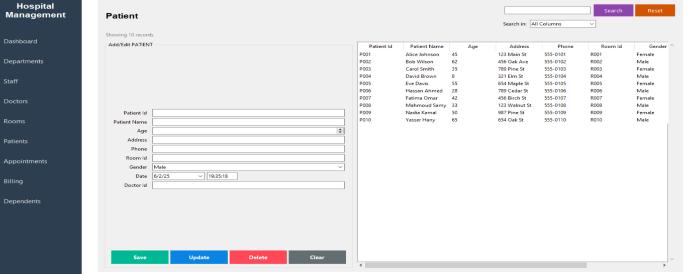
Thismoduleenableshospitalstafftoregister,update,and viewpatientrecords.Datafieldsincludename,age,gender, contactinformation,medicalhistory,andassignedroom.
Integratedwithappointmentandbillingtablesthrough uniquepatientIDs.
Include search, update, and delete functionalities for seamlessrecordhandling.
2)DoctorandStaffManagementModule
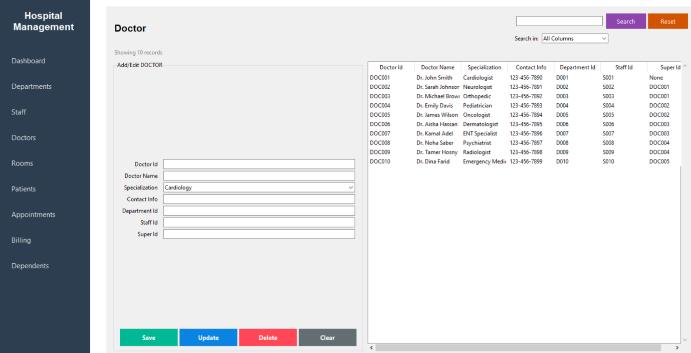
Thismodulemanagesinformationrelatedtodoctors,nurses, andadministrativestaff.
Captures specialization, department, role, and availability.
Enables easy assignment of doctors to patients and departments.
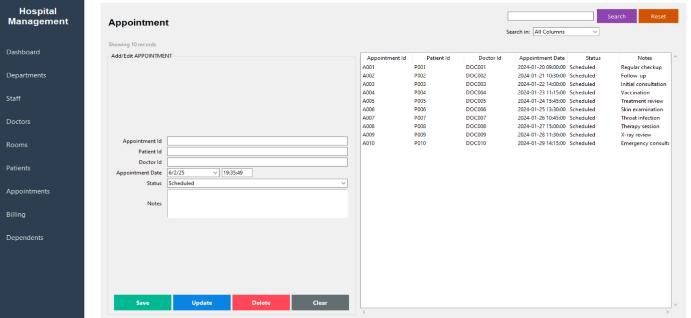
3)AppointmentSchedulingModule
This module handles the scheduling, rescheduling, and cancellationofappointments.Itincludesreal-timeconflict checkingtoavoidoverlappingtimeslots.
Searchfiltersallowappointmentstobesortedbydate, department,ordoctor.
Timestamps and department codes are used for traceability.
2025, IRJET | Impact Factor value: 8.315 | ISO 9001:2008
International Research Journal of Engineering and Technology (IRJET) e-ISSN: 2395-0056
Volume: 12 Issue: 09 | Sep 2025 www.irjet.net p-ISSN: 2395-0072
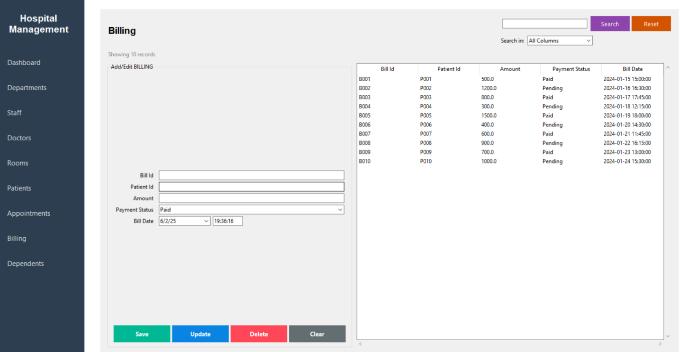
4)BillingModule
The billing module calculates consultation fees, treatment charges, room rates, and additional service costs automatically.
Itemizedbillinglinkedtothepatientandappointment tables.
Printablebillswithtimestampedfinancialsummaries.
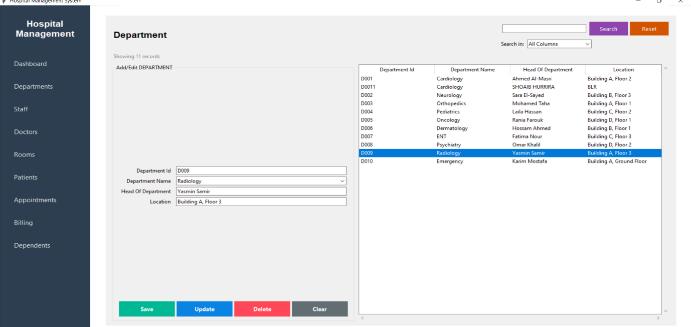
5)DepartmentandRoomAllocationModule
This module handles the assignment of patients to appropriatehospitaldepartmentsandavailablerooms.
Preventsoverbookingusingdynamicroomavailability status.
Tracksreal-timeoccupancyanddepartmentalloads.
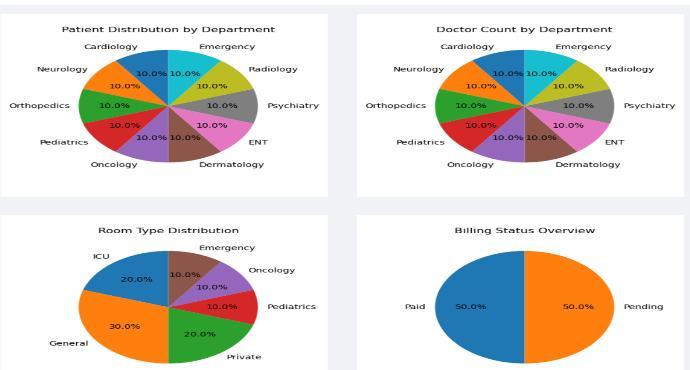
6)GraphicalResultsVisualizationModule
Matplotlibisused togeneratestatistical visualizationsfor administrators.
Barandpiechartsdisplaytrendsinpatientflow,billing revenue,roomusage,anddepartmentalappointments.
Visualizations are embedded within the Tkinter interface.
7)AdvancedSearchandFilterEngine
SQL-basedfiltersandkeywordsearchesareimplementedto facilitatefastrecordretrieval.
Supportedfiltersincludedateranges,departmentcodes, billingamount,andpatientstatus.
OptimizedSQLqueriesensureperformanceoverlarge datasets.
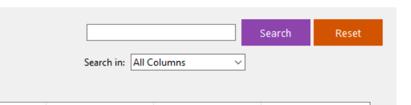
Fig - 8: Searchandfilterinterfacewithmultiplefield selection
C.IntegrationLogic
All modules are integrated via a centralized relational schemainMySQL.
Foreign key constraints ensure consistent linking betweenpatient,billing,andappointmentrecords.
Backend CRUD operations are handled by modular Pythonfunctions.
International Research Journal of Engineering and Technology (IRJET) e-ISSN: 2395-0056
Volume: 12 Issue: 09 | Sep 2025 www.irjet.net p-ISSN: 2395-0072
Input validation and exception handling prevent insertionofinvalidorincompletedata.
D.UserInterfaceDesign
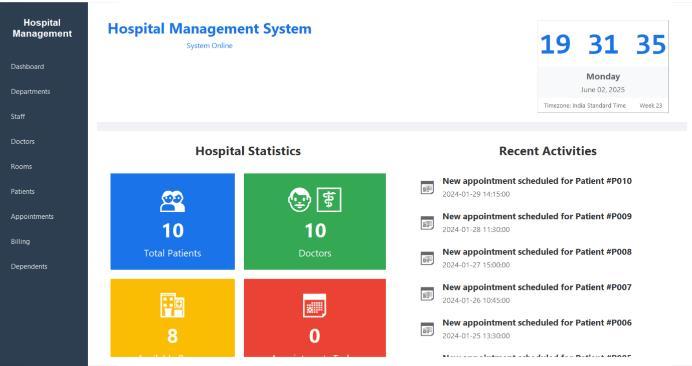
The application GUI is implemented using Tkinter’s tabbased layout with a consistent user experience across all modules.
Labelled fields, dropdowns, and confirmation dialogs supportintuitiveinteraction.
Graphical reports are displayed in separate windows withexport-to-PDFcapability.
Modulesareaccessiblefromacentraldashboard,shown inFig.9.
5. RESULTS AND VALIDATION
Acomprehensivetestingandvalidationstrategywasapplied toevaluatethereliability,performance,andcorrectnessof the developed Hospital Information System (HIS). Both individual module behavior and end-to-end system workflows were assessed under simulated real-world conditions.Thetestingmethodologyincludedunittesting, integration testing, system testing, and performance analysis.
A.TypesofTestingPerformed
1)UnitTesting
Each module was tested independently to verify expected outputs,handleedgecases,andidentifylogicflaws.
Verified core operations such as patient data entry, appointmentbooking,andbillgeneration.
Testedinputvalidationforhandlingemptyfields,invalid formats,andduplicateentries.
2)IntegrationTesting
Modules were integrated to ensure proper data flow and logicalconsistencyacrossthesystem.
Validated seamless transitions between patient → appointment→billingmodules.
Confirmed that updates in one module reflected accurately in dependent modules using foreign key references.
3)SystemTesting
Full-scale testing was conducted on the entire application undercontrolled,real-timeusagescenarios.
Examined overall system behavior, cross-module navigation,andloadhandling.
VerifiedGUIresponsiveness,reportingmoduleaccuracy, anddatabasesynchronization.
B.TestingOutcomes
Thetestingphaseyieldedthefollowingresults:
Module
Test Outcome Observations
PatientManagement ✅ Passed
Doctor/Staff Management ✅ Passed
Appointment Scheduling ✅ Passed (withfix)
BillingSystem ✅ Passed
Accurate record creation, retrieval, andupdates
Inputvalidationand record updates functionedcorrectly
Overlap detection was implemented duringtesting
Correct charge calculations and linkages to patient records
GraphicalReporting
Minorissue (resolved)
Handled chart failures for empty datasets using exceptionlogic
SearchandFiltering ✅ Passed
Database Transactions ✅ Passed
Fast and accurate retrieval from large datasets
Referential integrity preserved through correct foreign key usage
International Research Journal of Engineering and Technology (IRJET) e-ISSN: 2395-0056
Volume: 12 Issue: 09 | Sep 2025 www.irjet.net p-ISSN: 2395-0072
C.ToolsandTechniquesUsed
ManualGUITesting:Verifiedforminputs,updates,and UItransitions.
SQL Validation: Performed manual and script-based checkstoensuredataintegrityandconsistency.
JOIN-basedDataChecks:Ensuredrelationallinksacross patient,billing,andappointmenttables.
StressTesting:Populatedmoduleswithbulkrecordsto assessperformanceandresponsiveness.
Time-Slot Conflict Simulation: Tested appointment overlapsscenariosundervariousloads.
D.ObservationsandImprovements
InputvalidationandIDuniquenesscheckseliminated mostuserinputerrors.
Graphicalbugswereresolvedbyaddingconditionsfor zeroormissingdatainvisualizations.
SQL query optimization and indexing significantly improvedsearch/filterresponsetimes.
Visual feedback mechanisms such as progress dialogs andconfirmationsenhancedusability.
E.Conclusion
The system successfully passed all major functional and integration tests with only minor issues, which were addressed during the testing phase. The modular architectureenabledefficientdebuggingandisolatedtesting, enhancingthesystem'sstabilityandmaintainability.Overall, theHISapplicationdemonstratedstrongreadinessforrealworlddeploymentinsmalltomid-sizedhospitalsettings.
6. CHALLENGES AND TROUBLE SHOOTING
DuringthedevelopmentandtestingphasesoftheHospital Information System (HIS), several technical and architectural challenges were encountered. These issues primarily involved input validation, real-time scheduling logic, graphical output rendering, and performance bottlenecks in database queries. Timely identification and resolution of these problems significantly improved the system’sstabilityanduserexperience.
A.KeyChallengesFaced
1. OverlappingAppointmentSlots
Issue:Multipleappointmentswereallowedforthesame doctoratthesametime.
Cause: The appointment module lacked time-slot conflictchecks.
Resolution: SQL-based conflict detection was implementedbeforeconfirminganynewappointment.
2. GraphRenderingwithEmptyData
Issue:Thevisualizationmodulefailedwhennorecords wereavailabletoplot.
Cause: Matplotlib attempted to process null or empty inputs.
Resolution: Exception handling and placeholder messages were added to handle empty datasets gracefully.
3. DuplicatePatientRegistrations
Issue:Rapidclicksorrepeatedsubmissionsresultedin duplicatepatiententries.
Cause: Lack of real-time validation or debounce mechanismintheformsubmissionlogic.
Resolution: Primary key constraints and submission lockswereaddedtopreventduplication.
4. DatabaseQueryDelays
Issue: UI lags occurred during searches over large datasets.
Cause:UnindexedcolumnsandinefficientSQLqueries.
Resolution: SQL JOIN and WHERE clauses were optimized, and indexes were added to frequently queriedfields.
5. UIFreezingDuringHeavyOperations
Issue: The interface became unresponsive during operationsinvolvinglargedataorgraphrendering.
Cause:Long-runningtaskswereexecutedonthemain thread,blockingtheUI.
Resolution: Buffered rendering, loading prompts, and executionoptimizationswereimplemented.
B.SummaryofBugsandFixes
Challenge Cause Fix Implemented
Overlapping appointment slots
Notimeconflict validation SQL-basedtime-slot checks
International Research Journal of Engineering and Technology (IRJET) e-ISSN: 2395-0056
Volume: 12 Issue: 09 | Sep 2025 www.irjet.net p-ISSN: 2395-0072
Challenge Cause Fix Implemented
Grapherrorwith emptydatasets Nullinputin Matplotlib
Duplicatepatient records
Nounique validationor debounce
Slowsearch/filter performance Unoptimized queries,no indexing
Application freezingduring operations UIblockingdue toheavytasks
C.LessonsLearned
Exceptionhandling andplaceholder visuals
Primarykey constraintsand submissionlocking
Queryoptimization andindexcreation
Bufferedrendering anduserfeedback mechanisms
Early input validation significantly reduces postdeploymenterrors.
Edge case handling (e.g., empty records, duplicate submissions)enhancesrobustness.
Queryoptimizationandindexingarevitalforreal-time responsiveness.
Visualizationcomponentsmustincludefallbacklogicto handleunpredictabledatastates.
Modular design facilitates isolated debugging and performancetuning.
D.Summary
Theprocessofidentifyingandaddressingthesechallenges strengthened the system’s architectural integrity and reliability.Debuggingandoptimizationeffortsledtoamore stable,responsive,andproduction-readyapplication.These lessonshavelaidthegroundworkforfutureenhancements such as multithreading, asynchronous processing, and scalableclouddeployment.
ThesecondphaseoftheHospitalInformationSystem(HIS) projectmarkedthesuccessfuldevelopment,integration,and validation of a complete desktop-based application for hospitalworkflowautomation.Buildingonearlierconcepts involvingblockchainandNFC-basedprescriptiontracking, this phase focused on real-world implementation using Python for the graphical interface and MySQL 8.0 as the backend database. The system incorporates essential modules including patient registration, staff and doctor management, appointment scheduling, billing, room and departmentallocation,andadvancedsearchfeatures.
A significant milestone was the integration of graphical reportingusingMatplotlib,whichallowedadministratorsto visualize patient trends, billing summaries, and departmental distributions. The user interface, developed with Tkinter, was designed to be intuitive and efficient, enabling hospital staff to navigate modules with minimal training.Throughoutdevelopment,astrongemphasiswas placed on maintaining data integrity through a wellstructured relational database schema, while ensuring modularity to facilitate independent testing and maintenance.
Extensive testing was conducted at unit, integration, and system levels to validate functional correctness, data consistency, and performance under real-time conditions. Thesystemwasfoundtobestable,accurate,andwell-suited fordeploymentinsmalltomid-sizedhealthcareinstitutions. All critical modules performed reliably, and any bugs or inefficiencies identified during testing were resolved throughoptimizationandcoderefinement.
Looking ahead, there are several directions in which this system can be enhanced. One key enhancement is the development of mobile application support using frameworkssuchasFlutter,allowingdoctorsandpatientsto manage appointments and records remotely. Cloud deploymentonplatformslikeAWSorAzurecouldimprove accessibility, enable centralized data storage, and offer automaticbackups.
Security can be strengthened by implementing role-based accesscontrol(RBAC),assigningdifferentlevelsofaccessto administrators, doctors, and front-desk staff. The system could also be extended with RESTful API integration to supportinteroperabilitywithdiagnosticlabs,pharmacies,or national healthcare databases. Real-time dashboards with predictive analytics could provide deeper operational insights for hospital administrators. To improve patient engagementandcompliance,anotificationsystemviaSMS or email can be introduced for reminders related to appointments,medications,orbilling.
In addition, ensuring compatibility with global healthcare data standards such as HL7 and FHIR would increase the system’sapplicabilityacrossinstitutionsandimprovelongtermscalability.Whilethecurrentsystemfulfillsitsintended objectives,thesefutureenhancementscantransformitintoa comprehensive, intelligent hospital management platform readyformoderndigitalhealthcareecosystems.
[1] G. A. Macriga, S. V. N, and Y. S, “Hospital Management System,” 2023 Intelligent Computing and Control for EngineeringandBusinessSystems(ICCEBS),Chennai, India, 14–15 Dec. 2023, pp. XX–XX. doi: 10.1109/ICCEBS979-8-3503-9458-0.
International Research Journal of Engineering and Technology (IRJET) e-ISSN: 2395-0056
Volume: 12 Issue: 09 | Sep 2025 www.irjet.net p-ISSN: 2395-0072
[2] Mhamdi, H.; Othman, S.B.; Zouinkhi, A.; Sakli, H. BlockchainTechnologyinHealthcare:UseCasesStudy. InIntelligentHealthcare;Chakraborty,C.,Khosravi,M.R., Eds.;Springer:Singapore,(2022).
[3] Ahmad, R.S.; Salah, K.; Jayaraman, R.; Yaqoob, I.; Ellahham,S.;Omar,M.Theroleofblockchaintechnology in telehealth and telemedicine. Analysis of basics of blockchainInt.J.Med.Inform.2021,148,104399(2021)
[4] DaliaKamalA.A.Rizk,HodaM.Hosny,andEl-SayedM. El-Horbaty, "SMART Hospital Management Systems BasedontheInternetofThings:Challenges,Intelligent Solutions,andFunctionalRequirements,"International Journal ofComputingandInformationSciencesIJICIS, Vol.22,No.1,32-43.(2020)
[5] Gadireddy D. D. Sai Kumar and B.N. Srinivasa Gupta, "DESIGN AND IMPLEMENTATION OF HOSPITAL MANAGEMENTSYSTEM,",Analysedtheimplementation methods.JE-TIR,May2020,Volume7,Issue5(2020)
[6] Wang,J.;Han,K.;Alexandridis,A.;Chen,Z.;Zilic,Z.;Pang, Y.;Jeon,G.;Piccialli,F.Ablockchainbasede-Healthcare system interoperating with WBANs. Analysis of the methodology. Futur. Gener. Comput. Syst. 2019, 110, 675–685.(2019)
[7] M.Alhussein,G.Muhammad,MS.Hossain,SU.Amin,and A.Rahman,"CognitiveSmartHealthcareforDetection and Monitoring," In: IEEE Access, p. 10745–10753(2019)
[8] G.Manogaran,R.Varatharajan,D.Lopez,P.M.Kumar,R. Sundarasekar,andC.Thota,"ANewArchitectureofthe InternetofThingsandBigDataEcosystemforSecured Smart Healthcare Monitoring and AlertingSystems," Future Generation Computer Systems 82375–387.(2018)
[9] GB. Koyuncu and H.Koyunc,"Intelligent Hospital Management System (IHMS),"2015 International Conference on Computational Intelligence and Communication Networks (CICN), Jabalpur, pp. 16021604(2015)