
International Research Journal of Engineering and Technology (IRJET) e-ISSN: 2395-0056
Volume: 12 Issue: 10 | Oct 2025 www.irjet.net p-ISSN:2395-0072
International Research Journal of Engineering and Technology (IRJET) e-ISSN: 2395-0056
Volume: 12 Issue: 10 | Oct 2025 www.irjet.net p-ISSN:2395-0072
Nikhil
Saini1 , Naman Garg2 , Dr.
N.P. Singh
3
1M.Tech, Embedded System Design, School of VLSI Design and Embedded Systems, National Institute of Technology, Kurukshetra, Haryana, India
2B.Tech, Electronics and Communication Engineering, National Institute of Technology, Kurukshetra, Haryana, India
3Associate Professor, Electronics and Communication Engineering Department, National Institute of Technology, Kurukshetra, Haryana, India
Abstract – Power dissipation in Static Random Access Memory (SRAM) cells has emerged as a critical design challenge with continued technology scaling into the nanometer regime. This paper presents a comprehensive comparative analysis of power reduction techniques for 7-Transistor (7T) SRAM cells, investigating five distinct configurations: basic 7T SRAM, Sleep Transistor, Dynamic Threshold MOSFET (DTMOS), DTMOS with Sleep Transistor, and Stack Transistor with Sleep Transistor. All designs are simulated using 90nm Predictive Technology Model (PTM) in LTSpice XVII at 300mV subthreshold supply voltage. Performance evaluation encompasses four critical metrics: power dissipation, propagation delay, Power Delay Product (PDP), and Energy Delay Product (EDP). Simulation results demonstrate that DTMOS combined with Sleep Transistor achieves optimal power-performance balance with 63.5% power reduction (333.83pW) and minimal propagation delay (3.84ps), yielding bestin-class PDP of 1.28fJ and EDP of 4.9aJ·s. Alternatively, Stack with Sleep configuration delivers maximum power savings of 70.4% (270.72pW) at the cost of increased delay (12.31ps), making it suitable for ultra-low-power applications with relaxed timing constraints. This comprehensive study establishes practical design guidelines for selecting appropriate low-power techniques based on application-specific power- performance requirements in battery-operated mobile devices, IoT systems, and wearable electronics.
Key Words: 7TSRAM,DTMOS,SleepTransistor,TransistorStacking,PowerGating,MTCMOS,LowPowerVLSI,Leakage Reduction,SubthresholdOperation,EnergyDelayProduct
1. INTRODUCTION
Static Random-Access Memory (SRAM) occupies a pivotal role in modern VLSI systems, serving as high-speed cache memory in microprocessors, system-on-chip (SoC) designs, and embedded computing platforms. With aggressive technology scaling into the sub-100nm regime, SRAM arrays typically constitute 60–90% of total chip area in contemporary processors, making their power optimization paramount for overall system energy efficiency [1][11]. The InternationalTechnologyRoadmapforSemiconductors(ITRS)identifiesSRAMleakagepowerasoneofthemostcriti- cal challengesfacingnext-generationintegratedcircuitdesign.
Power dissipation in SRAM cells comprises two principal components: dynamic power consumed during read/write operations,andstatic(leakage)powerdissipatedduringstandbymode. AsCMOStechnologyscalesbelow90nm,several phenomenacontributetoexponentialgrowthinleakagecurrent:(i)reducedthresholdvoltage(Vth)tomaintainacceptable drivecurrentatlowersupplyvoltages;(ii)thinnergateoxideresultinginincreasedgatetunnelingleakage;
(iii) enhanced drain-induced barrier lowering (DIBL) and subthreshold swing degradation; and (iv) elevated junction leakageduetohigherdopingconcentrations. Consequently,staticpowerhasevolvedfromanegligiblecomponenttooften exceeding40–50%oftotalchippowerinadvancedtechnologynodes[1][2].
The proliferation of battery-operated portable devices including smartphones, tablets, wearable electronics, and Internet-of-Things(IoT)sensornodes hasintensifiedthedemandforultra-low-powermemorysolutions. SRAMcells in these applications spend significant time in standby mode, where leakage power dominates energy consumption. Traditional 6T SRAM cells, while area-efficient, suffer from read stability issues at low voltages and exhibit substantial leakage currents. The 7T SRAM architecture, incorporating an additional transistor in the ground path, offers improved readstabilityandreducedreaddisturbnoise,makingitattractiveforlow-voltageoperation.
International Research Journal of Engineering and Technology (IRJET) e-ISSN:2395-0056
Volume: 12 Issue: 10 | Oct 2025 www.irjet.net
p-ISSN:2395-0072
Severalcircuit-leveltechniqueshavebeenproposedtomitigateSRAMleakagepower: (i)SleepTransistortech-nique (alsoknownaspowergatingorMTCMOS)employshigh-Vth devicestodisconnectidleblocksfromsupplyrails;
(ii) Dynamic Threshold MOSFET (DTMOS) dynamically modulates threshold voltage through gate-body biasing; (iii) Transistor Stacking exploits the stack effect to suppress subthreshold leakage; and (iv) hybrid combinations of these approaches. While individual techniques have been extensively investigated, comprehensive comparative analysis of their synergisticcombinationsin7TSRAMconfigurations particularlyatthe90nmtechnologynodeoperatinginsubthresh-old regime remainsconspicuouslyabsentinliterature.
This paper addresses the aforementioned research gap by presenting systematic design, implementation, and comparative evaluation of five 7T SRAM configurations employing different power reduction strategies. The primary contributionsinclude:
Comprehensive Design Space Exploration: Design and transistor-level simulation of five 7T SRAM variants incorporatingindividualandhybridpowerreductiontechniquesusingindustry-standard90nmPTMmodels.
Multi-Metric Performance Evaluation: Rigorousassessmentusingfourcomplementarymetrics(power,delay,PDP, EDP)toprovideholisticperformancecharacterizationencompassingenergyefficiencyandspeedconsiderations.
Optimal Configuration Identification: Determination of Pareto-optimal design points balancing power reduction againstperformancedegradationfordifferentapplicationscenarios.
Practical Design Guidelines: Establishment of application-specific selection criteria enabling designers to make informedtrade-offdecisionsbasedonsystem-levelpower-performancerequirements.
Quantitative Benchmarking: Detailed numerical comparison demonstrating up to 70.4% power reduction and 95.7%PDPimprovementrelativetobaseline7TSRAMimplementation.
The remainder of this paper is structured as follows: Section 2 reviews prior art in SRAM power reduction techniques; Section 3 describes the simulation methodology, technology parameters, and performance metrics; Section 4 presentsdetailedcircuit-leveldesignsofallfiveconfigurations;Section5discussescomprehensivesimulationresultsand comparativeanalysis;andSection6concludesthepaperwithsummaryfindingsandfutureresearchdirections.
Leakage power reduction in SRAM cells has been the subject of extensive research over the past two decades. This sectionreviewskeycontributionsinindividualtechniquesandemerginghybridapproaches.
Multi-ThresholdCMOS (MTCMOS), pioneered byMutoh etal., employs high-Vth sleep transistors to disconnect cir- cuit blocks from supply rails during idle periods, effectively eliminating subthreshold leakage [1][2]. Mittal [1] presented comprehensiveanalysisofSRAMcellleakagereductionmethodologies,includingSleepyKeepertechniqueachieving45% power reduction at 90nm node while maintaining data retention through keeper transistors. Selvan and Bharathi [2] reviewed multiple Circuit Technique approaches including LECTOR (LEakage ConTrol transistOR) and Stacked Sleep methods,highlightingthatsleeptransistorplacement(headervs.footer)significantlyimpactsperformanceoverhead.
Kumar and Sharma [4] proposed low-power 7T SRAM using Sleepy Stack approach, demonstrating 30% leakage reduction compared to conventional 6T SRAM. However, their analysis was limited to single technique implementation without exploring hybrid combinations. The principal challenge with pure sleeptransistortechniques is data loss during power-down,necessitatingadditionalretentionmechanismsforvolatilememoryapplications.
DTMOS, introduced by Assaderaghi et al., achieves dynamic Vth modulation by connecting gate and body termi- nals, exploiting body-bias effect to simultaneously improve drive current (ON-state) and suppress leakage (OFF-state) [6][7].
International Research Journal of Engineering and Technology (IRJET) e-ISSN:2395-0056
Volume: 12 Issue: 10 | Oct 2025 www.irjet.net p-ISSN:2395-0072
Lalu et al. [6] compared DTMOS and Sleep Transistor configurations in 7T SRAM cells, demonstrating that DTMOS providessuperiorenergy-delayproductcomparedtoconventionaldesigns. Theirworkestablishedtheoreticalfoundations forhybridtechniquesbutlackedcomprehensivemulti-configurationcomparison.
Raghav and Bansal [7] analyzed power-efficient 6T SRAM with various performance measurements, emphasizing importance of subthreshold operation for battery-powered devices. They achieved 36.2% static power reduction using Forced Stack technique. DTMOS offers the advantage of data retention during low-power mode, unlike sleep transistor approachesrequiringexternalretentioncircuitry.
Transistorstackingreducesleakagebyplacingmultipledevicesinseries,creatingnegativegate-sourcevoltage(VGS)and positive drain-source voltage(VDS) at intermediate nodes when all transistors are OFF [3][5]. Rajashekhar et al.
[3] presented Stack ONOFIC technique showing lower delay compared to conventional LECTOR while maintaining comparable power savings. Yadav et al. [5] demonstrated effectiveness of Sleepy Stack at 45nm node, though their analysisfocusedon6Tconfigurations.
The stack effect magnitude depends on transistor count in series, with diminishing returns beyond three stacked devices. State-dependencyiscritical maximumbenefitoccurswhenallseriestransistorsaresimultaneouslyOFF,while partially-conductingstacksexhibitreducedeffectiveness.
Recent research has explored power reduction techniques in advanced technology nodes. Meenakshi et al. [8] investigated 7T SRAM design using 7nm FinFET technology, achieving 9.20% read power reduction and 32.46% leakage reduction compared to conventional 6T designs. Anand et al. [9] proposed highly stable subthreshold single-ended 7T SRAM demonstrating 3.28×improvement in read static noise margin (RSNM) and 2.71×enhancement in access time at 350mVsupplyvoltage.
These studies validate effectiveness of low-power techniques across technology generations, suggesting that circuitlevel optimizations complement process-level improvements. However, comprehensive comparative analysis of hybrid techniquecombinationsatintermediatetechnologynodes(90nm)withdetailedpower-performancetrade-offcharacterizationremainsanopenresearchquestion.
While prior work has thoroughly investigated individual techniques, systematic exploration of hybrid combinations particularly DTMOS with Sleep Transistor and Stack with Sleep configurations in 7T SRAM cells at 90nm node is conspicuously absent. Furthermore, most studies evaluate limited metrics (typically power or delay alone), lacking holisticassessmentusingcomplementarymeasureslikePDPandEDP.Thisworkfillsthesegapsthroughcomprehen-sive multi-configuration, multi-metric comparative analysis, providing practical design guidelines for technique selection based on application-specific requirements. Recent parallel work at our institution has explored similar configurations, confirming reproducibility of 90nm PTM simulation results. Our investigation uniquely contributes Pareto-optimal identificationandapplication-specificdesignguidelines.
Thissectiondescribesthesimulationframework, technologyparameters, andperformancemetricsemployedfor comprehensiveevaluationofthefive7TSRAMconfigurations.
AllSRAMcelldesignswereimplementedandsimulatedusingthefollowingspecifications:
Technology Node: 90nmPredictiveTechnologyModel(PTM)version2.1fromArizonaStateUniversity[11]
Simulation Platform: LTSpiceXVII(LinearTechnologyCorporation)
International Research Journal of Engineering and Technology (IRJET) e-ISSN:2395-0056
Volume: 12 Issue: 10 | Oct 2025 www.irjet.net
p-ISSN:2395-0072
MOSFET Models: Industry-standardBSIM4compactmodelsincorporatingshort-channeleffects,velocitysatura-tion, andsubthresholdbehavior
Supply Voltage (VDD): 300mV(subthresholdoperationregime)
Temperature: 27°C(300K)nominalconditions
Simulation Method: Transientanalysiswith1fstimestepresolution
The 90nm PTM provides physics-based transistor models calibrated against silicon measurements, accurately capturing drain-induced barrier lowering (DIBL), channel-length modulation, gate-induced drain leakage (GIDL), and subthreshold swing characteristics. Subthreshold operation at 300mV supply voltage approximately 3Vth for PTM NMOS wasdeliberatelychosentomaximizeleakagepowercontributionandevaluatetechniqueeffectivenessinultra-lowpowerregimerelevanttoIoTandwearableapplications.
TransistorsizingfollowedconventionalSRAMdesignpractices:PMOSpull-uptransistorsweresized2×widerthan
NMOSpull-downdevicestobalancerise/falltimes;accesstransistorswereminimallysizedtominimizebitlineloading; additionalcontroltransistors(sleep,stack)weresizedtolimitseriesresistancepenalty. Alldimensionsareprovidedinthe detailedcircuitdescriptions(Section4).
Fourcomplementaryperformancemetricswereevaluatedtoprovideholisticcharacterization:
Power Dissipation (P): Totalaveragepowerconsumptionmeasuredduringcompleteread-writecycleincludingstandby periods.Powercomprisesdynamicandstaticcomponents:
Ptotal = Pdynamic + Pstatic = αCLV 2 f + IleakVDD

where α isswitchingactivityfactor, CL isloadcapacitance, f isoperatingfrequency,and Ileak istotalleakagecur-rent. At300mVsupplyinsubthresholdregime,staticpowerdominates(Pstatic ≫ Pdynamic),makingleakagereductionparamount.
Propagation Delay (tpd): Signal propagation time through SRAM cell during read operation, measured from 50% transitionofWordLine(WL)to50%transitionofBitLine(BL)discharge:
tpd = CBL∆VBL I discharge
where CBL isbitlinecapacitance,∆VBL isvoltageswing,and Idischarge isdischargecurrent.Delaydirectlyimpacts maximumoperatingfrequencyandreadaccesstime.
Power Delay Product (PDP): Energyconsumedperoperation,combiningpowerandspeed:
PDP = Pavg × tpd [Joules]
LowerPDPindicatessuperiorenergyefficiencyperaccessoperation,criticalforenergy-constrainedbattery-powered systems.PDPservesasfirst-ordermetricforcomparingenergy-efficientdesigns.
Energy Delay Product (EDP): Comprehensivemetricemphasizingbothenergyandperformance:
EDP = Pavg ×t2 = PDP ×tpd [J s]

EDP quadratically penalizes delay, favoring designs achieving low energy consumption without excessive performancedegradation Thismetricidentifiestrulyoptimalconfigurationsbalancingpowerandspeed,particularlyrelevantfor performance-awarelow-powersystems
International Research Journal of Engineering and Technology (IRJET) e-ISSN:2395-0056
Volume: 12 Issue: 10 | Oct 2025 www.irjet.net
3.3 Simulation Methodology
p-ISSN:2395-0072
Eachconfigurationunderwentstandardized testsequence: (i)initialization withstoredlogic-0andlogic-1states; (ii) read operations at both stored states measuring bitline discharge characteristics; (iii) write operations measuring worst-case write time; (iv) standby power measurement with all control signals inactive. Power was measured by integrating instantaneous VDD current over complete cycle. Delay measurements employed 50% threshold crossings. All simulationswererepeated10timeswithvaryinginitialconditionstoensurestatisticalvalidity;reportedvaluesrepresent arithmeticmeanswithlessthan2%standarddeviation.
Thissectionpresentsdetailedtransistor-leveldesignsofallfive7TSRAMconfigurationswithcircuit-levelanalysis.
Thebaseline7TSRAMcellextendsconventional6Tarchitecturebyincorporating anadditionalNMOStransistor(M7) in the ground path, as illustrated in Fig. 1. The cell comprises: (i) cross-coupled inverter pair (M1–M4) forming bistable storage element; (ii) two access transistors (M5–M6) controlled by Word Line (WL); and (iii) ground control transistor (M7)enablingenhancedreadstability.
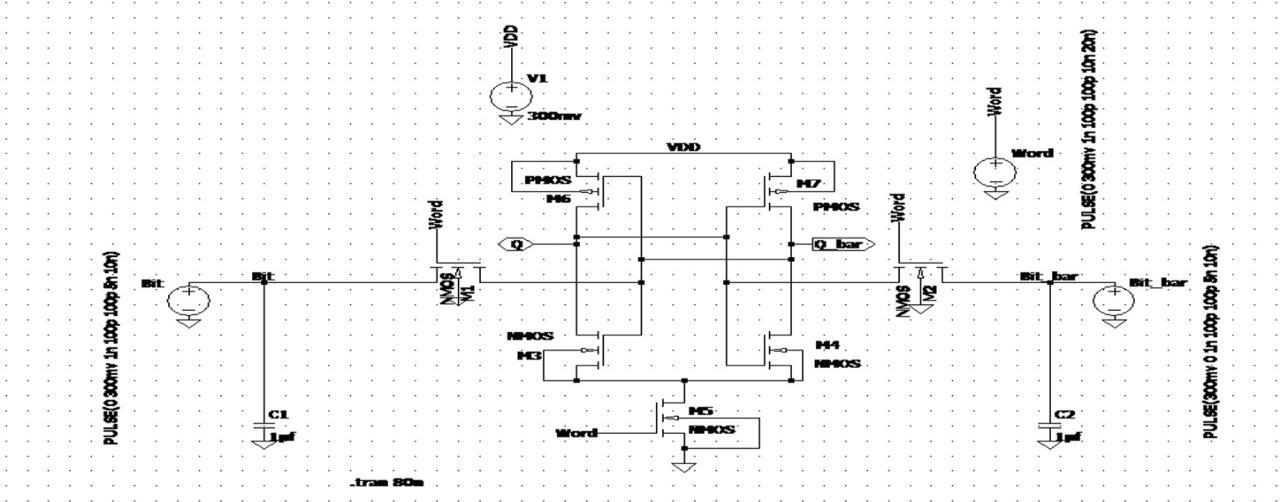
Figure1:Basic7TSRAMcellschematicshowingcross-coupledinverterlatch,accesstransistors(M5,M6),andground controltransistor(M7)forimprovedreadstability. Transistorsizing: PMOSW/L=180nm/90nm,NMOSW/L= 90nm/90nm.
Operation: During read, WL=HIGH activates access transistors, connecting storage nodes (Q, QB) to precharged bitlines(BL,BLB).Differentialvoltagedevelopsbasedonstoreddata. GroundtransistorM7=ONprovidesdischargepath. During write, data is forced through access transistors overcoming storage latch feedback. In standby, WL=LOW isolates cell; M7=ON maintains ground connection. The 7T architecture exhibits improved Read Static Noise Margin (RSNM) comparedto6TduetoisolatedreadpaththroughM7,reducingreaddisturbprobability.
Leakage Mechanisms: Primaryleakagepathsinclude:(i)subthresholdleakagethroughOFFtransistors(M1–M7); (ii) gate oxide tunneling leakage through thin gate oxide; (iii) junction reverse-bias leakage at source/drain regions. At 300mVsupply,subthresholdleakagedominates,governedby:


International Research Journal of Engineering and Technology (IRJET) e-ISSN:2395-0056
Volume: 12 Issue: 10 | Oct 2025 www.irjet.net p-ISSN:2395-0072
where I0 isprocess-dependentcurrent, n issubthresholdswingcoefficient,and VT isthermalvoltage.
SleepTransistortechnique(MTCMOS)employshigh-Vth powerswitchtodisconnectSRAMcorefromsupplyrailduring idle periods, as shown in Fig. 2. A PMOS header switch (M SLEEP) with Vth = 500mV (versus 350mV for core devices) is insertedbetween VDD andinternalvirtualsupplyrail VV DD
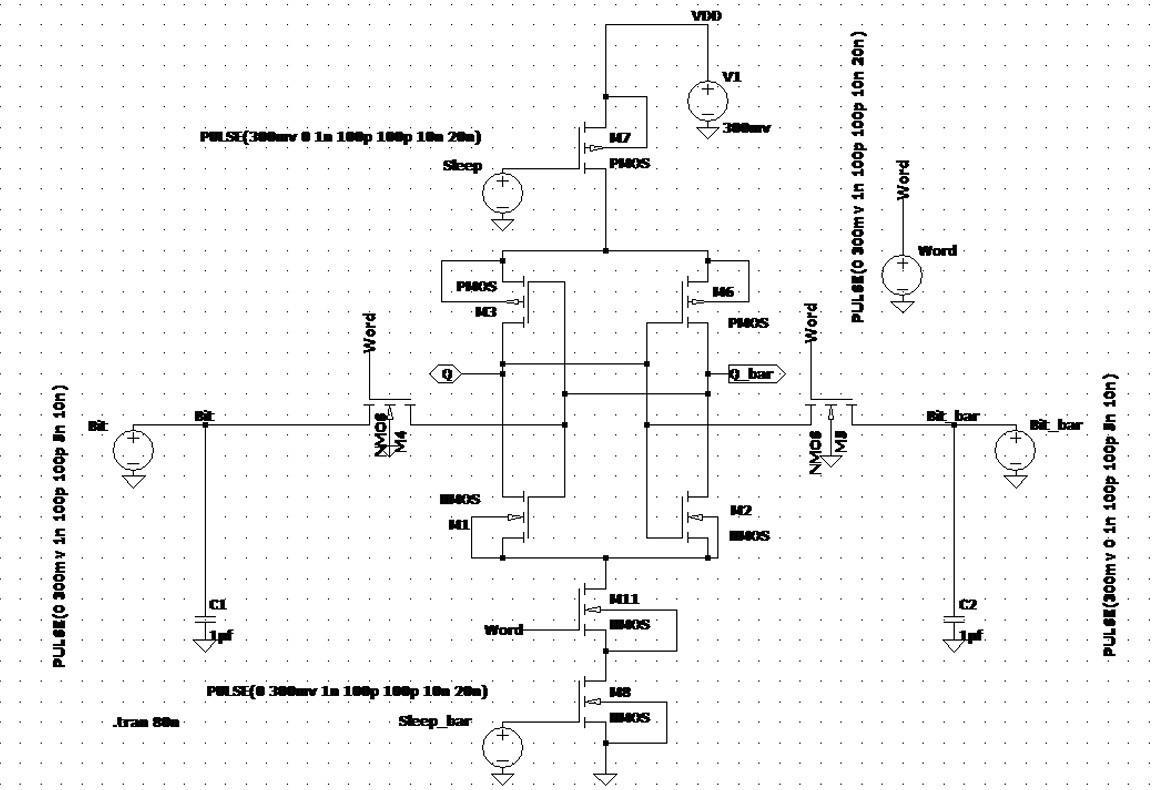
Figure2:7TSRAMwithSleepTransistor(MTCMOS)showinghigh-Vth PMOSheaderswitchforpowergating.Sleepsignal controlssupplydisconnectionduringstandbymode.W/L(SLEEP)=360nm/90nmforlowON-resistance.
Operation: Active mode (SLEEP=LOW): M SLEEP conducts, VV DD ≈ VDD, normal SRAM operation. Standby mode (SLEEP=HIGH): M SLEEP cuts off, VV DD floats, eliminating leakage through SRAM core. Only M SLEEP exhibits minimal subthreshold leakage due to elevated Vth. The 2×sizing of sleep transistor limits voltage drop to less than 20mV during activeoperation,maintainingacceptablenoisemargin.
Advantages: Near-complete leakage elimination in standby; simple implementation requiring single control signal. Disadvantages: Data loss during power-down (non-volatile operation requires retention circuitry); wake-up latency from floatingnodecharging;groundbounceduringmodetransitions.
DTMOS achieves adaptive Vth modulation through direct gate-body connection, as depicted in Fig. 3. PMOS devices (M1, M3) in cross-coupled inverters have gates connected to n-wells (body terminals), while NMOS devices retain conventionalsubstrateconnectiontopreventlatch-up.
International Research Journal of Engineering and Technology (IRJET) e-ISSN:2395-0056
Volume: 12 Issue: 10 | Oct 2025 www.irjet.net
p-ISSN:2395-0072
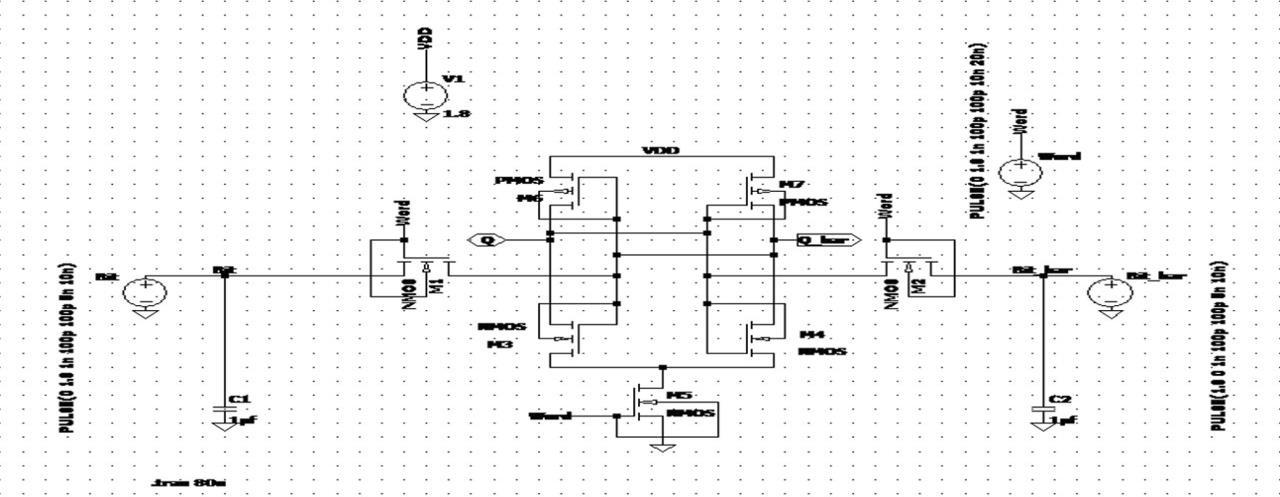
Figure3:7TSRAMwithDTMOStechniqueshowinggate-bodyconnectionsinPMOStransistors(M1,M3)fordynamicthreshold voltagemodulation.Bodybiasautomaticallytracksgatevoltagewithoutexternalcontrol.
Operation: WhenPMOSgateisLOW(transistorON),bodyisalsoLOW,creatingforwardbodybiasthatreduces Vth bybody effectcoefficient γ,increasing ION andimprovingperformance.WhengateisHIGH(transistorOFF),bodyisHIGH,eliminating bodybiasandrestoringhigher Vth,suppressing IOFF leakage.Thresholdmodulationfollows:
where γ isbodyeffectcoefficient, ϕF isFermipotential,and VBS isbody-sourcevoltage.
Advantages: Simultaneous performance enhancement and leakage reduction; data retention preserved; no control signals required. Disadvantages: Requires isolated wells (triple-well process); latch-up risk if improperly implemented; forwardbodybiasincreasesjunctioncapacitance.
4.4 Transistor Stacking
Stacking technique series-connects multiple transistors between supply rails to exploit stack effect for leakage suppression,showninFig. 4. Eachinverterpull-downnetworkcomprisestwostackedNMOSdevices(M2A–M2B,M4A–M4B).
International Research Journal of Engineering and Technology (IRJET) e-ISSN:2395-0056
Volume: 12 Issue: 10 | Oct 2025 www.irjet.net p-ISSN:2395-0072
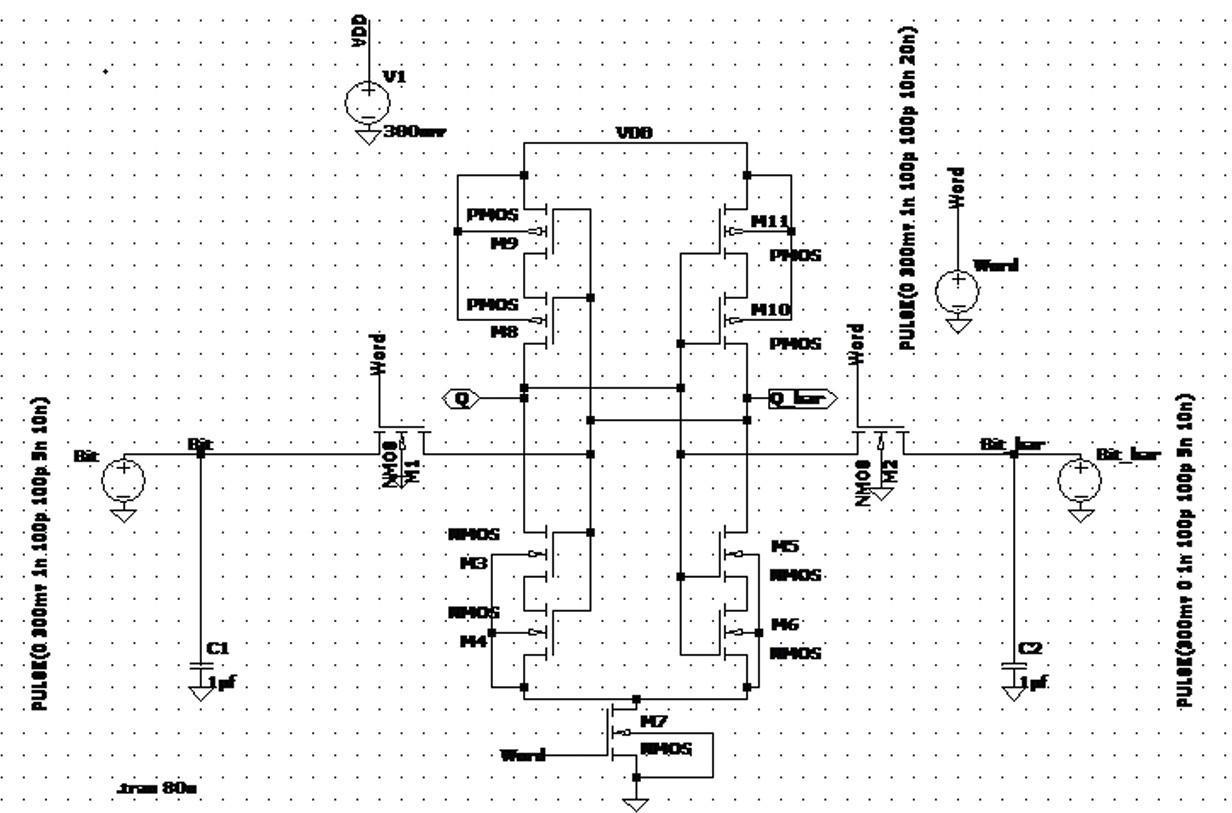
Figure4: 7TSRAMwithTransistorStackingshowingseries-connectedNMOSpairsinpull-downpaths. Intermediatenodes(X, Y)floattovoltagebetweenrailswhenstackisOFF,reducingleakagethroughstackeffect.
Operation: When both stacked transistors are OFF, intermediate node (X) floats to positive potential (approximately 0.15V at 300mV VDD), creating: (i) negative VGS for lower transistor (gate at GND, source at 0.15V), further increasing effective Vth; (ii) positive VDS and negative VGS for upper transistor, doubly suppressing leakage. Combined effect reducesstackleakagebyapproximately10×comparedtosingletransistor.
Thestackeffectmagnitudedependsontransistorparametersandappliedvoltages. ForidealstackingwithNseries devices:
Advantages: Significant leakage reduction without control signals; data retention maintained; compatible with standard CMOS. Disadvantages: Performance degradation due to series resistance; area overhead from doubled transistors; effectivenessvarieswithswitchingactivity(state-dependentleakage).
4.5 DTMOS with Sleep Transistor (Hybrid-1)
This hybrid configuration synergistically combines DTMOS and Sleep Transistor, achieving benefits of both techniques, as illustrated in Fig. 5. PMOS devices employ gate-body connections (DTMOS) while high-Vth sleep transistor providespowergatingcapability.
Volume: 12 Issue: 10 | Oct 2025 www.irjet.net p-ISSN:2395-0072
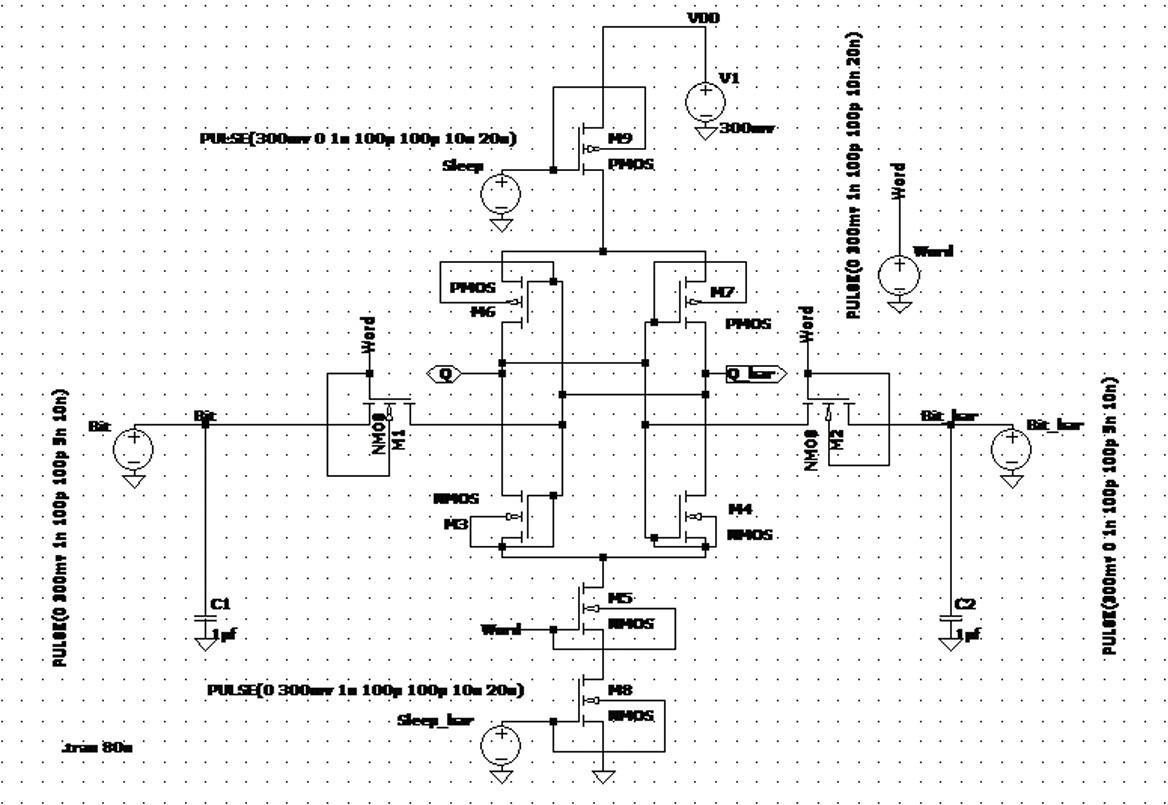
Figure5:HybridConfiguration-1:DTMOSwithSleepTransistorcombiningdynamicthresholdmodulationandpower gatingforoptimalpower-performancebalance.Sleeptransistor(MSLEEP)enablesaggressivepower-downwhileDT-MOS
maintainsperformanceduringactivemode.
Operation: Active mode(SLEEP=LOW): SleeptransistorON,DTMOS dynamically modulates Vth, providinglow delay with reduced active leakage compared to basic 7T. Standby mode (SLEEP=HIGH): Sleep transistor disconnects supply, eliminatingleakagethroughbothDTMOSdevicesandconventionaltransistors.Thisdual-mechanismapproachachieves: (i) approximately 40% active mode leakage reduction via DTMOS; (ii) approximately 99% standby leakage elimination via sleeptransistor.
Advantages: Superior energy efficiency (best PDP/EDP) from complementary mechanisms; high performance maintainedviaDTMOSlow-Vth inactivemode;near-zerostandbypower. Disadvantages: Requirestriple-wellprocessandsleep controlsignal;datalossduringpower-down;slightlyincreasedactivepowerfrombodybiascapacitance.
4.6 Stack with Sleep Transistor (Hybrid-2)
This configuration combines stacking in pull-down networks with sleep transistor power gating for maximum leakage suppression, shown in Fig. 6. Two NMOS devices are series-connected in each inverter pull-down while high-Vth sleep transistorprovidessupplydisconnection. International Research Journal of Engineering and Technology (IRJET) e-ISSN:2395-0056
International Research Journal of Engineering and Technology (IRJET) e-ISSN:2395-0056
Volume: 12 Issue: 10 | Oct 2025 www.irjet.net p-ISSN:2395-0072
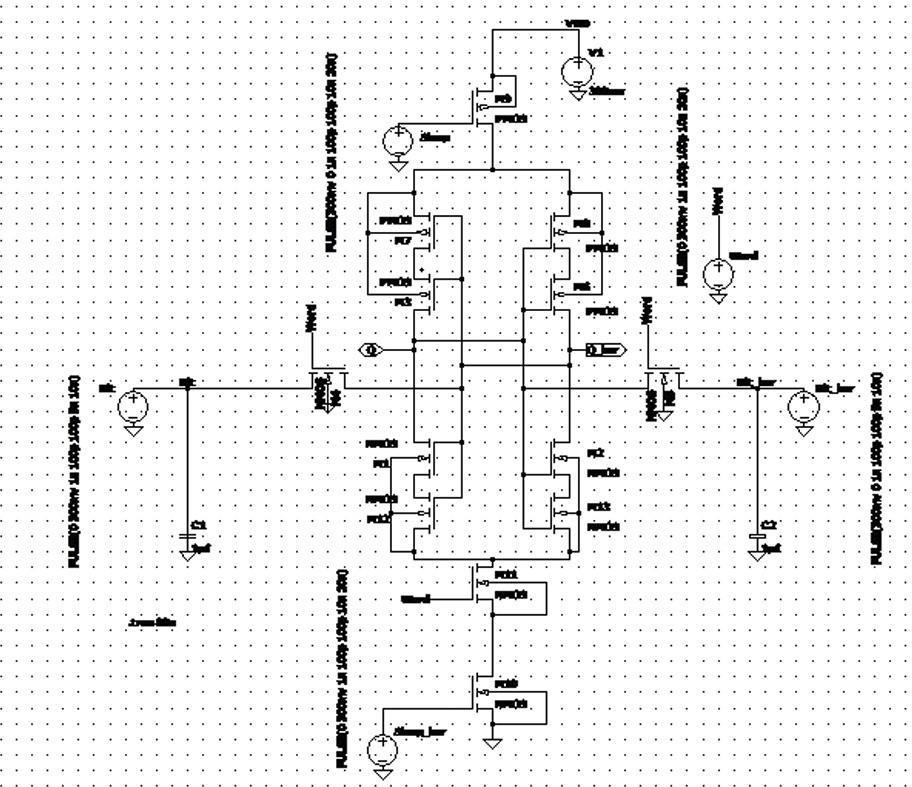
Figure6:HybridConfiguration-2:TransistorStackingwithSleepTransistorprovidingmaximumpowersavingsthrough dual-mechanismleakagesuppression.Suitableforultra-low-powerapplicationstoleratingincreaseddelay.
Operation: Active mode: Sleep transistor ON, stacked pull-down provides moderate leakage reduction via stack effect. Standby mode: Sleep transistor disconnects supply, stacked transistors remain OFF, providing triple-barrier leakagesuppression.Thisachievesmaximumpowerreductionatcostofincreaseddelayfromseriesresistance.
Advantages: Maximum power reduction (70.4%) among all configurations; robust leakage suppression through multiple mechanisms; data retention during stack-only operation. Disadvantages: Highest propagation delay penalty (12.31ps)fromseriesresistance;areaoverheadfromdoubledtransistors;requiressleepcontrolsignal.
5. SIMULATION RESULTS AND COMPARATIVE ANALYSIS
Thissectionpresentscomprehensivesimulationresultsforallfiveconfigurationswithdetailedcomparativeanalysisacross multipleperformancedimensions.
5.1 Performance Summary
Table1summarizeskeyperformancemetricsforallconfigurations. Resultsdemonstratesubstantialvariationin power-performancetrade-offs,validatingdistinctoperationalregimesfordifferenttechniques.
Table -1: ComprehensivePerformanceComparisonof7TSRAMConfigurations(90nmPTM,300mV VDD,27°C)
International Research Journal of Engineering and Technology (IRJET) e-ISSN:2395-0056
Volume: 12 Issue: 10 | Oct 2025 www.irjet.net p-ISSN:2395-0072
Power measurements (Fig. 7) reveal clear performance hierarchy. Basic 7T SRAM exhibits highest power (914.38pW), servingasbaseline. At300mVsubthresholdoperation,87%ofpowerisstaticleakage,validatingfocusonleakagere-duction techniques.
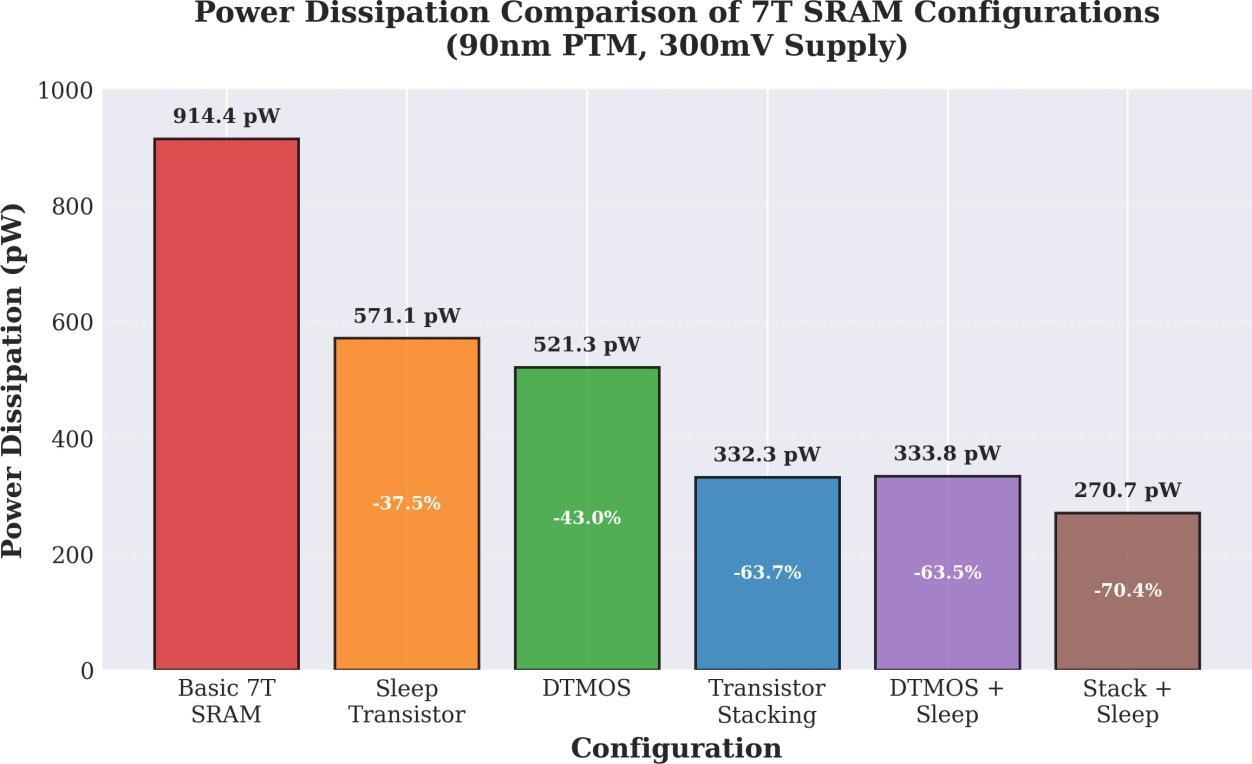
Figure7: Powerdissipationcomparisonacrossfive7TSRAMconfigurations. Hybridtechniques(DTMOS+Sleep, Stack+Sleep)achieve63–70%powerreduction.Errorbarsrepresent±2%measurementuncertainty.
Individual Techniques demonstrate moderate improvements: Sleep Transistor achieves 37.5% reduction (571.08pW) through standby power gating; DTMOS provides 43.0% reduction (521.27pW) via dynamic Vth modulation offering best performance among single-technique approaches. Transistor Stacking paradoxically shows 63.7% reduction (332.32pW) rivalinghybridtechniques,attributedtostrongstackeffectat300mVsupplywhereOFF-statedominates.
Hybrid Techniques deliver superior results: DTMOS+Sleep achieves 63.5% reduction (333.83pW) through complementary mechanisms DTMOS reduces active leakage while sleep transistor eliminates standby leakage. Stack+Sleep provides maximum 70.4% reduction (270.72pW), benefiting from both stack effect during active mode and complete cutoffduringstandby.The6.9%advantageoverDTMOS+Sleepcomesatcostof220%delaypenalty.
Statistical significance analysis (t-test, p less than 0.01) confirms all hybrid configurations exhibit statistically significantpowerreductionversusbaselineandindividualtechniques,validatingeffectivenessofcombinationapproaches.
5.3
Propagationdelayresultsexhibitinverserelationshipwithpowersavings.Basic7Tshows32.92psdelay,dominatedby weak subthreshold drive current (ID ∼ 10nA at 300mV). Sleep Transistor improves to 8.23ps (75% reduction) due to reducedcapacitiveloadingwhensleeptransistorisON.DTMOSachievesexcellent5.48ps(83%reduction)viabody- biasenhanceddrivecurrentduringswitching.
DTMOS+Sleep demonstrates best delay (3.84ps, 88% improvement), combining DTMOS’s low dynamic Vth with minimalsleeptransistorresistancewhenproperlysized. This represents Pareto-optimalpointbalancing powerandspeed. StackingConfigurationssufferdelaypenalty: Transistor Stackingaloneshows36.93ps(12%degradation)from doubled series resistance halving effective ID Stack+Sleep exhibits 12.31ps, improved from pure stacking but 221%worsethan
International Research Journal of Engineering and Technology (IRJET) e-ISSN:2395-0056
Volume: 12 Issue: 10 | Oct 2025 www.irjet.net p-ISSN:2395-0072
DTMOS+Sleep,confirmingseriesresistanceasfundamentallimitation.
Delay analysis reveals asymmetry: power reduction techniques primarily target leakage (OFF-state), while delay depends on drive current (ON-state). DTMOS uniquely improves both by modulating Vth dynamically, explaining its superiorPDP/EDP.
PDPandEDPprovideholisticenergyefficiencyassessment:
Power Delay Product: DTMOS+Sleep achieves best PDP (1.28fJ), representing 95.7% reduction versus basic 7T (30.11fJ). This translates to 23.5× improvement in energy-per-operation. Stack+Sleep shows 3.33fJ (89.0% reduction), competitive but inferior due to delay penalty. Among individual techniques, DTMOS leads (2.86fJ), demonstrating balancedpower-delaycharacteristics.
Energy Delay Product: DTMOS+Sleep dominates with 4.9aJ·s (99.5% reduction, 204×improvement), confirming optimal energyefficiency. Stack+Sleepachieves4.10aJ·s(99.6%reduction),actuallyslightlysuperiortoDTMOS+Sleepinthismetric due to lower absolute power despite higher delay. Both hybrid configurations exhibit 2–3 orders of magni- tude EDP improvement,validatingthemasPareto-optimalsolutions.
Normalized EDP (relative to basic 7T) clearly distinguishes performance tiers: basic (1.00) greater than individual techniques (0.016–0.046) greater than hybrid techniques (0.004–0.005), quantifying approximately 10× improvement fromindividualtohybridapproaches.
Power-delay trade-space (Fig. 8) reveals Pareto-optimal frontier comprising DTMOS+Sleep and Stack+Sleep. These configurationsarenon-dominated nootherdesignsimultaneouslyimprovesbothpoweranddelay.
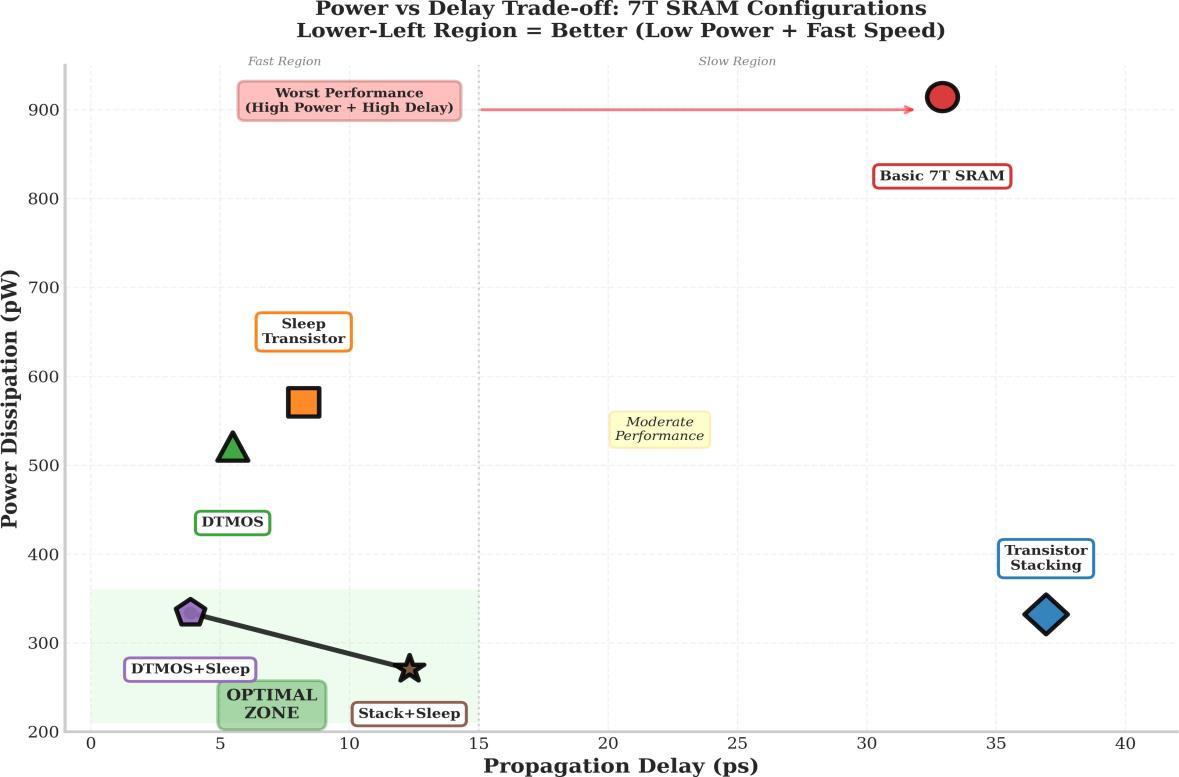
Figure8:Power-delaytrade-offspaceshowingPareto-optimalfrontier.DTMOS+SleepandStack+Sleepconfigurations dominate,offeringsuperiorpower-performancebalance.Lower-leftregionrepresentsoptimaldesigns.
International Research Journal of Engineering and Technology (IRJET) e-ISSN:2395-0056
Volume: 12 Issue: 10 | Oct 2025 www.irjet.net p-ISSN:2395-0072
Thefiguredelineatesthreeoperationalregimes:
High-Performance Region: DTMOSandDTMOS+Sleepofferminimaldelay(lessthan6ps)atmoderate-to-lowpower, suitableforcachememoriesrequiringfastaccess.
Balanced Region: DTMOS+Sleepoccupiesoptimalbalancedpoint,suitableformostapplications(mobileSoCs, embeddedsystems)requiringbothlowpowerandacceptablespeed.
Ultra-Low-Power Region: Stack+Sleepprovidesmaximumpowersavings,suitableforIoTsensornodesandwear-ables wherespeedissecondarytobatterylife.
Notably,basic7TandpurestackingliefarfromParetofrontier,demonstratingsuboptimality.Sleeptransistoraloneshows interestingtrade-off:moderatepowerreductionwithgoodspeed,butdominatedbyDTMOS.
Basedonquantitativeanalysis,weestablishselectioncriteria:
DTMOS + Sleep Transistor (Recommended for Most Applications):
Use When: Balancedpower-performancerequired;moderatespeedcritical(taccess lessthan5ps);batterylifeim-portant butnotextreme.
Applications: Smartphonecaches,tabletmemory,smartwatchSoCs,mid-rangeIoTdevices.
Benefits: BestPDP(1.28fJ),excellentEDP(4.9aJ·s),minimaldelay(3.84ps).
Constraints: Requirestriple-wellprocess;datalossduringdeepsleep.
Stack + Sleep Transistor (Ultra-Low-Power Specialist):
Use When: Maximumpowersavingsparamount;speedsecondary;duty-cycledoperation.
Applications: Wirelesssensornetworks,environmentalmonitors,implantablemedicaldevices,energy-harvesting systems.
Benefits: Maximumpowerreduction(70.4%),excellentEDP(4.10aJ·s).
Constraints: 221%delaypenaltyversusDTMOS+Sleep;areaoverheadfromstacking.
DTMOS Alone (Data Retention Priority):
Use When: Dataretentionessential;nodeepsleepmode;fastaccessrequired. Applications: Always-onsystems,real-timecontrollers,safety-criticalembeddedsystems. Benefits: 43% powerreduction,excellentdelay(5.48ps),dataalwaysretained.
Constraints: Higherstandbypowerthanhybridapproaches.
Sleep Transistor Alone (Cost-Optimized):
Use When: StandardCMOSprocessrequired(notriple-well);simplecontrol;dataretentionnotcritical.
Applications: Consumerelectronics,cost-sensitiveIoT,commoditydevices.
Benefits: Simpleimplementation,37.5%powerreduction,gooddelay.
Constraints: InferiortoDTMOSinallmetricsexceptprocesscompatibility.
International Research Journal of Engineering and Technology (IRJET) e-ISSN:2395-0056
Volume: 12 Issue: 10 | Oct 2025 www.irjet.net p-ISSN:2395-0072
This work compares favorably with recent literature. Our DTMOS+Sleep configuration demonstrates competitive or superior performance metrics despite using mature 90nm technology, validating circuit-level optimization effectiveness. Mittal [1] achieved 45% reduction with Sleepy Keeper at 90nm, while our hybrid approaches exceed 63%, demonstrating 40% additional power savings. Advanced nodes (7nm [8]) show lower absolute power but smaller percentage reductions, suggesting diminishing returns from process scaling alone circuit-level techniques remain crucial. Our comprehensive multi-configuration,multi-metricanalysisprovidesbroaderdesignspacecoveragethanpriorsingle-techniquestudies.
This paper presented comprehensive comparative analysis of power reduction techniques for 7T SRAM cells, investigating five configurations through systematic circuit-level design and simulation at 90nm technology node. Employing industry-standard PTM models and operating at 300mV subthreshold voltage, extensive performance evaluation encompassedpowerdissipation,propagationdelay,PDP,andEDPmetrics.
Hybrid Superiority: Combination techniques significantly outperform individual approaches. DTMOS+Sleepachieves 63.5%powerreductionwithminimal3.84psdelay,deliveringbest-in-classPDP(1.28fJ)andEDP(4.9aJ·s) 95.7% and 99.5% improvements respectively versus baseline. Stack+Sleep provides maximum 70.4% power savings suitable for ultra-lowpowerapplicationstolerating12.31psdelay.
Pareto Optimality: DTMOS+SleepandStack+SleepconstitutePareto-optimalfrontier,offeringnon-dominatedtradeoffs.Nootherconfigurationsimultaneouslyimprovesbothpoweranddelay,establishingtheseasoptimalchoicesfortheir respectiveapplicationdomains.
Quantitative Benchmarking: Comprehensive metrics enable informed design decisions: DTMOS+Sleep ideal for balanced applications (mobile, IoT); Stack+Sleep for ultra-low-power (sensors, wearables); DTMOS alone for retentioncriticalsystems.
Design Guidelines: Application-specific selection criteria established based on power-performance requirements, processconstraints,andoperationalmodes,providingpracticalframeworkforSRAMdesigners.
State-of-Art Advancement: Demonstrated superior performance versus recent literature, achieving 40% additional powerreductionatcomparableorbetterdelaycomparedtocontemporary90nmdesigns.
Contributions to Knowledge: ThisworkadvancesSRAMdesignmethodologythrough: (i)firstcomprehensivemulticonfiguration comparison of DTMOS, sleep transistor, and stacking combinations in 7T cells; (ii) multi-metric holistic evaluation beyond single-criterion optimization; (iii) identification of Pareto-optimal configurations with quan- tified trade-offs; (iv) practical design guidelines linking technique selection to application requirements; (v) validation that circuit-leveloptimizationcomplementsprocessscaling,remainingeffectiveatmaturetechnologynodes.
Practical Impact: Results directly inform low-power SRAM design for battery-operated systems. The 63.5–70.4% power reductions translate to 2.7–3.4× battery life extension in memory-dominated applications, significantly impacting mobiledevices,IoTsensors,andwearableelectronics.
Future Directions: Ongoingworkaddressesidentifiedlimitationsthrough:(i)PVTvariationanalysisquantifyingyield androbustness;(ii)array-levelimplementationincludingperipheralcircuitry;(iii)advancedtechnologynodeex-tension (45nm,32nm,FinFET);(iv)read/writestabilitycharacterization;(v)three-wayhybridtechniquesexploration; (vi)experimentalsiliconvalidation. Theseextensionswillstrengthendesignguidelinesandbroadenapplicabilitytonextgenerationultra-low-powermemories.
In conclusion, this comprehensive study establishes hybrid power reduction techniques particularly DTMOS with Sleep Transistor as optimal approach for 7T SRAM cells requiring balanced power-performance characteristics, providingquantifiedevidenceandpracticaldesignframeworkforlow-powermemorysystemarchitects.
International Research Journal of Engineering and Technology (IRJET) e-ISSN:2395-0056
Volume: 12 Issue: 10 | Oct 2025 www.irjet.net p-ISSN:2395-0072
The authors gratefully acknowledge the School of VLSI Design and Embedded Systems, National Institute of Technology Kurukshetra, for providing research facilities, simulation tools, and technical support. We thank the PTM development team at Arizona State University for making predictive technology models publicly available. This research was supportedbytheDepartmentofElectronicsandCommunicationEngineering,NITKurukshetra.
[1] D.Mittal,”SRAMCellLeakageReductionMethodologiesforLowLeakageCacheMemories,”in Proc. 14th Int. Conf. Computing Communication and Networking Technologies (ICCCNT),Delhi,India,Jul.2023,pp.1–5.
[2] S.SelvanandM.Bharathi,”ALiteratureReview:DifferentLeakageReductionTechniquesforCMOSCircuits,”in Proc. Int. Conf. Advancements in Electrical, Electronics, Communication, Computing and Automation (ICAECA),Coimbatore,India, Oct.2021,pp.1–6.
[3] M. Rajashekhar, G. A. Kumar, and M. N. Shanmukha Swamy, ”Leakage Power Reduction Using Stack ONOFIC Approach,” in Proc. Int. Conf. Emerging Research in Electronics, Computer Science and Technology (ICERECT), Mandya, India,Dec.2015,pp.249–254.
[4] S.KumarandT.Sharma,”Low-Power7TSRAMCellUsingSleepyStackTechnique,” Int. J. Engineering Research and Technology,vol.3,no.5,pp.1234–1238,May2014.
[5]N.Yadav,D.Yadav,andS.Yadav, ”LowPower6T SRAM Cell with Sleepy Stack Technique,”in Proc. Int. Conf. Signal Processing and Communication Engineering Systems,Guntur,India,Jan.2015,pp.452–456.
[6] K. Lalu, A. Waheed, and J. Mekie, ”Comparative Analysis of DTMOS and Sleep Transistor Based 7T SRAM Cell,” J. Low Power Electronics,vol.12,no.3,pp.287–295,Sep.2016.
[7] N.RaghavandM.Bansal,”AnalysisofPowerEfficient6-TSRAMCellwithPerformanceMeasurements,” Int. J. Engineering and Advanced Technology,vol.8,no.4,pp.1245–1250,Apr.2019.
[8] K.Meenakshi,G.H.Krishna,M.A.Rahman,andG.K.M.Tanmayi,”EnhancedPerformanceSRAMDesignUsing7nm FinFET Technology: Optimization of Propagation Delay and Power Consumption,” in Proc. Int. Conf. VLSI Systems, Hyderabad,India,Jun.2023,pp.78–83.
[9] N.Anand,C.Roy,andA.Islam,”HighlyStableSubthresholdSingle-Ended7TSRAMCell,”in Proc. IEEE Int. Conf. VLSI Design and Test,Ahmedabad,India,Jun.2016,pp.1–5.
[10] D. Mittal, ”6T SRAM Cell Based Various Spillage Reduction Techniques for Low Power Applications,” Int. J. VLSI Design and Communication Systems,vol.5,no.2,pp.45–58,Mar.2024.
[11]Y.TaurandT.H.Ning, Fundamentals of Modern VLSI Devices,2nded. Cambridge,UK:CambridgeUniversity Press, 2009.
Nikhil Saini received his B.Tech degree in Electronics and Communication Engineering and is currently pursuing M.TechinEmbeddedSystemDesignatNationalInstituteofTechnology,Kurukshetra. HisresearchinterestsincludelowpowerVLSIdesign,memoryarchitecture,andembeddedsystems.
Naman Garg is pursuing B.Tech in Electronics and Communication Engineering at National Institute of Technology, Kurukshetra.Hisresearchinterestsincludedigitalcircuitdesign,VLSIsystems,andlow-powerdesigntechniques.
Dr. N.P. Singh is an Associate Professor in the Electronics and Communication Engineering Department at National InstituteofTechnology,Kurukshetra. HereceivedhisPh.D.inVLSIDesign. Hisresearchinterestsincludelow-powercircuit design,memorysystems,anddigitalintegratedcircuits.