
International Research Journal of Engineering and Technology (IRJET) e-ISSN:2395-0056
Volume: 12Issue: 04 | Apr2025 www.irjet.net p-ISSN:2395-0072
International Research Journal of Engineering and Technology (IRJET) e-ISSN:2395-0056
Volume: 12Issue: 04 | Apr2025 www.irjet.net p-ISSN:2395-0072
1st Dr.D.Durga Prasad∗ , 2nd K.V.N.SSusanth∗ , 3rd Sk.Ahmed Nazeer ∗ , 4th K.Senapathi Reddy∗ , 5th P.B.V Prasad ∗
Department of Computer Science and Engineering (CSE), PSCMR College of Engineering and Technology, Vijayawada, India ***
Abstract Early detection of dermatological conditions is crit- ical for treatment and management. But manual detection is time-consuming, subjective, and knowledge based. We present a system in this work that employs deep learning to identify and detect prevalent skin diseases using the YOLOv8 object detection model. We possess our database of twelve dermatological conditions, such as Acne, Chickenpox, Eczema, Monkeypox, Pimple, Psoriasis, Ringworm, Basal Cell Carcinoma, Melanoma, Tinea Versicolor, Vitiligo, and Warts. We employ the trained model of YOLOv8 coupled with an intuitive web interface developed using Flask, HTML, CSS, and JavaScript. Userscan upload images oftheirskinfrom the interface, which displays the output image with disease detection annotations, symptoms, medications prescribed by a doctor, and precautions. It proves to be helpful for early detection, especially in remote or resource-limited environments, and can be of assistance to patients as well as medical professionals. We demonstrate that deep learning models like YOLOv8 can become a vital part of dermatological diagnoses by employing accessible, real-time solutions.
KeyWords - Deep Learning, YOLOv8, Flask, Image Classification.
Dermatoses are among the most common diseases all over the world, and millions of individuals fall ill every year. Early diagnosis and treatment are extremely crucial to manage the diseases, as delayed or inappropriate diagnoses may result in complications and unjustified treatments. But computer diagnosis relies on specialist dermatologists and can contain a subjective interpretation of visual signals. As the pressure mounts to make quicker and more precise diagnoses, there is a growing need for automated technology that can support healthcare professionals, particularly in less affluent orruralareaswherespecialistaccessmayberestricted.
Deep learning methods, especially convolutional neural net-works(CNNs),havebeenhighlypromisingintheareaof medical image analysis, with greater accuracy and speed in
detectingandclassifyingmanydiseases.Amongthese,object detection architectures such as YOLO (You Only Look Once) haveshownoutstandingabilitytodetectobjectsinimagesin real time. The advanced YOLOv8 model is fast and accurate and,thus,anappropriatetooltodetectskindisease.
Inthispaper,weintroducetheuseofYOLOv8forobject detection and classification of twelve common skin diseases such as Acne, Chickenpox, Eczema, Monkeypox, Pimple, Psoriasis, Ringworm, Basal Cell Carcinoma, Melanoma, Tinea Versicolor, Vitiligo, and Warts. We train themodelonacustomdatasetandintroduceasimplewebbased UI implemented using Flask, HTML, CSS, and JavaScript. This interface allows for the uploading of skin images, which are then used by the model to identify whether or not a certain disease exists. The output is the identified disease, along with related information such as symptoms,drugs,andprecautions.
This study aims to offer a practical, easy-to-use tool for both medical professionals and patients to identify the disease at an early stageandenhance the overall quality of diagnostics. With real-time object detection and deep learning, we expect the efficiency of dermatological diagnostics to be elevated, par- ticularly in environments where professional medical expertise is not easily accessible.
Inthefewyears,deeplearningalgorithms,especiallyconvolutional neural networks (CNNs), have drastically changed the nature of medical image analysis. More so in thecaseofdermatology,in whichdeep learningalgorithms have had a lot of potential for applying machine learning on skin disease detection. Several works have been concentrating on using such techniques for detecting, segmenting,andclassifyingskindisordersfromimages.
The paper titled ”Machine Learning and Deep Learning Integration for Skin Diseases Prediction”[1] by SamirKumar Bandyopadhyay, Payal Bose, Amiya Bhaumik, and Sandeep Poddar explorestheintegrationofGoogleNetInception V3
2025, IRJET | Impact Factor value: 8.315 | ISO 9001:2008 Certified Journal | Page1971
International Research Journal of Engineering and Technology (IRJET) e-ISSN:2395-0056
Volume: 12Issue: 04 | Apr2025 www.irjet.net p-ISSN:2395-0072
for effective skin disease classification. The study emphasizes the advantage of combining deep learning for feature extraction with machine learning techniques for classification. However, it faces limitations due to a restricteddatasetand thepotentialforoverfitting.
In ”Machine Learning and Deep Learning Approaches for the Detection of Skin Cancer”[2], authors Tehseen Mazhar, Inayatul Haq, Allah Ditta, and Syed Agha Hassnain Mohsan employ VGG-Net, ResNet, and InceptionV4 to address the drawbacks of manual diagnosis. While their approach is effectiveinovercomingtraditional diagnostic limitations,it encounters challenges such as data limitations, computationalexpenses,overfitting,anddataimbalance.
Thestudy ”Classification of Skin Cancer from Dermoscopic Images Using Deep Neural Network Architectures”[3] by Jaisakthi S M, Mirunalini P2, Chandrabose Aravindan, and Rajagopal Appavu utilizes Deep Convolutional Neural Networks (DCNN) to extract effective features from dermoscopic images. Although the model delivers promising results in terms of learning capability, the authors acknowledge the high computational costs as a primarylimitation.
”Skin Cancer Classification Using Deep Spiking Neural Network”[4]bySyedQasimGilani,TehreemSyed,Muhammad Umair, and Oge Marques applies Spiking VGG-13 and AlexNet to achieve better performance in classification. The method showcases improved accuracy, but the increased train- ing complexity presents a significant challenge.
Lastly, in the work ”Automated Diagnosis of NonMelanoma Skin Cancer”[5],YufeiZhou,CanKoyuncu,Cheng Lu, and Rainer Grobholz propose a solution using ResNet- 50 combined with Generative Adversarial Networks (GANs). Their method is commendable for its ability to control data leakage, though there remains a concernregardingthepoten-tialintroductionofartifacts.
The data quality and diversity largely influence performance in any deep learningmodel. Twelve common skin diseases were chosen for this study. In total, 12 diseases were selected to be included in this extensive dataset of high-quality pho- tographs: Acne, Chickenpox, Eczema, Monkeypox, Pimple, Psoriasis, Ringworm, Basal Cell Carcinoma, Melanoma, Tinea Versicolor, Vitiligo, and Warts. The images were obtained from various publicly available sources: medical repositories, databases for dermatology, and various authoritative open- source repositories.Eachimagewascriticallyanalyzedforclarity,
relevance, and an accurate identification of the skin condition.
Pre-training of the model was preceded by image prepro- cessing steps applied after data collection. All images were reshaped to a unified size in order to ensure uniformity across the dataset. Data augmentation techniques, such as rotation, flipping, scaling, and brightness, were also used, allowingforanincreaseinthe variation of image samples and an enhancement of the model’s generalization capability. The aforementioned manipulations were performed to implement real-timevariablelightinganglesandskintones.Theaddedaspectof normalization was carried out afterwards, whereby individual pixel values were normalized to a scale that would ensure the stability and speed of convergence during their training. Bounding boxlabels weredelineated foreveryimageintherespectiveareasoftheskininvolved, thereby providing the YOLOv8 model with information pertinent to localization and classification of the skin condition.Withthehighlyprepared,diversifieddataset,the step of making stronger and reliable detection systems is significantlyenhanced.
This section details the methodology involved in the process of creating the deep learning-based skin disease diagnostic system,involving data acquisition,model choice, training procedure, and model implementation in a webbaseduserinterface.
The dataset used in this research includes images of twelve skin conditions: Acne, Chickenpox, Eczema, Monkeypox, Pimple, Psoriasis, Ringworm, Basal Cell Carcinoma, Melanoma, Tinea Versicolor, Vitiligo, and Warts. These images were gathered from diverse public repositories, derma- tology websites, and medical imaging datasets. The dataset was annotated thoroughly to provide bounding boxes around the lesions or infected areas on each image, together with the respective disease label. Rotation, flipping,andscalingdataaugmentationmethodswereused to enrich the diversity of the dataset and enhance model generalization
• TrainingSet(70%):Usedtotrainthe YOLOv8 model.
• Validation Set (15%): Used for hyperparameter tuning andmodelevaluationduringtraining.
• TestSet(15%):Usedtoevaluatethemodel’sfinalperformance.
International Research Journal of Engineering and Technology (IRJET) e-ISSN:2395-0056
Volume: 12Issue: 04 | Apr2025 www.irjet.net p-ISSN:2395-0072
TheYOLOv8objectdetectionmodelwasselectedforthis project due to its speed and real-time detection. A new versionoftheYOLOarchitectureknownasYOLOv8aimsto improve detection speed and accuracy. When a detected objectisfoundin an image, the model outputs bounding box coordinates and class labels. Since YOLOv8 inherently supports rapid inference, the ability to execute real-time detectionofdiseaseusinganeasy-to-useinterfacemakesit perfect for this use. Before refining on our dermatology dataset, the model itself was pre-trained on a large dataset (ImageNet or COCO) so that it can leverage transfer learning.
TrainingtheYOLOv8modelinvolvedthefollowingsteps:
• Hyperparameter Selection: Optimal hyperparameters, in-cludinglearningrate,batchsize,numberofepochs, and optimizer (Adam), were selected based on preliminary experiments and existing literature on objectdetectiontasks.
• Transfer Learning: The model was first pre-trained on a large general-purpose dataset (ImageNet or COCO) andthenfine-tunedonthedermatologicaldataset.This made it possible for the model to use pre-learned features, including shapes, textures, and edges, which areallprevalentinmedicalimages.
• Loss Function: The model employed both crossentropy loss for classification and bounding box regression loss to identify the position of lesions withintheimages.
Performance of the model was assessed using means like mean average precision (mAP), precision to measure the accuracy ofskindiseasesdetectionandclassification.
D. User Interaction and Output
• Detected Disease: The disease detected in the uploadedimage.
• Bounding Box: A visual representation of the affectedareasintheimage.
• Symptoms: Common symptoms associated with the de-tecteddisease.
• Medications:Suggestedtreatmentsormedicationsfor thedetectedcondition.
• Precautions: Preventive measures or advice for managingthedisease.
This interface is designed to be easy to use, ensuring that users without technical knowledge can still benefit from theautomateddiagnostictool
ThetechnologyusedinYOLOv8isreal-timeobjectdetection of objects. The algorithmdivides animage intoa grid, and for every grid, it predicts bounding boxes, confidence es- timates, and class probabilities. What makes YOLOv8 special is how it’s more precise in predicting those bounding boxes and with multiple objects, even when they’reoverlappingor atweirdangles.YOLOv8issimpler toworkwiththanyoumight think. With Python or even a deep learning librarylikePyTorch,youcangetYOLOv8 upandrunninginafewlines of code. To get fancy, you must load the pre-trained YOLOv8 model (or train the model on your data) and start object detection from images or video streams. Theflexibilityof YOLOv8 makes it suitable for any number of applications, from security cameras to autonomousrobots. Let’s break down what motivates YOLOv8. To begin with, the backbone network—this part of the network takes the input image and learns important features. It’s similar to the first layer of the brain, rapidly and effectively recognizing patterns and textures. This is followed by the refinement of those features in the neck network. It combines information from multiple layers to aid in the detection of objects of any size, whether large or small. Finally, the head network accurately predicts the bounding boxes, class probabilities, andconfidence scores while not sacrificing speed and efficiency. This combining makes YOLOv8 a strongreal-timeobjectdetectiontool.
A. Forumlas
• Mean Average Precision (mAP): mAP is a performance measure to test object detection model performance.Itfindsthemeanaverageprecision(AP) ofallclasses.AveragePrecision(AP)foreveryclassis computed by taking the precision-recall curve into consideration.
International Research Journal of Engineering and Technology (IRJET) e-ISSN:2395-0056
Volume: 12Issue: 04 | Apr2025 www.irjet.net p-ISSN:2395-0072
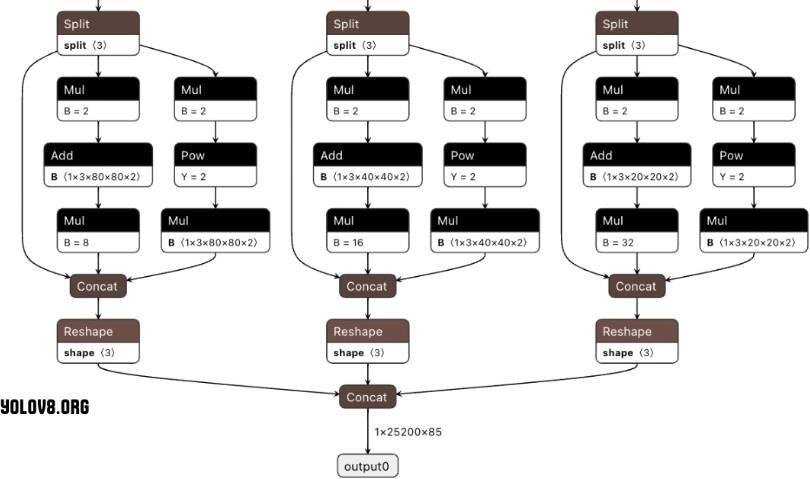
1. YOLOv8 Architecture.
WhereP(r)istheprecision atrecallr.Inpractice,thisis typically computed by summing up the precision values at different recall levels. Mean Average Precision (mAP) is the mean of the Average Precision values across all classesC:

C c c=1
• Precision : Precision is a metric used to measure the accuracy of the positive predictions made by the model. It is defined as the ratio of true positive detections to the total number of detections (true positives + false
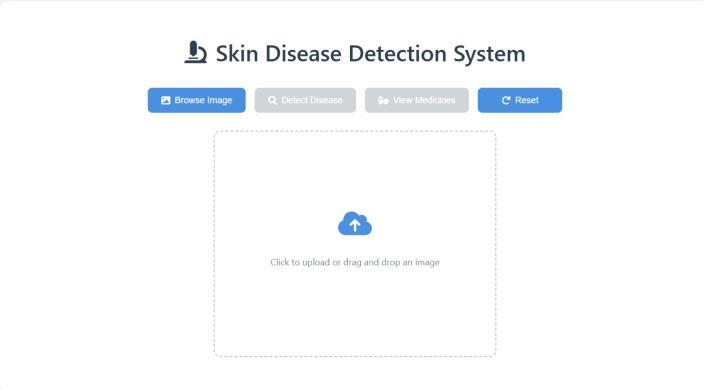
Fig.2. User InterFace. positives).
Precision= TP TP+FP
The YOLOv8 model was trained on the custom dataset containing images of 12 dermatological conditions: Acne, Chickenpox, Eczema, Monkeypox, Pimple, Psoriasis, Ringworm, Basal Cell Carcinoma, Melanoma, Tinea Versicolor, Vitiligo, and Warts. The model was evaluated based on its performance in detecting and classifying these skin diseases, usingstandardobjectdetectionmetrics:meanAveragePrecision(mAP),Precision,andRecall.
This image shows the user interface of a Skin Disease Detection System. It allows users to upload or drag-anddrop an image for analysis, and provides options to detect the disease, view suggested medicines, and reset the process.
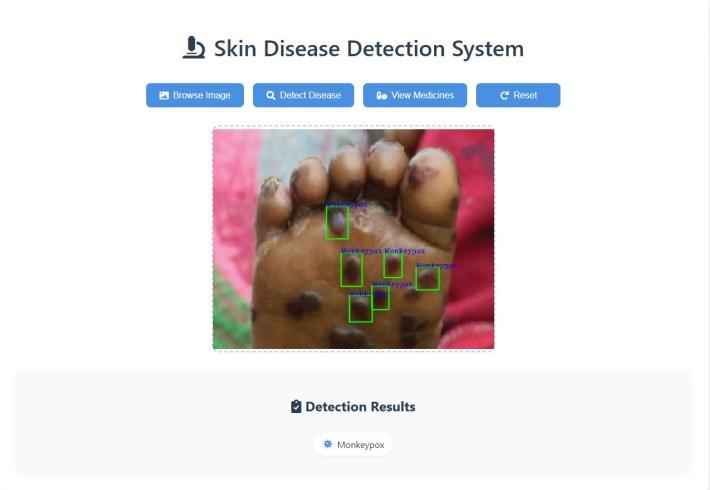
Fig.3. DetectionResults.
TheimageshowstheresultscreenoftheSkinDiseaseDetection System after analyzing an uploaded image. The system has detected ”MonkeyPox” and highlighted the affected area with a green bounding box, displaying the resultbelowtheimage.
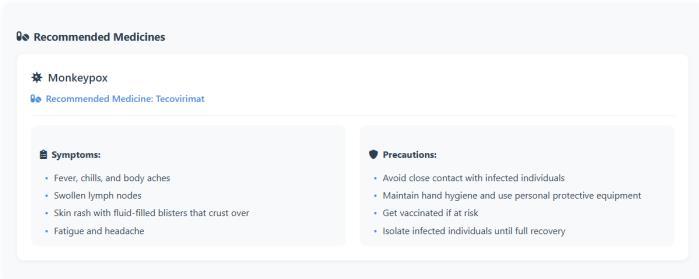
Fig.4. MedicinesRecommendation.
International Research Journal of Engineering and Technology (IRJET) e-ISSN:2395-0056
Volume: 12Issue: 04 | Apr2025 www.irjet.net p-ISSN:2395-0072
Monkeypox is a viral disease with fever, chills, swollen lymph nodes, and a characteristic skin rash with blisters that contain fluid. The drug of choice is Tecovirimat. Prevention methods include avoiding close contact with affected persons, hand hygiene, vaccination if exposed, and quarantiningaf-fectedindividualsuntilcompleterecovery.
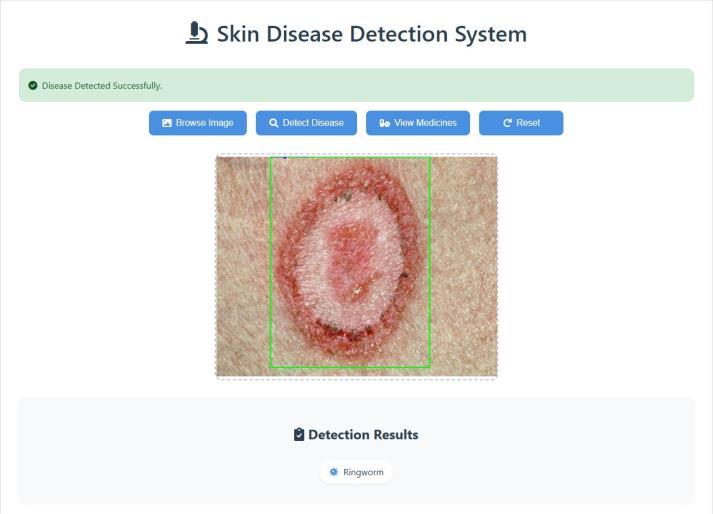
The Fig 5 shows the result screen of the Skin Disease Detection System after analyzing an uploaded image. The system has detected ”RingWorm” and highlighted the affected area with a green bounding box, displaying the resultbelowtheimage.
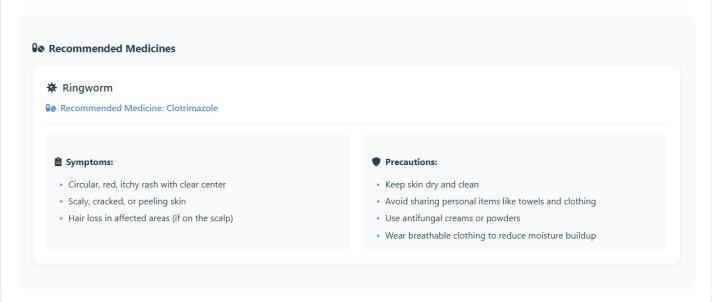
TheFig6suggested medicineisClotrimazole,symptoms such as itchy, red rash and peeling skin, and precautions such as keeping skin dry and avoiding shared items.Itgivesinformativeadvicetopatientsafterdetection. TheFig7showsthe training and validation loss over 50 epochs, indicating
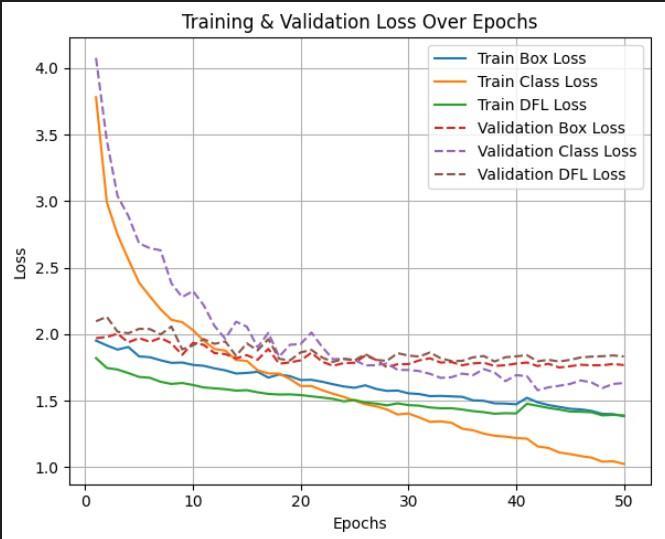
a steady decline in all loss components with training loss consistentlylowerthanvalidationloss.
The Fig 8 shows mAP metrics, where both mAP@50 and mAP@50-95 improve steadily, suggesting better model
7. Trainingandvalidationlossoverepochs. performance witheach epoch.
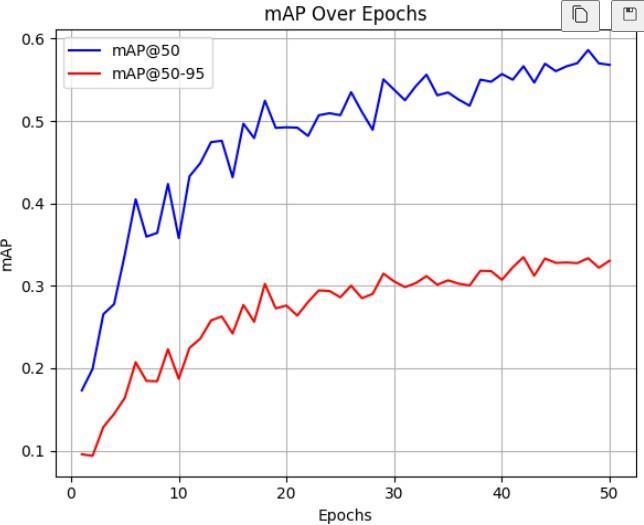
Fig.8. MeanAveragePrecision(mAP).
International Research Journal of Engineering and Technology (IRJET) e-ISSN:2395-0056
Volume: 12Issue: 04 | Apr2025 www.irjet.net p-ISSN:2395-0072
A. Conclusion
The most critical aspect of this project is its machine learning aspect, which addresses real concerns related to healthcare today-diagnosis of skin conditions using AI. An easy-to-use platform is built using the YOLOv8 model, which simplifies the detection or recognition of rashes and other skin problems from images. By rigorous dataset curation, massive training and analysis in real-time, the system will diagnose 12 common skin diseases and keep users informed with recommendations. Application of data augmentations and advanced methods of object detection allows the model to be increasingly reliable when it comes to different skin and con- dition types. A minimalistic, neat interface-withFlask, HTML, CSS and JavaScript-ready-to-go invites users to engage with the tool and to participate activelyintheirskinhealth-relatedactivities.Infact,thishas been a pioneer project-demonstrating the power of deep learning in dermatology and paving the way for a brighter, easierAI-drivenhealthcaretomorrow.
B. Feature Work
In the future, we can use this to detect different types of diseases, and based on the detection, we can recommend a specialist. Improve the model accuracy by adding more imagestothedataset.
[1] S. K. Bandyopadhyay, P. Bose, A. Bhaumik, and S. Poddar, “Machine learning and deep learning integrationforskindiseasesprediction,”Int.J. Eng.Trends Technol., vol. 70, no. 2, pp. 11–18, Feb.2022.
[2] T. Mazhar, I. Haq, A. Ditta, S. A. H. Mohsan, F. Rehman, I. Zafar, J. A. Gansau, and L. P. W. Goh,“The role of machine learning and deep learningapproaches for the detection of skin cancer,” Healthcare, vol. 11, no.3,p.415,Feb.2023.
[3] S. M. Jaisakthi, P. Mirunalini, C. Aravindan, and R. Appavu,“Clas- sificationofskincancerfromdermoscopic images using deep neural network architectures,” MultimediaToolsAppl.,vol.82,no.10,pp. 15763–15778, Apr.2023.
[4] S. Q. Gilani, T. Syed, M. Umair, and O. Marques, “Skin cancer classification using deep spiking neural network,”J.Digit.Imag.,vol. 36,no.3,pp.1137–1147,Jan. 2023.
[5] Y. Zhou, C. Koyuncu, C. Lu, R. Grobholz, I. Katz, A. Madabhushi, and A. Janowczyk, “Multi-site cross-organ calibrated deep learning (MuSClD):Automateddiagnosis ofnon-melanomaskincancer,”Med. ImageAnal.,vol.84, Feb.2023,Art.no.102702.
[6] Ademide Adelekun, Ginikanwa Onyekaba, and Jules B Lipoff. Skin color in dermatology textbooks: an updated evaluation and analysis. Journal of the American AcademyofDermatology,84(1):194–196, 2021.
[7] J. He, S. L. Baxter, J. Xu, J. Xu, X. Zhou, K. Zhang, The practical implementation of artificial intelligence technologiesinmedicine,Nature medicine 25 (1) (2019) 30.
[8] Catarina Barata, M Emre Celebi, and Jorge S Marques. Explainable skin lesion diagnosis using taxonomies. PatternRecognition,110:107413, 2021.
[9] R. Ashraf, S. Afzal, A.U. Rehman, S. Gul, J. Baber, M. Bakhtyar, I. Mehmood, O.Y. Song, M. Maqsood Region-ofInterest based transfer learning assisted framework for skincancerdetectionIEEEAccess,8 (2020),pp.147858147871
[10] N. Nida, A. Irtaza, A. Javed, M. H. Yousaf, and M. T. Mahmood, “Melanomalesiondetectionandsegmentation using deep region based convolutional neural network and fuzzy C-means clustering,” Int. J. Med. Informat., vol. 124,pp.37–48,Apr.2019.
[11] S. Parvatanini, A. Fathi, F. Khozeimeh Automated skin disease classi- fication system using MobileNet V2 and LSTM models Multimed Tool Appl, 80 (38) (2021), pp. 28093-28107
[12] R. Li, W. Lin, Z. Li,L. Zeng,Z. Luo Deep learning model for skin disease detection using a self-attention mechanism Comput Methods ProgrBiomed,214(2022),Article 106472