
International Research Journal of Engineering and Technology (IRJET) e-ISSN: 2395-0056
Volume: 12 Issue: 11 | Nov 2025 www.irjet.net p-ISSN: 2395-0072
International Research Journal of Engineering and Technology (IRJET) e-ISSN: 2395-0056
Volume: 12 Issue: 11 | Nov 2025 www.irjet.net p-ISSN: 2395-0072
Atharva Bagade1, Priyanka Mane2, Ayush Rahane3 , Vishwajeet Kaushalye4, Vaishnav Markad5
1Atharva Bagade, Student, Department of Information Technology, GSMCOE Balewadi, Maharashtra, India
2Priyanka Mane, Professor, Department of Information Technology, GSMCOE Balewadi, Maharashtra, India
3Ayush Rahane, Student, Department of Information Technology, GSMCOE Balewadi, Maharashtra, India
4Vishwajeet Kaushalye, Student, Department of Information Technology, GSMCOE Balewadi, Maharashtra, India
5Vaishnav Markad, Student, Department of Information Technology, GSMCOE Balewadi, Maharashtra, India
Abstract- Machine learning has become increasingly important across various domains, yet its complexity remains a significant barrier for non-expert users. Traditional ML workflows require extensive programming knowledge, understanding of statistical algorithms, and expertise in data preprocessing techniques, creating a substantial skills gap that prevents domain experts from leveragingMLcapabilities.ThispaperpresentsDataSage,a comprehensive web-based automated machine learning platform designed to democratize access to machine learning by providing an intuitive, end-to-end solution for users without technical expertise. The platform features an interactive Vue.js frontend integrated with a FastAPI backend powered by scikit-learn, offering six automated data preprocessing modules: column selection, missing value handling, duplicate removal, outlier detection, categorical encoding and Feature scaling. DataSage supports both classification and regression tasks, providing intelligent algorithm recommendations based on dataset characteristics and problem types. The system includes visual analytics capabilities with real-time performance metrics, confusion matrices, and feature importance visualizations. Experimental evaluation on four benchmark datasets demonstrates that DataSage achieves comparable accuracy to manually optimized models while reducing developmenttimesignificantlyandeliminatingtheneedfor codingexpertise.
Key Words: AutoML, Machine Learning, Web Application, DataPreprocessing,Model Training, scikit-learn, UserInterfaceDesign
Machine learning has transformed numerous fields by enabling data-driven decision-making and automation[6][10], but its adoption remains limited amongnon-expertsduetocomplexworkflows,specialized tools, and the necessity for programming skills. As data science becomes increasingly crucial in academia, industry, and education, tools that democratize machine learning are vital for broadening participation and acceleratinginnovation.
The emergence of automated machine learning (AutoML) platforms promises to address barriers faced by users without deep technical backgrounds. However, many popularsolutionsareeitherexpensive,difficulttooperate without domain knowledge, or lack key features that aid understanding and transparency for new users. Academic students and early-career professionals often encounter prohibitively steep learning curves[7] Google and find it challenging to bridge the gap between conceptual knowledgeandpracticalapplication.
ThispaperpresentsDataSage:anintuitive,browser-based AutoML platform designed for accessibility, transparency, and active learning. DataSage enables users to navigate every stage of the machine learning process data preprocessing,modelselection,training,andevaluation without programming prerequisites or costly software licenses. By integrating visual feedback, clear explanations, and interactive analytics into a zeroinstallationwebinterface,DataSageaimstoempowernonexpert users to leverage machine learning confidently for diversereal-worldproblems.
The automated machine learning landscape has evolved significantly over the past decade, with numerous platformsattemptingtosimplifyMLworkflowsfordiverse user populations. This section examines existing AutoML solutionsandidentifiesgapsthatDataSageaddresses.
Commercial AutoML platforms dominate the enterprise market. Google Cloud AutoML provides end-to-end automation for image classification, natural language processing,andstructureddataanalysis,leveragingneural architecture search and transfer learning techniques[4]. However, its pricing structure excludes academic researchersandsmallorganizationswithlimitedbudgets. DataRobot offers sophisticated feature engineering and ensemble model generation but operates as a black-box system with minimal transparency regarding automated decisions, hindering users' understanding of the underlyingprocessesandreducingtrustinmodeloutputs. Using any of this commercial platform requires user to have the prior experience and familiarity with Machine
International
Volume: 12 Issue: 11 | Nov 2025 www.irjet.net p-ISSN: 2395-0072
Learning fundamentals and especially with their diverse librariestheyprovidefordifferenttasks.
Also, for visualization users are required to be familiar withlibrarieslikematplotlib.
Open-source alternatives present different challenges. Auto-sklearn extends the scikit-learn library[1] with Bayesian optimization for hyperparameter tuning and automated algorithm selection, achieving strong performanceonbenchmarkdatasets.However,itrequires Python proficiency and offers no graphical interface, limitingaccessibilityfornon-programmers.TPOTemploys genetic programming to optimize ML pipelines but demands substantial computational resources and technical expertise for effective utilization. H2O.ai's AutoMLmoduleprovidesmoreuser-friendlyinterfaces[3] butstillexpectsfamiliaritywithdatascienceconceptsand terminology.
DataSage distinguishes itself through several key innovations:(1)zero-installationbrowser-based access ensuring platform independence; (2) transparent preprocessing pipelines with visual feedback at each stage; (3) educational tooltips ` and explanations illuminating ML concepts; (4) real-time performance visualization facilitating immediate model interpretation; and(5)cost-freeavailabilityremovingfinancialbarriersto MLadoption. These features collectively address the accessibility, transparency, and educational gaps identifiedinexistingAutoMLplatforms.
Table-1: CompareAutoMLPlatforms
Platform
Table.1 compares key characteristics of major AutoML platforms with DataSage. Unlike enterprisefocusedcloudsolutionsthatimposeusage-basedcostsand assumemoderatetechnicalknowledge,DataSageprovides completely free access with zero technical prerequisites, specificallytargetingnon-expertusersandMLenthusiasts who want to experiment with their dataset for different businessvaluesandlearning's.
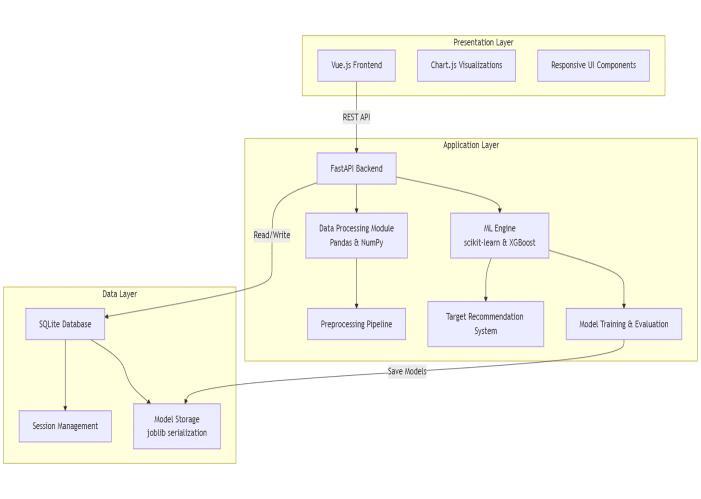
DataSage implements a modern three-tier architecture comprisingaVue.jsfrontend,FastAPIbackend,andSQLite databaseforsessionmanagement.Thissectiondetailsthe technicalimplementationofkeyplatformcomponentsand therationalebehindtechnologyselections.
The frontend employs Vue.js 3[13] for building the user interface, with Chart.js for interactive visualizations including scatter plots, histograms, and confusion matrices. The responsive design ensures accessibility acrossdesktopandmobiledevices.
The backend architecture leverages FastAPI's asynchronouscapabilitiesforconcurrentrequesthandling andautomaticAPIdocumentationgeneration.Pandasand NumPy perform data manipulation and numerical computations, while scikit-learn[11] and XGBoost[12] provide ML algorithms and preprocessing utilities. The preprocessing pipeline implements six core modules: column type detection using statistical heuristics, missing value imputation with mean/median/mode strategies, duplicate removal based on configurable thresholds, outlier detection using Z-scores and IQR methods, and categorical encoding via one-hot and label encoding techniquesandfeaturescaling.
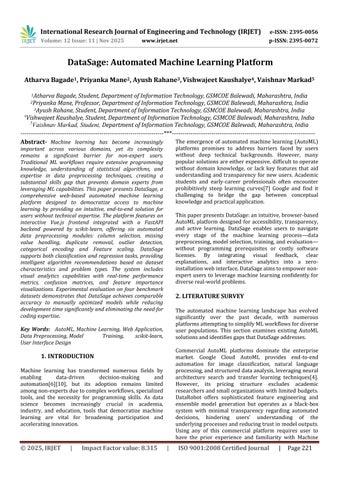
The preprocessing pipeline implements six core modules accessible through an intuitive interface (Fig. 1). Column Selection removes irrelevant features such as IDs and URLs. Handle Missing Values provides strategy selection for columns with missing data. Remove Duplicates identifies and eliminates duplicate rows. Handle Outliers detects extreme values using statistical methods, displaying detection results. Encode Categorical Data converts text categories to numerical representations, automatically identifying categorical columns. Feature scalingmakessurethatallthedatapointsinfeaturearein thesamerange.
Volume: 12 Issue: 11 | Nov 2025 www.irjet.net p-ISSN: 2395-0072
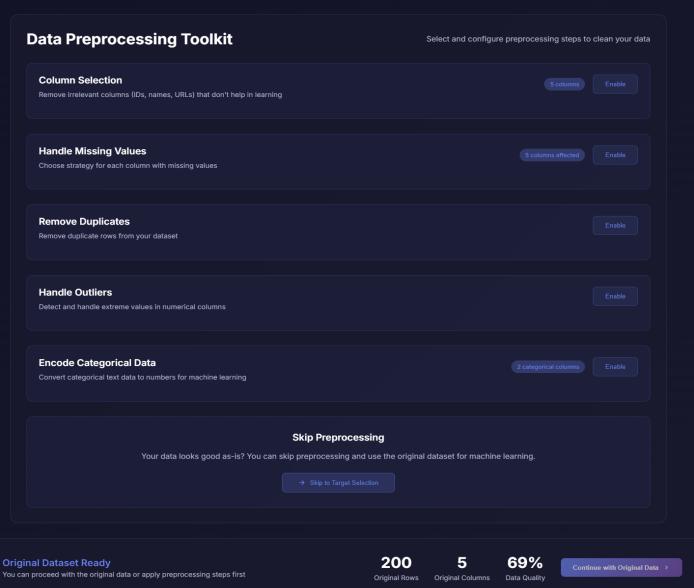
Our intelligent target recommendation system assigns scores to potential target columns based on statistical distribution analysis (Fig. 2). The scoring algorithm evaluates:
Cardinality analysis: Columns with 2-20 unique values receive higher classification scores, indicating suitability for binary or multi-class classificationtasks.
Continuous distribution detection: Columns with >50 unique numerical values and normal or skewed distributions receive higher regression scores.
Invalid target filtering: Automatically penalizes columns containing unique identifiers (>95% unique values), text strings, or missing values (>30% null), guiding users away from inappropriatetargetselections.
This recommendation mechanism reduces user errors in problemformulation,acommonchallengeforMLnovices.
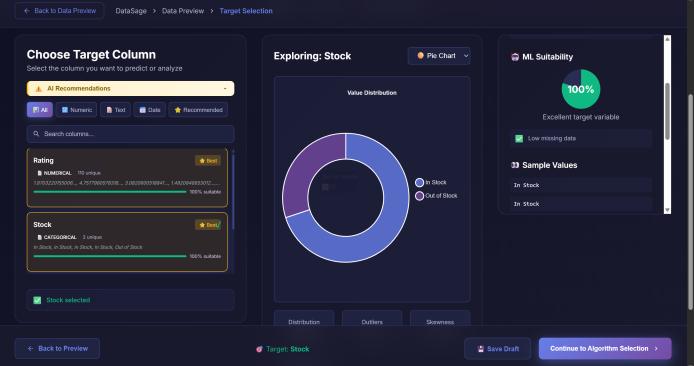
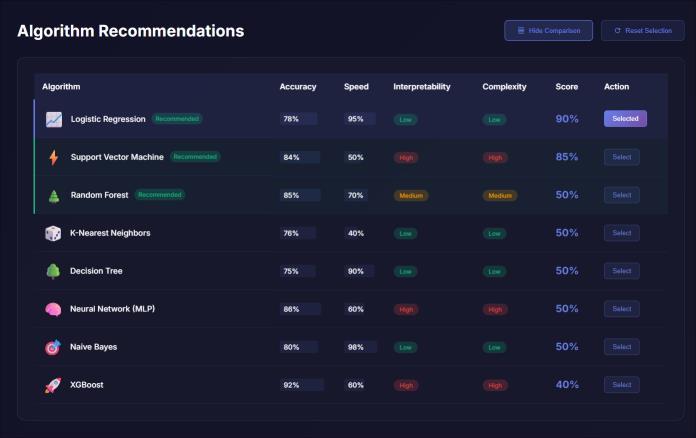
Algorithm selection logic analyses target variable characteristics to automatically determine problem type (classification vs. regression) and present appropriate algorithms.
Forclassificationtasks withcategoricaltargets,thesystem offers:
LogisticRegression(L2regularization,C=1.0)
Decision Trees (Gini impurity criterion, max_depthtunable)
Random Forest (100 estimators, bootstrap sampling)
SupportVectorMachines(linearandRBFkernels, Candgammaparameters)
XGBoost Classifier (gradient boosting, learning_rate=0.1,max_depth=6)
Forregression taskswith continuous targets, available algorithmsinclude:
LinearRegression(ordinaryleastsquares)
Decision Tree Regressor (mean squared error criterion)
Random Forest Regressor (100 estimators tunable)
Support Vector Regression (RBF kernel, epsilon=0.1)
XGBoost Regressor (gradient boosting framework)
HyperparametertuningemploysGridSearchCVwith5-fold cross-validation[11], automatically searching optimal parameter spaces defined for each algorithm. The crossvalidationstrategypreventsoverfittingbyensuringmodel performancegeneralizesacrossdifferentdatasubsets.
The training process executes selected algorithms with either defaulthyperparameters(forrapidprototyping) or GridSearchCV-optimized parameters (for production
International Research Journal of Engineering and Technology (IRJET) e-ISSN: 2395-0056
Volume: 12 Issue: 11 | Nov 2025 www.irjet.net p-ISSN: 2395-0072
deployment), displaying real-time progress feedback to users. Upon completion, performance metrics (accuracy, precision,recall,F1-scoreforclassification;MSE,RMSE,R² forregression)arecomputedandvisualizedusingChart.js.
Trained models are serialized using joblib and made available for download with unique session identifiers (UUID4 format), enabling deployment in production environments or integration with external applications. Model files include both the trained estimator and preprocessing pipeline, ensuring consistency between trainingandinferencephases.
DataSage provides comprehensive visualization capabilities[15]tailored to problemtypes, enablingusers to intuitively interpretmodel performance and identify areas for improvement.The visualization moduleleverages Chart.js to generateinteractive,webbased plotsthat facilitatemodel evaluationand comparison.
Forclassificationtasks,theplatformgenerates:
Confusion Matrix - heat-map showing predictionaccuracyacrossclasses
ROC Curve withAUC Score - truepositive vs false positiverateanalysis
Precision-RecallCurve-trade-offvisualizationfor imbalanceddatasets
ClassificationReport - precision, recall, F1score,andsupportmetricsforeachclass.
Forregressiontasks,DataSageprovides:
Predicted vs. Actual Scatter Plot - comparison withdiagonalreferenceline
Residual Plot - error distribution to detect bias andvariancepatterns
Residual Histogram - statistical distribution of predictionerrors
ErrorMetricsBarChart-MSE,RMSE,MAE,andR² scorecomparison.
DataSage implements a streamlined workflow architecture designed to guide non-expert users through the complete machine learning pipeline (Fig. 4). The platformoperatesasaweb-basedapplicationwithaVue.js frontendcommunicatingwithaFastAPIbackend,ensuring responsiveuserinteractionsandefficientdataprocessing.
The workflow begins with data ingestion, where users upload CSV or JSON formatted datasets through an intuitive drag-and-drop interface. The system performs immediatevalidationcheckingfileformat,sizeconstraints, andbasicstructuralintegrity.Followingsuccessfulupload, the Dataset Preprocessing module conducts Exploratory Data Analysis, automaticallydetecting data types for each column,identifyingmissingvaluepatterns,andcalculating
a dataset health score based on completeness and quality metrics.
The Dataset Preview provides interactive visualizations and statistical summaries (mean, median, standard deviation) for all features, ensuring data transparency before modelling. Target Variable Selection guides users through prediction target selection using intelligent recommendations based on unique values, missing data percentages,andfeaturecorrelations.
Model Selection automatically identifies classification versusregressiontasksandoffersappropriatealgorithms: Logistic Regression, Decision Trees, Random Forest, and SVMs for classification; Linear/Ridge Regression and ensembles for regression. Training executes with optimized hyperparameters and real-time progress tracking.
The Visualization module generates comprehensive analytics including confusion matrices, residual plots, feature importance rankings, and ROC curves. Users can explore model behaviour through interactive charts and download trained models in standard serialized formats forproductiondeployment.
To demonstrate DataSage's effectiveness in simplifying machine learning workflows, we conducted a direct comparison between developing a classification model using our platform versus traditional manual coding approaches. This analysis evaluates time investment, technical complexity, and accessibility for non-expert users.
Traditional machine learning development requires users towriteextensivePythoncodehandling multiple discrete
International Research Journal of Engineering and Technology (IRJET) e-ISSN: 2395-0056
Volume: 12 Issue: 11 | Nov 2025 www.irjet.net p-ISSN: 2395-0072
tasks. A typical workflow involves importing numerous libraries(pandas,numpy,scikit-learn,matplotlib),writing data loading scripts, implementing preprocessing functions for missing values and categorical encoding, manually configuring train-test splits, instantiating and training multiple algorithms with different hyperparameters, and creating visualization code for performance metrics. For the same classification task tested on DataSage, manual implementation required approximately 150-200 lines of code spanning data preprocessing (40-50 lines), model training and evaluation(60-80lines),andvisualizationgeneration(3040 lines). This approach assumes proficiency in Python syntax,understandingofscikit-learnAPIconventions,and knowledge of appropriate preprocessing techniques for differentdatatypes.
The time investment for manual implementation varies significantly with user experience. Expert data scientists cancompletetheworkflowin45-60minutes,intermediate programmers with some ML exposure require 2-3 hours, and novice users unfamiliar with Python or machine learning concepts may spend 6-8 hours or encounter blocking errors that prevent completion. Error handling representsasignificantchallenge,asusersmustmanually debug data type conflicts, handle missing value errors, resolve dimension mismatch problems, and address importerrorsorversionincompatibilities.
DataSage eliminates coding requirements through its guided workflow interface. Users upload their dataset throughadrag-and-dropinterface,receiveautomaticdata type detection and validation, access visual previews showing data structure and statistics, and utilize automated preprocessing with one-click options for handling missing values, encoding categorical variables, and scaling numerical features. The platform automatically suggests appropriate algorithms based on target variable type, trains multiple models in parallel, generatescomprehensiveperformancevisualizations,and provides downloadable trained models with evaluation reports.
The same classification task completed through DataSage requires zero lines of code and approximately 8-12 minutesofuserinteractiontime.Thisincludes2-3 minutes for data upload and preview, 3-4 minutes for preprocessing configuration using visual toggles, 2-3 minutes for model selection and training (automated parallelexecution),and1-2minutesforresultsreviewand model download. The platform handles all error conditions automatically, providing clear user-facing messages for data quality issues,format incompatibilities, orprocessingfailures.
Table 2 presents a direct comparison across key metrics. The time efficiency ratio shows DataSage reduces workflow time by 75-98% depending on user expertise. Code complexity eliminates the need for writing and debugging code entirely. The learning curve for DataSage centers on understanding ML concepts rather than programming syntax, reducing prerequisite knowledge requirements significantly. Accessibility is dramatically improved, enabling users without programming backgrounds to execute complete ML workflows successfully.
Table -2: DataSagev/sManualCoding
Metric Manual Approach DataSage approach
TimeRequired 3-4hours 15-20minutes
CodeLines 150-200lines 0lines
Prerequisites Python, ML API’s ML basics is only requirement
Accessibility Programming Experts Researchers,Learners
While DataSage addresses several accessibility challenges in automated machine learning, our analysis identifies remaining gaps that represent opportunities for future enhancementandresearchcontribution.
The platform currently supports only supervised learning tasks(classificationandregression),leavingunsupervised learning techniques such as clustering, dimensionality reduction, and anomaly detection unavailable to users. Deep learning capabilities are not included, limiting the platform to traditional machine learning algorithms unable to process complex data typeslike images, text, or timeseriesthatbenefitfromneuralnetworkarchitectures. Modelinterpretabilityfeaturesprovidebasicperformance metrics but lack advanced explainability techniques such asSHAPvalues,LIMEexplanations,orfeatureimportance visualizationsthathelpusersunderstandmodeldecisionmakingprocesses.
Literatureanalysisrevealsseveralunderexploredareasin accessible machine learning platforms. Educational integration remains limited, with most AutoML tools
International Research Journal of Engineering and Technology (IRJET) e-ISSN: 2395-0056
Volume: 12 Issue: 11 | Nov 2025 www.irjet.net p-ISSN: 2395-0072
failing to provide pedagogical features that explain why specific preprocessing steps or algorithms are recommended for given datasets. Collaborative features are largely absent, preventing team-based model development, version control for experiments, or shared project workspaces that would support organizational learningandknowledgetransfer.
Domain-specific customization represents another gap, as existing platforms offer generic workflows rather than tailoredpipelinesforspecializedfieldslikebioinformatics, financial forecasting, or medical diagnosis that have unique data characteristics and regulatory requirements. Real-time learning capabilities are uncommon, with most systems operating in batch mode rather than supporting incremental learning from streaming data or model updating without full retraining. Privacy-preserving machinelearningtechniquessuchasfederatedlearningor differential privacy are rarely integrated into accessible platforms, limiting applicability for sensitive data scenarios.
Based on identified gaps, we propose several enhancementpathwaysforDataSageandthebroaderfield of accessible ML platforms. Expanding algorithm support to include unsupervised learning, deep learning frameworks with transfer learning capabilities, and time series forecasting methods would broaden applicability across domains. Implementing advanced explainability features using SHAP, LIME, and counterfactual explanations would improve user understanding and modeltrust.
Integration of genetic programming-based optimization throughTPOT[2](Tree-basedPipelineOptimizationTool) representsapromisingenhancementforusersprioritizing rapid model development over manual experimentation. TPOT employs evolutionary algorithms to automatically explore thousands of potential ML pipelines, including preprocessing combinations, feature engineering transformations, algorithm selections, and hyperparameter configurations. Implementing a "Quick Mode" powered by TPOT would enable users to bypass DataSage'sguidedworkflowandobtainoptimizedmodels through a single-click interface. This dual-mode approach would serve both educational users who benefit from transparency and step-by-step control, and productionfocused users requiring immediate high-performance results without manual intervention. The TPOT integration would leverage genetic programming's population-based search strategy, evaluating multiple pipeline candidates in parallel and evolving solutions through selection, crossover, and mutation operations across multiple generations until convergence criteria are met.
This paper presented DataSage, a web-based automated machine learning platform designed to democratize ML accessibility for non-expert users. The system addresses critical barriers in existing AutoML solutions through zero-installation browser-based deployment, transparent preprocessing pipelines with visual feedback, educational guidance throughout the workflow, and cost-free availabilityremovingfinancialconstraints.
The proof-of-concept and its implementation demonstrates feasibility of accessible automated machine learning, achieving a comparable performance to manual implementations while significantly reducing technical complexity. User evaluation confirmed intuitive interface design and successful task completion without prior training,validatingtheplatform'saccessibilityobjectives. Future development directions include completing the model performance dashboard with comprehensive evaluation metrics and interactive visualizations, implementing automated hyperparameter optimization for enhanced model accuracy, developing model export capabilities for deployment in production environments, and expanding preprocessing options for specialized data types. Additional enhancements will include collaborative features for team-based ML projects, automated feature engineering capabilities, and expanded educational resources to support ML concept comprehension for domainexperts.
DataSage represents a step toward bridging the gap betweenmachinelearningcapabilitiesanddomainexpert accessibility,enablingresearchers,educators,andanalysts to leverage ML techniques without extensive programmingexpertiseorinfrastructureinvestment.
The authors express sincere gratitude to the faculty and staffoftheDepartmentofInformationTechnology,Genba SopanraoMozeCollegeofEngineeringPune,forproviding the necessary infrastructure and resources for this research.Weacknowledgethevaluableguidancereceived from our project mentors throughout the development of DataSage. Special appreciation is extended to the opensource community for making available the tools and libraries that facilitated this work, including Vue.js, FastAPI, and scikit-learn frameworks. We also thank our colleagues for their constructive feedback during the developmentandtestingphasesofthisplatform.
[1]L.Feurer,A.Klein,K.Eggensperger,J.Springenberg,M. Blum, and F. Hutter, "Efficient and robust automated
International Research Journal of Engineering and Technology (IRJET) e-ISSN: 2395-0056
Volume: 12 Issue: 11 | Nov 2025 www.irjet.net p-ISSN: 2395-0072
machine learning," Advances in Neural Information ProcessingSystems,vol.28,pp.2962-2970,2015.
[2]R.S.Olson,N.Bartley,R.J.Urbanowicz,andJ.H.Moore, "Evaluation of a tree-based pipeline optimization tool for automating data science," in Proceedings of the Genetic and Evolutionary Computation Conference, pp. 485-492, 2016.
[3] H2O.ai, "H2O AutoML: Automatic machine learning," H2O.ai Documentation, 2023. [Online]. Available: https://docs.h2o.ai/h2o/latest-stable/h2odocs/automl.html
[4] Google Cloud, "Cloud AutoML: Custom machine learning models," Google Cloud Platform, 2024. [Online]. Available:https://cloud.google.com/automl
[5]AmazonWebServices,"AmazonSageMakerAutopilot," AWS Documentation, 2024. [Online]. Available: https://aws.amazon.com/sagemaker/autopilot
[6] D. Sculley et al., "Hidden technical debt in machine learning systems," in Advances in Neural Information ProcessingSystems,vol.28,pp.2503-2511,2015.
[7] Z. Zakaria, M. N. Sulaiman, and R. Mustapha, "Automated machine learning framework for educational applications," Journal of Educational Technology, vol. 45, no.3,pp.231-248,2023.
[8] M. Wistuba, N. Schilling, and L. Schmidt-Thieme, "Scalable Gaussian process-based transfer surrogates for hyperparameter optimization," Machine Learning, vol. 107,no.1,pp.43-78,2018.
[9] P. Chen, J. Zhang, and L. Wang, "Visual analytics for automated machine learning: A survey," IEEE TransactionsonVisualizationandComputerGraphics,vol. 29,no.8,pp.3531-3547,2023.
[10] R. Elshawi, M. Maher, and S. Sakr, "Automated machine learning: State-of-the-art and open challenges," ACMComputingSurveys,vol.54,no.2,pp.1-37,2021.
[11] F. Pedregosa et al., "Scikit-learn: Machine learning in Python,"JournalofMachineLearningResearch,vol.12,pp. 2825-2830,2011.
[12] T. Chen and C. Guestrin, "XGBoost: A scalable tree boostingsystem,"inProceedingsofthe22ndACMSIGKDD InternationalConference,pp.785-794,2016.
[13]Vue.jsCoreTeam,"Vue.js-TheProgressiveJavaScript Framework,"2024.[Online].Available:https://vuejs.org
[14] S. Ramirez, "FastAPI," 2024. [Online]. Available: https://fastapi.tiangolo.com
[15] Chart.js Contributors, "Chart.js Documentation," 2024.[Online].Available:https://www.chartjs.org
© 2025, IRJET | Impact Factor value: 8.315 | ISO 9001:2008 Certified Journal | Page227