
International Research Journal of Engineering and Technology (IRJET) e-ISSN:2395-0056
Volume:12Issue:10|Oct2025 www.irjet.net p-ISSN:2395-0072
International Research Journal of Engineering and Technology (IRJET) e-ISSN:2395-0056
Volume:12Issue:10|Oct2025 www.irjet.net p-ISSN:2395-0072
Rukshad Amaria,
College of Computing, New Jersey Institute of Technology, Newark, NJ - 07102 , US https://orcid.org/0009-0003-4291-0213
Abstract: Cryptocurrency markets operate in a highly volatile, decentralized, and non-stationary environment that challenges traditional econometric methods. This paper presents a theoretical framework for multi-asset cryptocurrency price forecasting using Artificial NeuralNetworks(ANNs).AfeedforwardANNtrained with the back-propagation algorithm is formulated to approximate nonlinear dependencies among blockchain, financial, and sentiment features for Bitcoin, Ethereum, and Solana. Twelve mathematical expressions describe the learning process, and five schematic figures illustrate data flow, architecture, and convergence. The study establishes that ANNs can capture nonlinearities more effectively than linear regression or GARCH models. It provides a foundation for future empirical studies integrating decentralized finance analytics and large-scale sentimentinformation
Keywords: Cryptocurrency, Artificial Neural Network, Backpropagation, Forecasting, Blockchain Analytics,ComputationalFinance
I. INTRODUCTION
Cryptocurrency markets function continuously and display complex price dynamics influenced by global liquidity,miningactivity,andinvestorsentiment.Linear econometric modelssuchasARIMAandGARCHassume stationarity that does not exist in these markets.
Artificial Neural Networks offer a non-parametric approach to approximate nonlinear mappings from heterogeneous inputs to price outputs. The backpropagationalgorithmiterativelyadjustsweightsto minimizepredictionerrorandadapttomarketvariation.
This paper develops a concise theoretical structure for ANN-based cryptocurrency forecasting. The focus is on mathematical clarity, feature formulation, and generalizedlearningbehaviorindecentralizedcontexts.
Althelaya et al. [1] compared multivariate recurrent architectures for cryptocurrency prediction. Chen et al.
[2] incorporated sentiment embeddings with temporal attention to capture emotional market cycles. Aggarwal et al. [3] studied cross-market sentiment links between equitiesandcryptoassets.ZhangandDagli[4]explored weekday anomalies using ANN classifiers. Li and Gupta [5]comparedGARCHandrecurrentmodelsforvolatility.
Hybrid CNN-LSTM designs [6] and transformer-based sentiment fusion [7] improved empirical accuracy but lacked explicit theoretical reasoning. The present paper emphasizes
analytical formulation and structural explanation for multi-assetANNsystems.
A.NeuronComputation
Eachneuron

computesanactivation



B.BackPropagation
ForNtrainingexamples,themean-squarederroris

International Research Journal of Engineering and Technology (IRJET) e-ISSN:2395-0056
Volume:12Issue:10|Oct2025 www.irjet.net p-ISSN:2395-0072



C.RegularizationandCostFunction

To reduce overfitting, a regularized objective is defined: whereλcontrolsL2penalty
D.NormalizationandFeatureScaling

ensuringzeromeanμandunitvarianceσtostabilize gradientflow.
E.ActivationFunctionDynamics

Fornumericalstabilityundervolatileinputs: (8) andgradient
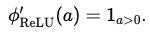
F.ConvergenceCriterion Traininghaltswhen


G.Multi-AssetIntegration whereαₘisanimportanceweightperasset.
H.DirectionalAccuracy
©2025,IRJET | ImpactFactorvalue:8.315 | ISO9001:2008CertifiedJournal | Page535 withηasthelearningrate.Gradienttermspropagate backwardusing

Performance can also be evaluated through sign consistency: whereI[·]istheindicatorfunction.
I.ExpectedGeneralizationBound wherehisthenetwork’sVCdimension.

IV. METHODOLOGY
Figure1:SystemsDesign:
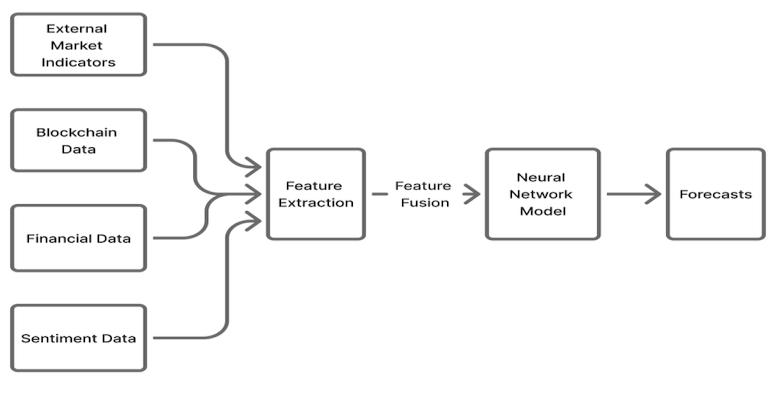
Multiple data streams : blockchain, financial, sentiment, and external market indicators undergo feature extraction and fusion before entering the neural network forpriceforecasting.
A.DataSourcesandPreprocessing
Featuresaredrawnfromthreeprimarydomains:
● Financial Data: open, close, high, low, volume, returns, volatility.
International Research Journal of Engineering and Technology (IRJET) e-ISSN:2395-0056
Volume:12Issue:10|Oct2025 www.irjet.net p-ISSN:2395-0072
● BlockchainMetrics:hashrate,blocktime,active addresses,transactioncount.
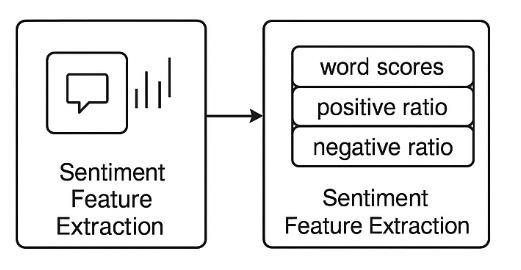
● Sentiment Features: positive/negative score ratiosderivedfromTwitterandReddit.
Each stream is normalized, aligned temporally, and fused into a single feature matrix X using weighted concatenation.
B.NetworkArchitecture
Athree-layerfeedforwardANNisimplemented:
Input→Hidden₁(128neurons)→Hidden₂(64neurons) →Output(oneperasset).
ReLU activation is used for hidden layers, linear activation for outputs.
C.TrainingConfiguration
Optimizer: Adam (η = 0.001).
Mini-batch size = 64.
Loss function = RMSE + λ ∥θ∥² .
Cross-validation split = 80/20.
D.Figures
Figure2:FeatureFusionFlow:
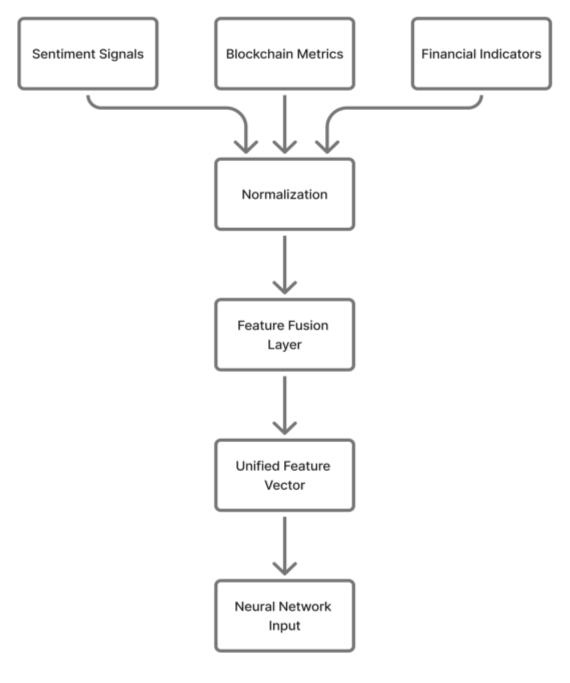
Financial, blockchain, and sentiment indicators are normalized, fused, and transformed into a unified feature vector that serves as input to the neural network model.
Figure3:NeuralNetworkArchitecture
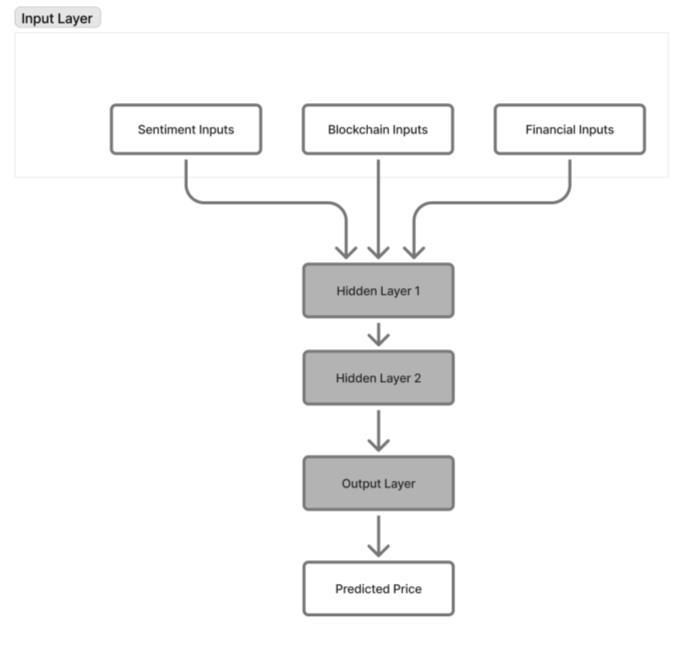
A multi-input ANN framework where financial, blockchain, and sentiment inputs flow into two nonlinear hiddenlayersbeforeproducingthepredictedpriceoutput. This architecture enables the model to approximate nonlinear interactions across heterogeneous cryptocurrencydatasources.
Figure4:LearningFlowModel
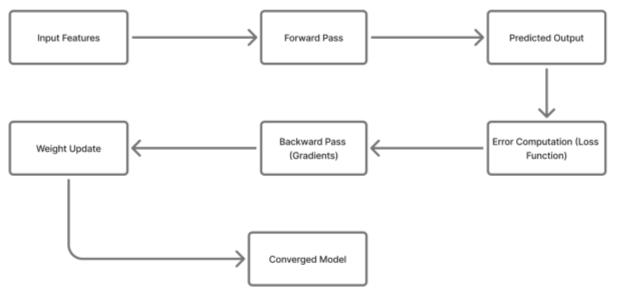
The forward pass computes predicted outputs from input features. The loss function measures error, which is backpropagated through gradients to update network weights iteratively until convergence, forming the optimizedneuralnetworkmodel.
International Research Journal of Engineering and Technology (IRJET) e-ISSN:2395-0056
Volume:12Issue:10|Oct2025 www.irjet.net p-ISSN:2395-0072
Figure5:SentimentAnalysis:Featureextraction
Although this paper remains theoretical, the derived frameworkimpliesthefollowingbehaviors:
Non-Linearity Capture: Hidden layers represent multimodalfeatureinteractionsabsentinlinearregression.
Generalization:Regularization(6)andnormalization(7) ensurestableconvergence(9).
Scalability:Objective(10)allowsparalleltrainingacross heterogeneousassets.
Interpretability: Gradient-based saliency could quantify featureimportancepost-training.
ANNs serve as universal approximators capable of capturing crypto-market chaos. Through distributed representations, they embed latent relationships between blockchain throughput, network congestion, and investor sentiment. Unlike deterministic econometric models, ANNs adapt continuously to nonstationary distributions, a key property for 24/7 markets.
This formulation provides theoretical justification for empirical findings observed in [1]–[4], bridging machine-learning theory with digital finance. Future empirical validation should compare this baseline against transformer-based temporal models and diffusion-basedgenerativepredictors.
Futureresearchdirectionsinclude:
1. HybridANN-LSTMsystemscapturingtemporal dependencies;
2. NLP integration for contextual sentiment vectorsusingLLMssuchasRoBERTa;
3. Real-timeon-chainfeaturefusionforautomated DeFidecisionsupport;
4. ReinforcementlearningtradersusingtheANN’s latentrepresentations.
This study extends classical ANN theory into decentralized multi-asset forecasting. By formalizing learning,normalization,andmulti-sourcefeaturefusion, it demonstrates the theoretical viability of ANNs for chaotic cryptocurrency systems. The proposed framework provides a foundation for future empirical worklinkingdeeplearningwithalgorithmictradingand blockchainintelligence.
[1] H. ALTHELAYA, E. EL-ALFY, AND S. MOHAMMED, “MULTIVARIATE CRYPTOCURRENCY PREDICTION: COMPARATIVE ANALYSIS OF THREE RECURRENT NEURAL NETWORK APPROACHES,” J.BIG DATA,VOL.9,NO.44,2022.
[2] X. CHEN, Z. ZHAO, AND L. XU, “SENTIMENT-DRIVEN CRYPTOCURRENCY FORECASTING: ANALYZING LSTM, GRU, BILSTM,ANDTAM,” SOC NETW ANAL MINING,VOL 15,2025.
[3] P. AGGARWAL ET AL., “THE PREDICTIVE POWER OF SOCIALMEDIASENTIMENT:EVIDENCEFROMCRYPTOCURRENCIES ANDSTOCKMARKETS,” MATH ,VOL 11,NO 16,P 3441,2023.
[4]Y.ZHANGANDC.DAGLI,“ARTIFICIALNEURALNETWORK ANALYSIS OF THE DAY-OF-WEEK ANOMALY IN CRYPTOCURRENCIES,” FINANC INNOV ,VOL 9,NO 33,2023.
[5] Z. LI AND A. GUPTA, “BITCOIN RETURN VOLATILITY FORECASTING: A COMPARATIVE STUDY BETWEEN GARCH AND RNN,” J.RISK FINANC MANAG ,VOL 14,NO 7,2021.
[6] D. MARTINEZ ET AL., “HYBRID CNN-LSTM ARCHITECTURES FOR FINANCIAL TIME SERIES FORECASTING,” IEEEACCESS,VOL.9,PP.15702–15715,2021.
[7] L. JIN AND T. KIM, “TRANSFORMER-BASED SENTIMENT FUSIONFOR CRYPTO-ASSET FORECASTING,” EXPERT SYST APPL , VOL 229,2025.
[8] K. PATEL AND R. SINGH, “COMPARATIVE STUDY OF MACHINELEARNINGMODELSFORBITCOINPRICEFORECASTING,” IEEETRANS COMPUT SOC SYST , VOL 11, NO 4, PP 945–956, 2024.
[9]E.SANTOSANDF.YAO,“EXPLAINABLEDEEPLEARNINGIN FINANCIAL FORECASTING,” IEEE TRANS. NEURAL NETW. LEARN. SYST.,VOL.33,NO.12,2022.
[10] A. RAZA AND H.IQBAL, “BLOCKCHAIN ANALYTICSAND DEEP LEARNING FOR DEFI RISK ASSESSMENT,” IEEE ACCESS, VOL 10,PP 124821–124835,2022.
International Research Journal of Engineering and Technology (IRJET) e-ISSN:2395-0056
Volume:12Issue:10|Oct2025 www.irjet.net p-ISSN:2395-0072
[11]S.NAKAMOTO,“BITCOIN:APEER-TO-PEERELECTRONIC CASHSYSTEM,”2008.
[12] T. HUANG AND J. LEE, “UNIVERSAL APPROXIMATION AND OPTIMIZATION STABILITYIN NEURAL FORECASTING,” IEEE TRANS NEURAL NETW ,VOL 35,NO 2,PP 212–226,2025.
©2025,IRJET | ImpactFactorvalue:8.315 | ISO9001:2008CertifiedJournal | Page538