
International Research Journal of Engineering and Technology (IRJET) e-ISSN: 2395-0056
Volume: 12 Issue: 10 | Oct 2025 www.irjet.net p-ISSN: 2395-0072
International Research Journal of Engineering and Technology (IRJET) e-ISSN: 2395-0056
Volume: 12 Issue: 10 | Oct 2025 www.irjet.net p-ISSN: 2395-0072
Datta Snehith Dupakuntla Naga
Senior Software Engineer - QA Automation, Teladoc Health, United States.
Abstract
This paper explores the use of Appium, and presents it as a cross-platform mobile testing framework through which highaccuracy validation can be performed in a critical domain healthcare. Apps are radically changing patient care and operational efficiency; however, an application’s direct effect on health results, combined with the compounding of sensitive information about patients, pushes quality assurance to an extremely tough level. This report will take into account architectural advantages that come with using Appium: cross-platform abilities along with simulating complex end-to-end scenariosinvolvingmultipledevices.WhilenotingsomeinherentdrawbackswithinAppium namelyperformanceissuesand testflakiness itcontextualizesstrategicintegrationswithadvancedtestingmethodologies,especiallyvisualvalidationdriven by AI and test data management as enablers that help to overcome these challenges [1]. The other will present a case study showinghowthisonecanbeappliedinhealthcaretocutdownmanualeffort,improvereleasespeedsandincreasequalityfor applications. The results emphasize that attaining high-accuracy verification in healthcare through Appium depends on a holistic testing environment focusing on ongoingcompliance witha broadcheck on data integrityplus the joint useof other technologies.
Keywords: Appium, mobile testing, healthcare, validation, accuracy, cross-platform, regulatory compliance, patient safety, testautomation,AI.
Mobile health(mHealth) applicationshave very recentlycomeastransformativetoolsinto thehealthcaresectorand altered care for the patient and how operations run. The mHealth applications provide benefits such as lower healthcare costs, increase patient awareness, and improve access to vital services. Examples of mHealth applications include appointment booking systems, aids for clinical diagnosis, medication management tools, telemedicine platforms, and EHRs ac-cess applicationsExamplesofmHealthapplications.Theuptakeofthesedigitalsolutionsiskeytomodernhealthcaredelivery[2].
ThedirectinfluenceofmHealthapplicationsonuserhealthandsafety,togetherwiththeirhandlingofverysensitive patient data, brings quality assurance to the level of an imperative rather than a best practice. The stakes in mHealth are profoundly high; these applications can directly influence patient outcomes, even to the effect of impacting life and death situations. This reality means that the definition of “quality” in mHealth extends far beyond typical software functionality; it covers prevention of harm, assurance of medical accuracy, and maintenance of user trust unconditionally. In turn, testing methodologies for mHealth applications must be inherently more rigorous and fault-intolerant than those applied in less criticaldomains anabsoluterequirementforhigh-accuracyvalidation!
Criticalitycanbecalculatedusing where & And
International Research Journal of Engineering and Technology (IRJET) e-ISSN: 2395-0056
Volume: 12 Issue: 10 | Oct 2025 www.irjet.net
Variablesfromtheaboveequation:
S= Severity ofadverseoutcomesifthefeaturefails(0=noharm,1=death/severeharm).
λ= Likelihood / Probability offailureorerroneousoutputinregularoperation(0–1).
P= Population affected proportion (fractionofusersorpatientsimpacted;0–1).
T= Time-sensitivity factor (0–1).Higherwhentimelyresponseiscritical(e.g.,emergencyalerts).
p-ISSN: 2395-0072
D = Detectability / Observability of failure (0–1), where higher DDD means it is easier to detect a fault. (If you prefer, use InverseDetectabilityID=1−DI_D=1-DID=1−Dsohighervaluesmeanhardertodetect.)
R = Recoverability / Mitigation (0–1), higher = easier to recover/mitigate after failure. Use IR=1−RI_R=1-RIR=1−R if you wanthighervaluestomeanworserecovery.
V=Vulnerabilityfactor
I=Impactfactor(includeimpactscope,timeurgency,detectabilityandrecoverability)
Challenges in achieving high-accuracy validation in mHealth applications necessarily involve a complex set of factors. Data securityandprivacymeasuresarefirstsincetheymustcomplywiththeprovisionsofHIPAAintheUnitedStates,anacronym for Health Insurance Portability and Accountability Act or else the GDPR General Data Protection Regulation in Europe. Beyond data protection, other regulations apply to guidelines from the U.S. FDA and ISO 13485, IEC 62304 standards noteworthylessfortheirroleasmedicalapplicationontopoftheirrequirementinhelptoimplementregulation.
Morechallengescamefromneedingtoworksmoothlywithcurrenthealthcareinfosystems,goodlinkingwithmany Internet of Things (IoT) medical devices, and supporting many user roles (like patients, doctors, admins). Also, keeping the highcorrectnessofmedicaldataduringthewholelifeoftheappisstillabigproblem.Addingtothesetechnicalandrule-based barriers are issues in the system like not having full security rules; not enough developers knowing how to make secure mHealthapps;makers'developmentandtestingteamsmissingbugs;andnotenoughsecuritytestpractices.Thegreatnumber andtypeoftheseproblemsshowthatonetestingframeworkcan'tcoverallpartsofmHealthqualitychecksbyitself.Rather, anintegrated approachisneeded whichcombinescore automation toolswithspecific strategies for data validation,security checks, and ongoing rule compliance [3]. This gives a wide view that's needed to help carefully steer through this highly complexandmulti-facetedprobleminmHealthvalidation.
Appium is open-source automation software for testing Native, Hybrid, and Mobile Web Applications on iOS and Android platforms[4].ExtendittoverifyOSversionsanddevicetypesavailableinthemarketforyourmobileapplications[3].It was primarily designed to allow cross-platform testing with a single codebase thereby reducing the effort and time that would have traditionally been associated with maintaining separate test suites for each operating system. Appium achieves this leveraging the WebDriver protocol Test Scripts can be written in just about any programming language that supports WebDriverincludingJava,Python,C#,JavaScript,etc.,thusofferinghugeflexibilitytothedevelopmentteams.
Appiumhasthegreatbenefitofofferingwidecodereusabilityandbroadcompatibility, butwithcertaintrade-offsin underlyingarchitecturalconsiderationsthataffectperformanceandelementidentification.Basically,theframeworkworksby simulatinguserinteractionsviaaccessibilityfeaturesoftheoperatingsystem;whilethisensurescross-platformconsistency,it normally comes at the cost of slower execution times and greater flakiness compared to native-specific frameworks like Espresso or XCUITest [5]. This trade-off between effectiveness in "write once, run everywhere" versus raw speed or nativelevel stability is a major consideration for high-accuracy validation in healthcare where reliability and performance are critical.
© 2025, IRJET | Impact Factor value: 8.315 | ISO 9001:2008 Certified Journal | Page451
International Research Journal of Engineering and Technology (IRJET) e-ISSN: 2395-0056
Volume: 12 Issue: 10 | Oct 2025 www.irjet.net p-ISSN: 2395-0072
Forcross-platformconsistencytesting(akeyAppiumfeature),wedefine: ( ) ( ) where
:observedoutputonplatformx(e.g.,Android)
:observedoutputonplatformy(e.g.,iOS)
d(⋅ , ⋅):differencemetric(e.g.,outputmismatchratio)
Thisresearch papertriesto lookattheskillsofAppium for testing mobileappsacross platformsinthehealthcarefield. The mainaimistocheckhowmuchAppiumhelpsinhigh-accuracyvalidation,giventhespecialandstrictneedsofmHealthapps. ThepaperwillgiveadetailedviewofAppium'sdesign,itsgoodpoints,anditsnaturallimits.Areal-lifeexamplewillbeshown todemonstratehowAppiumworksinhealthcare,alongwithalookatrelatedperformanceandqualitymeasures.Intheend, thisstudyhopestoofferideasonhowAppiumcanbeusedwell, oftenwithothernewways,tomakesuremHealthsolutions arereliable,safe,andfollowingrules[2].
AccuracyofAppium=
2. Appium as a Cross-Platform Testing Framework
2.1 Architecture and Core Capabilities
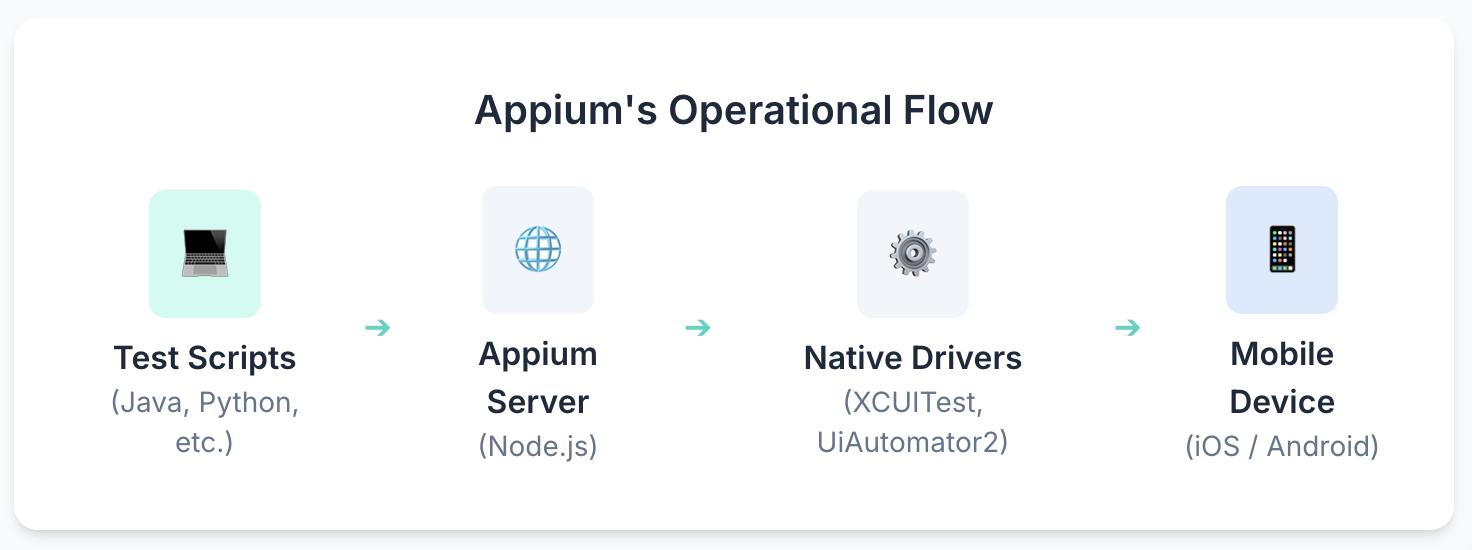
Appiumrunsinaclient-servermodel.ItisanHTTPserverthatinitiatesiOSandAndroidsessionsusingWebDrivercommands. Inthisway,itcandrivemobileapplicationsjustlikeahumanwoulddobyperformingactionssuchastap,swipe,orscroll on thedevice[5].ForapplicationsbuiltwithframeworkslikeFlutter,AppiumusesaccessibilityelementsfromFluttertoidentify interactablecomponentssincetherenderingengineisnotnativeiOSorAndroid.
Figure 1:Appium’sOperationalFlowillustratinghoweachstageisconnectedtothepreviousandnext.
International Research Journal of Engineering and Technology (IRJET) e-ISSN: 2395-0056
Volume: 12 Issue: 10 | Oct 2025 www.irjet.net
p-ISSN: 2395-0072
Appiumprovidesaverygoodsetofcorefunctionalitieswhichmakeitflexibletochooseformobiletestautomation:
Cross-Platform Strength:MajorstrengthofAppium liesinthefactthatitachievestestautomationonbothiOSand Androidplatformswithinasingleframework,therebygreatlyminimizingtheneedforplatform-specifictestscripts[5].
Application Type Support: It supports automation testing of native applications, hybrid applications, and mobile webapplications[4].
Programming Language Flexibility: Appium is very flexible. It supports various programming languages for test authoringsuchasJava,Python,JavaScript,Ruby,andC#.ThisallowstheQAteamstousetheirexistingskillsets.
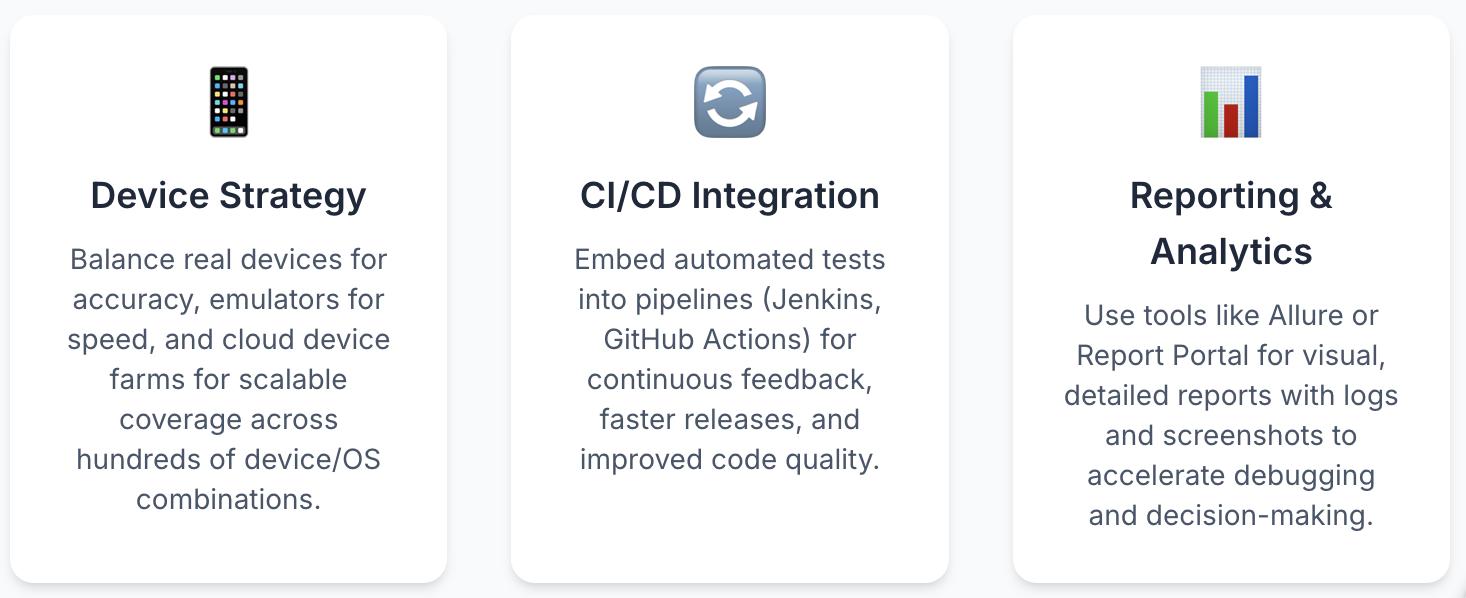
Integration with CI/CD tools: Appium integrates well with popular Continuous Integration tools like Jenkins, Bambooamongothers.Thismeansthatautomatedregressioncheckscanbetriggeredoneverycommitofcode andfeedback cyclesareshortened.
Diverse Testing Environments: Testscanrunonrealmobiledevicesplusemulatorsandsimulatorssupportingwide arraysoftestingenvironmentsensuringconsistentuserexperienceacrossdifferenthardware.
Interaction Beyond Application Under Test (AUT) :AppiumhastheabilitytotalktoUIelementsoutsideoftheapp. Thiscanincludethingslikesystempop-ups,noticesor evenopening nativeappslikethedevice'saddressbook todothings. ThisisabigpluscomparedtoframeworkswhicharestuckonlyintheAUT.
End-to-End Multi-Device Testing: Appiumallowsyoutorundifferentpartsofthesametestatthesametimeontwo separatedevices.Thishelpsyousimulatereal-lifescenariosbetter likecheckingacallfromonedevicetoanother.
Application State Management: It gives an inbuilt flag (noReset capability) to clear app data. Resetting the applicationstatebeforetestexecution.
Screenshot and Keyboard Interaction: Appium has inbuilt functions to take screenshots, record video of the test, andcandirectlytalktothesoftkeyboard,includingtypingtext.
2.2
Design and capabilities of Appium bring major advantages to the testing of mobile applications, particularly applicable to complexdomainssuchashealthcare.
The greatest benefits offered lie in the reusability of code since it permits one codebase for testing on iOS and Android, along with different software versions and devices. In this way, Appium dramatically cuts down on the effort to develop and time needed for creating and maintaining test scripts. Such a consolidated approach makes the process more efficientteam-wiseforcross-platformmHealthapplicationdevelopmentandfurthermakesitstreamlined.
International Research Journal of Engineering and Technology (IRJET) e-ISSN: 2395-0056
Volume: 12 Issue: 10 | Oct 2025 www.irjet.net p-ISSN: 2395-0072
2:KeyadvantageswithAppiumwhenusingforMobiletesting
Appiumgiveslotsofliberty.ManyprogramminglanguagesaresupportedwhichallowsQAteamstojoinAppium with their current tech stacks of Selenium WebDriver-based tools and frameworks. Thus, the test environment becomes very flexible,somethingthatisgreatlydesiredinfast-changinghealthcaredevelopmentcycles.
Appium allows running automated tests on simulators, emulators, real devices; hence complete test coverage is achieved. Consequently, an applicationsupported environment achieves a more reliable user experience as with adequate vettingacrossmultiplehardwareandsoftwareconfigurations.
Arguablyinthemostcriticalareaofhealthcare,Appiumperformswellincomplexend-to-endscenarios.Itsone-of-akind ability to run different parts of the same test simultaneously on multiple devices aids in realistic simulation of very complexworkflows forinstance,a mHealthapplicationmayinvolveapatiententeringsymptomdatavia amobileappand, at the same time, a clinician checking that information in an EHR system on another device. Multi-device testing offered by Appiumwoulddirectlyenablevalidationofsuchhigh-complexityinteractionsfoundinhealthcarethatrequire high-accuracy validationbecausetheymirroractualuse.ThisisparticularlyimportantformHealthworkflowsinvolvingmorethanoneuser ordevice forexample,doctor-patientinteractionorsyncingwearabledatawithEHRs.
Appium hasmany merits butit alsocomes withmany demerits whichhave to be takeninto account, particularlywhen high accuracyvalidationisbeingsoughtinacriticalenvironmentlikehealthcare.
International Research Journal of Engineering and Technology (IRJET) e-ISSN: 2395-0056
Volume: 12 Issue: 10 | Oct 2025 www.irjet.net p-ISSN: 2395-0072
Figure 3:GraphexplainingthevariousfactorscomparisonbetweenAppiumandothernativeframeworkslikeEspresso.
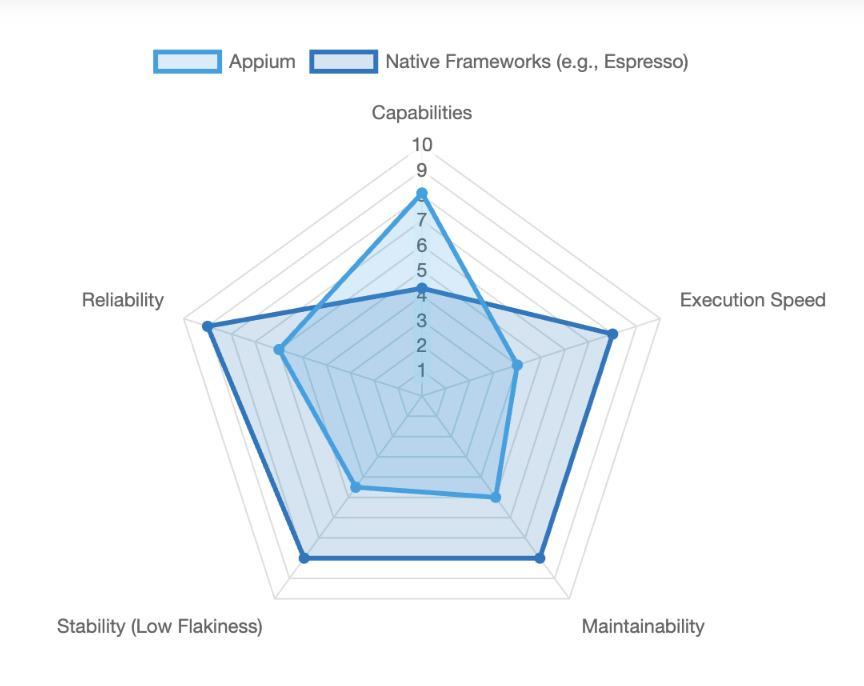
Performanceisoneofthefactorstotakeintoconsideration.Appiumalwaystakeslongerthannativeframeworkslike EspressoandRobotiuminexecutingtests.Thismaylargelybeattributedtoitsclient-servermodelsincethereisoverheadin communicationbetweentheAppiumserverandthedeviceplusitusesintermediatelayersforelementsonthedevicerather thandirectinteractionwhichcouldleadtoslowertestexecutionandmoreoutliersinperformance;henceunpredictability.
Maintainabilityandflakinessarebigissues.AppiumtestsnormallyneedmoreLOCchangesper-versionsandhavea bigger total LOC so they are less maintainable than some alternatives. This framework also requires even more wait statements(e.g.,144reportedinonestudy)duetotimingissues,networkdelays,oranimationswhichthenleadstoincreased testflakinessandahigherfailurerateforunstabletests.WhenUIelementsdynamicallychange,mostoftheexistingtestcases break that require huge efforts in terms of maintenance. This has an immediate impact on how reliable the validation is becauseifitfailssometimestherewillbemistrustintheautomationresultshencedelayedreleases[5].
AnothercommonchallengeisthesetupcomplexityoftheAppiumenvironment,inwhichmultipledependencieslike Node.js,Appiumserver,AndroidStudio,andXcodehavetobeconfigured.Thisinitialoverheadcanbeabarrierfornewteams.
The choice of element locator strategies tends to be very bulky especially for hybrid applications [4] and crossplatform because of wide differences in user interface feature design between Android and iOS. This, therefore, means that althoughtheAppiumInspectoraidsintheprocessoflocatingUIelements,updatinglocatorswithchangingelementproperties eatsintoalotoftimeandiserror-prone.
© 2025, IRJET | Impact Factor value: 8.315 | ISO 9001:2008 Certified Journal | Page455
International Research Journal of Engineering and Technology (IRJET) e-ISSN: 2395-0056
Volume: 12 Issue: 10 | Oct 2025 www.irjet.net p-ISSN: 2395-0072
AppsdonothaveAI-basedautomationtoolslikeself-repairorautomatictestcasecreationfromuseractions.So,ifa propertyofanelementchanges,thetestwillbreakandmanualhelpisneededtofixthescript.
Also,Appiummayhavetroublerunningparallelexecutionsonmultiplereal iOSdevicesbecauseofrestrictionsinthe basicXCUITestframeworkandmayneedcomplexsettings.Thiscanblockscalabletestingefforts.
The noted shortcomings, especially in terms of performance, flakiness, and upkeep, point to an essential void for healthcare apps where reliability plus speed are critical. These hurdles require additional methods or integrations like AIpowered tools plus strong test design patterns to guarantee that Appium can satisfy the more rigorous needs of highaccuracyvalidationwithinaregulatedenvironment.
In the health domain, patient safety is of utmost priority; thus, high-accuracy validation becomes an indispensable requirementforallmHealthapplications.Thereshouldberigidtestingprotocolssoastoensurenopotentialharmcanarise from data inconsistency or software malfunction and design flaw. This means checking the application to ensure it offers correct medical data, maintains patient record confidentiality, and does not create any misleading information that could adverselycompromiseclinicaldecision-makingorpatientwelfare.
Data accuracyandqualitylaythefoundationsforthereal outcomesofanypatientandappropriateclinical decisionmaking.Inaccuratedatacanleadtomisdiagnosis,wrongtreatment,oradministrativeerrors;hence,itcanbeverydangerous. Studieshaveshownthatautomateddatavalidationcanachieveincrediblyhighratesofconcordance;somevariablesshowed agreement up to 99.0% with manuallycollected data. The high level of agreement further underpins the immense prospects that come with automated testing frameworks when integrated with strong data validation strategies in improving patient record handling plus processing clinical data through mHealth applications. Well-functioning systems for routine structured data leverage reliably measurable quality care in real-time, even making manual data collection for quality measurement obsolete. That already means healthcare data integrity is way beyond just being technically correct it affects clinical effectivenessandpatientsafety.
The governance of healthcare application is, indeed, very sensitive in an extremely stringent manner to various legal and normative frameworks because they must comply. In the United States, a robust safeguard measure for patient health information is now mandated under the Health Insurance Portability and Accountability Act (HIPAA); in Europe, that regulation falls more explicitly with the General Data Protection Regulation (GDPR). Besides data privacy, the same application,operatingasamedicaldevice,shallbesubjectedtoregulatoryclearanceorcertificationfromsuchagenciesas the U.S. Food and Drug Administration through any related international impositions like ISO 13485 & IEC 62304 in one quality managementsystem&softwarelifecycleprocessformedicaldevices.
Compliance is more than just a legal checklist; it underpins the foundation of user trust and safety in healthcare technologies. The regulations demand administrative safeguards (e.g., written policies, risk assessment), physical safeguards (e.g., secure servers, access controls), and technical safeguards (e.g., encryption, multi-factor authentication, audit trails). Othersincludeprinciplessuchasdataminimization-onlynecessarydatatobecollected,purposelimitation-datatobeused forintendedpurposesonly,andanupholderofdatasubjectrights-accesstodata,correctionofdata,erasureofdata.
SoftwarevalidationunderISO13485andIEC62304iscoretotheregulatoryrequirementsbecauseitensuresthatthe software will function safely, operationally effectively, and in full compliance with an applicable standard throughout its lifecycle. The regulatory controls are pervasive; hence, testing under healthcare is not a segregated end-of-cycle phase but rather integrated as ongoing activity throughout the process. Therefore, testing frameworks must allow continuous compliancecheckingplusstrongauditabilitymovingfrommerefunctionaltestingtowarda"compliance-by-design"approach to quality assurance. Dynamic regulatory landscapes and ensuring "value over time" for mHealth applications make complianceanongoingautomatedverification.
International Research Journal of Engineering and Technology (IRJET) e-ISSN: 2395-0056
Volume: 12 Issue: 10 | Oct 2025 www.irjet.net
p-ISSN: 2395-0072
Beyondthetypicalfunctionalandperformancetestingthatapplytoallmobileapplications,mHealthappsbringinanewset of considerations, which requires specialized approaches in testing. Critical non-functional attributes that affect patient safety anddataintegrity.
Keyspecializedtestingareasinclude:
Security Testing:Themajorareasforspecializationincludesecuritytestingbecausepatientdataishighlysensitive; anyvulnerability,weakencryption,poorauthentication,orunauthorizedaccessshouldbeidentified.Simultaneously,theapp mustensurecompliancewithHIPAAandGDPR.
Usability and Accessibility Testing: A simple and easy interface is very important for users, whether they are healthcareprovidersorpatients.Thetestingshouldevaluatethedesign,navigation,andoveralluserexperiencetoensureitis easytouse,especiallyforuserswhomaynotbeveryproficientwithtechnologyorwhohavedisabilities.
Integration Check: The healthcare app has to smoothly work with all the current setups – like Electronic Health Recordsandmedicalmachines.ThismeanscheckingifitfollowsruleslikeFHIRforquickdatasharing.
Device Compatibility and Fragmentation: Mobileappshavetorunwellonmanydifferentgadgets,screensizes,and OSversions.Wemusttestfordevicesplitandmakesuretheuserexperienceisuniform.
Network Variations Testing: Since telemedicine and remote monitoring apps depend much on the network conditions, there is a need for simulation of low bandwidth, no connectivity, dynamic carrier selection based on coverage strength and availability, and switching between different types of networks (Wi-Fi, 4G, 5G) for testing to ensure optimal performance.
Interrupt Handling: Mobile applications face constant interruptions due to incoming calls, text messages, or push notifications. It is required that testing verify proper resumption of the application after such an interruption as well as gracefulhandlingofanysystem-generatedalerts.
Battery Consumption and Heat Management: Applicationsthatrapidlyconsumebatterypowerorcausethedevice to heat up will annoy users. Therefore, testing should focus on features that are resource-intensive to optimize their consumption.
AI/ML Model Validation: Use of AI models has been increasing for diagnostics, medical imaging, and personalized recommendationsfortreatments[1].Correspondingvalidationisneededtorecognizeandmitigatethebiasesanderrorsthat leadtomisdiagnosesorwrongtreatmentrecommendations.
4.1 Strategies for Data Validation and Functional Accuracy
AppiumensuresfunctionalcorrectnessanddatavalidationinmHealthapplications.Itcanautomatemostofthefunctionaland regression tests on the main features patient record management, appointment scheduling and billing processes in mHealth applications.Thisautomationiscriticaltokeepthehealthcareworkflowscriticallyintact.
Use Appium for data validation to check input, process, and output data accurately and ensure that information is integrated systems updated correctly [6]. For example, it can simulate a user entering patient demographics and then check thatthisdataiscorrectlydisplayedinanEHRsystemandconsistentacrossitsdifferentviews.
Becausehealthcaredataissosensitive,itneedsverygoodtestdatamanagementpracticestogoalongwithAppium's automatedtesting.Testdatamanagementistheorganizedmakingoftestdata includingmaskingandkeepingit tomake sureit'sgood,safe,andrightfortesting.Inhealthcare,animportantpartisusingdatamaskingtokeepkeypatientdetailssafe whiletesting changingreal informationintofakelettersornumbersbutkeeping theoriginal form.Also,makingsynthetic
International Research Journal of Engineering and Technology (IRJET) e-ISSN: 2395-0056
Volume: 12 Issue: 10 | Oct 2025 www.irjet.net p-ISSN: 2395-0072
data is key for private healthcare information helping create real-looking anonymized datasets that are like true patient infowithoutgivingawayactualprotectedhealthdetails.
Appium does not do data masking or synthetic data generation since it is only an automation driver that facilitates runningtestsusingsuchpre-prepareddata.ThisunderpinsthatAppriumcontributestodataaccuracythroughitsintegration into strong TDM practices plus wide-ranging strategies for validating data not as a standalone solution for achieving data integrity [2]. The capability of automated validation of data to produce very high concordance (up to 99.0% in some cases) withmanualcollectionfurther underscorestheneedthatAppium'sautomationbejoinedwiththosespecializedpracticeson datatomakepatientrecordsandclinicaldataprocessingreliable[5].
AppiumhelpstomeetstrictrulesinhealthcareaboutlawslikeHIPAAandGDPR.Itcanmakesecuritytestingautomaticsowe cancarefullylookforproblemslikebadencryption,weakwaystocheckwhoisusingthesystem,andtryingtogetinwithout permissiononmHealthapps.Bycopyingbaduseractionsorifthesystemletsgo,Appiumtestscanhelpfindpossiblebreaks andmakesuretheapp'ssecuritystepsarestrongandfollowrulesonkeepingdatasafe.
Appium, through automated regression testing which is its core competency ensures continuous compliance. As mHealth applications are dynamic with constant updates and new features, in turn making a risk that these changes may inadvertently break existing compliance features or introduce new vulnerabilities, Appium can execute comprehensive test suitesrepeatedlyaftereachmodificationtoverifytheapplication'sabilitytocontinueadherencetoregulatorystandardsand maintainitssecurityposture.
Moreover, Appium is very important because it can seamlessly integrate with the Continuous Integration and ContinuousDelivery(CI/CD)pipelinesthatsupportcomplianceinever-changing mHealthapps.Ina CI/CDsetup,automated tests run on every code commit so that immediate feedback is provided on whether the changes have introduced any complianceissues.Withthis,complianceshiftsfrombeinganannualchecktooneofcontinuousautomatedassessmentsthat readilymanagedynamicregulatorylandscapesandprovidevalueovertimefortheapplication.Inthisway,bybuildinginthe compliance checks as part of the development pipeline, organizations get to identify potential violations early and address themmuchearliertherebydrasticallyloweringtherisksofactualnon-complianceandrelatedlegalandreputationaldamage. This provides a continuous feedback loop that enables proactive management of adherence to regulations thus improving accuracyandreliabilityduringtheentirelifecycleofapplications.
AlthoughAppiumoffersastrongbaseforcross-platformmobiletesting,itsnativeissueswithflakytestsandhighupkeepcan belargeblockerstowardthefine-grainedvalidationthathealthcareneeds.Thisshallliftthetestingprecisiontoanewlevelby meansofintegratingAppiumwithadvancedtestingapproachesespeciallyArtificialIntelligence[1]basedones.
AI-powered visual testing tools like Applitools join with Appium to offer better accuracy in visual check. Old-style pixel-based tools can't compare because AI-driven visual testing can manage changing content and spot important visual differenceswithoutgivingfalsealarms.ThisabilityiskeyformakingsuretheUserInterface(UI)andUserExperience(UX) in healthcareappsareright,whereevensmallvisualdifferencescouldhurthoweasysomethingistouseorgivewrongcritical info.Byautomatingthelookchecks,thesetoolsmakesuretheapplicationlooksperfectandworkswellonallsortsofdevices andbrowserswhichleadsdirectlytohigh-accuracyvalidation.
Self-healing tests are another major leap that takes away the usual challenges faced by Appium. AI-based frameworkscanupdateelementlocatorsautomaticallywhenUIelementshavechanged(likeabuttonrenamedormoved),so thereisno need formanual reworkingofscriptsthatusuallyleadstohighermaintenanceeffortandtestfailure.Suchability drasticallycutsdownonflakinessofthetestsandmaintenanceoverhead,henceenablingQAteamstokeepstableautomation within agile environments where the UI rapidly evolves. This points directly to a weakness in Appium and thus makes this testingframeworkmuchmorerobustandreliableforhealthcareapplications.
International Research Journal of Engineering and Technology (IRJET) e-ISSN: 2395-0056
Volume: 12 Issue: 10 | Oct 2025 www.irjet.net p-ISSN: 2395-0072
Predictive analytics andAIcouldalsoincreasethecoverageoftestsaswell asdefectdetectionbyhighlightinghighrisk areas in the application and even generating test cases automatically from user behavior and historical logs [1]. This allows for an even more intelligent and efficient focus of testing resources on the most defect-prone or critical-for-patientsafety areas. The same AI-driven test automation can also perform continuous validation of predictive models being used in healthcareapplicationstoensureaccuracy unearthbiasesleadingtomisdiagnosisorwrongtreatmentrecommendations.
Appium and AI Testing Tools Synergy: The Mechanism for "High-Accuracy Validation." Artificial Intelligence [1] Will Directly Alleviate the Inherent Weaknesses of Appium (Flakiness, Maintenance, and UI Element Detection Slowness) While Simultaneously Enhancing Its Capabilities (Visual Validation, Intelligent Test Generation). Through This Combined Approach,ThereWillBeaMoreRobust,Efficient,andAccurateTesting[6]SolutionThatIsIndispensablefortheComplexand HighlyRegulatedHealthcareEnvironment.
5.1
Pragma-ITisahealthcaretechnologycompanythathadbigproblemsmakingsureitscompletemobileapp,therapyBOSS,was readyontimeandwithgoodquality.Thisappismadetohelpwork betterfortreatingpatientsintheirhomesandhasmany featuressoitneedslotsofregulartestingwheneverthereisanewrelease.
The major challenge being faced was the huge delay coupled with very high manual effort in repetitive manual regression testing. After the first release, this refactoring and improvements to the application subsequently delayed app versionstobedeliveredbecausetheQAteamcouldnotkeepupwiththemanualtestingdemands.
The particular technical difficulties comprised installing Appium with Selenium Java, executing tests on various platforms(iOSandAndroid)atthesametime,andcreatingsynchronized,thoroughtestreportsforbothoftheseplatforms.
Toachievethesetgoals,RomexsoftQAautomationexpertsjoinedhandswithPragma-ITtorolloutadetailedtestautomation solutionfocusedonAppium[2].
Tool Selection: Appium was picked as the main automation framework owing to its native flexibility and strong cross-platform support for both iOS and Android apps. This choice mattered a lot for making a unified testing approach possibleacrossdifferentmobileecosystems.
Framework Setup:TheteamusedAppiumServiceBuildertomakethesetupoftheAppiumservereasy,overcoming the initial problems with configuration. To manage tests on different platforms, TestNG was joined with Selenium; this also allowsrunningtestsinparalleloniOSandAndroiddevices.Detailedandwell-structuredreportsaboutwhathappenedduring thetestsweremadeusingExtentReports;thesereportsgiveacloselookattheresultsoftestsforbothplatforms.
Test Design: Romexsoft QA engineers applied their deep expertise in the user flows of the mobile application and specificbusinesslogiconthetherapyBOSSapplicationtodesignandimplementautomatedfunctionalandregressiontests.To ensure test maintainability and reusability, the Page Object Model (POM) design pattern was adopted [4]. This approach separatestestlogicfromUIelementsmakingscriptsmoreresilienttoUIchangesandeasiertoupdate.
Device Coverage: Toachievewidedevicecoverageandidentifydevice-relatedissues,thetestscriptswereexecuted ona setof emulatorsandreal devices.Theselectionof thesedevices wasguidedby clientusagestatisticssothatthetesting environment reflected the target user base accurately [6]. This proved to be very important in validating the application’s performanceandconsistencywithindiverseuserenvironments.
The successful use of Appium in this study shows that though Appium faces natural difficulties, they can be successfullyovercomebydesigningastrategicframework,addingsupportingtools,andmanagingtheenvironmentcarefully.
International Research Journal of Engineering and Technology (IRJET) e-ISSN: 2395-0056
Volume: 12 Issue: 10 | Oct 2025 www.irjet.net p-ISSN: 2395-0072
This proves Appium's usefulness as a main element for high-accuracy checking when it is properly built within a complete testingecosystem.
The implementation of the Appium-based test automation for the healthcare application led to significant improvements in several KPIs and qualitative aspects. The manual to automated testing transition addressed the primary challenges of the clientandmadeitmoreefficientandreliable.
Metric Description
TestExecutionTime
DefectLeakageRate
TestCoverage(%)
Pass/FailRatio
TestReusabilityRate
Timetakentocompletea testsuite.
Percentage of defects foundafterrelease.
Percentageofapplication codecoveredbytests.
Proportion of tests that passversusfail.
Percentageoftestscripts reusable across platformsorreleases.
DataAgreementRate
Mean Time to Issue Resolution (Compliance)
Agreement between automated and manual data collection/validation.
Time taken to resolve a complianceissue.
Relevance for Healthcare
Faster cycles enable continuous testing and quicker releases of criticalupdates.
Directly impacts patient safety and trust; low leakageisparamount.
Ensures thorough validation of complex functionalities and regulatoryrequirements.
Indicates test suite reliabilityandapplication stability.
Reduces maintenance burden and accelerates testing for frequent updates.
Direct measure of data accuracy for patient recordsandclinicaldata.
Critical for mitigating risks and maintaining regulatoryadherence.
Target/Improvement (Observed)
Reduced time (e.g., 6080%reductionintesting timewithautomation).
<5% leakage; 30-50% drop in defects postautomation.
Highcoverage (e.g.,99% API test coverage reported in similar contexts).
>90%passrate.
Highreusability(Appium scripts inherently updatableandreusable).
Upto99.0%agreement.
Shorterresolutiontime.
TheautomationsolutionhascutthetimetakenforApplicationRegressionTestingandallowedforeasyvalidationof newlydevelopedfeatures[2].Itisthroughthisthatnewfunctionalitiesandupdatesaredeliveredatamuchfasterrate;there was earlier human error during the development phase, which has now been eliminated along with iterative test scenario execution.Thetestingcyclesgotmuchfasterfortheclient,thusupdateandnewfeaturelaunchesgotmuchquicker.
It is not just about efficiency, but also the quality of the refactored code improved. Existing feature consistency was maintainedandanybugsin theexistingworkflowwereeasiertodetectduetofailedscriptsectionidentification.Automated
International Research Journal of Engineering and Technology (IRJET) e-ISSN: 2395-0056
Volume: 12 Issue: 10 | Oct 2025 www.irjet.net
p-ISSN: 2395-0072
scripts might also be able to detect potential performance issues. The very detailed reporting mechanism gave very clear viewsoftheapp'sperformanceandtestresults,verydetailedinsightsintowhereitneedstoimprovecontinuously.
Despitethesewins,youshouldunderstandAppium'sperformancetraits,whichusuallycomewithtrade-offs.
Characteristic
Capabilities
ExecutionTime
Maintainability
Flakiness
Reliability
BatteryUsage
AppiumPerformance
Performs 17/21 (80.95%) capabilities completely(e.g.,interactoutsideAUT,end-toend multi-device testing, clear app data, screenshots,softkeyboardinteraction).
Consistently longest execution times across devices;largestvariationandmoreoutliers.
RequiresmoreLinesofCode(LOC)changesfor releases;largertotalLOC;leastmaintainable.
Requires most wait statements (144); higher failurerate(7.14%)inflakytests;takeslonger todetectelements.
Higher percentage of failures due to framework-specific issues (e.g., scrolling, elementdetection,"sockethangup"errors).
Highestbatteryconsumptionacrossdevices.
ComparedtoEspresso/Robotium
Best framework in terms of capabilities; Espresso (9/21), Robotium(fewerthanAppium).
Worse than Espresso and Robotium.
Worse than Espresso and Robotium.
Worse than Espresso and Robotium.
Worse than Espresso and Robotium.
Worse than Espresso and Robotium.
This case study will emphasize that though Appium offers cross-platform flexibility [2] and ways to perform end-to-end testing across multiple devices, its performance characteristics speed, flakiness, maintainability need to be carefully managed with complementary strategies. This successful outcome was not due to Appium itself but rather the strategic implementationofanentireecosystemoftoolsandpractices.
A major takeaway was the vital need for strong test reporting in detailed analysis and ongoing enhancement. Completereportsoftestresultsgaveverygoodvisibilityintotheoutcomesoftheexecution,bywhichtheteamcouldpickup spotsneedingcodequalityupgrades,andkeepmakingconsistent.
Also, using modular design rules, mainly the Page Object Model (POM), and putting in right wait plans (like explicit waitsratherthanhard-codedsleeps)werekeyforhandlingtestscriptupkeepandeasingflakiness[4].Thesehabitsmadethe testsuitemoreabletodealwithappchangesandcutdownontimespentfixingbugs.
ThetherapyBOSScasestudy,ina way,successful despiteknownlimitationsofAppium,broughtoutthefactthatthe “frameworkforhigh-accuracyvalidation”doesn’trestonAppiumitselfbutratherthewholesurroundingecosystemoftools, practices, and strategic integrations. This involves complimentary technologies like Selenium and TestNG for parallel execution;strongtestdata management;andcontinuousintegration.Suchaholisticviewisveryimportantin achievinghigh accuracyandreliabilityinademandingdomainlike healthcarebecauseitwilldemonstratethatAppiumcanbeengineeredto becomeapowerfulcomponentwhenitjoinsotherelementswithinacomprehensivevalidationstrategy[6].
International Research Journal of Engineering and Technology (IRJET) e-ISSN: 2395-0056
Volume: 12 Issue: 10 | Oct 2025 www.irjet.net
p-ISSN: 2395-0072
ThisstudytestedAppium,across-platformmobiletestingframework,forhigh-accuracyvalidationinhealthcare.Itreconfirms the value of Appium, especially its strength in multi-device end-to-end testing a critical need for simulating complex, interconnected workflows in mHealth applications. Because this capability to test real scenarios with multiple users and devices directly improves the reliability and accuracy of validation where patient safety is paramount Appium gains due recognition.
ThestudyhasalsobroughttothefrontAppium’sinherentchallenges.Itrunsslower;itmakestestflakinessworseand addsevenmoreoverheadtomaintenancethannativeframeworks.Constraints especiallyinhealthcarewherereliabilityand speed of feedback are paramount cannot be compromised. More importantly, this research is building a case that such challengescanbegreatlyneutralizedthroughstrategicintegrationwithadvancedtestingmethodologies.Forinstance,synergy withAI-drivenvisual testingtoolsvastlyimprovesUI/UXaccuracyandreducesfalsepositives;AI-poweredself-healingtests finallysolvetheproblemswithdynamicUIelementsandcutdownmaintenanceburden.Whatismore,itenablescontinuous compliance checks/data integrity across the entire development lifecycle by synthesizing Appium into CI/CD pipelines with strongtestdatamanagementpracticesasoneusingsyntheticdataforprivacy.
The case study of therapyBOSS gave a real example of these rules, showing how a carefully built Appium-based automationfixcanbringrealgoodthingslikelessmanualwork,fasterreleasetimes,andbettercodequality.Themeasurable and observable good things noticed, including high data agreement levels and better defect leakage levels, highlight the possibility for Appium to help with high-accuracy checks when used within a complete and smartly designed testing environment.
7. References:
[1] Jun Cui, Wangmei Chen, Qiang Wan, Zhongxin Gan, and Zihao Ning, “Design and Analysis of a Mobile Automation Testing Framework: Evidence and AI Enhancement from Chinese Internet Technological Companies: A Case Study,” Frontiers in Business, Economics and Management,2023.
[2]“QATestingforHealthcare:AppiumandCypressSolutionsCaseStudy,”Testrig,June2023.
[3] A. A. Alotaibi and R. J. Qureshi, “Novel Framework for Automation Testing of Mobile Applications using Appium,” International Journal of Modern Education and Computer Science,vol.9,no.2,pp.34-40,Feb.2017.
[4] M. A. Hissam, Karthikeyan J., Nishanth R., and L. Maheswari, “Research on Hybrid Automation Framework for Mobile Application Testing Based on Page Object Model and Appium,” International Journal of P2P Network Trends and Technology (IJPTT),vol.10,no.4,pp.12-15,2020.
[5] S. Mojahed, “ODACE: An Appium-based Testing Automation Platform for Mobile Applications,” in Proceedings of the 2024 IEEE International Conference on Software Testing, Verification and Validation Workshops (ICSTW),2024.
[6] “Automation in Mobile Testing: Techniques and Strategies for Faster, More Accurate Testing in Healthcare Applications,” Universal Research Reports,vol.10,no.4,article1356,DOI:10.36676/urr.v10.i4.1356.