
International Research Journal of Engineering and Technology (IRJET) e-ISSN: 2395-0056
Volume: 13 Issue: 03 | Mar 2026 www.irjet.net p-ISSN: 2395-0072
International Research Journal of Engineering and Technology (IRJET) e-ISSN: 2395-0056
Volume: 13 Issue: 03 | Mar 2026 www.irjet.net p-ISSN: 2395-0072
Sandip Shinde1 , Aakarshit Gupta2 , Aayush Wase3, Aditya Shah4, Aditya Chauhan5
1HOD, Dept. of Computer Engineering, Vishwakarma Institute of Technology, Pune, Maharashtra, India
2Student, Dept. of Computer Engineering, Vishwakarma Institute of Technology, Pune, Maharashtra, India
3Student, Dept. of Computer Engineering, Vishwakarma Institute of Technology, Pune, Maharashtra, India
4Student, Dept. of Computer Engineering, Vishwakarma Institute of Technology, Pune, Maharashtra, India
5Student, Dept. of Computer Engineering, Vishwakarma Institute of Technology, Pune, Maharashtra, India ***
Abstract - E-commerce is quite popular, in the recent years the field has had a growing demand for some sort of a tool which helps a user identify a product and track/compare its prices across different websites (Amazon, Flipkart, etc.), so that the user can make educated decisions regarding their purchase. Cost Curve does just that – this paper presents the algorithm and the need of a tool which tracks prices in real time. The tracker makes use of webscraping techniques to feed the pricing data from a number of e-commerce platforms and these prices are fetched into a user-friendly interface where the user can either look at the prices across websites, history of the prices over a specific period of time or set a threshold at which the user wants to buy the product. If the product reaches a price below said threshold, the user is notified about it so that they can take advantage of the discount and save money. Overall, Cost Curve is a valuable tool for the customers to chase deals and prices, all at the right time.
Key Words: Web scrapping, Dynamic Pricing, ECommerce, Price Comparison, Price Alerts, DataDriven pricing
E-Commerce, Online shopping, and all these technologies have enabled an individual to place an order in the comfort of his or her home. Over the past few years, an increasing number of individuals have been choosing to buy products and services online. As a result of this, the onlinemarkethasturnedintoa verycompetitiveoneand has made a large imprint on the local businesses. It has compelled local businesses to offer the best of prices and present other forms of deals at the appropriate time besides other innovative actions aimed at attracting and retainingthecustomer.
Anexampleofhowanofflinebusinesscanmatchwiththe online market is by checking the price of a particular product and then setting the price of his/her products based on the online market this also allows the businessman to give discounts at the appropriate time. Thisassiststhebusinessin makingapricingdecisionthat isdata-driven.
The online price tracker is not only efficient to a local business-it also helps a customer to investigate the inflated/anomalouspriceofaparticularplatforminorder toknowwhetheritwouldbeappropriatetobuyaproduct on the specific platform or the other platform. He is also abletocheck theproduct pricehistory,toensurethatthe userisabletomakehis purchaseattheappropriatetime, and not be fooled/deceived by the price. This helps the customer to make a wise purchase that would end up savinghisorhermoney.
Dynamic pricing adopted by e-commerce platforms has madepricemonitoringandanalysisanecessity.Anumber of studies have examined systems which monitor prices, predicttrendsorhelpconsumerstolocatethosepurchase windowswhichwouldbethemostadvantageoustothem. An example is the Parashar et al. [4] paper where they deployed a fundamental Product Price Tracker, which gathers price information of the online stores and stores theminadatabasethatuserscanquery.Also,thePilakavil et al. [2] designed a Real-Time Product Price Monitoring andAnalysissystemthatassistsacustomerinestablishing the most suitable buy-price prior to making an online purchase. These primitive systems defined the need to havehistoricalrecordsofpricesanddisplayitinamanner thatisusefulininformativeshopping.
Moreover, the approaches of mobile-based monitoring in terms of technology have been investigated, including PriceWatchapplicationbyCayabyabetal.[3],whichused Exponential Smoothing to predict prices of agricultural products and showed the utility of the integration of prediction-based functions to the user-oriented system. Khairnar et al. [1] took this direction a step further by incorporating dynamic pricing algorithms in an ecommerce price tracker demonstrating how algorithmic logicandwebscrapingcanbeusedtopresentcompetitive prices in a more efficient manner. All these works emphasize on the necessity of some automated, datadrivensystemsthatshouldbeabletoanalyzecurrentand pastpricedata.
Pricing strategies and decision-making frameworks have also been the issue of heavy research. Nowak and
International Research Journal of Engineering and Technology (IRJET) e-ISSN: 2395-0056
Volume: 13 Issue: 03 | Mar 2026 www.irjet.net p-ISSN: 2395-0072
Pawlowska-Nowak [5] investigated the use of machine learningmodelsofSVM,NaiveBayesandKNN toassistin managerial price adjustment decision-making. Once Xu et al.[6]andMiaoetal.[7]presentedreinforcementlearning and clustering-based models, respectively, they demonstrated the advanced AI-driven methods to optimize the pricing under unpredictable or sparse-data conditions. Even though each of them leans towards the sellers, not the consumers, each of such studies demonstrates how hard price changes can get on the ecommercesites,anissuethatissimplified bythetracking software(suchasCostCurve)tothefinalconsumers.
Othersthataremoreconsumer-orientedarepresentedby Sakhare et al. [8], who have coupled price tracking with sentiment analysis to add value to the decision-making process, and by various papers [9], [10], [11], [12], [13], [14], [15] that addressed the topic of real-time scraping systems, comparison engines, and mobile alert applications. These experiments showed that it was possible to create platforms capable of tracking prices between multiple locations, notifying, or visualizing simpletrends.Nevertheless,themajorityofthemwerenot multi-platform scalable, continuously and automatically automated, easily customizable alerts, or visualization of price-history over an extended time span - features required in a holistic and dependable price-tracking service.
Despite the fact that the contributions make great progresstowardsthefield,mostoftheavailableworksare limited to single-platform scraping or only solve the dynamic pricing models of companies or do not use continuous monitoring but instead take snapshots at regular intervals. There is hardly any to offer a single systemthatincorporatesmulti-platformscrapingservices, historical trends visualization, user-generated alerts, automatic scheduling, and all these into one consumerorientedapplication.
Cost Curve tackles this gap by providing a commodious platform free of charge that allows the user to monitor price fluctuations of a product over time, visualize it, cross-platform trends, and get a personal notification when a product hits the desired threshold. The system aims to offer a more data-heavy online shopping experience by filling the gap between the academic approaches to dynamic pricing and the actual needs of consumers.
Theapproachthatwillbeusedinthisprojectisbasedona systematicapproachtowardsdesigning,developingand testingamulti-platformprice-trackingsolutionthatwill beinapositiontogetreal-timeproductdataontheIndian e-commercewebsites.Theentireprocessiscategorized
intofourkeysteps,namelyDataCollection,Data Processing,SystemIntegrationandgenerationofthe output.
The data of products is automatically gathered in several e-commercewebsitesinIndia includingAmazon,Flipkart, Snapdeal, Naaptol, Shopsy, JioMart, Meesho and IndiaMART. Billions of current web pages were searched with a custom Python scraping engine written using Requests and BeautifulSoup and optionally Selenium WebDriverwasusedtoloadanyJavaScript-basedpage.
The scraper uses mobile/desktop user-agent rotation, stochastic delays, URL normalization and HTML selection/extractortoextractthefollowingfields:
Producttitle
Currentprice
ProductURL
Imagelink
Platformname
Availabilitystatus
All of the platforms are scraped with special scraping functions and high reliability with anti-bot bypass mechanisms like dynamic headers, stealth browser configurations or fallback parsing as well as fallback parsingstrategies.
Raw product data are extracted and processed through variousstepstomakeitconsistent:
Noise filtering: the extraneous extraneous results are eliminatedwiththehelpofkeywordmatching.
Normalization: price data is changed to integers; currencyischangedtoINR.
Fallback processing: the loss of a field initiates regeneratesordifferentextractroutes.
De-duplication: duplicated entries in platforms are integrated.
Thesemeasuresenhanceprecisionandminimizethefalse positiveinsubsequentcomparison.
The backend of the system will combine the scraper as a part of a single service that may be manually or periodicallyevoked.Theworkflowincludes:
Approvingaqueryfortheuser(searchterm).
Requested all the platform-specific scraping modules concurrently.
CombiningallresultsobtainedtoastructuredJSON.
Savinginformationinthedatabasewhereprice-trend analysisistobedone.
Firingalertlogicwhenpricesareobservedtofall.
International Research Journal of Engineering and Technology (IRJET) e-ISSN: 2395-0056
Volume: 13 Issue: 03 | Mar 2026 www.irjet.net p-ISSN: 2395-0072
The scraper is constructed as a reusable component interchangeable with being slotted into a microservicebasedstructureoreffortlesslyplacelikeRESTAPIs.
Therefinedandsummeddata isdeliveredin JSON format sothatitcanbeusedin:
WebapplicationUI(Reactfrontend)
Pricecomparisonviews
Historicalpricetrackinggraphs
Notificationpipelineforprice-dropalerts
Theendresultsofprocessingaredeliveredtotheusersat once, as they obtain them through search, or at the regularly scheduled times, in accordance with planned activities.
3.5. Evaluation Framework
Evaluation parameters also form part of the methodology andinclude:
Scrapingaccuracyacrossplatforms
Responselatency
Abilitytobypassanti-botrestrictions
Consistencyofpriceextraction
Successfulalerttriggeringforvaliddrops
This will guarantee that the system will be tested on the actualconstraintsofthedynamice-commercesites.
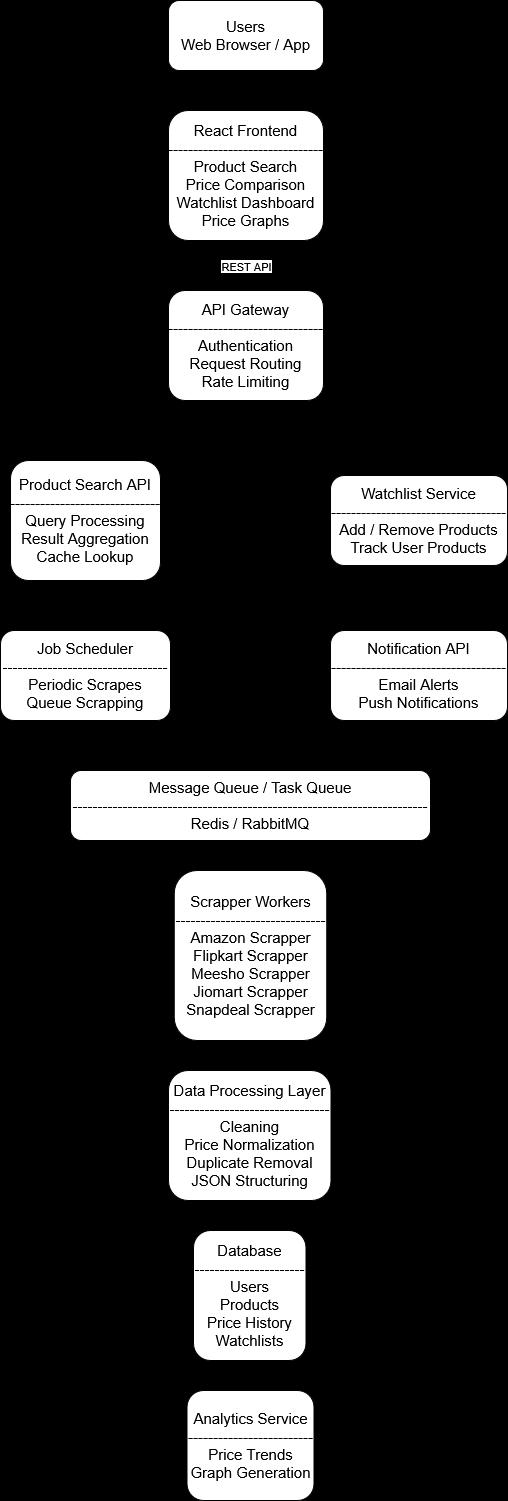
CostCurvesystemadherestoamodulardesignthatcanbe easily used to gather, process and display the price of products on various e-commerce sites. The architecture comprises of five major components, these include the userinterfacelayer, thelayer of backend service, the web scraping engine, the data processing module, and the database system. These elements are interconnected to provide the ability to track the prices of their products in realtime,comparethem,andnotifytheuser.
On the user interface level, there is a web-based frontend created with React that gives the user an interactive interface where they can search their products, compare prices across various e-commerce websites, and control their own watchlist. Price trends are also shown on the interface and the user can set prices limits on which notificationscanbeset.
The service layer of the system is the central control unit that is called the backend service layer. It is implemented on a Python-based API framework, accepting user requests, authenticating and coordinating communication between the frontend and scraping modules and the database. With the search of a product, the search engine activates the scraping engine and gathers the findings of variouse-commercewebsites.
The web scraping engine will gather the product information of various e-commerce websites in India like Amazon, Flipkart, Naaptol, JioMart, Meesho, and IndiaMART. Individual platforms are scraped with platform-specific modules in the form of libraries like Requests,BeautifulSoup,andSelenium.Thesemodulesare able to get major product characteristics such as product title, product price, product URL, product image link and productavailabilitystatus.
Dataiscollectedandtheinformationistransferredtodata processingandnormalizationmodule.Someofthetasksit executesincludenoisefiltering,pricenormalizationtoINR format, duplicate elimination and structuring of data. The steps will guarantee that the information gathered is consistent and reliable before it is stored or made availabletotheuser.
The processed data is then put into database layer where it stores the information about the product, historical price history and the watchlists of the users. The data storedisusefulinthevisualizationofhistoricalpricesand price-drop detection. Once the system realizes that a product price has gone below a set price limit set by the user,thealertsystemwillfiretoalerttheuser.
The modular design of CostCurve makes the system easy toscalebyaddingnewscrapingmodulesorincorporating more sophisticated analytics elements into the system in the future. Fig. 1 shows the architecture and data flow of theproposedsystemingeneral
International Research Journal of Engineering and Technology (IRJET) e-ISSN: 2395-0056
Volume: 13 Issue: 03 | Mar 2026 www.irjet.net p-ISSN: 2395-0072
The creation and incorporation of the CostCurve framework had a few remarkable results that indicated the viability and efficiency of a multi-platform producttracking and notification system in terms of e-commerce products.
DevelopmentofFrontendInterface:
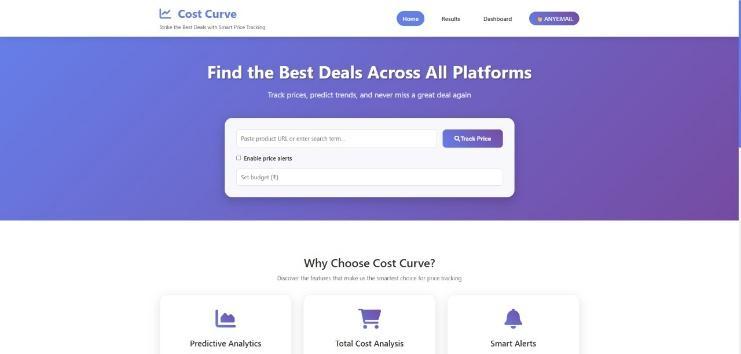
Fig. 2: FrontendofCostCurve
The creation of a fully functioning and responsive frontend to be built in React was developed successfully. The interface is comprised of the home page, product search module, user authentication pages and watchlist dashboard. The design is the focus, it is easy to use, minimalistic, and understandable so that one can find his/her way around the system without any trouble. The interface enables interaction with price-tracking features quicklyandthechoices beingmadeintermsoftheUI/UX proverightafterearlyusertesting.
WebScrappingonMultiplePlatforms
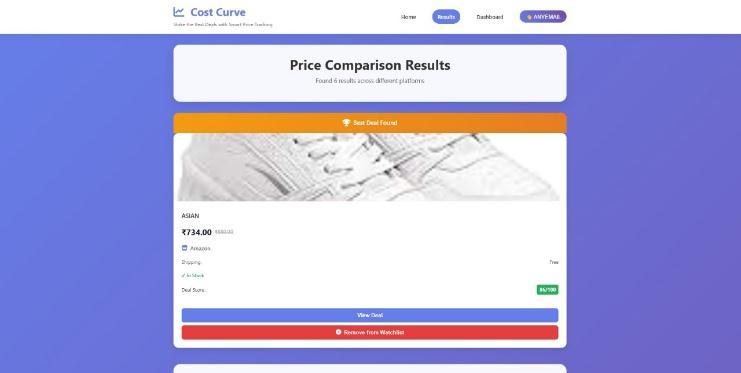
Fig. 3: PageAfterSearching
It managed to successfully implement the web-scraping engine with Amazon, Flipkart, Naaptol, Shopsy, JioMart, Meesho, and IndiaMART. Product important details such astitle,price,URLandimagearereclaimedbythescraper withahighdegreeofreliability.
International Research Journal of Engineering and Technology (IRJET) e-ISSN: 2395-0056
Volume: 13 Issue: 03 | Mar 2026 www.irjet.net p-ISSN: 2395-0072
The findings validate that the scraping functionality can work on a wide range of HTML structure, dynamic element, and platform-specific appearance. The system is capable of creating trusted product comparisons on-thefly,whichshowsagoodcross-platformcompatibility.
WatchlistandProductTrackingFeature:
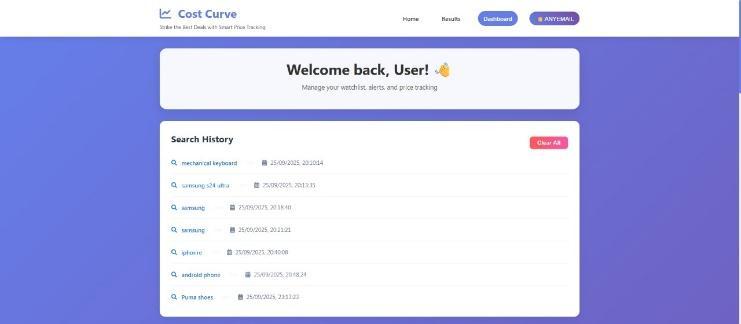
Fig. 4: WatchlistSection
A watchlist module has been implemented into the back end and front end. The users may add a product to their individual watch list where they can access and see the mostrecentpricevaluesofthetrackedproducts. Persistent tracking between sessions is made possible by this feature and the basis of future mechanisms of alerts. Initial internal errors indicate that watchlist retrieval is precise and up to date as new scraping outcomes have beencreated.
Aggregation of multi-results:
Thesystemcanconductmulti-platformsearcheswithonly a single query and compile the results in a common format. The scraper yields structured objects in the form ofJSONwhichcanbeusedtodisplaytheresultsuniformly withallthee-commercewebsites.
This demonstrates the practicality of building an unified price-analysis application without using platform API whichisusuallynarroworuncertified.
The test showed that the scraper has a good work performance of moderate loads and provides results in a few seconds, in most cases. Latency was experienced mainly on pages that were highly dynamic (e.g. Amazon), although we reduced these and used fallback parsing approachesandrotatinguser-agents.
Aggregated results were provided in real time to the frontend with no perceivable bottlenecks in the performance, which proves that the architecture of the system allows providing timely information updates and highinteractionrateswiththeuser.
ThefindingsconfirmthatCostCurveeffectivelyovercomes key limitations that were found in previous literature, including, but not limited to: absence of cross-platform tracking, no trend storage, and the inability to provide user-customizable functionality. The modular scraping engineandwatchlist-driventrackingsystemofthesystem are a good prerequisite to high-tech extensions, like the automated price-drop notifications, visualization of the historicaltrends,andpredictiveanalytics.
However, challenges remain. Certain sites can update the HTMLlayoutregularlywhichalsomeansthatscraperswill need to be maintained. Secondly, auto-detection of dynamicrenderingandanti-bottechniquesmayaffectthe success rate of scraping in the future, so future versions can be enhanced to allow headless browser support or API-basedintegrationwhenitexists.
Allinall,alltheappliedelementsconfirmtheveryidea of Cost Curve, and prove that it can be an effective device to enableconsumerstomakeinformedbuyingchoicesbased ondata.
The existingdeploymentof Cost Curvecreatesa powerful purpose of tracking prices on a multi-platform basis, but there are multiple developments that can substantially improve the technology and make it more usable. A potential opportunity involves automated delivery of price-drop notifications, such as email, SMS, or push, as well. With enabling users to specify individual threshold values, the system may send real-time notifications and minimize the necessity of conducting manual re-checks, which allows enhanced user engagement and more usefulness.
The other technological advancement that could occur is thestoringofthehistoricalpriceandrepresentationofthe trend. Use of a backend database to document the fluctuation in the prices at all times would enable generation of graphs that would show the overall longterm price trend. The visual analytics could also help the users identify the seasonal trend, approximate the reduction in the future and make superior purchasing decisions. Going into more details, the machine learning systems, such as LSTM or Prophet, can be instantiated to providepredictionsaboutthefuturefluctuationsofaprice andmaygiveforetermguidancetobuy.
The system too got the chance of being marked to deal with a broader range of e-commerce solutions, which includeinternationalmarketplaces.Thiswouldmakesure thatCostCurvewouldhavebeenimplementedonaglobal background and would strengthen on its competitive knowledge. In addition, scraper robustness might be
Volume: 13 Issue: 03 | Mar 2026 www.irjet.net p-ISSN: 2395-0072
improved through the use of browser automation, proxy rotation, and changing adoptions dynamically to enable it to be enhanced in dealing with anti-bot measures that wouldevolvewithtime.
On the user experience front future products can acquire extensions to the browser or mobile applications that would allow the user to monitor prices on the product pages.Theadditionofsocialfunctions,suchasthesharing oftrackeditemsorcommunityupdatedealstothem,may assist in even better keeping users. Finally, developing an analytics dashboard, which is used to monitor the behaviorofthescrapers,performanceofthewebsite,and trendaccuracywouldassistinmaintainingmaintainability inthelong-term.
Altogether, these would transform Cost Curve into an innovative price-tracking application, a detailed and intelligent price-analysis platform fearing to the future andwithrealtimeautomation.
The birth of Cost Curve indicates that one price tracking system can be developed successfully; it can be used to collect the information about products efficiently in different e-commerce systems. The key characteristics that the project had been able to roll out successfully comprise cross-platform search and real-time web scraping and a usable front-end with a working watchlist. All these are compound factors that will debate the key shortcomings that are experienced in the existing literature where most of the systems failed to integrate multi-platform use, centralized monitoring and tailored tracking.
Cost Curvehelpsto provide theusers withunproblematic access to the latest price information by means of the straightforward access to its modular system and the efficient scraping tools and templates create a strong foundation of data-driven decision-making in online purchases. The results disclose that the system applies uniformly across all the major marketplaces and offers a convenient and user friendly prototype to the customers whocanagreetothechangeinthepricesoftheproducts.
Though the current form is more concerned with data mining and delivery of basic user experience, the future scope of the work presupposes the saleable model of the future enhancement, which might involve the automated scouts of price drops, the graphic visualization of the historical progressions, and forecast analysis. With these upgradesinplace,CostCurvecanevolveitselftobecomea more comprehensive price intelligence solution that wouldallowuserstomake betterbuyingdecisionswithin amoredynamiconlinemarketplace.
[1] D. Parashar, R. Dixit, A. Dhami, A. Pratap, J. Ali, “Product Price Tracker,” International Journal of Advances in Engineering and Management (IJAEM) Volume5,Issue2Feb.2023,pp:01-03
[2] G.T.Cayabyab,R.E. Castillo,P.J.Castro,W.V.Ramos, “Price Watch: An Online Price Monitoring Mobile Application with Exponential Smoothing for AgribusinessandMarketingAssistanceService”
[3] D.Khairkar,S.Dambhare,O.Gupta,V.Thakre,N.Raut, S.N. Dagakar, “E-Commerce Product Price Tracker usingDynamicPricingAlgorithm”
[4] Varun Pilakavil, Hitesh Chaudhari, Pratik Khedekar, Aniket Deotale, Jameer Kotwal, “Real Time Product Price Monitoring & Analysis Application for ECommerceWebsites”
[5] Marcin Nowak * and Marta Pawłowska-Nowak, “DynamicPricingMethodintheE-CommerceIndustry UsingMachineLearning.”
[6] Xiaoping Xu, Yuting Wang, T.C.E. Cheng, Tsan-Ming Choi, “Dynamic Pricing Model of E-Commerce PlatformsBasedonDeepReinforcementLearning”.
[7] Sentao Miao, Xi Chen, Xiuli Chao, Jiaxi Liu,Yidong Zhang, “Context-Based Dynamic Pricing with Online Clustering”
[8] Nitin Sakhare, Devika Verma, Vikas Kolekar, Avinash Shelke, Akhilesh Dixit, Nikhil Meshram, “E-Commerce Product Price Monitoring and Comparison using SentimentAnalysis.”
[9] M.Anitha,T.Anusha,SK.Fathimabi,P.DurgaSowmya, N. Preethi, “Real-Time Product Price Scraping and Analysis”
[10] D.C.Montgomery,“Cross-PlatformPriceComparison SystemUsingPythonScraping(2022)”
[11] MuneebIqbal,FaizanHamayat,RanaFayyazAhmad, Syed Khursheed Husnain, “A MachineLearning-Based Framework for Predicting E-Commerce Product Ratings”
[12] Olamilekan Shobayo, “Innovative Sentiment Analysis andPredictionofStockPrice”
[13] M Premkuma, S. R Ashokkumar, S Anupallavi, Dhamodharan Srinivasa, K Prem, Ajmeera Kiran, “AI based strategic decision framework for precise ecommerceapplications”
International Research Journal of Engineering and Technology (IRJET) e-ISSN: 2395-0056
Volume: 13 Issue: 03 | Mar 2026 www.irjet.net p-ISSN: 2395-0072
[14] “Dynamic Web Scraping for E-Commerce Analytics (2022)”
[15] “Mobile Price-Drop Alert App with Cloud Backend (2023)”