
International Research Journal of Engineering and Technology (IRJET) e-ISSN: 2395-0056
Volume: 13 Issue: 03 | Mar 2026 www.irjet.net p-ISSN: 2395-0072
International Research Journal of Engineering and Technology (IRJET) e-ISSN: 2395-0056
Volume: 13 Issue: 03 | Mar 2026 www.irjet.net p-ISSN: 2395-0072
P.P. Sawant1 , Rudresh Atmaram Padate2 , Gunjan Dilipraj Dhuri3 , Aryan Vaibhav Asolkar4 , Tanishka Gurudas Gawas5 , Tanisha Gurunath Bange6
Department of civil engineering, Yashwantrao Bhonsale Polytechnic, Sawantwadi, Sindhudurg, Maharashtra
Abstract - Filler slab is an innovative and economical roofing technique used inbuilding construction to reduce the consumption of concrete and steel without compromising structural performance. The basic concept of filler slab technology is the replacement of concrete in the tension zone of the slab with lightweight filler materials such as clay tiles, bricks, terracotta pots, or other locally available materials. Since concrete in the tension zone contributes little to structural strength, replacing it with filler materials helps reduce dead load and construction cost. This paper presents theconcept,materials,methodology,andbasiccalculationsof a filler slab model and highlights its economic and environmental advantages.
Key Words: Filler Slab, Sustainable Construction, RCC Slab, Low-Cost Housing, Concrete Reduction
1. INTRODUCTION
Concrete is one of the most widely used construction materials in the world. Conventional reinforced cement concrete(RCC)slabsconsumelargequantitiesofcementand steel, increasing the weight and cost of buildings. A large portionofconcreteinslabsliesinthetensionzonewhereit contributes little to structural strength. Filler slab technology replaces this unnecessary concrete with lightweightfillermaterials.Thistechniquereducesthedead loadofthestructure,lowersconstructioncost,andimproves thermalinsulationwhilemaintainingstructuralsafety.
1. In a small town, builders noticed that every new house used thick, heavy concrete slabs that consumedalotofcementandsteel,makinghomes expensiveandstructuresunnecessarilyheavy.
2. Werealizedthatmuchoftheconcreteintheseslabs wasn’t even doing any real work it just added weightwithoutcontributingtothestrengthofthe building
3. As prices of cement and steel increased, homeowners struggled to afford strong yet economical roofs. Builders started searching for waystoreducecostswithoutcompromisingsafety.
4. Webecameawarethatexcessiveuseofcementalso harms the environment by increasing carbon
emissions,yetsustainablealternativeswererarely used.
5. ThisledtotheideaofusingFillerSlabs,wherewaste or local materials could replace unnecessary concrete, reducing cost, saving resources, and creatingeco-friendlybuildings.
1. Theprojectstudiesthedesignandconstructionofa fillerslabasanalternativetoaconventionalRCCslab.
2. The project focuses on reducing concrete in the tensionzonewithoutaffectingstrength.
3. Itincludestheselectionofsuitablefillermaterialslike claytiles,pots,orlightweightblocks.
4. Cost estimation and comparison with normal slabs arepartofthestudy.
5. The project evaluates savings in cement, steel, and overallconstructioncost.
6. It examines environmental benefits by promoting eco-friendlymaterials.
1. Toreduceconstructioncostbyminimizingtheuseof concreteinthetensionzoneoftheslab.
2. To maintain structural strength and safety while usingalternativefillermaterialslikeclaytilesorpots.
3. Topromotesustainableandeco-friendlyconstruction byusinglocallyavailableandlow-energymaterials.
4. Tostudyandcomparetheperformanceoffillerslab with conventional RCC slab in terms of strength, economy,anddurability.
2. LITERATURE SURVEY
2.1 Design and Analysis of Filler Slab Using Terracotta Fillers
Author: Janmesh Bhoir, Prathamesh Ade, Kuwar Gupta, AdityaLokaret,JesslyRajan.
Published on: 08/08/2023
International Research Journal of Engineering and Technology (IRJET) e-ISSN: 2395-0056
Volume: 13 Issue: 03 | Mar 2026 www.irjet.net p-ISSN: 2395-0072
In the gracefully developing industry of construction,thecostoftheprojectplaysanimportantrole, whichismainlydeterminedbytheconcrete.Toreducethe quantityofconcretewithoutcompromisingtheStrengthof concrete,fillerslabtechnologyhasbeenused.Theprimary ideabehindemployingfiller-slabTechnologyistodecrease the amount of concrete in the tension zone, as not all concreteinthiszonecontributestothetensileproperties. Instead,lightweight,inert,andinexpensivefillermaterials are utilized to replace this non-contributing concrete, withoutcompromisingthequalityandstructuralstabilityof the building. In the design of a two-way slab, the filler materialispositionedbetweenthereinforcementspacing, ensuringadequatecover.Terracottapotsareusedasfiller materials Overall, filler slabs offer a cost-effective and sustainablealternativetotraditionalsolidslabconstruction, withseveralbenefitssuchasimprovedthermalinsulation, aestheticappearance,andreducedenvironmentalimpact.
Author: AdityaSainath,SangeetaDas
Published on: 01/08/2020
Thewholeweightofthebuildingistakenawayby theself-weightofthereinforcedconcrete.Inordertoreduce theusageofconcreteandtheself-weightofslabs,theusually preferredslabsarevoidedslabsorhollowslabs.Suchslabs have benefits such as reduced weights, longer spans, reducedfloor-to-floorheights,etc.Costreductionsinroofs/ floorsaregainedthroughthechoiceoffillingapartofthe concreteinthetensionzonewithcheapermaterials.Inthe context, with the use of waste material in building constructionandsolvingitsdisposalproblem,atechnology has been developed at the Central Building Research Institute (CBRI), Roorkee, India, to build reinforced floor/roofslabwithmultiplematerialsasfillermaterial.This paper discusses about the benefits of a filler slab when comparedtoaconventionalslab,consideringtheparameters of thermal performance and materials, construction techniqueandacousticalbenefits.
Author: Harshal Khandekarl, Tanmay Khamkar, Rahul Bagu,MayankPawar,Prof.K.H.Ghorpade
Published on: 02/06/2023
Lightweightstructuralcomponentscalledfillerslabs areutilizedinbuildingconstruction,particularlyforroofing applications.Contrarytotraditionalsolidslabs,fillerslabs usenon-structuralfillersinthelowestpartoftheslab,such as lightweight aggregates or waste materials. While preservingstructuralintegrityandload-bearingcapability, thisdesignmaximizestheuseofconcrete.Theinvestigation ofalternativetechnologieshasbeenpromptedbytherising need for eco-friendly and affordable roofing solutions. A possiblemethodforbuildingroofsthatarebothinexpensive
andenvironmentallyfriendlyisthefillerslab,whichisone such invention. As an alternative to conventional roofing technology,infillslabsaredescribed.
2.4 A Review on “To examine and compare filler slab technique and rat trap bond as an alternative low-cost construction technology”
Author: SiddhantN.Bhagat,SnehaS.Sawant.
Published on: 10/06/2022
Indiaisadevelopingcountrywithonly20%ofthe highest paid group. Affordable housing can be considered affordableforalow-ormiddle-incomepersonifthefamily cangetaunitofhousingforupto30%ofthefamilyincome. Thelow-incomegroupofdevelopingcountriesoftendonot haveaccesstothehousingmarket.Affordablehousingisa related and closely related budget and seeks to reduce constructioncoststhroughbettermanagement,efficientuse oflocalresources,skillsandtechnologieswithoutsacrificing theenergyandhealthofthebuilding.The“RatTrapMouse andFillerSlab”approachcanbeappliedtoahousingproject toachievecosteffectivenessandstructuralstabilitywithout compromisingthestrengthanddurabilityofthesystem.In this project, we work on Rat Trap Bond and Filler Slab Conceptforanalternativelow-costconstructionmaterial.It wasanalysedinthiscasestudyofAjniintheNagpurdistrict ofMaharashtra.
Author: MahanandaRK,VikasMendiandRaveeshRM.
Published on: 2020
Filler slab technology is an innovative and costeffective technology where the dead load of the slab is reducedbyreplacingtheconcretewithfillermaterial.The conceptbehindtheuseoffiller-slabtechnologyistoreducea substantialportionofconcreteinthetensionzone,sinceall theconcreteinthetension zonecontributestothetensile properties.Thisconcreteisreplacedwithlightweight,inert andinexpensivefillerwithoutcompromisingthequalityand structural stability of the structure. A two-way slab is designed; the filler blocks are placed between the reinforcementspacingbyprovidingacoverof20mm.The fillermaterialsaregranitedustandfoundrysand.Thisfiller slabisanalysedusingSTAAD.RoandANSYSsoftware.Filler slabiscomparedwiththeconventionalslabofthesamesize. This study describes the Structural behavior and cost effectiveness of the filler slab when compared to the standardslab.
International Research Journal of Engineering and Technology (IRJET) e-ISSN: 2395-0056
Volume: 13 Issue: 03 | Mar 2026 www.irjet.net p-ISSN: 2395-0072
3.1PRACTICAL METHODOLOGY FOR THE PROJECT
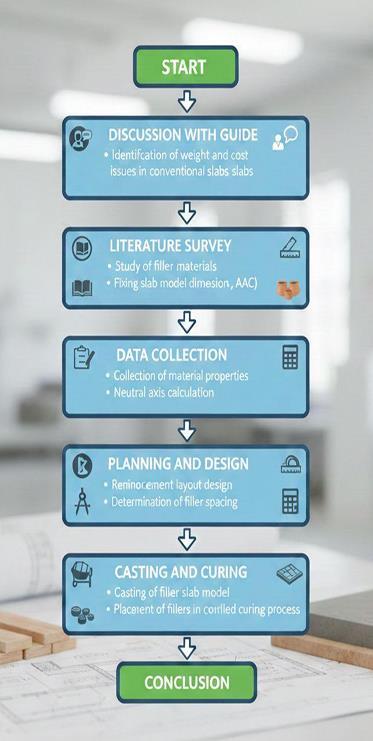
Themethodologyofafillerslabmodelinvolvesstudying the structural concept, preparing the slab design with proper reinforcement detailing, and identifying the tension zone where concrete can be replaced with lightweightfillermaterialssuchasclaytilesorpots.In the model, reinforcement bars are arranged as per design, filler materials are placed between them, and concrete(orplasterforthemodel)ispouredandcured properly.Thefillerslabismainlyusedinresidentialand low-costhousingprojectstoreducetheconstructioncost anddeadloadofthestructure.Itsnecessityarisesfrom the need to eliminate unnecessary concrete in the tension zone, reduce material consumption, promote eco-friendlyconstruction,andachieveaneconomicalyet structurallysaferoofingsystem.
3.3
1.Cement–Forpreparingconcreteorplastermix.
2.FineAggregate(Sand)–Usedinconcretemix.
3.CoarseAggregate–Forconcretepreparation(optional insmallmodels).
4.Water–Formixingandcuring.
5. Steel Bars (Reinforcement rods) – Main bars and distributionbars.
6.BindingWire–Fortyingreinforcementbars.
7.Claytiles/Claypots/Terracottablocks–Placedin tensionzonetoreduceconcreteusage.
8.Plywood/ThermocolSheet–Baseplatform.
9.FevicolorAdhesive–Forfixingpartsinthemodel.
10.Measuringscale,cutter,andsmalltools–Forshaping andalignment.
BasePreparationUseaflatplywoodorthermocolsheet as the base of the model to provide stable support for the slab.
EdgeShutteringFixsmallthermocolorcardboardstrips along the edges to create the boundary of the slab and maintainitsthickness.
Levelling and Alignment Check the base and side shuttering to ensure the surface is level and the slab thicknessisuniform.
SurfacePreparationApplyathinlayerofoil,vaseline,or adhesive sheet on the base to prevent plaster or model concretefromsticking,allowingeasyremovalaftercuring.
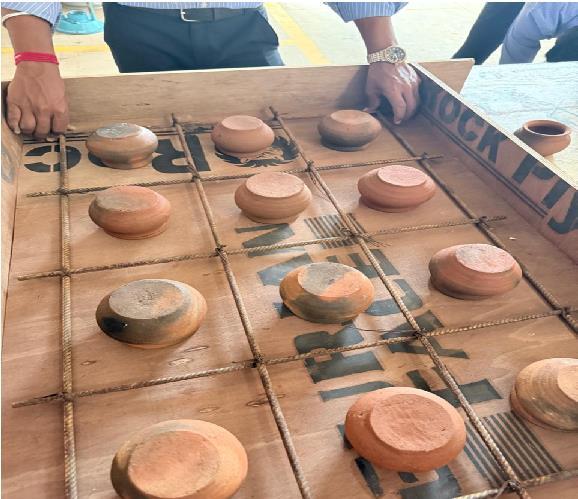
CuttingandBendingBarsCutsmallsteel rodsorthin wires according to the slab dimensions and bend them as requiredtoformthemainanddistributionreinforcementfor themodel.
Placing Main Reinforcement Position the main bars along the length of the slab, keeping proper spacing to simulateactualstructuralreinforcement.
Placing Distribution Bars Place smaller bars perpendiculartothemainbars,tyingthemtogetherwiththin bindingwireoradhesivetomaintainstability.
International Research Journal of Engineering and Technology (IRJET) e-ISSN: 2395-0056
Volume: 13 Issue: 03 | Mar 2026 www.irjet.net p-ISSN: 2395-0072
EnsuringProperCoverMaintainasmall gapbetween reinforcementandbase(usingsmall spacersorcardboard pieces)tosimulateconcretecoverandpreventdirectcontact withthebase.
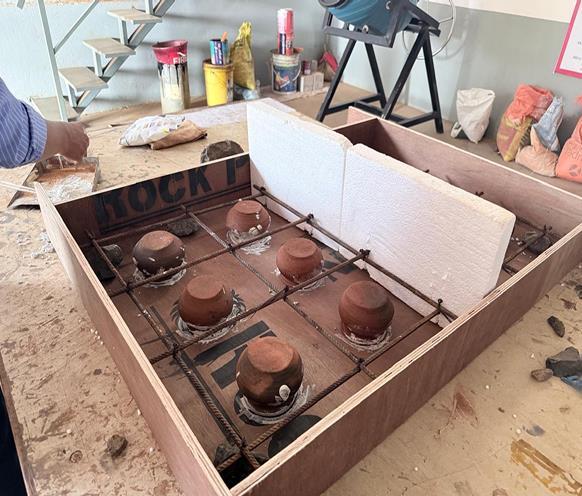
-2:ArrangementDetailsforFillerSlabs
PreparingConcrete/PlasterMixForthemodel,prepare a small quantityofcementandsandmix(1:2or1:3ratio) withwatertoachieveasmooth,pourableconsistency.
PlacingFillerMaterialsArrangetheclaytiles,claypots, or other filler materials in the tension zone between the reinforcementbarsbeforepouringtheconcrete/plaster.
PouringtheMixCarefullypourthepreparedmixover thereinforcementandfiller,fillingallgapsandensuringthe mixsurroundsthefillersandbarsproperly.
CuringtheSlabModelKeepthemodelmoistbycovering itwithawetclothorsprayingwaterfor7–10days(oruntil plastersets)toallowpropercuringandpreventcracks.
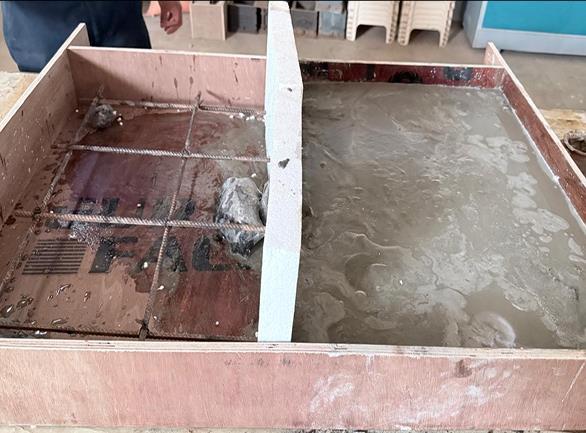
SurfaceLevellingAftercuring,removeanyunevenspots on the top surface of the model using a small trowel or sandpapertomakeitsmoothanduniform.
EdgeFinishingTrimorsmooththeedgesoftheslabto matchthedimensionsandremoveanyexcessmaterialfrom theformwork.
Surface Polishing Lightly polish the surface using sandpaper or a soft brush to improve the appearance and demonstrateafinishedlookforthemodel.
Final InspectionCheck theslab forcracks, alignment, andproperplacementoffillersandreinforcement,ensuring the model accurately represents the actual filler slab construction.
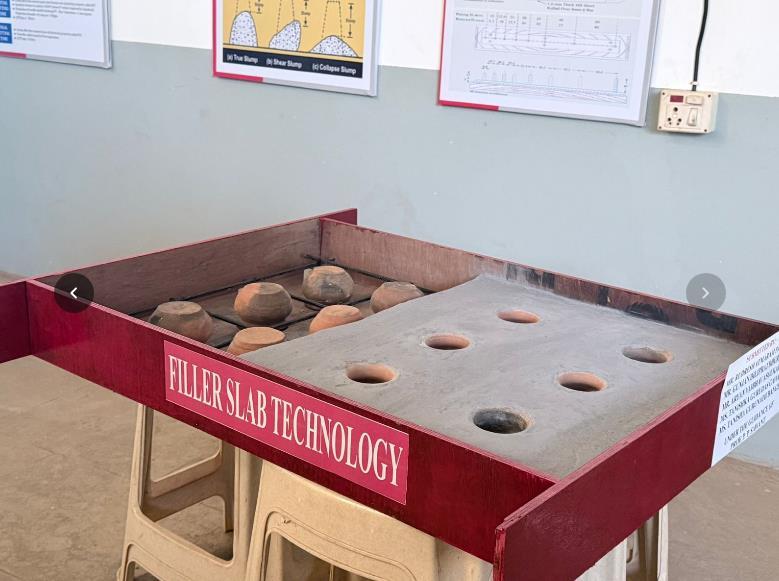
1. Slab Dimensions & Volume Summary
Tofindthetotalvolumeoftheslab,thefollowingstepswere taken:
1. Unit Conversion
Theinitial dimensionsinfeetwereconvertedtometersto standardizethecalculation: Length: 2ft=0.61m Width: 1.5tft=0.46m
2. Area Calculation
Thesurfaceareaoftheslabisdeterminedbymultiplyingthe lengthandwidth: Area=0.61*0.46=0.28m2
3. Volume Calculation
Usingtheassumedslabthicknessof 75 mm (0.075m), thetotalvolumeis: Volume=Area*Thickness
Volume=0.28*0.075=0.021m3
International Research Journal of Engineering and Technology (IRJET) e-ISSN: 2395-0056
Volume: 13 Issue: 03 | Mar 2026 www.irjet.net p-ISSN: 2395-0072
2. Volume Reduction by Pots
Assume regular pot diameter = 100mm (0.1 m) and height =70mm(0.07m)
Volume of one pot:
V=πr2h
V=3.14*(0.05)2 *0.07
V=0.00055m3
For 6 pots: 6*0.00055=0.0033m3
3. Concrete Volume Required
Subtracting the volume of the pots from the total slabvolume:
Concrete =0.021-0.0033
Concrete=0.0177m3 approx.0.018m3
4. Concrete Material Quantity
Assume M20 mix: (1:1.5:3) →TotalParts=5.5
Dry volume factor: 1.54
Dry Volume Calculation:
Dryvolume=0.018*1.54=0.0277m3
Cement Calculation:
1/5.5*0.0277=0.0050m3
Standard cement bag volume: 0.035m3 Cement=0.14bagsapprox.7kg
5. Steel Quantity (8 mm bars)
Assumegridspacingof 150 mm
Bars along 2 ft direction:
0.61/0.15approx.4bars
Lengthperbar=0.46m
Total length: 4*0.46=1.84m
Bars along 1.5 ft direction:
0.46/0.15approx.3bars
Lengthperbar=0.61m
Total length: 3*0.61=1.83m
6.Total Steel Weight
Total Steel Length:
1.84+1.83=3.67m
Weight of 8 mm bar:
Weight/m=d2/162
Weight/m=82/162=0.395kg/m
Final Steel Weight:
3.67*0.395=1.45kg approx.1.5kgsteel.
4. CONCLUSIONS
Cost-Effectiveness and Viability: The studies conclude that filler slab technology is a costeffective and viable alternative to traditional construction methods. It is an ideal solution for affordable housing, especially in developing
countries where reducing material costs is a priority.
Structural Integrity: Thestructuralstrengthofa filler slab is nearly the same as that of a conventionalRCCslab.Byreplacingconcreteinthe tension zone where it contributes little to strength the slab maintains its load-bearing capabilitieswhilesignificantlyreducingdeadload.
Material and Economic Savings: From an economic standpoint, the technique saves approximately30%ofconcreteconsumption.This reductionincementandsteelrequirementsresults inasignificantdecreaseintheoverallprojectcost withoutsacrificingquality.
Enhanced Thermal and Acoustic Properties:
Beyondstructuralsavings,fillerslabsimprovethe building'sinternalenvironmentbyprovidingbetter thermal insulation and acoustical benefits comparedtosolidslabs.Thismakesthetechnology particularlysuitableforcreatingcomfortableliving spacesinvariousclimates.
Environmental Sustainability: Theuseoflocally available,low-energy,orwastematerialsasfillers promoteseco-friendlyconstruction.Byminimizing theconsumptionofcarbon-intensivecement,filler slabtechnologyservesasasustainablealternative thatreducestheoverallenvironmentalfootprintof thestructure.
5. FUTURE SCOPE
1. Use of Alternative Eco-Friendly Materials
Future filler slabs can use recycled or industrial waste materialslikeplasticbottles,flyashbricks,coconutshells,or polystyreneblockstofurtherreduceenvironmentalimpact.
2. Lightweight and Low-Cost Construction
Fillerbeamsandslabswillcontinuetobeusedinlow-cost housingand rural projectsto minimizeconcreteandsteel consumption,reducingdeadloadandconstructioncost.
3. Integration with Sustainable Building Practices
Withgreenbuildingcertificationsbecomingcommon,filler beams can contribute to energy efficiency, thermal insulation, and lower carbon footprints in modern structures.
4. Technological Advancements in Design
Advanced structural software can optimize filler beam designsforhigherspans,loadbearingcapacity,andhybrid materials,makingthemmoreefficientforcommercialand residentialprojects.
5.Urban and Disaster-Resistant Applications
Filler beams can be adapted for earthquake-resistant or modularconstruction,especiallyinareaswherelightweight, strong,andeconomicalstructuresareneeded.
International Research Journal of Engineering and Technology (IRJET) e-ISSN: 2395-0056
Volume: 13 Issue: 03 | Mar 2026 www.irjet.net p-ISSN: 2395-0072
5. Educational and Research Use
Fillerslabandbeammodelswillcontinuetobevaluablein civil engineering education and research for studying sustainableconstructiontechniquesandmaterialefficiency.
It is with great pleasure and heartfelt gratitude that we expressoursincereappreciationtoourprojectguide,Prof.P. P. Sawant Sir, for his valuable technical guidance, unwaveringsupport,andeffortsthroughoutthecompletion ofthisproject.Hisexpertiseandencouragementhavebeen trulyInstrumentalinshapingourwork.
1. T.S.Varghese,J.P.Shaj,2013.BehaviourofRCFiller Slabs with Aerobic Microbial Bricks in RC Filler Slabs.
2. A. Madhumathi, S. Radhakrishnan, and R. Shanthi Priya, 2014. Sustainable Roofs for Warm Humid Climates.
3. Mr. Amit D Chougule, Mr. Manoj H. Mota, and Dr. Mrs.UshadeviSPatil,2015.Tostudythefillerslab asanalternativeconstructiontechnology.
4. 4.S.Sundari,S.Sukumar,2016.Studyonfillerslab usingself-compactingconcretewithterracottapots as filler. From "Benefits of Filler Slab over R.C.C Slab": Study of propertiesof concretemadeusing Recycled aggregate and Industrial waste with specialapplicationtohousing,Chapter-9
5. MR.AmitDChougule,M R.ManojH.Mota,DR.MRS. Ushadevi S Patil "To study the filler slab as alternativeconstructiontechnology-Areview" Deepika Dinesh "Study on Flexural Behaviour of RCCSlabFilledwithHollowRoofingTiles."
BIOGRAPHIES


P.P. Sawant1
Head of the Department, Department of civil engineering, YashwantraoBhonsalePolytechnic, Sawantwadi,Sindhudurg, Maharashtra
Rudresh Atmaram Padate2
FinalYearStudent,Departmentof civil engineering, Yashwantrao BhonsalePolytechnic,Sawantwadi, Sindhudurg,Maharashtra




Aryan Vaibhav Asolkar4
FinalYearStudent,Departmentof civil engineering, Yashwantrao BhonsalePolytechnic,Sawantwadi, Sindhudurg,Maharashtra
Gunjan Dilipraj Dhuri3
FinalYearStudent,Departmentof civil engineering, Yashwantrao BhonsalePolytechnic,Sawantwadi, Sindhudurg,Maharashtra
Tanisha Gurunath Bange6
FinalYearStudent,Departmentof civil engineering, Yashwantrao BhonsalePolytechnic,Sawantwadi, Sindhudurg,Maharashtra
Tanishka Gurudas Gawas5
FinalYearStudent,Departmentof civil engineering, Yashwantrao BhonsalePolytechnic,Sawantwadi, Sindhudurg,Maharashtra