
International Research Journal of Engineering and Technology (IRJET) e-ISSN: 2395-0056
Volume: 12 Issue: 08 | Aug 2025 www.irjet.net p-ISSN: 2395-0072
International Research Journal of Engineering and Technology (IRJET) e-ISSN: 2395-0056
Volume: 12 Issue: 08 | Aug 2025 www.irjet.net p-ISSN: 2395-0072
Shahmir Khan1 , Muhammad Hussain Khan2 , Prof. Dr R.P Singh Kushwah3
1PG student M-tech Structural Engineering, Chhatrapati Shivaji Maharaj University, Maharashtra, India
2 Independent Researcher, Maharashtra, India.
3 Professor Dept. of Civil Engineering, Chhatrapati Shivaji Maharaj University, Maharashtra, India.
Abstract - This study carefully compares Prestressed Concrete (PSC) and Ultra-High-Performance Concrete (UHPC) girders for a 30-meter simply supportedspan. The maingoalis to assess how each material affects the size requirements and the related costs under typical bridge loading conditions. This evaluation provides a solid base for engineeringprofessionals, giving them useful data to guide important designchoices. The research looks at the trade-offs of each material option, offering practical advice for choosing the best one. By matching a project's specific size and budget needs with the insights given, this study aims to help with making smart material choices for bridge superstructure design.
Key Words: Comparative Analysis, Economic Feasibility, Bridge Superstructure, Prestressed Concrete (PSC), UltraHigh-PerformanceConcrete(UHPC),Girder.
1.INTRODUCTION
Bridge infrastructure is fundamental to transportation networks,requiring designs thatbalancesafety, economy, anddurability.Thisstudypresentsacomparativeanalysis betweentwodistinctmaterial technologiesfora standard 30-meter simply supported I-girder: conventional Prestressed Concrete (PSC) and innovative Ultra-HighPerformanceConcrete(UHPC).PSCisaprovenworkhorse, valuedforitsreliabilityandcost-effectivenessinachieving long spans through pre-compression. Conversely, UHPC offers exceptional strength and durability, enabling more slender, lightweight designs with potentially enhanced longevity. This research evaluates both systems under identicalloadingconditions,focusingoncriticalperformance metricsincludingflexuralandshearcapacity,serviceability deflection, crack resistance, and material efficiency. The objectiveistoprovideaclear,practicalcomparisonoftheir structuralbehavior,movingbeyondtheoreticaladvantages toassesstangibletrade-offs. Ultimately,thiswork aimsto deliver actionable insights for engineers, supporting informedmaterialselectioninpursuitofmoreefficientand sustainablestructuralsolutions.
Thecoreobjectiveoftheresearchistoconductacomparative structural assessment of Prestressed Concrete (PSC) and Ultra-High-PerformanceConcrete(UHPC)girdersfora30meter simply supported span. This analysis focuses on evaluating the influence of each material on dimensional
requirementsandcostimplicationsunderstandardbridge loading conditions. The aim is to provide a valuable frameworkforengineerstomakeinformeddesigndecisions byaligningproject-specificgeometricandbudgetaryneeds withdetailedtechnicalandeconomicinsights.
1.Syed Sofiya et al. (2023) Thisstudyuses STAAD.Proto compare RCC and PSC T-beam girders for a 50m bridge. Results show the PSC girder is superior, with significant reductions in bending moment (32.91%), shear force (18.18%),anddeflection(13.22%).
2.Yang Hang (2022) This review analyzes the interface betweenUHPCandnormalconcrete(NC).ItfindstheUHPCNCbondhasexcellentmechanicalanddurabilityproperties, far exceeding NC-NC interfaces, due to UHPC's fibers and treatment.
3.Prashansha Sanjay Jaiswal et al.(2021) Amanualdesign studyfora30mspanshowsPSCgirdersrequiredrastically lessmaterialthanRCC:167.67%lesssteeland46.52%less concrete,provingitseconomicandstructuralefficiency.
4.Govind H. Dake et al. (2021) Thispaperexploresusing granitedusttoimproveconcreteproperties.Addinggranite dust increases strength, reduces porosity and water absorption,andenhancestheoveralldensityanddurability oftheconcrete.
5.Sharma Debraj et al. (2021) Thispracticalpaperdetails the construction of precast PSC I-girders, covering mix design,cableprofiling,andpost-tensioningproceduresasper Indian codes, providing valuable on-site implementation data.
6.Murugan M et al. (2020) ThisreviewhighlightsUHPC's exceptionalstrength(>150MPa)anddurabilitybutnotesits high cost in India. It concludes that despite the initial expense, UHPC offers long-term benefits from a longer lifespanandreducedmaintenance.
7.Rahul Gangwar et al. (2020) ASTAAD.Proanalysisacross spans(20m-30m)findsPSCgirdersaremoreeconomicalfor spans over 25m,offeringa 17%cost savingat that length, whileRCCissuitableforshorterspans.
International Research Journal of Engineering and Technology (IRJET) e-ISSN: 2395-0056
Volume: 12 Issue: 08 | Aug 2025 www.irjet.net p-ISSN: 2395-0072
Rohan Rajendra Bagade et al. (2020) Thisreviewpaper synthesizesfindingsfrommultiplestudies,concludingthat PSCgirdersarerecommendedforspansgreaterthan25m duetobetterperformanceandeconomy,whileRCCisfitfor shorterspans.
Rajani A et al. (2019) Acode-baseddesigncomparisonfora 10m beam shows PSC sections require 82.7% less main reinforcement and have a shallower depth than RCC, demonstratingsuperiorsectionalefficiency.
Ayush Tiwari & Dr. Sudhir S. Bhadouria (2017) A cost analysis using PWD rates finds PSC girders are more economicalthanRCCforspansfrom30-40m,withsavings increasingwithspanlength(upto~₹49lakhat40m).
3. METHODOLOGY
Thisstudypresentsacomparativestructuralassessmentof Prestressed Concrete (PSC) and Ultra-High-Performance Concrete (UHPC) I-girders, modeled as simply supported elements,formodernbridgesuperstructures.
3.1 Span and Girder Geometry
Theanalysisfocusesonaspanof30 m,withbothPSCand UHPC girders designed as simply supported beams. The cross-sectional dimensions were iteratively optimized to satisfystructuralrequirements,includingbendingandshear resistance, deflection and cracking limits, and material efficiencythroughreducedself-weight.Initialgirderdepths wereselectedbasedonstandardcodalprovisions(L/18for PSC and L/25 for UHPC) and revised during the design process.
3.2 Design Philosophy and Standards
BothgirdersweredesignedfollowingtheLimitStateDesign approach, ensuring adequate safety at the Ultimate Limit State (ULS) and satisfactory service performance at the ServiceabilityLimitState(SLS).
PSCgirderdesign:IS1343:2012andIRC:112-2020
UHPCgirderdesign:fibModelCode2010
Loadcombinations:IRC6:2017
Windloads:IS875(Part3)
Seismicloads:IS1893(Part1)
3.3 Material Properties
The design used conservative values for UHPC to ensure reliability:
PSC Girder (M60 Concrete):
Concrete:fck =60 MPa,density=25 kN/m³,Ec =30 GPa
Prestressing steel: 15.2 mm strands, fpu = 1,862 MPa, Ep = 195 GPa
Reinforcement:Fe500,fy =500 MPa,Es =200 GPa
UHPC Girder: The UHPC girder is designed using M170 gradeconcretereinforcedwith2%steelfibresbyvolume. MaterialpropertiesareadoptedfromYang(2022)[2].The keycharacteristicsareasfollows:
Concrete: Characteristic compressive strength (fck) = 170 MPa,tensilestrength(fct)=8 MPa,density=25 kN/m³, ModulusofElasticity(Ec)=50 GPa.
SteelFibres:2%byvolume,providingaflexuralstrengthof approximately30 MPaandruptureenergyof~20 kJ/m².The concreteisself-compactingandhighlyflowable.
Reinforcement: Fe500 grade steel, yield strength (fy) = 500 MPa,ModulusofElasticity(Es)=200 GPa.
Noprestressingapplied
3.3 Load Calculations and
DesignloadswereappliedinaccordancewithIRC6:2017, comprisingdeadload(DL),superimposeddeadload(SIDL), live load (LL),wind load (WL), and seismic load (SL). The self-weightandSIDLwerecomputedbasedonthegirderand deckgeometry,whileliveloadswereconsideredasperIRC Class A. Wind and seismic effects were evaluated in both transverse and longitudinal directions, accounting for equivalent uniformly distributed loads (UDLs) and uplift forces.
Table-1showstheresultoftheanalysisdone.
Table -1: ComparativeResults
Comparative:PSCvs.UHPCI-Girder
Parameter PSC Girder UHPC Girder Remarks
Material Properties
Compressive Strength 60MPa 170MPa
Tensile Strength 4.7MPa 8MPa (matrix)+ fiber bridging
Modulusof Elasticity 35GPa 50GPa
Girder Dimensions
Depth 1.8m 1.2m
UHPChas ≈183%higher strength
UHPCoffers superiorcrack resistance
UHPCisstiffer
UHPCis34% shallower
International Research Journal of Engineering and Technology (IRJET) e-ISSN: 2395-0056
Volume: 12 Issue: 08 | Aug 2025 www.irjet.net p-ISSN: 2395-0072
CrossSectional Area 0.778m² 0.497m²
Self-Weight 19.45 kN/m 12.425 kN/m
Loads
ULSMoment (NonSeismic) 10,710 kNm 9,703kNm
Ultimate Moment Capacity 13,480 kNm 9,700kNm
Crack Control Prestressdependen t Fibercontrolled (≤0.05mm)
Cost (Per Girder) ₹ 4,75,295 ₹18,07,590
Cost Per Meter ₹15,843 ₹60,253
Life-Cycle Cost Higher (mainten ance) Lower (minimal maintenanc e)
UHPCuses36% lessconcrete
UHPCis36% lighter
UHPChaslower momentdueto lessself-weight
PSChashigher capacitydueto prestressing
UHPCoffers bettercrack control
UHPCis≈3.8× moreexpensive initially
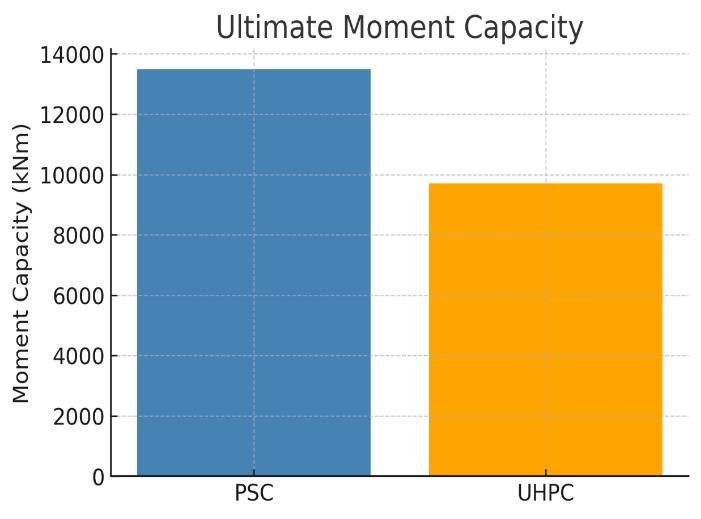
-2:ComparativeGraphshowingUltimatemoment capacity.
UHPCismore economical long-term
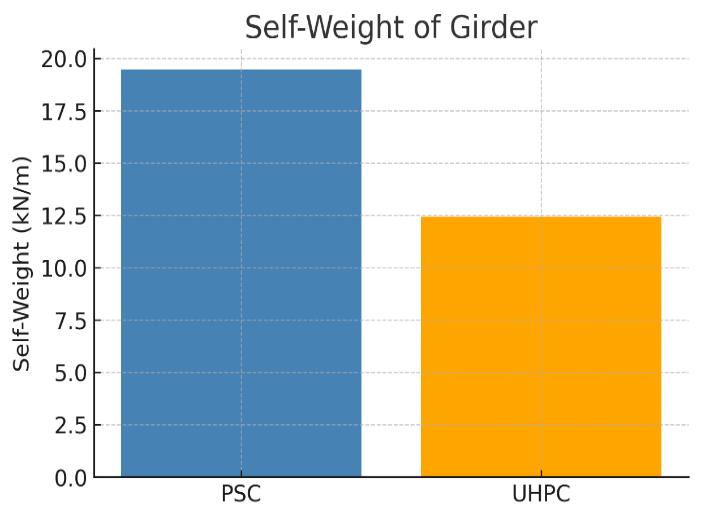
Graph -1:ComparativeGraphshowingSelf-weightof Girder
UHPC’ssmallercross-section(0.497m²vsPSC’s0.778m²) reducesitsself-weightby~36%.
Thishasabigadvantageforbridgesupportsandfoundations sincelowerdeadloadreducespierandfootingsizes,andthis cansignificantlyreducetheCostoftheoverallbridge.
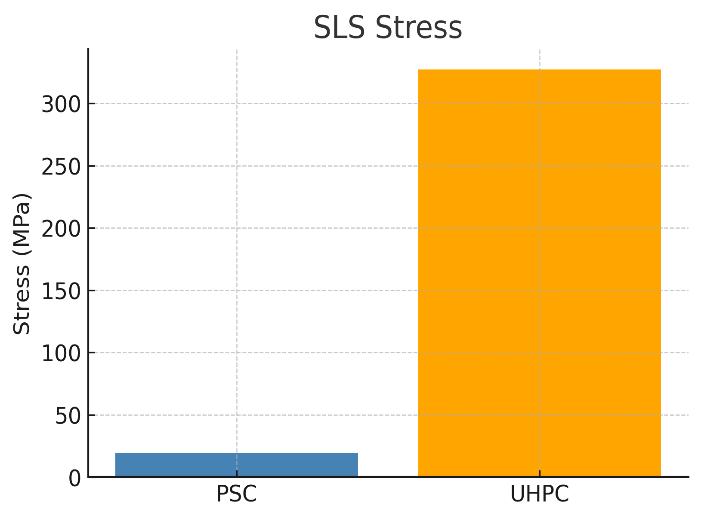
-3:ComparativeGraphshowingSLSStress
UHPC’s fibers control crack width (≤0.05 mm), giving excellentserviceperformanceevenathighsteelstresses
Weight and Size: UHPCgirdersaresignificantlylighterand moreslender,withuptoa36%reductioninself-weightand a33%reductionindepthcomparedtoPSCgirders.
Structural Efficiency: WhilethespecificUHPCdesigninthis studyhada lowerultimate capacitydueto the absence of prestressing, its material properties suggest potential for higherefficiencywhenfullyoptimized.
Durability: UHPChasadensermicrostructureandsuperior crackresistance,givingitaservicelifeofover100years.PSC girders are prone to long-term issues like creep and shrinkage,oftenrequiringrehabilitationwithin40-60years.
Cost: PSC is 75% cheaper in initial construction costs for conventional spans.However,UHPCofferssignificantlifecyclecostsavingsduetominimal maintenanceandrepair needs.
International Research Journal of Engineering and Technology (IRJET) e-ISSN: 2395-0056
Volume: 12 Issue: 08 | Aug 2025 www.irjet.net p-ISSN: 2395-0072
We are grateful for the invaluable guidance of our dissertationguide,Prof.(Dr.)RajpalSingh,andthesupport from ouruniversityprofessors;weextenda special thank you to the team from GHV India Pvt. Ltd., including Mr. JitendraVyas,Mr.RajanTalkar,Mr.AyubShaikh,Mr.Imran Siddiqui,Mr.SuchitLotkar,andMr.IkramJagrala.
[1] Syed Sofiya, Porumatti Santhi, Mathangi Varshitha, S. Padmaja(2023),“ComparativeAnalysisofRCCGirder andPrestressedGirderforBridgesbyusingSTAAD.Pro,” InternationalJournalforModernTrendsinScienceand Technology,ISSN:2455-3778,Vol.9(05),pp.602–607.
[2] Yang Hang (2022), “A Review of Research into the InterfacePropertiesofUltra-highPerformanceConcrete andNormalConcrete,”JournalofEngineeringResearch andReports,ISSN:2582-2926,Vol.23(11),pp.45–53.
[3] PrashanshaSanjayJaiswal,etal.(2021),“Comparative StudyofRCCGirderandPrestressedGirderforRoadway Bridge,” International Journal of Engineering Development and Research, ISSN: 2321-9939, Vol. 9(02),pp.103–106.
[4] GovindH.Dake,etal.(2021),“Feasibility&Comparative Study of Analysis & Design of RCC & PSC Girder,” InternationalJournalofTechnicalInnovationinModern Engineering& Science, e-ISSN:2455-2585,Vol.7(08), pp.1–6.
[5] Sharma Debraj et al. [September 2021], "Prestressed ConcreteI-Girder"InternationalJournalofAllResearch Education and Scientific Methods (IJARESM), ISSN: 2455-6211,Vol.9Issue9,pp.2348-2354.
[6] MuruganM,RajeshJ,SridharR[March2020],"Review ofUltra-High-PerformanceConcreteandCostImpactof UHPC in Durability Aspects" International Journal of Engineering Research & Technology (IJERT), ISSN: 2278-0181,Vol.9Issue03,pp.27-29.
[7] RahulGangwaretal.[Apr2020],"ComparativeStudyof RCCandPSCGirder"InternationalResearchJournalof EngineeringandTechnology,e-ISSN:2395-0056,7(04), Apr2020,pp.3884-3888.
[8] Rohan Rajendra Bagade et al. [Aug 2020], "A Review PaperonComparativeAnalysis&DesignofRCC&PSC Girder&Feasibility"InternationalResearchJournalof EngineeringandTechnology,e-ISSN:2395-0056,7(08), Aug2020,pp.1107-1108.
[9] Rajani A et al. [May 2019], "Comparative Study of ReinforcedConcreteandPrestressedConcreteFlexural
Elements: Sectional and Structural Properties" ProceedingsoftheNationalConferenceonAdvancesin Infrastructure and Civil Engineering, ISBN 978-81926416-6-9,(NCAICE-2019),pp.153-156.
[10] Ayush Tiwari & Dr. Sudhir S. Bhadouria [Sept 2017], "Cost Comparison of RCC Girder and PSC Girder" International Journal for Scientific Research & Development,e-ISSN:2321-0613,5(09),Sept2017,pp. 67-69.
[11] IRC:112-2020, Code of Practice for Concrete Road Bridges,IndianRoadsCongress,NewDelhi.
[12] IRC:18-2000,DesignCriteriaforPrestressedConcrete RoadBridges(Post-Tensioned),IndianRoadsCongress, NewDelhi.
[13] IS1343:2012,CodeofPracticeforPrestressedConcrete, BureauofIndianStandards,NewDelhi.
[14] IS456:2000,CodeofPracticeforPlainandReinforced Concrete,BureauofIndianStandards,NewDelhi.
[15] IS 875 (Part 1 to 5):1987, Code of Practice for Design Loads (Other than Earthquake) for Buildings and Structures,BureauofIndianStandards,NewDelhi.
[16] IS 10262:2019, Guidelines for Concrete Mix Design Proportioning,BureauofIndianStandards,NewDelhi.