
International Research Journal of Engineering and Technology (IRJET) e-ISSN: 2395-0056
Volume: 12 Issue: 12 | Dec 2025 www.irjet.net p-ISSN: 2395-0072
COMPARATIVE STUDY OF HORIZONTAL STRUCTURAL BEHAVIOR IN TALL BUILDINGS CONSTRUCTED USING VARIOUS CONCRETE GRADES
Fazal
Ahmad1 , Mr. Ushendra Kumar2
1Master of Technology, Civil Engineering, Lucknow Institute of Technology, Lucknow, India
2Head of Department, Department of Civil Engineering, Lucknow Institute of Technology, Lucknow, India
Abstract - Horizontal structural behavior (HSS) is one of the most significant issues related to earthquake design oftall buildings, especially those located inareas whereearthquakes are common. The mechanical characteristics of materials, specifically concrete type/grade, have an effect on stiffness, mass, and dynamic responses of these types of structures. In this paper, the seismic performances of tall buildings made of various types of concrete (concrete grade of M25, M40 and precast concrete) have been compared through an analytical study. To compare the performance of three dimensional building models created based on Indian Standards, linear static analysis and response spectrum analysis havebeenused by using software called ETABS. Results have indicated that high strength concrete produces higher stiffness than low strength concrete which reduces the lateral displacement and improves the drift control but has higher base shear forces. As a result, the overall HSS of precast concrete is better than other two types of concrete. This study emphasizes the necessity of selecting appropriate strength of concrete for enhanced seismic safety, serviceability and economy of tall building structure.
Key Words: Tall buildings, Concrete grade, Horizontal structural behaviour, Seismic analysis, Storey drift, Base shear,ETABS
1. INTRODUCTION
1.1 Rapid Growth of Tall Buildings and Challenges Due to Lateral Loads
Urban growth has increased the number of high rise buildingsthatarebeingconstructedinurbanizedareas.The lackoflandavailabilityhasmadeitnecessaryforbuildersto buildtallerandclosertogether.Buildingcodes,engineering technology,computeraidedanalysistools,etc.,haveallowed fordesignerstocreateeventallerandslendererbuildings than ever before. As buildings get taller, so does their susceptibilitytohorizontalloadingsuchasearthquakesand winds.Horizontalloadingsproducesignificantamountsof shear force, moment, and overturning at the base of a buildingwhichdeterminehowsafethebuildingisandhow wellitwillperformunderextremeconditions.Tallbuildings aredifferentfromshortbuildingsbecauseofthewaythey respond dynamically to loads due to the higher mode numbersofvibrations,theincreasedamountofflexibilityof thestructure,andtheinteractionbetweenthemassesand stiffness’salongtheentirelengthofthebuilding.
1.1.1 Role of Concrete Grade in Stiffness, Mass, and Seismic Performance
Thequalityoftheconcretehasasignificantinfluenceonhow stiff,strongandmassiveareinforcedorprecaststructural memberwillbe.Thehigherthequalityoftheconcretethe higherthecompressivestrengthandelasticmodulusthatit willhaveandtherefore,thestifferthecolumns,beamsand wallswillbe.Thisincreasedstiffnessresultsinlowerlateral deflections and story drifts when subjected to wind and seismic loading, and therefore better overall structural performance. However, a higher quality of concrete may resultinanincreaseinthemassofthestructureandsince seismicinertiaforcesareproportionaltomass,thenthiscan affecttheseismicforcegeneratedbyearthquakes(Neville, 2011).
From a seismic performance viewpoint, the quality of concrete also has an effect on cracking behavior, energy absorptionandpost-elasticresponseofstructuralmembers. High strength concrete has a superior load carrying capability,however,itmayloseitsductilityifthedetailing doesnotallowsufficientdeformationtooccur.Therefore,a balancemustbeachievedbetweenstrengthandductilityto achieve satisfactory seismic performance. In the case of precastconcretestructures,highstrengthsofconcreteare commonly used to counteract stresses developed during fabrication, transportation and construction, whilst also providing enhanced durability and serviceability of tall buildingstructures(Nilsonetal.,2010).
1.1.2 Need for Comparative Evaluation of Different Concrete Grades in Tall RCC and Precast Buildings
Mostdesignapproachestotallbuildingconstructionutilize uniformconcretegradesthroughoutthestructure,whichis likely not the best combination from both an engineering and economic perspective. Tall structures have varying demand levels at various heights of the structure; lower floors experience larger axial forces and moment requirements, whereas upper floors are subjected to displacement and other dynamic load requirements. Therefore, the utilization of different concrete grades in strategically selected structural elements will improve structural efficiency, reduce materials needed, and better resistseismicevents.
International Research Journal of Engineering and Technology (IRJET) e-ISSN: 2395-0056
Volume: 12 Issue: 12 | Dec 2025 www.irjet.net p-ISSN: 2395-0072
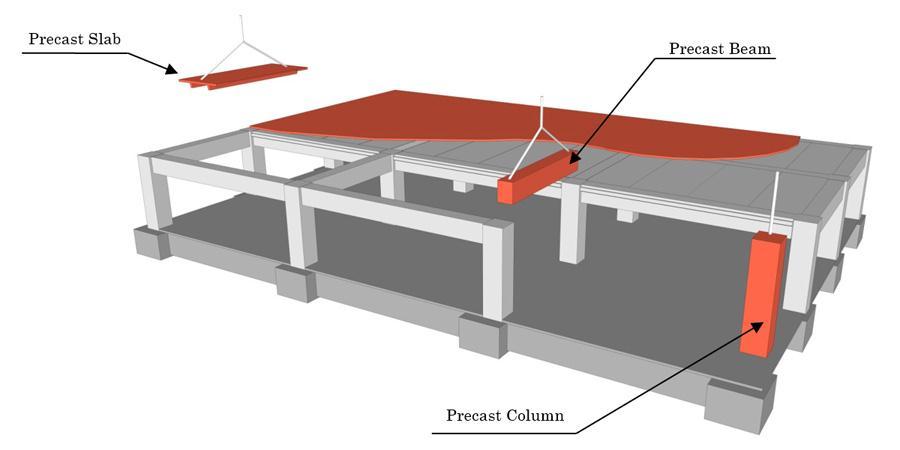
Figure-1: Precast Member
1.1.3 Objectives and Scope of the Present Study
Theprimaryobjectiveofthepresentstudyistoevaluateand comparethehorizontalstructuralbehavioroftallbuildings constructedusingdifferentconcretegradesunderseismic andwindloadingconditions.Thestudyaimstoquantifythe influence of concrete grade on key response parameters suchasbaseshear,storydisplacement,storydrift,natural period, and internal force distribution. Analytical models representingconventionalreinforcedconcreteandprecast concrete construction are developed and analyzed using ETABSinaccordancewithIndianStandardcodes.
Thescopeofthestudyislimitedtolineardynamicanalysis asperIS1893(Part1):2016andwindloadanalysisasperIS 875 (Part 3):2015. The findings are intended to support structuralengineersinselectingappropriateconcretegrades for tall buildings, ensuring safety, serviceability, and economicefficiency.Theoutcomesofthisresearchalsoaim tocontributetotheexistingbodyofknowledgebyproviding a clear comparison of material-grade influence on lateral performance of tall RCC and precast buildings (Bureau of IndianStandards,2016).
2. LITERATURE REVIEW
2.1
Overview of Literature Review
The literature review forms a critical foundation for understandingtheexistingresearchrelatedtothehorizontal structural behavior of tall reinforced concrete (RC) and precastconcretebuildings.Previousstudieshaveextensively examinedtheresponseoftallbuildingsunderlateralloads such as earthquakes and wind; however, variations in materialproperties,especiallyconcretegrades,haveoften been treated simplistically. This section systematically reviewsearlierresearchfocusingonlateralloadresponse, the influence of concrete strength on seismic behavior, comparative analytical studies using ETABS software and IndianStandardcodes,andidentifiesgapsthatmotivatethe presentresearch.
2.1.1 Lateral Load Response of Reinforced Concreteand Precast Buildings
Numerous studies have investigated the lateral load responseofreinforcedconcretebuildings,highlightingthe importanceofstiffnessdistribution,structuralconfiguration, and detailing in controlling seismic and wind-induced effects.TallRCbuildingsareparticularlysensitivetolateral forces due to increased flexibility and higher mode participation. Research has shown that inadequate lateral stiffnesscanresultinexcessivestorydriftanddisplacement, leadingtostructuralandnon-structuraldamage(Taranath, 2016).
2.1.2 Effect ofConcreteStrengthonSeismicPerformance
Concrete strength significantly affects the seismic performanceofbuildingsbyinfluencingstiffness,strength, crackingbehavior,andenergydissipationcapacity.Studies havereportedthathigher-strengthconcreteincreaseslateral stiffness,resultinginreducedstorydisplacementsanddrift demands.However,high-strengthconcretemayalsoexhibit more brittle behavior if not accompanied by adequate ductile detailing, particularly in seismic regions (Park & Paulay,1975).
2.1.3 Comparative Studies Using ETABS and IS 1893
With the advancement of computational tools, ETABS has becomeoneofthemostwidelyusedsoftwarepackagesfor analyzing tall buildings subjected to lateral loads. Several studieshaveemployedETABStoevaluateseismicresponse parameterssuchasbaseshear,natural period, story drift, and mode shapes in compliance with IS 1893 provisions. These studies confirm that response spectrum analysis providesreliableestimatesofseismicdemandsforregular tallbuildings(CSI,2018).
3. RESEARCH SIGNIFICANCE AND OBJECTIVES
3.1
Research Significance
Understandingtheinfluence ofmaterial propertiesonthe horizontalbehavioroftallbuildingshasbecomeincreasingly importantduetogrowingurbandensityandseismicriskin manyregions.Whilestructuralsystemsandgeometryhave traditionally dominated design considerations, materiallevel parameters particularly concrete grade directly affect stiffness, mass, and dynamic response of tall structures.Variationsinconcretestrengthalterlateralload resistance mechanisms, influencing seismic force distribution, deformation capacity, and vibration characteristics. Therefore, systematic investigation of horizontal behavior under varying concrete grades is essentialfordevelopingperformance-efficientandresilient tallbuildingdesigns(Boothetal.,2015).
International Research Journal of Engineering and Technology (IRJET) e-ISSN: 2395-0056
Volume: 12 Issue: 12 | Dec 2025 www.irjet.net p-ISSN: 2395-0072
3.1.1 Importance of Understanding Horizontal Behaviour with Varying Concrete Grades
The horizontal behavior of tall buildings is governed by complex interactions between structural stiffness, mass distribution,andenergydissipationcapacity.Concretegrade significantly influences these parameters by modifying elastic modulus and compressive strength of structural elements. Higher-grade concrete generally increases stiffness,resultinginreducedlateraldisplacementsanddrift, butmayalsoattracthigherseismicforcesduetoincreased massparticipation.Conversely,lower-gradeconcreteoffers greater deformability but may result in excessive lateral movementsifnotadequatelydesigned(Fardis,2009).
3.1.2
Practical Relevance for Structural Designers and Precast Construction
From a practical standpoint, the findings of this research hold direct relevance for structural designers engaged in bothconventionalRCCandprecastconstruction.Designers frequently rely on uniform material grades for simplicity, which may not be optimal for tall buildings with varying force demands along the height. The use of higher-grade concrete in critical load-resisting components such as columns and shear walls, combined with normal-grade concrete in secondary elements, can enhance structural efficiencyandreduceconstructioncosts.
3.2 Research Objectives
The primary objective of this study is to analytically investigateandcomparethehorizontalstructuralbehavior oftallbuildingsconstructedusingdifferentconcretegrades underseismicloading.Theresearchfocusesonquantifying the influence of material variation on critical seismic response parameters through code-compliant numerical modelingandanalysis.
3.2.1 Evaluation of Base Shear Variation
One of the key objectives of the study is to evaluate the variationofbaseshearresultingfromchangesinconcrete grade. Base shear represents the total seismic force transferredtothefoundationandisinfluencedbystructural mass,stiffness,andnaturalperiod.Byanalyzingbaseshear response for buildings with different concrete grades, the study aims to identify trends in force demand and assess howmaterialstiffnessinfluencesseismicforceattractionin tallbuildings(CloughandPenzien,2003).
3.2.2
Comparison of Storey Displacement and Drift
Another important objective is to compare story displacementandinter-story driftamongbuildingmodels withvaryingconcretegrades.Theseparametersarecritical indicators of structural performance and serviceability under lateral loads. Excessive drift can lead to damage in non-structural components and compromise occupant
safety.Thestudyseekstoevaluatehowincreasedconcrete stiffness contributes to drift control and compliance with code-specifiedlimits(Ghosh,2010).
3.2.3
Study of Changes in Natural Period and Structural Stiffness
Thenaturalperiodofabuildingisafundamentaldynamic property that influences seismic demand and response spectrumvalues.Changesinconcretegradedirectlyaffect member stiffness and, consequently, the natural period of thestructure.Thisresearchaimstostudyhowvariationsin concretestrengthmodifythedynamiccharacteristicsoftall buildings, particularly the fundamental period and modal behavior, which play a crucial role in seismic response evaluation(ChopraandGoel,2011).
4. METHODOLOGY
4.1 Description of Building Models
The methodology adopted in this research involves numerical modeling and seismic analysis of tall building structures to evaluate the influence of varying concrete grades on horizontal structural behavior. Multiple threedimensional building models are developed to represent conventional reinforced concrete and precast concrete construction.Themodelsareidealizedasmoment-resisting frame systems, which are commonly used in tall building construction due to their flexibility and architectural adaptability.Thestructuralconfigurationiskeptconsistent acrossallmodelstoensurethattheobservedvariationsin response are primarily attributed to changes in material properties rather than geometry or layout (Ali and Moon, 2007).
4.1.1
Geometry and Configuration of Tall Building Models
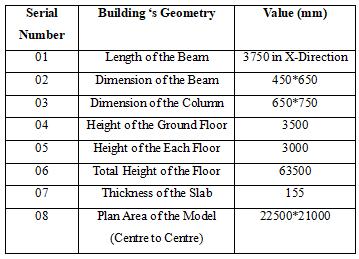
The geometric configuration of the building models is designed to represent a regular tall building plan, minimizing torsional irregularities and ensuring uniform mass and stiffness distribution. Regularity in plan and elevationismaintainedinaccordancewithseismicdesign recommendationstoobtainreliableanalyticalresults.The building height, bay spacing, and member dimensions are selected to reflect realistic proportions used in contemporarytallbuildings,ensuringpracticalrelevanceof thestudy(ASCE,2017).
International Research Journal of Engineering and Technology (IRJET) e-ISSN: 2395-0056
Volume: 12 Issue: 12 | Dec 2025 www.irjet.net p-ISSN: 2395-0072
Table-1: Geometry of Models
4.1.2 Storey Height, Plan Dimensions, and Structural System
Uniformstoryheightsareadoptedthroughoutthebuilding tosimplify modelingand maintainvertical regularity.The plan dimensions are selected to provide adequate lateral resistance in both principal directions while avoiding excessive slenderness. The structural system consists of reinforced concrete beams, columns, and slabs forming a spaceframesystemcapableofresistinggravityandlateral loads.Thisconfigurationenableseffectivetransferofseismic forces from superstructure to foundation and allows meaningful comparison of dynamic characteristics across differentconcretegrades(MacGregorandWight,2012).
4.2 Material Properties
Materialpropertiesareacriticalcomponentoftheanalytical study, as concrete grade directly influences stiffness, strength, and mass of structural members. The models incorporate different concrete grades commonly used in Indian construction practice to examine their effect on seismic response parameters. All material properties are defined in accordance with relevant standards to ensure accuracyandconsistencyinanalysis(Mehtaand Montero, 2014).
4.2.1 Concrete Grades Used (M25, M40, and Precast Concrete)
Normal-strengthconcreteofgradeM25isusedtorepresent conventional RCC construction, while higher-strength concrete of grade M40 is adopted for precast structural elements. Precast concrete is modeled with enhanced material properties reflecting controlled manufacturing conditions and improved durability. The elastic modulus, unitweight,andcompressivestrengthvaluesareassigned based on standard empirical relationships and code recommendations, allowing realistic representation of materialbehaviorunderlateralloads(NevilleandBrooks, 2010).
4.2.2 Reinforcement Details
Reinforcement is modeled using high-strength steel commonlyadoptedinseismicdesignofRCstructures.The reinforcement properties are defined to ensure adequate strength and ductility in beams and columns. Although reinforcement detailing is not explicitly modeled at the element level, the assigned properties reflect ductile detailing provisions recommended for seismic resistance. Thisapproachensuresthatglobalresponsecharacteristics such as displacement and base shear are realistically captured(Paulay,1996).
4.3 Software Used
ETABSisemployedformodeling,analysis,andevaluationof seismic response of the building models. ETABS is a specialized structural analysis software developed for buildingsystemsandiswidelyrecognizedforitsaccuracyin simulatingdynamicbehavioroftallbuildings.Thesoftware supports linear static, response spectrum, and modal analysis,enablingcomprehensiveassessmentofhorizontal structural behavior. Its ability to define different material properties and load combinations makes it particularly suitableforcomparativestudiesinvolvingmultipleconcrete grades(CSI,2020).
4.4 Load Considerations
All relevant gravity and lateral loads are considered in accordancewithIndianStandardcodestosimulaterealistic loading conditions. Load magnitudes are applied consistentlyacrossallmodelstomaintaincomparabilityof results. The load definitions reflect typical residential or commercial building usage and comply with codal recommendationsforstructuralsafety(IS875).
4.4.1 Dead Load, Live Load, and Floor Finish Load
Dead loads include the self-weight of structural members and permanent fixtures, automatically calculated by the software based on assigned material densities. Live loads represent occupancy-related loads and are applied uniformly on floor slabs. Additional floor finish loads are includedtoaccountfornon-structuralcomponentssuchas flooringandfinishes.Theseloadscontributetotheseismic weight of the structure and influence lateral force calculations(Arumugam,2013).
4.4.2 Seismic Load as per IS 1893:2016
Seismicloadsareappliedusingresponsespectrumanalysis in accordance with IS 1893 (Part 1):2016. The design spectrum is generated based on seismic zone, soil type, importance factor, and response reduction factor. Modal analysisiscarriedouttocapturedynamiccharacteristicsof the structure, and modal responses are combined using appropriate combination rules. This approach provides a
International Research Journal of Engineering and Technology (IRJET) e-ISSN: 2395-0056
Volume: 12 Issue: 12 | Dec 2025 www.irjet.net p-ISSN: 2395-0072
rational estimation of seismic demands on tall buildings (Murty,2019).
4.5
Seismic Parameters
SeismicparametersareselectedinaccordancewithIndian seismic zoning and design recommendations. These parameters directly influence the magnitude of seismic forcesandthedynamicresponseofthestructure.Uniform seismicparametersareadoptedacrossallmodelstoisolate theeffectofconcretegradevariation(BommerandPinho, 2006).
4.5.1
Seismic Zone, Importance Factor, and Response Reduction Factor
Theseismiczonefactorrepresentstheexpectedintensityof groundmotionatthesite.Theimportancefactoraccounts for the functional significance of the building, while the response reduction factor reflects the energy dissipation capacity of the structural system. These parameters collectivelydeterminedesignseismicforcesandareselected to represent realistic seismic design scenarios for tall buildings(BozorgniaandBertero,2004).
4.5.2
Soil Type and Damping Considerations
Soilconditionssignificantlyaffectseismicresponsedueto soil–structureinteractioneffects.Mediumsoilconditionsare consideredinthisstudy,astheyarecommonlyencountered in urban regions. A standard damping ratio is adopted to representinherentenergydissipationinreinforcedconcrete structures.Theseassumptionsareconsistentwithseismic analysis practices for linear dynamic analysis (Wolf and Deeks,2004).
4.6 Analysis Procedure
The analysis procedure follows a systematic approach beginning with model development, load application, and dynamicanalysis.Linearelasticbehaviorisassumedforall structural members, which is acceptable for preliminary comparative evaluation of seismic response. The results obtained provide insight into relative performance trends amongdifferentconcretegrades(Wilson,2002).
4.6.1
Linear Static and Response Spectrum Analysis
Linearstaticanalysisisusedtoevaluategravityloadeffects, whileresponsespectrumanalysisisconductedtocapture dynamicseismicresponse.Modalparticipationfactorsand massparticipationratiosareexaminedtoensuresufficient modes are considered. This combined approach enables accurateestimationofbaseshear,displacement,andmodal propertiesoftallbuildings(Chopra,2012).
4.6.2 Load Combinations as per IS Codes
LoadcombinationsareappliedinaccordancewithIS1893 andIS456provisionstoaccountforsimultaneousactionof gravity and lateral loads. Both strength-based and serviceability-based combinations are considered to evaluatecriticalresponseparameters.Thisensuresthatthe analysisresultscomplywithcodalsafetyrequirementsand reflectrealisticdesignconditions(Subramanian,2014).
5. RESULTS AND DISCUSSION
5.1 Base Shear Comparison
Base shear is a fundamental seismic response parameter representingthetotalhorizontalforcetransferredfromthe superstructuretothefoundationduringanearthquake.Itis directly influenced by the seismic weight, stiffness, and dynamiccharacteristicsofthestructure.Inthisstudy,base shearvaluesareextractedfromresponsespectrumanalysis results for building models constructed using different concretegrades.Thecomparisonrevealsthatbuildingswith higherconcretegradesexhibitrelativelyhigherbaseshear due to increased stiffness and mass participation, which results in greater seismic force attraction under identical groundmotionconditions(Humar,2012).

Fogure-2: Base Shear of Models.
5.2 Story Displacement
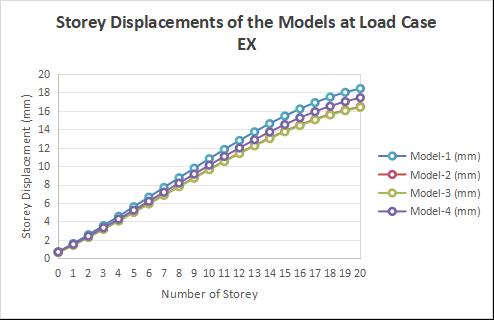
Story displacement is a critical response parameter that reflectsthelateralflexibilityofabuildingunderseismicand windloads.Excessivedisplacementcancauseserviceability issues,non-structuraldamage,anddiscomforttooccupants. In tall buildings, displacement demand typically increases with height due to cumulative deformation effects. The results obtained from the analysis show a systematic reductioninmaximumstorydisplacementwithincreasing concretegrade,attributedtoenhancedstiffnessofstructural members(Ellingwood,2001).
International Research Journal of Engineering and Technology (IRJET) e-ISSN: 2395-0056
Volume: 12 Issue: 12 | Dec 2025 www.irjet.net p-ISSN: 2395-0072
5.2.1 Maximum Storey Displacement under Lateral Loads
Themaximumstorydisplacementisobservedatthetopmost levels of the building, consistent with cantilever-type behavior of tall structures under lateral loads. Buildings constructedwithM25concreteexhibithigherdisplacement valuescomparedtothoseusingM40andprecastconcrete. Thereductionindisplacementwithhigherconcretegrades confirmstheroleofmaterialstiffnessincontrollinglateral deformation.Thisbehaviorisparticularlysignificantfortall buildings,wheredisplacementoftengovernsdesignrather than strength considerations (Stafford Smith and Coull, 1991).
5.3 Storey Drift
Storeydrift, definedasthe relativedisplacement between consecutivefloors,isakeyindicatorofpotentialdamageto structural and non-structural components. Excessive drift may lead to cracking of partitions, façade damage, and failure of structural elements. The drift profiles obtained fromtheanalysisprovidevaluableinsightintodeformation distribution along the height of the building (Bertero and Bertero,2002).
5.4
Natural Period
Thenaturalperiodofabuildingrepresentsitsfundamental dynamiccharacteristicandsignificantlyinfluencesseismic demand. It is primarily governed by structural mass and stiffness.Changesinconcretegradealterstiffnessproperties of members, leading to variation in the fundamental time period.Accurateestimationofthenaturalperiodisessential forreliableseismicresponseevaluation(Priestley,2003).
6. CONCLUSION
This study presented a comparative evaluation of the horizontalstructuralbehavioroftallbuildingsconstructed using different concrete grades under seismic loading.
Analytical resultsclearlydemonstratethatconcretegrade significantly influences key seismic response parameters, includingbaseshear,storeydisplacement,inter-storeydrift, andnaturalperiod.Buildingsconstructedwithhigher-grade concreteexhibitedincreasedstiffness,resultinginreduced lateraldisplacementsandimproveddriftcontrolacrossthe height. Although higher stiffness led to marginally higher base shear demand, the overall seismic performance improved due to enhanced deformation control and structural stability. Precast concrete models showed superior horizontal performance owing to better material qualityandstiffnesscharacteristics.Thereductioninnatural periodobservedinhigher-gradeconcretebuildingsconfirms theirincreasedresistancetolateraldeformation.Overall,the findingsemphasizethatmaterialselectionshouldbetreated asacriticaldesignparameterintallbuildingsratherthana secondaryconsideration.Thestudysupportstheadoptionof optimized concrete grades to achieve improved seismic resilience, serviceability, and safety in tall reinforced concreteandprecastbuildingsystems.
7. LIMITATIONS OF THE STUDY
Study limited to linear analysis, regular geometry, and specificseismicassumptionsonly.
8. FUTURE SCOPE OF WORK
Future research can extend the present study by incorporating nonlinear static and nonlinear time-history analysestocaptureinelasticbehaviorunderstrongground motions.Theinfluenceofmixedconcretegradeswithinthe samebuilding,suchashighergradesinlowerstoreysand normal grades in upper storeys, can be investigated for structuralandeconomicoptimization.Furtherstudiesmay includeirregularbuildingconfigurations,differentstructural systemssuchasshearwalls,outriggersystems,anddiagrids, and varying soil conditions considering soil–structure interaction effects. Experimental validation using scaled models or field data from existing tall buildings would enhance the reliability of analytical results. Additionally, performance-based seismic design approaches can be exploredtodevelopdesignguidelinesforoptimizeduseof concrete grades in tall reinforced concrete and precast buildings.
REFERENCES
1. Ali, M.M. and Moon, K.S. (2007) ‘Structural developments in tall buildings: current trends and futureprospects’,ArchitecturalScienceReview,50(3), pp.205–223.
2. ASCE (2017) Minimum Design Loads and Associated CriteriaforBuildingsandOtherStructures(ASCE/SEI 7-16).Reston,VA:AmericanSocietyofCivilEngineers.
International Research Journal of Engineering and Technology (IRJET) e-ISSN: 2395-0056
Volume: 12 Issue: 12 | Dec 2025 www.irjet.net p-ISSN: 2395-0072
3. Bertero, V.V. and Bertero, R.D. (2002) ‘Performancebased seismic engineering: the need for a reliable conceptual approach’, Earthquake Engineering & StructuralDynamics,31(3),pp.627–652
4. Bommer, J.J. and Pinho, R. (2006) ‘Advances in earthquake engineering research’, Bulletin of EarthquakeEngineering,4(3),pp.199–202.
5. Bozorgnia, Y. and Bertero, V.V. (2004) Earthquake Engineering: From Engineering Seismology to Performance-Based Engineering. Boca Raton: CRC Press.
6. Calvi,G.M.(1999)‘Adisplacement-basedapproachfor vulnerability evaluation of buildings’, Journal of EarthquakeEngineering,3(3),pp.411–438.
7. Chopra, A.K. (2012) Dynamics of Structures: Theory andApplicationstoEarthquakeEngineering.4thedn. Boston:PearsonEducation.
8. Chopra, A.K. (2017) Earthquake Engineering: Theory and Practice. 2nd edn. New Delhi: Oxford University Press.
9. Clough, R.W. and Penzien, J. (2003) Dynamics of Structures.3rdedn.Berkeley:Computers&Structures Inc.
10. Computers and Structures Inc. (CSI) (2020) ETABS Integrated Building Design Software – User Manual. Berkeley,CA:CSI.
11. Ellingwood,B.R.(2001)‘Earthquakeriskassessmentof buildingstructures’,ReliabilityEngineering&System Safety,74(3),pp.251–262
12. Fardis, M.N. (2009) Seismic Design, Assessment and RetrofittingofConcreteBuildings.Dordrecht:Springer.
13. fib (2013) Model Code for Concrete Structures 2010. Lausanne:FédérationInternationaleduBéton.
14. Ghosh,S.K.(2010)SeismicDesignReviewofBuildings. BocaRaton:CRCPress.
15. Goel,R.K.andChopra,A.K.(1997)‘Periodformulasfor moment-resisting frame buildings’, Journal of StructuralEngineering,123(11),pp.1454–1461.
16. Holmes, J.D. (2015) Wind Loading of Structures. 3rd edn.BocaRaton:CRCPress.
17. Humar, J.L. (2012) Dynamics of Structures. 3rd edn. BocaRaton:CRCPress.
18. Jain,S.K.andMurty,C.V.R.(2005)AProposedDraftfor IS1893(Part1).Roorkee:IITRoorkee.
19. Kowalsky, M.J. (2000) ‘Deformation limit states for reinforced concrete columns’, Journal of Structural Engineering,126(8),pp.869–878.
20. Kurama,Y.C.(2010)‘Seismicdesignofprecastconcrete walls’,ACIStructuralJournal,107(1),pp.3–12.
21. Lagomarsino,S.(1993)‘Forecastmodelsforvibration periodsofbuildings’,JournalofWindEngineeringand IndustrialAerodynamics,48(2–3),pp.221–239.
22. MacGregor, J.G. and Wight, J.K. (2012) Reinforced Concrete: Mechanics and Design. 6th edn. Boston: PearsonEducation.
23. Mehta, P.K. and Monteiro, P.J.M. (2014) Concrete: Microstructure,Properties,andMaterials.4thedn.New York:McGraw-Hill.
24. Miranda, E. and Akkar, S.D. (2006) ‘Generalized interstory drift spectrum’, Journal of Structural Engineering,132(6),pp.840–852.
25. Mirza, S.A. and MacGregor, J.G. (2009) Design of ConcreteStructures.NewYork:JohnWiley&Sons
26. Moehle, J. and Deierlein, G.G. (2004) ‘A framework methodology for performance-based earthquake engineering’,PEERReport2004/01,Berkeley.
27. Murty, C.V.R. (2019) Earthquake Tips: Learning Earthquake Design and Construction. Kanpur: IIT Kanpur.
28. Neville, A.M. (2011) Properties of Concrete. 5th edn. Harlow:PearsonEducation.
29. Paulay,T.andPriestley,M.J.N.(1992)SeismicDesignof ReinforcedConcreteandMasonryBuildings.NewYork: Wiley.
30. Paz, M. (1997) Structural Dynamics: Theory and Computation.4thedn.NewYork:Springer.
31. Priestley, M.J.N. (2003) ‘Myths and fallacies in earthquakeengineering’,BulletinofNZSEE,36(3),pp. 129–154.
32. Priestley,M.J.N.,Calvi,G.M.andKowalsky,M.J.(2007) Displacement-Based Seismic Design of Structures. Pavia:IUSSPress.
33. SEAOC(2012)Vision2000:Performance-BasedSeismic Engineering.Sacramento:SEAOC.
34. SEAOC (2015) Seismic Design Manual. 2nd edn. Sacramento:SEAOC.
35. Smith,B.S.andCoull,A.(1991)TallBuildingStructures: AnalysisandDesign.NewYork:Wiley.
International Research Journal of Engineering and Technology (IRJET) e-ISSN: 2395-0056
36. Stafford Smith, B. and Coull, A. (1991) Tall Building Structures.NewYork:JohnWiley&Sons.
37. Subramanian,N.(2014)DesignofReinforcedConcrete Structures.NewDelhi:OxfordUniversityPress.
38. Wilson, E.L. (2002) Three-Dimensional Static and DynamicAnalysisofStructures.Berkeley:Computers& StructuresInc.
Volume: 12 Issue: 12 | Dec 2025 www.irjet.net p-ISSN: 2395-0072 © 2025, IRJET | Impact Factor value: 8.315 | ISO 9001:2008