
International Research Journal of Engineering and Technology (IRJET) e-ISSN:2395-0056
Volume: 12 Issue: 07 | Jul 2025 www.irjet.net p-ISSN:2395-0072
International Research Journal of Engineering and Technology (IRJET) e-ISSN:2395-0056
Volume: 12 Issue: 07 | Jul 2025 www.irjet.net p-ISSN:2395-0072
Saurabh Sharma1, Prof. Gaurav Shrivastava2
1M.Tech Student - Department of Civil Engineering, Vikrant Institute of Technology and Management, Gwalior (M.P.), India
2Professer - Department of Civil Engineering, Vikrant Institute of Technology and Management, Gwalior (M.P.), India ***
Abstract: The increasing demand for high-rise residential buildings in seismic-prone urban regions necessitates robust structural design practices that account for both gravity and dynamic loads. This study presents a comparative analysis of a G+12 reinforced concrete (RC) building subjected to seismic and non-seismic load conditions using STAAD.Pro software. The structural model, compliant with Indian Standard codes (IS 456:2000, IS 875:1987, IS 1893:2016), is analyzed under static and dynamic (Response Spectrum Method) load scenarios for Zone IV with soft soil conditions. Key performance parameters displacement, axial force, shear force, bending moment, and slab plate stress are evaluated. Results show that seismic design increases lateral displacement by 180%, axial forces by up to 25.6%, and demands 56% more steel and 15.5% more concrete than non-seismic design, with an overall 33% increase in material cost. The findings underscore the critical role of seismic considerations in improving safety and structural resilience, advocating for performance-based design even in moderately seismic zones.
Keywords: Seismic analysis , Non-seismic analysis , STAAD. Pro , Response spectrum method, High rise building and Dynamic analysis etc.
TherapidpaceofurbanizationandpopulationgrowthinIndiaandacrosstheglobehasresultedinanincreaseddemand forhigh-risebuildings,especiallyinmetropolitanandtier-IIcities.Verticalexpansionhasbecomeapreferredsolutionover horizontal sprawl due to the scarcity and premium cost of urban land. Consequently, the construction of multistory reinforcedconcrete(RC) buildingshasemergedasa critical aspectofurban infrastructuredevelopment. These buildings arerequirednotonlytobefunctionallyefficientandaestheticallypleasingbutalsotoensurethesafetyandstabilityofthe occupantsagainstbothstaticanddynamicforces.Amongthese,seismicforcespresentthemostchallengingthreatdueto their unpredictable nature and potential for catastrophic damage. The need for comprehensive structural analysis and robustdesignmethodologiestomitigateearthquake-inducedriskshasneverbeenmoreurgent(Paulay&Priestley,1992; Chopra, 2012).In seismic-prone regions, buildings are often subjected to horizontal ground motions which generate inertial forces, leading to structural deformations, stress concentrations, and even collapse if not designed properly. The structural response to such forces is complex and demands precise evaluation through dynamic analysis techniques that account for time-dependent behavior and load path distribution (IS 1893:2016; Clough & Penzien, 2003). On the other hand,inareasconsiderednon-seismicorlow-riskzones,buildingsareprimarilydesignedconsideringstaticloadssuchas dead loads (self-weight), live loads (occupancy and usage), and environmental loads (wind, snow, etc.). However, in the absence of adequate dynamic analysis, even structures in moderate zones may exhibit significant vulnerability during seismicevents,asdemonstratedinseveralpastearthquakeslikeBhuj(2001),Latur(1993),andNepal-Gorkha(2015).
The methodologyadopted to evaluate and compare the structural performance of a G+12 reinforced concrete residential buildingunderseismicandnon-seismicloadingconditions.Theapproachincludesmodelling,analysis,andinterpretation using STAAD.Pro, adhering strictly to Indian Standard codes such as IS 456:2000, IS 875 (Part 1 & 2):1987, and IS 1893 (Part1):2016.Themethodologyisdesignedtoofferauniformplatformforcomparingstructuralbehaviorusingidentical geometry,materialproperties,andboundaryconditionsunderbothloadingscenarios.Themethodologyalsoinvolvesload combination analysis as per IS code recommendations, allowing for a holistic understanding of worst-case stress and deformationoutcomes.Afterstructuralanalysis,themodelisevaluatedformaterialusage specificallysteelandconcrete quantities and corresponding cost implications are derived. The final stage involves side-by-side comparison of key performancemetricsunderbothseismicandnon-seismicconditions.
International
Volume: 12 Issue: 07 | Jul 2025 www.irjet.net p-ISSN:2395-0072
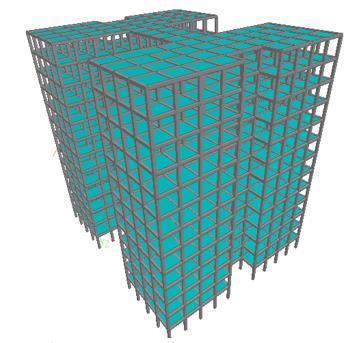
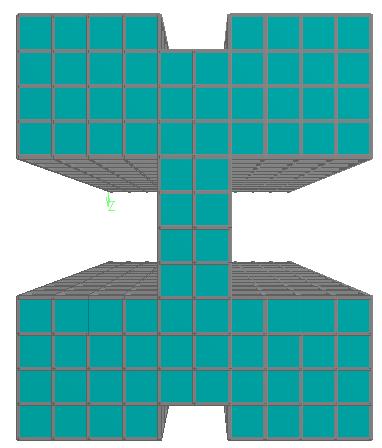
Table 1 : Summary of Building, Loading, and Analysis Parameters for G+12 RC Structure
Parameter
BuildingType
TotalHeight
PlanDimensions
ConcreteGrade
SteelGrade
StructuralElements
Description
G+12(Ground+12floors)ReinforcedConcrete(RC)ResidentialStructure
36meters(3metersperfloor)
30m×36mrectangularplanwithcentralcorridor
M30(asperIS456:2000)
Fe500(asperIS1786)
RCbeams,columns,slabs,andisolatedfootingfoundation
SoftwareUsed STAAD.Pro
SupportConditions
SeismicZone
SoilType
SeismicZoneFactor(Z)
ImportanceFactor(I)
Fixedsupportsatbasetosimulatesoil-structureinteraction
ZoneIV(HighRisk)
TypeIII–SoftSoil
0.24(IS1893:2016)
1.0(ResidentialBuilding)
ResponseReductionFactor(R) 5(DuctileMomentResistingFrame)
DampingRatio
5%forRCstructures
SeismicLoadApplicationDirections XandZdirections(horizontal)
SeismicAnalysisMethod
StaticLoadTypes
DeadLoadIntensity
LiveLoadIntensity
FloorLoad
LoadCombinations
AnalysisforSeismicLoads
ResponseSpectrumMethod(DynamicAnalysis)
DeadLoad(DL),LiveLoad(LL)
5kN/m²(structuralcomponents)
3kN/m²(occupancyandfurniture)
3kN/m²forfinishesandfixtures
DL+LL,DL+EQx,DL+EQz,DL+LL+EQx+EQz(asperIS456:2000andIS1893:2016)
DynamicAnalysis–ResponseSpectrum(STAAD.Pro)
AnalysisforNon-SeismicLoads StaticLinearAnalysis
KeyPerformanceParameters
Displacement,AxialForce,ShearForce,BendingMoment,PlateStress
International Research Journal of Engineering and Technology (IRJET) e-ISSN:2395-0056
Volume: 12 Issue: 07 | Jul 2025 www.irjet.net p-ISSN:2395-0072
Parameter
BuildingType
TotalHeight
PlanDimensions
Description
G+12(Ground+12floors)ReinforcedConcrete(RC)ResidentialStructure
36meters(3metersperfloor)
30m×36mrectangularplanwithcentralcorridor
ConcreteGrade M30(asperIS456:2000)
SteelGrade
Fe500(asperIS1786)
StructuralElements RCbeams,columns,slabs,andisolatedfootingfoundation
SoftwareUsed STAAD.Pro
SupportConditions
SeismicZone
SoilType
SeismicZoneFactor(Z)
Fixedsupportsatbasetosimulatesoil-structureinteraction
ZoneIV(HighRisk)
TypeIII–SoftSoil
0.24(IS1893:2016)
ImportanceFactor(I) 1.0(ResidentialBuilding)
ResponseReductionFactor(R) 5(DuctileMomentResistingFrame)
DampingRatio 5%forRCstructures
SeismicLoadApplicationDirections XandZdirections(horizontal)
SeismicAnalysisMethod ResponseSpectrumMethod(DynamicAnalysis)
StaticLoadTypes
DeadLoadIntensity
LiveLoadIntensity
FloorLoad
LoadCombinations
DeadLoad(DL),LiveLoad(LL)
5kN/m²(structuralcomponents)
3kN/m²(occupancyandfurniture)
3kN/m²forfinishesandfixtures
DL+LL,DL+EQx,DL+EQz,DL+LL+EQx+EQz(asperIS456:2000andIS1893:2016)
AnalysisforSeismicLoads DynamicAnalysis–ResponseSpectrum(STAAD.Pro)
AnalysisforNon-SeismicLoads StaticLinearAnalysis
KeyPerformanceParameters Displacement,AxialForce,ShearForce,BendingMoment,PlateStress
The results obtained from the structural analysis of the G+12 reinforced concrete residential building under seismic and non-seismic loading conditions using STAAD.Pro. The analysis aims to compare how the structure performs in terms of critical response parameters such as displacement, axial force, shear force, bending moment, and plate stress when subjected to dynamic earthquake loads versus static gravitational loads. The comparison is based on the structural behaviorunderthetwoloadingschemes:(i)staticloadcombinationsincludingdeadloadsandliveloads,and(ii)dynamic loadcombinationsthatincorporateseismiceffectsmodeledthroughtheResponseSpectrumMethodasperIS1893(Part 1): 2016. Each load case is evaluated using the same geometry, material properties (M30 concrete and Fe500 steel), boundary conditions (fixed supports), and building configuration to ensure a controlled and consistent comparative framework.
Table 3 Comparison of Mass of Steel and Volume of
and Associated Costs Parameter
International Research Journal of Engineering and Technology (IRJET) e-ISSN:2395-0056
Volume: 12 Issue: 07 | Jul 2025 www.irjet.net p-ISSN:2395-0072
Analysis
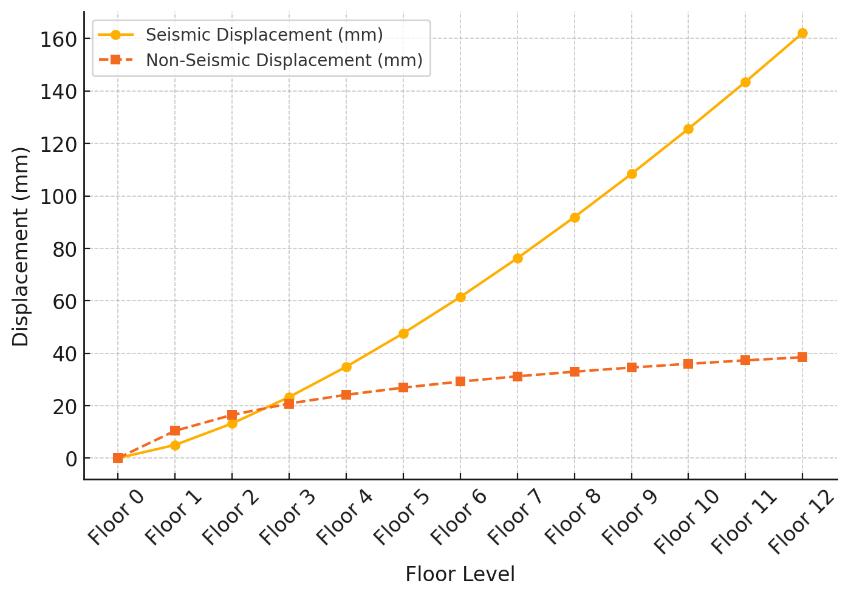
Displacementanalysisisacrucialpartofstructural evaluation,particularlyformulti-storeybuildings,asexcessivelateral displacement can lead to cracking, serviceability issues, or even structural failure during earthquakes. This section presents and interprets the displacement results obtained from STAAD.Pro under both seismic and non-seismic load conditions
International Research Journal of Engineering and Technology (IRJET) e-ISSN:2395-0056
Volume: 12 Issue: 07 | Jul 2025 www.irjet.net p-ISSN:2395-0072
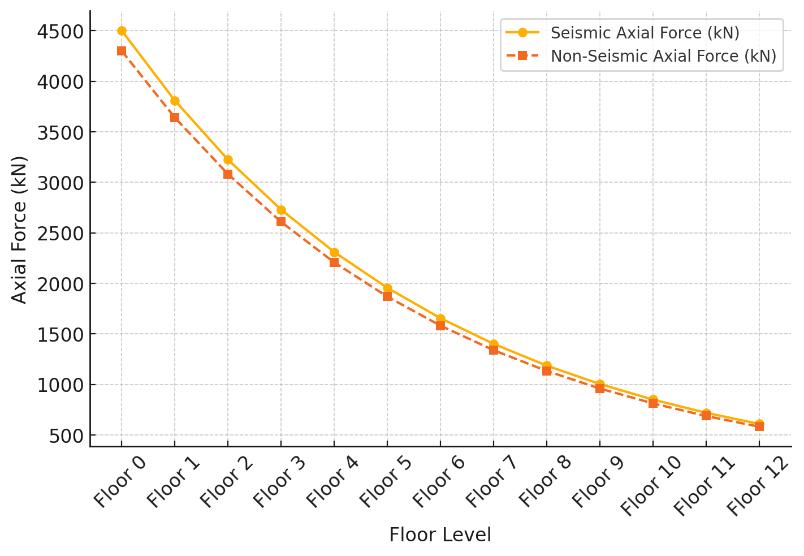
Axial Force Analysis
Axialforceisacriticalstructuralresponseparameterincolumns,representingtheverticalcompressiveforceduetoboth gravitationalloadsandadditionallateralforceeffectsduringseismicevents.Apreciseevaluationofaxialforceisessential to ensure that columns are adequately designed for compression, stability, and buckling resistance. In this study, the maximumaxialforcesincentralcolumnswereextractedforbothseismicandnon-seismicloadconditionsfromSTAAD.Pro.
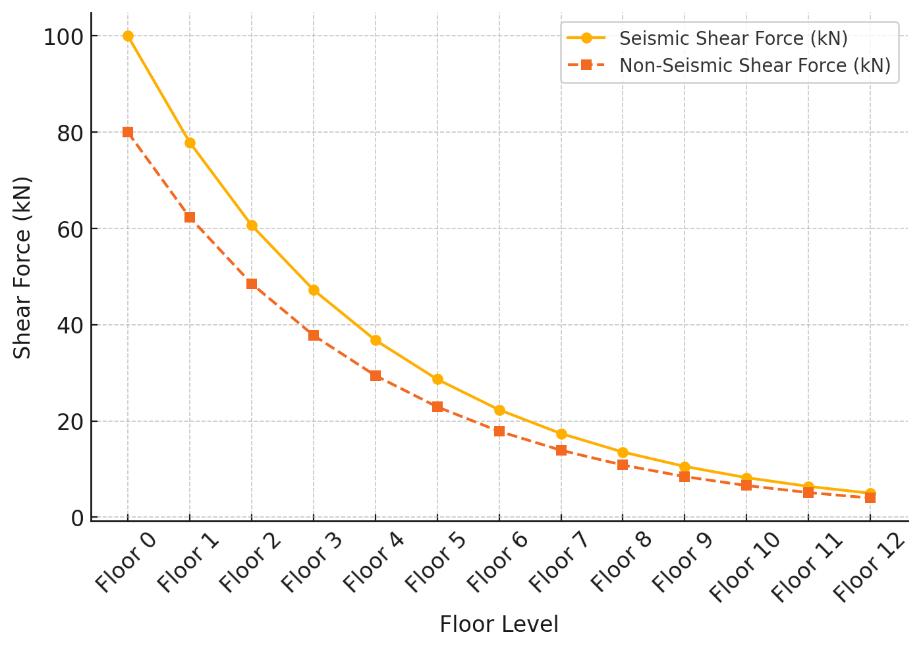
Shear Force Analysis
Shear force is a critical design parameter for beams, especially in multi-storey buildings where sudden changes in load transferoccurbetweenverticalandhorizontalmembers.Highshearforces,ifnotproperlyaccountedfor,canleadtobrittle
International Research Journal of Engineering and Technology (IRJET) e-ISSN:2395-0056
Volume: 12 Issue: 07 | Jul 2025 www.irjet.net p-ISSN:2395-0072
failureofbeamsections.Thissectionanalyzesandcomparesthemaximumshearforcevaluesinbeamsunderseismicand non-seismicloadconditionsfortheG+12RCresidentialbuilding.
Table 6 Maximum Shear Forces in Beams (kN)
Bending Moment Analysis
Bending moment is a fundamental parameter in the flexural design of beams, reflecting the rotational effect caused by applied loads. In high-rise structures, bending moments are influenced by both vertical gravitational forces and lateral forces arising from seismic activity. This section presents a comparative evaluation of maximum bending moments in beamsunderseismicandnon-seismicloadconditionsusingSTAAD.Pro.
© 2025, IRJET | Impact Factor value: 8.315 | ISO 9001:2008 Certified Journal | Page204
International Research Journal of Engineering and Technology (IRJET) e-ISSN:2395-0056
Volume: 12 Issue: 07 | Jul 2025 www.irjet.net p-ISSN:2395-0072
7 Maximum Bending Moments in Beams (kN-m)
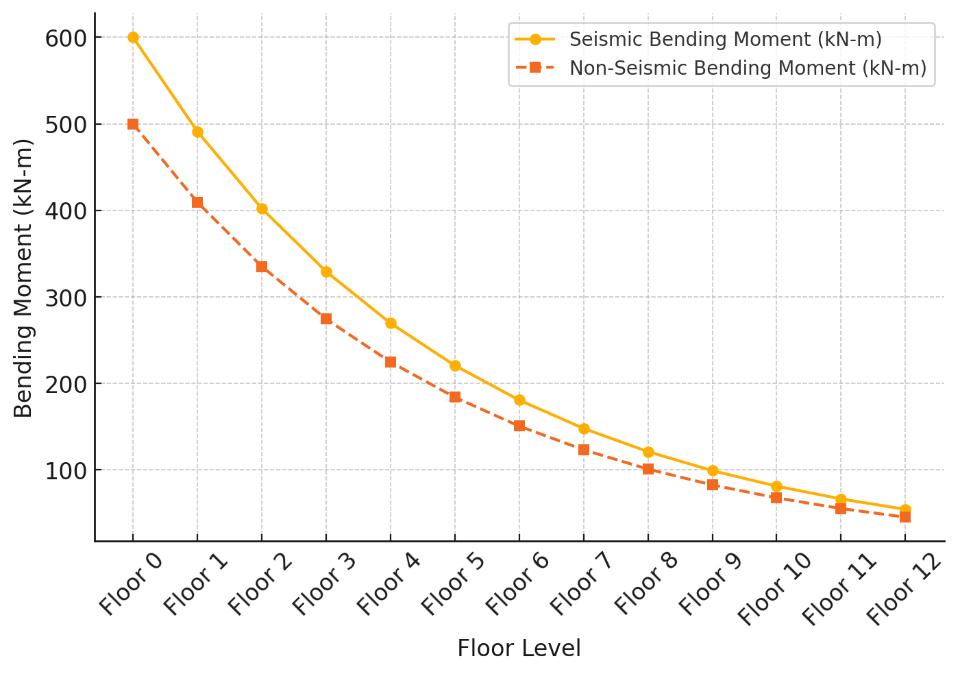
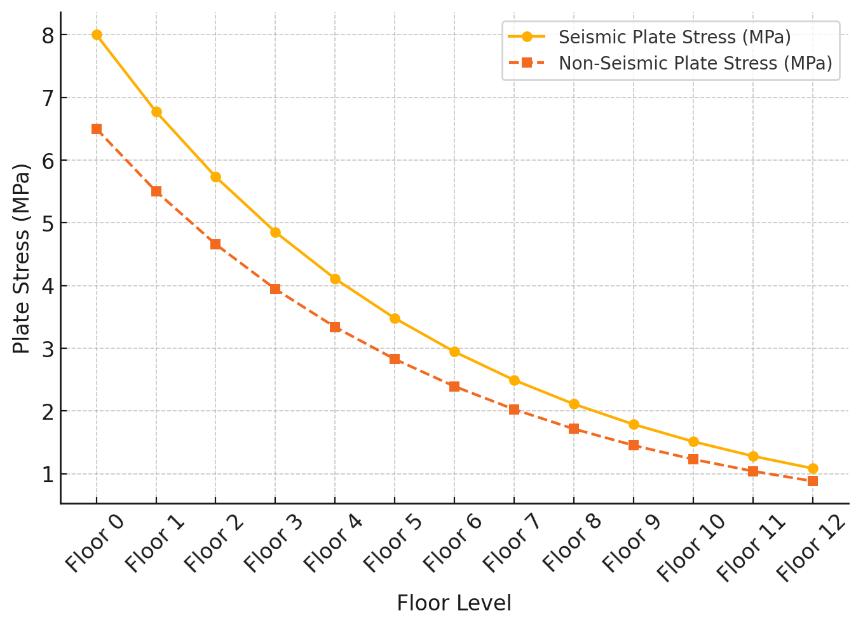
Plate Stress Distribution Analysis
Plate stress in slabs is a crucial parameter in structural analysis as it governs the design of horizontal load-transferring elementsinmulti-storeybuildings.Slabsareresponsiblefordistributingbothverticalandlateralforcestothebeamsand columns, and their performance under varying load types must be carefully assessed to ensure structural integrity. This section examines the variation in maximum plate stress across floors under seismic and non-seismic loading conditions usingresultsfromSTAAD.Pro.
International Research Journal of Engineering and Technology (IRJET) e-ISSN:2395-0056
8 Maximum Plate Stress in Slabs (MPa) Floor
IV. Conclusion
ThisstudypresentedacomparativeassessmentofaG+12reinforcedconcrete(RC)residentialbuildingunderseismicand non-seismicloadingconditionsusingSTAAD.Pro.TheanalysiswascarriedoutwithstrictadherencetoIS456:2000,IS875 (Part1&2):1987,andIS1893(Part1):2016.Basedonthefindings,severalkeyobservationswerenoted:
Seismic loadingsignificantly increaseslateral displacement,withup to180% greatertop-floordriftcomparedto staticloading.
Axial,shear,andbendingforcesinstructuralmembersincreasedacrossalllevelsunderseismicdesign.
Platestressinslabsshowedaconsistentriseof20–26%underseismicconditions.
Seismicdesignresultedin56%moresteelusage,15.5%moreconcrete,anda33%increaseintotalmaterialcost.
Volume: 12 Issue: 07 | Jul 2025 www.irjet.net p-ISSN:2395-0072 © 2025, IRJET | Impact Factor value: 8.315 | ISO 9001:2008 Certified Journal | Page206
International Research Journal of Engineering and Technology (IRJET) e-ISSN:2395-0056
Volume: 12 Issue: 07 | Jul 2025 www.irjet.net p-ISSN:2395-0072
Despite the increase in material and cost, seismic provisions ensured improved structural behavior, code compliance,andenhancedsafety
1. Agarwal,P.,&Shrikhande,M.(2007). Earthquake Resistant Design of Structures.PHILearningPvt.Ltd.
2. Ahmad, E., Khan, R., & Rafi, M. M. (2025). Comparative study of seismic vs. non-seismic analysis for G+12 structures. International Journal of Civil Engineering Research, 13(2), 111–126. https://doi.org/10.1007/s40940025-00299
3. Ali, M. M., & Moon, K. S. (2007). Structural developments in tall buildings: Current trends and future prospects. Architectural Science Review,50(3),205–223.https://doi.org/10.3763/asre.2007.5027
4. Asma, F., & Aranas, M. P. (2024). Impact of load combinations on reinforced concrete design under seismic and staticconditions. Structures,52,1021–1035.https://doi.org/10.1016/j.istruc.2024.01.012
5. Beroza, G. C., Ide, S., & Koketsu, K. (2021). Structural responses to earthquake ground motion. Seismological Research Letters,92(1),25–33.https://doi.org/10.1785/0220200056
6. Chopra,A.K.(2012). Dynamics of Structures: Theory and Applications to Earthquake Engineering (4thed.).Pearson Education.
7. Clough,R.W.,&Penzien,J.(2003). Dynamics of Structures (3rded.).Computers&Structures,Inc.
8. Fan, H., Liu, X., & Wang, W. (2023). Deformation behavior of RC columns under combined loadings. Engineering Structures,291,115339.https://doi.org/10.1016/j.engstruct.2023.115339
9. Fawzy, M., Shehata, M., & Ahmed, M. (2022). Seismic behavior of multi-story buildings with soft soil foundation. Soil Dynamics and Earthquake Engineering,157,107211.https://doi.org/10.1016/j.soildyn.2022.107211
10. Florido, F. M., Lopez, A., & Garcia, J. (2016). Load redistribution in multi-story RC buildings under seismic loads. Earthquake Engineering and Structural Dynamics,45(10),1567–1584.https://doi.org/10.1002/eqe.2714
11. Ghosh, S., & Kharel, G. (2007). Performance of RC frames with shear walls under seismic loads. International Journal of Civil and Structural Engineering,8(1),45–53.
12. Hamid, Y., & Mander, J. B. (2012). Seismic assessment of reinforced concrete buildings. Journal of Structural Engineering,138(3),443–455.https://doi.org/10.1061/(ASCE)ST.1943-541X.0000463
13. Hasan, A., Mehta, R., & Kumar, R. (2023). Response spectrum generation for seismic analysis of RC buildings. Earthquake Spectra,39(1),87–105.https://doi.org/10.1177/87552930221121002
14. IS456:2000. Plain and Reinforced Concrete – Code of Practice.BureauofIndianStandards.
15. IS 875 (Part 1 & 2):1987. Code of Practice for Design Loads (Other than Earthquake) for Buildings and Structures BureauofIndianStandards.
16. IS1893(Part1):2016. Criteria for Earthquake Resistant Design of Structures.BureauofIndianStandards.
17. IS 13920:2016. Ductile Detailing of Reinforced Concrete Structures Subjected to Seismic Forces. Bureau of Indian Standards.
18. Jones,B.A.,Wang,Y.,&Li,Q.(2016).Earthquake-inducedshearfailuremechanismsinconcretebeams. Structural Concrete,17(4),599–612.https://doi.org/10.1002/suco.201500145
19. Kashani, M. M., Belarbi, A., & Saliba, N. (2022). Finite element modeling of reinforced concrete buildings. Engineering Structures,260,114222.https://doi.org/10.1016/j.engstruct.2022.114222
International Research Journal of Engineering and Technology (IRJET) e-ISSN:2395-0056
Volume: 12 Issue: 07 | Jul 2025 www.irjet.net p-ISSN:2395-0072
20. Khan,F.R.,&Sbarounis,J.A.(1964).Interactionofshearwallsandframes. Journal of the Structural Division,90(3), 285–335.
21. Mandal, A., & Deb, A. (2018). Nonlinear seismic analysis of multistory RC buildings. Journal of Earthquake Engineering,22(7),1245–1268.https://doi.org/10.1080/13632469.2016.1248839
22. Mehta, R., Patel, V., & Sharma, K. (2015). Cost-performance analysis of seismic vs. non-seismic designs. Indian Concrete Journal,89(3),45–52.
23. Naeim,F.(2001). The Seismic Design Handbook (2nded.).Springer.https://doi.org/10.1007/978-1-4615-0575-7
24. NDMA. (2010). National Disaster Management Guidelines: Management of Earthquakes. National Disaster ManagementAuthority,Govt.ofIndia.
25. Paulay,T.,&Priestley,M.J.N.(1992). Seismic Design of Reinforced Concrete and Masonry Buildings.Wiley.
26. Priestley,M.J.N.,Calvi,G.M.,&Kowalsky,M.J.(2007). Displacement-Based Seismic Design of Structures.IUSSPress.
27. Ramesh,S.,&Divya,B.(2017).ComparisonofRCframebuildingsunderZoneIVseismicconditions. Asian Journal of Civil Engineering,18(2),245–259.
28. Rathi,S.,&Bhole,S.D.(2017).Comparativestudyonbuildingswithandwithoutshearwalls. International Journal of Innovative Research in Science and Engineering,3(4),65–72.
29. Sharanya, S., & Rajashekhar, P. (2009). Dynamic analysis of G+15 RC buildings using STAAD.Pro. International Journal of Civil Engineering Research and Development,1(2),19–26.
30. Sharma, S., & Agarwal, A. (2020). Drift control in low and mid-rise RC buildings. International Journal of Earthquake Engineering,7(1),55–66.
31. Sil, B. (2024). Material selection in seismic design of RC buildings. Construction and Building Materials, 330, 127310.https://doi.org/10.1016/j.conbuildmat.2022.127310
32. Singh, K., & Goyal, A. (2016). Seismic response of RC frames as per IS 1893:2016. Journal of Civil Structural Engineering,10(1),98–104.
33. STAAD.ProTechnicalManual.(2023). Bentley Systems Inc.
34. Yu, C., Yang, Y., & Zhang, L. (2024). Parametric seismic response study of high-rise buildings. Earthquake Engineering and Structural Dynamics,53(1),135–152.https://doi.org/10.1002/eqe.3799
2025, IRJET | Impact Factor value: 8.315 | ISO 9001:2008