
International Research Journal of Engineering and Technology (IRJET) e-ISSN:2395-0056
Volume: 12 Issue: 11 | Nov 2025 www.irjet.net p-ISSN:2395-0072
International Research Journal of Engineering and Technology (IRJET) e-ISSN:2395-0056
Volume: 12 Issue: 11 | Nov 2025 www.irjet.net p-ISSN:2395-0072
AGARALA REVATHI [1], Dr. D.V. PRASADA RAO [2]
1PG Student, Department of Civil Engineering, Sri Venkateswara University College of Engineering, Tirupati, Andhra Pradesh, India.
2Professor, Department of Civil Engineering, Sri Venkateswara University College of Engineering, Tirupati, Andhra Pradesh, India, Email: dvprsvu@gmail.com ***
ABSTRACT: This paper has presented the findings of an experimental study that was carried out on the strength of properties of M30 grade of concrete reinforced with hooked steel fibre and monofilament polypropylene fibre at the dosage of 0.25, 0.5, 0.75 and 1.0 percent by the volume of concrete. The research involves the comparison of the strength of concrete to assess the compressive strength, split tensile strength, and flexural strength, in order to establish the best fibre content. It was discovered that the compressive strength greatly increased when there was 0.75% of steel fibres and 0.5% of polypropylene fibres. The highest tensile strength split is obtained at 0.5% dosage of fibre in both types and highest flexural strength is obtained at 0.75% dosage of steel fibre and 0.5% dosage of polypropylene fibre. This demonstrates that addition of fibres to concrete increases the impact resistance of fibre-strengthened concrete, as the optimum fibre dosages of 0.5% polypropylene fibre and 0.75% hooked steel fibre by volume of concrete significantly increases impact strength on drop weight. The polypropylene fibres also were found to be better than the steel fibres in flexural strength and resisting crack propagation. In addition, polypropylene fibres emerged to be cheaper than steel fibres in an economic viewpoint. Findings confirm that the mechanical behaviour of concrete may be significantly enhanced by the fibre reinforcement with optimum proportions and result in the enhanced structural behaviour.
Keywords: Steel fibres, Polypropylene fibres, Reinforced concrete, Compressive Strength, Split tensile strength, Flexural Strength
Concreteisaconstructionmaterialwhichishighlyutilizedintheworld.Itisveryversatileandcanbeshapedinanyform, and the material is made using cost-effective materials. But concrete is brittle substance that has low tensile strength, flexuralstrengthanditformscrackswhenitisunderservicesloads.Fibre-reinforcedconcrete(FRC)isdesignedinorder to eliminate these shortcomings. FRC is a composite material that is constituted of hydraulic cement, water, aggregates, and discontinuous discrete fibre. Fibre gives concrete superior toughness, ductility, crack resistance and post crack behaviour, and over the last few years, there has been intense research leading to significant success and innovations in fibre technology [1]. Some of the materials studied include steel, glass, polypropylene and carbon fibre which has enhancedunderstandingofmechanicalbehaviourofconcretewiththefibres.
Theuseoffibresinexperimentalstudiesisowedtootherfibresincludingthesteelfibresduetotheirhightensilestrength and strain to increase impact resistance [6]. The polypropylene fibres are of choice as they are light in weight and nonreactive.Theybothimprovecompressive,tensileandflexuralstrength,butthecomparativeeffectivenessisdependenton thekindoffibreutilized,dosageanddispersalofthefibreinthemix[2].Althoughmanystudieshaveclaimedtoimprove mechanicalpropertiesasaresultofaddingfibre,thecomparativestudyundercontrolledconditionsisrequiredtoidentify aspecificdosageandperformanceefficiencyofdifferenttypesoffibres.
The given study will fill this research gap by providing an experimental study of M30 grade concrete reinforced with differentratioofhookedsteelfibreandpolypropylenefibreandtodeterminetheoptimumdoseoffibrestobeappliedto provide the concrete with maximum strength properties (compressive strength, split tensile strength, and flexural strength).
The mechanical performance improvements of fibre-reinforced concrete have been studied widely. Gupta et al. [1] evaluatedtheM40gradeconcretewithsteelandpolypropylenefibres(0.3cent)andfoundthatpolypropylenefibreswith
International Research Journal of Engineering and Technology (IRJET) e-ISSN:2395-0056
Volume: 12 Issue: 11 | Nov 2025 www.irjet.net p-ISSN:2395-0072
a60-aspectratiohada greaterflexuralstrengththansteel fibres.Inasimilarstudy,FathimaandVarghese[2]compared steelandpolypropylenefibresinM30gradeconcreteandemphasizedthattheflexuralbehaviourwasgreatlyenhancedby thepresenceof0.5%polypropylenefibresbutnotbythecrimpedandhooked-endsteelfibres.
Bharath et al. [3] experimentally obtained optimum dosage of polypropylene (0.05%) and steel (0.75%) fibres in M30 concrete, which showed better compressive and flexural strengths than regular mixes. Indra Kumari and Ravi [4] established that incorporation of 0.4-1.2% polypropylene and crimped steel fibres into M30 concrete improved compressive,tensileandflexuralstrengthsby61%atoptimumcontents.
Kiran Kumar[5] evaluated hybridfibre reinforcedconcrete(HFRC)andshowedthattheadditionofanequal quantityof steel and polypropylene fibre (up to 1.5%) enhanced all mechanical properties. In a study of hooked-end steel fibres reinforced concrete and conventional concrete, Reddy and Rafi [6] concluded that hooked-end steel fibres considerably increasedtheoverallperformanceoftheconcretestructure.
Concrete mixes containing steel and glass fibre were studied by George et al. [7] and demonstrated enhanced flexural behaviour; polypropylene fibres, instead, were shown to have a positive impact on the fibre reinforced concrete performancebyAntarvedi[8].Onthesamenote,UniyalandRawat[9]establishedthatcementreinforcedwithsteelfibres increasedtheresistanceandstrengthofreinforcedconcrete.
AsnotedbyBhatandKhan[10],theadditionoffibresteelacceleratedtheearlystrengthgainofconcrete.Moreover,Ali et al. [11]verifiedthatsteelfibreshadapositiveeffectonmechanicalpropertiessuchascompressiveandtensile.Concrete mixdesignand material behaviourcontinuetorelyon standard textbookslikeShetty[12]andNeville [13],andIScodes [14,24].
To study the influence of the addition of hooked steel fibres and polypropylene fibres on compressive, split tensileandflexuralstrengthofM30gradeconcrete.
To determine the optimum dose of fibres to be used to attain maximum strength properties of fibre-reinforced concrete.
To evaluate and compare the strength characteristics of concrete reinforced with hooked steel fibres and polypropylenefibres.
MATERIALS AND METHODOLOGY
CEMENT:
Inthepresentexperimentalinvestigation,53GradeOrdinaryPortlandcement(OPC)wasused.Thephysicalpropertiesof cementareshowninTable1.
Table1PhysicalPropertiesofCement
3
4 InitialSettingTime
IS:4031(part4)&IS269
min >30Min IS:4031(part5)&IS269
5 FinalSettingTime 335min <600Min.IS:4031(part5)&IS269
Aggregate is also an important constituent of concrete, in the present experimental investigation, locally available sand confirmingtoZoneIIofIS383-2016[19].ThePhysicalPropertiesoffineaggregateasshowninTable2
International Research Journal of
Volume: 12 Issue: 11 | Nov 2025 www.irjet.net
Table2PhysicalPropertiesofFineAggregate
The coarse aggregates are irregular broken stones or naturally available gravels that are used in making concrete. Aggregates that have a size more than 4.75 mm are considered as coarse aggregates. They are usually found in stone quarriesandstonecrusherswithsizesof4.75mmto80mm.Thegradedmixtureof20mmand12mmcoarseaggregates wasadoptedinthecurrentexperimentalstudytoattainhighercompactionandimprovethemechanicalpropertiesofthe concrete.AsindicatedinTable3,thePhysicalPropertiesofcoarseaggregateareasfollows.
Table3PhysicalPropertiesofCoarseAggregate
Casting and curing of the specimens were carried out using potable water The quality of water plays a crucial role in determining the strength and durability of concrete. Therefore, it must be free from substances that are harmful to both concrete and reinforcement. Parameters such as pH, chloride content, sulphate content, alkalinity, acidity, and hardness are typically evaluated to assess the suitability of water for construction purposes. In this experimental study, water sampleswereanalyzed,andtheresultsarecomparedwiththepermissiblelimitsspecifiedinIS:456–2000[21]toverify compliancewithstandardrequirements.ThelaboratorytestresultsofthewaterqualityarepresentedinTable4
Table4AnalysisofWaterUsedforCastingandCuringofConcrete
Although the water sample exhibited higher alkalinity and hardness beyond desirable limits, the concrete achieved satisfactorystrength. Thisoutcome maybeattributedtothefactthat a slightincreasein alkalinityandhardness does not affect the hydration of concrete. Moreover, other critical parameters, including pH, chlorides, and sulphates, were within safelimits.
International Research Journal of Engineering and Technology (IRJET) e-ISSN:2395-0056
Volume: 12 Issue: 11 | Nov 2025 www.irjet.net p-ISSN:2395-0072
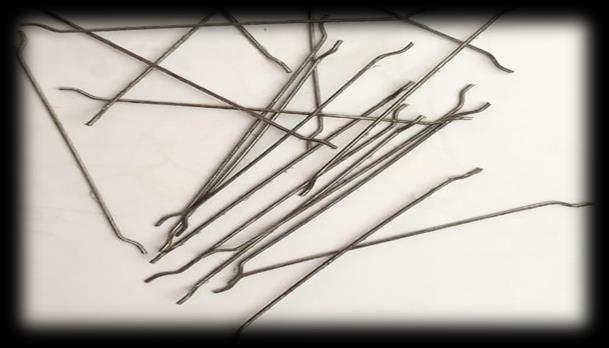
Steel Fibre Reinforced Concrete (SFRC) is a composite material which is a mixture of hydraulic cement, aggregates and dispersion of discontinuous steel fibres. These fibres are randomly distributed in the concrete mix to promote the mechanical properties of the concrete. High toughness, ductility, crack resistance and energy absorption are some of the applicationsof SFRC.This investigation involves round andhooked-typesteel fibres.Aspect ratio Steel fibres (Length 60 mm and diameter 0.75 mm) with tensile strength of 1120 N/mm2. Fig. 1 demonstrates steel fibres used in the current experimentalstudy.
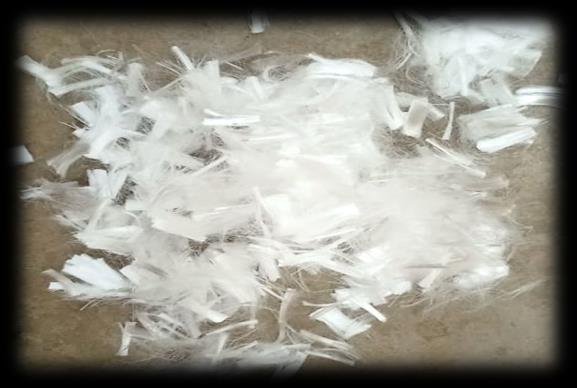
Polypropylenefibrereinforcedconcrete(PPFRC)referstoacategoryoffibre-reinforcedconcreteinwhichpolypropylene fibres are incorporated in the concrete mix to improve concrete performance, in particular its crack resistance, impact strength and durability. Polypropylene is a synthetic thermoplastic polymer, and the fibres are chemically inert, thus highlyresistanttoalkalineconcreteconditions
Mono-filamentPolypropyleneFibresusedintheexperimentalinvestigationareshowninFig.2 ThePolypropyleneFibres ofdiameter0.024 mm,length12 mm(Aspect ratio500 approximately) and tensile Strength of750N/mm2 wereutilized. Monofilament fibresarefineindividual strands, which arespecificallyeffectiveincurbing plasticshrinkage cracksinthe earlydevelopmentphasesofconcretesetting.
CONCRETE MIX
In compliance with IS 10262:2019 [20] and IS 456:2000 [21], concrete mix design is a procedure of determining the proportionsoftheconstituentsofconcreteinordertoachievetherequiredstrengthandworkability.Theproportionsof designmixofgradeofM30concreteare1:1.9:3.68water-cementratio=0.5,andcementcontent=340kg/m3
© 2025, IRJET | Impact Factor value: 8.315 | ISO 9001:2008 Certified Journal | Page197
International Research Journal of Engineering and Technology (IRJET) e-ISSN:2395-0056
Volume: 12 Issue: 11 | Nov 2025 www.irjet.net p-ISSN:2395-0072
Test specimens of concrete are in the shape of cubes (150 mm × 150 mm × 150 mm), cylinders (150mm × 300mm) and prisms(100mm×100mm×500mm).Concretecubeswerecastedtotest3,7,28,and56dayscompressivestrengththough cylindricalandprismspecimensweredriedtotest28days.Hardenedconcretewascastafterwhichtestswerecarriedout onhardenedconcretetoestablishthecubecompressivestrengthofconcrete,splittensilestrength(oncylinders),flexural strength (on prisms) and drop weight impact strength. The outcomes of the test were compared with the control mix concrete (devoid of fibre) to identify the impact of fibre reinforcement on different strength characteristics, and the conclusionsweremade.
Compressive Strength:
Initially,aCompressionstrengthtestwasconductedoncuredconventionalM30gradeconcretecubes,inaccordancewith IS 516:2021 [23]. The cubes were tested at the ages of 3, 7, 28, and 56 days to determine the compressive strength. The resultsofthecompressivestrengthtestofconcreteareshowninFig.3.
ub e Compres si ve Str engt h ( N / m m 2 )
Mix 3 Days 7 Days 28 Days 56 Days
International Research Journal of Engineering and Technology (IRJET) e-ISSN:2395-0056
Volume: 12 Issue: 11 | Nov 2025 www.irjet.net p-ISSN:2395-0072
3 Days 7 Days 28 Days 56 Days
Fig3VariationofCubeCompressiveStrengthConcretewithdifferenttypesofFibresandVaryingPercentagesofFibres(a) Hookedsteelfibres,(b)Polypropylenefibres
Fig.3 indicates that compressive strength of the hooked steel fibre concrete and polypropylene fibre concrete have a similarvariation.TheStrengthofhookedsteelfibreconcreteincreasessteadilywiththeadditionoffibrescontentandthe optimumcontentis0.75%andcompressivestrengthisloweredat1.0%.Thismeansthata0.75percentoptimumofsteel fibreisreachedandabovethatthefibreformsaweakermatrix.Ontheotherhand,polypropylenefibreconcreteexhibitsa linear relationship with the increase in fibre percentage and maximum fibre is 0.5% and the compressive strength has reduced slightly above 0.5%. This is due to the reduction in workability of concrete quantity of fibre exceeds 0.5%. The compressive strength of both fibre concretes constantly rises with curing period. It is therefore possible to observe that additionoffibresenhancescompressivestrengthoverthatofthecontrolmixbutthebestpercentageisdependentonthe typeoffibreused.
Thesplittensilestrengthtestinthecurrentexperimentalstudywasconductedoncylindricalspecimens thatwerecastin conventionalM30gradeconcreteof150mmand300mmdiameterandheightrespectively.ItwasthetestconductedinIS 5816:1999 [22]. The specimens were also cured in water after casting and allowed to cure in a period of 28 days. The specimenswereputinthemachinelyinghorizontally,andcompressiveloadwasapplieduponitsverticaldiametricplane untilfailure.
International Research Journal of Engineering and Technology (IRJET) e-ISSN:2395-0056
Volume: 12 Issue: 11 | Nov 2025 www.irjet.net p-ISSN:2395-0072
Fig 4 represents the variation of split tensile strength after 28 days of curing of cylinders of M30 grade concrete, with hookedsteelfibresandpolypropylenefibres ofvaryingquantities,0.25%,0.50%,0.75%and1.0%.Theadditionoffibres has a great impact on improving the split tensile strength. The concrete with 0.25% of hooked steel fibre and polypropylene fibre possesses an increase in strength, which shows that the addition of fibres has a positive effect on tensile resistance. The optimum split tensile strength is obtained for 0.50% of fibre content, where the fibres are well dispersed and securely bridge the cracks, thus enhancing the tension of concrete. The reason for the decrease in split tensilestrengthcanbeattributedtotheclusteringoffibresandtheinsufficientdispersionoffibresatlargervolumes.The hookedsteelfibresalwaysexhibitedmorestrengththanthepolypropylenefibresatallpercentagesbecausetheyaremore rigidandhaveahighcrack-arrestingcapacity.
Flexural Strength:
The flexural strength test is conducted to evaluate the ability of concrete to resist bending or flexural stresses. In this study, the test was carried out on M30-grade conventional concrete prisms of size 100 mm × 100 mm × 500 mm, in accordancewithIS516:2021[23].Aftercasting,thespecimenswerecuredinwaterfor28days.
International Research Journal of Engineering and Technology (IRJET) e-ISSN:2395-0056
Volume: 12 Issue: 11 | Nov 2025 www.irjet.net p-ISSN:2395-0072
Fig.5 illustrates the flexural strength variation of M30 grade concrete to different number of hooked steel and polypropylene fibres as opposed to the control mix. Flexural strength of Polypropylene fibre concrete is higher than the hookedsteelfibreconcreteofsamepercentageoffibrecontents.Inthecaseofhookedsteelfibrereinforcedconcretethe strength rose at a slow rate to 0.75% and slightly dropped at 1%. On the other hand, the polypropylene fibre reinforced concreteshoweda higherlevel ofimprovement,thestrengthrose by0.5%.Thisisexplainedbythehighaspectandwell dispersionofthepolypropylenefibresascomparedtothehookedsteelfibresintheconcrete.Morethanoptimumcontent offibres,theflexuralstrengthofconcretereduction couldbeexplainedbythedeclineinworkabilityofconcrete.Judging by the results of the conducted test, one can conclude that flexural strength properties of concrete are increased when polypropylenefibresareused.
A drop weight impact strength test is conducted to determine the strength of concrete. The impact strength test determinesthe numberofblowsthatarerequiredtocauseparticularmagnitudesofdistresstoconcretespecimens.The casting is done in cylindrically shaped moulds (diameter 150 mm and thickness 64 mm). It will be tested based on ACI 544.2R-89[24]. Fig. 6, indicates the comparison of impact strength of the control concrete and the fibre reinforced concrete. According to the test findings the impact strength of fibre reinforced concrete is higher than the controlled concrete.
Polypropylene Fibers 0.75% Hooked Steel Fibers
1. The compressive strength of 0.75% hooked steel fibre reinforced concrete exhibits 20% to 25% and Polypropylene fibre reinforced concrete exhibits 10 % to 23% more strength than the control concrete at 3, 7, 28, and 56 days of curing.
2. The maximum split tensile strength of concrete is obtained at 0.5% for steel and Polypropylene fibre reinforced concretes.Thesplittensilestrengthoffibrereinforcedconcrete(steelandPolypropylenefibres)isapproximately18 %morethanthecontrolconcrete.
3. Basedonthetestresults,improvedflexuralstrengthoffibrereinforcedconcreteattheoptimumcontentoffibrescan beobserved. Theincreaseinflexuralstrengthofconcreteis21.5%incaseofSteelfibresand42%forPolypropylene fibres. The improved flexural strength properties can be attributed to the delayed crack formation due to the presenceoffibres.
Finally, based on the results of the experimental investigation, it can be concluded that the presence of steel fibresorPolypropylenefibresimprovesthestrengthpropertiesofconcrete.Theoptimumpercentageoffibresdepends on the type of fibres used. Hence, the use of fibre reinforced concrete is recommended for various structural applicationsandthedurabilityofconcretecanbeenhanced.
International Research Journal of Engineering and Technology (IRJET) e-ISSN:2395-0056
Volume: 12 Issue: 11 | Nov 2025 www.irjet.net p-ISSN:2395-0072
1. T.Gupta,K.Bhutani,A.Bhardwaj,Studyusingdifferentfibresinfibrereinforcedconcrete, Int. J. Eng. Res. Appl. Sci. 9 (11)(2021).
2. A.K.M.Fathima,S.Varghese,Behaviouralstudyofsteelandpolypropylenefibrereinforcedconcrete, Int. J.Eng. Res. Technol. (IMPACT: IJERT) 2(10)(2014)17–24.
3. S. Bharath, A. Kumar, G.S. Meghana, V. Rakshitha, S. Shashi Kumar, Experimental study on properties of polypropyleneandsteelfibrereinforcedconcrete, Int. J. Eng. Technol. (IJET) 4(5)(2017).
4. P.IndraKumari,C.Ravi,Flexuralbehaviourofreinforcedconcretewithpolypropyleneandcrimpedsteelfibre, Int. J. Eng. Res. Appl. Sci. 7(3)(2020).
5. S.KiranKumar,Effectofsteelandpolypropylenefibreonmechanicalpropertiesofconcrete, Int. J. Civ. Eng. Technol. 7(3)(2016)342–346.
6. B.J. Reddy, D.M. Rafi, Comparative study on the strength of steel fibre reinforced concrete with conventional concrete, Int. Res. J. Modern. Eng. Technol. Sci. 4(8)(2022).
7. R. George, A. Thomas, A.M.P.B. Mary, Study on steel and glass fibre reinforced concrete, Int. J. Eng. Res. Technol. (IJERT) 4(13)(2016).
8. B.Antarvedi,Experimentalinvestigationofsteelfibresandpolypropylenefibreseffectonfibrereinforcedconcrete, Research Square (2022).
9. A. Uniyal, N.S. Rawat, Study on the use of steel fibre reinforcement material with concrete, in: Conf. Recent Innov. Emerg. Technol. Sci.,JBInst.ofTechnol.,Dehradun&IJCRT,2018.
10. K.M.U.D.Bhat,M.Z.Khan,Effectofsteelfibrereinforcementonearlystrengthofconcrete, Int. J. Trend Sci. Res. Dev. (IJTSRD) 2(5)(2018).
11. A.M. Ali, M.W. Falah, A. Hafedh, Z.S. Al-Khafaji, S. Radhi, Evaluation of the influence of steel fibre on concrete characteristics, Period. Eng. Nat. Sci. 10(5)(2022)368–379.
12. M.S.Shetty, Concrete Technology,6thed.,S.ChandPublications,NewDelhi,2013.
13. A.M.Neville, Properties of Concrete,5thed.,PearsonPublications,London,2012.
14. BureauofIndianStandards, IS 269:2013 –Ordinary Portland Cement,5threv.,BIS,NewDelhi,2013
15. BureauofIndianStandards, IS 4031(Part 1):1996 –Method of physical Tests for Hydraulic Cement,2ndrev.,BIS,New Delhi,1996.
16. BureauofIndianStandards, IS 4031(Part 4):1988 –Method of physical Tests for Hydraulic Cement,1strev.,BIS,New Delhi,1988.
17. BureauofIndianStandards, IS 4031(Part 5):1988 –Method of physical Tests for Hydraulic Cement,1strev.,BIS,New Delhi,1988.
18. Bureau of Indian Standards, IS 4031(Part 11):1988 –Method of physical Tests for Hydraulic Cement, 1st rev., BIS, NewDelhi,1988.
19. BureauofIndianStandards, IS 383:2016 –Coarse and Fine Aggregate for Concrete,3rdrev.,BIS,NewDelhi,2016.
20. BureauofIndianStandards IS 10262:2019 – Concrete Mix Proportioning Guidelines,BIS,NewDelhi,2019.
21. BureauofIndian Standards IS 456:2000 – Plain and Reinforced Concrete Code of Practice,4th rev.,BIS,NewDelhi, 2000.
22. BureauofIndianStandards IS 5816:1999 – Splitting Tensile Strength of Concrete – Method of Test,5threv.,BIS,New Delhi,1999.
23. BureauofIndianStandards IS 516:2021 – Hardened Concrete-Method of Test,1strev.,BIS,NewDelhi,2021.
24. ACI544.2R-89(2009) – Measurement of properties of Fiber Reinforced Concrete.