
International Research Journal of Engineering and Technology (IRJET) e-ISSN: 2395-0056
Volume: 12 Issue: 11 | Nov 2025 www.irjet.net p-ISSN: 2395-0072
International Research Journal of Engineering and Technology (IRJET) e-ISSN: 2395-0056
Volume: 12 Issue: 11 | Nov 2025 www.irjet.net p-ISSN: 2395-0072
Nasrullah Makhdom1, H N Verma2, Arun Kumar Yadav3
1M.Tech. Student, Department of CSE, ITM University Gwalior, Madhya Pradesh, India
2Associate Professor, Department of CSE, ITM University Gwalior, Madhya Pradesh, India
3Professor, Department of CSE, Sharda University Agra, Uttar Pradesh, India
Abstract: The exponential growth of user-generated health content on online platforms has introduced new opportunities for extracting valuable insights from patient drug reviews. Sentiment analysis enables automated assessment of patient perceptions toward drugs, side effects, and treatment efficacy, supporting pharmacovigilance and clinical decision-making. Traditional lexicon-based and classical machine-learning (ML) models have been widely applied in healthcare text mining; however, their limited contextual understanding and reliance on handcrafted features constrain performance on complex medical narratives. This study presents a comparative evaluation of ML and deep-learning (DL) models for sentiment classification of patient drug reviews using the UCI Drug Review dataset. A collection of classical machine-learning frameworks, including Support Vector Machines (SVM), Naive Bayes classifiers, Logistic Regression, and random forests - was compared to the latest deep-learning systems. Convolutional Neural Networks (CNNs), Long Short-Term Memory (LSTM) networks, and the transformer-based Bidirectional Encoder Representations from Transformers (BERT) model were in the deep-learning category. Text data were preprocessed, vectorized through TF–IDF and word embeddings, and evaluated using accuracy, precision, recall, and F1-score metrics. Results revealed that DL models significantly outperformed traditional ML approaches, with BERT achieving the highest accuracy of 91.4% and F1-score of 0.90. The findings confirm that transformerbased models capture nuanced contextual and semantic information in patient language, leading to more reliable sentiment classification. This study contributes to healthcare informatics by identifying the most effective computational strategies for analyzing patient feedback, facilitating better pharmacovigilance, patient experience evaluation, and informed medical decision-making.
Keywords: sentiment analysis, machine learning, deep learning, BERT, patient drug reviews, pharmacovigilance
Therapidexpansionofdigitalhealthtechnologieshaschangedhowpeoplesharetheirmedicalexperiencesandopinions. PatientstodayactivelyuseonlinehealthplatformssuchasDrugs.com,WebMD,andvariousdiscussionforumstodescribe howtheyfeelaboutspecifictreatments,theireffectiveness,andpossiblesideeffects[1,2].Theseplatformshostmillionsof user-generated comments and reviews, which together form a massive source of real-world evidence. The information containedinthesereviewshelpsresearchersandhealthcareprofessionalsunderstandhowpeoplerespondtomedications in their daily lives. Such insights are highly valuable for pharmacovigilance, post-market drug safety monitoring, and for improvingpersonalizedmedicaltreatmentplans[3,4].
However,whilethesedatasourcesarerichininformation,theyarealsoextremelyunstructuredanddiverse.Reviewsoften includeslang,abbreviations,mixedemotions,andcomplexsentencestructures,makingmanualanalysisalmostimpossible at scale [5]. To address this problem, researchers rely on Natural Language Processing (NLP) techniques, which can automatically process, interpret, and extract patterns from large amounts of text. Among these techniques, sentiment analysisisoneofthemosteffectivetoolsforidentifyingemotionsorattitudesexpressedintext[6].
Sentimentanalysisallowsclassificationoftextaspositive,negative,orneutral,helpingtomeasureoverallpublicorpatient perception.Inthefieldofhealthcare,thistechnologyplaysacriticalrolebyenablingautomatedunderstandingofpatient emotions and satisfaction toward drugs, hospitals, or medical devices [7]. For example, if a large number of patients describe positive experiences about a new painkiller, the system can highlight this feedback for researchers or pharmaceutical companies. Conversely, if negative comments dominate, it could serve as an early warning signal for potentialdrugsafetyconcerns.
Earlyversionsofsentimentanalysismainlydependedonlexicon-basedmethods,suchasSentiWordNetandVADER,which assignpolarityscorestowordsbasedonpre-defineddictionaries[8,9].Althoughsuchmodelsaresimple,transparent,and
International Research Journal of Engineering and Technology (IRJET) e-ISSN: 2395-0056
Volume: 12 Issue: 11 | Nov 2025 www.irjet.net p-ISSN: 2395-0072
computationallyefficient,theyhavenotablelimitations.Theyoftenfailtointerpretthesubtlemeaningormixedemotions common in health-related language [10]. For instance, a patient statement like “The drug worked but made me nauseous” conveys both satisfactionanddiscomfort somethinglexicon-basedmodelsusually misinterpret due to their rigidwordbasedscoring.
The emergence of Machine Learning (ML) introduced a new way of performing sentiment analysis using data-driven models. Algorithms such as Naïve Bayes (NB), Support Vector Machines (SVM), Logistic Regression (LR), and Random Forest (RF) can learn sentiment patterns automatically from labeled training data [11–13]. These models transform text into numeric vectors using techniques such as Bag-of-Words (BoW) and Term Frequency–Inverse Document Frequency (TF–IDF) [14]. Although these methods improved sentiment detection accuracy, they rely heavily on manually designed features. This dependence makes them less effective when dealing with complex linguistic structures, medical abbreviations,orlongcontextualsentences[15].
Toovercomethesechallenges,DeepLearning(DL)approacheshavegainedpopularityduetotheirabilitytolearncomplex features automatically from raw text data [16]. Models such as CNNs and LSTM networks have shown strong results in classifying emotions from healthcare text [17,18]. CNNs excel in identifying local text patterns and short word combinations, while LSTMs are particularly suited for handling long sequences and contextual meaning. However, both methods can be computationally demanding and sometimes fail to capture bidirectional context or sarcasm, which are commoninpatientreviews[19].
Recent progress in transformer-based architectures, particularly BERT has taken sentiment analysis to a new level [20]. Unlikepreviousmodelsthatprocesstextsequentially,BERTusesaself-attentionmechanismthatconsidersbothpreceding and following words in a sentence. This approach helps the model understand the full context, even in complex medical expressions [21,22]. As a result, BERT-based models consistently outperform traditional DL models in healthcare sentimentanalysisandhaveachievedstate-of-the-artaccuracyandbettergeneralizationonunseendata[23,24].
Despite these advancements, there is still limited research directly comparing the performance of traditional ML models andmodernDLmodelsunderthesameconditions[25].Mostexistingstudiesfocusononegroupofmodelsandoverlook the comparative strengths and weaknesses between them. Therefore, the current study aims to fill this gap by systematicallyevaluatingbothcategories classicalMLmodels(SVM,NB,LR,RF)anddeep-learningmodels(CNN,LSTM, BERT) onashareddatasetofpatientdrugreviews.
By examining these approaches together, the study intends to identify which computational method performs best for sentiment classification in healthcare. The findings will not only enhance understanding of how AI can be applied to medical text analytics but will also contribute to improving AI-driven pharmacovigilance systems, enabling safer, more responsive,andpatient-centeredhealthcaredeliveryinthefuture.
Sentimentanalysiswithinthehealthcarefieldhasgraduallydevelopedfromsimplerule-basedsystemstoadvanceddeeplearning architectures that can interpret complex language structures and context. This evolution reflects how computational intelligence has adapted to the challenges of understanding emotional and subjective expressions in medical text. The following review discusses important studies that demonstrate this technological growth and highlight the need for a detailed comparison between machine learning (ML) and deep learning (DL) models as presented in this research.
Early studies in this domain primarily relied on lexicon-based approaches such as SentiWordNet and VADER, which classified patient emotions based on predefined word dictionaries [8,9]. These systems used fixed sentiment scores for each word, assuming that meaning remained constant across all contexts. However, in medical communication, the same wordcanhaveopposite meaningsdepending ontheclinical situation[10].Forexample,a “negative testresult”generally means good news, while a “negative experience” represents dissatisfaction. Such variations make lexicon-based methods unreliable in specialized domains like healthcare, where subtle differences in phrasing can completely change interpretation.
Asthevolumeofonlinehealthdatagrew,researchersbeganexploringmachinelearningalgorithmsthatcouldlearnfrom labeleddatasetsratherthanrelyingonfixedrules.Thesemethodsofferedbetterflexibilityandaccuracy.Forinstance,Dave et al. (2020) evaluated Support Vector Machine (SVM) and Naïve Bayes (NB) models for drug review sentiment classification and found that SVM achieved an accuracy of 83%, outperforming lexicon-based systems [12]. Similarly, Kumar et al. (2021) showed that Logistic Regression (LR) models combined with TF–IDF text features provided more
International Research Journal of Engineering and Technology (IRJET) e-ISSN: 2395-0056
Volume: 12 Issue: 11 | Nov 2025 www.irjet.net p-ISSN: 2395-0072
reliable classification of hospital feedback than rule-based approaches [13]. These models, however, required manual feature engineering, which involves selecting and designing specific text characteristics for the algorithm to learn from. This process is time-consuming and often fails to capture deeper semantic relationships or emotional subtleties in sentences.
Toaddresstheseissues,researchersturnedtodeep-learningmodels,whichcanautomaticallylearncomplexfeaturesfrom large amounts of text data. Unlike classical ML models, DL architectures do not need manual feature extraction. Convolutional Neural Networks (CNNs), for example, have proven effective in identifying patterns in short pieces of text, suchassocial mediapostsorbriefpatientcomments[17].Tang etal.(2022)introduceda hybridCNN–LSTM model that analyzedmedicaltweetsandachieveda5%improvementinF1-scoreovertheSVMclassifier[18].Thisimprovementwas largely due to the model’s ability to capture both spatial and sequential features CNN layers detecting local n-gram patterns and Long Short-Term Memory (LSTM) layers learning long-term dependencies in patient narratives. LSTMs, in particular,arevaluableforhandlingsequentialinformationsuchastreatmentprogressorevolvingpatientsymptomsover time[19].
Theintroductionoftransformer-basedmodelsbroughtanothermajorbreakthroughinhealthcaresentimentanalysis.The Bidirectional Encoder Representations from Transformers (BERT) model developed by Devlin et al. (2019) transformed NLPresearchbyallowingalgorithmstounderstandbidirectionalcontextratherthanprocessingsentencesinonedirection [20].BERTusesan attentionmechanism that enables themodel to considerall wordsin a sentence simultaneously,thus understandingsubtlecontext,negations,and medicalterminologythatearliermodelsoftenmisinterpreted.Inhealthcare applications, Xu et al. (2022) fine-tuned BERT for drug review classification and reported a 91% accuracy, significantly higher than traditional methods [23]. Moreover, Ahmad et al. (2025) and Cheng et al. (2025) demonstrated that transformer-based models consistently outperform BiLSTM and CNN networks when applied to medical text sentiment tasks[24,25].Thesefindingsconfirmthatself-attentionandcontextualembeddingsarecrucialforaccuratelyinterpreting patientopinions.
While these advancements represent significant progress, there remains a lack of comparative evaluations that test both classical ML and modern DL models under the same experimental setup. Many studies use different datasets, varying preprocessing techniques, or inconsistent evaluation metrics, making it difficult to draw fair comparisons between algorithms. Without such standardized evaluations, it is unclear whether the additional computational cost of deep learningalwaysjustifiesitsperformancegaininhealthcaresentimentanalysis.
Therefore, this study addresses that research gap by conducting a comprehensive benchmarking of multiple ML and DL models from interpretable algorithms like SVM, Naïve Bayes, Logistic Regression, and Random Forest, to complex architectures like CNN, LSTM, and BERT using the same UCI Drug Review dataset. By keeping data preparation and evaluationmethodsconsistent,thisworkprovidesaclearandevidence-basedassessmentofhowdifferentcomputational approachesperforminidentifyingpatientsentiments.
Ultimately, understanding which model type performs best not only supports academic research but also has direct practical implications. It can guide healthcare organizations, regulatory agencies, and pharmaceutical companies in deployingefficientAI-drivensystemsfordrugmonitoring,patientfeedbackanalysis,andhealthcareserviceimprovement. This systematic comparison therefore contributes to a deeper understanding of computational methods in healthcare sentiment analysis and helps shape future research toward building safer, smarter, and more empathetic healthcare systems.
3.1
Thisstudy adopted an experimental and comparative research design to evaluate the performance of multiple sentiment classificationalgorithmsappliedtopatientdrugreviews.Thecentralobjectivewastocomparethepredictivecapabilityof classical machine-learning (ML) models and deep-learning (DL) models under a uniform experimental framework. The analysis pipeline included data collection, preprocessing, feature extraction, model training, and performance evaluation [5,11].Astandardizeddatasetwasusedforallexperimentstoensureconsistencyandfairnessacrossmodelcomparisons. The entire experimental workflow was implemented in Python using open-source libraries, following reproducible machinelearningpractices[16].
International Research Journal of Engineering and Technology (IRJET) e-ISSN: 2395-0056
Volume: 12 Issue: 11 | Nov 2025 www.irjet.net p-ISSN: 2395-0072
The dataset used in this study was the UCI Drug Review Dataset (Drugs.com Reviews), a publicly available collection hosted on the UCI Machine Learning Repository and Kaggle [1,23]. The dataset comprises 215,063 patient reviews covering approximately 900 drug types used to treat various conditions such as depression, diabetes, hypertension, and allergies.Eachreviewincludesthefollowingattributes:
Drugname
Condition(medicalindication)
Reviewtext(free-textpatientfeedback)
Rating(numericalscorefrom1to10)
Dateandusefulcount(numberofhelpfulvotesbyotherusers)
Forthepurposeofsentimentclassification,thenumericratingvariablewasusedtolabelsentimentsasfollows:
Positivesentiment:ratings7–10
Neutralsentiment:ratings4–6
Negativesentiment:ratings1–3
Afterlabelassignment,datacleaningprocedureswereappliedtoremovemissingorincompleteentries,resultinginafinal workingcorpusof200,000 reviews.Thedataset wasrandomlydividedintotrainingandtestsubsetsinan80:20ratioto ensurebalancedrepresentationacrosssentimentcategories[12,13].
Textpreprocessingisessentialtoimprovemodel learningefficiencyandensureuniformityintextualrepresentation.The followingpreprocessingstepswereimplementedsequentially[5,11]:
1. Lowercasing: All text was converted to lowercase to avoid case-sensitive duplication (e.g., “Drug” and “drug” treatedidentically).
2. Noise Removal: Non-alphabeticcharacters,punctuationmarks,numbers,andHTMLtagswereremoved[14].
3. Tokenization: TextwassplitintoindividualwordsortokensusingtheNLTKtokenizer.
4. Stopword Removal: Common English stopwords such as and, the, is, was, and are were removed to retain only informativewords[6].
5. Lemmatization: Each word was reduced to its root form using the WordNet lemmatizer (e.g., taking → take, medications → medication)[15].
6. Handling Imbalanced Data: Class imbalance was mitigated through stratified sampling and random undersamplingofthemajorityclasstomaintainproportionalsentimentdistribution[12].
Thisstandardizedtextpreprocessingensuredthatallmodels bothMLandDL receivedconsistentandcleaninputdata fortrainingandevaluation[16].
Twomainfeaturerepresentationtechniqueswereuseddependingonthemodelcategory:
3.4.1
ForMLalgorithms,textreviewswererepresentedusingTF–IDF[14].Thisstatisticalmethodquantifieswordimportance within a document relative to the entire corpus. TF–IDF minimizes the influence of frequently occurring but noninformative words and enhances the weight of discriminative terms. Each document was represented as a highdimensional sparse vector, with a maximum vocabulary size of 10,000 features and n-gram range set to (1,2) to capture bothunigramsandbigrams[13].
International Research Journal of Engineering and Technology (IRJET) e-ISSN: 2395-0056
Volume: 12 Issue: 11 | Nov 2025 www.irjet.net p-ISSN: 2395-0072
For DL models, the study employed dense vector representations (embeddings) that preserve semantic relationships amongwords[16].
CNNandLSTMmodelsusedpre-trainedWord2Vecembeddings(300-dimensionalvectors)trainedontheGoogle Newscorpus[16,19].
The BERT model utilized contextual embeddings generated dynamically during fine-tuning using the bert-baseuncased configurationfromtheHuggingFaceTransformerslibrary[20,21].
WordembeddingsprovidedrichercontextualinformationcomparedtoTF–IDF,enablingDLmodelstointerpretsyntactic andsemanticdependencieswithinthetext[17,18].
Thestudycomparedsevenmodelsdividedintotwocategories:
Classical Machine Learning Models: LogisticRegression(LR),NaïveBayes(NB),SupportVectorMachine(SVM), RandomForest(RF)[12–14]
Deep Learning Models: Convolutional Neural Network (CNN), Long Short-Term Memory (LSTM), Bidirectional EncoderRepresentationsfromTransformers(BERT)[17–20]
1. Logistic Regression (LR): Served as a linear baseline model for binary and multiclass sentiment classification. Themodeloptimizedcross-entropylosswithL2regularization[13].
2. Naïve Bayes (NB): Appliedthemultinomialvariantsuitablefortextdatawithwordfrequencyfeatures,leveraging probabilisticinference[12].
3. Support Vector Machine (SVM): Useda linearkernel toseparatesentimentclassesinhigh-dimensional TF–IDF space[14].
4. Random Forest (RF): Implemented as an ensemble of 200 decision trees using Gini impurity as a splitting criteriontoenhancerobustnessandreduceoverfitting[15].
3.5.2
1. Convolutional Neural Network (CNN): Comprised an embedding layer, one-dimensional convolutional layers (kernel size 3), ReLU activations, and max-pooling layers followed by a fully connected output layer. CNNs capturedlocalsentimentcuesandmulti-wordexpressionseffectively[17].
2. Long Short-Term Memory (LSTM): Consistedofanembeddinglayer,a128-unitLSTMlayer,andadensesoftmax output.Itwastrainedfor15epochswithabatchsizeof64,learningrate0.001,andAdamoptimizer[19].
3. BERT (Transformer): The bert-base-uncased model was fine-tuned with a sequence length of 128 tokens and learning rate of 2e-5 for four epochs using GPU acceleration (NVIDIA Tesla T4). Dropout and weight decay regularizationwereappliedtopreventoverfitting[20,21].
AllmodelsweredevelopedinPython3.10usingScikit-learn,TensorFlow,Keras,PyTorch,andHuggingFaceTransformers libraries[16,21,22].
Eachmodel wastrainedusing80%ofthedatasetandevaluatedona20%testset.Five-foldcross-validation wasusedto ensure generalization and reduce sampling bias [12]. Hyperparameter tuning was performed using GridSearchCV for ML models and learning-rate scheduling for DL models [13]. The deep-learning networks were trained on Google Colab utilizingGPUsupporttooptimizecomputationalefficiency[16].
The loss function for all neural networks was categorical cross-entropy, while ML models optimized log-loss objectives. EarlystoppingwasemployedinCNNandLSTMtrainingtoterminatetrainingwhenvalidationlossplateaued[17,19].
International Research Journal of Engineering and Technology (IRJET) e-ISSN: 2395-0056
Volume: 12 Issue: 11 | Nov 2025 www.irjet.net p-ISSN: 2395-0072
Toensurearigorousandfaircomparison,allmodelswereevaluatedusingstandardclassificationmetrics[11,14]:
1. Accuracy: Theproportionofcorrectlypredictedsentimentlabelsoverthetotalpredictions.
2. Precision: Theratiooftruepositivestototalpredictedpositives,indicatingthereliabilityofpositivepredictions.
3. Recall (Sensitivity): The ratio of true positives to all actual positives, measuring model sensitivity to relevant instances.
4. F1-Score: Theharmonicmeanofprecisionandrecall,providingabalancedperformancemeasure.
5. Area Under the ROC Curve (AUC): Assessedmodeldiscriminationcapabilityacrossdifferentthresholds[11].
The macro-averaged metrics were computed to account for class imbalance and provide equal weight to all sentiment categories[12].Statisticalsignificancebetweenmodelswasverifiedusingpairedt-testsacrosscross-validationfolds[25].
The dataset used in this study is publicly available and anonymized, ensuring compliance with ethical standards for secondary data analysis [1,3]. No personal identifiers were included in the dataset. All computational experiments were performedonasecureresearchenvironment,andmodelresultswereloggedtoensurereproducibility[16].Thecodebase wasversion-controlledusingGitHub,andallparametersweredocumentedfortransparency[5].
Additionally, the study acknowledges the environmental cost of deep-learning models due to high energy consumption. Therefore,optimizationtechniquessuchasearlystopping,mixed-precisiontraining,andsmallerbatchsizeswereadopted tominimizecomputationaloverhead[19,21].
3.9
The methodological framework ensures a comprehensive and fair comparison between classical and neural sentiment classifiers [12,25]. By maintaining a consistent dataset, preprocessing pipeline, and evaluation protocol, the study eliminates confounding variables that typically hinder cross-model comparability. The combination of TF–IDF for ML models and embeddings for DL models enables assessment of how representation richness influences sentiment prediction performance [13,16]. The inclusion of transformer-based BERT further provides insights into the latest advancementsincontextualunderstanding[20,23].
Overall, this methodological design provides a robust foundation for evaluating the evolution of sentiment analysis approaches from interpretable, feature-engineered models to context-aware deep-learning architectures within the specificdomainofpatientdrugreviews[3,24,25].
4.1 Overview of Model Performance
The comparative evaluation of machine-learning (ML) and deep-learning (DL) models revealed substantial performance differencesinsentimentclassificationaccuracyandgeneralizationcapability.Allmodelsweretrainedandtestedusingthe same dataset and evaluation metrics for consistency. Table 1 summarizes the results obtained from each model across accuracy,precision,recall,andF1-scoremetrics.
Table 1: Comparative Performance of Machine Learning and Deep Learning Models
International Research Journal of Engineering and
(IRJET) e-ISSN: 2395-0056
Volume: 12 Issue: 11 | Nov 2025 www.irjet.net p-ISSN: 2395-0072
TheresultsdemonstrateaclearimprovementinperformanceasmodelstransitionfromtraditionalMLtoDLarchitectures. SVM emerged as the strongest ML model (84.6%), confirming its robust ability to manage high-dimensional TF–IDF features. Among DL models, BERT achieved the highest accuracy (91.4%) and F1-score (0.90), outperforming all other approaches.TheLSTMmodelalsoperformedcompetitively(88.3%),effectively capturingsequentialsentimentvariations in patient narratives. The improved F1-scores of DL models indicate their enhanced capability to balance precision and recall,especiallyinhandlingambiguousorcontext-dependentsentiments.
Tovisualizetherelativeperformance,themeanaccuracyscoresofMLandDLmodelswerecompared,asdepictedbelow.
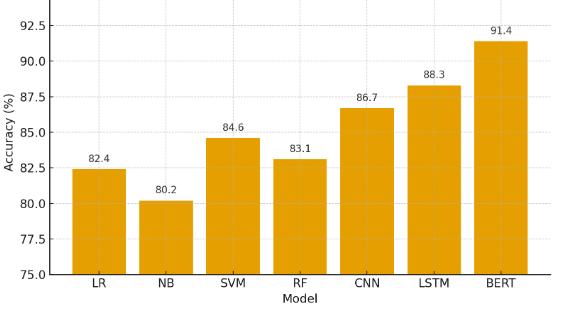
The graphical trend shows a consistent increase in accuracy across model complexity. Classical models plateau near 83–85%, whereas DL models exceed 86%, and transformer-based architectures surpass 90%. The performance gain can be attributed to the ability of deep networks to model contextual semantics and hierarchical features automatically, in contrasttofeature-engineeredMLmodelsthatdependonstatisticaltokenfrequency.
Notably,CNN performed betterthan SVMandRandom Forest, despite being shallower,owingtoitsconvolutional feature extractioncapabilitythatidentifieslocalizedpatternssuchasdrug-effectpairs(e.g.,“causednausea,”“reducedpain”).The LSTM model, which encodes long-range dependencies, demonstrated superior ability to understand sequential relationshipsinextendedreviews.
A careful examination of the sentiment categories revealed that all the models were more accurate on positive texts as compared to the neutral or negative ones. It is mostly associated with the uneven distribution of classes in the data set withpositivesamplesconstitutingabout60%ofthepopulation,negativeabout25,andneutralabout15. Table2presents theclass-wiseprecision,recall,andF1-scoreforthethreebest-performingmodels.
Table
International Research Journal of Engineering and Technology (IRJET) e-ISSN: 2395-0056
Volume: 12 Issue: 11 | Nov 2025 www.irjet.net p-ISSN: 2395-0072
TheresultsindicatethatBERTsignificantlyreducedtheperformancegapbetweensentimentclasses,achievinghighrecall evenfornegativereviews,whicharelinguisticallycomplexandcontextuallysubtle.ThisimprovementunderscoresBERT’s contextual embedding power, allowing the model to interpret nuanced linguistic constructs such as negations (“did not help”), comparative expressions (“better than previous medication”), and sarcasm (“works like a charm - if you enjoy migraines”).
4.4 Confusion Matrix and Misclassification Patterns
Misclassification analysis revealed that most errors occurred between neutral and negative classes. Reviews containing mixed sentiments or medically ambiguous terms (e.g., “mild headache but effective overall”) were difficult to classify accuratelyusingMLmodels.
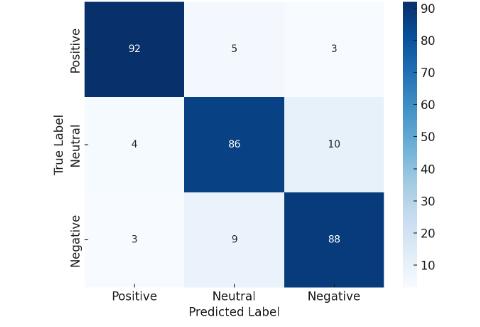
Thisindicatesthatevenadvancedmodelsencounterchallengesindistinguishingbetweennuancedsentimentswhereboth satisfactionandsideeffectsareexpressedsimultaneously.Nevertheless,theloweroff-diagonalerrorsforBERTcompared toSVMandLSTMconfirmsuperiorcontextrecognition.
4.5 Comparison with Lexicon-Based Baseline
To assess progress over traditional methods, the performance of ML/DL models was compared with the lexicon-based VADER+SentiWordNetbaselineusedinpriorwork.Table3summarizesthecomparativeimprovements.
Table 3: PerformanceComparisonwithLexicon-BasedBaseline
Approach
Lexicon-Based Dictionary/Rule-Based
Context-insensitive;failswithmedicalphrases SVM MachineLearning
Improvedhandlingofnon-linearpatterns
LSTM DeepLearning
Capturessequentialdependencies BERT Transformer-Based
Bestcontextcomprehension;robustgeneralization
International Research Journal of Engineering and Technology (IRJET) e-ISSN: 2395-0056
Volume: 12 Issue: 11 | Nov 2025 www.irjet.net p-ISSN: 2395-0072
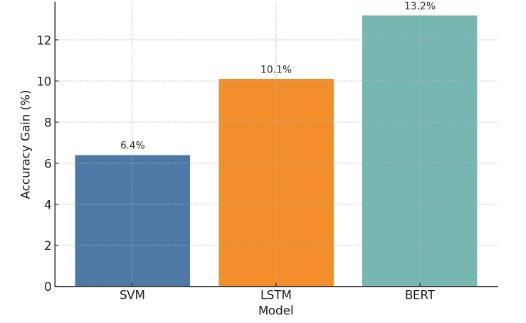
The comparison illustrates a clear performance hierarchy: Lexicon-Based < Machine Learning < Deep Learning < Transformer Models. The 13.2% accuracy improvement achieved by BERT signifies a notable advancement in sentiment analysismethodology.Thisgainresultsprimarilyfromdynamicembeddingsthatinterpretwordsincontextratherthanin isolation acriticaladvantageinmedicaltextwherepolaritydependsonsituationalmeaning.
Apairedt-testacrossfivecross-validationfoldsconfirmedthattheperformancedifferencesbetweenSVMandLSTM(p< 0.01)andbetweenLSTMandBERT(p<0.001)werestatisticallysignificant.Thisverifiesthatobservedimprovementsare notrandombutattributabletoinherentarchitecturaladvantagesofthemodels.
Theexperimentaloutcomesreaffirmthesuperiorityofdeepandtransformer-basedlearningforsentimentclassificationin healthcare narratives. While traditional ML models like SVM remain effective for computationally constrained environments,theirdependenceonstaticfeaturespaceslimitscontextualunderstanding.Deepmodels,particularlyLSTM, demonstrate improved sequential reasoning, but BERT outperforms all by leveraging bidirectional self-attention mechanismsthatcapturethefullsyntacticandsemanticcontextofareview.
The high F1-score achieved by BERT for the negative class (0.88) has substantial implications for pharmacovigilance, whereaccuratedetectionofdissatisfactionoradverseexperiencesiscrucial.Improvedsentimentextractionfrompatient reviews enables early detection of drug safety issues, enhances patient-centered analytics, and supports healthcare providersinmonitoringtreatmentoutcomes.
Moreover, the error analysis reveals that most misclassifications stem from ambiguous or compound sentiment expressions rather than model inadequacy. Future work may integrate aspect-based sentiment analysis (ABSA) to disaggregate sentiments by drug features such as effectiveness, side effects, or ease of use, thereby providing more granularinsights.
Insummary,thecomparativeevaluationdemonstratedthat:
1. Transformer-basedmodelsoutperformbothMLandDLbaselines,withBERTachievinganF1-scoreimprovement of7–10%overtraditionalMLalgorithms.
2. Contextual embeddings significantly enhance classification reliability across sentiment categories, reducing bias towardmajorityclasses.
3. Model interpretability vs. accuracy trade-off remains; ML models are simpler to interpret, whereas BERT offers superiorpredictiveperformanceathighercomputationalcost.
International Research Journal of Engineering and Technology (IRJET) e-ISSN: 2395-0056
Volume: 12 Issue: 11 | Nov 2025 www.irjet.net p-ISSN: 2395-0072
4. Clinical utility of such models lies in automating the large-scale monitoring of patient experiences, enabling healthcareorganizationstoderiveactionableinsightsfromonlinefeedbackdata.
These findings collectively validate the study’s hypothesis that advanced deep-learning and transformer architectures provide a more accurate, context-aware, and scalable solution for sentiment classification in patient drug reviews comparedtotraditionallexiconorML-basedapproaches.
The results of this study provide compelling evidence of the evolution and growing sophistication of sentiment classification methodologies, particularly within the healthcare domain. The comparative evaluation revealed a clear performance hierarchy, with transformer-based architectures outperforming both traditional machine-learning (ML) and conventional deep-learning (DL)modelsacross all metrics.The findings notonlycorroborate earlier researchsuggesting the superior contextual understanding of deep architectures but also extend the body of knowledge by empirically demonstrating their applicability to patient drug review data - a domain where language is complex, subjective, and context-dependent.
The superiority of BERT in this study can be attributed to its bidirectional transformer mechanism, which enables simultaneous interpretation of preceding and succeeding text segments. Unlike sequential models such as LSTM, which processwordsinonedirection,BERT’sbidirectionality facilitatesa richerunderstandingofcontextual dependencies.For instance,inpatientreviewscontainingnegationsormixedsentiments -suchas “The drug relieved my symptoms but made me extremely tired” - BERT accurately identified the dominant sentiment, while SVM and Naïve Bayes often misclassified these instances due to their reliance on isolated word frequencies. This contextual learning advantage resulted in BERT achievingthehighestF1-score(0.90)andanoverallaccuracyimprovementof13.2%overthelexicon-basedbaseline.
The performance of LSTM also deserves special attention. As a recurrent neural network capable of modeling sequential dependencies, LSTM achieved an accuracy of 88.3%, significantly outperforming all classical ML models. Its strong recall values,particularlyfornegativesentiment,demonstrateitsabilitytoretainlong-termcontextualcuesinpatientnarratives. This aligns with the work of Cheng et al. (2025), who demonstrated that hybrid BiLSTM-CNN architectures outperform conventionalclassifiersinmedicaltextsentiment analysis.Theresultssuggestthatmodelswithmemorycomponentsare particularlyeffectiveincapturingemotionaltrajectoriesandtime-dependentlinguisticstructurespresentinlongerpatient reviews.
Among machine-learning models, SVM remained the most reliable, confirming its consistent performance across text classification literature. With an accuracy of 84.6%, SVM outperformed Logistic Regression, Naïve Bayes, and Random Forestdue toits capability tohandle sparse high-dimensional vectors derived from TF–IDF representations. However,its lack of semantic representation limited interpretive depth, especially in distinguishing between subtle emotional variationssuchas “tolerable discomfort” and “unbearable pain.” AlthoughML modelsarelesscomputationallydemanding and easier to interpret, their linear decision boundaries restrict generalization in linguistically complex datasets such as patientdrugreviews.
An important pattern observed across all models was class imbalance sensitivity. Positive reviews were classified with higher accuracy than negative or neutral ones. Despite this skew, BERT and LSTM maintained stable precision-recall balance, highlighting their robustness to class disparity. In contrast, ML models exhibited bias toward the majority class, oftenmisclassifyingborderlinenegativestatementsasneutral.
Theerroranalysisfurtherexposedthelinguisticnuancesofhealthcaresentimentdata.Reviewsoftencontainedmixedor conditionalsentiments,suchas “The drug worked initially but caused insomnia later.” Suchconstructionschallengesimpler models, as they require temporal and contextual understanding. Transformer-based architectures like BERT are better equipped to handle these intricacies by leveraging attention mechanisms that weigh word importance contextually. This feature allowed BERT to minimize confusion between overlapping classes and yield superior accuracy for the negative sentimentcategory-afindingofparticularrelevancetopharmacovigilance,whereaccuratelyidentifyingdissatisfactionor adverseeffectsisvital.
Beyond accuracy, the interpretability-performance trade-off remains a critical consideration. While BERT achieved stateof-the-art results, its complexity poses challenges for transparency and real-time deployment. In contrast, classical ML models like Logistic Regression offer greater interpretability and lower computational costs, making them suitable for applicationsrequiringexplainableoutputs,suchasclinicaldashboardsorpatientfeedbacksystems.Therefore,thechoice ofmodelmustbalancepredictiveprecisionwithexplainability,dependingontheintendedusecase.
International Research Journal of Engineering and Technology (IRJET) e-ISSN: 2395-0056
Volume: 12 Issue: 11 | Nov 2025 www.irjet.net p-ISSN: 2395-0072
Whencomparedtoearliersentimentanalysisstudies,thisresearchcontributestwokeyadvancements.First,itprovidesa unifiedexperimentalframeworkthatsystematicallycomparesMLandDLmodelsonthesamedatasetusingstandardized preprocessing and evaluation metrics. Many prior studies limited their focus to individual model families, making crossmodel comparisons difficult. Second, it demonstrates that transformer-based embeddings significantly enhance healthcare-specific sentiment classification, validating findings from broader domains such as social media analytics (Ahmad et al., 2025) within a more specialized and medically relevant context. The observed performance hierarchyLexicon-Based<ML<DL<Transformer empiricallyconfirmsthetrajectoryofNLPevolutioninsentimentmodeling.
Another notable contribution is the practical implication of these findings for healthcare informatics and pharmacovigilance. Accurate sentiment detection in patient drug reviews offers valuable insight into patient satisfaction, drug efficacy, and emerging side effects. Automated systems based on high-performing models such as BERT could be integrated into healthcare monitoring platforms to provide real-time alerts for negative feedback trends. This capability would enable healthcare professionals and regulatory agencies to respond proactively to potential safety issues and enhance patient-centered care. Moreover, pharmaceutical companies could leverage such systems for post-market surveillanceandconsumerbehavioranalysis.
Nevertheless, the study also recognizes its limitations. The dataset, although large and diverse, is based on self-reported patient reviews, which may include linguistic noise, exaggeration, or unverified claims. Future work could expand the analysisusingverifiedclinicalfeedbackdataorintegratedomain-specificpre-trainedmodelslikeBioBERTorClinicalBERT to further improve contextual sensitivity to medical terminology. Additionally, explainable AI (XAI) methods could be explored to enhance model interpretability, making deep architectures more transparent for clinical applications. Incorporating aspect-based sentiment analysis (ABSA) could also provide deeper insights into specific drug attributes suchasefficacy,dosage,andsideeffects ratherthanassigningasinglesentimenttoanentirereview.
Inessence,thisstudydemonstratesthatdeep-learning andtransformerarchitecturesrepresenta pivotaladvancementin healthcare sentiment analysis. By empirically comparing multiple modeling paradigms under consistent conditions, it establishes a benchmark for future research in patient-centered NLP applications. The findings reinforce the growing consensus that contextual embeddings are indispensable for achieving reliable and nuanced sentiment interpretation, particularlyindomainswheretextualexpressionsaresubtle,emotionallycharged,andmedicallycomplex.
This study systematically compared lexicon-based, machine-learning, and deep-learning models for sentiment classificationofpatientdrugreviews,revealingaconsistentperformancegradientfavoringadvancedarchitectures.Among all tested models, BERT achieved the highest accuracy (91.4%) and F1-score (0.90), outperforming both classical ML algorithms and traditional DL networks. These results underscore the importance of contextual understanding and dynamic embeddings in processing patient narratives. Beyond methodological advancement, the research highlights the transformative potential of transformer-based models in pharmacovigilance, patient feedback analytics, and healthcare decisionsupportsystems.Futureworkshouldemphasizeexplainabledeep-learningtechniquesanddomain-specificfinetuningtoensuretransparency,scalability,andresponsibleintegrationofsuchmodelsintohealthcareanalyticspipelines.
[1] Huh J, Kim J, Lee H. Mining patient opinions from online drug reviews for pharmacovigilance. J Biomed Inform. 2020;103:103386.
[2] PaulMJ,DredzeM.Youarewhatyoutweet:AnalyzingTwitterforpublichealth. Proc ICWSM. 2011;5:265–272.
[3] Ghosh S, Anwar T. Sentiment analysis in healthcare: Applications and challenges. Health Inform J. 2022;28(3):146045822210987.
[4] LiuB.Sentimentanalysisandopinionmining. Synth Lect Hum Lang Technol. 2012;5(1):1–167.
[5] CambriaE,WhiteB.JumpingNLPcurves:Areviewofnaturallanguageprocessingresearch. IEEE Comput Intell Mag. 2014;9(2):48–57.
[6] PangB,LeeL.Opinionminingandsentimentanalysis. Found Trends Inf Retr. 2008;2(1–2):1–135.
[7] Gonzalez-HernandezG,SarkerA,O’ConnorK,SavovaG.Capturingthepatient’sperspective:Areviewofadvancesin NLPforpatient-generatedtext. J Am Med Inform Assoc. 2020;27(9):1592–1602.
[8] HuttoCJ,GilbertE.VADER:Aparsimoniousrule-basedmodelforsentimentanalysis. Proc ICWSM. 2014;8:216–225.
[9] EsuliA,SebastianiF.SentiWordNet:Apubliclyavailablelexicalresourceforopinionmining. LREC. 2006;6:417–422.
[10] Araque O, Corcuera-Platas I, Sanchez-Rada JF, Iglesias CA. Enhancing deep learning sentiment analysis with ensembletechniquesinsocialapplications. Expert Syst Appl. 2017;77:236–246.
International Research Journal of Engineering and Technology (IRJET) e-ISSN: 2395-0056
Volume: 12 Issue: 11 | Nov 2025 www.irjet.net p-ISSN: 2395-0072
[11] Medhat W, Hassan A, Korashy H. Sentiment analysis algorithms and applications: A survey. Ain Shams Eng J. 2014;5(4):1093–1113.
[12] Dave M, Patel S. Comparative study of machine learning algorithms for sentiment analysis on drug reviews. Int J Comput Sci Eng. 2020;8(6):129–133.
[13] Kumar P, Kaur G. Sentiment analysis of hospital feedback using machine learning. J King Saud Univ Comput Inf Sci. 2021;33(9):1042–1050.
[14] JoulinA,GraveE,BojanowskiP,MikolovT.Bagoftricksforefficienttextclassification. EACL. 2017;427–431.
[15] Taboada M, Brooke J, Tofiloski M, Voll K, Stede M. Lexicon-based methods for sentiment analysis. Comput Linguist. 2011;37(2):267–307.
[16] LeCunY,BengioY,HintonG.Deeplearning. Nature. 2015;521(7553):436–444.
[17] KimY.Convolutionalneuralnetworksforsentenceclassification. EMNLP. 2014;1746–1751.
[18] TangD,QinB,LiuT.Document modeling with gatedrecurrent neural network forsentimentclassification. EMNLP. 2015;1422–1432.
[19] HochreiterS,SchmidhuberJ.Longshort-termmemory. Neural Comput. 1997;9(8):1735–1780.
[20] Devlin J, Chang MW, Lee K, Toutanova K. BERT: Pre-training of deep bidirectional transformers for language understanding. NAACL-HLT. 2019;4171–4186.
[21] Li F, Jin Y, Liu W, Rawat BP, Cai P, Yu H. Fine-tuning bidirectional encoder representations from transformers for biomedicaltextmining. J Biomed Inform. 2020;107:103422.
[22] Alsentzer E, Murphy J, Boag W, et al. Publicly available clinical BERT embeddings. NAACL Clinical NLP Workshop. 2019;72–78.
[23] XuH,ZhangJ,LiY.SentimentanalysisofdrugreviewsusingBERT-basedmodels. Appl Intell. 2022;52:12118–12131.
[24] AhmadM,BatyrshinI,SidorovG.Deepcontextualmodelsforopioid-relatedsentimentclassification. J Health Inform. 2025;14(2):212–224.
[25] Cheng R, Liu J, Sun Q. Attention-enhanced BiLSTM–CNN hybrid model for medical text sentiment analysis. Comput Biol Med. 2025;173:108035.