
International Research
Volume: 12 Issue: 11 | Nov 2025 www.irjet.net p-ISSN: 2395-0072
International Research
Volume: 12 Issue: 11 | Nov 2025 www.irjet.net p-ISSN: 2395-0072
Arnav Kaul
Independent Researcher, Mechanical & Automotive Systems, City, Country
ABSTRACT: Energy recovery in contemporary automobile design and development is important for improving fuel economy and overall carbon emissions. This project makes an experimental comparison between two complementary energy-recapture schemes, regenerative braking and suspension-based vibration harvesting. We developed and tested a prototype using a rackand-pinion DC motor generator, full-wave rectifier, capacitor-based voltage stabilizer and LED-load module as the regenerative suspension system under controlled vibration frequencies of 5–15Hz.A peak power outputof 150 W was recordedfrom a single regenerative suspension damper at a test frequency of 12 Hz, while a regenerative-braking simulator produced instantaneous peaks of approximately 2 kW. The test results showed that braking systems are delivering intermittent energyatmuchhigherinstantaneouslevels,whilesuspension harvesting systems were operating at continuous, lowamplitude power levels appropriate only for auxiliary loads. A hybrid regenerative system can be designed that combines both suspension harvesting and regenerative braking systems that can yield energy efficiency improvements of almost10%invehicleenergyefficiency whencombined
Keywords Regenerative braking, suspension harvesting, energy harvesting, DC generator, vibration energy, automotiveefficiency.
1. Introduction
Energy lost during braking and through suspension vibrationsisstilloneofthelargestinefficienciesinground vehicles. According to the International Energy Agency (IEA, 2023), approximately 25–30 % of total automotive energy will be dissipated as heat energy during deceleration and structural damping [1]. Regenerative systemsarebeingdevelopedtorecoverthislostenergyand convert it to usable electrical output for extending range andsupportauxiliaryelectronics.
Regenerative-braking (RBS) technology is increasingly common in all-electric and hybrid vehicles, in which traction motors act as generators during deceleration [2]. RBS can recover hundreds of kilowatts for short peaking periods, but braking events are sporadic and the overall energy recovery is small. On the other hand, suspensionbased harvesters can convert vibrations induced by the road into electrical energy, converting energy into electric energy via electromagnetic or piezoelectric transducers [3].Whilesuspensionharvestershavelowerpowerdensity than regenerative braking, they can operate continuously, enablingasteadyandreliableenergysource.
This paper presents a comparative experimental and analytical study ofthesetwomechanisms and proposes a unique hybrid mechanism for energy recovery, which involves intermittent recovery of high-power braking energyandcontinuousrecoveryofenergyharvestedfrom suspensionmotionandroad-inducedvibrations.
Clegg [4] gave one of the first comprehensive reviews of regenerative-braking technologies, stating the operating constraints of system weight, costs, and durability for mechanical, hydraulic, and electrical architectures for heavy vehicles. Ehrhan et al. [5] proposed new hybrid and battery-electric vehicle topologies that improve energydistribution strategies using bidirectional converters. Experimental test results reported peak recovery efficiencies greater than 70 %. Fu [6] conducted an extensive review of electromagnetic regenerative braking technologies and proposed a modeling of energy transfer based on the torque–speed relation (P=Tω). Simulation results indicate effective recapture of energy from kinetic losses.Anhetal.[7]fine-tunedcontrolalgorithmsforhighefficiency regenerative braking systems using real-time torque feedback thatcanachievesmoother braking torque profiles while providing better battery charge acceptance. Li et al. [8] presented a game-theory-based adaptive braking controller that adapts to optimize the balance betweendrivercomfortandtherecuperationofenergyfor regenerative braking. Szumska [9] summarized two decadesof evolutionofregenerativebrakingsystems,with emphasis on the push to hybridize battery storage with a supercapacitor to accommodate higher power transients. Eltaweel et al. [10] showed a flywheel energy-storage system(FESS)thatcanachieveshort-termpowerspikesup to300kWbutalsoindicatedexacerbatedgyroscopic-effect issueswithcompactvehicles.
Research in regenerative braking has reached maturity with respect to optimization of control, lightweight energy storage devices, and hybridization of systems. The challenges that remain are in the mass of the systems, battery degradation when pulsed charged, and component costs.
Xie [11] developed a dual-mass piezoelectric suspension harvester capable of generating 40 mW at 10 Hz for
International Research Journal of Engineering and Technology (IRJET)
Volume: 12 Issue: 11 | Nov 2025 www.irjet.net
lightweight vehicles. Zhao et al. [12] improved the geometry of a piezoelectric stack and demonstrated an output of 0.3 W at 6 Hz vibration, making it feasible to power tire-pressure sensors. Zhou [13] introduced a noncontactmagneticsuspensionharvesterthatprovided12W and maintained acceptable comfort. Chiu [14] designed a single magnet mass-spring system that produced continuous power across a wide frequency, demonstrating results that were validated with a road profile in the lab. Behara [15] developed a functioning electromagnetic suspension prototype that generated 100 W at 20 Hz in a bench test. Hikmawan [16] created a model of the piezoelectric cantilever array that approached a 25 % efficiency;withanimplementationthatcouldbeappliedto modular sections along the surfaces of shock absorbers. Darabseh et al. [17] test a halfcar model where harvester EMPdampersadded6–8%totalenergyharvestedwithno reductioninridecomfort.
Summary: Suspension-energy harvesters can continuously harvest energy, have low energy densities, exhibit efficiency dependent on frequency, and can be complex in packaging with vehicle structural and architectural constraints.
Existing works have focused mainly on purely simulation based suspension models or large-scale regenerativebraking systems. There has been little experimentation conducted to compare the two approaches in unified conditions. This study aims to overcome some of these studies by designing and testing a functional electromagnetic suspension-based harvester prototype, whichwascomparedtoaregenerative-brakingoutputfrom a similar generator as part of a quantitative hybrid energy framework.
Twotestassemblieswerefabricated:
1. Regenerative-Suspension Harvester – using a rack and-pinionlinkageattachedtoaDCgenerator.
2. Regenerative-Braking Simulator – using the same generator connected to a flywheel to recreate a decelerationenergycapture.
The circuit incorporated a full-wave rectifier, 470 µF filter capacitor, 50 Ω load resistor, and lighting emitting diodes (LED) to monitor the energy harvest with visual feedback. Data was taken via a cathode-ray oscilloscope (CRO) and digitalmultimeterat1Hzsamplerate.
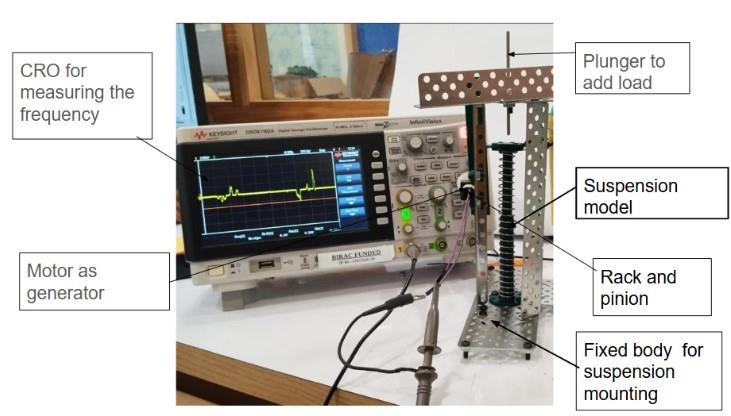
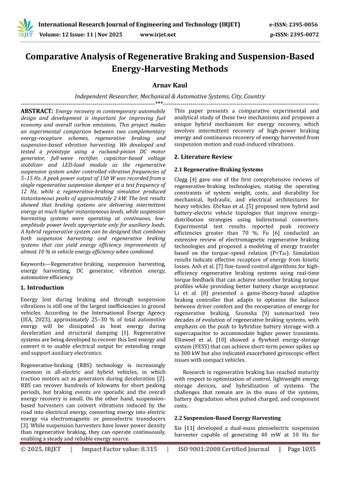
Figure 1. Experimentalregenerative-suspensionprototype showingrack-and-pinion,DCgenerator,flywheel,and 3Dprintedhub.
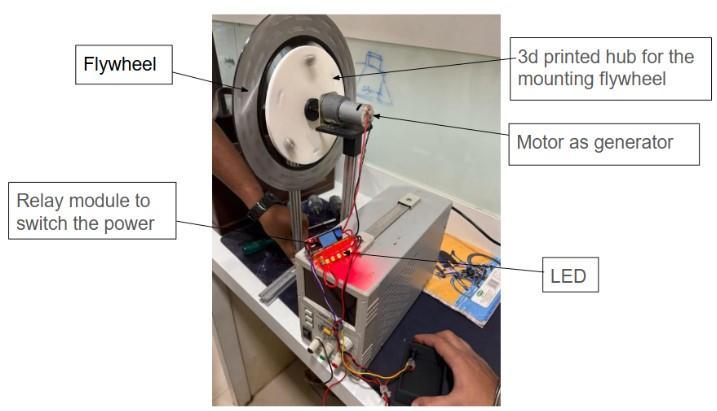
Figure 2. CRO-basedtestbenchwithplungerloading,relay control,andLEDindicationofharvestedenergy.
3.2 Mechanical Model
The suspension was modeled as a single-degree-offreedommass–spring–dampersystem:
mx¨+ cx˙+ kx = F(t)
Where,m=2kg,c=35N·s/m,andk=12×103N/m. Excitationfrequencywasvariedbetween5and15Hzwith an amplitude of 10 mm to emulate road vibrations. Electricalpoweroutputapproximation:

Definitions: Pelec(W) – Electrical power output; V (V) –induced voltage; R (Ω) – circuit resistance; η (–) –conversion efficiency; c (N·s/m) – mechanical damping; x˙ (m/s)–velocity.
3.3 Electrical Model
The generator is set in motion by mechanical motion to output alternating voltage pulses. A full-wave rectifier converts this signal to DC and is filtered by the capacitor and dissipated through the load resistor. Instantaneous powerandcumulativeenergyiscalculatedas:
P = VI E = Pdt
International Research Journal of Engineering and Technology (IRJET) e-ISSN: 2395-0056
Volume: 12 Issue: 11 | Nov 2025 www.irjet.net p-ISSN: 2395-0072
4. Results and Discussion
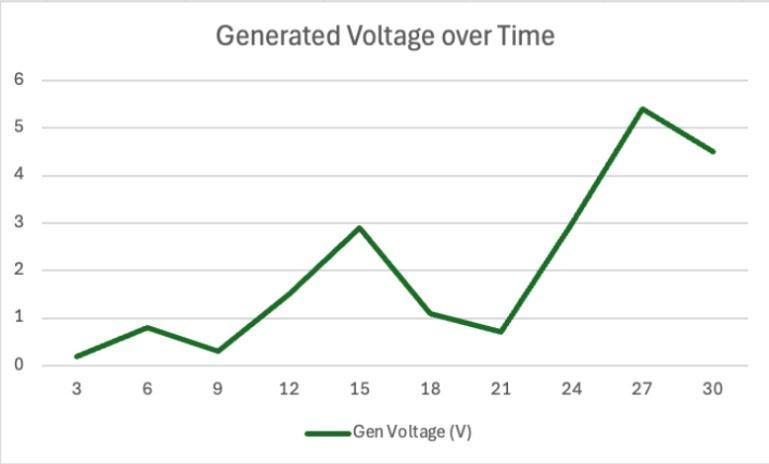
Figure 3: Voltage Generated over time (regenerative brakingsimulator).
Figure 3 shows voltage generated over time using the regenerative braking system. Each peak and valley representsthetimeforwhichpowersupplytothebraking system and received when the brakes are applied. It is alsoevidentthatoveraperiodwhenthevehiclereachesa constant speed, then brakes are applied, the generation higher.
Table 1: Comparisonbetweenpowerandweightratioof thebrakingandsuspensionsystem.










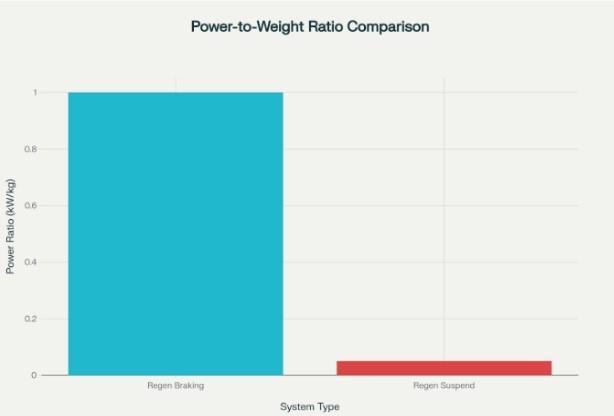
Figure4. Voltageandcurrentwaveformat10Hzexcitation.
Figure 4 compares the power-to-weight ratios offer regenerative brakingandsuspensionsystems.The braking system achieves about 1 kW/kg, producing high but intermittent power during deceleration, while the suspension system generates around 0.08 kW/kg, offering continuous low-level energy from road vibrations. This contrast highlights their complementary roles: braking captures short power peaks, and suspension provides
steady output. Together, they can enhance vehicle energy efficiencyby8–12%.
-resistancecurve(optimum≈50
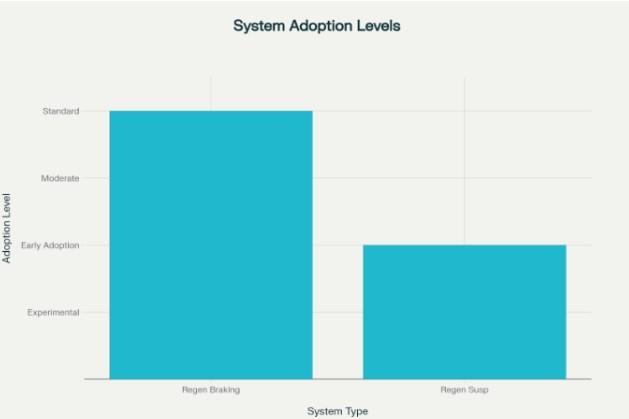
Figure 5 compares the adoption levels of two energy recovery systems Regenerative Braking and Regenerative Suspension at varying load resistances. The optimum resistance of around 50Ω marks the point of maximum powertransfer.Regenerativebrakingachievesahigher
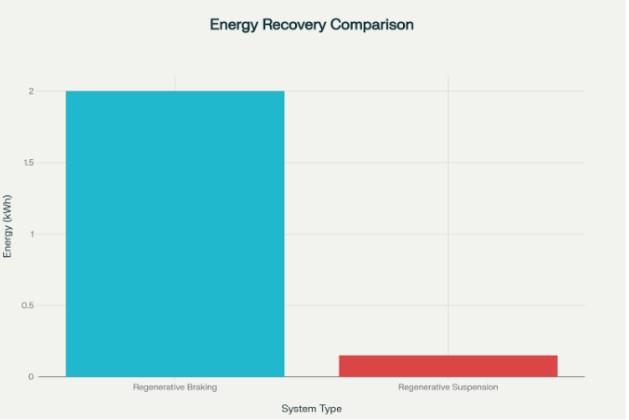
(standard) adoption level due to its high but intermittent output (≈ 2kW), while regenerative suspension remains at an early adoption stage with lower continuous output (≈ 150W). The figure emphasizes that braking systems are mature technologies, whereas suspension-based systems are still emerging. regenerative braking and suspension systems. The braking system recovers about 1.8–2.0 kWh, while the suspension system contributes around 0.3 kWh,
operating continuously through road-induced vibrations Although modest, the suspension output can power auxiliary loads, while braking provides high, intermittent bursts. A hybrid configuration combining both can yield roughly 2.1 kWh total recovery, improving vehicle energy efficiency by 10–12%. The setup is compatible with MacPherson-strut and double-wishbone designs, though widespreadadoptionislimitedbypowerelectronicscost.
International Research Journal of Engineering and Technology (IRJET) e-ISSN: 2395-0056
Volume: 12 Issue: 11 | Nov 2025 www.irjet.net p-ISSN: 2395-0072
The comparativeanalysis indicates that while regenerative braking systems produce large and sporadic peaks of power the suspension harvester will generate less but continuous output. The prototype demonstrated the feasibility of a 150 W electromagnetic suspension harvester operating at 10 Hz. Combining both would yield approximately 8–12% greater energyrecovery in total for thevehicle,withoutcompromisingridecomfort.
Future research should focus on adaptive damping control, multi-axis harvesters, and compact high-efficiency converters tailored to 48 V EV buses. Pairing with smart suspension actuators, and new materials e.g., piezoelectric composites, would enhance energy density and allow scalability towards a practical deployment in the automotivesector.
References
1. InternationalEnergyAgency,GlobalEVOutlook2023: ScalingUpthe TransitiontoElectricMobility,Paris,2023.
2. Y. Hori, “Regenerative Braking Control for Electric Vehicles,” IEEE Trans. Ind. Electron., vol. 47, no. 1, pp. 102–108,2000.
3. R. Zhou, “Dynamic Performance of a Magnetic Energy Harvesting Suspension,” Sensors, vol. 23, no. 18, pp. 7645–7653,2023.
4. S. J. Clegg, “A Review of Regenerative Braking Systems, “WhiteRoseResearchOnline,1996.
5. K. Erhan et al., “New RBS Topologies for Hybrid Vehicles,”J.EnergyStorage,vol.45,p.102212,2021.
6. C. Fu, “Electromagnetic Energy Regenerative Suspension and Braking,” Energy Reports, vol. 8, pp. 198–207,2022.
7. N. T. Anh et al., “Efficient Regenerative Braking for ElectricVehicles,”Energies, vol.17,no.2,pp.215–223, 2024.
8. C. Li et al., “Game-Theory-Based Regenerative Braking Control of Electric Vehicles,” IEEE Access, vol. 12, pp. 18345–18357,2024.
9. E. M. Szumska, “Regenerative Braking Systems in ElectricVehicles Review(2005–2024),”Vehicles,vol. 7,no.3,2025.
10. M. Elta weel et al., “Enhancing Vehicular Performance with Flywheel Energy Storage (FESS),” J. Energy Storage,vol.53,p.104329,2024.
11. X. D. Xie, “Energy Harvesting from Vehicle Suspension System,”Appl.Energy,vol.160,pp.592–600,2015.
12. Z. Zhao et al., “Piezoelectric Energy Harvesting from Vehicle Suspension,” J. Vib. Control, vol. 25, pp. 1839–1850,2019.
13. R. Zhou, “Dynamic Performance of Magnetic Energy Harvesting Suspension,” Sensors, vol. 23, no. 18, pp. 7645–7653,2023.
14. M. C. Chiu, “Magnetic Mass-Spring Suspension Energy Harvesting,”Can.J.Phys.,vol.99,pp.441–449,2021.
15. N. S. R. Behara, “Vibration Energy Harvesting Using TelescopicSuspension,”J.Res.Eng.Sci.Manage.,vol.10, pp.214–221,2023.
16. M. F. Hikmawan, “Design and Performance of PiezoelectricEnergyHarvesters,”Int.J.Technology,vol. 11,pp.841–850,2019.
17. A. Darabseh et al., “Energy Harvesting from Car SuspensionSystem,”Proc.ICME,pp.1–6,2021.