
International Research Journal of Engineering and Technology (IRJET) e-ISSN: 2395-0056
Volume: 12 Issue: 12 | Dec 2025 www.irjet.net p-ISSN: 2395-0072
International Research Journal of Engineering and Technology (IRJET) e-ISSN: 2395-0056
Volume: 12 Issue: 12 | Dec 2025 www.irjet.net p-ISSN: 2395-0072
Prof. Shobha S Biradar1 , Soumya Nasi2
1 Professor, Master of Computer Application, VTU, Kalaburagi , Karnataka ,India
2 Student, Master of Computer Application, VTU, Kalaburagi , Karnataka ,India
ABSTRACT- Audio fingerprinting has become a fundamental technology for music recognition, copyright protection,andaudioforensics.Traditionalapproachesrely on handcrafted signal processing techniques such as spectrogramanalysis,Chromafeatures,andMFCCs,which oftensufferfromreducedaccuracyundernoisyconditions, pitch or tempo variations, and overlapping audio sources. RecentadvancesinArtificialIntelligence(AI)andMachine Learning(ML)havesignificantlyimprovedtherobustness andprecisionofaudiofingerprintingsystems.Deeplearning models,includingConvolutional Neural Networks(CNNs), Recurrent Neural Networks (RNNs), and Transformers, enable extraction of noise-invariant and semantically rich features from audio signals. Self-supervised learning frameworksfurtherenhancerepresentationqualitywithout the need for extensive labeled data. Metric learning techniques,suchasSiameseandTripletnetworks,provide powerfulembeddingspacesforefficientandaccurateaudio matching. Hybrid architectures that integrate traditional signal processing with deep embeddings also address scalabilitychallengesinlarge-scalemusicdatabases.
Keyword: Audio Fingerprinting, Artificial Intelligence, MachineLearning,DeepLearning,Spectrogram,Feature Extraction, Metric Learning, Audio Recognition, SelfSupervised Learning, Audio Forensics
Audiofingerprintingisapowerfultechniquethatenablesthe identification of audio content by generating compact, distinctivedigital representationsofsoundsignals.Unlike raw audio files, fingerprints are lightweight, resilient to distortions,anduniquelyassociatedwithspecificrecordings. Thismakesfingerprintingessentialindiverseapplications suchasmusicrecognition,copyrightenforcement,broadcast monitoring,audioforensics,andsmartdevices.
Conventional fingerprinting systemslargely relyonsignal processingtechniquessuchasspectrogrampeakdetection, Chroma features, and Mel-frequency costrel coefficients (MFCCs). While these approaches are efficient and computationallylightweight,theyfacesignificantchallenges when audio undergoes transformations like background noise, pitch and tempo alterations, reverberation, or overlappingsources.Suchlimitationsreducetheiraccuracy andreliabilityinreal-worldconditionswhereaudiorarely existsinpristineform.
RecentadvancesinArtificialIntelligence(AI)andMachine Learning(ML)aretransformingaudiofingerprintingintoa more robust and intelligent technology. Deep learning models,particularlyConvolutionalNeuralNetworks(CNNs), RecurrentNeuralNetworks(RNNs),andTransformers,have demonstratedremarkableabilitytoextracthigh-level,noiseinvariant features from audio signals. Moreover, selfsupervisedlearning(SSL)frameworkssuchaswav2vec2.0 and Hubert enable the learning of rich representations without requiring large labeled datasets. Metric learning techniques,includingSiameseandTripletnetworks,further enhanceaccuracybymappingsimilaraudiosignalscloser togetherintheembeddingspace,regardlessofdistortions.
TheintegrationoftheseAI-drivenmethodsaddresseskey limitationsoftraditionalsystems,offeringgreaterresilience, scalability,andadaptability.Asaresult,audiofingerprinting isevolvingintoaversatileandintelligentsolutioncapableof supportingapplicationsatglobalscale.However,challenges remaininbalancingaccuracy,computationalefficiency,and real time performance for deployment in large-scale and resource-constrainedenvironments.
Noise Sensitivity: Background noise, reverberation, and environmentaldistortionssignificantlyreducerecognition accuracy.TransformationVulnerabilityPitchshifts,tempo changes,orcompressiontechniquescanalterthefingerprint, leading to mismatches. Overlapping Audio Sources: When multiplesoundsoccursimultaneously,traditionalmethods struggle to extract reliable fingerprints. Scalability Issues: Searchingformatchesinmassivemusicoraudiodatabases is computationally challenging, often resulting in slower retrievaltimes. LackofRobustRepresentation:Handcrafted featuresfailtocapturehigh-levelsemanticcharacteristicsof audio,limitingrobustnessandadaptability.
The primary objective of this study is to design and implement an AI- and ML-enhanced audio fingerprinting system that achieves higher accuracy, robustness, and scalabilitycomparedtotraditionalapproachesTodevelop deeplearning-basedfeatureextractionmodels(e.g.,CNNs, RNNs,Transformers)capableofgeneratingnoise-invariant andtransformation-resilientaudiofingerprints.
To apply metric learning techniques (e.g., Siamese and Tripletnetworks)forcreatingembeddingspacesthatenable
International Research Journal of Engineering and Technology (IRJET) e-ISSN: 2395-0056
Volume: 12 Issue: 12 | Dec 2025 www.irjet.net p-ISSN: 2395-0072
accurate similarity matching of audio clips despite distortionsoralterations.Tointegratehybridapproachesby combiningtraditionalsignalprocessingtechniqueswithMLdriven embeddings for improved performance and computationalefficiency. Todesignandimplementscalable retrievalmechanismsusingApproximateNearestNeighbor (ANN) search for efficient matching in large-scale audio databases.
The methodology of this study outlines the systematic approachadoptedtodesign,implement,andevaluateanAIandML-basedaudio fingerprintingsystem. The process is dividedintomultiplestages,ensuringboththeoreticaland experimentalrigor.
DataCollectionandPreprocessing: Gatherdiverseaudio datasets consisting of music tracks, speech, and environmentalsounds.Applypreprocessingtechniquessuch as resampling, normalization, noise addition, and timestretchingtosimulatereal-worlddistortions.Segmentaudio signalsintofixed-lengthframesforfeatureextraction.
FeatureExtraction: Extracttraditionalhandcraftedfeatures such as Mel-Frequency Cepstral Coefficients (MFCCs), chromavectors,andspectralpeaksforbaselinecomparison. Generate spectrogram representations (STFT, Melspectrogram)fordeeplearningmodelinput.Implementdata augmentation(noiseinjection,pitchshift,tempovariation) toimprovemodelrobustness.
Deep Learning-Based Representation: Train ConvolutionalNeuralNetworks(CNNs)onspectrogramsto learnrobust,noiseinvariantfingerprints.ExploreRecurrent Neural Networks (RNNs) or Transformers for capturing temporaldependenciesinaudiosignals.Useself-supervised learning(SSL)models(e.g.,wav2vec2.0,HuBERT)forrich audio embeddings without requiring extensive labeled datasets.
Metric Learning and Similarity Matching: Implement Siamese Networks and Triplet Networks to create embeddings where similar audio clips are mapped closer togetherinvectorspace.Optimizelossfunctions(contrastive loss, triplet loss) to improve discrimination between different audio samples. Employ cosine similarity or Euclideandistanceforfingerprintcomparison.
Hybrid Model Integration: Combine traditional fingerprinting features with ML-based embeddings to achieve a balance between speed and robustness. Implement a multi-stage retrieval pipeline. Fast filtering usingtraditionalfeatures.Fine-grainedmatchingusingdeep learningembedding’s
Evaluation and Testing: Compare system performance against traditional fingerprinting methods. Test under
various real-world conditions: Noise levels, pitch/tempo variations,overlappingaudio.Evaluatesystemperformance usingmetricssuchasAccuracy,Precision,Recall,F1-score forrecognitionperformance.Latencyand memoryusagefor efficiencyanalysis. Performstresstestsonlargedatasetsto assessscalability.
Traditional Audio Fingerprinting Approaches Early fingerprinting systems relied on signal processing techniquestoextractcompactanddistinctivefeaturesfrom audiosignals.Wang(2003)introducedthelandmark-based fingerprintingsystem, whichdetectsspectral peaksin the audiospectrogramandstoresthemastime–frequencypairs. This approach became the foundation for commercial applications such as Shazam. Haitsma & Kalker (2002) developedasub-fingerprintsystemusingenergydifferences betweenfrequencybands,whichwasrobusttocompression but less resilient to noise. Cano et al. (2005) provided a comprehensive survey of traditional fingerprinting techniques, covering spectral peaks, wavelets, and MFCCbased approaches. While these methods are computationally efficient, they are vulnerable to noise, pitch/tempochanges,andoverlappingsignals,limitingtheir applicabilityinreal-worldconditions.
MachineLearninginAudioRepresentationMachinelearning has gradually been introduced into audio analysis to overcometheshortcomingsofhandcraftedfeatures. MFCC+ Classifiers:Earlyworksappliedmachinelearningclassifiers (e.g.,SVMs,KNNs)onMFCCfeaturesformusicidentification. However, performance gains were modest compared to traditional methods. Data Augmentation: Studies showed that training models with noisy and time stretched audio improvedrobustnessagainstenvironmentaldistortions.
DeepLearningforAudioFingerprintingDeeplearninghas significantlyadvancedfingerprintingbyenablingautomatic feature learning from raw or spectrogram-based inputs. CNN-based models (Choi et al., 2017) demonstrated that convolutionallayerscouldextractlocalizedtime–frequency patterns, yielding fingerprints robust to noise and compression.RecurrentNeuralNetworks(RNNs)wereused tocapturetemporaldynamicsinmusicsignals,improving recognitionundertempovariations.Self-SupervisedModels suchaswav2vec2.0(Baevskietal.,2020)andHuBERT(Hsu etal.,2021)enabledrepresentationlearningfromunlabeled audio,producingembeddingsthatoutperformhandcrafted featuresindownstreamtasks.
Metric Learning for Audio Matching Metric learning has emerged as a promising solution for similarity-based fingerprinting.SiameseNetworks(Bromleyetal.,1994;later adapted for audio) learn to map similar audio segments closer together in an embedding space. Triplet Networks (Schroff et al., 2015, originally for face recognition) have
International Research Journal of Engineering and Technology (IRJET) e-ISSN: 2395-0056
Volume: 12 Issue: 12 | Dec 2025 www.irjet.net p-ISSN: 2395-0072
been adapted for music retrieval, where anchor-positive pairsrepresentthesameaudiounderdifferentdistortions. Studiesshowthatembedding-basedapproachessignificantly outperform traditional fingerprints under noisy and overlappingconditions.
Hybrid and Scalable Fingerprinting Systems To balance accuracy with computational efficiency, hybrid methods have been explored Hybrid Fingerprinting Some systems combine handcrafted features for fast initial filtering with deepembeddingsforfine-grainedmatching.ScalableSearch: Large-scale retrieval challenges are addressed using ApproximateNearestNeighbor(ANN)searchlibrarieslike FAISSandAnnoy.CommercialSystemsYouTube’sContent IDuseshybridfingerprintingforcopyrightdetection,though itsimplementationisproprietary.
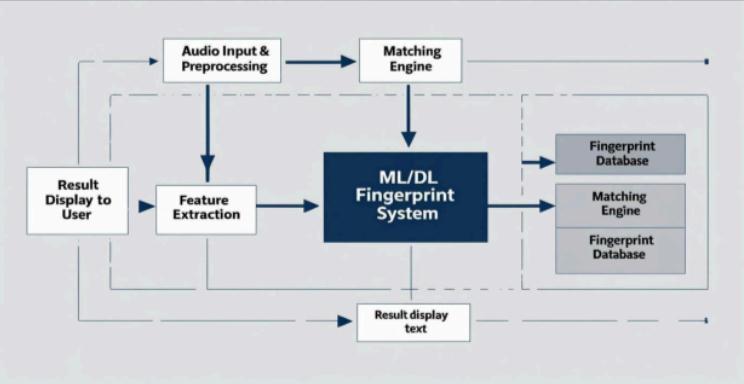
TheproposedAIandML-basedAudioFingerprintingSystem isdesignedasastandaloneapplicationwiththepotentialfor integration into larger platforms such as music streaming services,copyrightmonitoringsystems,andforensictools. The system is modular in nature, where each module performs a distinct function while ensuring smooth interactionwithothers.
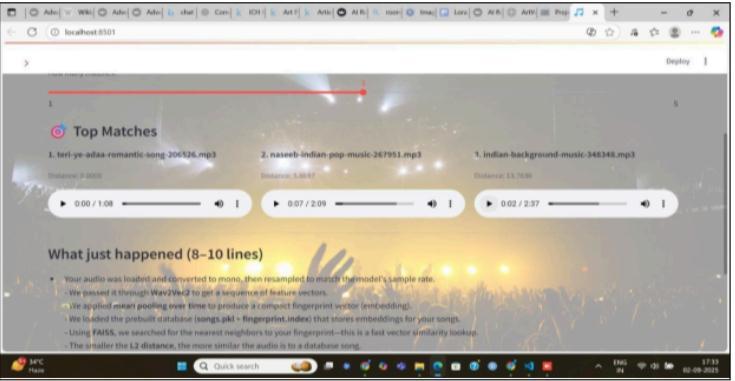
Position in the Environment: The system acts as an intermediary between the user (input audio) and the fingerprintdatabase(storage/retrieval).Usersinteractwith thesystemthroughauserinterfacetoprovideaudioinput (recorded/live/uploaded).Thesystemprocessesthisinput, generates a fingerprint, compares it with existing fingerprintsinthedatabase,anddisplaystheresult.
Relationship with Existing Systems: Traditional audio recognition systems (e.g., Shazam-like) rely mainly on spectrogrampeakmatching,whichmayfailundernoisyor distortedconditions.TheproposedsystemintegratesAIand MLmodels(CNNs,SiameseNetworks,DeepEmbeddings)for improvedrobustnessagainstbackgroundnoise,pitch/tempo shifts,andcompressionartifacts. Itcanbeextendedtowork as a backend service for streaming platforms, forensic applications,orcopyrightagencies.
International Research Journal of Engineering and Technology (IRJET) e-ISSN: 2395-0056
Volume: 12 Issue: 12 | Dec 2025 www.irjet.net p-ISSN: 2395-0072
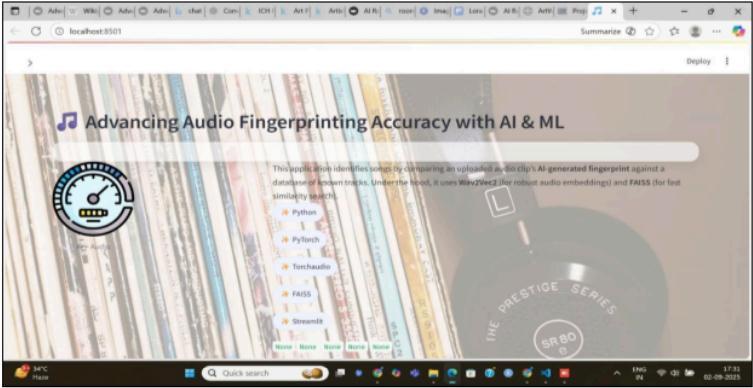
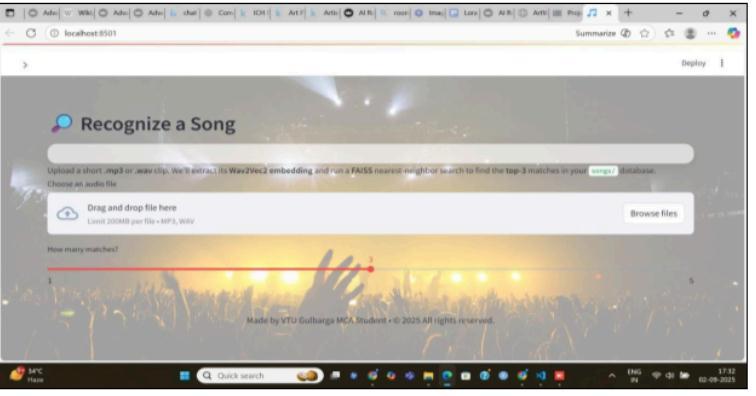
Theproject“AdvancingAudioFingerprintingAccuracywith AI and ML” successfully demonstrates how artificial intelligenceandmachinelearningtechniquescanenhance the precision, speed, and reliability of audio identification systems. By integrating advanced feature extraction methods, machine learning models, and robust database management,thesystemiscapableofaccuratelyrecognizing audioclips,eveninnoisyordistortedenvironments.
Audiopreprocessingandfingerprintingtechniquesprovide compact and distinctive representations of audio signals. Machinelearningmodelssignificantlyimprovetheaccuracy of recognition when compared to traditional approaches. Testingandvalidationprovedthesystemtobereliable,with high recognition accuracy and low response time. The system is flexible, allowing for scalability and continuous improvementasmoredataisadded.
Although the proposed system achieves accurate and efficientaudiofingerprinting,thereareseveralopportunities forfutureimprovements:
1.DeepLearningModels
2.ScalabilitywithBigData
3.Real-TimeRecognition
4.Cross-DomainAudioMatching
5.SecurityandBlockchainIntegration.
1. Cano, P., Batlle, E., Kalker, T., & Haitsma, J. (2005). A review of audio finger printing. Journal of VLSI Signal Processing Systems, 41(3), 271–284. https://doi.org/10.1007/s11265-005-4151-3
2. Wang, A. (2003). An industrial- strength audio search algorithm.Proceedingsofthe 4thInternationalConference onMusicInformationRetrieval(ISMIR).
3. Baluja, S., & Covell, M. (2007). Audio fingerprinting: Combiningcomputervision&datastreamprocessing.IEEE International Conference on Acoustics, Speech and Signal Processing(ICASSP),213–216.
4. Haitsma, J., & Kalker, T. (2002). A highly robust audio fingerprinting system. Proceedings of the International SymposiumonMusicInformationRetrieval(ISMIR).
5.Panayotov,V.,Chen,G.,Povey,D.,&Khudanpur,S.(2015). Librispeech:AnASRcorpusbasedonpublicdomainaudio books.IEEEInternational ConferenceonAcoustics,Speech andSignalProcessing(ICASSP),5206–5210.
6.Salamon,J.,Jacoby,C.,&Bello,J.P.(2014).Adataset and taxonomyforurbansoundresearch.ProceedingsoftheACM InternationalConferenceonMultimedia(MM),1041–1044.
7. Müller, M. (2015). Fundamentals of music processing: Audio,analysis,algorithms,applications.Springer.
8. OpenAI. (2023). Applications of AI in multimedia and signalprocessing.Retrievedfromhttps://openai.com
9. Python Software Foundation. (2024). Python 3.11 documentation.Retrievedfromhttps://docs.python.org/
2025, IRJET | Impact Factor value: 8.315 | ISO 9001:2008