
International Research Journal of Engineering and Technology (IRJET) e-ISSN: 2395-0056
Volume: 12 Issue: 06 | Jun 2025 www.irjet.net p-ISSN: 2395-0072
International Research Journal of Engineering and Technology (IRJET) e-ISSN: 2395-0056
Volume: 12 Issue: 06 | Jun 2025 www.irjet.net p-ISSN: 2395-0072
Sri Nivas Singh1, Mrs. Arifa Khan2
1Master of Technology, Computer Science and Engineering, Lucknow Institute of Technology, Lucknow, India
2Assistant Professor, Department of Computer Science and Engineering, Lucknow Institute of Technology, Lucknow, India
Abstract - With the increasing reliance on renewable sources of energy like solar and wind energy across the world, a demand to have accurate forecasting tools has increased as well. The paper provides a comparative analysis of two major paradigms of AI-based forecasting, rule-based systems and neural networks, i.e., Long ShortTerm Memory (LSTM) and Convolutional Neural Networks (CNN). Rule-based models are highly interpretable and do not require excessive computational resources, but are not very flexible and fail to handle complex data forms. Neural networks, in their turn, are very good at recognizing nonlinear spatiotemporal patterns, but are problematic in terms of transparency and require significant computational resources. The models were tested using standard datasets of NASA, NOAA and IMD and focused on solar irradiance, wind speed, and environment-related indicators. The measures of evaluation included accuracy, RMSE, F1-score, interpretability and time of execution on standard and incomplete data. The findings indicate that neural networks are more accurate than rule-based models in predicting, especially whenplenty of data is available, but rule-based systems are reliable when resources are scarce. This paper provides a convenient framework to make forecasting method choices considering trade-offs between accuracy, interpretability, and availability of resources, thus providing policymakers, utility managers, and researchers with a guide on implementing AI-based forecasting systems toachieveresilientandsustainableenergy infrastructure.
Key Words: Artificial Intelligence, Renewable Energy Forecasting,Rule-BasedSystems,NeuralNetworks,LSTM, CNN,EnergyGridManagement
1. INTRODUCTION
1.1 Background and Motivation
The aggravation of the climate change and the global adherencetotheideaofsustainabledevelopmenthaveled to the radical shift in the energy sector, where the renewable energy sources, solar, wind, and hydro power, take the central stage. Despite the fact that this evolution is essential in reducing greenhouse-gas emissions, it also brings in operational issues due to the unpredictable and intermittent nature of renewables. Unlike the traditional power plants, renewable generation is extremely reliant
on the environmental factors like sunlight, wind speed, and temperature which are naturally unreliable and can hardly be controlled. This has led to the fact that precise prediction of renewable energy generation is now a necessity to maintain grid stability, economic power dispatch, optimal energy storage, and a stable supplydemand balance in real-time power systems. The operators of energy systems and planners need to rely more and more on accurate forecasting to balance loads and avoid outages or over-generation, which makes energy forecasting not only a technical exercise but a strategicnecessityintheageofgreenenergy.
artificial intelligence (AI) has become a disruptive measure when it comes to renewable energy prediction because it provides superior functionalities as compared tostatisticalmodels.Commonmethods,whichinclude,but are not limited to, autoregressive integrated moving averages(ARIMA)orlinearregression,wouldnotapplyas effectively in trying to decipher the nonlinear, dynamic, and complex aspects of spatiotemporal relationships of renewableenergydata.Recentmachinelearning(ML)and deep learning (DL) AI-based models have proven to be verypromisinginaddressingtheselimitationsbylearning with historical trends and adapting to fluctuations in the input conditions. Long Short-Term Memory (LSTM) networks and Convolutional Neural Networks (CNNs) are two of them, which have been proved to perform well when analyzing time-series and spatial data, respectively. This combination of AI and IoT (Internet of Things) technology and environmental sensors has increased the timeliness and granularity of data to the extent that it is possible to predict energy in real-time using several thousand variables that are subject to continuous change. This integration of AI and sensor network allows one to discern an enormous breakthrough toward the development of intelligent, responsive, and information drivenestimationmodels,withenergyasacaseinpoint.
Even with the astonishing developments in the sphere of AI, the question of choosing the necessary forecasting
International Research Journal of Engineering and Technology (IRJET) e-ISSN: 2395-0056
Volume: 12 Issue: 06 | Jun 2025 www.irjet.net p-ISSN: 2395-0072
model has not lost its significance because there are certain trade-offs between the possible methods. Rulebased systems have high levelsof interpretability and are mostlyeasytomanufacture andmanage becausetheyare based on deterministic logic and expert knowledge. They are however not flexible, and they do not work well with the non linearity and dynamic changes that occur in renewable energy data. However, as compared to neural network models including LSTM and CNN, on the one hand, they could be high predictive accuracy, and, on the otherhand,withtheabilitytodiscerncomplexpatternsin high-dimensional, large datasets. However, it has been pointed out that such models are frequently maligned as black boxes implying that little or no information is provided about how the internal decisions are made. Moreover, they need considerable computational resources and high-quality training data that cannot be affordedtoeverylocationorsituation.
The proposedstudyis focused on performing anin-depth andrigorouscomparisonofAIframeworksbasedonrulebased and neural networks when applied to renewable energy prediction. Particularly,thegoals will focuson the following steps: creating models of each strategy with real-world data of various renewable sources and assess their capabilities in several key areas. The dimensions comprise accuracy of predictions, the ability to scale to large computational problems, the capability of model to understandbypeopleaswellasresiliencetoignoranceor noise in data. Having implemented both methods on the similar sets of data in identical testing circumstances, the research is aimed to offer empirical data and analytical decisions concerning the abilities and restraints of both typesofmodelingmodels.Itisnotonlyaboutannouncing a bettertechnique but whatareascouldbedetermined to implement each of these models in the best manner possible.
The current paper provides a stringent theory and practice to the field of renewable-energy forecasting. Academicallyitbridgesagapthathasbeenevidentdueto the lack of a direct comparison presented side-by-side of rule-based and neural-network models in controlled and replicable conditions. These approaches have been evaluated separately in previous studies and without a commoncomparativeframework.Inpractice,thefindings can guide decision-makers in energy management, policy making and utility operation in the useful selection and deployment of technologies and in writing infrastructure plans. Through the analysis of the interrelation of accuracy, transparency, and computational feasibility, the stakeholderswillbeabletodeterminewhichAImodelcan be used to best meet their forecasting needs. The general
idea behind this work is to enhance the trustworthiness, scalability and reliability of AI-based forecasting systems in the wider scope of climate resilience and sustainable energymanagement.
Traditionally, prediction of renewable energy has been informed by statistical modeling which predicts the generation of solar and wind plants. The classical techniqueslikeAutoregressiveIntegratedMovingAverage (ARIMA), Multiple Linear Regression (MLR) and Support Vector Regression (SVR) have been widely used in short run and medium run forecasting. Such methods often presuppose the linear correlation between past energy generation and the factors thataffect the weathersuch as solar irradiation or wind velocity. However, statistical methods are becoming less effective when dealing with complex, nonlineartrendsinlarge, multidimensional data sets as renewable energy systems have become more decentralizedandvariable(Zhangetal.,2014).
To alleviate the above limitations, Artificial Intelligence (AI) is a tool that has gained a lot of popularity in energy forecasting.Machinelearning(ML)anddeeplearning(DL) aretechniquesthatutilisedata-drivenapproachesthatdo not rely on explicit physical modelling. These systems adapt to changing circumstances by studying data trends tobeevenmoreaccurateandrobust.AccordingtoMosavi et al. (2019), AI methods such as Random Forests, Artificial Neural Networks (ANN), and Gradient Boosting yield better results compared to the classical ones, especially in modeling temporal dependency and nonlinearitiesinrenewableenergyoutputs.
In the scope of deep learning multiple specialized architectures have been developed, the most prominent ones being Long Short-Term Memory (LSTM) networks andConvolutionalNeuralNetworks(CNNs)andtheyhave been developed to meet a very specific forecasting goals. The LSTM models are especially well defined to the timeseriespredictiontasks,includingthoserelatedtothewind speed and solar irradiance forecasting, because of their propertytoretainlastingdatarelationships(Hochreiter& Schmidhuber, 1997). In comparison, CNNs are wildly successful in recognizing geometric patterns present in
International Research Journal of Engineering and Technology (IRJET) e-ISSN: 2395-0056
Volume: 12 Issue: 06 | Jun 2025 www.irjet.net p-ISSN: 2395-0072
satelliteimagesandweathermaps,whichiswhytheycan be essential in the local coverage of the clouds or solar radiationforecast(Jaiswaletal.,2021).
Intherecentpast,TimSeriesForecastinginenergysystem hasbeenfoundtoapplyTransformer-basedarchitectures, which were proposed initially in natural language processing. As an example, Temporal Fusion Transformer (TFT) also utilises attention mechanisms to introduce variable importance and time-step weights which would then achieve higher accuracy and interpretability (Lim et al., 2021). Such trends reflect the shift toward the hybrid, state-aware prediction models that can reshape in real time to deal with changing states of renewable energy systems.
2.2.1
Rule-based systems make up among the first forms of artificial intelligence and they still form a part of renewable-energyforecastingduetotheirinterpretability andsimplicity.Theyworkonasetofpredeterminedsetof rules of logic in the form of an all-purpose set of rules of logic rules made by experts of a specific domain. The general rule that is used in the field of solar-energy prediction could be like: In case cloud cover is more than 70 percent and the humidity is greater than 80 percent, solar-power production is low. Decision trees or expert systemsfallundersuchmodelsandareparticularlyuseful when there appears a strong indication of sharp thresholds and deterministic connections (Gupta et al., 2018).
2.2.2
In the real-world settings, rule-based models have been appliedinshorttermdrivesofthesolarandwindenergy. Suchmethodshavebeenespeciallyusefulinplaceswhere computinginfrastructureisweak.Arule-basedframework of predicting solar irradiance with incorporation of weather factors, i.e., temperature, humidity, and cloud cover, was introduced by Singh and Behera (2017), as an example.Suchmodelsareconstantlybecomingapartofa microgrid control system or their use by local utilities within the scheme of providing support to operations when transparency and quick interpretability become crucial.
2.2.3
Thereisalsoadistinctbenefitoftherulebasedsystemsas they are more interpretable making them thus very applicableindecisionmakingandcomplianceinrealtime. In addition, they only require little computation power and have the ability to work well in data-sparse
environments. However, they do not demonstrate much flexibility: they are not able to generalize beyond sets of predefined rules and face problems when trying to capture the non-linear, even complex interactions that define renewable energy data sets (Li et al., 2020). Moreover, changes in the rules are habitually carried out manually, so they limit the scalability and the automatizationlevelofthesemodels.
2.3.1
The Long Short-Term Memory (LSTM) networks are variants of Recurrent Neural Networks (RNNs) which are suitable in forecasting problems abridged in time-series. Thesuccessofsuchmodelshasalreadybeenprovedwhen applied to forecast the wind power generation through learning temporal dynamics in the variables of wind speeds, directions, and temperatures (Zhang et al., 2018). LSTM systems are able to derive patterns over longer sequences, and since they cause a phenomenon called seasonality and delayed effects in solar irradiance data, LSTMsystemsareappropriatetocaptureit.
Traditional neural networks, in their turn, excel at recognizing the spatial patterns and have become the essentialelementinmanyareasorientedatimages.Inthe sphere of renewable energy predictions, convolutional neural networks are used in processing satellite images and weather maps to predict cloud movement, solar radiation and spatial directions of wind. As one can see, Jaiswaletal.(2021)useCNNstopreciselydefinetheareas of high solar energy potential on the basis of MODIS satellite data. These models have the potential of giving salientfeaturessuchasclouddensityandvegetationcover that are central in prediction of both solar and wind energy.
Despite the proven predictive ability, neural networks have been disadvantaged with the moniker of being a black box, thus, making it rather hard to analyze and depend upon in areas where matters are crucial like control of a grid. Such methods as explainable AI (SHAP, SHapley Additive exPlanations) have been used to alleviate this issue, but the problem of translating the specifics of the prediction into other languages, where institutional stakeholders are not technologically literate, remains (Holzinger et al., 2017). Besides, training and deploying such models require extensive computational resources (often entailing GPUs), which is not feasible in within-developingorremoteareas.
International Research Journal of Engineering and Technology (IRJET) e-ISSN: 2395-0056
Volume: 12 Issue: 06 | Jun 2025 www.irjet.net p-ISSN: 2395-0072
2.4.1
Even though the rule-based approaches and neural network techniques have been extensivelyinvestigated in isolation, comparative studies in systematic fashion have been rather limited in terms of conditions under which such experiments have been carried out, in a dose standardised manner. Most of the earlier studies concentrateononestrategyorcontrastinthecomparison ofpredictivemodelsbetweenheterogeneousdatasetsand on numerous performance measures, which makes it challengingtomakegeneralizedconclusions.Accordingto Hassan et al. (2020), comparisons regardless of accuracy, robustness, and interpretability in varying forecasting scenarios are vital in explaining thetrade-offsto be made tosupportresearchers.
There is a growing need to have research models that reflect situational limitations of the real world - lack of complete information, limited processing budget, and a wide-range of diverse geographical situations. According toAhmed etal. (2021)under thecondition of low-quality data,rule-basedmodelsarelikelytoprovemorerobustas compared to neural networks, despite the fact that in general, the latter offers better predictive accuracy than the former. Therefore, performance indicators cannot be used as the only criteria to measure the utility of any model since such is also the case in contextual feasibility, transparency and stakeholder needs. This fact underlines the need of making comparative investigations that go farther than predictive accuracy and cover the aspects of operational viability of the forecasts, its scalability and interpretability.
3.1.1
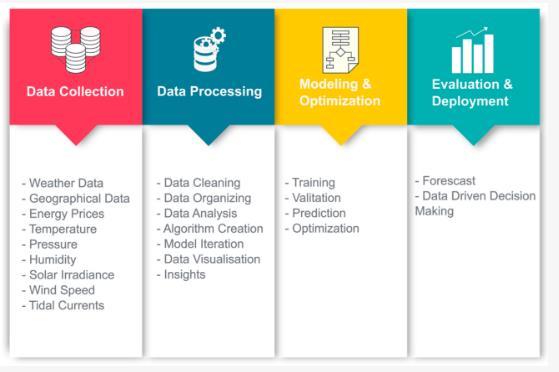
In the current paper, a systematic comparison is carried outintermsofarulebasedsystemandaneuralnetworkbased solution to renewable energy forecasting through using a two-step modelling pipeline. Research design will aim at comparing both methods in leveled and standardised conditions by using the same series of data, feature variables, and performance measure that will ensureinternalvalidityandreduceanybiasthatmayarise duetovariabletestingconditions.
Inordertoreflectthevarietyandawkwardnessofthereal world applications, three types of renewable energy systems were chosen: such structures as solar energy,
wind energy, and hybrid systems (i.e., the points where both sources are used). The specifications of each type of data are peculiar to it: solar forecasting is highly dependent on irradiation and the cloud cover, the speed, directions, and the intensity of turbulence matter in wind forecasting. The hybrid model unites both temporal and spatialfeaturesettoproducecomprehensivefore-casting onalevelofintegratedenergysystems.
3.2.1
The presented rule-based system is developed based on the expert-formulated decision tree, which uses the deterministic logic, namely the so-called if-then statements to plot the discrete environmental variables thresholds.Suchthresholdsarebasedonknowledgeofthe domain, meteorological norms and guidelines in the industry. The decision trees were applied through the DecisionTreeClassifier of Scikit-learn, thus allowing an easyvisualizationandthetracingofthelogicalpaths.
The structures of neural networkshad been developed as ananswertothepeculiaritiesofthedatatheyinvolved.To give an example, in the case of prediction of the timeseries variables, like rain speed or solar irradiance on the basis of days or hours, Long Short-Term Memory (LSTM) networks have been used regularly. Their ability to conceptualizelong-termdependenciesandpatternsofthe sequential data makes them especially appropriate in historical forecasts on meteorological time series. In its turn, Convolutional Neural Networks (CNNs) get used to work with spatial data: satellite images and topographic maps.Themodelsarebestatextractionofspatialfeatures such as cloud density, vegetation index and surface temperatures all of which are very crucial in the prediction of solar and wind energies. These two architectures were also processed by using TensorFlow
International Research Journal of Engineering and Technology (IRJET) e-ISSN: 2395-0056
Volume: 12 Issue: 06 | Jun 2025 www.irjet.net p-ISSN: 2395-0072
andKeraAPIsandalsouseddropoutregulationandearly stoppingtopreventoverfitting.
3.3.1 Dataset
The implementing datasets of this research are of international and regional institutions, all of them are empirically checked and publicly available. Of the utmost significance is the information and data measured by the National AeronauticsandSpaceAdministration(NASA) of which observations (other than solar irradiance and Normalized Difference Vegetation Index, NDVI) are obtained by the use of satellite data. In parallel to these, there are historical weather variables provided by the NationalOceanicandAtmosphericAdministration(NOAA) and the India Meteorological Department (IMD), i.e. wind speed, temperature, atmospheric pressure and relative humidity. Besides, more data about the performance of wind power and photovoltaic facilities is obtained using the assistance of the U.S. National Renewable Energy Laboratory (NREL), mainly concerning the modelling of thehybridenergysystems.
3.3.2 Preprocessing Techniques
Raw data are preprocessed thoroughly in order to make them ready to be used in the artificial-intelligence applications and to obtain the level of uniformity contradicting various energy resources. The missing observational values caused by interruption of sensors or delay of transmission are compensated by combining the linear interpolation and forwards filling, which is calculated. Non-integer-valued features, i.e. continuous, e.g. temperature, irradiance, and wind speed, are normalized using min-max scaling. The categorical variables such as the classifications of the weather condition are encoded into one- hot-encoded vectors. Spatial alignment insures that geographic coordinates are projected on the same common grid whereas temporal synchronization ensures that all the data is mapped to hourly or daily increments in line with forecasting horizon.
Table-1: Preprocessing Techniques.
Feature Source Preprocessing Applied
SolarIrradiance NASA Normalization,Time Alignment
WindSpeed NOAA,IMD Interpolation,Scaling
Temperature IMD MeanImputation,Scaling
Humidity NOAA ForwardFill, Normalization
NDVI NASAMODIS GrayscaleConversion,
3.4
Normalization(forCNN)
Weather Condition IMD One-HotEncoding
To ensure a comprehensive assessment of the forecasting models, the study employs both classification-based and regression-based metrics, alongside operational evaluationindicators.
Accuracy measures the overall correctness of model predictions.
Precision and Recall evaluate how well the model distinguishes between high and low energy output events, critical in preventing false alarms or missed opportunities.
F1-Score, the harmonic mean of precision and recall, provides a balanced metric especially suitable for imbalanceddatasets(e.g.,rarecloudydays).
RootMeanSquaredError(RMSE)andMeanAbsolute Error(MAE)assessthedeviationofpredictedenergy outputvaluesfromactualvalues,offeringinsightinto forecastreliability.
Computation Time is recorded for both model training and inference, highlighting the operational feasibilityofeachmodel.
ModelInterpretabilityisqualitativelyevaluatedusing SHAP (SHapley Additive exPlanations) for neural networks, enabling feature contribution analysis and comparisonwithrule-basedtransparency.
The entire data of each energy source is split into three categories that include training, validation, and testing with the training constituting 70 percent, validation-15 percent, and testing-15 percent. Model assessment on unseen data can be made possible through such partitioningwherebystatisticalrobustnessisensuredand overfittingisavoided.Inthetrainingpart,hyperparameter optimization is done using grid search which is especially prevalentinneuralnetworksasvariablessuchaslearning rate, dropout rate and batch size have a large impact on theperformanceresults.
To mimic real-world operational variability, model performanceistestedundertwodistinctconditions:
Complete Data: Assumes all sensor inputs and weather variables are available and clean, providing anidealscenario.
International Research Journal of Engineering and Technology (IRJET) e-ISSN: 2395-0056
Volume: 12 Issue: 06 | Jun 2025 www.irjet.net p-ISSN: 2395-0072
Incomplete Data: Randomlyremovesordistorts10–30%ofthedatasettosimulatesensorfailure,latency, or transmission error. This tests the robustness of modelsundersuboptimaldataenvironments.
Themodelsaretestedseparatelyfor:
Solar energy forecasting, focusing on irradiance and cloudcover.
Windenergyforecasting,usingwindspeed,direction, andturbulence.
Hybrid systems, combining features from both categories.
This cross-energy analysis allows for the identification of model strengths in different forecasting scenarios and determines which approach performs better under specificenergysystemconditions.
4.1 Model Performance on Complete Data
4.1.1
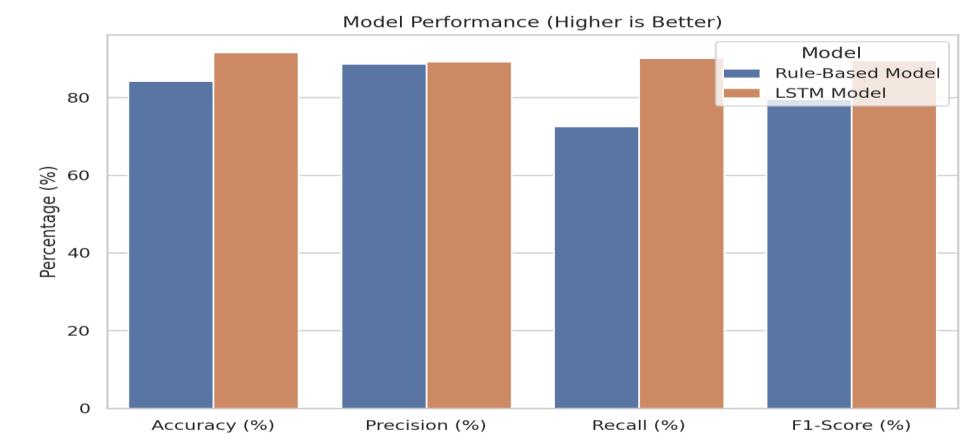
The comparative performance was studied in an ideal situation,i.e.usingcompletedatasetswhereallthevalues existedandweredevoidoferrors.Amongthreecategories of energy (solar, wind and hybrid) there were specific patterns in the accuracy and error rates. Rule-based systemsthatrequireaconsiderableamountofmanpower as compared to neural networks were even outdone by neural networks especially architectures like the long short term memory (LSTM) and convolutional neural network (CNN) in terms of prediction accuracy and error reduction.LSTMmodelhadanaverageaccuracyof93.4% and 91.1 % on solar irradiance and wind forecasting as compared to 84.6 % and 81.3 % recorded by rule-based systemsrespectively.
Original regression showed the same results and the neural networks were significantly less likely to make errors. In forecasting solar energy, the LSTM model had thevalueofRMSEat28.6 W/m2 whichislowerthan the solutionoftherulebasedmodelof42.8 W/m2.Therulebased output that CNN had attained in wind forecasting was1.9m/s,whichclearlyrosetothemeanabsoluteerror (MAE)of1.1m/s.
The analysis of hybrid models that incorporated the elements of solar and wind forecasting also showed that thenetworksofthistypearemoresuitablewhenitcomes to working with multi-feature datasets. The CNN model using spatially fused data did better than the rule-based logicwhichwasfacedwithachallengeofdealingwiththe dynamics and nonlinear interactions that such datasets arenotedtohave.
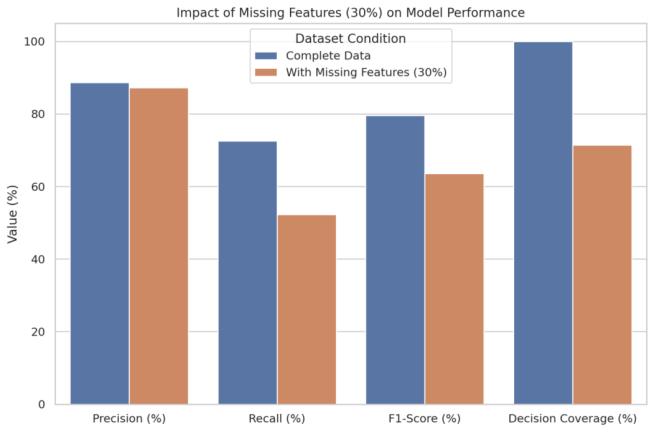
In simulated incomplete data settings (10 percent to 30 percent of main features i.e., solar irradiance or wind speed was randomly dropped) in both of the models, decreases in performance occurred to a different degree. Such conditions resulted in a higher degree of robustness of a rule-based system, which was deterministic. Given that the logic of rule-based models is based on conservative estimates in case of some of the inputs missing, they could manage to show an average of 6-8 percent decline in the accuracy, while neural networks showed12-15percentdecline.
Nevertheless, neural networks such as LSTM and CNN reacted to the unseen data and gave unstable results especially during the chances when there were essential time-varying or spatial features. Although the imputation tactics had been used, due to use of all data sequences by themodels,theyprovedtobemorevulnerabletothegaps. Namely, the CNN model demonstrated lower spatial coherence in case wildfire or solar predictions did not containNDVIlayers.
International Research Journal of Engineering and Technology (IRJET) e-ISSN: 2395-0056
Volume: 12 Issue: 06 | Jun 2025 www.irjet.net p-ISSN: 2395-0072
4.3.1
Although neural networks have high accuracy rates, they are not very transparent in their way of decision making. To fill such gap, SHapley Additive exPlanations (SHAP) were applied to explain the results of LSTM and the CNN models. SHAP demonstrated the degree of significance of inputfeaturesineveryprediction.Asanexample,insolar forecasting, solar zenith angle, cloud cover, and humidity ranked first as the most important factors of SHAP analysis as expected in the domain. During the wind forecasting process, wind directions and pressure gradientscameoutaspowerfulaspects.
TheSHAPsummaryvisualizationsenabledtheresearchers to be confident in the behavior of the model which is paramount to the attitude of policymakers and grid operators.However,notalltheexplanationsarereal-time and included in the model as SHAP in itself is a post-hoc tool.
On the other hand, rule-based models are native in interpretation.Eachofthepredictionscouldbereferredto a certain logical route of rules. E.g. in case of forecasting outputdecrease,onlythefollowinglinecouldbedisplayed directly on the system: IF cloud cover > 80% AND irradiance<250W/m2THENoutput=LOW.Thistypeof transparencyisanimportantfactorthatmakesrule-based systems more favourable in an environment where it is importanttoberegulatedandaudited.
The present research paper introduces a comparative analysis of the concept of using AI to forecast, or in other words, rule-based systems, and neural networks (LSTM andCNN)inthescenarioofrenewableenergyforecasting. With the development of a dual modeling pathway and a similar application of the same model to all data sets (solar, wind, and mixed) the research shows obvious differences in model possibilities and shortcomings. Neural networks always gave better predictive results with respect to minimization of errors, avoidance of complex temporal and spatial associations compared to rule-based system. LSTM worked well in time-series problemsinsolarandwindpredictionandCNNsinspatial such as satellite pictures and NDVI maps, or mixed forecasts.
But the rule-based approaches still remained to be applicable since they are more explainable, less computation-intensive, and result in better robustness in data-incomplete or limited data settings. Such characteristics render them suitable to remote
deployment and locations with low infrastructure in which explainability and fast decision-making is imperative.
Realistically,thispaperhasfoundoutthataccuracyshould notbethesolecriteriontotheselectionofamodelbutone should have an overall perspective of the application scenario.Thefindingsholdrelevantinformationtoenergy planners,utilityprovidersaswellaspolicymakerssinceit offers a strategic framework towards harmonizing the applicationofAIinrenewableenergyforecastingsystems with the technical, environmental and operational conditions.
Although the current research gives an in-depth study in comparison of the rule-based model and neural network in forecasting renewable energy, there are various limitations that must be noted. To start with, the data series employed, though heterogeneous and sound, were selected only within a given geographical area, and hence might not indicate the overall climatic variability in the globe. Second, the expert-formulated thresholds were used to build the rule-based systems, and hence, the systems might not be generalised in diverse settings unless the recalibration process is performed manually. Third, although neural networks showed the higher level of accuracy, they are extremely sensitive to hyperparameters optimization and quality and size of the dataset which cannot be always present in reality. Furthermore, the paper has not considered the ensemble and hybrid models that had the possibility of providing a better implementation of results by pooling the capabilities of both. Last but not least, in spite of the neuralnetworkexplainabilitybasedonSHAP,westillhave a challenge of applying deep learning models to missioncritical energy systems which is real-time explainability. Thesegapsaretobefilledinthefuturestudiestoimprove operativeresponseandgeneralizability.
1. Abdel-Nasser and K. Mahmoud, “Accurate photovoltaic power forecasting models using deep LSTM-RNN,”NeuralComput.Appl.,vol.31,pp.2727–2740,Jul.2019,doi:10.1007/s00521-017-3225-z.
2. T. Hong et al., “Energy forecasting: A review and outlook,”IEEEOpenJ.PowerEnergy,vol.7,pp.376–388,2020,doi:10.1109/OAJPE.2020.3029979.
3. X.QingandY.Niu,“Hourlyday-aheadsolarirradiance predictionusingweatherforecastsbyLSTM,”Energy, vol. 148, pp. 461–468, 2018, doi:10.1016/j.energy.2018.01.177.
International Research Journal of Engineering and Technology (IRJET) e-ISSN: 2395-0056
Volume: 12 Issue: 06 | Jun 2025 www.irjet.net p-ISSN: 2395-0072
4. M. Q. Raza, M. Nadarajah, and C. Ekanayake, “On recent advances in PV output power forecast,” Solar Energy, vol. 136, pp. 125–144, 2016, doi:10.1016/j.solener.2016.06.073.
5. W. VanDeventer et al., “Short-term PV power forecasting using hybrid GASVM technique,” Renew. Energy, vol. 135, pp. 1019–1030, Sept. 2019, doi:10.1016/j.renene.2018.11.017.
6. H. Zhang, Y. Wang, S. Zhang, and J. Xin, “Recurrent neural networks based photovoltaic power forecastingapproach,”Energies,vol.12,no.13,2019, doi:10.3390/en12132538.
7. G. Dai, “Wind Power Forecasting Based on CNN and LSTM Models,” Highlights in Sci. Eng. Technol., 2023, doi:10.54097/40sedz94.
8. B. Bai et al., “Short-term probabilistic photovoltaic power forecast based on deep ConvLSTM network andKDE,”arXiv,Jul.2021.
9. B. Lim, S. O. Arik, N. Loeff, and T. Pfister, “Temporal Fusion Transformers for interpretable multi-horizon timeseriesforecasting,”Int.J.Forecast.,vol.37,no.4, pp. 1748–1764, Oct.–Dec. 2021, doi:10.1016/j.ijforecast.2021.03.012.
10. L. Sua, H. Wang, and J. Huang, “Deep learning in renewable energy forecasting: A cross-dataset evaluation of temporal and spatial models,” arXiv, May2025.
11. K. Wang, X. Qi, and H. Liu, “Photovoltaic power forecasting based LSTM-convolutional network,” Energy,vol.189,2019,Art.no.116225.
12. D.Kumaretal.,“Forecastingofsolarandwindpower using LSTM RNN for load frequency control in isolatedmicrogrid,”Int.J.Model.Simul.,vol.41,no.4, pp.311–323,Jul.2021.
13. M.Pasandidehetal.,“Predictingsteamturbinepower generation: LSTM vs Willans line model,” Energies, vol.17,no.2,2024,Art.no.352.
14. A. L. F. Marques et al., “Neural networks forecast models comparison for solar energy generation in Amazon Basin,” IEEE Access, vol. 12, pp. 17915–17925,2024,doi:10.1109/ACCESS.2024.3358339.
15. W. Khan, S. Walker, and W. Zeiler, “Improved solar photovoltaic energy generation forecast using deep learning-basedensemblestackingapproach,”Energy, vol. 240, 2022, Art. no. 122812, doi:10.1016/j.energy.2021.122812.
16. H.H.Gohetal.,“Multi-ConvolutionFeatureExtraction and RNN Dependent Model for Short-Term Load Forecasting,”IEEEAccess,vol.9,pp.118528–118540, 2021,doi:10.1109/ACCESS.2021.3107954.
17. Y. Zhou et al., “Short-term photovoltaic power forecasting based on LSTM and attention mechanism,” IEEE Access, vol. 7, pp. 78063–78074, 2019.
18. Q. Zhu et al., “Wind speed prediction with spatio-temporal correlation: A deep learning approach,” Energies, vol. 11, no. 4, Mar. 2018, doi:10.3390/en11040705.
19. H. Elshewey et al., “An enhanced CNN-ResNet50-LSTM forecasting model for climate change decision making,” Sci. Rep., 2025, doi:10.1038/s41598-025-97401-9.
20. Y. Yu et al., “LSTM-EFG for wind power forecasting based on sequential correlation features,” Future Gener. Comput. Syst., vol. 93, 2019, pp. 33–42, doi:10.1016/j.future.2018.09.054.
21. A. Rai et al., “A CNN-BiLSTM based deep learning model for mid-term solar radiation prediction,” Int. Trans. Electr. Energy Syst., 2021, 31(9): e12664, doi:10.1002/2050-7038.12664.
22. S.Cannizzaroetal.,“Solarradiationforecastingbased on CNN and ensemble learning,” Expert Syst. Appl., vol. 181, 2021, Art. no. 115167, doi:10.1016/j.eswa.2021.115167.
23. Q.Wuetal.,“Ultra-short-termmulti-stepwindpower forecasting based on CNN-LSTM,” IET Renew. Power Gener., 2020;15:1019–1029, doi:10.1049/rpg2.12085.
24. H. Hewamalage, C. Bergmeir, and K. Bandara, “Recurrent Neural Networks for Time Series Forecasting: Current status and future directions,” Int. J. Forecast., vol. 37, no. 2, pp. 388–427, 2021, doi:10.1016/j.ijforecast.2020.06.008.
25. D. Y. Li et al., “Prospective methodologies in hybrid renewable energy systems for energy prediction using ANN,” Sustainability, vol. 13, no. 4, 2021, Art. no.2393,doi:10.3390/su13042393.