
International Research Journal of Engineering and Technology (IRJET) e-ISSN: 2395-0056
Volume: 12 Issue: 10 | Oct 2025 www.irjet.net
p-ISSN: 2395-0072
International Research Journal of Engineering and Technology (IRJET) e-ISSN: 2395-0056
Volume: 12 Issue: 10 | Oct 2025 www.irjet.net
p-ISSN: 2395-0072
Author: Aayan Munim
Co-Authors: M.Abubakar Saleem, M.Fawwad Samad, M. Hamza Zafar, Muhammad Rayyan Shafiq, Chaudary Ayaan Hussain
Aitchison College, Lahore
ABSTRACT- Due to its possible underground liquid waterreserves,Europa,oneofJupiter’sfascinatingmoons, has piqued scientific curiosity and raised concerns regarding the existence of extraterrestrial life. Understanding the ice layer thickness, a crucial factor determining the viability of future missions for liquid water extraction, still has major uncertainty. To estimate the practicality of liquid water extraction, this paper presents a thorough investigation of cutting-edge remote sensingtechniquestodeterminethicknessoftheicecover in selected geographic regions of Europa. Through meticulously reviewing historical mission data, including Galileo and Voyager, and employing state-of-the-art modelingtechniques.
Moreover,weelucidatetheimplicationsofourfindings on the prospect of liquid water extraction by illuminating the ice layer’s structural stability and potential water mobility. The results demonstrate regions with favorable conditions for future exploration and identify critical target areas for further in-site verification. As prior mentioned,thispaperisaboutidentifyingthethicknessof iceintargetedgeographicalzonesonEuropa,todetermine the feasibility of extracting liquid water with different prospective drilling or any hypothetically plausible water extraction methods, limited solely to Europa, and Enceladus.
Due to its possible underground liquid water reserves, Europa, one of Jupiter’s fascinating moons, has piqued scientific curiosity and raised concerns regarding the existence of extraterrestrial life. Understanding the ice layerthickness,acrucialfactordeterminingtheviabilityof futuremissionsforliquidwater extraction,still hasmajor uncertainty. To estimate the practicality of liquid water extraction,thispaperpresentsathoroughinvestigationof cutting-edge remote sensing techniques to determine thicknessoftheicecoverinselectedgeographicregionsof Europa. Through meticulously reviewing historical mission data, including Galileo and Voyager, and employingstate-of-the-artmodelingtechniques.
Moreover,weelucidatetheimplicationsofourfindings on the prospect of liquid water extraction by illuminating the ice layer’s structural stability and potential water mobility. The results demonstrate regions with favorable conditions for future exploration and identify critical target areas for further in-site verification. As prior mentioned,thispaperisaboutidentifyingthethicknessof iceintargetedgeographicalzonesonEuropa,todetermine the feasibility of extracting liquid water with different prospective drilling or any hypothetically plausible water extraction methods, limited solely to Europa, and Enceladus.
1.1 Analysing hypotheses of various astronomical studies
Europa has a core of silicate rock with an outer crust of liquidwaterandwatericethatmayonlybeapproximately 20 km thick. [1]. The distance of Europa from the Earth and the Sun asks for autonomous analytical tools that maximize the scientific return at minimal resources, demanding new experimental concepts, which are mentioned within this study. A basis of many of our instruments is the electrical conductivity of the surface helps in any image detection upon the basis of energy perturbation. Furthermore, by utilizing tomographic data, those images provide only moderate- to high-resolution views of the moon’s surface and are therefore a critical resource for scientific analysis and future mission planning. Unfortunately, uncertain knowledge of the spacecraft’s position and pointing during image acquisition resulted in significant errors in the location of theimagesonthesurface.
( Bland, M. T., Weller, L. A., Archinal, B. A., Smith, E., and Wheeler, B. H. (2021). Improving the Usability of Galileo and Voyager Images of Jupiter’s Moon Europa. Earth and Space Science, 8(12), e2021EA001935. https://doi.org/10.1029/2021EA001935)[2]
International Research Journal of Engineering and Technology (IRJET) e-ISSN: 2395-0056
Volume: 12 Issue: 10 | Oct 2025 www.irjet.net p-ISSN: 2395-0072
Cryovolcanic zones within surface-level reach of quasisymmetric double ridges will be the primary site in question,duetopropagativevariationinsystemenergyas well asmass(throughliquid excursion).The followingisa cryo-volcanic zone that fits the aforementioned requirement.
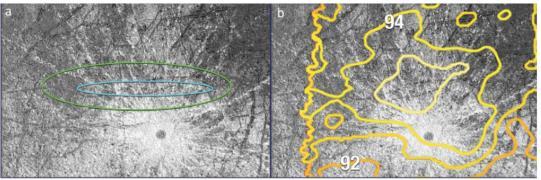
Figure 2.1: The yellow annotations in (b) show contour heat maps of cryovolcanic zone areas. Upwelling in (a) is definedbygreenandcyanellipses(cyandefinestheregion ofhigherplumeactivitybasedonoldreports)
These domains manifest as dynamic locales where subsurface aqueous reservoirs, conceivably in the form of subsurface oceans, find proximal exposure to the moon’s frigid surface via volcanic processes. These regions allude torecentorongoingcryovolcanicactivity,thusimplicating the likelihood of renewed materials, including liquid water.
The geological and geophysical significance of cryovolcanic territories is unequivocal, offering unprecedented insights into Europa’s intricate internal dynamics and potential habitability parameters. Deciphering the distribution of water and sundry constituents within these venerated locales augments our discernment of the moon’s enigmatic ice-water interface, inspiring diligent efforts to address the daunting challenges of European exploration. Notwithstanding the rigorous environmental milieu characterized by harsh cryogenic temperatures and hazardous radiation flux, embarking upon concerted investigations within Europa’s cryovolcanic precincts stands as an intellectual prerogative to unravel the enigmas of this glacial moon and discern its propensity for harboring conditions amenabletolife.
1.3 Overview of ice layer-thickness deduction methods on Europa
First of all, thickness of the ice is important as it is an indirect measure of the total tidal heating europa is getting. It would also determine where and how material reachesthesurfaceandgoesbackdown.Itwouldgiveusa directiononhowtoexplorethesatellite.
TheimagesofcratersonthesurfaceofEuropafromthe Galileoprobearecomparedtothoseonthesurfacesofits sistersatellitesGanymedeandCallisto.Thiscomparisonis basedonacomparisonofthetopographyandmorphology ofimpactcratersontherespectivesatellites.
Pictures and Images from N.I.M.S of the Galileo Probe are used to deduce the thickness. N.I.M.S is A remote sensinginstrumentthatmakesmeasurementsinthenearinfrared region of the light spectrum, from which the chemical composition, structure, and temperature of planetaryandsatelliteatmospherescanbedetermined,as well as the mineral composition and geochemistry of planetary and satellite surfaces. These images give us a clear view of the craters on the surface of Europa. These craters differ significantly from those on Ganymede and Callisto.Theshapeofthecarterschangesastheirdiameter exceeds30kilometres.Craterssmallerthan30kilometres havevisiblerimsandcentraluplifts,featurestypicalofan impact crater, but are surrounded by concentric rings, whilecraterslargerthan30kilometresseeminglyhaveno rims or uplifts. This change indicates a change in the ice layer.Themostviableexplanationforthisisthatthereisa change from solid to liquid. The rings are most probably causedby thecollapseofthecrater floor,andasthe floor collapsesandcracks,thematerial underit movestofill in the gaps. Larger craters penetrate more deeply into the planet,andthecratersizeisdeterminedbythepropertyat thedepthitgoesto.Therefore,todeterminethethickness, one must determine how big the crater is and how deep below the liquid layer must be before it can affect the shape of the crater. This is derived from numerical calculations and laboratory experiments into impact mechanisms. A crater collapse model is created, which is thenusedtoconvertthetransitionaldiameter,inthiscase 30km, to the thickness of the layer, which is estimated to be19–23kilometresdeep.
1.4 Analyzing data from N.I.M.S of Galileo probe for ice layer-thickness estimates
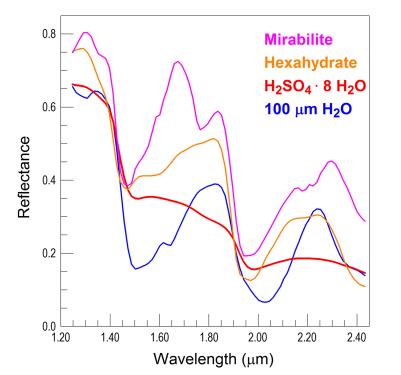
Byexaminingdistinctivespectralsignaturesofice,N.I.M.S data has provided crucial clues to set a specific estimate From a visual perspective ultimately, linear(trailing and leading hemisphere) patterns exhibit between 1.4µm and 2.0µm. Mirabilite, hexahydrate are hydrous vitreous salts, andwillnotbededucedbyplainobservations.
International Research Journal of Engineering and Technology (IRJET) e-ISSN: 2395-0056
Volume: 12 Issue: 10 | Oct 2025 www.irjet.net p-ISSN: 2395-0072
We will also be employing linear mixing, which is most appropriateforsituationswheretheexactimagedsurface is made up of separate subsurfaces - perfect for Europa’s chaotic terrain patterns, as well as cryovolcanic fluxes resulting in leading hemispheric surface patterns to be distinctly visible from space. During this procedure, reflectance spectra of suspected surface materials are combined linearly, to replicate the radiative properties individually, and are used most visibly in compositional mappingusingMCMCmodeling.[1]Asecondarymethodof radiative transfer calculations can be employed, which maybecollectivelydiversesinceitdescribesthebehavior of incident photons with particles present on the surface. [1]
1.5 Analyzing spectroscopic datasets from Galileo Solid-State Imaging Camera for layer thickness estimates
The near-I.R observations of N.I.M.S have a primary flaw: Jupiterexertshighenergyradiation,mid-infrared,andthe visible light spectrum falls within this limit. This displays the minorly-superfluous variation in spectroscopic readings of salty water and the observable minerals beneath the ice layer. (Klaasen, K.P., M.C. Clary, James R. Janesick, Charge-Coupled Device Television Camera for Nasa’s Galileo Mission To Jupiter, 23(3). p. 334- 342, Optical Engineering, May 1984.) These results depict icelayer thickness between 16 and 18km, followed by an unknown depth of salty-ocean water(extraneous to researchandspecify)
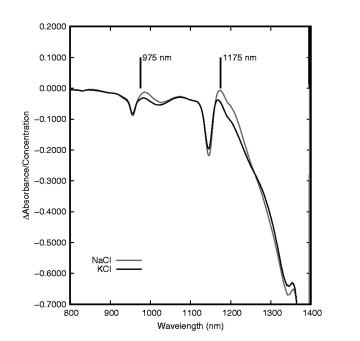
Figure 2.3: The aforementioned graph shows composite spectroscopic data of salt-water samples taken from Earth’s oceans. There is bound to be variance, primarily minimal.
We have calculated the absorbance by first, calculating transmittancethrough
T=l/l0
Afterthis,wecalculateabsorbance(A)withtheequation: A=−log10T
T=Transmittancel=Finalreadingl0=Blankreading
2. EXPERIMENTAL ANALYSIS AND METHODOLOGY OUTLINE
2.1 Gathering relevant datasets and imagery from past missions to Europa, as well as from Earth-based observations and simulation
2.1.1Simulatingtemperature
From December 2017 to August 2018, JPL simulated the conditions on Europa on ’Project Ark’. It utilized a pumpdriven vacuum chamber, that would ’pump’ kinetically energized particles, of various low kinetic energies, into the chamber to simulate an average of 129.12K. Towards the end of the timelapse, the ice appears to expand as water molecules accrete in colder sections of the ice, growing new ice patterns. Various light patterns applied displaythediurnalcyclepresentonEuropa.
International Research Journal of Engineering and Technology (IRJET) e-ISSN: 2395-0056
Volume: 12 Issue: 10 | Oct 2025 www.irjet.net p-ISSN: 2395-0072
2.1.2Simulatingterrain
Chaos terrains are a very prominent terrain class on Europa henceforth analysis of the simulation of such terrains assists us in deducing the prominence and frequencyof quasi-symmetricridge-like,andcryovolcanic geographical structures, most commonly found in the trailinghemisphereregion:
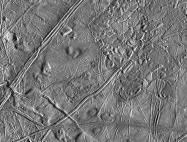
Chaos Figure 3.1: The visible lines are quasi-symmetric ridge patterns. The complex ridge crossing the picture in theupperleftcornerispartofafeaturethatcanbetraced to hundreds of miles of terrains, also contain dark bands, disruptions, and perturbative patterns, which are present alongside criss-cross bands in regions like Agenor Linea. Such chaos patterns are influenced by various gravitational parameters, primarily the result of Jupiter’s strong gravitational influence affecting the icy crust on Europa, across all band patterns under chaos terrain categorization.
2.2 Applying different methods, such as tilt series tomography, thermal imaging, to estimate ice layerthickness in targeted regions of Europa
2.2.1Tilt-seriestomography
Tilt series tomography, a technique commonly employed in electron microscopy has the potential to minorly deduce the ice-layer thickness, but with immense limitations, mentioned below in chapter 3. By capturing multiple satellite images at a 30° angle, it is possible to create3Dconstructionsofasurface.
2.2.2Thermalimaging
By utilizing a laser-scanning method, and directing a thermal laser at the ice, due to the surface-affected deformation of the laser, it projects a contour-curve 13 shape. Laser altimeters would be employed alongside the introduction of high-speed optical cameras, which would takeimagesoftheicelayers.[2]frommultipleanglesina similarmagnitudeshiftastilt-seriestomography.Thermal imagingthroughtheaforementionedmethodwouldnotbe affected by spectral problems, due to its use of thermal radiation, as opposed to visible light. Furthermore,
infrared thermography identifies targets through discrepanciesinthermalconductivitycharacteristics.
2.3 Comparing the results obtained from various methods and validating them against known features on Europa to ensure accuracy
Comparingtheresultsobtainedfromvariousmethodsand validating them against known features on Europa to ensureaccuracyTo measuretheexactthicknessoftheice, we would take samples of Europan ice from a quasisymmetric ridge area, to coalesce previous result data. After that we would utilize the sample thickness and absorbanceandtransmittancereadingstocomparewitha larger scale. Such an accuracy would require prospectiveonsite probes, and could be greatly assisted by N.A.S.A Clipper. Fig.1.2 displayed the wavelength and reflect of surface composite substances present in double-ridge trailing hemispheric zones values.Reflectance variation is prominentinmirabillitesobservedatavariousnumberof wavelengths ranging from 1.2 to 2.4 micrometres.Waterbound salts and water experienced relatively less reflectance variation. [4] .Moving to Fig.1.3, the reason N.A.S.A used Galileo N.I.M.S to observe layer depth and waterdepthwasduetomid-infraredrangebeingreached at higher wavelengths, resulting in major decrease of absorbance readings, proving reverse-linearity when tested from near-infrared (800nm to 2500nm) to midinfrared(3µmto50µm)
2.4 Integrating information on potential geothermal heat sources to understand their influence
Many locations exhibit geothermal activity, which is characterized by localized heat dissipation and thermal upwelling, which produce thermal gradients that rise above the frozen lithosphere. The different geothermal signals show a complex interaction between latent primordial energy stores, radiogenic heating, and tidal forces.Theseenergydetails,whichcontrolthedistribution ofheatsourcesbelowthesurface,produceheterogeneous ice-layer formations. Different geothermal zones have different impacts. These effects can include localized thinning of the ice, mobility of subsurface meltwater, and even14 remnantcryovolcanicresurgences.Theability to distinguishbetweenthesegeothermalheterogeneitieshas beenmadepossiblebyrecentdevelopmentsintheoretical thermal models and remote sensing and imaging techniques. Through thermal mapping and the analysis of the spectral properties of individual surface features, researchers attempt to infer the subtle effects of geothermaldynamicsonthethicknessoftheicecover.[3]
International Research Journal of Engineering and Technology (IRJET) e-ISSN: 2395-0056
Volume: 12 Issue: 10 | Oct 2025 www.irjet.net p-ISSN: 2395-0072
The financial feasibility of Europa’s water extraction missions is closely linked to the underlying costs of interplanetarylogisticsandthederivedvalueofaccessible water reserves as a propellant and life-sustaining resource. The cumulative cost of the Europa Clipper mission alone is estimated at approximately $5 billion (NASA OIG, 2023) [5], representing a benchmark for exploratory or resource retrieval operations. When viewed through the framework of cost/benefit analysis, the extraction of extraterrestrial water convertible to hydrogen and oxygen for space fuel has potential to substantially reduce launch mass dependency on Earth and thus lower long-term exploration costs by up to 40% [6].Thiscostdeflation,relativetotraditionallaunchbased refueling, positions Europa’s liquid water as a strategic interplanetary economic resource rather than a purely scientificone.
Europa exploration is tantamount to a high risk longhorizon investment. Traditional financial models such as EMV and Monte Carlo simulations can evaluate and compute mission returns uncertainty by merging probabilities of technological success and commodity price fluctuations. According to Metzger et al. (2013) [6], risk-adjusted returns in space extraction projects depend primarily on the technological maturity level (TRL) and orbitaltransportcostvariance.Investorsinsuchventures faceexposuretosystemicrisk,geopoliticalregulation,and exogenouscosmichazards.Hence,portfoliodiversification throughmulti-planetaryexploration(Moon,Mars,Europa) canmitigateidiosyncraticriskwhilemaintainingexposure to the rapidly expanding astro financial sector, which has already attracted capital through specialized funds and ETFstiedtoaerospaceandresourceinnovationindices.
Should Europa’s water extraction enter private hands, it may instigate a new era of resource privatization beyond Earth, redefining global water economics. Water from Europa, branded as an extraterrestrial commodity, would inherently possess extreme rarity and prestige value, likelycommandingastronomical pricesinspeculativeand luxury markets. Such developments parallel historical trends where geographic scarcity has been financially exploited comparable to the 20th century commercialization of Arctic ice and mineral water
industries [7]. As corporations capitalize on “Europan Water,”terrestrialbottledwatermarketscouldexperience artificial inflation, driven by novelty demand and speculativetrading.Thiscould furtherwidenglobalwater inequality, concentrating profit in the hands of a few aerospace conglomerates while ordinary consumers face higher price volatility in Earth-based water markets. In financial markets, new derivative instruments such as water futures linked to extraterrestrial extraction rates may emerge, echoing the commodification cycles of gold andoilinpriorcenturies.
After analyzing the Spectroscopic and tomographic data, we reach an indirect conclusion of the absolute experimental analysis. Firstly, the targeted zones for data analysis have been deduced based on energy-based variation, that ultimately make the sites analyzed in this area active zones, affecting the increase in analyzed datasets available. Using a technique of electronmicroscopy( tilt-series tomography) in large-scale topographic imaging presents innumerable challenges. Firstly, tilt-series tomography is used for smooth, or microscopic terrain. Europa possesses a challenging and intricateclassofterrain,whichmakesscanningaccurately difficult,tothepointofmajorexperimentaluncertainty.
We would experience limitations for geothermal heat patterns as well. Radiative variation would be prominent due to the immense thermal energy perturbations occurringonEuropa,causingunknownvariancewithinice thickness.
Ultimately, the effort that has been made to infer the thicknessoftheicelayerinparticulargeographicareasof Europa, based on a thorough combination of geophysical modeling, remote sensing techniques, and careful data analysis, represents a significant advancement in our understanding of the complex dynamics present on this mysteriousmoonofJupiter.Bycombiningradarsounding, thermal imaging, and gravity data, underlying ice stratigraphy has been quantified, which has made stratified interpretation of Europa’s cryospheric architecture possible. Iterative analysis based on meticulous empirical measurements and computer simulations provides a more sophisticated understanding of the temporal variability and spatial distribution of icelayerproperties.
From these conclusions, we can draw important conclusions about how to better comprehend how habitable Europa might be in light of the planned extraction of liquid water resources. The specific places that have been targeted and identified through this
International Research Journal of Engineering and Technology (IRJET) e-ISSN: 2395-0056
empirical discourse could serve as future exploration missions’ focal points when combined with the identificationofsubsurfaceheatgradientsandgeothermal activity. This work clearly represents a significant breakthrough in our capacity to assess the viability of liquid water extraction projects on Europa, skillfully combining scientific investigation with practical explorationgoals.
[1] Oliver King, Leigh N. Fletcher, and Nicolas Ligier. Compositional mapping of europa using MCMC modeling of near-IR VLT/SPHERE and galileo/NIMS observations. ThePlanetaryScienceJournal,3(3):72,mar2022.
[2] SG Pavlov, EK Jessberger, H-W H¨ubers, S Schr¨oder, I Rauschenbach, S Florek, J Neumann, H Henkel, and S Klinkner.Miniaturizedlaser-inducedplasmaspectrometry for planetary in situ analysis–the case for Jupiter's moon Europa.Advancesinspaceresearch,48(4):764–778,2011.
[3] Louise M. Prockter and Robert T. Pappalardo. Chapter 36-Europa.InTilmanSpohn,DorisBreuer,andTorrence V. Johnson, editors, Encyclopedia of the Solar System (Third Edition), pages 793–811. Elsevier, Boston, third editionedition,2014.
[4] Huai-Ruo Zhang, Ray F. Egerton, and Marek Malac. Local thickness measurement through scattering contrast and electron energy-loss spectroscopy. Micron, 43(1):8–15, 2012. Applications of EELS in Materials and Physics Research.
[5] NASA Office of Inspector General (2023). NASA’s Management of the Europa Clipper Mission. Washington, D.C.
[6] Metzger, P. T. et al. (2013). Affordable, rapid bootstrapping of the space industry and solar system civilization.JournalofAerospaceEngineering.
[7]Cockell,C.S.etal.(2016).WaterinSpaceExploration: ResourceandRisk.PhilosophicalTransactionsoftheRoyal SocietyA,374(2071):20150385.
Volume: 12 Issue: 10 | Oct 2025 www.irjet.net p-ISSN: 2395-0072 © 2025, IRJET | Impact Factor value: 8.315 | ISO 9001:2008 Certified Journal | Page385