
International Research Journal of Engineering and Technology (IRJET) e-ISSN: 2395-0056
Volume: 12 Issue: 06 | Jun 2025 www.irjet.net p-ISSN: 2395-0072
International Research Journal of Engineering and Technology (IRJET) e-ISSN: 2395-0056
Volume: 12 Issue: 06 | Jun 2025 www.irjet.net p-ISSN: 2395-0072
Mayur
Jadhav1, A.B.Kakade2
1Undergraduate student , Department of Electronics and Telecommunication Engineering, Rajarambapu Institute of Technology, Islampur, Maharashtra, India
2Professor, Department of Electronics and Telecommunication Engineering, Rajarambapu Institute of Technology, Islampur, Maharashtra, India
Abstract – This paper introduces a system designed to help prevent people from accidentally running into each other during activities like walking or jogging at blind corners. The system uses motion detection to recognize movementpatterns and gives a warning when a potential collision is likely. It has been tested in real-life situations and shown to work effectively. The paper explores the ideabehindthesystem,how it was built, and how well it performs in practice, showing its usefulness in helping people avoid accidental collisions.
Key Words: Collision Alert, Motion Detection, Safety, Real time operating system, Blind spot.
1.INTRODUCTION
Human collision avoidance is a critical concern in a wide rangeofenvironmentswhereindividualsareconstantlyon themove.Theseincludeeducationalinstitutions,healthcare facilities, workplaces, and public venues. In such places, individuals may be walking or running, often unaware of others approaching from different directions. Traditional methods to prevent collisions, such as visual signage, designatedlanes,orhumanvigilance,areofteninsufficient due to limited visibility, distractions, or high-speed movements. For instance, in schools and universities, studentsrushingbetweenclassescanunintentionallycollide with one another, leading to minor or serious injuries. In hospitalsorelder-carefacilities,suchcollisionscanbeeven more dangerous due to the frailty of patients or elderly residents.
The need for a non-intrusive, automated, and efficient collision avoidance mechanism has never been more relevant. With the growing complexity of indoor infrastructure and increased human density in confined spaces, technology-driven solutions are essential to proactively manage human movement. This is especially important in environments where visual contact between individualsmayberestrictedduetoarchitecturaldesignor obstructions,makingmanualcollisionpreventionineffective.
Withtheadventofsmartsensingtechnologiesandembedded systems, there is an increasing shift toward automated solutionsforsafetyandmonitoring.Sensor-baseddetection systems have emerged as reliable tools for capturing realtime human movement without requiring direct user
interaction.Amongthese,PassiveInfrared(PIR)sensorsare particularly effective and affordable for motion detection applications.PIRsensorsmeasureinfraredradiationemitted frombodies,enablingthemtodetectmotionwithinaspecific range. They offer advantages such as low power consumption,easeofdeployment,andimmunitytoambient lightconditions.
ThisresearchintroducesanovelsystemthatleveragesPIR motion sensors and a simple alert mechanism (buzzer) to detectpotentialhuman-to-humancollisionpathsinrealtime. ThedesigniscenteredaroundfourstrategicallyplacedPIR sensorstomonitortwoindividualsapproachingeachother from opposite directions. When motion is detected by the rearsensors(3and4),acountdownbegins.Ifthefront-facing sensors (1 and 2) also detect motion within a limited window,thesystemactivatesabuzzertoalertbothusersof animminentcollision.
Thepurposeofthisstudyistodemonstratehowalow-cost, low-complexity sensing mechanism can be integrated into common indoor spaces to significantly enhance human safety. Through systematic testing, we show that the proposed system can achieve high accuracy in detecting motionanddeliveringtimelyalerts,therebyminimizingthe riskofaccidentalcollisions.Thissystemservesasascalable and practical solution for real-time collision prevention in everydaysetting
Automotive collision avoidance systems (CAS) have been extensively studied and developed to prevent vehicle-tovehicle collisions. These systems utilize sensors such as radar, lidar, and cameras to detect potential obstacles and providewarningsorautomaticbrakingtoavoidaccidents.A comprehensivereviewbyJohnDahletal.(2018)categorizes threat-assessmentalgorithmsusedinCAS,includingsinglebehavior threat metrics, optimization methods, formal methods, probabilistic frameworks, and data-driven approaches like machine learning. These methodologies couldbeadaptedforhuman-to-humancollisiondetectionby employingappropriatesensorsandalgorithms.[1]
International Research Journal of Engineering and Technology (IRJET) e-ISSN: 2395-0056
Volume: 12 Issue: 06 | Jun 2025 www.irjet.net p-ISSN: 2395-0072
Pedestriandetectionsystemsinvehiclesaimtoidentifyand prevent collisions with individuals on foot. These systems often employ computer vision techniques and artificial intelligencetorecognizepedestriansinthevehicle'spathand initiate warnings or automatic braking. The principles of pedestriandetection,suchasreal-timeimageprocessingand pattern recognition, can be applied to detect individuals approachingadoorwayfromoppositesides.Implementing similarsensortechnologiesandalgorithmscouldenhancethe accuracy and reliability of a doorway collision warning system.[2]
Understanding human behavior and response to warning systemsiscrucialindesigningeffectivecollisionavoidance technologies.ResearchbyShreeraman(2018)examinesthe effectsofdriver,vehicle,andenvironmentcharacteristicson collisionwarningsystemdesign,emphasizingtheimportance ofuseracceptanceandappropriatewarningstrategies.These insights highlight the need for intuitive and non-intrusive alert mechanisms in human-to-human collision warning systems to ensure users respond effectively without experiencingalarmfatigue.[3]
The selection of appropriate sensors is vital for accurate detection incollision warning systems. Ultrasonic sensors, infraredsensors,andcamerashavebeenutilizedinvarious applicationstodetectobstaclesandmeasuredistances.For instance, an Arduino-based forward collision detection systememploysultrasonicsensorstodetectvehiclesahead andalertdriverstopotentialcollisions.Adaptingsuchsensor technologiesfordoorwayapplicationsinvolvesconfiguring themtodetecthumanpresenceandmovementaccurately, considering factors like sensor range, field of view, and environmentalconditions.[4]
Researchintodoorcollisionavoidancehasprimarilyfocused on preventing accidents between doors and obstacles, including humans. For instance, a patent by Rhode et al. (2018) discusses systems and methods for vehicle door collisionavoidance,utilizingsensorstodetectobstaclesand preventdooroperationtoavoidcollisions.Althoughcentered onvehicleapplications,theprinciplesofobstacledetection and preventive measures can be adapted for human-tohumancollisionscenariosindoorwaysettings.[5]
Advancements in sensor technologies have significantly contributed to collision prevention systems. Pepperl and Fuchs offers dual-technology sensors combining motion detection and presence sensing to enhance safety in automatic door applications. These sensors utilize active infrared technology to create protective fields, preventing collisions by detecting the presence of individuals near doorways.Suchtechnologiescanbeadaptedtomonitorboth sides of a door, providing warnings when two people approachsimultaneously.[6]
Similarly, OndoSense provides radar sensors designed for collision avoidance, capable of reliable obstacle detection eveninchallengingenvironmentalconditions.Thesesensors can be employed in various applications, including monitoring pedestrian traffic in doorways to prevent collisions.[7]
PIR(PassiveInfrared)sensorshavebeenwidelyutilizedfor motiondetectionduetotheiraffordability,energyefficiency, andeaseofdeployment.Mainettietal.(2013)demonstrated thatPIRsensorscouldeffectivelydetecthumanpresencein smartbuildingapplications,especiallyinlow-lightconditions wherevision-basedsystemsunderperform.Ridaetal.(2015) furtherillustratedhowPIRsensorscouldbeintegratedinto Internet of Things (IoT) frameworks for intelligent home automationandpresence-basedenergycontrol.[8]
In the wake of the COVID-19 pandemic, wearable sensor technologiesgainedattentionforenforcingsocialdistancing. Ahmed et al. (2021) developed a wearable system using ultrasonic sensors that alerted users when interpersonal distance dropped below a threshold. However, the practicalityofwearablesystemsisoftenchallengedbyissues suchasdiscomfort,batteryconstraints,andtheneedforuser compliance.[9]
For mobility assistance, Smith and Lee (2019) designed a collisiondetectionsystemformotorizedwheelchairsusing infrared sensors. Although their system was effective for obstacleavoidanceinacontrolledsetting,itwastailoredto assistive devices and lacked generalizability to common pedestrianinteractions.[10]
Zhao and Cook (2018) reviewed the concept of ambient intelligence, where unobtrusive sensors embedded in the environment monitor and respond to user behavior. They emphasizedtheuseofPIRsensorsfornon-intrusivepresence detection without compromising privacy, supporting the directionofthepresentstudy.[11]
Morecomplexapproachesutilizecomputervisionsystems, such as the YOLO (You Only Look Once) object detection modelbyRedmonandFarhadi(2018).Whilethesemodels offer real-time,high-accuracy objecttracking,theyrequire substantial processing power and raise concerns about surveillance and privacy, making them unsuitable for lightweight,privacy-preservingapplications.[12]
International Research Journal of Engineering and Technology (IRJET) e-ISSN: 2395-0056
Volume: 12 Issue: 06 | Jun 2025 www.irjet.net p-ISSN: 2395-0072
3. Methodology used to develop the model
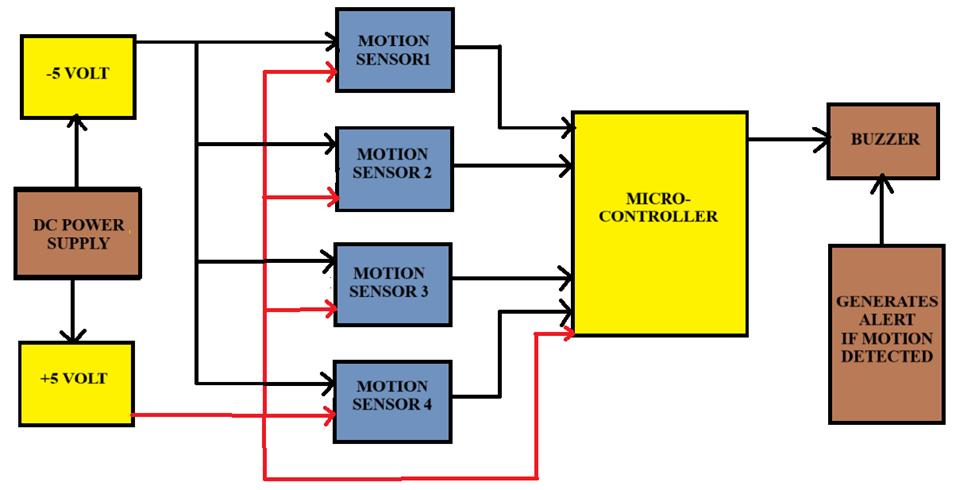
Figure-1 :BlockDiagramofSystem
1.SystemOverview:
The collision alert system is designed to monitor two individuals walking or running toward each other from oppositedirectionsinadefinedindoorspace.Thesetupuses fourPIRsensorstodetectmotionwithinarangeof30feet. Thesystemoperatesbasedonspecifictimingconditionsand sensoractivationsequencesthatindicateapossiblecollision scenario. When such a pattern is detected, the system activatesabuzzertoalertbothindividuals,thuspreventing potentialcontact.
2.PowerSupplyandVoltageRegulation:
To power the motion sensors and microcontroller, a 5V regulatedDCpowersupplyisrequired.Sincetheavailable powersourceisAC,acustom-designed5VACtoDCconverter circuitwasdeveloped.
This+5VoutputisusedtopowerthefourPIRmotionsensors andthemicrocontrollerunit.
3.SensorConfigurationandPlacement:
ThefourPIRmotionsensorsarestrategicallypositionedto covertwomovementpathsfromoppositedirections:
Sensor3andSensor4areplacedattherearentrypointsof two opposing paths. Their role is to detect initial motion, indicatingtheentryofaperson.
Sensor1andSensor2areplacedfurtheralong eachpath, closertothepotentialpointofcollision.
ThesensorsareconfiguredtosendadigitalHIGHsignalto themicrocontrollerwhenmotionisdetectedintheirfieldof view.
4.MicrocontrollerIntegration
FunctionalLogicFlow:
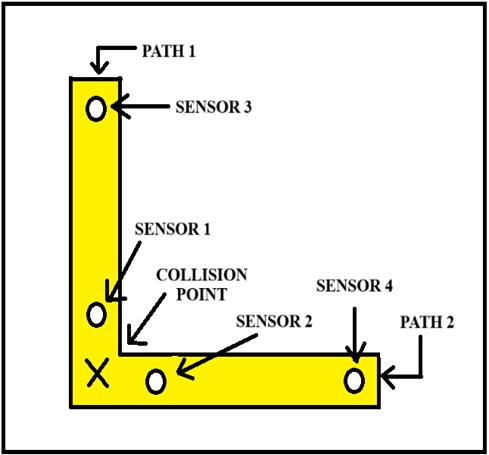
Figure-2 :Schematicofsensorplacement
4.1.ActivationWindow1(RearDetection):
Asshowninfig.2.IfSensor3orSensor4detectsmotion,a7secondtimerisstarted.
Withinthis7-secondwindow,ifbothSensor1andSensor2 detectmotion,thesysteminterpretsthisastwoindividuals approachingeachotherandactivatesthebuzzertoissuean alert.
IfnomotionisdetectedbySensor1andSensor2within7 seconds, the activation window is closed, and no alert is triggered.
4.2.ActivationWindow2(DirectDetection):
If Sensor 1 and Sensor 2 detect motion simultaneously or within 5 seconds of each other without prior activation of Sensor 3 or Sensor 4, the system still interprets this as a directpotentialcollision.
Inthiscase,thebuzzeristriggeredasasafetymeasure.
This two-condition logic allows the system to detect both approachingindividualsfromoppositeendsandindividuals approaching directly without rear detection, thereby increasingaccuracyandreducingfalsepositives.
5.BuzzerAlertMechanism
The buzzer is connected to a digital output pin of the microcontroller.Oncethelogicconditionsaremet,thebuzzer is turned onusinga HIGHsignal. Thealertcontinues fora fixeddurationoruntilthecollisionwindowisresolved.The
International Research Journal of Engineering and Technology (IRJET) e-ISSN: 2395-0056
Volume: 12 Issue: 06 | Jun 2025 www.irjet.net p-ISSN: 2395-0072
buzzer is powered through a transistor switch circuit to ensure sufficient current drive and isolation from the microcontroller.
Thispaperintroducesareliableandefficientcollisionalert systemusingfourPIRmotionsensorstoimprovepersonal safetyinindoorenvironmentssuchascorridors,schools,and publicfacilities.Byemployingfourmotionsensorsinsteadof theconventionaltwo,thesystemcandeterminethedirection ofindividuals'movement,significantlyreducingfalsealerts especiallyincaseswherepeoplearemovingawayfromeach otherratherthantowardacollisionpoint.
The microcontroller processes sensor output data using a logical,time-basedsequence.Whenmotionisfirstdetected byrearsensors(Sensor3or4),atimewindowisactivated, andfurthermotiondetectedbyfrontsensors(Sensor1and 2)confirmsapotentialhead-onpath,triggeringthebuzzer alert.Thesystemalsoaccountsfordirectmotiondetectionby Sensor 1 and 2 within a short span, even without rear detection,ensuringthatnogenuinecollisionriskismissed.
The system's low-power design, ease of deployment, and privacy-preserving characteristics make it a strong alternative to camera-based solutions. With further improvementssuchaswirelesscommunicationormachine learning for pattern recognition, this framework can be scaled into more advanced safety systems for smart environments.
[1] J. D. Cardenas, O. Contreras-Ponce, C. A. Gutierrez, R. Aguilar-Ponce,F.R.Castillo-Soria,andC.A.Azurdia-Meza, Experimental Assessment of a Forward-Collision Warning System Fusing Deep Learning and Decentralized Radio Sensing,arXiv,2023.
[2]J.Wang,D.Wen,H.Zhao,andM.Liu,“AForwardCollision WarningSystemUsingDrivingIntentionRecognitionofthe Front Vehicle and V2V Communication,” in IEEE Xplore, 2019.
[3] N. Sreeraman, “Performance Study on IR Sensor for AutomobileBrakingSystem,” InternationalResearchJournal of Engineering and Technology (IRJET),2018.
[4] C. Kuchimanchi, S. S. P. Rao, and K. S. R. Anjaneyulu, “Collision Warning With Automatic Braking System for ElectricCars,” ResearchGate,2016.
[5] D. S. Rhode, D. J. Schmidt, and L. Tellis, Systems and Methods for Door Collision Avoidance,U.S.PatentApplication No.15/436,364,2018.
[6]PepperlandFuchs, Dual-TechnologySensorforPreventing Collisions,TechnicalDocumentation,2024.
[7] OndoSense, Collision Avoidance with Radar Sensors, OndoSenseApplications,2017.
[8]G.Al-HudhudandI.F.T.Al-Shaikhli,“AHybridCollision Avoidance System for Indoor Mobile Robots Based on Human-RobotInteraction,”in IEEE InternationalConference on Industrial Technology,2016.
[9] R. Smith and M. Lee, “Obstacle Avoidance System for Powered Wheelchairs Using Infrared Sensors,” IEEE Transactions on Rehabilitation Engineering,vol.27,no.2,pp. 205–213,2019.
[10]Y.ZhaoandD.J.Cook,“AmbientIntelligenceSystemsfor Real-Time Human Activity Recognition in Smart Environments,” Journal of Ambient Intelligence and Humanized Computing,vol.9,no.5,pp.1355–1371,2018.
[11] J. Redmon and A. Farhadi, YOLOv3: An Incremental Improvement,arXivpreprintarXiv:1804.02767,2018.
[12]J.H.Park,B.S.Lee,andS.H.Kim,“IndoorLocalization UsingSensorFusionofPIRandUltrasonicSensors,” Sensors and Actuators A: Physical,vol.246,pp.277–284,2016.