
International Research Journal of Engineering and Technology (IRJET) e-ISSN:2395-0056
Volume: 12 Issue: 06 | Jun 2025 www.irjet.net p-ISSN:2395-0072
International Research Journal of Engineering and Technology (IRJET) e-ISSN:2395-0056
Volume: 12 Issue: 06 | Jun 2025 www.irjet.net p-ISSN:2395-0072
Pranjal
S. Kamble1 , Gauravi K. Kadam2 , Ishita U. Kadekar3 , Prachi R. Arage4
1,2,3,4 Students, Department of Computer Science & Engineering Padmabhooshan Vasantraodada Patil Institute of Technology (PVPIT), Budhgaon ( Sangli ), India ***
Abstract - In an era where automation is essential for operational efficiency, traditional methods of managing college bus transportation and student attendance continue to suffer from several drawbacks, including manual errors, delays, lack of real-time monitoring, and additional dependency on physical verification methods. To address these issues, we present a comprehensive and cost-effective *College Bus Automation System* that leverages face recognition for student attendance, an admin portal for centralizeddataandfundmanagement,andareward-based monthly payment system to encourage consistent bus usage. The proposed system ensures seamless attendance marking without requiring any contact or physical input from students, thereby enhancing safety and efficiency. Using widely available libraries such as Python, OpenCV, and NumPy, the system eliminates the need for costly biometric or RFID hardware. The admin portal allows real-time trackingofstudent data, fund management, and monitoring attendance trends, while also calculating student-specific reward points to apply payment discounts. The project was successfully implemented and tested with real-world scenarios, showcasing high accuracy, reliability, and user satisfaction. The modular architecture also ensures easy scalability, paving the way for future integrations like GPS tracking, mobile app support, and instant parent notifications.Thispaperdiscussesthecompletedevelopment lifecycle of the system, from design methodology and implementationtotesting,analysis,andfutureprospects.
Key Words: College transportation, face recognition, attendance system, admin portal, automation, Python, OpenCV, real-time monitoring, reward system, student safety.
The management of student attendance in college transportation systems has traditionally relied on manual processes or biometric technologies that often face issues such as errors, delays, hardware costs, and lack of scalability. With growing concerns around data accuracy, security,andoperationalefficiency,itbecomesessentialto leverage smarter, touchless, and more robust technologies thatsimplifyattendancetrackingandfundmanagementin real time. This project proposes an advanced system that replaces traditional attendance systems with a face recognition-based alternative while enabling
administrators to monitor operations via a centralized digitalportal.
Themainobjectivesofthisprojectareasfollows:
-Todevelopatouchlessfacerecognition-basedattendance systemthatrecordsstudententriesastheyboardthebus.
-Tocreateanadmindashboardthatallowsadministrators to manage students' data, monitor attendance, and view funds.
- To implement a reward system that encourages timely and consistent use of transportation through a pointsbaseddiscountmodel.
- To reduce dependency on expensive RFID/biometric hardware and use cost-effective open-source software alternatives.
- To ensure data security, modular design, and future scalabilitywithminimaloperationalcost.
The proposed College Bus Automation System comprises thefollowingprimarymodules:
-FaceRecognitionModule
-AdminPortalModule
-RewardandPaymentModule
-DatabaseModule
Each module is designed to enhance efficiency and streamlineworkflowsspecifictoitsusergroup.
The College Bus Automation System prioritizes the security and privacy of student data throughout its lifecycle. The facial recognition module only processes image data locally during authentication and avoids storing unnecessary visual data. All sensitive information, including student profiles, attendance logs, and financial
International Research Journal of Engineering and Technology (IRJET) e-ISSN:2395-0056
Volume: 12 Issue: 06 | Jun 2025 www.irjet.net p-ISSN:2395-0072
data, is encrypted within the database using standard hashingandencryptionprotocols.
Accesstotheadminportalisrole-basedandsecuredusing login credentials with session management and timeout features to prevent unauthorized access. The system also employs HTTPS protocols for secure data transmission between the server and the client, ensuring that sensitive data such as login credentials or personal information is notexposedduringcommunication.
Additionally, database access is controlled by privilege separation and audit logs to track access history and changes. While our current system is deployed in a controlled environment, it has been designed to meet broader data protection standards to facilitate future implementationinwiderinstitutionalnetworks.
The development of the CBAS utilized the following hardware andsoftwareresources:
Name of Equipment
Laptop / Desktop I5 processor, 4 GB RAM,Mouse,500GB
Table:Materialsused.
Theseresourcesensuredacost-effectiveandefficient developmentprocess.
Note: Tools were chosen for their cost-effectiveness, compatibility with web development (e.g., PHP and MySQL), and widespread use in academic projects. AlternativeslikeApacheor paidIDEswereconsideredbut notadoptedduetobudgetconstraints.
This paper includes activity diagrams for each module to illustrateworkflows:
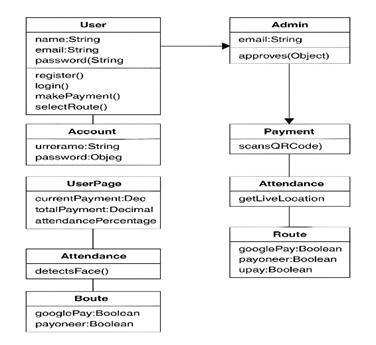
Fig.1:ClassDiagram
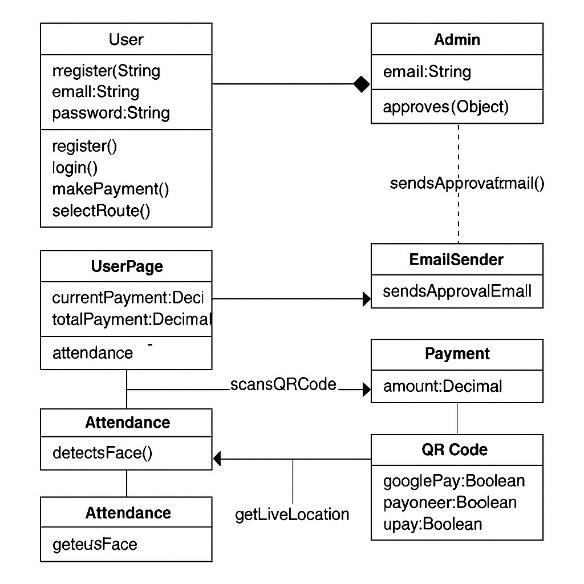
Fig.2:EntityRelationshipDiagram
7.Result and Discussion
The deployment of the CBAS yielded significant improvements:
Upon testing the system in a simulated environment, we observedhighaccuracyinfacial detectionand recognition under well-lit conditions. Attendance logging occurred within seconds, and the admin portal effectively reflected real-time updates. The reward system successfully calculateddiscounts based on monthlyattendance counts, demonstratingbothfunctionalaccuracyandpotentialrealworldimpact.
International Research Journal of Engineering and Technology (IRJET) e-ISSN:2395-0056
Volume: 12 Issue: 06 | Jun 2025 www.irjet.net p-ISSN:2395-0072
Althoughreal-timetrackingwaspartiallyimplemented,its accuracy was limited due to the lack of dedicated GPS hardware. Nonetheless, administrators were able to retrieve logs and student records efficiently. The test results were validated through controlled user trials and compared against manual attendance logs, showing improvedspeedandfewererrors.
Accesstotheadminportalisrole-basedandsecuredusing login credentials with session management and timeout features to prevent unauthorized access. The system also employs HTTPS protocols for secure data transmission between the server and the client, ensuring that sensitive data such as login credentials or personal information is notexposedduringcommunication.
Additionally, database access is controlled by privilege separation and audit logs to track access history and changes. While our current system is deployed in a controlled environment, it has been designed to meet broader data protection standards to facilitate future implementationinwiderinstitutionalnetworks.
8.Conclusion
This project introduces an innovative, hardwareminimized solution for college bus management through face recognition-based attendance, real-time fund management, and reward-incentivized payments. By removing costly biometric systems and embracing software-based automation, the College Bus Automation System presents an accessible, scalable, and highly efficient platform that enhances transportation logistics for educational institutions. The results confirm its viability,accuracy,andadaptabilityforpracticaluse.
With appropriate hardware integration in future versions such as GPS tracking, mobile applications, and parent notification systems the proposed model can be expandedintoafull-scalesmarttransportecosystem.
[1] Z. Zhang, “A Survey of Recent Advances in Face Detection,” Microsoft Research, 2018. [Online]. Available: https://ieeexplore.ieee.org/document/8411207
[2] R. G. Lathkar and V. V. Gohokar, “Design and Implementation of a Facial Recognition Attendance System,”IEEEICCCNT,2020.
[3] S. M. R. Islam, Y. Tian and M. A. Hossain, “A Survey on Deep Learning Techniques for Face Recognition,” IEEE Access,vol.7,pp.161954-161976,2019.
[4] P. Viola and M. Jones, “Robust Real-Time Face Detection,”Int’lJournalofComputerVision,2004.
[5]A.S.M.Zahid,M.AhmadandN.Noor,“FaceRecognition Based Smart Attendance System with Embedded GPS Tracker,” in 2020 IEEE 10th International Conference on System Engineering and Technology (ICSET), Shah Alam, Malaysia,2020.