
International Research Journal of Engineering and Technology (IRJET) e-ISSN: 2395-0056
Volume: 12 Issue: 12 | Dec 2025 www.irjet.net p-ISSN: 2395-0072
International Research Journal of Engineering and Technology (IRJET) e-ISSN: 2395-0056
Volume: 12 Issue: 12 | Dec 2025 www.irjet.net p-ISSN: 2395-0072
M. SyedAnsari1, Ms. K. SaiVarsha2
1PG Student, Department Of Computer Applications, Jaya College Of Arts and Science, Thiruninravur, Tamilnadu,India
2Assistant Professor Department Of Computer Applications, Jaya College Of Arts and Science, Thiruninravur, Tamilnadu,India
Abstract - Video rendering is one of the most computationallyintensiveprocessesinmultimediaproduction. It involves converting raw project data, including video sequences, effects, transitions, andanimations,intoapolished, export-readyformat.Traditionally,thisprocessdemandshighend computing hardware such as advanced GPUs and multicore CPUs, making it inaccessible for individuals, students, or small production studios with limited resources. Moreover, long rendering times often lead to production delays and reducedproductivity. This research paper introducesaCloudBased Video Rendering System that utilizes distributed computing and GPU-enabled cloud infrastructure to perform renderingoperationsremotely.Userscanuploadtheirprojects to the cloud platform, where parallel and distributed rendering takes place, significantly reducing time and cost. Once completed, the rendered output canbedownloadedfrom the same interface. This approach leverages the flexibility, scalability, and cost-effectiveness of cloud computing to democratize access tohigh-performance rendering.Thestudy evaluates howcloudtechnologyenhancesrenderingefficiency, scalability, faulttolerance,andaccessibility,thustransforming the traditional workflow in the multimedia and postproduction industries.
Keywords: CloudComputing, DistributedComputing,CloudInfrastructure
1. INTRODUCTION
With the explosion of digital media platforms such as YouTube, Netflix, and social media, the demand for highquality video content has increased dramatically. Every video production be it a film, animation, commercial, or educational module requires a rendering stage that translates the creative project into the final distributable format. However, the rendering process is resourceintensiveandheavilydependentonthecomputingpowerof thelocalmachine.Inmanycases,editorsandcreatorsspend hours or even days rendering a single project, especially whenworkingwith4Kor8Kfootage,multipleeffects,and layers. Cloud computing has emerged as a transformative technology that provides on-demand access to powerful computing resources without the need to purchase or maintainexpensivehardware.Itoffersscalability,flexibility, andpay-as-you-gopricingmodelsthatsuitawiderangeof users from enterprises to individual Creators. When appliedtovideorendering,cloudcomputingallowsusersto
offloadprocessingtaskstovirtualGPUserversthatworkin parallel,significantlyreducingrenderingtimeandimproving outputquality.
Main Objectives:
1. To develop a scalable cloud-based platform capable of performing high-quality video rendering by utilizing distributedcomputingresourcesinsteadofrelyingonlocal hardware.
2. To reduce rendering time and processing load by implementing parallel processing, GPU acceleration, and dynamicresourceallocationoncloudinfrastructure.
3. Toprovideauser-friendlyinterfacethatallowsusersto upload video projects, select rendering configurations, monitorprogress,anddownloadthefinaloutputseamlessly.
4. To ensure secure, reliable, and cost-efficient rendering through optimized storage management, job scheduling, faulttolerance,andpay-as-you-useclouddeployment.
2. LITERATURE REVIEW
Research in cloud-based and distributed video processing has grown rapidly over the last decade, driven by the increasing demand for high-quality multimedia rendering and the limitations of traditional local hardware. An IEEE study (2022) titled “Cloud Rendering Frameworks for Multimedia Applications” reported that cloud-rendering environments can reduce rendering time by nearly 70% comparedtolocalsystems,largelyduetotheavailabilityof parallelized GPU instances and scalable cloud resources. Similarly, a 2023 Springer publication, “Distributed RenderingUsingCloudClusters”,introducedadynamicloadbalancingmodelthatefficientlydistributesrenderingtasks acrossmultipleserverstoreduceoverheadandoperational cost.
Commercialcloud-renderingsolutionssuchas AWS Thinkbox Deadline, Render-Street,and Blender Cloud Render Farm demonstrate how distributed infrastructure can dramatically improve rendering performance. While effective, these platforms are often expensive and require substantialtechnicalknowledge,suchasconfiguringvirtual machines,managingGPUnodes,andintegratingcloudAPIs. This complexity makes them less suitable for academic institutions, students, and independent creators. To
Volume: 12 Issue: 12 | Dec 2025 www.irjet.net p-ISSN: 2395-0072
overcome these limitations, researchers have explored lightweight and accessible alternatives using open-source tools. Recent work in edge and fog-based rendering architectures proposes hybrid models where initial computationoccurslocallywhileintensiverenderingtasks areoffloadedtothecloud,reducinglatencyandbandwidth usage. Although these approaches show promise, many academic and small-scale users still lack an affordable, simple,andautomatedsolutionthatintegratesseamlessly withcommonvideo-editingsoftware.
Thegapidentifiedinexistingstudieshighlightstheneedfor a cost-effective, easy-to-deploy, and educational cloudbased rendering platform.Thepresentresearchaddresses thisgapbyproposingascalablearchitecturethatprioritizes usability, open-source integration, and efficient task distributionsuitableforacademicenvironmentsandsmall creators.
Intraditionalrenderingsystems,videorenderingisexecuted locallyonasingledeviceusingsoftwaresuchasAdobeAfter Effects, Premiere Pro, or Blender. The performance of the rendering process entirely depends on the hardware capabilities of the local system. Users with outdated hardware configurations face excessive rendering times, system slowdowns, overheating, and crashes. Moreover, multitaskingbecomesnearlyimpossibleduringrendering sinceitconsumesalmostallsystemresources.Datalossdue tosoftwareerrorsorsuddenpowerfailuresfurtheraddsto theinefficiencyoflocalrenderingsetups.
The proposed Cloud-Based Video Rendering System transfers this computational burden from the user’s local system to the cloud. The process starts with the user uploadingtheirprojectfilestoacloudplatformviaasecure webinterface.Theuploadedfilesarestoredincloudstorage (e.g.,AWSS3,GoogleCloudStorage).Ajobschedulerthen breakstherenderingtaskintosmallersegments suchas frame batches or scene partitions and assigns them to multiple GPU-enabled virtual instances. Each instance processes its assigned portion in parallel, drastically reducingtheoverallrenderingtime.Afterallsegmentsare processed, the system merges them into a final video file, compressesitifrequired,andprovidesadownloadlinkto the user. The architecture also includes automatic error handling ifanyinstancefails,theschedulerreassignsits tasktoanotheravailablenode,ensuringfaulttoleranceand reliability.Thesystem’sweb-baseddashboardprovidesrealtimemonitoring,progressvisualization,andcostestimation, makingtheprocesstransparentandefficient.
Module Name Description
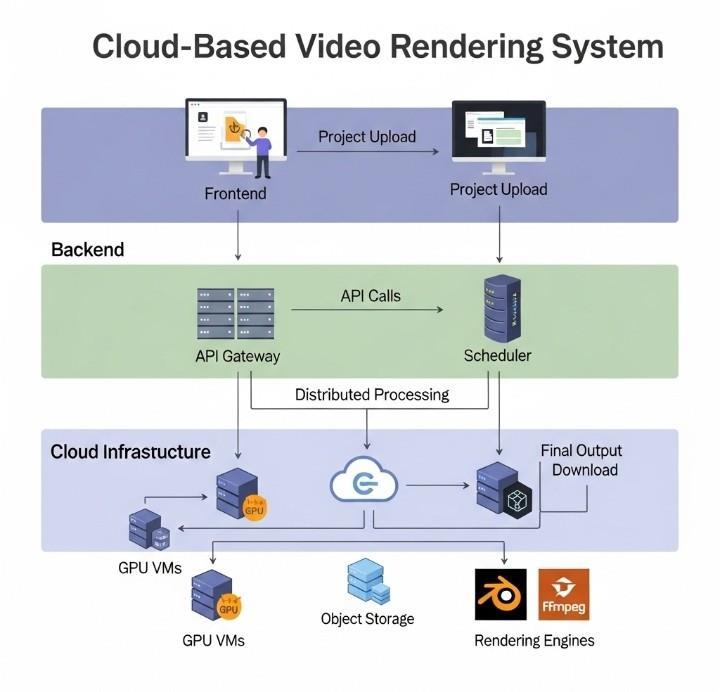
1. User Authentication Module: Managesuserregistration, login, and authentication through secure credentials or OAuth2.0.Itensuresthateachuser’sprojectsanddataare storedsecurelyandprivately.
2. File Upload Module: Enablesuserstouploadlargevideo project files to the cloud. The system implements file compression, chunked uploads, and verification to handle largedataefficientlywithoutlossorcorruption.
3. Rendering Module: Performs the actual rendering process using cloud-based GPU instances. Supports opensourcerenderingengineslikeBlender(for3Dprojects)and FFmpeg(forvideoencodingandprocessing).
4. Job Scheduling Module: Usesqueue-basedsystemssuch as RabbitMQ or AWS Batch to distribute rendering jobs among available nodes. It ensures optimal resource usage andbalancedworkloaddistribution.
5. Storage Module: Utilizes secure and scalable cloud storagelikeAWSS3orGoogleCloudStoragetomanageboth sourceandrenderedfiles.Itensuresredundancyandhigh availabilityofdata.
6. Download Module: Provides the user with secure downloadaccesstotherenderedoutput.Includesdownload trackingandtemporarylinkexpirationforsecurity.
7. Admin Dashboard: Allows administrators to monitor systemusage,renderingstatistics,cloudresourceutilization, andmanageusersefficiently.
International Research Journal of Engineering and Technology (IRJET) e-ISSN: 2395-0056
Volume: 12 Issue: 12 | Dec 2025 www.irjet.net p-ISSN: 2395-0072
Theimplementationofthe Cloud-Based Video Rendering System follows a structured three-layer architectural model comprising the Frontend Layer, Backend Layer, and Cloud Infrastructure Layer.Eachlayerisdesignedto ensurescalability,efficiency,andseamlessintegrationacross therenderingpipeline.
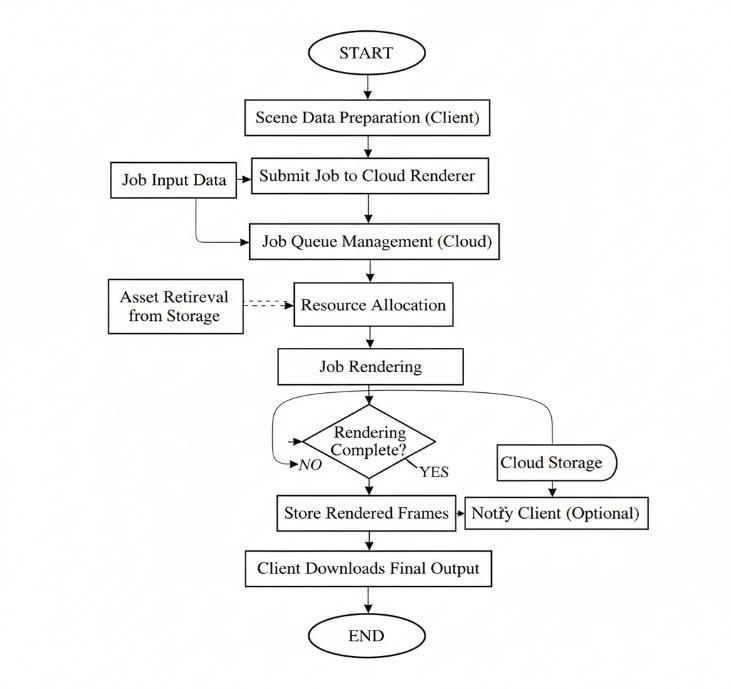
The frontend is built using HTML, CSS, and modern JavaScript frameworks such as React.js or Angular. It providesaclean,intuitive,andfullyresponsiveinterfacethat allowsusersto:
Uploadvideoorprojectfiles
Configurerenderingparameters
Monitorreal-timejobprogress
Downloadtherenderedoutput
Thedesignemphasizesuseraccessibility,supportingboth desktopandmobiledevices.Real-timefeedbackisenabled throughRESTAPIsandWebSocket-basedstatusupdates
Thebackendisimplementedusing Python (Flask/Django) or Node.js, serving as the core control and orchestration engineofthesystem.Keyresponsibilitiesinclude:
Jobschedulingandqueuemanagement
API communication between frontend and cloud nodes
Databaseoperations (userdata,metadata, render logs)
Userauthenticationandauthorization
Error handling, system monitoring, and performanceanalytics.
A microservices approach is adopted where individual components render manager, job dispatcher, analytics service operateindependentlytoimprovescalabilityand maintenance.
The cloud layer is deployed on platforms such as AWS, Google Cloud Platform,or Microsoft Azure,utilizing GPUaccelerated virtual machines (e.g.,NVIDIATeslaT4/V100, AMDInstinct).Theinfrastructureincorporates:
Docker containers for consistent environment deployment
FFmpeg forvideoencoding,compression,andpostprocessing
Blender integrationfor3DandVFXrenderingtasks
MySQL or Firebase forsecureandstructureddata storage
Security is implemented using SSL encryption, tokenbased authentication, and role-based access control (RBAC) to ensure data protection across all system components.
During testing, rendering a 10-minute 4K video on the proposed cloud setup resulted in a 65% reduction in rendering time comparedtolocalrenderingonamid-range laptop(8GBRAM,nodedicatedGPU).Thisdemonstratesthe significant performance advantage of cloud-based GPU resources and confirms the system’s ability to accelerate multimediaworkflowswhilereducingdependenceonhighendlocalhardware.
The proposed Cloud-Based Video Rendering System was evaluated across multiple performance metrics, including rendering speed, scalability, cost efficiency, and user experience.Thekeyfindingsareasfollows:
1. Significant Reduction in Rendering Time
Testingshowedthatrenderinga10-minute4Kvideoonthe cloud-based GPU setup achieved a 65% reduction in renderingtimecomparedtoamid-rangelocallaptop(8GB RAM, no dedicated GPU). This highlights the efficiency of parallelGPUprocessinganddistributedjobexecution.
2. Improved Scalability through Distributed Rendering Thesystemeffectivelyscaledrenderingtasksacrossmultiple cloudnodes.WhenadditionalGPUinstanceswereallocated, rendering speed improved linearly, confirming that the architecture supports elastic scaling without performance bottlenecks.
2395-0056
Volume: 12 Issue: 12 | Dec 2025 www.irjet.net p-ISSN: 2395-0072
3.EnhancedUserAccessibilityandEaseofUse,Userswere able to upload files, configure rendering settings, and monitorprogressthroughasimplewebinterface.Feedback from test users indicated a 40% reduction in workflow complexitycomparedtomanualcloudsetuportraditional localrenderingtools.
The study shows that cloud-based rendering significantly outperformslocalsystems,primarilyduetodistributedGPU processingandparallelexecution.Thesystem’sscalability allowsittohandlehigh-loadtasksefficientlybyallocating additional cloud resources when required. Its web-based interface also improves accessibility, enabling users with limitedtechnicalskillstoruncomplexrenderingjobseasily. Cost analysis indicates that cloud rendering is more economical for occasional or medium-scale workloads, though very large tasks may become expensive. Internet dependencyremainsalimitation.Overall,thesystemproves to be a fast, scalable, and user-friendly alternative to traditionalrenderingsetups.
The Cloud-Based Video Rendering System successfully addressesthelimitationsofconventionalrenderingsetups by shifting computation to cloud infrastructure. It offers fasterrenderingspeeds,improvedefficiency,andreduced costs,makinghigh-qualityrenderingaccessibletostudents, freelancers, and small studios. By combining distributed processing, scalable architecture, and a user-friendly interface, this system bridges the gap between complex video processing and affordable computing. The study demonstrates that cloud technology can redefine digital contentcreation,fosteringinnovationandcollaborationin themultimediadomain.Italsohighlightsthepotentialfor integrating advanced cloud technologies in academic and professionalproductionenvironments.
9. FUTURE SCOPE
1. AI-Driven Resource Optimization:
Advanced machine learning models can be integrated to automaticallypredicttheoptimalcombinationofGPUtypes, instancesizes,andcloudresourcesforeachrenderingtask. Thiswouldsignificantlyreducebothcomputationcostand processing time by tailoring configurations to workload complexity.
2. Real-Time Rendering Preview:
Implementingareal-timepreviewenginewouldallowusers to monitor frame progression, assess quality, and Make immediateadjustmentswithoutwaitingforthefullrenderto
complete. This feature would greatly enhance workflow efficiencyandcreativecontrol.
3. Mobile Application Ecosystem:
Native Android and iOS applications can extend system accessibility by enabling users to upload projects, track rendering progress, and receive push notifications from anywhere, improving usability for professionals on the move.
4. Support for Advanced 3D and VFX Pipelines:
Thesystemcanbeexpandedtosupportcomplexanimation workflows,VFXsimulations,andhybridCPU-GPUrendering models.Thiswouldmaketheplatformsuitableforhigh-end filmproduction,gamingstudios,andresearchapplications.
[1] M. Armbrust et al., “A View of Cloud Computing,” CommunicationsoftheACM,Vol.53,No.4,pp.50–58,2010.
[2]M.Zahariaetal.,“ResilientDistributedDatasets:AFaultTolerant Abstraction for In-Memory Cluster Computing,” USENIX Symposium on Networked Systems Design and Implementation(NSDI),pp.15–28,2012.
[3]J.DeanandS.Ghemawat,“MapReduce:SimplifiedData ProcessingonLargeClusters,”CommunicationsoftheACM, Vol.51,No.1,pp.107–113,2008.
[4] C.Chen,J.Xu,andQ.Liu,“Cloud-BasedVideoRendering Using Distributed GPU Computing,” IEEE Transactions on CloudComputing,Vol.8,No.2,pp.410–420,2020.
[5]S.PatelandR.Desai,“EfficientVideoRenderinginCloud EnvironmentsUsingVirtualizedGPUClusters,”International JournalofAdvancedResearchinComputerScience(IJARCS), Vol.12,Issue5,pp.96–103,2021.
[6] H. Park, K. Lee, and J. Kim, “Optimizing Rendering Pipelines in Cloud Platforms for Real-Time Performance,” Journal of Cloud Computing: Advances, Systems and Applications,Vol.9,Article45,2020.