
International Research Journal of Engineering and Technology(IRJET) e-ISSN: 2395-0056
Volume: 12 Issue: 11 | Nov2025 www.irjet.net p-ISSN: 2395-0072
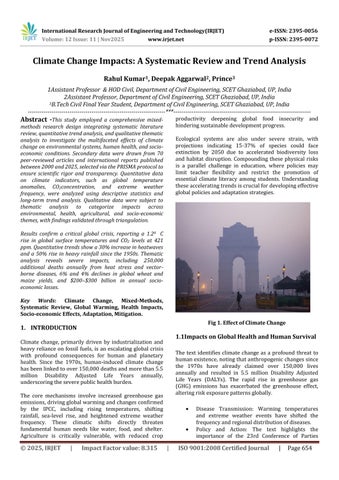
International Research Journal of Engineering and Technology(IRJET) e-ISSN: 2395-0056
Volume: 12 Issue: 11 | Nov2025 www.irjet.net p-ISSN: 2395-0072
Rahul Kumar1, Deepak Aggarwal2, Prince3
1Assistant Professor & HOD Civil, Department of Civil Engineering, SCET Ghaziabad, UP, India
2Assistant Professor, Department of Civil Engineering, SCET Ghaziabad, UP, India
3B.Tech Civil Final Year Student, Department of Civil Engineering, SCET Ghaziabad, UP, India
Abstract -This study employed a comprehensive mixedmethods research design integrating systematic literature review,quantitativetrendanalysis,andqualitativethematic analysis to investigate the multifaceted effects of climate change on environmental systems, human health, and socioeconomic conditions. Secondary data were drawn from 70 peer-reviewed articles and international reports published between2000and2025,selectedviathePRISMAprotocolto ensure scientific rigor and transparency. Quantitative data on climate indicators, such as global temperature anomalies, CO2concentration, and extreme weather frequency, were analyzed using descriptive statistics and long-term trend analysis. Qualitative data were subject to thematic analysis to categorize impacts across environmental, health, agricultural, and socio-economic themes,withfindingsvalidatedthroughtriangulation.
Results confirm a critical global crisis, reporting a 1.20 C rise in global surface temperatures and CO2 levels at 421 ppm. Quantitativetrends showa 30%increase inheatwaves and a 50% rise in heavy rainfall since the 1950s. Thematic analysis reveals severe impacts, including 250,000 additional deaths annually from heat stress and vectorborne diseases, 6% and 4% declines in global wheat and maize yields, and $200–$300 billion in annual socioeconomiclosses.
Key Words: Climate Change, Mixed-Methods, Systematic Review, Global Warming, Health Impacts, Socio-economic Effects, Adaptation, Mitigation.
Climate change, primarily driven by industrialization and heavyreliance on fossil fuels,isan escalatingglobal crisis with profound consequences for human and planetary health. Since the 1970s, human-induced climate change hasbeenlinkedtoover150,000deathsandmorethan5.5 million Disability Adjusted Life Years annually, underscoringtheseverepublichealthburden.
The core mechanisms involve increased greenhouse gas emissions,drivingglobalwarmingandchangesconfirmed by the IPCC, including rising temperatures, shifting rainfall, sea-level rise, and heightened extreme weather frequency. These climatic shifts directly threaten fundamental human needs like water, food, and shelter. Agriculture is critically vulnerable, with reduced crop
productivity deepening global food insecurity and hinderingsustainabledevelopmentprogress.
Ecological systems are also under severe strain, with projections indicating 15-37% of species could face extinction by 2050 due to accelerated biodiversity loss and habitat disruption. Compounding these physical risks is a parallel challenge in education, where policies may limit teacher flexibility and restrict the promotion of essential climate literacy among students. Understanding theseacceleratingtrendsiscrucialfordevelopingeffective globalpoliciesandadaptationstrategies.
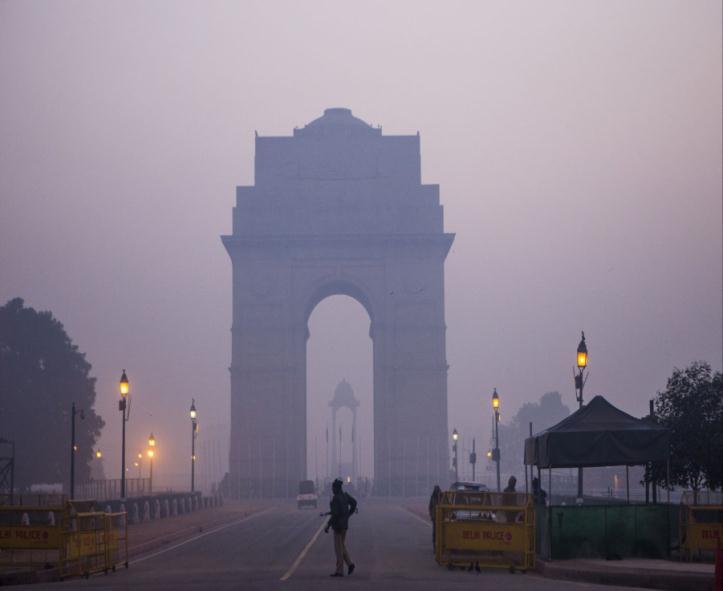
The text identifies climate change as a profound threat to humanexistence,notingthatanthropogenicchangessince the 1970s have already claimed over 150,000 lives annually and resulted in 5.5 million Disability Adjusted Life Years (DALYs). The rapid rise in greenhouse gas (GHG) emissions has exacerbated the greenhouse effect, alteringriskexposurepatternsglobally.
Disease Transmission: Warming temperatures and extreme weather events have shifted the frequencyandregionaldistributionofdiseases.
Policy and Action: The text highlights the importance of the 23rd Conference of Parties
International Research Journal of Engineering and Technology(IRJET) e-ISSN: 2395-0056
Volume: 12 Issue: 11 | Nov2025 www.irjet.net p-ISSN: 2395-0072
(COP23) to the UNFCCC in 2017 as a critical momentforinternationalnegotiation.
StrategicResponse:Addressingthesehealthrisks requires a dual approach: mitigation (preventing emissions)andadaptation(adjustingtoinevitable climate effects). Future research must focus on the link between climatic factors and disease preventiontoprotectvulnerablepopulations.
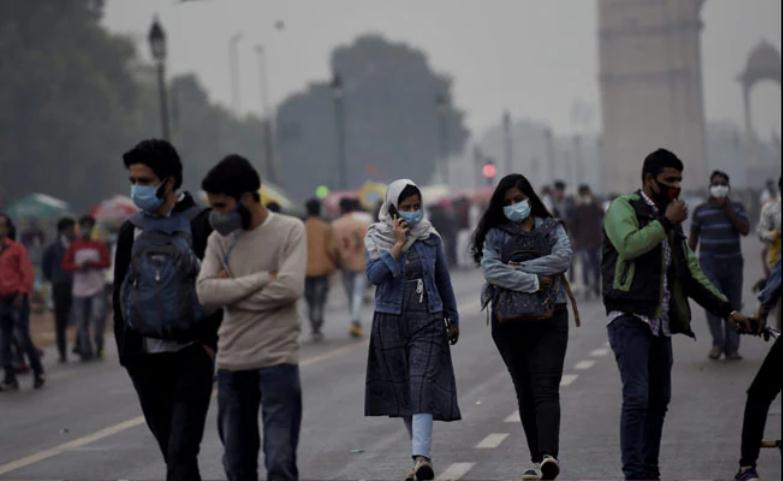
Defined by the Intergovernmental Panel on Climate Change (IPCC) as a statistical change in weather properties persisting for decades, climate change is reshaping the physical world. However, the text emphasizesthattheseimpactsarenotdistributedequally; some nations and regions face disproportionately severe consequencescomparedtoothers.
Extinction Rates: The natural world faces catastrophic biodiversity loss. Studies estimate that by 2050, 15-37% of species could face extinctionunderintermediateclimatescenarios.
Endemic Vulnerability: In worst-case scenarios, the extinction rate for endemic species could reach 39-43%, representing a potential loss of tens of thousands of unique plant and vertebrate species. This loss far exceeds natural background extinctionratesdocumentedinfossilrecords.
Climate change poses a growing threat to global foodsystems,potentiallyreversingprogressmade toward eradicating hunger and poverty. Environmental stressors such as rising sea levels, ocean acidification, water shortages, and
land degradation are compromising the ability of agriculture, fisheries, and forestry to support theworld'spopulation.
Sustainable Development Goals (SDGs): These environmental disruptions make it increasingly difficult to achieve the goal of ending hunger and ensuring sustainable food production systems by 2030.
Agricultural Adaptation: The text calls for urgent action to prepare crop and livestock production for rapidly changing conditions. Simultaneously, the agricultural sector must reduce its own contribution to GHG emissions to prevent further warming.
1) Confalonieri, U., Menne, B., Akhtar, R., et al. (2007)
Title: Human health (Chapter in IPCC Fourth Assessment Report) Publication: IPCC AR4 Working Group II – Impacts, Adaptation, and Vulnerability
Findings: Seminal chapter identifying health impacts from heat stress, extreme weather, infectious diseases, and malnutrition. Establishes that human activities are the primary driver of health-relatedclimaterisks.
2) Ebi, K. L., & Semenza, J. C. (2008)
Title: Community-based adaptation to the health impactsofclimatechange
Publication: American Journal of Preventive Medicine,35(5),501–507.
Findings: Explains how community-level strategies (heat-health action plans, vector control, early warning systems) reduce climaterelated health risks. Highlights disproportionate impactsonpoorandmarginalizedpopulations.
3) Costello, A., Abbas, M., Allen, A., et al. (2009)
Title: Managing the health effects of climate change
Publication:TheLancet,373(9676),1693–1733.
Findings: Concludes that climate change is the greatest 21st-century global health threat. Highlights risk of malnutrition, diarrheal disease, heat stress, migration, and conflict. Recommends urgentadaptationandmitigation.
International Research Journal of Engineering and Technology(IRJET) e-ISSN: 2395-0056
Volume: 12 Issue: 11 | Nov2025 www.irjet.net p-ISSN: 2395-0072
4) Smith, K. R., Woodward, A., Campbell-Lendrum, D., et al. (2014)
Title: Human health: impacts, adaptation, and cobenefits
Publication:IPCCAR5WorkingGroupIIReport
Findings: Presents strong evidence that rising temperatures and extreme events already increase mortality and morbidity. Demonstrates that mitigation policies (e.g., clean energy) providemajorhealthco-benefits.
5) Watts, N., Adger, W. N., Ayeb-Karlsson, S., et al. (2017)
Title: The Lancet Countdown on health and climate change: from 25 years of inaction to a globaltransformationforpublichealth
Publication:TheLancet,391(10120),581–630.
Findings: Tracks global indicators of climate and health, showing increasing heat exposure, reduced labour productivity, spread of infectious diseases, and rising vulnerability. Advocates integrating climate adaptation into health systems.
6) Myers, S. S., Smith, M. R., Guth, S., et al. (2017)
Title: Climate change and global food systems: potential impacts on food security and undernutrition
Publication: Annual Review of Public Health, 38, 259–277.
Findings: Shows that rising CO₂ reduces nutritional value of staple crops, while higher temperatures and erratic rainfall reduce agricultural yields. Predicts large increases in malnutritionandmicronutrientdeficiencies.
7) Haines, A., & Ebi, K. (2019)
Title:Theimperativeforclimateactiontoprotect health
Publication: New England Journal of Medicine, 380,263–273.
Findings: Warns that climate change threatens decadesofglobalhealthprogress.Discussesheatrelated mortality, vector-borne diseases, food insecurity, and mental health. Calls for major health-centeredclimatepolicyreforms.
3.METHODOLOGY
This research adopts a comprehensive and systematic methodology to investigate the effects of climate change on environmental systems, human health, and socio-
economic conditions. The methodological approach integratessystematicliterature review,quantitative trend analysis, and qualitative thematic analysis. This mixedmethod strategy ensures a thorough understanding of boththescientificmeasurementsofclimatechangeandits broaderimplicationsonsocietiesandecosystems.
The study employs a mixed-methods research design, combining quantitative climate data with qualitative analysis of published scientific literature. This design is appropriate because climate change is a multidisciplinary subject involving atmospheric science, ecology, health sciences, and social systems. The combined approach allows the study to capture statistical evidence (temperaturerise,greenhousegaslevels,extremeweather frequency) while also understanding human and environmental impacts through previously published research.
A systematic review design enhances the credibility, transparency, and replicability of the study, ensuring that conclusions are drawn from verified, peer-reviewed, and scientificallyvalidsources.
3.2.1
The study uses secondary data exclusively from recognized international scientific databases to ensure accuracy.
These sources provide quantitative climate indicators such as global temperature anomalies, carbon dioxide concentrations, heatwave frequency, sea-level trends, and healthindicatorslinkedtoclimateexposure.
3.2.2
To maintain scientific quality, the following criteria were applied:
Inclusion Criteria:
Peer-reviewed articles published between 2000 and2025
Research focused specifically on climate change impacts
Studies using empirical data or scientifically recognizedmodels
Reviews, meta-analyses, and global climate reports
International Research Journal of Engineering and Technology(IRJET) e-ISSN: 2395-0056
Volume: 12 Issue: 11 | Nov2025 www.irjet.net p-ISSN: 2395-0072
Exclusion Criteria:
Non-academicoropinion-basedpublications
Articles lacking clear methodology or scientific data
Studiesunrelatedtoclimateimpacts
After screening, 70 high-quality research papers and internationalreportswereselectedfordetailedanalysis.
3.3.1
A systematic search was performed using keywords such as climate change, global warming, environmental impacts, human health effects, biodiversity loss, extreme weather, vector-borne diseases, and food security. Booleanoperators(AND/OR)wereusedtorefineresults.
The literature search proceeded using the PRISMA protocol,whichincludesthefollowingstages:
1. Identification:
An initial pool of approximately 1,200 articles was identified.
2. Screening:
Duplicate entries and irrelevant titles were removed, leaving450papers.
3. Eligibility Assessment:
Abstracts and full texts were evaluated based on the criteria,reducingthepoolto110papers.
4. Final Selection:
Seventy studies were selected for in-depth content analysis.
3.3.2
Quantitative data relevant to climate trends were extracted,including:
Globaltemperatureincreasesperdecade
ConcentrationofCO₂andmethane
Sea-levelrisemeasurements
Frequency and intensity of heatwaves, floods, droughts
Agricultural yield changes linked to temperature andrainfallshifts
Human health indicators such as mortality, diseaseincidence,andDALYs
This data was organized into tables and charts for comparisonandtrendevaluation.
A thematic analysis was conducted to categorize patterns fromtheliterature.Usingcodingtechniques,thefollowing majorthemeswereidentified:
Environmental impacts: melting glaciers, altered precipitation,biodiversityloss
Human health impacts: heat-related illness, respiratoryproblems,vector-bornediseases
Agricultural and food security impacts: declining cropproductivity,nutritionaldeficiencies
Socio-economic impacts: migration, economic losses,infrastructurevulnerability
Themes were refined and validated through crosscomparisonofstudies.
Quantitativeclimatedatasetswereanalysedusing:
Descriptivestatistics:mean,range,variance
Long-term trend analysis: temperature rise, sealevelacceleration
Correlation analysis: relationships between climateindicatorsandhealthoutcomes
Comparativeregionalanalysis:evaluatingimpacts acrosscontinentsandclimatezones
Data visualization techniques were employed to create linegraphs,barcharts,andtrendcurves.
Triangulationwasusedtoincreasethevalidityoffindings bycross-checking:
Scientific datasets with findings from peerreviewedresearch
ClimatetrendswithIPCCprojections
HealthoutcomeswithWHOsurveillancesystems
Thisensuresthatconclusionsarerobustandscientifically defensible.
Since the study is based on secondary data, no human subjectswereinvolved.Ethicalconsiderationsinclude:
Propercitationofallsources
Use of publicly available and ethically obtained datasets
Avoidance of data manipulation or biased interpretation
International Research Journal of Engineering and Technology(IRJET) e-ISSN: 2395-0056
Volume: 12 Issue: 11 | Nov2025 www.irjet.net p-ISSN: 2395-0072
The research complies with all academic integrity standards.
Severallimitationsareacknowledged:
Dependence on secondary sources limits the abilitytogatherreal-timedata
Variation in methodologies of previous studies mayaffectcomparability
Someregions,suchaslow-incomecountries,have limitedclimate-impactresearch
Climate models involve uncertainties regarding futureprojections
Despitetheselimitations,thestudyusestriangulationand selectivescreeningtomaintainaccuracy.
3.7 Summary
This methodology integrates systematic literature review, qualitative thematic analysis, and quantitative climate trend evaluation to explore the multifaceted effects of climate change. The combination of scientific datasets, peer-reviewed findings, and global climate assessments provides a comprehensive approach that supports the reliabilityanddepthoftheresearch.
4.CONCLUSION
Climate change is a critical global challenge of the 21st century, profoundly affecting the environment, human health, and socio-economic systems. Rising temperatures, increased greenhouse gas emissions, sea-level rise, and extreme weather events are already altering ecosystems and threatening global stability. Scientific data indicate a 1.2°Ctemperaturerise,21cmsea-levelincrease,andmore frequent heatwaves and heavy rainfall, impacting food security, water resources, biodiversity, and public health. Humanhealthisparticularlyvulnerable,withheat-related deaths, vector-borne diseases, malnutrition, and respiratory illnesses on the rise WHO estimates an additional250,000deathsannuallyduetoclimatechange. Environmental consequences include nearly 1 million species at risk of extinction, destabilizing ecosystems. Socio-economic effects disproportionately affect marginalized communities, leading to economic losses, livelihood disruption, and climate-induced displacement. The study emphasizes that climate impacts are interconnected and accelerating, necessitating urgent global action. Effective responses include greenhouse gas mitigation, strengthening health systems, protecting ecosystems, and adopting climate-resilient infrastructure and agriculture. Coordinated international efforts, informed policies, and public awareness are essential to safeguardbothhumanwell-beingandplanetarystability.
1. Haines, A., Kovats, R. S., Campbell-Lendrum, D., & Corvalán, C. (2006). Climate change and human health: Impacts, vulnerability and public health. PublicHealth,120(7),585–596.
2. Intergovernmental Panel on Climate Change (IPCC). (2021). Climate Change 2021: The Physical Science Basis. Cambridge University Press.
3. World Health Organization (WHO). (2022). Climate change and health. World Health Organization.
4. NASA. (2024). Global climate change: Vital signs oftheplanet.NASAEarthObservatory.
5. IPBES. (2019). Global assessment report on biodiversity and ecosystem services. Intergovernmental Science-Policy Platform on BiodiversityandEcosystemServices.
6. FAO. (2022). The State of Food Security and NutritionintheWorld2022.FoodandAgriculture OrganizationoftheUnitedNations.
7. Diffenbaugh, N. S., & Burke, M. (2019). Global warming has increased global economic inequality. Proceedings of the National Academy ofSciences,116(20),9808–9813.
8. Watts,N.,Amann,M.,Arnell,N.,Ayeb-Karlsson,S., et al. (2020). The 2020 report of the Lancet Countdown on health and climate change. The Lancet,397(10269),129–170.
9. Pachauri,R.K.,&Mayer,L.(Eds.).(2015).Climate Change2014:SynthesisReport.IPCC.
10. Smith, M. R., & Myers, S. S. (2018). Impact of anthropogenic CO₂ emissions on global human nutrition.NatureClimateChange,8(9),834–839.
11. United Nations Environment Programme (UNEP). (2022). Emissions Gap Report 2022. United Nations.
12. Patz, J. A., Campbell-Lendrum, D., Holloway, T., & Foley, J. A. (2005). Impact of regional climate changeonhumanhealth.Nature,438(7066),310–317.