
International Research Journal of Engineering and Technology (IRJET) e-ISSN: 2395-0056
Volume: 12 Issue: 06 | Jun 2025 www.irjet.net p-ISSN: 2395-0072
International Research Journal of Engineering and Technology (IRJET) e-ISSN: 2395-0056
Volume: 12 Issue: 06 | Jun 2025 www.irjet.net p-ISSN: 2395-0072
Er. Ananda Sarjerao Mane Er. Harshvardhan Jitendra Mohite, Er. Ayush Ankush Jadhav Er. Girish Prakash Mohole
Guide: Prof. S.R. Kadam
H.O.D: Prof. A. N. Patil
Maharashtra, India
Abstract - This research addresses the growing concern of climate variability by analyzing environmental data from various districts within Maharashtra, India. It centers on understanding how key environmental indicators such as atmospheric temperature, carbon dioxide (CO₂) emissions, annualrainfall,forestdepletion,rapidurbanexpansion,anda synthesized Climate Impact Index vary regionally. The primary goal is to identify whether these indicators demonstrate statistically significant disparities among districts,whichisachievedthroughtheapplicationofone-way Analysis of Variance (ANOVA)
To move beyond statistical insight and toward proactive planning, the study also incorporates a predictive machine learningframework.Aregression-basedmodelisimplemented using Python, leveraging powerful data science libraries includingPandasfordatamanipulation,NumPyfornumerical computations, and Joblib for model serialization and deployment.TheprojectusesMongoDB,aNoSQLdatabase,to efficiently store and manage vast environmental datasets, enabling quick access and scalability.
The developed system not only identifies climate trends but also forecasts future changes at the district level. This predictive capacity offers actionable intelligence for regional plannersandpolicymakerstotailorenvironmentalstrategies specific to local conditions. By integrating statistical evaluationwithmachinelearning,thisprojectsupportsdatadriven, evidence-based decision-making in environmental governance and climate resilience planning
Key Words: : onewayANOVA,Deforestation,Regression Model,CO₂Emission,Urbanization
1.INTRODUCTION
Climatechangehasemergedasoneofthemostpressing globalchallenges,withitseffectsvaryingsignificantlyacross different geographical regions. Maharashtra, a diverseand denselypopulatedstatein
India,experienceswide-rangingenvironmentalconditions acrossitsdistricts makingitanidealsubjectforlocalized climate impact assessment. Understanding how
environmentalindicatorsdifferatthedistrictleveliscritical for developing effective and region-specific climate mitigationandadaptationstrategies.
Thisprojectfocusesonanalyzingdistrict-wisevariationsin essential environmental parameters such as temperature, CO₂ emissions, precipitation, deforestation, and urbanization.Touncoverstatisticallysignificantdifferences acrossregions,thestudyappliesone-wayANOVA,arobust statistical technique for comparing means across multiple groups.However,statisticalanalysisalonedoesnotprovide predictiveinsights.
To address this, the project integrates machine learning througharegression-basedmodeldevelopedinPython.By usinglibrarieslikePandas,NumPy,andJoblib,thesystem learns from historical environmental data and forecasts potential future trends. The data is managed using MongoDB, allowing efficient storage and retrieval of large datasetsforseamlessprocessing.
Theaimistobuildacomprehensive,scalable,andinsightful platform that supports district-level climate intelligence, ultimately helping authorities, researchers, and policymakers make informed, data-driven decisions to combatclimatechangelocally.
IrjetTemplatesampleparagraph.Defineabbreviationsand acronymsthefirsttimetheyareusedinthetext,evenafter theyhavebeendefinedintheabstract.Abbreviationssuchas IEEE,SI,MKS,CGS,sc,dc,andrmsdonothavetobedefined. Donotuseabbreviationsinthetitleorheadsunlesstheyare unavoidable.
Climate conditions do not affect all regions equally; their impacts are shaped by local geography, urbanization, vegetationcover,andhumanactivity.Maharashtra'sdistricts exhibitdiverseenvironmentalprofiles,makingitessentialto analyze climate data at a granular level. By focusing on district-wise patterns, this study helps identify high-risk zones, detect anomalies in environmental behavior, and formulatelocalizedclimateactionplans.
International Research
Volume: 12 Issue: 06 | Jun 2025 www.irjet.net p-ISSN: 2395-0072
Traditional environmental studies often rely on observational insights, which, while informative, lack predictive power. Integrating data science and machine learning into climate research enhances the ability to anticipatefuturechangesbasedonhistoricalpatterns.Inthis project, a regression-based model is utilized to forecast climate behavior using district-level environmental data. Thisdata-drivenapproachnotonlyimprovesaccuracybut also enables timely decision-making, empowering stakeholderstoimplementproactivemeasuresforclimate resilience.
The proposed system is developed following a structured methodology aimed at analyzing and predicting climate impactacrossdistrictsinMaharashtra.Theprojectbegins with the collection of environmental data, including variables such as temperature, CO₂ levels, rainfall, deforestation rate, urban growth, and a derived Climate ImpactIndex.Thisdataisorganizedbasedonadministrative divisionssuchasstate,district,taluka,andyear to ensure detailedandlocalizedanalysis.
For the statistical component, a one-way ANOVA test is employed to determine whether themean valuesof these indicatorsdiffersignificantlybetweendistricts.Thishelpsin identifying regions with unique or extreme climate behaviorsthatmayrequirefocusedattention.
Inthepredictivephase,aregression-basedmachinelearning model is developed using Python. Core libraries such as PandasandNumPyareusedfordatapreprocessing,while Joblibisutilizedforsavinganddeployingthetrainedmodel. Data is stored and managed using MongoDB, which offers scalable and efficient handling of large, unstructured datasets.
This methodology ensures a robust and comprehensive approach, combining statistical insight with predictive capabilitiestosupportdata-drivendecision-makingatthe districtlevel.
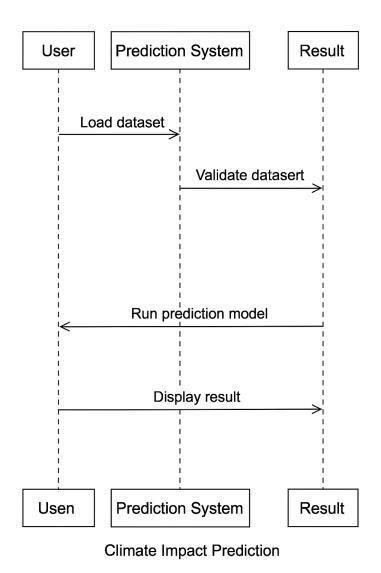
Table -1: SampleTableformat
Sample District-wise Environmental Data
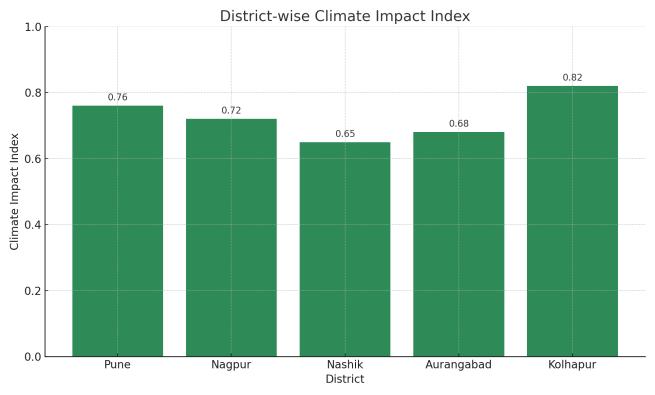
isacompositescore derivedfrommultipleenvironmentalindicators,including
International Research Journal of Engineering and Technology (IRJET) e-ISSN: 2395-0056
Volume: 12 Issue: 06 | Jun 2025 www.irjet.net p-ISSN: 2395-0072
temperature, CO₂ emissions, rainfall, deforestation, and urbangrowth.Asshown,Kolhapurrecordsthehighestindex value (0.82), indicating relatively higher environmental pressure or impact, while Nashik has the lowest (0.65), suggestingacomparativelymoderateclimateburden.This visual analysis aids in quickly identifying regions that require prioritized environmental planning and policy intervention.
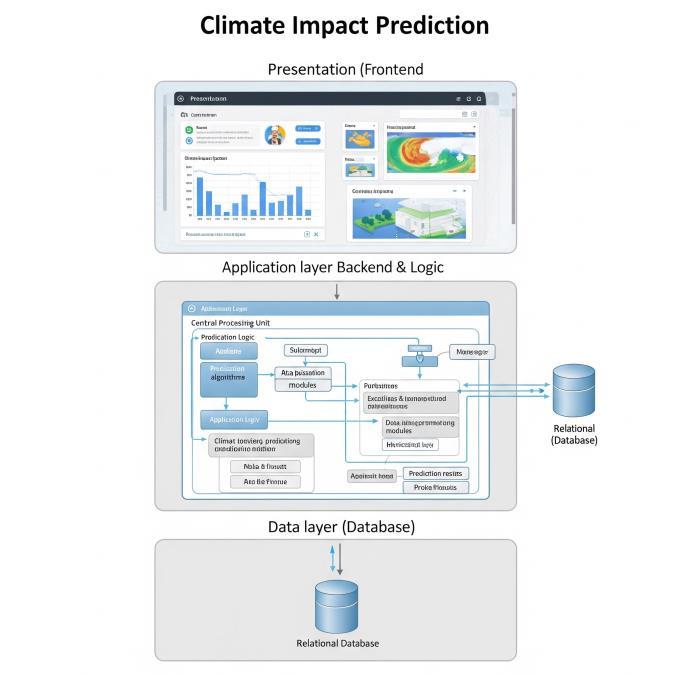
The diagram illustrates a three-tier architecture for a Climate Impact Prediction system. This architecture separatesthesystemintothreelogicalandphysicallayers:
Presentation Layer: This is the user interface, built with technologieslikeHTML5,CSS3,andJavaScript,whereusers interactwiththesystem,inputdata,andviewclimateimpact predictions.
Application Layer: Developed using Python 3.x and libraries like Pandas, NumPy, and Scikit-learn, this layer contains the core logic, including the machine learning model that processes environmental data and generates predictions.
Data Layer: UtilizingMongoDB,thislayerisresponsiblefor storingandmanagingallenvironmentalandpredictiondata.
The "Climate Impact Prediction" project successfully leveragesmachinelearningtoanalyzeandforecastclimaterelatedchanges,utilizingdiverseenvironmentalindicators suchastemperature,CO₂levels,precipitation,deforestation, urbanization, humidity, and air quality. The primary objectiveofpredictingclimateimpactvariationsatregional anddistrictlevelsusinghistoricalandenvironmentaldata hasbeeneffectivelymet.
Thedevelopedsystemprovidesanaccessibleplatformfor users to obtain region-specific climate predictions. This is achieved through the integration of a regression-based machinelearningmodel,auser-friendlywebinterface,anda MongoDBdatabase.Thisinitiativenotonlyraisesawareness aboutenvironmentalrisksbutalsoempowersresearchers, planners,andpolicymakerstoformulatemoresustainable environmentalstrategies.
IwouldliketoexpressmyprofoundgratitudetoProf.Mr. Kadam S. R. for their invaluable guidance, unwavering support, and the confidence they placed in this project, whichsignificantlymotivatedourefforts.
My sincere thanks also go to Prof. Patil A. N., Head of the Computer Engineering Department, for their timely cooperationandassistance.
Finally,Iextend myappreciationtoall theStaffMembers, friends,andcolleagueswhosesupportwasinstrumentalin thesuccessfuldevelopmentofthisproject.
1. https://climate.nasa.gov – NASA Climate Change andGlobalWarming
2. https://www.ipcc.ch–IntergovernmentalPanelon ClimateChange
International Research Journal of Engineering and Technology (IRJET) e-ISSN: 2395-0056
Volume: 12 Issue: 06 | Jun 2025 www.irjet.net p-ISSN: 2395-0072
3. https://www.epa.gov/climate-indicators – U.S. EnvironmentalProtectionAgency
4. https://www.kaggle.com – Datasets for Machine LearningandClimateAnalytics
5. https://scikit-learn.org–DocumentationforScikitLearnLibrary
6. https://pandas.pydata.org – Documentation for PandasLibrary
7. https://numpy.org – Documentation for NumPy Library
BIOGRAPHIES





Prof.KadamShrikantRangrao
ProjectRole:ProjectGuide
ManeAnandaSarjerao
ProjectRole:BackendDeveloper
MohiteHarshvardhanJitendra
ProjectRole:DataAnalyst
JadhavAyushAnkush
ProjectRole:FrontendDeveloper
MoholeGirishPrakash
ProjectRole:BackendDeveloper