
International Research Journal of Engineering and Technology (IRJET) e-ISSN:2395-0056
Volume: 12 Issue: 11 | Nov 2025 www.irjet.net p-ISSN:2395-0072
International Research Journal of Engineering and Technology (IRJET) e-ISSN:2395-0056
Volume: 12 Issue: 11 | Nov 2025 www.irjet.net p-ISSN:2395-0072
Shubham Deshmukh, Om Bhise, Shubham Rao, Vishal Daware
1,2,3,4Student, Dept. of Information Technology, MET's Institute of Engineering, Nashik, Maharashtra, India ***
Abstract – Weknow in today’sworlddata professionals spend so much of their time, almost 50-80% on manual cleaning, this blocks the path to analysis. This paper presents Cleansera, an AI-powered desktop application made to speed up this process. Cleansera introduces a context-aware cleaning approach, this enables the system to apply industry-specific standards for domains like finance, supply chain, manufacturing. A RetrievalAugmented Generation (RAG) framework is used in the system, allows users to interact with their data using natural language commands. To ensure data integrity, the system uses a dual-checkpoint quality assurance mechanism which tracks data loss and master fields. Application is built using Electron.js, functioning completely local with data privacy are the prioritizes. Ensuring high accuracy in AI command clarification are the key objectives. Cleansera automates complex data cleaning, allowing data professionals to focus on analysis andmakeaccuratedata-drivendecisions.
Keywords: Data Cleaning, Context-Aware Systems, Retrieval-Augmented Generation (RAG), Artificial Intelligence (AI), Data Preparation Automation, DualCheckpoint Quality Assurance, Domain-Specific Data Standards, Electron.js Application, AI Systems, Natural Language Interface, Knowledge Retrieval, Data Integrity Verification, Industry-Aware Rule Application, Data Loss Detection,Cross-PlatformDesktopApplication
Intoday’sdata-centricworld,informationisakeyassetfor decision-making and organizational strategy. To understand customer behavior, optimize operations, and plan for future growth, many businesses, small or large, relyonhighqualitydata.However,therawdata collected by organizations is rarely ready for analysis. The data cleaning and preparation are essential yet complex processes, due to different quality standards across different industries. For example, the rules for financial transaction are different from those required for marketingorecommerce.
Traditional data cleaning tool often can’t handle this complexity,asthey relyon one-size-fits-all approach.Due to this approach the domain-specific requirements, compliance requirements, and standards that each industrysectordemandsareignored.Becauseofthis,data
professionalshavetosetupthevalidationrulesmanually, a process that takes time and can easily lead to mistakes. These tools lack intelligence to understand the context of the data for example a “date” field in a financial ledger is treated identically to a “date” field in a supply chain manifest. This becomes even more difficult for professionals whohandle data across differentindustries. Eachdomainwhetherit’sBanking,FinancialServices,and Insurance or supply chain management has their own rulesandstandardsthatneedstobefollowedduringdata preparation.
To overcome these inefficiencies, this study introduces Cleansera, an innovative desktop application that performs context-aware data cleaning. Cleansera is an AIpowered tool that understands and adapts to specific industry contexts by applying domain-specific data cleaning strategies. The system uses a RetrievalAugmented Generation (RAG) framework, this allows the system to access external industry knowledge bases and best practice resources. This makes sure that all cleaning processesfollowtherightindustrystandards,movingpast generic rules to create a smarter and more efficient data preparationsolution.
The automation of data cleaning using large language models (LLMs) and artificial intelligence (AI) has been studied by several researchers in recent years. However, scalability,domainadaptation,transparencyandreal-time quality verification remain major obstacles for most currentsystems.
The effectiveness and scalability of traditional data cleaningandpreprocessingtoolswereevaluatedbyPedro Martins et al. In 2025. Their research showed that although these tools work well on structured datasets, theydonottakedomain-specificvalidationandcontextual understandingintoaccount. Togetaroundthislimitation, Cleansera offers context-aware intelligence that modifies intelligence that modifies cleaning processes based on supplychain,manufacturingandBFSIDomains.
AutoDCWorkflow, an LLM-based system that automatically creates data cleaning workflows, was presented by Lan Li et al. In 2025. The system needed human validation for most of its decision and lacked
International Research Journal of Engineering and Technology (IRJET) e-ISSN:2395-0056
Volume: 12 Issue: 11 | Nov 2025 www.irjet.net p-ISSN:2395-0072
domain awareness, even though it decreased manual labor. To enable automation, domain-accurate cleaning without constant human supervision, Cleansera improves on this by integrating Retrieval-Augmented Generation (RAG)toaccessindustry-specificknowledgebases.
The potential of LLMs as data preprocessors was examinedbyElyasMeguellatietal.in2025.Althoughthey made some progress, their work lacked a systematic approach to identifying context, which led to poor results across industries. Cleansera, on the other hand, offers an automatedcontextdetectionmodule thatappliesrelevant industry-specific rules dynamically by identifying value distributions,columnpatterns,anddatasemantics.
Despite requiring a lot of processing power and falling tovalidateagainstdomain-specific standards,ShuoZhang et al. (2024) showed that LLMs are superior to conventional rule-based techniques in identifying data errors. This is addressed by Cleansera, which uses Electrons.jstoimplementalightweight,effectiveAlmodel with local execution, guaranteeing performance optimisation and full offline functionality for settings that aresensitivetoprivacy.
RetClean, a retrieval-based framework created by Naeem et al. (2024), improved contextual accuracy by leveraging enterprise data lakes. However, it lacked generalisation for smaller or cross-domain datasets and was exclusively developed for large organisations. By providing a modular RAG architecture that scales across industriesandfacilitateslocalknowledgebaseintegration, Cleansera expands this idea while preserving accuracy independentofenterpriseinfrastructure.
Version controlled user interaction, industry-aware rule application, AI-driven context identification, RAGbased knowledge retrieval and dual-checkpoint quality assuranceareallincludedinthemethodology.
Inordertoapplyindustryspecific intelligenceduringdata cleaning, Cleansera uses Retrieval-Augmented Generation. TheRAGSystemobtainsimportantinformationfrom:
Industrystandardrepositories
Validationrulelibraries
Templatesfortransformation
Errorpatterndatabases
As a result, the AI model can produce cleaning operations which are in line with domain-specific procedures. RAG improves the system’s capacity to apply regulatory rules during cleaning based on the identified context, detect anomaliesandstandardiseformats.
The System allows users to communicate in plain English Through an AI-powered chat interface with version control. Without completely repeating workflows, users canduplicate,editandrerunearlierprompts.Theinterface ensures continuous improvement of cleaning operations, supports selective editing and keeps track of all prompts and responses. By avoiding workflow resets, this conversation approach improves user experience and boostsproductivity.
First Checkpoint: Master Field Identification
AI isused by thesystemtodetermine which master fields are needed for data validation. Batch numbers in manufacturing, product codes in supply chain datasets, campaignIDsinmarketingdataandtransactionIDsinBFSI are few examples. To make sure that cleaning procedures don’t damage important identifiers, these Fields are highlightedforverification.
Second Checkpoint: Identification of Data Loss
The System Measures data loss by comparing the cleaned datasetwiththerawdatasetafterthecleaningoperations. This involves fields that have been updated, records that havebeendeleted,missingvaluesandtransformedentries. TheSystemproducesfullreportwhichexplainthechanges made and effects they have on the dataset. This ensures transparencyandconfidenceinthecleaningprocedure.
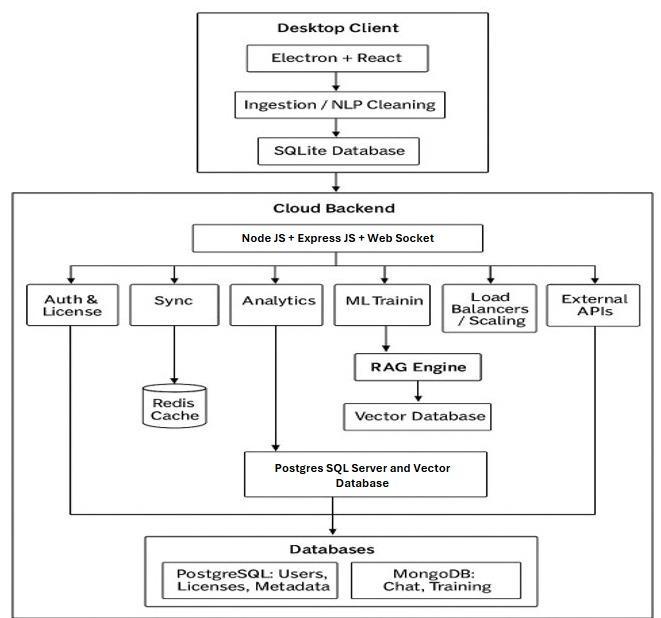
Electron.js is used in the development of Cleansera to enable cross-platform desktop deployment. The applicationincludes:
Presentation Layer: Dashboards, chat systems and user interface.
ApplicationLayer:Versioncontrol,RAGengineandcontext engine.
Data Layer: Vector databases, local storage and dataset management.
Completelocalfunctionalityisensuredbythisarchitecture, whichalsoshieldsprivateinformationfromattackers.
International Research Journal of Engineering and Technology (IRJET) e-ISSN:2395-0056
Volume: 12 Issue: 11 | Nov 2025 www.irjet.net p-ISSN:2395-0072
This paper presents Cleansera, a major advancement in data preparation that directly confronts the drawbacks of generic,one-size-fits-allcleaningtools.Cleanseraisanextgeneration system built on a Retrieval-Augmented Generation (RAG) architecture, establishing a signal, context-awareparadigm.Theplatformshowsanabilityto understand and implement domain standards of fields such as finance, supply chain, and manufacturing, thus ensuring that cleaning operations are not only automated butalsooperateaccordingtothecurrentbestpracticesin the field. Central to the platform is a dual-checkpoint qualityassurancesystemthatverifiesdata integritywhile transparently recording information loss. The main finding of this study is a platform that allows data professionals to greatly reduce cleaning time. As a result, we bring the researcher closer to turning raw data into meaningfulinsights.
We would like to express our sincere gratitude to Prof. Kanchan Dhomse and Prof. Kishor Mahale for invaluable guidance, constant encouragement, and insightful feedback throughout the development of this research work.Herexpertiseandsupporthaveplayedacrucialrole in shaping this project and ensuring its successful completion.
We also extend our thanks to the Department of InformationTechnology,METInstituteofEngineering,for providing the necessary resources and a supportive research environment. We appreciate the cooperation of allfacultymembersandpeerswhocontributeddirectlyor indirectlytothisstudy.
P. Martins, F. Cardoso, P. V´az, J. Silva, and M. Abbasi, ”Performance and Scal ability of Data Cleaning and Preprocessing Tools: A Benchmark on Large Real WorldDatasets,”MDPI,2025.
L. Li, L. Fang, B. Lud¨ascher, and V. I. Torvik, ”AutoDCWorkflow: LLM-based Data Cleaning Workflow Auto-Generation and Benchmark,” arXiv preprint,2025.
E.Meguellatietal.,”AreLLMsGoodData Preprocessors?,” 2025.
S.Zhang,Z.Huang,andE. Wu,”Data CleaningUsingLarge LanguageModels,”arXivpreprint,2024.
M. Naeem et al., ”RetClean: Retrieval-Based Data Cleaning UsingLLMsandDataLakes,”arXivpreprint,2024.
L. Biester et al., ”LLMClean: Context-Aware Tabular Data CleaningviaLLMGeneratedOFDs,”2024.
S. Zhang, Z. Huang, and E. Wu, ”Cocoon: Data Cleaning UsingLLMs,”arXivpreprint,2024.
W.Nietal.,”IterClean:IterativeDataCleaningwithLLMs,” 2024.
F. Ahmadi, Y. Mandirali, and Z. Abedjan, ”Accelerating the Data Cleaning SystemsRaha andBaranthroughTask andDataParallelism,”VLDBWorkshop,2024.
J. Choi et al., ”Multi-News+: Cost-efficient Dataset Cleansing via LLM-based Data Annotation,” in ProceedingsofEMNLP,2024.
E. Rahm and H. H. Do, ”Data Cleaning: Problems and Current Approaches,” IEEE Bulletin of the Technical Committee on Data Engineering, vol. 23, no. 4, pp. 313,2000.
P. Lewis et al., ”Retrieval-Augmented Generation for Knowledge-Intensive NLP Tasks,” in Proceedings of NeurIPS,2020.
Y.Gaoetal.,”Retrieval-AugmentedGenerationfor Large Language Models: A Survey,” arXiv preprint arXiv:2312.10997,2023.
International Research Journal of Engineering and Technology (IRJET) e-ISSN:2395-0056
Volume: 12 Issue: 11 | Nov 2025 www.irjet.net p-ISSN:2395-0072
J. Devlin et al., ”BERT: Pre-training of Deep Bidirectional Transformers for Language Understanding,” in ProceedingsofNAACL-HLT,2019.
T.Brownetal.,”LanguageModelsareFew-ShotLearners,” inProceedingsofNeurIPS,2020.