
International Research Journal of Engineering and Technology (IRJET) e-ISSN: 2395-0056
Volume: 12 Issue: 04 | Apr 2025 www.irjet.net p-ISSN: 2395-0072
International Research Journal of Engineering and Technology (IRJET) e-ISSN: 2395-0056
Volume: 12 Issue: 04 | Apr 2025 www.irjet.net p-ISSN: 2395-0072
Chakka Naga Venkata Satya Sai Siri1, Gonnuri Lalitha Sai Jayamani2, Paidikondala Sarasvathi Sai Himaja3, Ms. Ch Naga Padma Latha4
1 CST, Sri Vasavi Engineering College(A), Pedatadepalli, Tadepalligudem – 534101.
2 CST, Sri Vasavi Engineering College(A), Pedatadepalli, Tadepalligudem – 534101.
3 CST, Sri Vasavi Engineering College(A), Pedatadepalli, Tadepalligudem –534101.
4 Assistant Professor, Department CSE, Sri Vasavi Engineering College(A), Pedatadepalli, Tadepalligudem-534101
Abstract - The rise of online communication has led to an increasedprevalenceoftoxic messagesthatnegativelyimpact user experiences. Our project focuses on developing an intelligent system to identify and mitigate toxic messages within chat applications. The proposed solution incorporates Natural Language Processing (NLP) and machine learning techniques for detecting and masking toxic content in realtime. When a sender attempts to send a message containing toxic words or phrases, the system immediately intervenes by masking the message. The receiver will see a placeholder indicating the message was identified as toxic, without revealing the specific toxic content. This preserves transparency without propagating harmful language. The sender receives a notification indicating that the message containsinappropriatecontent, encouraging morerespectful communication behavior. Thisproject aimstofosterhealthier online interactions by preventing the circulation of offensive orharmfullanguage. Oursolution ishighlyscalable,ensuring seamless integration into existing chat applications, while maintaining user privacy and optimizing performance
Key Words: BERT, Concealment System, Content moderation,Real -timeChatSecurity,ML,NLP,Real-time moderation, Respectful communication, Toxic message detection, User safety, Message filtering, NLP-based moderation, Offensive language detection
Intoday'sdigitalera,onlinecommunicationplatformshave becomeanintegralpartofdailyinteractions.However,the widespreaduseoftheseplatformshasledtoanincreasein toxic and harmful messages, negatively impacting user experiencesandfosteringanunsafedigitalenvironment.
To address this issue, our project, ChatEclipse360, introducesanIntelligentToxicMessageConcealmentSystem designed to detect and moderate harmful content in realtime.LeveragingthepowerofNaturalLanguageProcessing (NLP) and Machine Learning, this system identifies toxic messages before they are delivered, ensuring that inappropriate content does not propagate further. Unlike traditional moderation tools that either completely block messages or rely on manual intervention, ChatEclipse360 takesamorerefinedapproachbymaskingharmfulmessages
whilestillnotifyingthesender.Thisfeaturehelpseducate users about respectful communication and prevents disruptionsinconversationflow.
Byimplementingthissolution,weaimtocreateasaferand more positive digital space where users can engage in meaningfulandrespectfulconversationswithoutthefearof encounteringharmfulcontent.
2.1) Navoneel Chakrabarty.“A Machine Learning Approach toCommentToxicityClassification” (2020).AI Research Journal. This study explores the use of machine learning techniques to classify toxic content based on categories such as threats and identity-based abuse obscenity,threats,insults,andidentity-basedhatred,tofilter harmfulcontent.[1]
2.2 H.Masoorian,M.Ahmadi,N.Mohammadzadeh,andS. M. Ayyoubzadeh “Research of Techniques used in Toxicity Detection” (2021) International Journal of Artificial Intelligence. They proposed the use of neural networks and machine learning techniques for automatic detectionoftoxiccomments,aimingtoprotectusersfrom harmfulonlinebehavior.[2]
2.3 P. G. Davange, P. Chaudhari, S. T. Patil, and A. Bhojawala. ” Toxic Chat Detection using Deep Learning. (2023)”. They proposed the use of machine learning and deep learning, particularly LSTM with BERT word embeddings, to categorize and filter toxic comments, achieving94%accuracy.[3]
2.4 D. Nithya, Nanthine K.S., Thenmozhi S., & Varshini Priya R. “Advanced social media Toxic Comments Detection System Using AI” (2024). They proposed the development of an automated system for detecting and flagging toxic comments in real-time on social media platformsusingNLPandMLtechniques.[4]
2.5 Z Yang, D Tullo, R Rabbany.” ToxiSight: Insights Towards Detected Chat Toxicity” (2024)..Theypropose an explainability dashboard for in-game chat toxicity detection,integratingXAItechniquesliketokenimportance analysis, model visualization, and dataset attribution. The
International Research Journal of Engineering and Technology (IRJET) e-ISSN: 2395-0056
Volume: 12 Issue: 04 | Apr 2025 www.irjet.net p-ISSN: 2395-0072
dashboardprovidesnearest exampleinsights,wordsense analysis for moderators, and free-text explanations to improveinterpretability.[5]
2.6 George Beknazar-Yuzbashev,Rafael Jiménez-Durán, Jesse McCrosky, and Mateusz Stalinski. "Toxic Content and User Engagement on Social Media: Evidence from a Field Experiment," (2025) conducted a six-week field experimentusingabrowserextensiontohidetoxiccontent on Facebook, Twitter, and YouTube. The study found that reducingexposuretotoxicityledtodecreasedadvertising impressions,timespentonplatforms,andotherengagement metrics, as well as a reduction in the toxicity of usergeneratedcontent.Asurveyexperimentindicatedthattoxic content triggers curiosity, suggesting a trade-off for platforms between curbing toxicity and maintaining user engagement.[6]
1. Limitations of Traditional Moderation
Manualorfixedfiltersareslow,ineffectiveinreal-time,and may store user data without consent, raising privacy concerns.
2. Conversation Disruption
Somesystemscompletelyblockmessages,interruptingthe natural flow of conversations and causing communication breakdowns.
3. Ineffective User Notification
Certainsystemsfailtonotifyusersproperly,makingthem less effective in promoting responsible and positive communication.
4. PROPOSED SYSTEM
UsesNLPandMachineLearningtodetectandfilter toxicmessagesinreal-time.
Notifies senders for message revision instead of completelyblockingmessages.
Replaces harmful messages with placeholders to maintaincontext.
Ensures seamless integration with chat platforms while maintaininguserprivacy.
5. ADVANTAGES
1. Real-Time Toxicity Detection:
Uses NLP and Machine Learning to accurately detect and filtertoxicmessagesastheyaresent,ensuringaseamless conversationflow.
2. User-Friendly Moderation:
Notifies the sender to revise toxic messages instead of blockingthementirely,promotingpositivecommunication habits.
3. Context-Preserving Filtering:
Replacesharmfulmessageswithplaceholders,allowingthe receiver to understand the context without exposure to toxicity.
4. Scalable & Privacy-Focused Integration:
Seamlesslyintegrateswithchatplatformswhilemaintaining user privacy, ensuring compliance with data protection policies.
6. METHODS
Methods for Toxicity Detection:
1.Data Collection and Preprocessing:
Input: Gatheradatasetofonlineconversations,chatlogs,or socialmediacomments.
Preprocessing: Cleanandpreprocessthedatabyremoving noise, special characters,andirrelevantcontent.Tokenize thetextandnormalize(lowercase,removestopwords,etc.) forbetteranalysis.
2.Feature Extraction:
NLP-Based Feature Extraction: Use NLP techniques like TF-IDF (Term Frequency-InverseDocumentFrequency) or word embeddings such as Word2Vec or BERT embeddings toconverttextualdataintonumericalvectors thatcapturethesemanticmeaningofthewords.
Toxicity Features: Identify specific features related to toxicity,suchassentimentanalysis,frequencyofoffensive words,orcontextofcertainphrases.
3.Model Selection and Training:
Supervised Learning Models: Train machine learning models such as SVM, Random Forests, or deep learning models like LSTM or CNN to classify messages as toxic or non-toxic.Modelscanbetrainedusinglabeleddatasets of toxicandnon-toxicmessages.
Pre-trained BERT Model: Fine-tunea BERT (Bidirectional EncoderRepresentationsfromTransformers)modelforthe taskoftoxicitydetection.Thisapproachutilizescontextual understandingandsemanticknowledgetocapturenuances inlanguage.
International Research Journal of Engineering and Technology (IRJET) e-ISSN: 2395-0056
Volume: 12 Issue: 04 | Apr 2025 www.irjet.net p-ISSN: 2395-0072
Toxicity Detection: Once a model is trained, use it to classify messages in real-time. If a message is flagged as toxic,maskthemessagebyreplacingoffensivewordswith placeholdersorsymbols.
7.1. Login /SignUp:
Users can create a new account or log in using their credentials to access the chat application. Secure authentication ensures user data privacy and prevents unauthorizedaccess.
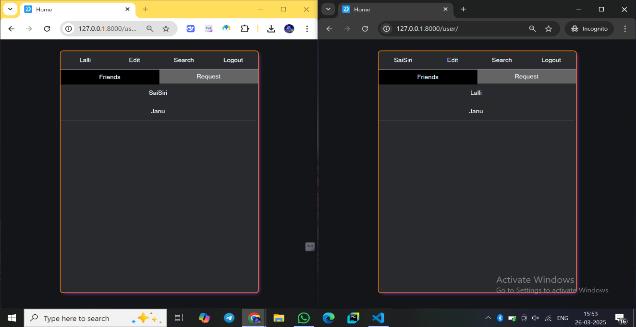
7.2. Home Page:
The home page provides an intuitive interface displaying active chats, user suggestions, and recent conversations. Users can navigate seamlessly to different sections of the chatapplication.
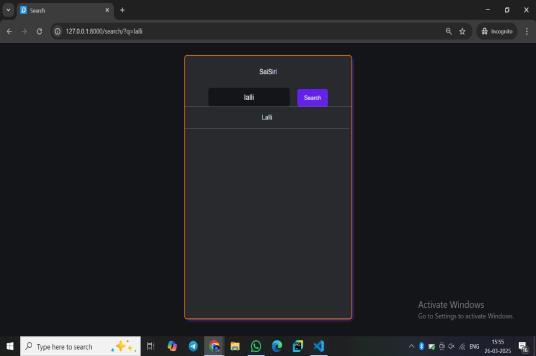
7.3. User Search:
Userscansearchforotherregisteredmembersusingtheir username or profile details. The search function helps in quickly finding and initiating conversations with specific users.
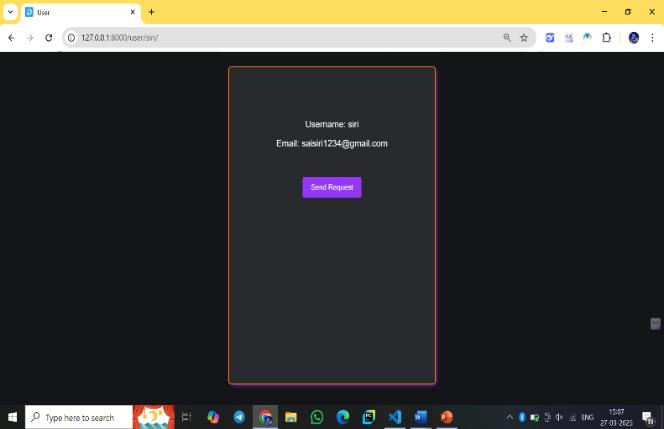
7.4. User Request:
Users can send connection requests to others before initiatingachat.Uponacceptance,bothuserscanengagein seamlesscommunication.
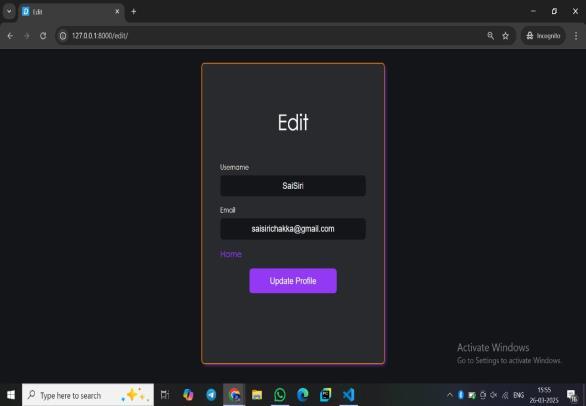
7.5. Update Profile:
Userscaneditandupdatetheirprofiledetails,suchasname, bio,andprofilepicture.Profileupdatesensurepersonalized interactionandbetteruserengagement.
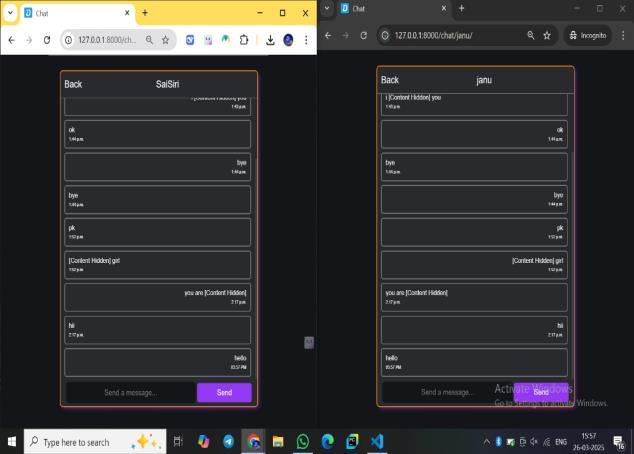
Thechatinterfacesupportsreal-timemessagingwithtext input,emojis,andmediasharing.Italsointegratesmessage moderation to filter toxic content before displaying it to users.
International Research Journal of Engineering and Technology (IRJET) e-ISSN: 2395-0056
Volume: 12 Issue: 04 | Apr 2025 www.irjet.net p-ISSN: 2395-0072
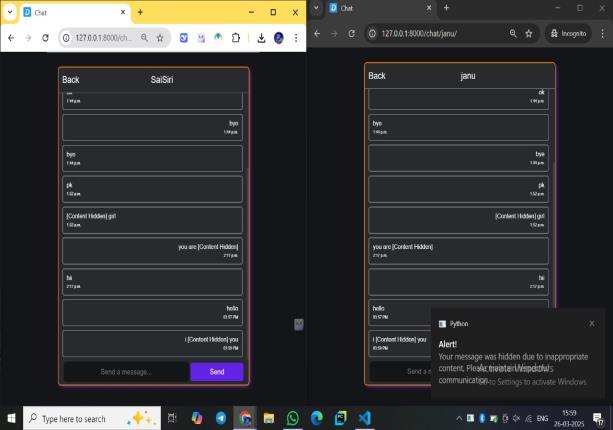
7.7. Result: (Message Moderation and Toxic Message Notification):
Whenausersendsatoxicmessage,thesystemautomatically detectsandmasksharmful content.Thesenderreceivesa notification about inappropriate language, promoting responsiblecommunication.
ChatEclipse360isachatmoderationsystemthatdetectsand filters toxic messages in real time. It notifies users about inappropriate content and replaces harmful words with placeholders instead of blocking messages. The system integrates seamlessly with chat platforms while ensuring user privacy. Its scalable design allows for smooth deployment without disrupting communication. Future improvementswillenhance accuracy,supportmultimedia moderation,andadapttoevolvingonlineinteractions.
Wearereallygratefulto Ms Ch NagaPadmaLatha,M.Tech, Assistant Professor, DepartmentofComputerScienceand Engineering, for all of her help and assistance during the creationofthisproject.Hermeticulouscritiques,insightful observations, and continuous encouragement have been crucial in helping to shape and bring our research to completion.
WealsoextendourappreciationtoDr.D.Jaya Kumariand Dr.G.V.N.S.R. Ratnakar Rao for cooperation and encouragement.
Lastly,wealso acknowledgetheunwaveringsupportofthe staff of the Department of Computer Science and Engineeringplayedacrucialroleinfacilitatingourproject work,andwethankthemfortheircontribution
[1] N. Chakrabarty, A Machine Learning Approach to Comment Toxicity Classification, arXiv preprint, arXiv:1903.06765,2019,https://arxiv.org/abs/1903.06765
[2] H. Masoorian, M. Ahmadi, N. Mohammadzadeh, S. M. Ayyoubzadeh, Research of techniques used in toxicity detection,AIPConferenceProceedings,Volume2705,Issue 1, 2023, Article 030005, ISSN 0094- 243X, https://doi.org/10.1063/5.0143130
[3]P.G.Davange,P.Chaudhari,S.T.Patil,andA.Bhojawala, “Toxic Chat Detection using Deep Learning,” International Journal of Engineering Research in Computer Science and Engineering (IJERCSE), vol. 11, no. 1, pp. 7–11, Jan. 2024. https://ijercse.com/article/CII_721563_Pratik%20Gopal%2 0Davange_IJERCSE%20 %20AL%20 %20%207%20%20to%20%2011%20(1).pdf
[4]D.Nithya,K.S.Nanthine,S.Thenmozhi,R.VarshiniPriya, AdvancedsocialmediaToxicCommentsDetectionSystem Using AI, International Journal for Research in Applied ScienceandEngineeringTechnology(IJRASET),Volume12, Issue IV, April 2024, https://www.ijraset.com/researchpaper/advanced-socialmedia-toxic-comments-detection-system-using-ai
[5] Z. Yang, D. Tullo, and R. Rabbany, "ToxiSight: Insights Towards Detected Chat Toxicity," Blackbox NLP 2024, 21 Sept2024,https://openreview.net/forum?id=iL6zxTh2HW [6]G.Beknazar-Yuzbashev,R.Jiménez-Durán,J.McCrosky, M.Stalinski,ToxicContentandUserEngagementonSocial Media: Evidence from a Field Experiment, CAGE Working Paper Series, 2025, https://warwick.ac.uk/fac/soc/economics/research/centres /cage/publications/workingpapers/2025/toxic_cont ent_and_user_engagement_on_social_media_evidence_from_a _field_experiment/

Chakka Naga Venkata Satya Sai Siri Iampursuingmyfourthyear in the Department of Computer Science and Technology at Sri VasaviEngineeringCollege(VSVT), Tadepalligudem, affiliated with JNTU Kakinada, AP. I am a proactiveanddedicatedindividual withastrongdrivetocontinuously improve and adapt to new challenges..
International Research Journal of Engineering and Technology (IRJET) e-ISSN: 2395-0056
Volume: 12 Issue: 04 | Apr 2025 www.irjet.net p-ISSN: 2395-0072

Gonnuri Lalitha Sai Jayamani
Iam Pursuing fourth year in the Department of Computer Science and Technology at Sri Vasavi Engineering College (VSVT), Tadepalligudem, affiliated with JNTU Kakinada, AP. I am an enthusiastic and adaptable individual,alwayseagertotakeon newopportunitiesandchallenges for personal and professional growth.

Paidikondala Sarasvathi Sai Himaja.
I am Pursuing fourth year in the Department of Computer Science and Technology at Sri Vasavi Engineering College (VSVT), Tadepalligudem, affiliated with JNTU Kakinada, AP. I am a committed and results-driven individual, always striving for excellence and ready to embrace challenges that foster continuous learningandgrowth.

Ch.N.P.Latha ,
completed my Masters in computer Science and Engineering at Sri Sai Aditya College of Science and Technology, Surampalem. Presently working as a Assistant Professor in Computer science andTechnologydepartmentat Sri Vasavi Engineering College, Pedatadepalli Wes Godavari District. I could deal with different academic projects in Web technology and Machine learning and also train-up the students in R, Python, .NET technologies.