
Volume: 12 Issue: 05 | May 2025 www.irjet.net p-ISSN: 2395-0072
Volume: 12 Issue: 05 | May 2025 www.irjet.net p-ISSN: 2395-0072
N Mohan Reddy1 , P Sathish2 , P Sumanth3, Poonamalli Lokesh4 , Mr. L Vijaya Kumar5 , Prof. M. E. Palanivel6
1234 UG Scholar, Dept. of CSE(AI), Sreenivasa Institute of Technology and Management Studies, Chittoor, A.P, India
5 Asst Professor, Dept. of CSE(AI), Sreenivasa Institute of Technology and Management Studies, Chittoor, A.P, India
6 Professor, Dept. of CSE(AI), Sreenivasa Institute of Technology and Management Studies, Chittoor, A.P, India
Abstract - Brain hemorrhage is a life-threatening medical condition that necessitates rapid and accurate diagnosis to prevent severe complications or fatalities. Current detection methods, such as manual analysis of CT scans by radiologists, are often time-intensive and susceptible to human error, especiallyinhigh-pressureemergencysituations.Thisproject aimstodevelopanadvanced,automatedsystemfordetecting brain hemorrhages using deep learning techniques. The system will utilize robust neural network models such as ResNet and MobileNet to analyze medical images and accurately distinguish between normal and hemorrhagic cases. A dataset comprising both normal and hemorrhage images will be used to train the model, enabling it to learn intricate patterns and subtle variations effectively. The proposed system leverages the superior feature extraction capabilities of deep learning to achieve high precision and reliability in diagnosis. By automating the detection process, the system can significantly reduce diagnostic time and provide consistent, unbiased results, thereby supporting healthcare professionals in making timely and informed decisions. This project has the potential to improve early diagnosis,facilitateprompttreatment,andultimatelyenhance patient outcomes in critical care scenarios.
Key Words: Brain hemorrhage, deep learning, automated diagnosis, medical imaging, feature extraction, hemorrhage detection, healthcare innovation, neural networks
Brainhemorrhageisacriticalandlifethreateningmedical conditions causing by internal bleeding within the brain tissuesorsurroundingareas.Thesetypeofconditionscan ariseduetovariousreasonssuchastrauma,andhighblood pressure,aneurysmrupture,ortheexcessiveusesofblood thinking medications. If not diagnosis and treat promptly and brain hemorrhages can lead to irreversible brain damage, long term disability or death early detection and intervention are vital to improving several rates and preventingcomplications.Currentlytheprimarymethodof diagnosisbrainhemorrhageinvolvesanalyzingbrainimage scanssuchascomputedtomographyormagneticresonance imaging.Thesescansareinterpretedmanuallybyradiologist who look for sign internal breeding, abnormalities, or swelling.Whiletheprocessisgenerallyaccurateitisatime consuming requires specialized expertise, and the
susceptible to human error practically high pressure environment such as emergency rooms. In rural the resource-constrained settings the ability of expired radiologists is often limited which can delay critical diagnosis.Toaddressthesechallengesartificialintelligence and deep learning techniques has emerged on promising toolsinmedicalimagesanalysis.Deeplearningandsubfield of machine learning uses neural networks in mimic the human brain’s ability to recognize patterns on features in data. Among the most effective deep learning models are neural networks and mobile net which have shown exceptional performance image classification task. These models can automatically learn to identify hemorrhagic featuresfrommedicalimagesofferingconsistent,fast,and highly accurate predictions. This project focuses on developinganautomated systemthatutilisesCNN mobile netarchitecturestodetectbrainhemorrhagefromCTand MRIimages.Thesystemincludesmodulesforimageupload, preprocessing, model selection, prediction, and visual explanationthroughGrad-CAMheatmaps.CNNoffershigh precisionandissuitableforclinicaldiagnosiswithmobile net provides lightweight and real time inference ideal for mobile and emergency scenarios. By integrating deep learning with medical imaging system aims to reduce diagnosis time minimize human errors and increasing accessibilitytoqualityhealthcareespeciallyinunderserved areas.Theoverallgoalistocreateareliable,interpretable, and scalable diagnostic tool that supports medical professionalsinmakingfasterandmoreaccuratedecisions forpatientssufferingfrombrainhemorrhage.
Automated detection of brain hemorrhage has become a growing research area within the field of medical image analysisespeciallywiththeemergenceofdeeplearningand computer visual techniques. Various researchers have exploredmissionlearninganddeeplearningmodelsanalysis CT and MRI images to improve the accuracy and speed of diagnosis.
1. Chilamkurthy et al. (2018) proposed a deep learning modeltodetectcriticalfindinginheadlesscitiesscans.Their system based on CNN achieved performance comparable school export radiologist especially in identifying intracranialhemorrhages. International Research Journal of Engineering and Technology (IRJET) e-ISSN: 2395-0056
International Research Journal of Engineering and Technology (IRJET) e-ISSN: 2395-0056
Volume: 12 Issue: 05 | May 2025 www.irjet.net p-ISSN: 2395-0072
2.Prevedelloetal.(2017)usedmachinelearningmodelsfart abnormality detection in CT images and empathised the potential for real time garage in emergency departments. TheresultshowedhowAIcouldreduceradiologistworkload andtimetodiagnosis.
3. Saba et al. (2019) explorer the use of deep learning for hemorrhagedetectionusingamodifiedU-netarchitecture for segmentation tasks. They achieved high sensitivity in localizinghemorrhagicregionwithinthebrain.
4.Titanoetal.(2018)developedanensembleofCNNmodels todetecthemorrhagesmasseffectsandotherintracranial abnormalities in head CTs. Their system performed well acrossmultiplecentressuggestinggoodgeneralisation.
5. Patel et al. (2020) achieving over 90% classification accuracy for hemorrhagic vs non-hemorrhagic cases by using a CNN based architecture to non-contrast CT scans. TheyusedgradCamgraphictohighlightstheexpandability ofmodel.
6. A scalable deep learning model for imaging diagnosis utilizing 3D CNNs was presented by Arbabshirani et al. (2018). Their method facilitated the quick and precise categorizationofhemorrhagesfromvolumetricdata.
7.Rajpurkaretal.(2017)createdtheCheXNetmodelforXray-basedpneumoniaidentification,whichsparkedrelated research on deep learning for CT/MRI in neurological applications,suchasbleeding.
8.AlexNetisagroundbreakingCNNthatgreatlyexpanded thefieldsofdeeplearningandimageidentificationwasfirst presentedbyKrizhevskyetal.(2012).Itwaslatermodified forusinmedicalimagingdiagnosticssuchasthatdetection ofhemorrhagesandstrokes.
9. MobileNetV2 a lightweight and effective architecture tailrated for mobile and embedded AI application was presented by Sandler et al. (2018). Its application in healthcareespeciallyinenvironmentwithlimitedsourcehas shownpromises
10.Toimprovedetectionaccuracyontheseriesscandata, Banerjeeetal.(2021)createdahybridCNN-RNNmodelthat includedspatialsequentiallyinformationfromCTscansfor breedingclassification.
Deeplearninghasemergedasoneofthemostpowerfuland transformative technologies in the field of medical image analysis.Itmimicsthestructureandfunctionofthehuman brainthroughartificialneuralnetworks,allowingmachines tolearnfromlargeamountsofdata.Inthecontextofbrain hemorrhage detection, deep learning plays a vital role by automatingtheanalysisofCTscansandidentifyingpatterns thatmaynotbeimmediatelyvisibletothehumaneye.Oneof
the biggest advantages of deep learning is its ability to automaticallyextractcomplexfeaturesfromrawimagedata withouttheneedformanualintervention.Traditionalimage processing techniques often rely on predefined rules or handcraftedfeatures,whichcanbetime-consumingandless adaptable to variations in medical images. Deep learning, particularly convolutional neural networks (CNNs), overcomes this limitation by learning hierarchical feature representationsdirectlyfromthedata,enablingthemodelto identifysubtledifferencesbetweennormalandhemorrhagic braintissue.Inemergencymedicalsituations,timeiscritical, anddeeplearningsystemscanhelpspeedupthediagnostic process.Awell-traineddeeplearningmodelcanprocessand interpret a CT scan in seconds, providing clinicians with immediateinsightsthatcanguidetreatmentdecisions.This isespeciallyimportantincasesoftraumaticbraininjuryor stroke,whereearlyinterventioncansignificantlyimprove patientoutcomes
The suggested approach improves and automates the identificationofbrainhemorrhagesfrommedicalimagesby utilising cutting edge deep learning models particularly MobileNet and ResNet. ResNet’s deep residual learning capabilitiesguaranteegreataccuracybyefficientlytraining very deep networks, while MobileNet’s lightweight architecture is optimised for deployment in resource constrainedenvironments.Preprocessingisapicturedata trainingthemodelsandassessingtheirperformanceusing metricslikeaccuracysensitivityandspecificityarethegoals of system. The suggested system aims to assist medical practitioners in establishing accurate and fast diagnoses whichwilleventuallyimprovepatientoutcomes,byoffering adependableandeffectivediagnostictool.
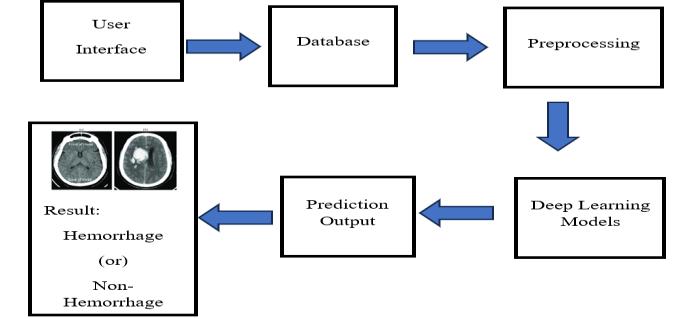
1. Image Input: This Module is in charge taking of user provided brain scan images using a design go build web interface.It’schecksbriefformatandqualityofimagebefore sending them for preprocessing and it supports PNG and JPEGimageformats.
2. Preprocessing:Tostandardizeimagesformodelinput, they go through a number of preprocessing stages. This covers noise reduction, normalization, scaling to fixed
International Research Journal of Engineering and Technology (IRJET) e-ISSN: 2395-0056
Volume: 12 Issue: 05 | May 2025 www.irjet.net p-ISSN: 2395-0072
dimensions (such as 224x224 pixels), and grayscale conversion.
3. Deep Learning Models: Classification takes place in systemscentretodistantmodelsareused.
CNN: Adeparturethathasbeenthoughttorecognise intricatepatternsinimages.Idealforobtaininghighbleeding detectionaccuracyforintricatepicturecharacteristics.
MobileNet: An effective and lightweighting architecture present for embedded and real time applications.Withitsdepth-wiseseparableconvolutionsit drastically cuts on computation without compromising accuracy. Evaluation criteria including as accuracy, precision, recall, F1-score, and inference time are used to compare the performance of each model, which operates separately.
4. OutputandvisualizationLayer:Thesystemindicatesif thescanisnormalorhemorrhagicaftermakingaforecast.It can be expanded to identify areas of concern using GradCAMorotherheatmapvisualizationsforexplainabilityand it’salsooffersaprobabilityandconfidencescore.
5. Interface for Users: Healthcare providers can upload photos and examined diagnostic results instantaneously throughanintuitiveDjango-basedonlineinterface.
3.PROPOSED WORK
The suggested approach improves and automates the identificationofbrainhemorrhagesfrommedicalimagesby utilising cutting edge deep learning models particularly MobileNet and ResNet. ResNet’s deep residual learning capabilitiesguaranteegreataccuracybyefficientlytraining very deep networks, while MobileNet’s lightweight architecture is optimised for deployment in resource constrained environments. Preprocessing is a picture data trainingthemodelsandassessingtheirperformanceusing metricslikeaccuracysensitivityandspecificityarethegoals of system. The suggested system aims to assist medical practitioners in establishing accurate and fast diagnoses whichwilleventuallyimprovepatientoutcomes,byofferinga dependableandeffectivediagnostictool.
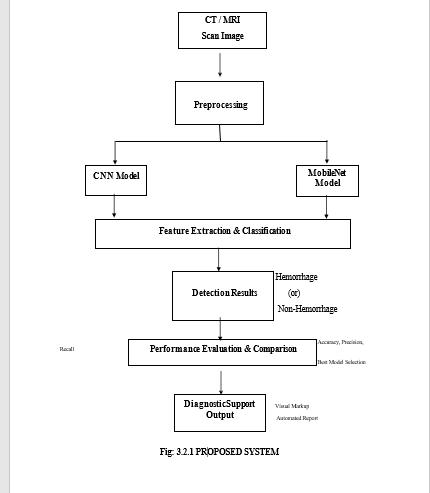
Theproposedautomatedbrainhemorrhagedetectionsystem wasevaluatedusingalabeleddatasetcomprisingCTimages ofbothhemorrhagicandnon-hemorrhagiccases.Twodeep learning architectures, ResNet and MobileNet, were implemented and trained on the dataset to compare their performanceintermsofaccuracy,precision,recall,F1-score, and inference time.The MobileNet model demonstrated strong performance, achieving an overall classification accuracy of 95.42%, with a precision of 95% and recall of 96%. Its deep architectureallowed it to effectively extract complex features andrecognize subtle patternsassociated withhemorrhagicregions.TheResNetbasedmodel,adeep architecture model optimized for an embedded devices, achieved an accuracy of 72.33%, with a slightly lower precisionof77%andrecallof72%comparedtoMobileNet. MobileNet model has given the accuracy of 95% which is morethantheResNetaccuracyof72%.
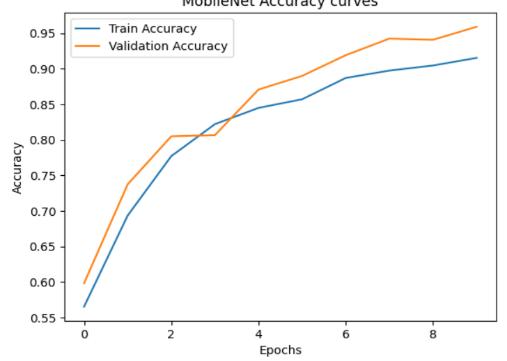
Figure2:comparisonsbetweenTrainAccuracyandValidation AccuracyforEpochsandAccuracyvaluecurves
International Research Journal of Engineering and Technology (IRJET) e-ISSN: 2395-0056
Volume: 12 Issue: 05 | May 2025 www.irjet.net p-ISSN: 2395-0072
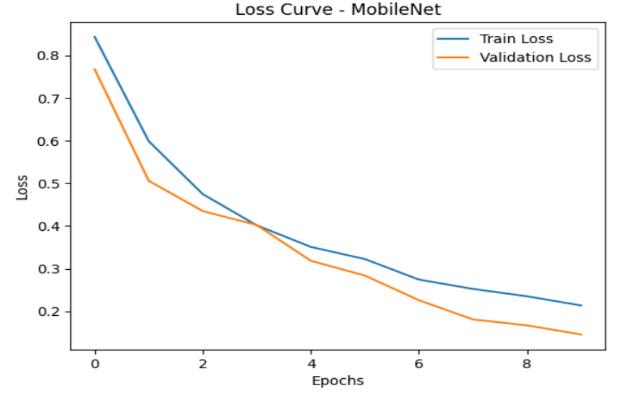
Figure3:comparisonsbetweenTrainlossandValidationloss forEpochsandlossvaluecurveofMobileNet
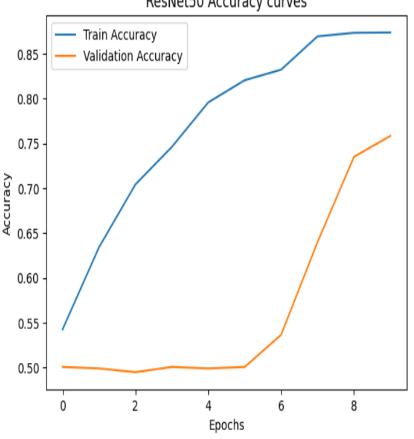
Figure4:comparisonsbetweenTrainAccuracyand ValidationAccuracyforEpochsandAccuracyvaluechanging curves
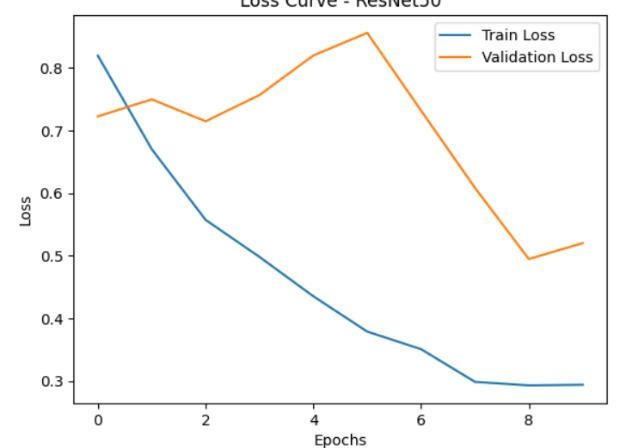
Figure2:comparisonsbetweenTrainLossandValidation LossforEpochsandLosscurve
3. CONCLUSIONS
Thisprojecthas explored theapplication ofdeeplearning techniques for the automated detection of brain hemorrhages in CT scan images. The study demonstrates thatdeeplearningmodels,particularlyconvolutionalneural networks such as ResNet and MobileNet, can significantly enhancethediagnosticprocessbyprovidinghighlevelsof accuracy, efficiency, and consistency. Through the use of
2025, IRJET | Impact Factor value: 8.315 |
annotated datasets comprising both normal and hemorrhagic brain images, the models were trained to recognize intricate features and subtle anomalies often missed during manual inspection, especially under time constraints or in high-pressure scenarios. The automated systemnotonlyreducedthedependencyonconstanthuman interpretation but also minimized the chances of misdiagnosisduetofatigueoroversight.Furthermore,the system’sabilitytoprovideconsistentoutputsregardlessof externalfactorshighlightsitspotentialtoassisthealthcare professionalsinmakingtimelyandinformeddecisions.By integratingthistechnologyintoclinicalworkflows,especially in emergency rooms and intensive care units, the turnaroundtimefordiagnosiscanbesignificantlyshortened, thereby facilitating quicker medical intervention and potentiallysavinglives.Despitethepromisingresults,this study also acknowledges the limitations encountered, including data availability, model generalization, and the challenge of clinical validation in real-world scenarios. Nonetheless, the foundation laid by this work opens up a wide range of opportunities for further innovation and improvementinAI-drivenmedicaldiagnostics.
[1] D. Kornack and P. Rakic, “Cell Proliferation without NeurogenesisinAdultPrimateNeocortex,”Science,vol. 294, Dec. 2001, pp. 2127-2130, doi:10.1126/science.1065467.
[2] M.Young,TheTechnicalWriter’sHandbook.MillValley, CA:UniversityScience,1989.
[3] R. Nicole, “Title of paper with only first word capitalized,”J.NameStand.Abbrev.,inpress.
[4] K.Elissa,“Titleofpaperifknown,”unpublished.Howard A.G., Zhu M., Chen B., et al. MobileNets: Efficient Convolutional Neural Networks for Mobile Vision Applications. arXiv preprint,2017.arXiv:1704.04861.
[5] Simonyan K., Zisserman A. Very Deep Convolutional Networks for Large-Scale Image Recognition. arXiv preprint,2014.arXiv:1409.1556.
[6] YasakaK.,AkaiH.,AbeO.,KiryuS.DeepLearningwith ConvolutionalNeuralNetworkforDifferentiationofLiver MassesatDynamicContrast-EnhancedCT:APreliminary Study. Radiology, 2018; 286(3): 887–896.doi: 10.1148/radiol.2017170706.
[7] Suzuki K. Overview of Deep Learning in Medical Imaging. RadiologicalPhysicsandTechnology,2017;10(3): 257–273.doi:10.1007/s12194-017-0406-5