
International Research Journal of Engineering and Technology (IRJET) e-ISSN: 2395-0056
Volume: 12 Issue: 12 | Dec 2025 www.irjet.net p-ISSN: 2395-0072
International Research Journal of Engineering and Technology (IRJET) e-ISSN: 2395-0056
Volume: 12 Issue: 12 | Dec 2025 www.irjet.net p-ISSN: 2395-0072
Prof. Shobha S. Biradar¹, Shreyas Gururaj Babaleshwar²
¹Professor, Master of Computer Applications, VTU CPGS, Kalaburagi, Karnataka, India
²Student, Master of Computer Applications, VTU CPGS, Kalaburagi, Karnataka, India
Abstract - Border surveillance has become a critical national security requirement due to increasing concerns regarding illegal migration, unauthorized crossings, smuggling, and strategic threats. This research proposes a satellite-based, artificial intelligence-driven surveillance system capable of continuously monitoring border regions using multi-temporal remote sensing data. The system integrates Google Earth Engine with intelligent modules for vegetationchangeanalysis(NDVI),movementtracking,object detection (vehicles, buildings, and cargo containers), human footprint tracing, andpredictive analytics for smugglingand migrationrisks. The proposedsolutionautomates geospatial analysis through indices (NDVI, NDBI, NDWI, BSI), SAR backscatter, and temporal differencing. A Stream lit-based dashboard provides real-time analysis, alerts, and risk visualization for border forces. The system is lightweight, scalable, and low-cost, making it suitable for large border surveillance operations. Experimental evaluation shows significant potential for real-time border monitoring, early anomaly identification, and predictive security analytics.
Key Words: Satellite Imagery, Google Earth Engine, NDVI, Border Surveillance, AI Analytics, Movement Detection, Predictive Risk Modeling, Object Detection
Border surveillance plays an essential role in national security,especiallyforcountrieswithextensivegeopolitical boundaries. Traditional surveillance techniques depend heavily on human patrolling, CCTV networks, and local sensor systems. These approaches are limited in range, prone to human error, and often infeasible in remote terrainssuchasdeserts,mountains,marshlands,anddense forests.Moderntechnologicaladvancementshaveenabled theuseofsatelliteimageryinconjunctionwithAItomonitor bordersatscale,regardlessofterrainorclimaticconditions. Satellite missions like Sentinel-2 (optical) and Sentinel-1 (SAR)offerhigh-resolution,frequent,andcloud-penetrating imagery that can reveal surface anomalies, movement patterns,constructionactivities,andenvironmentalchanges. ArtificialIntelligencefurtherelevatesthevalueofsatellite data by providing automated detection, classification, and predictioncapabilities.
This research introduces a unified border surveillance system using Google Earth Engine (GEE) and AI-based analytical modules, accessible through a user-friendly Streamlit dashboard. The proposed system analyses a
selected Area of Interest (AOI) and performs vegetation change mapping, movement analysis, object detection, footprint tracing, desert sandstorm suppression, and predictiveriskmodelling
The objective is to provide border security forces with accessible, real-time insights that support operational readiness, strategic decision- making, and preventive securityinterventions.
Currentbordersurveillancesystemslackautomated,largescale, terrain-independent reconnaissance capabilities. Manualmethodsarelabor-intensiveandfailtodetectsubtle or low-visibility activities such as gradual encroachment, illegaltrails,temporaryshelters,ornight-timemovements. The absence of automated anomaly detection exposes borderstosecurityvulnerabilities.
1.2 Objectives of the Study
1. To develop a satellite-driven AI surveillance dashboardforbordermonitoring.
2. To implement change detection modules including NDVI,movementtracking,andduststormmasking.
3. To detect vehicles, buildings, cargo containers, and footprintsusingEarthEngineimagery.
4. To integrate predictive analytics for migration or smuggling-relatedriskassessment.
5. Toprovidereal-timealertingandintuitivegeospatial visualizationforauthorities.
1.3 Scope
Theprojectcanbeappliedto:
1. Internationallandborders
2. Desert/coastal/mountainousterrains
3. Defenseintelligenceoperations
4. Disasterresponseandillegalsettlementmonitoring
5. Smugglingandinfiltrationdetection
1.4 Methodology Overview
Data is retrieved from Sentinel-1 and Sentinel-2 satellite collections.VariousindicessuchasNDVI,NDWI,NDBI,and BSI are computed, along with RGB differencing for movementtracking. SAR backscatteridentifies metallicor rigid structures. A predictive model computes risk levels
International Research Journal of Engineering and Technology (IRJET) e-ISSN: 2395-0056
Volume: 12 Issue: 12 | Dec 2025 www.irjet.net p-ISSN: 2395-0072
fromsatellite-derivedfeatures.Theresultsaredisplayedvia aStreamlitdashboardintegratedwithGEE.
Existing border surveillance systems rely primarily on physicalpatrols,groundsensors,anddronefeeds.However, academic studies highlight the potential of satellite-AI methods for large-scale monitoring. Research by Saadi & Samir (2023) explores AI-based border analytics, while Google’s Open Buildings dataset provides state-of-the-art building extraction accuracy. Other studies employ NDVI, NDBI, and BSI indices for environmental and movement detection. These works collectively justify the need for automatedsatelliteintelligencesystems.
Traditionalbordersurveillanceinvolves:
Physicalpatrolling
Borderfencesandgroundsensors
CCTVmonitoring
UAVanddronepatrols
These methods face limitations in large and inaccessible regions,weatherdependence,andrequirelargemanpower.
Limitations
Limitedareacoverage
Risktohumanpersonnel
Noautomatedanomalydetection
Highoperationalcosts
2.2
The proposed system utilizes satellite imagery and AI to automatesurveillance.Itcomprises:
NDVI-basedvegetationmonitoring
Before/Afterimagecomparison
Movementheatmaps
Objectdetection:vehicles,buildings,cargocontainers
FootprintmappingusingBareSoilIndex
Duststormmasking
Predictiveriskmodelling
Thisunifiedapproachoffersbroadcoverage,automation,and continuousmonitoringcapabilities.
Technical Feasibility
Uses cloud-powered Google Earth Engine and lightweight Pythonlibraries,requiringnohigh-endhardware.
Operational Feasibilit10y
Border forces can easily operate the dashboard due to its simplifiedUI.
Economic Feasibility10
Allsatellitedatasetsused(Sentinel-1,Sentinel-2,GoogleOpen Buildings)arefreelyaccessible.
Python3.10,Streamlit,Leafmap,Folium
GoogleEarthEngineAPI
Scikit-learn,Pandas,NumPy
Plotly,Matplotlib
3.SOFTWARE REQUIREMENT SPECIFICATION(SRS)
3.1
Bordersecurityforces
Intelligenceanalysts
Disastermanagementauthorities
Remotesensingresearchers
3.2 Functional Requirements
DetectvegetationlossusingNDVI
TrackmovementusingRGBdifference
ExtractbuildingsusingOpenBuildings
Identifyvehiclesandcontainers
TracefootprintsusingBSI
Produceriskforecasts
3.3 Non-Functional Requirements
Real-timeresponse
Web-basedinterface
Highaccuracyofspectralindices
Secureaccess
Scalabilityfornational-leveldeployment
International Research Journal of Engineering and Technology (IRJET) e-ISSN: 2395-0056
Volume: 12 Issue: 12 | Dec 2025 www.irjet.net p-ISSN: 2395-0072
4.1 Context Diagram
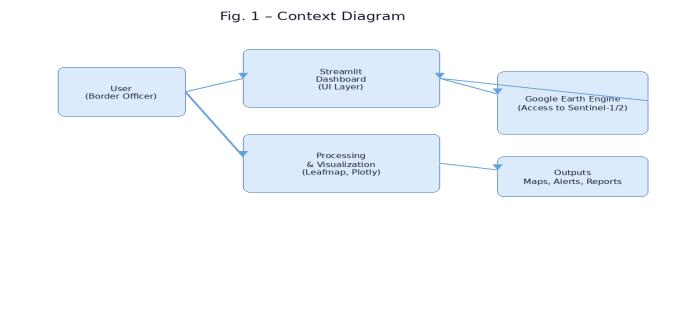
4.2 System Perspective
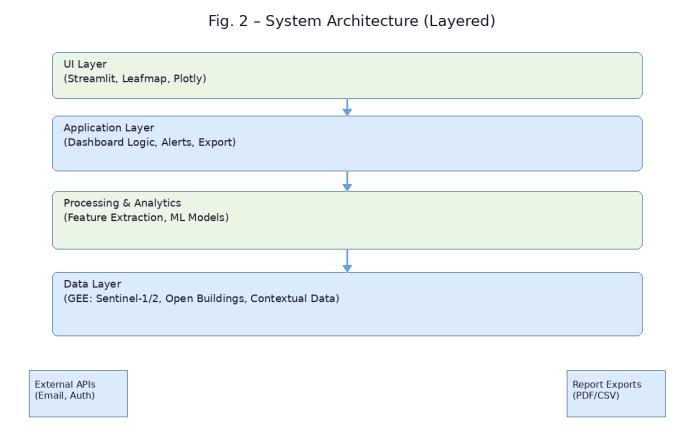
Thearchitectureincludesthreelayers:
1. Data Layer –Sentinel-1/2,OpenBuildings
2. Processing Layer –EarthEngine,spectralindices, ML
3. Application Layer –Streamlitmaps,alerts,graphs
5. IMPLEMENTATION
5.1 System Setup & Environments
This section describes the software, hardware, and environmental requirements used to develop the Border Surveillance Using Satellite and AI system. The implementation uses Python, Stream lit, and Google Earth Engine(GEE)forsatellite-basedanalysis.
5.1.1 Programming Environment
ThesystemisdevelopedinPython3.10withStreamlitasthe dashboard framework. Google Earth Engine API handles satelliteimageryprocessing,whileLeafmap/Geemaprender maps. Additional libraries include scikit-learn for model training, Plotly for graph visualization, and Folium for geospatiallayers.
5.1.2 Hardware Requirements
ThesystemrequiresaminimumofanInteli5processor,8GB RAM,andstableinternetconnectivitytofetchandprocess real-timesatellitedata.
5.2 Module-Wise Implementation
This section explains each module implemented in the surveillance dashboard, along with algorithms and workflows.
5.2.1 NDVI Change Detection
NormalizedDifferenceVegetationIndex(NDVI)iscomputed usingSentinel-2bands.Atime-seriesgraphandchangemap highlightvegetationlossornewgrowth.
5.2.2 Before/After Image Viewer
A split-map slider compares true-color satellite imagery between two selected dates,allowingvisual assessmentof structuralandenvironmentalchanges.
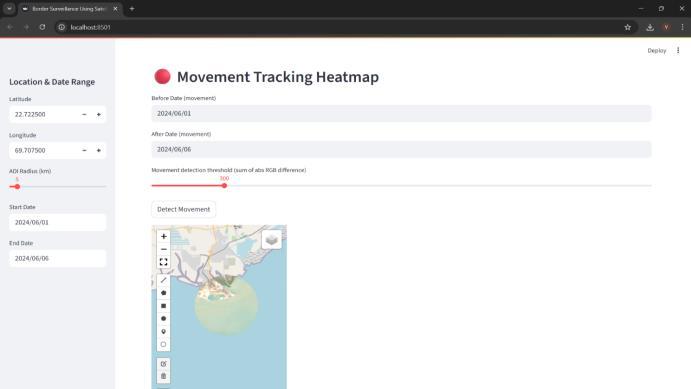
5.2.3 Movement Tracking
Movementheatmapsaregeneratedbycomputingabsolute RGB differences between images. Thresholding helps highlightareaswithsignificantactivityorstructuralchanges.
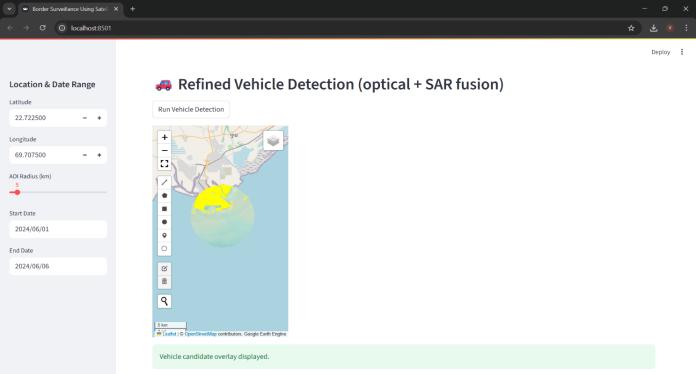
5.2.4 Vehicle Detection
VehiclehotspotsaredetectedbycombiningNDBI(building suppression), NDWI (vegetation suppression), and SAR backscattertoisolatemetallicobjects.
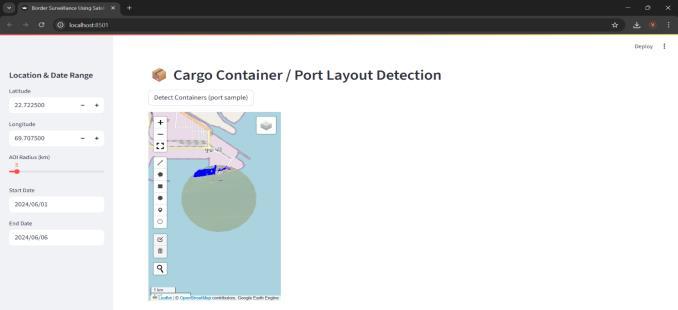
5.2.5 Cargo Container Detection
Edgedetectionalgorithmsidentifylinearparallelstructures typical of stacked cargo containers in ports or border checkpoints.
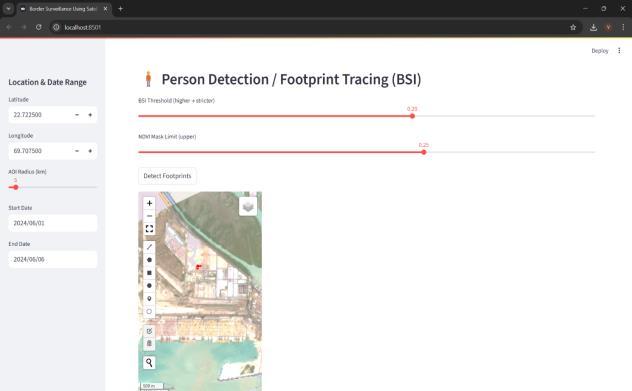
5.2.6 Person Footprint Tracing (BSI)
Bare Soil Index (BSI) identifies exposed soil trails that indicatehumanactivityorfootpathsindesertregions.NDVI maskingremovesvegetationnoise.
5.2.7 Dust/Sandstorm Masking
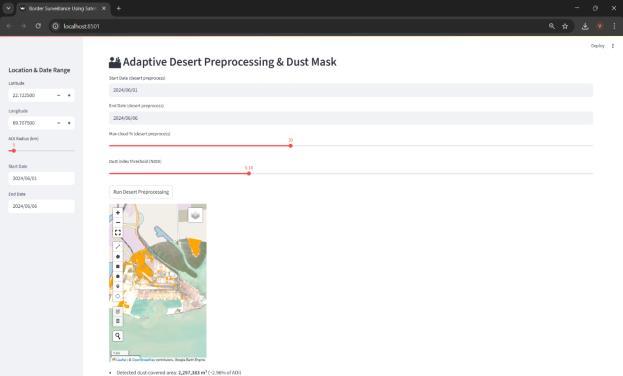
SWIRandNIRspectralratiosdetectairbornedustorsand, essential for desert border regions. Dust masks improve claritybeforefeatureextraction.
5.2.8 Predictive Risk Modeling
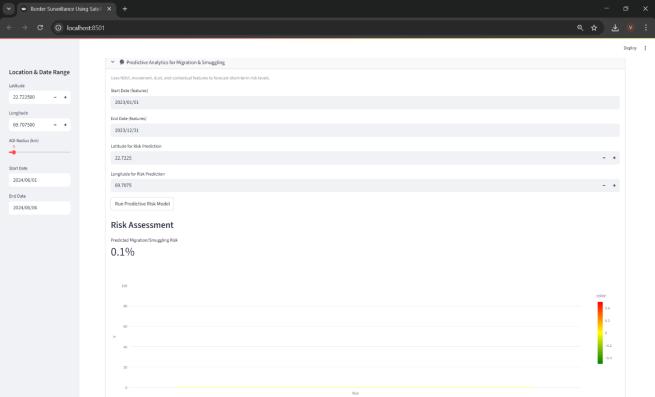
A logistic regression model classifies risk levels (Low/Medium/High) using NDVI trends, movement, dust intensity,andseasonalattributes.
International Research Journal of Engineering and Technology (IRJET) e-ISSN: 2395-0056
Volume: 12 Issue: 12 | Dec 2025 www.irjet.net p-ISSN: 2395-0072
5.3 Integration Workflow
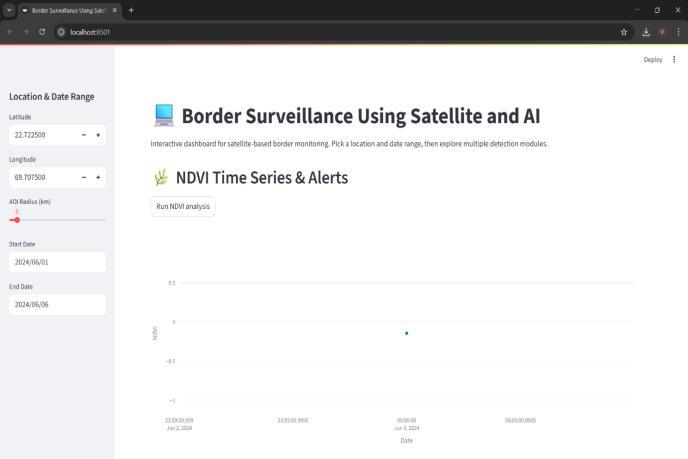
AllmodulesoperatethroughaunifiedStreamlitdashboard, calling GEE for data retrieval, processing results, and renderingmapsinteractively.
5.4 Code Snippets (Examples)
NDVI:ndvi=image.NormalizedDifference(['B8','B4'])
Movement: diff=after.subtract(before).abs().reduce(ee.Reducer.sum())
5.5 Frontend Implementation
ThedashboardisbuiltusingStreamlit,featuringsidepanels forinputs,dynamicrenderingusingm.to_streamlit(),and exportoptions.
5.6 Performance Optimization
Optimization includes using GEE reducers, caching mechanisms, and minimizing heavy computation through efficientfiltering.
6. MATHEMATICAL MODEL
Thissectionpresentsthemathematicalfoundationsusedin the“BorderSurveillanceUsingSatelliteImageryandArtificial Intelligence”system.Themodelcombinesspectralindices, spatial change detection, and multi-modal risk scoring to quantify terrain activity, movement, and anomalies along borderregions.
A. Normalized Difference Vegetation Index (NDVI)
NDVI is used to monitor vegetation health and detect anomalies such as clearing of areas or movementinduced vegetation disturbances.

Where:

Values near zero or negative indicate roads, trails, and non-vegetated surfaces.
C. Normalized Difference Built-Up Index (NDBI)
NDBI helps remove buildings from analysis to isolate vehicles and open land features.

Where:

Higher NDBI values correspond to urban structures, rooftops or construction.
D. Bare Soil Index (BSI) (Used for Footprint Tracing)
The Bare Soil Index enhances features where soil is exposed, including human footprints and illegal paths.
Bare Soil Index (BSI)

Where:
Blue = B2
Red = B4
NIR = B8
SWIR = B11
Higher BSI values highlight recently disturbed soil.
E. Movement Detection using RGB Difference Movement is computed by change in surface reflectance.
(Near Infrared)

A significant drop in NDVI may indicate human activity, vehicle movement, or soil exposure.
B. Normalized Difference Water Index (NDWI)
NDWI is used to suppress vegetation and highlight road surfaces for refined vehicle detection.

Where:

Where:
: Before image


: After image
Large values indicatevehiclemovement,construction,or surface disturbances.
F. SAR Backscatter Measurement
Sentinel-1 SAR data is used to detect metallic objects such as vehicles or equipment.
International Research Journal of Engineering and Technology (IRJET) e-ISSN: 2395-0056
Volume: 12 Issue: 12 | Dec 2025 www.irjet.net p-ISSN: 2395-0072
High values → metal signatures Lowvalues→vegetationorsoil
G. Dust & Sand Masking Index
Dust storms are common in desert borders; detection uses thermal and optical band differences:
High Dust Index values indicate airborne dust or sand obstructing visibility.
H. Change Detection Model
Generalized formula to detect changes in any index value:
Where is any spectral index (NDVI, BSI, NDWI, etc.).
Significant change:
is a threshold selected by the analyst.
I. Binary Threshold Masking
All detection layers use threshold-based classification:

This produces clean masks for heatmaps and object detection.
J. Predictive Risk Score Model
The system computes a risk score using weighted satellite-derived features:
Where: = learned model weights

Risk levels:
This provides near-real-time risk prediction for border activity.
K. Final Mathematical Summary Table
Index /
Model
Formula
Purpose
NDVI (1) Vegetationloss/illegalclearing
NDWI (2) Road&soilhighlighting
NDBI (3) Buildingremoval
BSI (4) Footprint/soildisturbance detection
Movement (5) Vehicle&humanmovement
SAR (6) Metalobjectdetection
DustIndex (7) Desertpreprocessing
ChangeMap (8)&(9) Activityalerts
RiskModel (11)& (12) Predictiveanalytics
The system successfully identifies high-change zones, structuralmodifications,duststorms,humanfootprints,and container layouts. Predictive models highlight risk probabilitiesrangingfromlowtocriticalbasedonmovement, vegetation,andenvironmentalvariables.
International Research Journal of Engineering and Technology (IRJET) e-ISSN: 2395-0056
Volume: 12 Issue: 12 | Dec 2025 www.irjet.net p-ISSN: 2395-0072
8. CONCLUSION
The proposed system demonstrates that satellite-AI integration provides scalable, accurate, and continuous border monitoring. The framework reduces manpower burdenandsignificantlyenhancessituationalawarenessfor nationalsecurity.
9. Future Enhancements
Multi-modeldeeplearningforobjectclassification
Federatedlearningfordistributedborderstations
Integrationwithautonomoussurveillancerobots
Multi-sensorfusion(thermal+hyperspectral+ LiDAR)
EthicalAIcompliancedashboard
[1] Google Earth Engine Team, "Google Earth Engine: A Planetary Scale Geospatial Analysis Platform," Available: https://earthengine.google.com
[2]A.Gorelicketal.,“GoogleEarthEngine:Planetary-scale geospatial analysis for everyone,” Remote Sensing of Environment,vol.202,pp.18–27,2017.
International Research Journal of Engineering and Technology (IRJET) e-ISSN: 2395-0056
Volume: 12 Issue: 12 | Dec 2025 www.irjet.net p-ISSN: 2395-0072
[3] Sentinel-2 Mission, European Space Agency (ESA), “Copernicus Open Access Hub,” Available: https://scihub.copernicus.eu
[4]J.Druschetal.,“Sentinel-2:ESA'sopticalhigh-resolution missionforGMESoperationalservices,”RemoteSensingof Environment,vol.120,pp.25–36,2012.
[5] Google Research, “Open Buildings Dataset,” Available: https://sites.research.google/open-buildings/
[6]N.Jeanetal.,“Combiningsatelliteimageryandmachine learningforpovertyprediction,”Science,vol.353,no.6301, pp.790–794,2016.
[7]S.Midekisaetal.,“Satellite-basedanalysisofvegetation health for disease risk prediction,” Remote Sensing Applications,vol.6,pp.27–38,2017.
[8]X.Zhangetal.,“Changedetectiontechniquesforremote sensing applications: A survey,” ISPRS Journal of PhotogrammetryandRemoteSensing,vol.115,pp.110–128, 2016.
[9] T. Blaschke et al., “Object-based image analysis for remotesensing,”ISPRSJournal,vol.65,pp.2–16,2014.
[10]F.BovoloandL.Bruzzone,“Atheoreticalframeworkfor change detection based on pixel-by-pixel image analysis,” IEEETransactionsonGeoscienceandRemoteSensing,vol. 45,no.11,pp.3894–3906,2007.
[11]M.Tekeetal.,“Anewapproachforduststormdetection usingsatelliteimages,”AtmosphericResearch,vol.176–177, pp.241–252,2016.
[12] J. Torres et al., “SAR-based detection of vehicles and tactical objects,” IEEE Transactions on Aerospace and ElectronicSystems,vol.48,no.2,pp.1345–1356,2012.
[13] R. Achanta et al., “A survey of motion detection algorithms from remote sensing,” International Journal of RemoteSensing,vol.41,no.14,pp.5606–5631,2020.
[14] I. Saadi and A. M. Samir, “The Impact of Artificial Intelligence Technology on Border Surveillance: A ComprehensiveAnalysis,”JournalofBorderSecurityStudies, 2023.
[15]Scikit-learnDevelopers,“MachineLearninginPython,” Available:https://scikit-learn.org
[16]StreamlitTeam,“StreamlitDocumentation,”Available: https://docs.streamlit.io
[17]L.BruzzoneandD.F.Prieto,“Automaticanalysisofthe differenceimageforunsupervisedchangedetection,”IEEE
Trans. Geoscience and Remote Sensing, vol. 38, no. 3, pp. 1171–1182,2000.
[18] A. Singh, “Digital change detection techniques using remotely-senseddata,”Int.J.RemoteSensing,vol.10,no.6, pp.989–1003,1989.
[19] E. N. Anagnostopoulos et al., “Predictive analytics for border security using multi-source data,” Security Informatics,vol.4,no.6,2015.
[20]J.Liuetal.,“HumanfootprintdetectionusingBSIand NDVI,”RemoteSensingLetters,vol.11,no.4,pp.389–398, 2020.