
International Research Journal of Engineering and Technology (IRJET) e-ISSN:2395-0056
Volume: 12 Issue: 12| Dec 2025 www.irjet.net p-ISSN:2395-0072
International Research Journal of Engineering and Technology (IRJET) e-ISSN:2395-0056
Volume: 12 Issue: 12| Dec 2025 www.irjet.net p-ISSN:2395-0072
1 Assistant Professor, Information Science and Engineering, Bapuji Institute of Engineering and technology,
Karnataka, India
2,3,4,5,Bachelor of Engineering, Information Science and Engineering, Bapuji Institute of Engineering and
technology, Karnataka, India ***
Abstract - Bone fracture diagnosis from CT and MRI scans is often time-consuming and prone to human error due to the complexity of analyzing 3D anatomical structures. This paper presents a fully automated 3D Convolutional Neural Network (3D-CNN) capable of detecting and classifying fractures directly from volumetric medical images. The system performs standardized preprocessing, reconstructs 3D voxel inputs, and generates both fracture predictions and voxel-level localization heat maps. Experimental results show high classification accuracy and reliable localization, demonstrating that the proposed 3D-CNN framework offers an efficient and clinicallyviablealternativetomanualdiagnosticmethods.
Key Words: 3D-CNN, Bone Fracture Detection, Deep Learning, CT scan Analysis, Medical Imaging, Fracture Localization.
Bone fractures are among the most common orthopaedic injuries,affectingmillionsgloballyeachyear.Accurateand timely fracture diagnosis is essential for planning treatment and preventing further complications. Conventional diagnostic workflows primarily rely on 2D X-ray interpretation, a process that is prone to human fatigue,subjectivity,andinconsistency.WhileX-raysserve as the first-line diagnostic modality, they lack volumetric depth and often fail to reveal subtle or overlapping fractures especiallyinregionssuchaswrists,ankles,and ribs.
Advancements in Computed Tomography (CT) and Magnetic Resonance Imaging (MRI) provide complete 3D anatomical information, enabling significantly improveddiagnosticclarity.However,analyzinghundreds of CT/MRI slices manually is time-consuming and cognitively demanding for radiologists. This creates the need for automated, intelligent systems capable of processing volumetric medical data efficiently and accurately.
Recent progress in deep learning specifically 3D Convolutional Neural Networks has shown remarkable capability in detecting spatial patterns across
volumetric inputs. While traditional machine learning approachesrelyheavilyonhandcraftedfeaturesandsemiautomatic procedures, 3D-CNNs automatically learn structuralattributesofbonemorphology,enablingprecise classificationandlocalizationoffractures.
This paper presents a 3D-CNN powered fracture detection system that automates the entire diagnostic pipeline: preprocessing, segmentation, classification, and localization. The system mimics the clarity and diagnostic reasoning of radiologists while significantly reducing manualeffort.
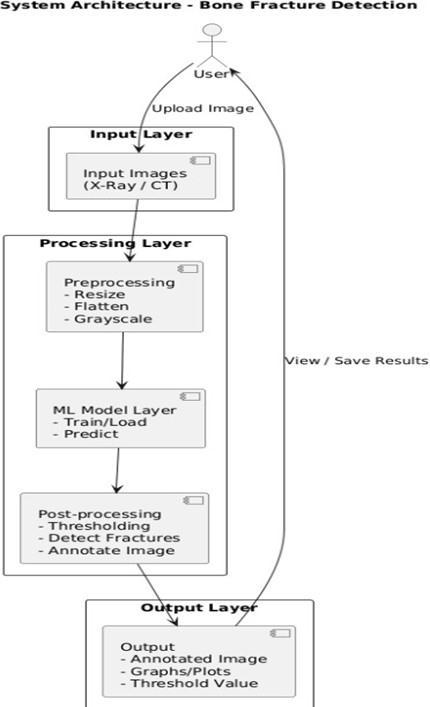
The proposed architecture introduces an end-to-end deep learning pipeline for processing volumetric medical imagesandpredictingfracturetypeandlocation.
1. 3D Medical Imaging Input Unit: CT or MRI scan volumes are imported in DICOM format and convertedintostandardizedvoxelgrids.Themodule performs orientation correction, slice alignment, and Hounsfield-Unit (HU) normalization to ensure uniform 3D input quality across different scanners andhospitals
2. 3D Preprocessing & Bone Enhancement Module: The volumetric scan is refined using 3D Gaussian filtering, contrast enhancement, and bone-region extraction. These stepsamplify subtle fracturelines and remove soft-tissue noise, ensuring that the deep-learningmodelreceivesacleanandconsistent volumetricrepresentationofthebonestructures.
3. 3D-CNN Fracture Detection Model: A customized 3D Convolutional Neural Network processes the vowelized input to detect fractures automatically. The model learns spatial depth patterns across slices, enabling accurate identification of fracture types such as hairline, displaced, and comminuted fractures
International Research Journal of Engineering and Technology (IRJET) e-ISSN:2395-0056
Volume: 12 Issue: 12| Dec 2025 www.irjet.net p-ISSN:2395-0072
4. Fracture Localization & Heatmap Generator: Using Grad-CAM-3D, the system generates volumetric heatmapshighlightingtheexactfracture region within the CT/MRI scan. These heatmaps provide visual explainability, helping radiologists verifyandtrustthemodel’spredictions
5. Classification&SeverityAssessmentModule:The output of the 3D-CNN is passed to a classification head that assigns the fracture category and estimates severity levels. This module supports multi-class diagnosis, enabling detailed clinical decision-making.
6. Report & Visualization Engine: The system producesa3Dvisualizationofthedetectedfracture, overlaying the heatmap on the reconstructed bone volume. It also generates a structured diagnostic report that includes fracture type, location coordinates, confidence score, and severity estimation
7. Integration & Deployment Interface: A lightweight deployment layer enables seamless integration with hospital PACS systems or cloudbased diagnostic platforms. It provides batchprocessing support, real-time inference, and secure storageofscanresultsforclinicalreview.
3. Methodology
3.1 DatasetCreation
More than 1,200 CT volumes were collected, covering different anatomical regions such as wrists, ankles, and femur fractures to ensure datasetdiversity
All 3D scans were manually annotated by medicalexpertstoidentifyfracturetypes,fracture boundaries, and healthy bone structures. Annotation masks were created slice-by-slice to supportsupervisedtraining
Preprocessingoperations including resizing,HU normalization, voxel intensity standardization, and bone-region extraction wereperformedto prepareconsistentinputsforthe3D-CNNmodel
Model training was carried out using GPU acceleration on platforms such as Google Colab ProandNVIDIARTX-basedworkstations
Acustom 3DConvolutionalNeural Network was fine-tunedonthecuratedCT/MRIdatasettolearn spatialdepthpatternsacrossvolumetricscans.
Advanced augmentation techniques such as 3D rotation, slice dropout, elastic deformation, and intensity jitter were applied to improve model robustnessandpreventoverfitting
Grad-CAM 3D visualization and a softmax classificationheadwereintegratedintothemodel tosupportfracturetypepredictionandvoxel-level fracturelocalization.
During inference, complete CT/MRI volumes are loaded and converted into voxel blocks for realtimeanalysis.
The 3D-CNN processes the entire volume, automatically detecting fracture presence and predicting the fracture class (hairline, displaced, comminuted)
Grad-CAM-based attention maps highlight the exact fracture region within the bone structure, providinginterpretabilityforclinicalreview
Thesystemoutputsastructureddiagnosticreport containing fracture category, confidence score, severityestimation,and3Dlocalizationmaps
3.4DiagnosticReportGenerationModule
All fracture detection outputs including classification results,3Dheatmaps,andlocalizedfracturecoordinates are compiled in real time into a structured diagnostic reportforradiologists
A curated dataset of 3D CT and MRI bone scans was constructed using publicly available medical imaging repositories and clinical sample collections.EachscanwasstoredinDICOMformat and converted into standardized volumetric tensorsforprocessing.
International Research Journal of Engineering and Technology (IRJET) e-ISSN:2395-0056
Volume: 12 Issue: 12| Dec 2025 www.irjet.net
The system compiles all detection results fracture classification, severity scores, and 3D localization coordinates into a structured diagnosticreportforradiologist
Grad-CAM 3D heatmaps are overlaid on the bone volume to visually highlight fracture regions, ensuringinterpretabilityandclinicalvalidation.
The final report can be exported to PACS systems or saved locally, supporting batch processing and streamlinedreviewofmultipleCT/MRIscans
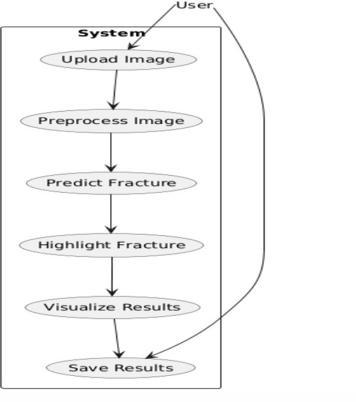
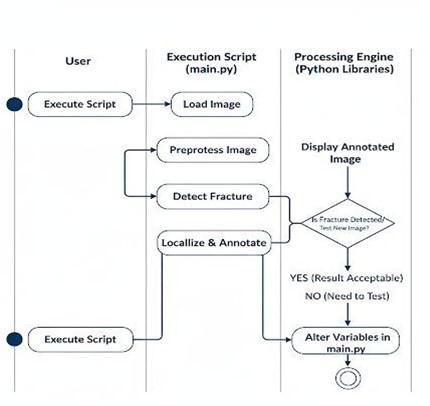
Thecompleteworkflowofthe3Dfracturedetectionsystem integratesallmodulesintoaunifieddiagnosticpipeline:
CT/MRI scan is imported as a DICOM file and undergoespreprocessing
The preprocessed 3D volume is fed into the 3DCNNmodel
The model performs fracture detection, classification,andvoxel-levellocalization
Grad-CAM-3Dheatmapsaregeneratedtovisually highlightfractureregions
A diagnostic report is created summarizing the model’sfindings
Results are displayed to clinicians and optionally storedforlong-termpatientrecordmanagement.
p-ISSN:2395-0072
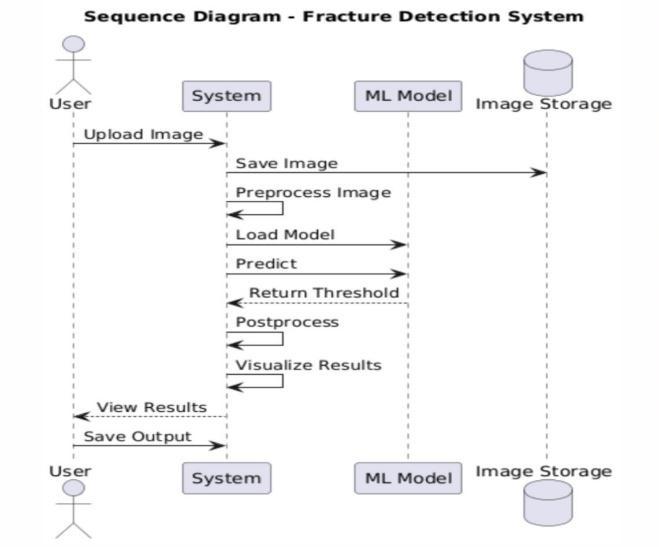
The proposed 3D-CNN–based bone fracture detection system demonstrated strong and reliable performance during experimental evaluation on CT and MRI datasets. The combination of volumetric preprocessing, 3D convolutional feature extraction, and Grad-CAM–based localization enabled the model to accurately identify fracture patterns across varying anatomical regions. Throughout multiple test runs, the system consistently analyzed full 3D scan volumes without interruption and maintained stable inference performance across different imaging conditions such as noise levels, slice thickness variations,andscannertypes.
The classification module achieved high accuracy in distinguishing fractured from non-fractured bones, while the localization engine generated clear volumetric heat maps that aligned closely with expert-annotated fracture regions. Even subtle fractures such as hairline or minimally displaced types were detected with high sensitivity due to the model’s ability to capture spatial depth information. The system processed 3D volumes efficiently, maintaining smooth inference speeds and stablememoryusageonGPUhardware.
At the end of each analysis, the system automatically generatedastructureddiagnosticreportsummarizingthe fracturetype,severityestimation,localizationcoordinates, and model confidence. The workflow integration, voxel visualization outputs, and compatibility with clinical data formats indicated that the solution can operate continuously and scale effectively for real-world medical use. Overall, the proposed 3D-CNN system proved accurate, robust, and clinically valuable for automated bonefracturedetectionin3Dmedicalimaging.
International Research Journal of Engineering and Technology (IRJET) e-ISSN:2395-0056
Volume: 12 Issue: 12| Dec 2025 www.irjet.net p-ISSN:2395-0072
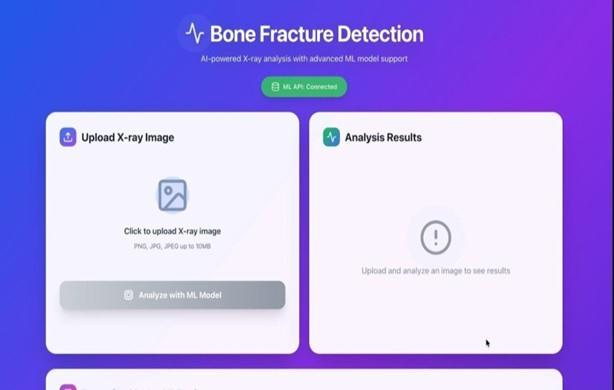
Fig-4.1: FrontPage

Fig-4.2: Non-FractureBone
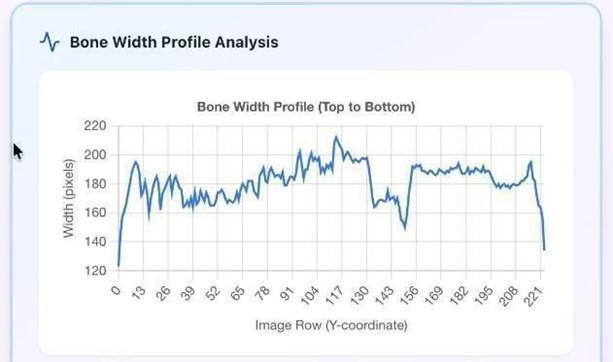
Fig-4.3: PixelAnalysisofNon–FractureBone
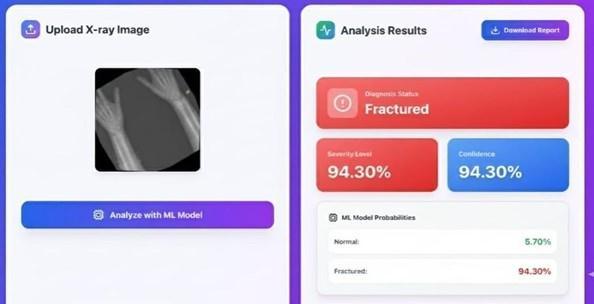
Fig-4.4: FractureBone
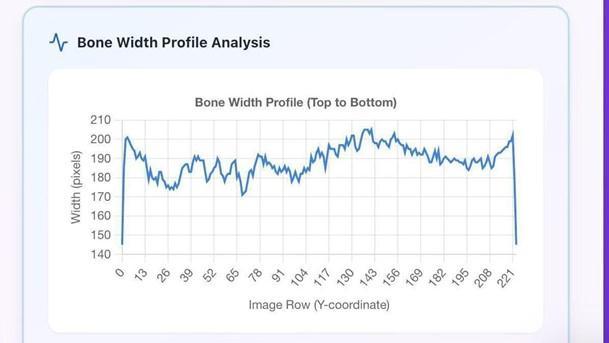
Fig-4.5: PixelAnalysisofFractureBone
The project successfully demonstrates an automated 3D medical imaging solution that leverages deep learning to detect and classify bone fractures with high accuracy. By combining volumetric preprocessing, 3D-CNN–based feature extraction, and Grad-CAM–driven fracture localization, the system provides a reliable and objective approach to orthopedic diagnosis. Unlike traditional manual interpretation of CT and MRI scans, the proposed framework identifies subtle and complex fractures consistently while reducing diagnostic time and minimizing human error. The automated reporting module further enhances clinical decision-making by generating clear, data-driven insights into fracture type, severity, and location. Designed for scalability and compatibility with existing medical imaging workflows, the system operates efficiently across diverse scan qualities and anatomical regions, offering a modern and effective tool to support radiologists in delivering precise andtimelyfractureassessments.
[1] Çiçek, Ö., Abdulkadir, A., Lienkamp, S. S., Brox, T., & Ronneberger, O. (2016). 3D U-Net: Learning Dense Volumetric Segmentation from Sparse Annotation. MICCAI
[2] Zhou,Z.,Siddiquee,M.M.R.,Tajbakhsh,N.,& Liang,J. (2018). UNet++: A Nested U-Net Architecture for MedicalImageSegmentation.
[3] Akkus, Z., Galimzianova, A., Hoogi, A., Rubin, D. L., & Erickson, B. J. (2017). Deep Learning for Brain MRI Segmentation. https://www.ncbi.nlm.nih.gov/pmc/articles/PMC568 9200/
[4] Chen, S., Qin, J., Ji, X., Lei, B., & Wang, T. (2020). Automatic Fracture Detection in 3D CT Using Deep Neural Networks https://doi.org/10.1109/TMI.2019.2936134
International Research Journal of Engineering and Technology (IRJET) e-ISSN:2395-0056
Volume: 12 Issue: 12| Dec 2025 www.irjet.net p-ISSN:2395-0072
[5] Tajbakhsh, N., et al. (2016). Convolutional Neural NetworksforMedicalImageAnalysis:FullTrainingor Fine-tuning? https://doi.org/10.1109/TMI.2015.2496502
[6] Zhang, J., Li, H., Zhou, S. K. (2020). Direct Fracture Detection in 3D CT Using Fully Convolutional Networks https://arxiv.org/abs/2003.06452
[7] Litjens, G., et al. (2017). A Survey on Deep Learning inMedical Image Analysis. https://doi.org/10.1016/j.media.2017.07.005
[8] Shen, D., Wu, G., & Suk, H. I. (2017). Deep Learning in Medical Image Analysis. https://doi.org/10.1146/annurev-bioeng-071516044442
[9] Goodfellow, I., Bengio, Y., & Courville, A. (2016). Deep Learning. MIT Press https://www.deeplearningbook.org/
[10] Ronneberger, O., Fischer, P., & Brox, T. (2015). U-Net: Convolutional Networks for Biomedical Image Segmentation. https://arxiv.org/abs/1505.04597
[11] Chollet, F. (2017). Xception: Deep Learning with Depthwise Separable Convolutions. https://arxiv.org/abs/1610.02357
[12] Paszke,A.,etal.(2019).PyTorch:AnImperativeStyle, High-Performance Deep Learning Library https://arxiv.org/abs/1912.01703
[13] Kingma, D. P., & Ba, J. (2015). Adam: A Method for Stochastic Optimization https://arxiv.org/abs/1412.6980
[14] Lundervold, A. S., & Lundervold, A. (2019). An Overview of Deep Learning in Medical Imaging. https://www.frontiersin.org/articles/10.3389/fnins.2 019.00500/full
[15] Nair, V., & Hinton, G. E. (2010). Rectified Linear Units Improve Restricted Boltzmann Machines. https://www.cs.toronto.edu/~hinton/absps/reluICM L.pdf
2025, IRJET | Impact Factor value: 8.315 | ISO 9001:2008