
International Research Journal of Engineering and Technology (IRJET) e-ISSN: 2395-0056
Volume: 12 Issue: 08 | Aug 2025 www.irjet.net p-ISSN: 2395-0072
International Research Journal of Engineering and Technology (IRJET) e-ISSN: 2395-0056
Volume: 12 Issue: 08 | Aug 2025 www.irjet.net p-ISSN: 2395-0072
Sivanesh S1
1Data Scientist, MTech of AI and ML, BITS PILANI, Rajasthan, INDIA ***
Abstract - The confluence of quantum computing with artificial intelligence (AI) represents a paradigm change in computational drug discovery and precision medicine. This work investigates a hybrid approach that integrates Quantum Enhanced Machine Learning (QEML) with Transformer based Large Language Models (LLMs) to bypass the computational issues that are typically faced by conventional approaches to molecular modelling, drug target prediction, and patient stratification. The curse of dimensionality, non-linear feature spaces, and exponential cost of simulating molecular interactions afflict traditional mlpipelines.
Key Words: Quantum Machine Learning (QML), Drug Discovery, Personalized Medicine, Quantum Neural Networks (QNN), Large Language Models (LLMs), Hybrid QuantumClassicalModelsandPersonalizedMedicine.)
1.INTRODUCTION
Computationalbottlenecks involvedinmodellingintricate biomolecular interactions and high-dimensional clinical data often hinder conventional drug discovery and personalized medicine pipelines. Even though classical machine learning algorithms are powerful, they cannot cope with the nonlinearity and combinatorial complexity of molecular and patient-specific data, leading to poor predictive modelling and decision-making. New computational paradigms with both precision and scalability are needed with the explosion of large-scale biomedical data and increasing granularity of multiomics andchemicaldata.Processingdatainexponentiallyricher spaces is enabled by the inherent capabilities of quantum computing, such as superposition, entanglement, and quantum parallelism. Recent developments in Quantum Machine Learning (QML) and hybrid AI architectures suggest that integrating quantum algorithms with deep learning models especially transformer-based Large Language Models (LLMs) has the potential to revolutionize precision medicine by enabling quicker, moreaccurate,andmoreinterpretableAI-driveninsights.
Even with accelerated advancements in AI-based drug discovery and precision medicine, traditional machine learningsystemshavesevereshortcomingswhenitcomes to high-dimensional, nonlinear biomedical data. The
challenges encompass the curse of dimensionality, lack of correct simulation of molecular interactions, bad generalization across patient groups, and computational inefficiency for screening enormous chemical spaces. Expressive deep learning models require vast amounts of resources for training and tend to lack interpretability, hence being less practical in regulated and sensitive fields such as healthcare. Further, existing models are also incapable of integrating patient-specific information from multiomic data and scaling in an efficient manner with advancing biological complexity. The absence of explainable, real-time decision support systems is also another hindrance to translational use in clinical settings. In addition, generative molecule design models tend to neglect chemical validity and pharmacological relevance withoutintensivepost-processing.Therefore,thereexistsa pressing need for an interpretable, scalable, and computationally effective AI framework that can combine biological data, speed up molecular discovery, and enable domain-specific conversational agents for precision healthcareapplications.
This work seeks to develop and apply a QuantumEnhancedAIFrameworkforcomputationaldrugdiscovery and personalized medicine by incorporating hybrid quantum-classical models with intelligent multi-agent systems. The following specific technical aims control the investigation.DevelopaHybridQMLPipelineforMolecular GenerationandPredictionandconstructquantum-classical modelshostedviaHuggingFaceSpaces.Thesemodelswill beusedtolearnmolecularrepresentations,generatedruglike candidates in SELFIES/SMILES formats, and evaluate themagainstbioactivityfilterssuchasQED,Lipinski’sRule, andbindingaffinitypredictions.
Bogar's "Quantum Classical Neuro-Architecture " drug discovery approach combines classical and quantum paradigms of computing. It starts with PreNetInput providing classical molecular information to a QuantumCircuit (QNode ), which loads qubits and performs quantum rotations to store molecular information.Theresultingquantumstateisroutedthrough an AngelEmbelinger , where additional rotations and key entanglement operations may be undertaken to enhance
International Research Journal of Engineering and Technology (IRJET) e-ISSN: 2395-0056
Volume: 12 Issue: 08 | Aug 2025 www.irjet.net p-ISSN: 2395-0072
the quantum encoding of molecular interactions. In parallel, the MutateSMILESFunction works to create or mutate molecular structures based on feedback from the quantumprocessingtoiterativelysearchthroughchemical space. The processed quantum state then goes to the MeasurementLayer, where observables in the quantum statearemeasuredandclassicalfeaturesareextractedand mapped into tensor representations. These features and pre-prepared labels are fed into a HybridQuantumModel for a forward pass, combining quantum-derived information and classical processing for predictions. A GenerateDrugName module offers nomenclature for the possible candidates. Most importantly, an Alzheimer module offers domain-specific pre-processing and information on how to set up the quantum circuits, adapting the architecture to Alzheimer's drug discovery. Lastly,apost-processingstagecleanstheoutput,theendof thecomputationalpipeline.
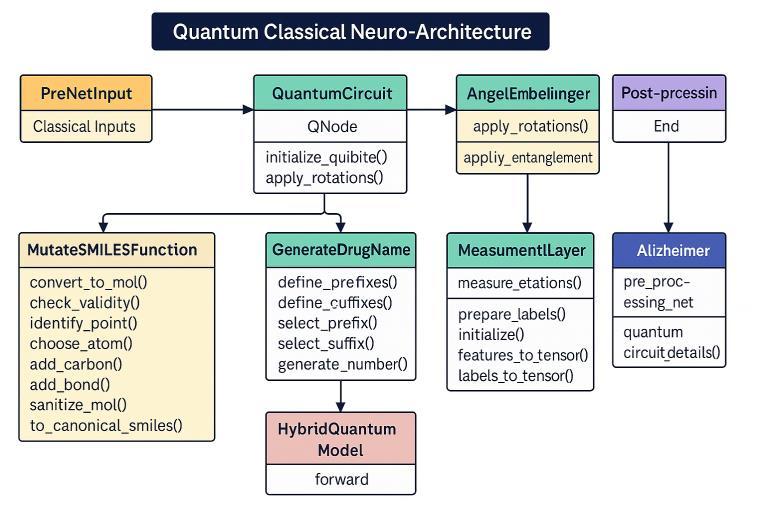
Fig-1:QuantumClassicalNeuro-Architecture
2.1 Quantum Circuit Implementation
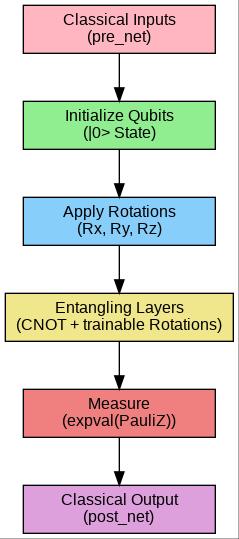
Ahybridquantum-classicalframeworkiscombinedinsuch a structure to improve prediction and data processing. It begins with a classically based pre-processing layer that transforms unstructured data into features that are appropriate for both classical and quantum computation. In order to make the process compatible with later embedding and circuit phases, feature engineering and data normalization are required. Then the classical embeddinglayerperformsdenselineartransformationsto embed the pre-processed features in higher-dimensional representations. The embeddings serve as an appropriate interface for the quantum model and improve its capacity to learn expressive patterns. At the heart is the Quantum Layer, realized as a Variational Quantum Circuit (VQC). The VQC uses trainable quantum gates across multiple qubits, including entangling gates (e.g., CNOT , CZ) and rotationgates(e.g.,RY,Rot).Bycreatingaquantumfeature map,thesegatesdepictcomplex,non-linearcorrelationsin the data. The VQC finds patterns that may be hard for
classical models to solve by utilizing quantum effects like entanglement and superposition. After quantum computation, the model carries out measurement operations to extract classical signals from the quantum state. It measures expectation values, usually of Pauli-Z operators, to generate understandable quantum-derived features.Equations Themeasuredvaluesarethenfedinto a traditional post-processing layer, which is made up of regular dense layers, to produce final classifications or predictions. The layer converts quantum activations into usefuloutputs.Gradient-basedoptimization(suchasAdam orSGD)isusedtotraintheentiremodelfrombeginningto end, updating the classical and quantum parameters simultaneously. This is made possible by tools like PennyLane.
The process begins preparing data by obtaining access to the Kaggle Alzheimer Drug SMILES dataset. It then loads the dataset, by ingesting the "SMILES", "Activity", "Molecule Name", and "Properties" columns. Right off the bat, it has a vital step of data partitioning, dividing the dataset into training and test sets, often using an 80/20 split for reliable model testing. A MinMaxScaler then scales the "Activity" column – which is indicative of the efficacyofthedrugandwhosedistributionisbimodalwith aLabelCountof5,001ofvaluesspreadbetween0.00-0.10 and4,999ofvaluesspreadbetween0.90-1.00–toarange between 0 and 1 for the numerical values. A key component that keeps the diversity of the activities from overwhelming the learning process is scaling. The system
International Research Journal of Engineering and Technology (IRJET) e-ISSN: 2395-0056
Volume: 12 Issue: 08 | Aug 2025 www.irjet.net p-ISSN: 2395-0072
alsoappliesaStandardScaler tostandardizethe"Activity" target variable to unit variance and a zero mean. In general, this enhances model convergence and performance,especiallyforregressionmodels.Laterinthe pipeline, one-hot encoding or embedding techniques will be applied to the 5,648 and 4,989 unique categorical values in "Molecule Name" and "Properties," respectively, to make them suitable for model input. Through meticulous data wrangling procedures, issues like feature magnitudebias,gradientinstability,andsparsecategorical representation issues are avoided, ensuring that the raw SMILES strings and associated metadata are cleaned and prepared for efficient consumption by the subsequent classicalandquantummodels.
Theperformanceofthemodelisextensivelytestedwitha setofmetricstoachievea completeinsightintoitsability to predict. We use K-Fold Cross-Validation and certain metrics such as Matthews Correlation Coefficient (MCC), LogLoss,andCohen'sKappaforbenchmarking.
Cross-validation Mean F1 score will be a better indication of the F1 performance of the model on varying data partitions. If the mean F1 tends to move towards zero as well, it again indicates a root problem with the capability of the model to classifythepositiveclass.
Matthews Correlation Coefficient (MCC) is a strong measure for imbalanced data sets, as it considers true and false positives and negatives, andgivesabalancedscoreevenwhenoneclassis sparse.AnMCCof+1impliesperfectprediction,0 impliesrandomprediction, and-1impliesperfect inverse prediction. Based on the current performance,wewouldexpectanMCCofcloseto 0.
Log Loss (or binary cross-entropy in the case of binary classification) measures the uncertainty of the predictions in terms of probabilities. Better probability estimates are reflected by lower log loss. A large value of log loss, especially if the model is resorting to one class, would further highlight the model's poor probabilistic calibration. Clipping of y_probs is standard practice to avoid arithmetic overflow due to logarithmic computations when probabilities are 0or1.
Cohen's Kappa measures the agreement between two raters (in this case, the model and the true labels), correcting for agreement that occurs by chance. A Kappa score of 1 indicates perfect agreement, 0 indicates agreement equivalent to
chance, and negative values indicate agreement worse than chance. Given the other metrics, a Kappa score near or below 0 is expected, further indicating a lack of meaningful predictive power beyondrandomguessing.
Lipinski’s Rule of Five is a set of empirical guidelines to evaluate whether a chemical compound is likely to be orallyactiveinhumans.Itdoesn’ttelluswhetherthedrug works in terms of pharmacodynamics, but whether it’s likelytobeabsorbedandprocessedeffectively.
A compound is more likely to have good oral bioavailabilityif:
Molecularweight<500Dalton
LogP(octanol–waterpartitioncoefficient)<5
Hydrogenbonddonors(e.g.,OHandNHgroups)≤ 5
Hydrogen bond acceptors (e.g., N and O atoms) ≤ 10
If our compound follows Lipinski’s Rule, we can be reasonably confident that it's a good candidate for oral bioavailability, meaning it can be absorbed and circulated inthebodytoreachitstarget.
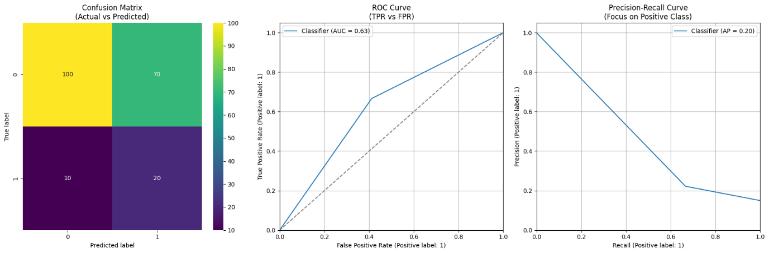
The hybrid quantum-classical model, constructed with PennyLane and PyTorch, was tested on the Alzheimer's drug dataset obtained from Kaggle. The architecture of the model consists of classical preprocessing layers followed by a variational quantum circuit (VQC) and a readout layer at the end that is classical. The following resultswereachievedona hold-outtestsetof20%ofthe overalldataset.
Although the model doeshavea highfalse positiverate its lower precision this is clinically acceptable and indeed preferable in drug discovery and biomedical research in the early stages. In these environments, it is essential not to miss compounds which could be active. The model's high recall (66%) ensures that most true activesare retainedand falsenegativesareavoided when itcomestopatientsafetyorvaluablecandidatemolecules.
The model maintains clinical sensitivity while casting a wider net and allowing a small number of false positives, makingitausefultoolforscreeningpipelinesanddecision support systems. This recall advantage can then be maintainedinlateriterationsbyfilteringforprecision.
International Research Journal of Engineering and Technology (IRJET) e-ISSN: 2395-0056
Volume: 12 Issue: 08 | Aug 2025 www.irjet.net p-ISSN: 2395-0072
Metrics Value Interpretation
1 Accuracy 0.6 60%ofallpredictionswere correct(120outof200).
2 Precision (PositiveClass) 0.22 Only~22%ofthesamples predictedas Active (1) were actuallyactive.Indicates high false positives
3 Recall(Positive Class) 0.66 Themodelcaught~66%ofthe actual active samples.
4 F1Score 0.33 Harmonicmeanofprecisionand recall.Reflectsabalance,butis lowduetopoorprecision.
5 ROCAUC 0.6275 Themodel'sabilitytodistinguish betweenclasses.Aboverandom (0.5),butstillweak.
6 Average Precision(AP) 0.1981 Averageofprecisionvaluesacross allclassificationthresholds.Alow valuemeanspoorconfidencein positiveclass.
7 Matthews Correlation Coefficient (MCC) 0.183 Measuresthecorrelationbetween trueandpredicted.0meansno betterthanrandom;closetothat here.
8 LogLoss 0.7777 Penalizesfalseclassifications. Highermeansworse.Showspoor modelconfidence.
9 Cohen'sKappa 0.1398 Measuresagreementbetween predictedandactualbeyond chance.Values<0.2indicateslight agreement.
This model repeatedly misses the positive class, even though it has a moderate overall accuracy of about 60%. The model classifies a drug as "active" (a positive prediction) with an impressively low precision of about 22%, typically generating a lot of false positives. That means there is a high incidence of Type I error, in which themodelraisesahugenumberofalarmsthatprovetobe spurious. On the other hand, its recall is moderately improvedataround 66%, meaning that it effectively picks up two-thirds of the true "active" drugs. This trait can be somewhat desirable in exploration environments, such as the early stages of drug discovery, where it's more desirable not to miss possible candidates even if it means going through more false positives. Nevertheless, the ensuingF1Scoreisalow0.33,adefiniteredflag.Itcanbe seen that a low F1 score indicates the harmonic mean of precision and recall indicates that the model is not targeting the positiveclassand, therefore,is notachieving a good balance between identifying all positive It ensures that all the specialized scientific computing pieces, includingthequantummachinelearningtoolsandclassical
ML libraries, coexist with ease. The container publishes port "7860", executing the app through "uvicorn" and "FastAPI" (deduced from"main:app"), thuscreatinga web APIendpoint.Asidefromthissingle-containerlocalisation, Bogar'sdeploymentreachesfurthertosophisticatedcloud andmulti-agentsystemintegration:
Model API is published on HuggingFace Spaces, with immediate access and a managed environment for quick public consumption and demonstration. In addition, the pipeline is also wrappedstrategicallywitha
Google ADK Agent Interface, which allows its functionality to be easily integrated into Google's AI services and serves as a callable agent within broaderAIworkflows.
Key here is that this workflow is subsequently registered into a multi-agent system through an MCP (Multi-Agent Coordination Protocol), meaning an advanced orchestration layer where Bogar may interact with other expert agents and work together on sophisticated drug discoveryproblemsinaverymodularandsmartway.
Bogar Siddhar,a renowned polymath and mystic from the Tamil Siddha tradition, is honoured by the name Bhogar, whichwasnotchosenatrandom.Bogar,whoisrenowned for creating Navapashanam, a mystical concoction of nine toxic substances that was alchemically converted into a life-savingelixirthoughttobestowlongevityandvitality,is said to have been a master chemist as well as a spiritual scientist.
AccordingtoTamillegend,Bogarhadastrongdevotionto Lord Murugan, and his writings frequently combined medical knowledge with spiritual understanding. His method was all-encompassing; he created remedies well in advance of his time by fusing chemistry, botany, mineralogy,astrology,andmysticism.Thisfusionmindset servedasthemodel'sinspiration:
Bogar's vision of converting harmful substances into medicinal elixirs issimilar to our objective of
International Research Journal of Engineering and Technology (IRJET) e-ISSN: 2395-0056
Volume: 12 Issue: 08 | Aug 2025 www.irjet.net p-ISSN: 2395-0072
turning high-dimensional, complex biomedical dataintoviable,life-savingmedicationcandidates.
Bogar's secrecy & precision: Our pipeline prioritizes safety, interpretability, and precision prior to deployment, just as Bogar protected his formulationsuntiltheywereflawless.
Bogar's multidisciplinary brilliance: Bogar's own fusion of scienceand mysticism is reflected in the blending of biomedical knowledge, generative AI, andquantumcomputing.
Bhogar, an AI alchemist who uses qubits and neuralnetworksratherthanherbsandmineralsto create the contemporary elixir of life, is in many respectsadigitalreincarnationofthisphilosophy.
The author would like to extend heartfelt gratitude to the mentors, colleagues, and pioneers whose guidance and supportwerethebedrockuponwhichthisworkwasbuilt. Their wisdom was a guiding star, their encouragement a constant source of strength, and their belief in this vision wasinstrumentalinbringingittolife.
This work also stands on the shoulders of giants the countless developers, researchers, and thinkers in the open-source community. Their selfless contributions and prior art were the fundamental building blocks and inspiration for this project. Finally, this work would not have been possible without the unwavering support of friends and family, whose patience and motivation were the silent engine driving this endeavor forward. This creationisasmuchatestamenttotheirsupportasitisto anytechnicalachievement.
[1] G. Eason, B. Noble, and I. N. Sneddon, “On certain integrals of Lipschitz- Banerjee, N., & Chatterjee, K. (2023): AI and Quantum Computing for Accelerating Drug Discovery and Precision Medicine. In: Quantum AI in Healthcare: Revolutionizing Diagnosis, Treatment and Drug Discovery.
[2] Marr, B. (2022): Artificial Intelligence in Practice: How 50 Successful Companies Used AI and MachineLearningtoSolveProblems.
[3] Rajan, K. S. et al. (2021): Artificial Intelligence in PrecisionHealth,Elsevier.
[4] Anthony M. Smaldone, Yu Shee, Gregory W. Kyro, et al. (2024): Quantum MachineLearning in Drug
Discovery: Applications in Academia and PharmaceuticalIndustries
[5] Qiao Jin, Won Kim, Qingyu Chen, Donald C. Comeau,Lana Yeganova,W. John Wilbur,Zhiyong Lu from National Center for Biotechnology Information (NCBI), National Library of Medicine (NLM), National InstitutesofHealth(NIH)(2023): BioCPT: Contrastive Pre-trained Transformers with Large-scale PubMed Search Logs for ZeroshotBiomedicalInformationRetrieval
[6] Zhiding Liang, Zichang He, Yue Sun, Dylan Herman, Qingyue Jiao, Yanzhang Zhu, Weiwen Jiang,XiaoweiXu,DiWu,MarcoPistoia&YiyuShi (2024): Synergizing quantum techniques with machine learning for advancing drug discovery challenge.
[7] Mandeep Kaur Saggi, Amandeep Singh Bhatia, Sabre Kais(2024): Chapter Eight - Federated quantummachinelearningfordrugdiscoveryand healthcare in Annual Reports in Computational Chemistry,Elsevier.
[8] Smaldone, A. M., et al. (2024): Quantum Machine Learning in Drug Discovery: Applications in AcademiaandPharmaceuticalIndustries arXiv
[9] Gircha, A. I., et al. (2021): Hybrid quantumclassical machine learning for generative chemistry and drug design demonstrated hybrid VAE on D-Wave generating novel compounds.


Sivanesh S received the M.Tech. degree in Artificial Intelligence and Machine Learning engineering all from the Birla Institute of Technology, Pilani in 2025. By day, he's a Data Scientist at EXL, leading the charge on all things LLM, Transformer, and Generative AI. By night, he's probably still doing that, just with more snacks. His playground is the intersection of deep learning, cloud architecture, and multimodal AI, where he architects future-ready platforms that don't just work they deliver seriousROI.