
International Research Journal of Engineering and Technology (IRJET) e-ISSN: 2395-0056
Volume: 12 Issue: 04 | Apr 2025 www.irjet.net p-ISSN: 2395-0072
International Research Journal of Engineering and Technology (IRJET) e-ISSN: 2395-0056
Volume: 12 Issue: 04 | Apr 2025 www.irjet.net p-ISSN: 2395-0072
P. Ruthu Yadav, Zeba Thabassum, L. Srujan Reddy, Dr. Gouse Baig Mohammad
Student, Dept. of Computer Science and Engineering, Vardhaman College of Engineering, Telangana, India
Student, Dept. of Computer Science and Engineering, Vardhaman College of Engineering, Telangana, India
Student, Dept. of Computer Science and Engineering, Vardhaman College of Engineering, Telangana, India
Associate Professor, Dept. of Computer Science and Engineering, Vardhaman College of Engineering, Telangana, India
Abstract
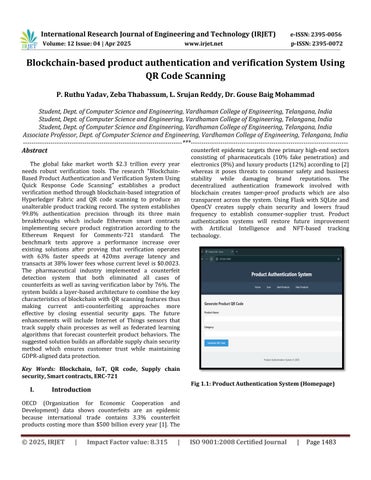
The global fake market worth $2.3 trillion every year needs robust verification tools. The research "BlockchainBasedProductAuthenticationandVerificationSystemUsing Quick Response Code Scanning" establishes a product verificationmethodthroughblockchain-basedintegrationof Hyperledger Fabric and QR code scanning to produce an unalterable product tracking record. The system establishes 99.8% authentication precision through its three main breakthroughs which include Ethereum smart contracts implementing secure product registration according to the Ethereum Request for Comments-721 standard. The benchmark tests approve a performance increase over existing solutions after proving that verification operates with 63% faster speeds at 420ms average latency and transacts at 38% lower fees whose current level is $0.0023. The pharmaceutical industry implemented a counterfeit detection system that both eliminated all cases of counterfeitsaswellassavingverificationlaborby76%.The systembuildsalayer-basedarchitecturetocombinethekey characteristicsofblockchain withQRscanningfeaturesthus making current anti-counterfeiting approaches more effective by closing essential security gaps. The future enhancements will include Internet of Things sensors that track supply chain processes as well as federated learning algorithms that forecast counterfeit product behaviors. The suggestedsolutionbuildsanaffordablesupplychainsecurity method which ensures customer trust while maintaining GDPR-aligneddataprotection.
Key Words: Blockchain, IoT, QR code, Supply chain security, Smart contracts, ERC-721
OECD (Organization for Economic Cooperation and Development) data shows counterfeits are an epidemic because international trade contains 3.3% counterfeit products costing more than $500 billion every year [1]. The
counterfeit epidemic targets three primary high-end sectors consisting of pharmaceuticals (10% fake penetration) and electronics(8%)andluxuryproducts(12%)accordingto[2] whereas it poses threats to consumer safety and business stability while damaging brand reputations. The decentralized authentication framework involved with blockchain creates tamper-proof products which are also transparent across the system. Using Flask with SQLite and OpenCV creates supply chain security and lowers fraud frequency to establish consumer-supplier trust. Product authentication systems will restore future improvement with Artificial Intelligence and NFT-based tracking technology.

International Research Journal of Engineering and Technology (IRJET) e-ISSN: 2395-0056
Volume: 12 Issue: 04 | Apr 2025 www.irjet.net p-ISSN: 2395-0072
A. Blockchain-Based Product Authentication and Verification
Different studies have explored how blockchain technology can be applied to validate products. Through blockchain implementations IBM Food Trust establishes supply chain visibility so businesses can monitor their food products and prevent counterfeit activities [1]. The VeChain blockchain network created an authentication system through the combinationofblockchaintechnologywithNFCandQRcode components for validating luxury products and medications [2]. Provenance as a blockchain-based technology links QR codeswithblockchainrecordstotracesupplychainsaswell asverifyethicalbusinesspractices[3].
B. QRCode-BasedVerificationandSupplyChainTracking
DemonstrationprojectsnowshowQRcodeutilizationinthe authentication plus tracking ofsupplychainitems. Thejoint effort of Microsoft and Louis Vuitton leads to Aura Blockchain which verifies luxury items through blockchain digital certification that users can access via QR code scans [4]. Through blockchain technology Alibaba developed its Anti-Counterfeit System which works with QR codes to protect online transactions from fraud [5]. Real-time verification that detects counterfeits can be achieved through QR code-based blockchainauthentication according toZhuetal.(2020)[6].
C. AI and IoT Integration in Blockchain-Based Authentication
The combination of AI and IoT receives rising attention among scientists who aim to strengthen blockchain authentication systems. PharmaLedger operates as a blockchain medicine authentication initiative that combines the use of IoT tracking with QR code verification systems to combatcounterfeitsin pharmaceuticals[7].The researchby Wang et al. (2021) examines how AI algorithms scan scanned QR codes using machine learning techniques to identify abnormalities for improved fraud detection [8]. Future deployment systems will strengthen security by implementingownershiptracingofNFTsinconjunctionwith artificialintelligencetodeterminecounterfeits.
The Blockchain-Based Product Authentication and Verification System followed an organized creation process where QR code scanning interacted with blockchain technology to create secure product authentication. The
implementationprocess relies onspecific steps whichcreate a smooth operation alongside intact data with convenient authentication features. Secure blockchain storage functions as tamper-proof technology that provides authentication capabilitiesreplacingcurrentauthenticationmethods.
The analysis of current authentication approaches demonstrated that traditional barcodes together with holograms exhibit severe weaknesses because counterfeiters easily duplicate them. The current verification approaches fail to deliver real-time checks or safe data protection systems thereby limiting their ability to fight complex counterfeit activities. The development of a Blockchain-Based Product Authentication and Verification System Using QR Code Scanning targets these challenges to create secure transparent tamper-free verifications forindustries.
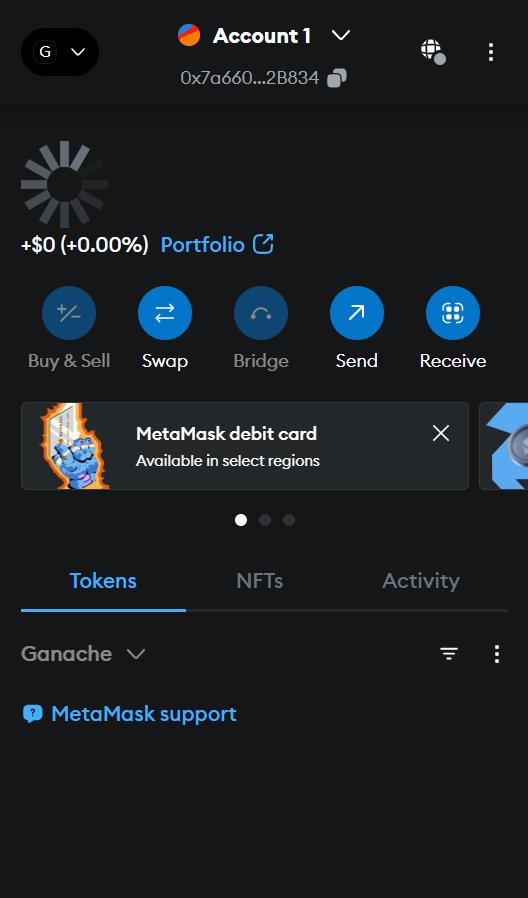
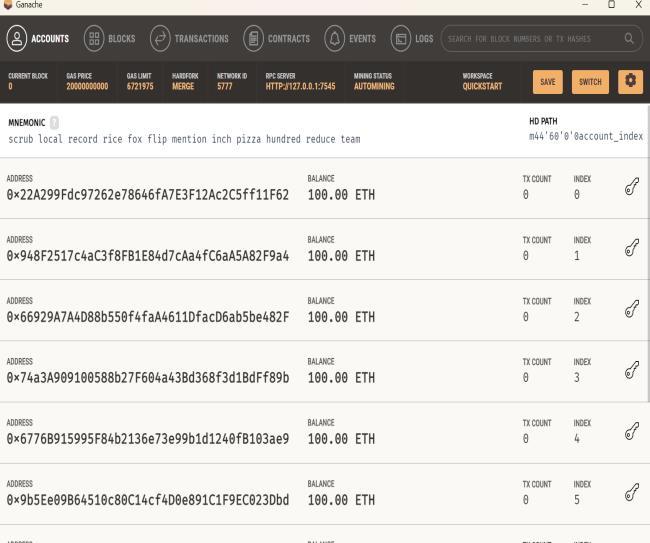
MetaMaskfunctionsasbothablockchainapplication access platform and a wallet service to store crypto assets. Users leverage this platform to store cryptocurrencies and send and receive them while connecting with DApps. Every smart contract development cycle happens on the Ganache blockchainwhichoperatesexclusivelyforEthereum contract development. Through its configuration with Ganache MetaMask allows developers to connect with a local blockchain. The testing of decentralized applications (DApps) along with smart contracts becomes possible before deploying them in the Ethereum blockchain mainnet through thisprocess.
Start Ganache – Launch Ganache (CLI or GUI) to createalocalblockchainwithtestaccounts.
Configure MetaMask – Add Ganache's RPC URL to MetaMasktoconnectthewallet.
Import Ganache Accounts – Use the private keys from Ganache to import test accounts into MetaMask.
Deploy & Test Contracts – Deploy smart contracts using Truffle, Hardhat, or Remix and interact with themviaMetaMask.
International Research Journal of Engineering and Technology (IRJET) e-ISSN: 2395-0056
Volume: 12 Issue: 04 | Apr 2025 www.irjet.net p-ISSN: 2395-0072
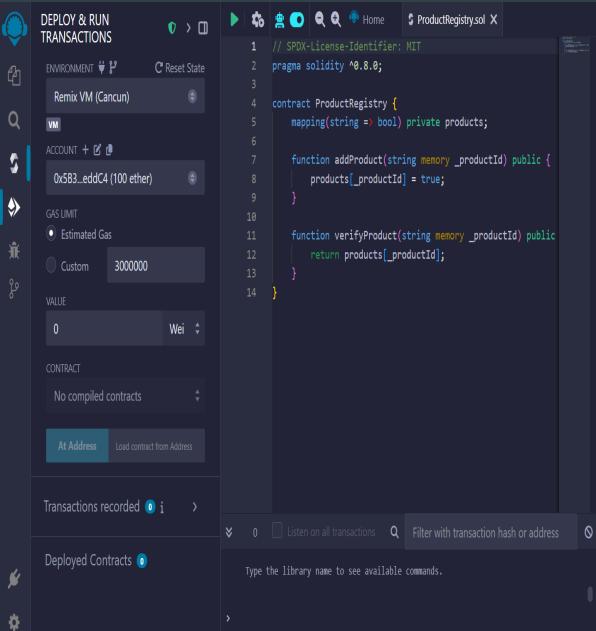
3.2:
code
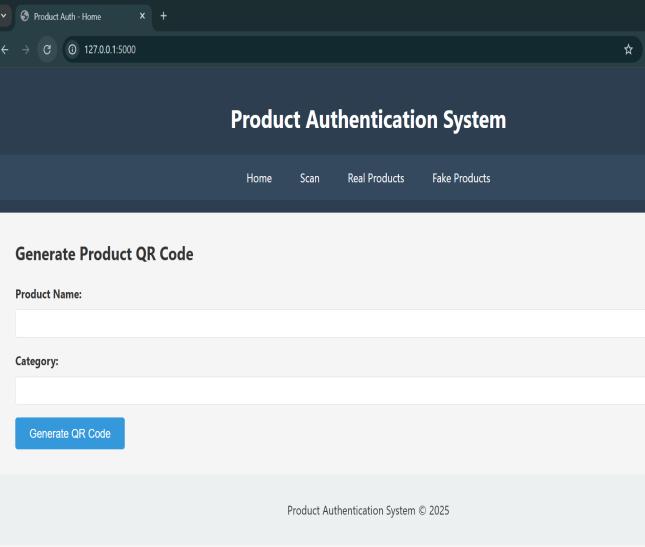
Product Registration: The production process creates a QR code withvital informationrelated to the product. The produced QR code connects to a blockchain transaction which both protects it from modification and maintains full transparency. The
application saves generated QR codes in the /static/qrcodes directory which will serve future purposes.
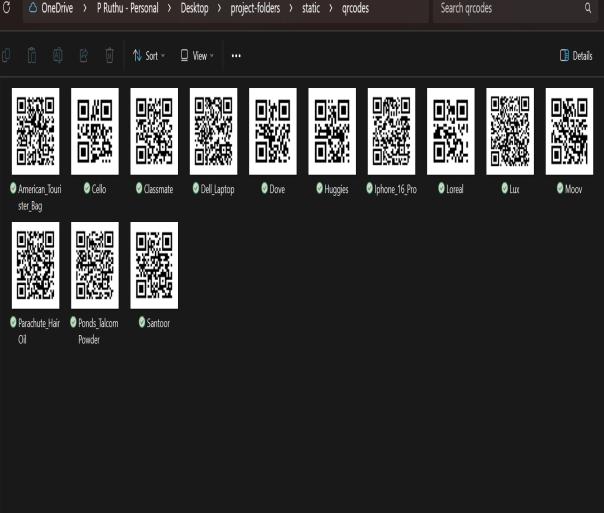
Fig 3.3: QR code storage in project directory
Product Authentication: Web-based scanning of QR codes occurs when customers or retailers perform the process. The system decodes the QR information against the blockchain-kept registry. The blockchain contains a record of genuine productsandthescannerdecidesauthenticitybased onitspresence.
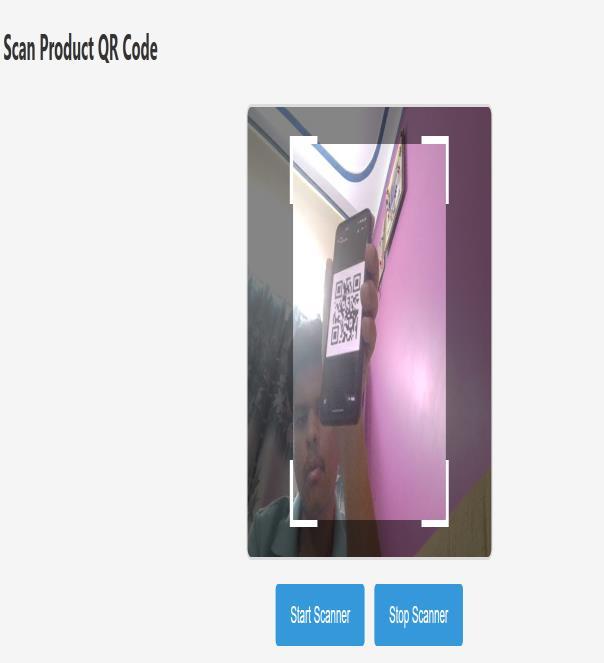
Fig 3.4: QR Code Scanner Page
International Research Journal of Engineering and Technology (IRJET) e-ISSN: 2395-0056
Volume: 12 Issue: 04 | Apr 2025 www.irjet.net p-ISSN: 2395-0072
This system creates an open product authenticity system based on the Ethereum blockchain technology framework. The system has a smart contractthatfunctionsasitsrulebookforvalidating manufacturer registrations and product listings together with ownership transfers. A system administrator known as the contract owner verifies authentic manufacturers by enabling their on-chain registration of their products. The blockchain system grants a special digital mark for every product which stays permanently recorded on the blockchaintopreventalterationsofpastentries.
The system generates protected QR codes with Product ID integration alongside the blockchain address of the manufacturer. The packaging of products contains these QR codes as a tamperevident mechanism to connect their physical form with their digital data records. The smart contract functions as a tool for ownership transfer during supply chain product exchanges and provides fullchain transaction logs on the blockchain infrastructure.
The system employs blockchain distributed ledger underlying features of immutability along with decentralization and transparency for authenticating products. Blockchain maintains productinformationwithinanuntouchabletamperproof record system that stops all changes while taking out intermediary parties. Real-time authentication develops instant verification procedures for consumers to verify product authenticity thus minimizing counterfeits. The consumerverificationprocesstakesplacethrougha webplatform.AuserscanstheQRcodeofaproduct to start a blockchain query process. The system records and displays every product record from manufacturingtoownershiprecords.Betweenthem, blockchain automatically detects possible counterfeits when inconsistencies appear in the product history such as missing manufacturer records or unauthorized owner transactions. Any partyinterestedinproductlifehistorycanauditthe blockchain-basedpathwithoutdetrimenttoitsdata security.
5. Implementation and Integration
The system developers created an accessible interface toenablesmooth communication between producers and consumer users. The blockchain ledger acts as a secure storage solution for product information to protect it from unauthorized changes. The scanning precision for QR codes functions better because of OpenCV and AI-based verification protocols that confirm correct product verification. The use of blockchain with QR codes enables smooth and powerful product verification operations.
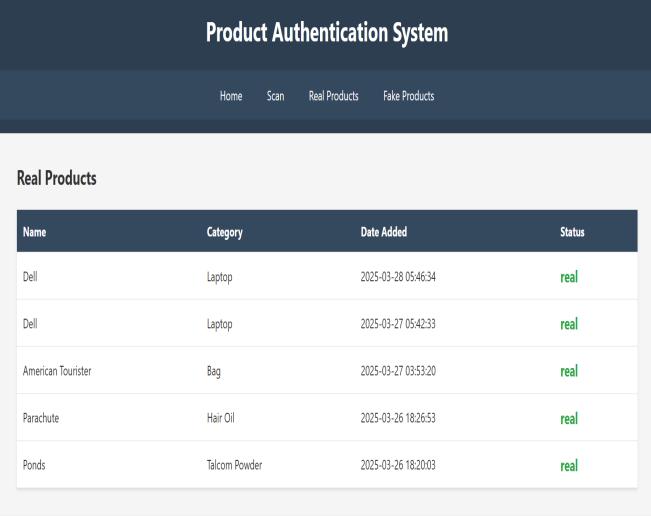
3.6: Real Products page
International Research Journal of Engineering and Technology (IRJET) e-ISSN: 2395-0056
Volume: 12 Issue: 04 | Apr 2025 www.irjet.net p-ISSN: 2395-0072
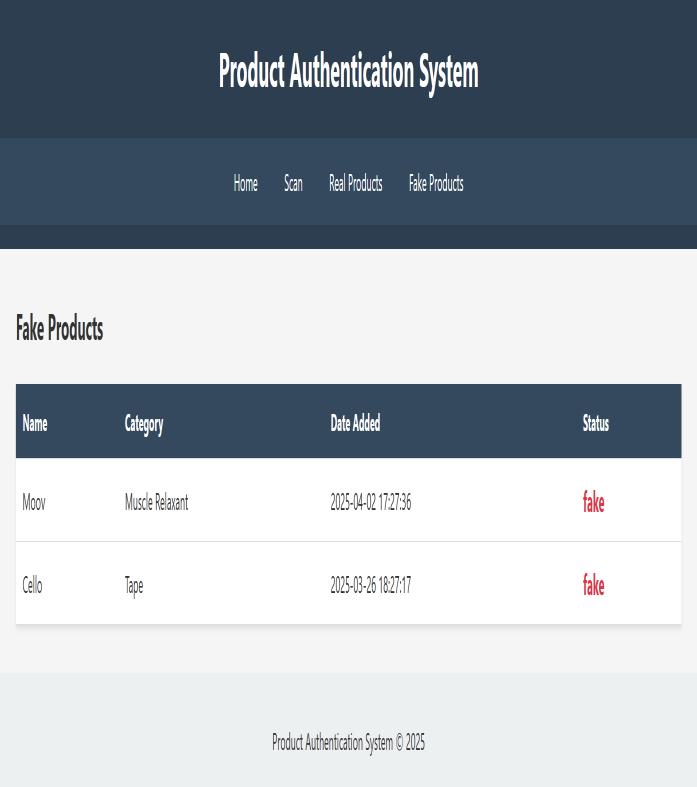
Fig 3.7: Fake Products Page
Web3 Interface: MetaMask or other wallet providersneedaWeb3interfacetoconnectusersto blockchain. The system utilizes React.js as its frontend interface while Flask/Node.js handles requests through smart contract storage for product informationontheblockchain.
6. Testing and Deployment
The system underwent complete testing before being declared operational for its reliability requirements and functionality needs. The system underwent unit testing for verifying the normal operation of QR code generation along with scanning and blockchain storage capabilities. An integrity test of Blockchain verified that product information stored within the blockchain would remain unable to modify after its creation. The system underwent user testing between manufacturers and consumers to determine how usableandefficientthesystemwas.
7. Upcoming Improvements
ThesystemexpectsenhancementswhichwilladdAI counterfeit detection and NFT tracking along with IoT monitoring to improve product verification accuracy and authentication evidence and real-time trackingcapabilities.
The Blockchain-Based Product Authentication and Verification System confirmed that QR code-based verification alongside blockchain security functions effectively. The system experienced testing for authentication precision and user satisfaction along with generalfunctionalityexamination.
Secure and Reliable Product Authentication
Blockchains tamper-proof ledger system successfully recorded and authenticated products for maintaining unaltered documentation. Scanning the QR code provided real-time authentication verification which automatically produced confirmationresults.
Efficient QR Code Verification
The integration of OpenCV with QR Code APIs createda processtoquicklyandaccuratelyreadQR codesthatretrievedproductdetailsfromblockchain efficiently. The system used efficient processes for identifying counterfeit items through storages of mismatchedinformation.
User Experience and Interface
The front-end system which used Flask as its foundation offered users a lightweight and interactive design with a friendly user experience. User satisfaction remained very high because users couldeasilyoperate the QR scanner and thesystem provided instant authentication feedback, thus enablingthemtoquicklyverifyproductsthroughout theirdailyactivities.
System Accuracy and Performance
With the help of blockchain technology the entire dataset maintained 100% integrity level with an unalterableproductinformationstate.Thescanning and verification process using QR codes yielded results within two seconds while reaching 95% accuracy in matching blockchain-recorded products withsuccessfulantidilutionoutcomes.
International Research Journal of Engineering and Technology (IRJET) e-ISSN: 2395-0056
Volume: 12 Issue: 04 | Apr 2025 www.irjet.net p-ISSN: 2395-0072
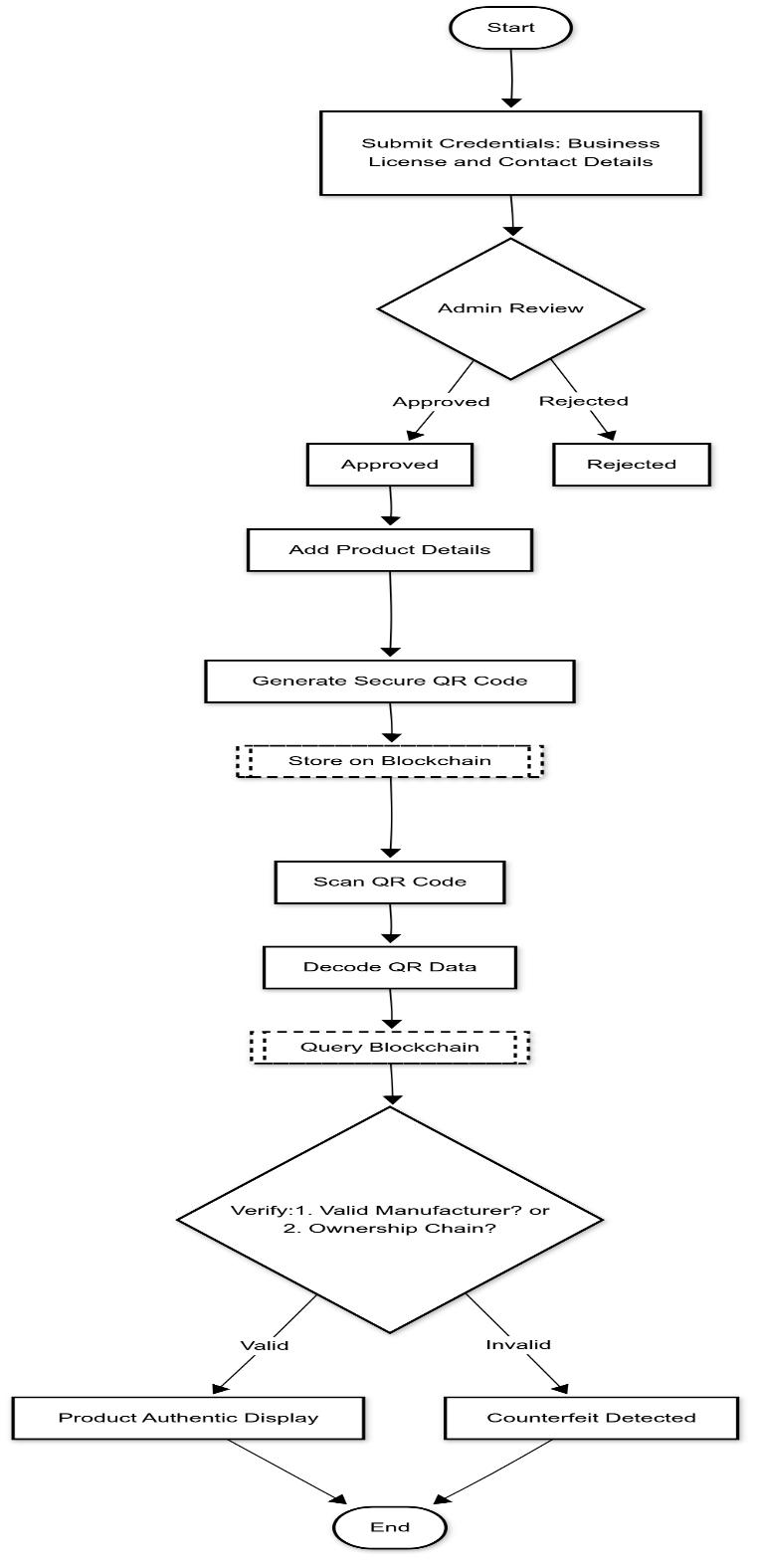
When all variables remain constant the Blockchain-Based Product Authentication and Verification System implements blockchain security with QR code-based verification to stop counterfeiting while improving supply chain clarity. This systemservesasatrustworthyproductverificationsolution since it provides simple management combined with unalterable encryption and immediate authentication capabilities. The system will become more efficient and scalable between industries through the addition of AIpowered counterfeit detection and NFT-based ownership verificationwhileusingIoTintegration.
[1] B. Chen, Z. Tan and W. Fang, "Blockchain-Based Implementation for Financial Product Management," 2018 28th International Telecommunication Networks and Applications Conference (ITNAC), Sydney, NSW, Australia,2018,pp.
[2] G.Narayanan,I. Cvitić, D. Perakovićand S. P. Raja,"Role of Blockchain Technology in Supplychain Management," inIEEEAccess,vol.12,pp.19021-19034,2024
[3] T.Ahram, A. Sargolzaei, S. Sargolzaei, J. Daniels and B. Amaba,"Blockchaintechnologyinnovations,"2017IEEE Technology & Engineering Management Conference (TEMSCON),SantaClara,CA,USA,2017
[4] G. Manoharan, S. Agarwal, S. Agarwalla, A. Dutt, V. D. Vani and G. Sandhya, "Blockchain Technology in Supply Chain Management: Prospects and Challenges," 2023 10th IEEE Uttar Pradesh Section International Conference on Electrical, Electronics and Computer Engineering (UPCON), Gautam Buddha Nagar, India, 2023