
International Research Journal of Engineering and Technology (IRJET) e-ISSN: 2395-0056
Volume: 12 Issue: 11 | Nov 2025 www.irjet.net p-ISSN: 2395-0072
International Research Journal of Engineering and Technology (IRJET) e-ISSN: 2395-0056
Volume: 12 Issue: 11 | Nov 2025 www.irjet.net p-ISSN: 2395-0072
SRAVAN K M
MSc Computer Science Student, St. Thomas (Autonomous) College, Thrissur 680001, Kerala, India ***
Abstract - An exponential rise in data generation,drivenby the spread of internet technologies, establishes Big Data Analytics (BDA) as an essential instrument for e-commerce companies. This literature survey offers a complete summary of the central function of BDA within the e-commerce environment, taking cues from new scholarly works found in prominent databases such as Scopus and Web of Science. Its range covers fundamental definitions, the changing traits of big data, and its diverse uses in e-commerce areas like customer analytics, supply chain improvement, and detecting fraud. Additionally, this review outlines different methods utilized for BDA, which feature bibliometric analysis,machine learning, and solutions based on cloud computing. A detailed critique compares current models, traces citations between articles, and pinpoints important voids in the research. The document finishes with a synthesis of major business consequences, a description of current obstacles covering technical, ethical, organizational, and regulatory fields and suggests a research plan for the future to promote innovation and lasting development in the digital marketplace.
Key Words: Big Data Analytics; E-commerce; Innovation; Predictive Analytics; Machine Learning; Supply Chain Management;CustomerBehavior.
Anunparalleleddataexplosion,frequentlycalled"bigdata," has marked the digital age, produced by pervasive online technologieslikedigitalsensorsandcloudcomputing.Inthe e-commercesector,thiseffectisespeciallynoticeable,asit hasexperiencedsubstantialexpansionandchangefollowing its beginnings in the 1990s. E-commerce, defined as commercialtransactionsconductedthroughdigitalchannels and internet-based platforms, includes a wide array of operations, spanning from internet-based purchasing and salestocomplexsupplychainsandclientsupport.
ResearchintoBigDataAnalytics(BDA)fore-commerce findsstrongmotivationfromitsvitalfunctioninadvancing innovative enterprises and company performance, particularlyamidmajordisruptionssuchastheCOVID-19 pandemic.E-commercecompaniescanendureandprosper with BDA by expanding their activities and executing informed choices using key intelligence from large-scale data. Businesses that utilize BDA show markedly greater productivityandexpansion,highlightingitssignificanceasa primary competitive advantage and a core catalyst for innovationandmarketplacevictory.
Thispaperaimstoprovideastructuredliteraturereview onBigDatainE-commerce.SectionIIsurveystheexisting
literature, covering the evolution and core definitions of BDA, its thematic applications, and the prevalent methodologies. Section III offers a critical analysis of the findings and identifies pertinent research gaps. Section IV elaboratesondiverseapplicationsandrelevantcasestudies. Section V discusses the inherent challenges and proposes future research directions, while Section VI concludes by synthesizing the knowledge and highlighting business implications.
Theconceptofbigdata,definedbyits"threemainfeatures of variety, volume, and velocity", and subsequently broadenedwith"veracityandvalue",becameakeytopicof academicinquirycirca2010,withitsmostrapidevolution occurring from 2011 forward. Prior to this, e-commerce itselfbeganitsjourneywiththeadventofonlineshoppingin the1990s,withcommercial activities officiallyintegrating intotheinternetdomainby1991.TheimpactofBDAonecommercebecamegreatlynoticeableafter2014,signifyinga periodofrapidadoptionandperceivedbenefits.
BigDataAnalytics(BDA)isdescribedastheintegrationof big data with analytics, creating business analytics. A broaderdefinitionstatesBDAis"theprocessofanalyzingbig datathatprovidesavisiontomakebusinessdecisions".This comprehensive method entails gathering, analyzing, applying, and interpreting data from multiple operational units to derive useful intelligence, generate commercial worth,andsecureacompetitiveedge.
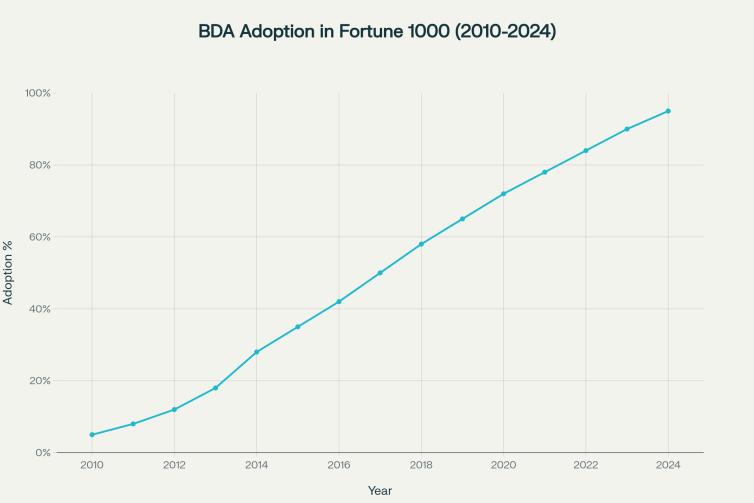
1. EvolutionofBDAadoptionamongFortune1000 companiesfrom2010–2024.
International Research Journal of Engineering and Technology (IRJET) e-ISSN: 2395-0056
Volume: 12 Issue: 11 | Nov 2025 www.irjet.net p-ISSN: 2395-0072
Incorporating BDA into e-commerce has produced major progress in a number of thematic fields, fueled mainly by using varied data forms such as transaction/business activity data, click-stream data, video data, and also voice data.
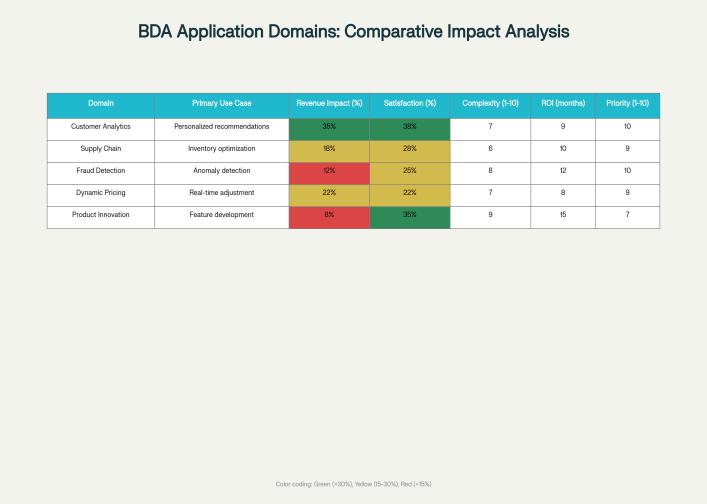
Fig.2.ComparativeanalysisoffiveBDAapplicationdomains withmetricsspanningrevenueimpact(8-35%),customer satisfaction improvement (22-38%), implementation complexity (6-9/10), time to ROI (8-15 months), and organizational priority (7-10/10), enabling strategic resourceallocationdecisions.
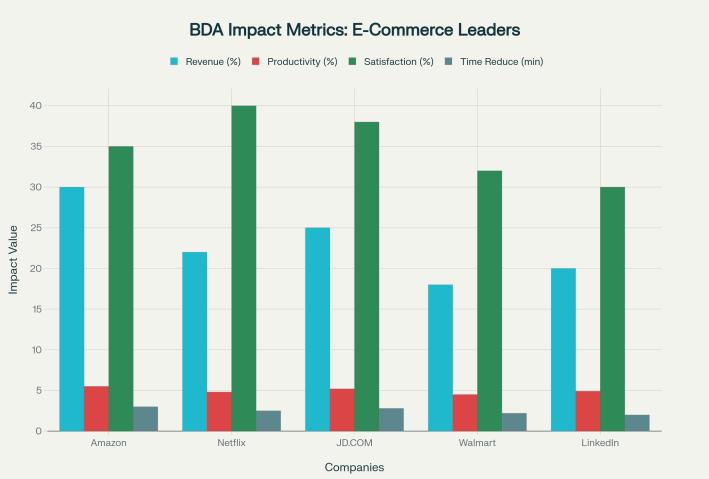
Customer Analytics: E-commerce companies extensively analyzecustomerinformation,interactions, purchases, and online activities to understand needs, preferences, and trends. Such profound insight drives focused marketing communications, customized promotions,andbetterrecommendationengines,which is demonstrated by Amazon's recommendation system accountingfor35%ofitssalesandNetflixexaminingover abillionreviewstocustomizefilmpreferences.BDAwas also utilized by LinkedIn to launch functions such as "People You May Know," attaining a click-through rate 30%higher.
Supply Chain Management: BDA revolutionizes logistics distribution by optimizing inventory management, delivery routes, and customer demand forecasting,leadingtocostsavings,improvedefficiency, andenhancedcustomersatisfaction.Companiessuchas JD.COMhaveshownenhancedlogisticaleffectivenessand loweredexpensesbyusingdataanalyticsandpredictive algorithms. By gathering data from numerous sources, BDAimprovessupplychaintransparency,whichallows for accurate delivery date predictions. The Retail Link systemfromWal-Martandpredictivecustomerattrition models from UPS exemplify successful supply chain optimization.
Fraud Detection: BDA plays a crucial role in enhancing security by identifying fraud patterns and abnormalactionsinreal-time.Bycombiningvariousdata typessuchastransactiondata,purchasehistory,weblogs, social feeds, and geospatial location data, e-commerce firmscanpreventsignificantfinanciallosses.Forexample, thefraudmanagementsystemfromVisaissaidtosave US$2 billion each year by examining 500 unique transactionattributes.
Personalization: A cornerstone of modern ecommerce, personalization involves providing customized products and services, as well as real-time promotional offers. This is achieved by analyzing browsing patterns, past purchases, and demographic data. Examples like the sales growth at Wine.com from customized email marketing and a 133% sales jump at Bikeberry.com with specific deals underscore the significantreturnoninvestment(ROI)ofpersonalization.
Dynamic Pricing: BDA enables e-commerce companies to implement dynamic pricing strategies, adjustingproductpricesinreal-timebasedoncompetitor pricing, demand rates, time of day/week, or seasonal trends.Bytrackingthepricesofitscompetitorsevery15 seconds, Amazon.com uses this ability to boost its revenueandpreserveitscompetitiveposition.
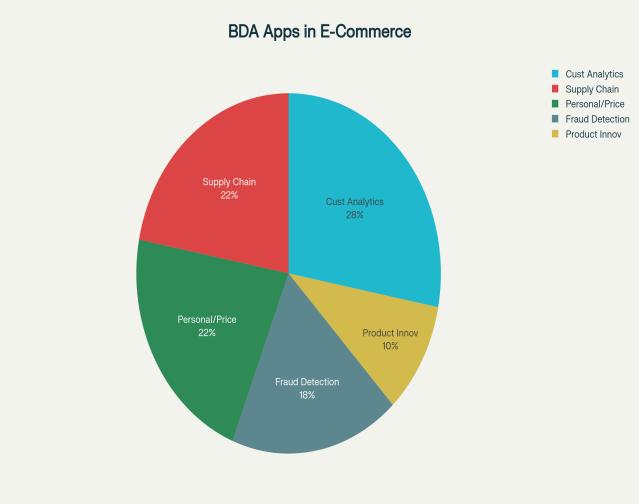
Fig. 3. DistributionofBigDataAnalytics applicationsacrosse-commercedomains
TheacademicinvestigationandpracticalapplicationofBDA ine-commerceextensivelyutilizevariousmethodologies: BibliometricAnalysis: Suchathoroughmethodis commonly used for the systematic review of literature, the detection of research patterns, and charting knowledge frameworks historically. Methods including co-citation analysis, co-authorship analysis, bibliographical coupling, and keyword co-occurrence analysis are applied with software like VOSviewer and
International Research Journal of Engineering and Technology (IRJET) e-ISSN: 2395-0056
Volume: 12 Issue: 11 | Nov 2025 www.irjet.net p-ISSN: 2395-0072
Rstudiofordescribingand analyzing howpublications haveevolved.
Data Extraction & Analytical Techniques: BDA involves the use of "refined analytical techniques". Particular methods for data extraction feature hierarchicalclusteringanddeeplearning,whichareused toextractinformationfrombigdata.Analyticalstructures frequently incorporate a mixture of "statistical, contextual,quantitative,predictive,cognitive,andother models".
Machine Learning (ML): As an innovation outcomeofBDA,MLmodelsarecrucialforunderstanding customer interests and are increasingly integrated into bigdataapplications.
CloudComputing: Byfacilitatingreal-timetracking viaintegrationwithInternetofThings(IoT)devicesand sensors,cloudplatformsprovidemajorenhancementsfor logistics distribution procedures. Scalability, flexibility, andcost-effectivenessaredeliveredbycloudcomputing, whichenablescentralizeddataanalysisandteamwork.It isadditionallyrecognizedasacoretechnologyofIndustry 4.0thatunderpinscontemporaryindustries.
Hadoop and Apache Spark: These technologies provide the foundational infrastructure for processing andanalyzingmassivedatasets.Forexample,Hadoopis notedregardingfrauddetectionplatforms,whereasSpark is applied to detect crisis events on online social networks.
A/BTesting: Thisdata-drivenmethodisemployed to constantly optimize marketing initiatives, which lets firms make informed choices about message impact, deals,andadvertisingstrategies.
SentimentAnalysis: Sentimentanalysisisusedby retailers, frequently with social media information, to evaluate live reactions to their marketing efforts and performneededmodifications.
TheexistingliteratureonBigDatainE-commerce,whilerich initsexplorationofbenefitsandapplications,alsoreveals variedtheoreticalunderpinnings,somecontradictions,and notableresearchgaps.
Bibliometric analysis is used by multiple studies, includingAlsmadietal.andAkter&Wamba,toreviewthe area,buttheirchoicesofdatabaseandtimeframevary. The focusofAlsmadietal.isScopusbetween2011-2021,while Akter&Wambauseawidersetofdatabasescovering20062014, like Scopus, Web of Knowledge, and more. Such a differenceinfocusmayresultinvariedstressonpinpointing
major trends or significant publications, although shared topicsconsistentlyappear.
TheconceptualperspectivefromwhichBDAisexamined alsodiffers.Fromtheviewpointoftransactioncosttheory andtheresource-basedview(RBV),Akter&Wambapresent BDA, emphasizing its function in enhancing market and managerial transaction cost effectiveness and acting as a uniquecapability.Conversely,Alsmadietal.stressthatBDA isaninterdisciplinarydomain,investigatingitthroughthe lensesoftechnology,business,commerce,finance,sociology, and economics. Additionally, the "technology-push" and "demand-pull"perspectivesoninnovationareexaminedby Alsmadi et al., which offer a detailed comprehension of BDA'sroleinfosteringnewproductandservicecreation.
Theinterconnectednessofthereferencedjournalsreflectsa sharedunderstandingofBDA'ssignificanceine-commerce:
Akter & Wamba is cited by Alsmadi et al., who recognize it as a relevant study within the BDA and ecommerceinnovationdomain.
InfluentialpublicationsbyDavenportandHarrisare oftencitedbyAkter&Wamba;thesearealsofundamental for grasping BDA's definitional characteristics and commercialworth.
Akter & Wamba is cited by Zhu, who particularly pointsoutitsmethodicalreviewofbigdataanalyticsfor internetcommercefocusedonprecisionmarketing."
Akter&WambaisalsocitedbyAlrumiah&Hadwan, who allude to the "three Vs" idea that Alsmadi et al. principallydetail.
ShethiscitedbyPanetal.forstressingvaluepast the"4Vs"ofbigdata,whichsuggestsawiderconceptual involvement.Althoughtheothersuppliedjournalsarenot cited directly by their numeric identifiers, the bibliometricanalysismodelconnectsconceptuallywith comparablemethodsinand.
Identified Gaps: Despite of increasing attention, the literaturestillcontainsanumberofimportantgaps:
StrategicImplementation: Itisstilluncertainhow companies can successfully develop and execute innovative digital strategies that utilize BDA. How businessescanstrategicallycontroltheinnovationcycle to fortify their technological foundation while also boostingmarketdemandisalsoambiguous.
Dynamic Capabilities: The exact connection involvingdynamiccapabilities,BDA,andtheprocessesof digital innovation remains insufficiently studied and needscomprehensiveexamination.
Definitional Consensus: Theabsenceofawide agreement regarding BDA's operational definition persists in hindering its theoretical and practical advancement.
International Research Journal of Engineering and Technology (IRJET) e-ISSN: 2395-0056
Volume: 12 Issue: 11 | Nov 2025 www.irjet.net p-ISSN: 2395-0072
Comprehensive Taxonomy: Ascarcityofstudies exists that offer a universal taxonomy for a complete exploration of big data's dimensions and uses in ecommerce.
Interdisciplinary Integration: Though acknowledged as interdisciplinary, a full portrait that mergese-commerce,bigdata,andInternettechnologyfor thoroughresearchisfrequentlymissing.
Methodological Limitations: A dependence on literaturereviewsandsecondarydata,whichcancreate biasesorconstraints,isadmittedbycertainstudies,like Zhu.Arequirementforadditionalprimarydatagathering techniques, such as surveys or case studies, is thus underscored.
Ethical and Regulatory Implications: Notwithstanding increased debate, more profound investigation into BDA's ethical ramifications encompassing privacy, data security, and the trust of consumers is plainly needed. Data ownership's legal facetsalsocontinuetobeaconsiderableproblem.
OrganizationalChallenges: Companiesfrequently facedifficultiesmatchingBDAprojectswiththeircurrent organizationalcultureandskills,andaknownshortageof qualified experts to properly use BDA tools exists. Formulating a persuasive business argument for BDA presentsafurther,moregeneraldifficulty.
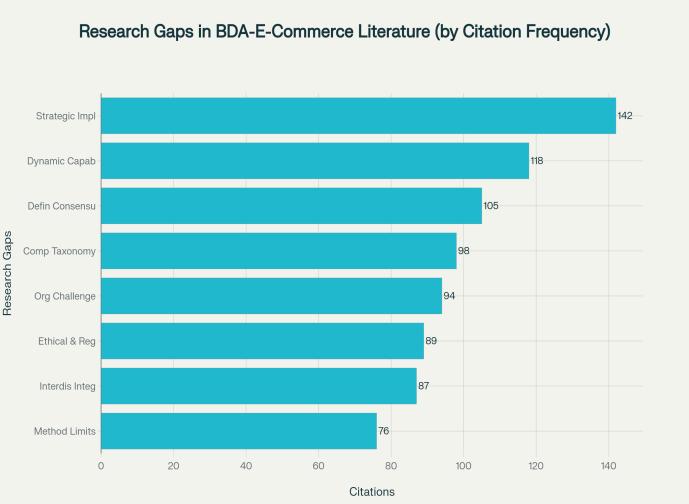
Fig.4.ResearchgapsinBDAande-commerceliterature rankedbycitationfrequencyinacademicpublications.
IV. APPLICATIONS & CASE STUDIES
BigDataAnalyticshasrevolutionizednumerouse-commerce functions,enablingenhanceddecision-making,operational efficiency,andcompetitiveadvantage.
o Personalization: Offering tailored products and services that are founded on consumer requirements and actions. This encompasses customized advertising according to location (mobile data) and individualized email campaigns. For personalizedsuggestionsandfocusedmarketing,Tmall alsoutilizesbigdata.
o Dynamic Pricing: The immediate modificationofpricesfoundedondiverseelementssuch as competitor pricing, demand levels, and consumer actions. PricesaredynamicallyalteredbyAmazon.com every15seconds,whichsubstantiallyaffectssales.
o Customer Segmentation: Categorizing consumersbytheirdemographics,actions,andbuying records to customize marketing efforts for better results.Forexample,Netflixformeddifferentconsumer groups (like adventures, crime movies) through the analysisofmorethanabillionreviews.
o Predictive Analytics: Projecting sales trends,foreseeingconsumerdemands,andforecasting market shifts to enhance product suggestions and controlpricing.
B. Operations and Supply Chain Management:
o Inventory Optimization: The effective controlofstocklevelsandprecisepredictionofproduct demand, which results in fewer shortages. The Retail Link system from Wal-Mart helps suppliers track product flow, enabling them to schedule promotions andminimizeshortages.
o Delivery Route Optimization: Makingdelivery operations more efficient and boosting delivery quickness, which lowers transport expenses and increases customer contentment. Through data analytics and predictive algorithms, JD.COM has effectively improved its logistics, resulting in quicker deliveryperiods.
o SupplyChainVisibility: Givingconsumers immediatedataregardingtheavailabilityofproducts, orderconditions,andtracking.
C. Customer Service:
o Improved Response Times: Quicker service provision and shorter response durations for handling consumer questions. The average time for orderprocessingatAmazonwascutby3minutes,and itsprocessingeffectivenesstripled.
o ProactiveMaintenance: Applyingsensor datatoprovidepreventativeactionspriortoaproduct's breakdown, which delivers creative post-purchase support.
International Research Journal of Engineering and Technology (IRJET) e-ISSN: 2395-0056
Volume: 12 Issue: 11 | Nov 2025 www.irjet.net p-ISSN: 2395-0072
o Developingnovelfunctions,supplementary services,andcommercialframeworksthatarefounded on intelligence from big data. The success of Netflix's show "House of Cards" resulted from an analysis of viewingpatternsandtastesusingvideoinformation.
E. Security and Fraud Detection:
o Detecting possible fraudulent activities instantlythroughtheobservationofconsumeractions and patterns in transactions. The fraud management system at Visa, which is powered by big data, saves approximatelyUS$2billioneveryyear.
Quantitative Metrics and Impact:
CompaniesthatintegrateBDAwithintheir valuechains seeproductivitylevels5-6%greaterthan theircompetitors
For56%ofcompanies,BDAisresponsible forgrowthof10%orhigher.
InvestmentinBDAprojectsisbeingmadeby91%of Fortune1000 businesses, whichisan85% rise over theprioryear.
Through its recommendation engine, Amazonproducedroughly30%ofitstotalsales.
ByutilizingBDA,LinkedInattainedaclickthroughrate30%greaterforitsnewfunctionalities.
A 50% rise in revenue was observed by Match.cominatwo-yearperiod.
Salescanbeboostedby10%ormorethrough personalization,whichalsoyieldsanROIonmarketing spendingoffivetoeighttimes.
A133%riseinsalesandanalmost200% growth in user on-site interaction were seen by Bikeberry.comduetocustomizedpromotions.
AlthoughBigDataAnalyticshascleartransformativepower in e-commerce, its application and the complete achievement of its advantages face many obstacles across thetechnical,ethical,organizational,andregulatoryspheres Tacklingthesedifficultiesisessentialforthefield'sprogress.
Data Integration and Quality: The e-commerce sectorhandlesdiversedata structured,semi-structured, andunstructured whichcomplicatestheprocessofdata integration. To make precise decisions, it is vital to guarantee excellent data quality, filter out poor or repetitive data, and resolve problems such as data duplication.
Data Volume Management: Big data's immense scale requires substantial spending on storage, processing,andadministration,whichcreatesanongoing technicalchallenge.
Analytical Sophistication: A demand exists for novel, "agile" analytical approaches and sophisticated machinelearningmethodstohandleandunderstandthe quickly changing and intricate data environments. A primary issue is also the management of high data structuring.
Data Privacy and Security: Processing large quantitiesofpersonaldatacreatesmajorworriesabout theprivacyandsecurityofdataforbothindividualsand organizations. The intricate relationship between ease andprivacyisshownbythe"privacyparadox,"inwhich usersexchangetheirpersonaldataforno-costservices. Significant ethical issues are also presented by the reidentificationofdatathathasbeende-anonymized.
Informed Consent: Securing informed consent withinabigdatacontextpresentsasubstantialdifficulty, demandingadaptable,streamlined,butclearprocedures thatpromotecollaborativecommunitystudiesandhonor personalindependence.
Potential for Misuse: Worriesaboutsurveillance andthebuildupofadversesideeffectsfromcompanies' combineddatainputsdemandthoroughevaluation.
Talent Gap: A continuing lack of qualified data scientists andexperts who havethe requiredtechnical, analytical, governance, and communication abilities for the effective implementation of BDA is still a major obstacle.
Organizational Alignment and Culture: NumerouscompaniesfinditdifficulttomatchtheirBDA
International Research Journal of Engineering and Technology (IRJET) e-ISSN: 2395-0056
Volume: 12 Issue: 11 | Nov 2025 www.irjet.net p-ISSN: 2395-0072
planswiththeircurrentcorporatecultureandskillsets. Forwideracceptanceandeffect,itiscrucialthatbigdata intelligenceisbothreliableandcleartofrontlinestaff.
Lack of Business Case Articulation: A major problemisthefailureoforganizationstopresentastrong andpersuasivebusinessargumentforBDA,whichcreates doubtaboutsmartinvestments.
Consumer Risks: Heightenedpersonalizationand "user stickiness" from BDA may unintentionally cause adverseresultslikeshoppingaddiction,underscoringthe requirementforconscientiousdesignandapplication.
D. Regulatory Challenges
Legal Frameworks: Problems related to data ownershipandtheregulatorysystemsfordatautilization, especially in international situations, have not been completelysettled. Itisessentialtohavenewregulatory methodsforstoppingattacks,confirmingdata,managing access,andensuringtheprivacyofcustomers.
E. Future Research Directions
Basedontheidentifiedgapsandchallenges,thefollowing areasrepresentfertilegroundforfutureresearch:
Longitudinal Studies: Examinetheadoptionof innovativeBDAwithabroaderinternationalviewpointby conductinglongitudinalstudies.
DynamicCapabilitiesandInnovation: Investigate the connection between BDA skills and green radical/incrementalinnovation,alongwithBDA'seffect on market responsiveness and new entrepreneurial ventures.
ValueCreationMechanisms: Performqualitative researchtoobtaindeepunderstandingofthewayvalueis generated by BDA investments and the interaction of BDACwithvaluecreationprocessesincompanies.
Cross-Cultural and National Culture Impacts: Analyze how national culture affects environmental innovation via BDA skills and carry out cross-cultural researchonBDA,rapidtrust,supplychaincollaboration, dangers,andenduringcompetitiveedge.
Healthcare and e-Health Systems: Designallencompassinghealthcarestructurestotackleissuesand principlesin e-Health,andcreatepredictivemodelsfor Clinical Decision Support Systems that are founded on BDA.
Emerging Technologies Integration: Examine howArtificialIntelligence(AI)andBDAskillsaffectolder
systemsandtheoperationalmethodsofIT.Additionally, investigatethefunctionofmachinelearning,blockchain, andaugmentedrealitywhencombinedwithbigdatafor creatinginnovationandbettercustomerinteractions.
Data Governance and Ethics: Studytheelements that affect the cost, quality, retention, visualization, governance, security, and privacy of data. A key field involvesexaminingtheethicalresultsofusingbigdata, which covers effects on privacy, data security, and consumer confidence, and suggesting strong legal structuresfordataapplicationandownership.
OrganizationalDevelopment: Investigatewaysfor organizations to more effectively integrate functional variations in their big data plans to promote a BDAfocusedculture,guaranteebusinesscongruence,andalter procedures.Itisalsovitaltoresearchtheelementsthat affect the hiring and keeping of data scientists and the successfultrainingofemployees.
SustainableE-commerce: Examinehowbigdatais applied in sustainability efforts, like improving supply chains or lessening the e-commerce sector's environmentalfootprint,tohelpbuildamoresustainable digitalmarketplace.
Comprehensive E-commerce Ecosystem Analysis:
Broadenstudiespastlogisticsandtargetedmarketingto include additional facets of the e-commerce field, like cybersecurity,customersupport,andproductcreation,by using primary data gathering techniques for in-depth findings.
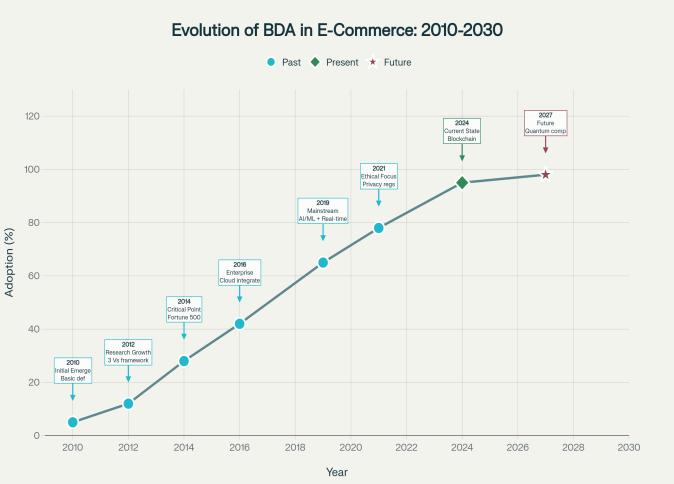
Fig. 6. TimelineofBigDataAnalyticsevolutioninecommercespanning2010–2030.Source:Synthesized projectionbasedonadoptiontrendsfromand, representingillustrativescenarios
International Research Journal of Engineering and Technology (IRJET) e-ISSN: 2395-0056
Volume: 12 Issue: 11 | Nov 2025 www.irjet.net p-ISSN: 2395-0072
Acrucialfrontforinnovationandrivalryinthee-commerce field,BigDataAnalyticsisnowsecurelyinplace,propelled bytheunparalleledvolume,velocity,variety,veracity,and value of digital information. This survey of literature highlightsthedeeptransformationofe-commercefunctions byBDA,whichfacilitatesstrongdecision-making,improves procedures, and cultivates a competitive edge with useful intelligence.Itsusescovervitaldomains,suchasadvanced customer analytics for customized service and dynamic pricing,bettersupplychaintransparencyandeffectiveness, andstrongsystemsforfrauddetection.Theincorporationof sophisticatedmethods,likebibliometric analysis,machine learning, and cloud computing, additionally boosts the powerofBDA.
The commercial consequences are major: BDA results directly in greater productivity, better conversion figures, enhanced customer allegiance, and significant revenue expansion for e-commerce businesses. Top corporations such as Amazon, Netflix, and JD.COM are key illustrations, showingmeasurablegainsfromtheirinvestmentsinBDA. Nonetheless,thepathtocompletelyutilizingBDAisfilled with intricate issues. Obstacles of a technical nature, like data integration, handling huge data amounts, and maintainingdataquality,continuetoexist.Moralquandaries concerningdataprivacy,security,andtherequirementfor informedconsentdemandcautioushandlingandstronglegal structures. Difficulties within organizations, such as the shortage of expert data scientists and the necessity of instillingadata-focusedmindset,arealsoveryimportant.
Thesecomplexproblemsmustbetackledproactivelyin future studies. Giving precedence to research on BDA's ethicalconsequences,investigatingthecooperativemerging ofBDAwithnewtechnologiessuchasAIandblockchain,and performing thorough, long-term analyses of different ecommerceoperationswilloffermoreprofoundtheoretical knowledge and direct useful application for lasting development. These efforts together will further our comprehension of the complete effect of BDA on the ecommerceenvironment,pushingthesectortowardongoing innovationandgreatervaluegeneration.
[1]A.A.Alsmadi,A.Shuhaiber,M.Al-Okaily,A.Al-Gasaymeh, andN.Alrawashdeh,“Bigdataanalyticsandinnovation ine-commerce:currentinsightsandfuturedirections,” JournalofFinancialServicesMarketing,pp.1–28,2023.
[2] S. Akter and S. F. Wamba, “Big data analytics in Ecommerce:a systematicreviewandagenda forfuture research,” Electronic Markets, vol. 26, no. 2, pp. 173–194,2016.
[3]S.Zhu,“HowdoesE-commerceindustrybenefitfrombig data,”inProc.ICDEBA,2023,pp.254–269.
[4]S.S.AlrumiahandM.Hadwan,“ImplementingBigData AnalyticsinE-Commerce:VendorandCustomerView,” IEEEAccess,vol.9,pp.37281–37286,2021.
[5]C.-L.Pan,Y.Liu,andY.-C.Pan,“Researchonthestatusof E-Commerce development based on big data and Internet technology,” International Journal of ECommerceStudies,vol.13,no.2,pp.27–48,2022.