
International Research Journal of Engineering and Technology (IRJET) e-ISSN: 2395-0056
Volume: 13 Issue: 01 | Jan 2026 www.irjet.net p-ISSN: 2395-0072
Manepalli
International Research Journal of Engineering and Technology (IRJET) e-ISSN: 2395-0056
Volume: 13 Issue: 01 | Jan 2026 www.irjet.net p-ISSN: 2395-0072
Manepalli
Nikhil Nandan ,Arrolla Bhargavi ,P. Deekshith Kumar Reddy, Rachala Sai TejaGoud
Mrs. B. Manjula
Department of CSE(Data Science), AVN Institute of Engineering and Technology under the guidance of Asst. Professor, Department of CSE(Data Science), AVN Institute of Engineering and Technology
Abstract- Automatic Beam Dimming System plays a crucial role in enhancing night-time driving safety by addressing the problem of headlight glare caused by oncoming vehicles. In conventional vehicles, drivers are required to manually switch between high and low beam headlights based on road conditions. This manual operation often results in delayed reactions, distraction, and improper beam usage, which significantly increases the risk of road accidents during night driving. Continuous exposure to high-intensity headlights can temporarily impair the vision of drivers, leading to reduced situational awareness. Therefore, an automated solution is essential to ensure timely and accurate beam adjustment without depending on driver intervention.
The proposed system employs light sensors such as Light Dependent Resistors (LDR) or photodiodes to detect the intensity of incoming light from approaching vehicles. The sensed data is processed by a microcontroller, which automatically controls a relay module to switch the headlight beam between high and low modes. This automatic operation ensures optimal road illumination for the driver while minimizing glare for other road users. The system provides fast response, improved driver comfort, and enhanced road safety. Additionally, its low-cost components and energy-efficient design make it suitable for integration in both two-wheelers and four-wheelers. Overall, the system offers a practical, reliable, and efficient approach toward intelligent vehicle lighting and modern automotive safety systems.
Index Terms - Automatic Beam Control, LDR Sensor, Microcontroller, Vehicle Safety, Embedded Systems
Roadsafetyduringnight-timedrivinghasbecomeasignificantconcernduetoreducedvisibilityandexcessiveglareproduced byvehicleheadlights.Duringnightconditions,thehumaneyerequiresmoretimetoadapttosuddenchangesinlightintensity. High-beam headlights, although useful for illuminating long distances, often cause discomfort, temporary blindness, and delayed visual recovery for drivers of oncoming vehicles. This glare effect is one of the major causes of road accidents, particularlyonhighwaysandpoorlyilluminatedroads.
Inconventionalvehicles,headlightbeamcontrolisperformedmanuallybythedriver.Thedrivermustcontinuouslymonitor traffic conditions and switch between high and low beams accordingly. This manual process demands constant attention, quick reflexes, and good judgment. However, in real-world driving scenarios, especially during long night journeys, drivers may experience fatigue, distraction, or delayed reaction times. As a result, high beams may remain ON longer than required, increasingtheriskofglare-relatedcollisions.
With the rapid growth of traffic density and increased night-time travel, manual beam switching has become inefficient and unreliable. Drivers may forget to dim headlights, respond late to oncoming vehicles, or misuse high beams due to lack of awareness.Theselimitationshighlighttheneedforanintelligentandautomatedlightingsystemthatcanrespondinstantlyto changingroadandtrafficconditionswithoutrelyingondriverintervention.
Recentadvancementsinembeddedsystemsandautomotiveelectronicshaveenabledthedevelopmentofsmartvehiclesafety solutions. Automatic headlight control systems can significantly improve night-time driving safety by dynamically adjusting headlight intensity based on real-time environmental conditions. Such systems not only reduce driver workload but also ensureconsistentandaccuratebeamcontrol,therebyimprovingoverallroadsafety.
Toaddressthesechallenges,thispaperproposesanAutomaticBeamDimmingSystemthatdetectstheintensityofincoming lightfromapproachingvehiclesandautomaticallyswitchesbetweenhighandlowbeammodes.Thesystemuseslightsensors andamicrocontroller-basedcontrolmechanismtoprovidefastandreliablebeamswitching.Byminimizingglareandensuring
International Research Journal of Engineering and Technology (IRJET) e-ISSN: 2395-0056
Volume: 13 Issue: 01 | Jan 2026 www.irjet.net p-ISSN: 2395-0072
optimalvisibility,theproposedsystemenhancesdrivercomfort,reducesaccidentrisk,andoffersapracticalandcost-effective solutionsuitableformodernvehicles,includingtwo-wheelersandfour-wheelers.
Overtheyears,numerousresearcheffortshavefocusedonimprovingnight-timedrivingsafetybyaddressingtheproblemof headlightglare.Traditionalvehicleheadlightsystemsrelyentirelyonmanualcontrol,requiringthedrivertoswitchbetween highandlowbeammodesdependingontrafficconditions.Whilethisapproachissimpletoimplement,itheavilydependson driveralertnessandreactiontime.Studiesindicatethatdelayedorimproperbeamswitchingisamajorfactorcontributingto glare-relatedaccidents,especiallyduringnightdrivingonhighwaysandpoorlyilluminatedroads.
Toovercomethelimitationsofmanualheadlightcontrol,researchershaveproposedautomaticbeamdimmingsystemsusing light-sensing technologies. One of the most commonly adopted approaches involves the use of Light Dependent Resistors (LDR) and photodiodes to measure incoming light intensity. Patil and Deshmukh developed an automatic headlight control system using an LDR and microcontroller, where the beam intensity is adjusted based on detected light levels. Their system demonstrated improved driver comfort and reduced glare; however, the accuracy of detection was affected under varying environmentalconditionssuchasfog,rain,andambientstreetlighting
Kumar and Gupta proposed a smart vehicle headlight control system that incorporated improved sensing mechanisms and threshold-based decision logic. Although their system provided better switching accuracy compared to basic LDR-based designs, it required additional hardware components, increasing system cost and complexity. Similarly, Singh and Kaur implemented an automatic beam switching mechanism using light sensors, emphasizing simplicity and low cost. However, theirsystemfacedchallengesindistinguishingbetweenoncomingvehicleheadlightsandotherlightsources,suchasroadside lampsorreflections.
Several researchers have explored embedded-system-based solutions to improve reliability and response time. Kumar and Reddy designed an embedded headlight dimmer using microcontrollers, focusing on low power consumption and fast response. While their approach reduced processing delays, it still relied on fixed threshold values, limiting adaptability to dynamictrafficandlightingconditions.Thesestudieshighlightthetrade-offbetweensystemsimplicityanddetectionaccuracy inlow-costembeddedsolutions.
In recent years, advanced techniques using camera-based detection and image processing have gained attention. These systems analyse visual data to identify oncoming vehicles, road curvature, and lighting conditions. Lee and Kim discussed intelligent automotive lighting systems that integrate cameras with advanced algorithms to achieve precise beam control. Although camera-based systems offer high accuracy and adaptability, they require high computational power, expensive hardware,andcomplexsoftwareframeworks.Asaresult,suchsystemsaremainlysuitableforhigh-endvehiclesandarenot practicalfortwo-wheelersorlow-costautomobiles.
Other studies have explored the integration of machine learning and artificial intelligence to enhance headlight control systems. These approaches enable adaptive decision-making based on real-time data and driving patterns. While promising, AI-based systems demand extensive training data, higher memory, and increased processing capability, which further raises systemcostandpowerconsumption.Thislimitstheirfeasibilityforwidespreaddeploymentinbudget-friendlyvehicles.
From the reviewed literature, it is evident that an ideal automatic beam dimming system should achieve a balance between accuracy,responsetime,cost,andeaseofimplementation.Manualsystemslackreliability,whileadvancedcamera-basedand AI-driven systems introduce excessive complexity and cost. Existing LDR-based systems are affordable but suffer from limitationsinenvironmentaladaptability.
Therefore,there isa clear needfora practical and efficient solutionthat combines simplicity with reliable performance. The proposed Automatic Beam Dimming System addresses these gaps by utilizing light sensors and a microcontroller-based control mechanismtoachievereal-timebeamswitching.Thesystemfocusesonfast response,cost-effectiveness,andeaseof integration, making it suitable for both two-wheelers and four-wheelers while significantly improving night-time driving safety.
International Research Journal of Engineering and Technology (IRJET) e-ISSN: 2395-0056
Volume: 13 Issue: 01 | Jan 2026 www.irjet.net p-ISSN: 2395-0072
The proposed Automatic Beam Dimming System is designed to intelligently control vehicle headlight operation by automatically switching between high and low beam modes based on real-time detection of incoming light intensity. The system eliminates the need for manual beam control, thereby reducing driver workload and minimizing glare-related accidentsduringnight-timedriving.Thedesignfocusesonsimplicity,reliability,fastresponse,andcost-effectiveness,making itsuitableforintegrationinbothtwo-wheelersandfour-wheelers.
Thesystemconsistsoffivemajorcomponents:alightsensingunit,aprocessingunit, acontrolunit,apowersupplyunit,and anoutputunit.Thelightsensingunitcontinuouslymonitorstheintensityoflightfromoncomingvehicles.Whenthedetected lightexceedsapredefinedthresholdvalue,theprocessingunitanalysestheinputandgeneratesacontrolsignal.
This signal is then sent to the control unit, which switches the vehicle headlight from high beam to low beam. Once the incominglightintensitydecreasesbelowthethreshold,thesystemautomaticallyrestoresthehighbeam.
This real-time operation ensures optimal road illumination for the driver while preventing discomfort and temporary blindnessforoncomingdrivers.Thesystemoperatescontinuouslywithoutrequiringdriverintervention,ensuringconsistent andreliableheadlightcontrolundervaryingtrafficandlightingconditions.
Thesensormoduleplaysacriticalroleindetectingincominglightintensityfromapproachingvehicles.ThesystemusesLight DependentResistors(LDR)orphotodiodesassensingelementsduetotheirsimplicity,lowcost,andsensitivitytochangesin lightintensity.TheresistanceoftheLDRdecreaseswhenexposedtohigh-intensitylight,producingacorrespondingchangein voltage.
Thesensorispositionedinsuchawaythatiteffectivelycaptureslightfromoncomingvehicleswhileminimizinginterference fromambientlightsourcessuchasstreetlamps.The analogueoutputfromthesensoriscontinuouslymonitoredandsentto the microcontroller for further processing. Proper calibration of the sensor ensures accurate detection and reliable system performance.
TheprocessingmoduleconsistsofamicrocontrollersuchasArduinoorATmega328P,whichactsasthecentralcontrolunitof thesystem.Themicrocontrollerreceivesanaloguesignalsfromthesensormoduleandconvertsthemintodigitalvaluesusing itsbuilt-inAnalog-to-DigitalConverter(ADC).Thesevaluesarethencomparedwithpredefinedthresholdlevelsstoredinthe programmemory.
Basedonthecomparisonresults,themicrocontrollerdecideswhethertheheadlightbeamshouldremaininhighbeammode orswitchtolowbeammode.Theprocessinglogicisdesignedtoensurefastdecision-makingwithminimaldelay.Additionally, hysteresislogiccanbeimplementedtoavoidfrequentbeamswitchingduetominorfluctuationsinlightintensity.
The control module is responsible for physically switching the headlight beam between high and low modes. It consists of a relaycircuitcontrolledbythemicrocontroller’sdigitaloutputpins.Whenthemicrocontrollersendsacontrolsignal,therelay activatesandswitchestheheadlighttotherequiredbeammode.
Relays are chosen due to their ability to handle high current loads associated with vehicle headlights. The control module ensures smooth and reliable switching without affecting headlight performance. Electrical isolation provided by the relay protectsthemicrocontrollerfromhigh-voltagefluctuations,enhancingsystemdurability.
International Research Journal of Engineering and Technology (IRJET) e-ISSN: 2395-0056
Volume: 13 Issue: 01 | Jan 2026 www.irjet.net p-ISSN: 2395-0072
The power supply module provides a stable and regulated voltage to all system components. The system typically uses the vehicle’s 12V DC battery as the primary power source. Voltage regulators are employed to step down the voltage to levels suitableforthemicrocontrollerandsensors.
This module also includes protective components such as diodes and capacitors to safeguard the system against voltage spikes, reverse polarity, and noise. A stable power supply ensures consistent system operation even under varying vehicle electricalconditions.
Theoutputmodulerepresentsthefinalstageofthesystemwheretheactualheadlightbeamadjustmenttakesplace.Basedon thecontrolsignalsgeneratedbythemicrocontroller,theheadlightswitchesautomaticallybetweenhighandlowbeammodes. Theoutputensuresoptimalilluminationforthedriverwhilereducingglareforoncomingvehicles.
The system operates in real time and adapts dynamically to changing traffic conditions. This automatic control enhances drivingcomfort,reduceseyestrain,andimprovesoverallroadsafetyduringnight-timedriving.
Theoperationalflowoftheproposedsystemcanbesummarizedasfollows:
1. Initializesystemcomponentsandsetthresholdvalues.
2. Continuouslymonitorincominglightintensityusingthesensormodule.
3. ConvertsensoroutputtodigitalformusingthemicrocontrollerADC.
4. Comparedetectedlightintensitywiththresholdvalue.
5. Ifintensityexceedsthreshold,switchheadlighttolowbeam.
6. Ifintensityfallsbelowthreshold,switchheadlighttohighbeam.
7. Repeattheprocesscontinuouslyforreal-timeoperation.
TheproposedAutomaticBeamDimmingSystemoffersseveraladvantages:
Reducesglare-relatedaccidentsduringnight-timedriving
Minimizesdriverworkloadanddistraction
Providesfastandreliablebeamswitching
Energy-efficientandcost-effectivedesign
Suitableforbothtwo-wheelersandfour-wheelers
Easytoimplementandmaintain
Comparedtomanualandcamera-basedsystems,theproposedsystemoffersabalancedsolutionbycombiningsimplicityand efficiency. Manual systems depend on driver response, while camera-based systems are expensive and computationally complex. The proposed sensor-based approach achieves reliable performance with minimal hardware and low processing requirements,makingitsuitableforwidespreadadoption.
International Research Journal of Engineering and Technology (IRJET) e-ISSN: 2395-0056
Volume: 13 Issue: 01 | Jan 2026 www.irjet.net p-ISSN: 2395-0072
IV. FIGURES


International Research Journal of Engineering and Technology (IRJET) e-ISSN: 2395-0056
Volume: 13 Issue: 01 | Jan 2026 www.irjet.net p-ISSN: 2395-0072
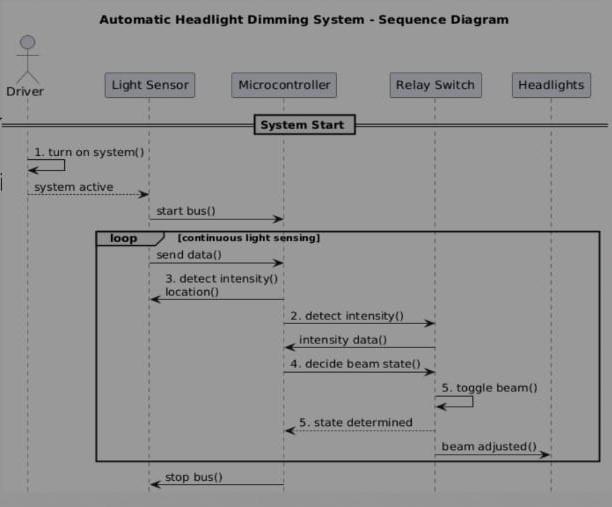
The proposed Automatic Beam Dimming System was tested and validated using simulation tools such as Proteus and Think arcadetoevaluateitsfunctionalityandperformanceundervariousnight-timedrivingconditions.Thesesimulationplatforms allowed accurate modelling of the sensor inputs, microcontroller logic, and relay-based headlight control. Different lighting scenarioswerecreatedbyvaryingtheintensityofincominglighttosimulateoncomingvehicleheadlights.
Thesimulationresultsdemonstratethatthesystemiscapableofaccuratelydetectingincominglightintensityandresponding appropriatelybyswitchingbetweenhighandlowbeammodes.Whennooncomingvehicleispresent,theheadlightremainsin high-beam mode, providing maximum road illumination. Upon detection of high-intensity light from an approaching vehicle, thesystemimmediatelyswitchestolow-beammode,therebyreducingglarefortheoncomingdriver.Oncethevehiclepasses andthedetectedlightintensitydropsbelowthepredefinedthreshold,thesystemautomaticallyrestoresthehighbeam.
Theresponsetimeofthesystemwasobservedtobeveryfastduetothesimplesensor-baseddetectionmechanismanddirect microcontroller control. The absence of complex image processing or heavy computation ensures real-time operation with minimal delay.Thisquick responseiscritical for preventingtemporaryblindnessandimprovingdriverreactiontimeduring nightdriving.
Overall,thesystemeffectivelyreducesglare,enhancesdrivercomfort,andimprovesnight-timedrivingsafety.Thesimulation results confirm that the proposed design provides reliable performance, energy efficiency, and practical feasibility. These outcomesdemonstratethattheAutomaticBeamDimmingSystemisasuitablesolutionforintelligentvehiclelightingandcan beeffectivelyimplementedinreal-worldautomotiveapplications.
TheAutomaticBeamDimmingSystempresentedinthisworkeffectivelyenhancesnight-timedrivingsafetybyautomatically controllingvehicleheadlightbeamsbasedontheintensityofincominglightfromoncomingvehicles.Byeliminatingtheneed for manual beam switching, the system significantly reduces driver workload, distraction, and delayed reactions. The use of light sensors, a microcontroller, and a relay-based control mechanism ensures fast and reliable switching between high and
International Research Journal of Engineering and Technology (IRJET) e-ISSN: 2395-0056
Volume: 13 Issue: 01 | Jan 2026 www.irjet.net p-ISSN: 2395-0072
low beam modes, thereby minimizing glare-related visibility issues. Simulation results confirm that the system operates efficientlyinrealtimeandprovidesimproveddrivingcomfortandsafetyduringnightconditions.
The proposed system is designed with simplicity, cost-effectiveness, and energy efficiency in mind, making it suitable for integrationinbothtwo-wheelersandfour-wheelers.Unlikecomplexcamera-basedorAI-drivensolutions,thesystemrequires minimal hardware resources while delivering reliable performance. Its modular architecture allows easy implementation, maintenance,andscalability,makingitapracticalsolutionforwidespreadadoptioninmodernautomotivelightingsystems.
Futureenhancementsofthesystemcanfocusonimprovingdetectionaccuracyandadaptabilityundervaryingenvironmental conditions. Camera-based detection techniques may be incorporated to identify vehicle distance and road curvature more precisely. Machine learning algorithms can be applied to dynamically adjust threshold values based on traffic patterns and lightingconditions.Additionally,integrationwithsmartvehiclenetworksandadvanceddriverassistancesystems(ADAS)can further enhance system intelligence and enable communication with other vehicle safety modules. These improvements can transformtheproposedsystemintoamoreadvancedandintelligentautomotivelightingsolutionsuitablefornext-generation vehicles.
[1] S.Patil andR.Deshmukh,“AutomaticHeadlightControl SystemUsingLDR and Microcontroller,” International Journal of EngineeringResearchandTechnology(IJERT),vol.6,no.4,pp.112–116,2017.
[2]A.KumarandS.Gupta,“DesignandImplementationofSmartVehicleHeadlightControlSystem,” InternationalJournalof AdvancedResearchinElectrical,ElectronicsandInstrumentationEngineering, vol.5,no.8,pp.6842–6847,2016.
[3]M.SinghandR.Kaur,“AutomaticBeamSwitchingforVehiclesUsingLightSensors,” InternationalJournalofScientificand EngineeringResearch,vol.8,no.5,pp.421–425,2017.
[4]P.R.KumarandK.S.Reddy,“EmbeddedSystemBasedAutomaticHeadlightDimmerforVehicles,” InternationalJournalof ComputerApplications,vol.135,no.9,pp.15–19,2016.
[5] J. Lee and H. Kim, “Vehicle Safety Enhancement Using Intelligent Automotive Lighting Systems,” IEEE Transactions on IntelligentTransportationSystems,vol.15,no.3,pp.1234–1242,2019.
[6] R. Verma and N. Sharma, “Automatic Headlamp Control System Using Arduino,” International Research Journal of EngineeringandTechnology(IRJET),vol.7,no.6,pp.1021–1025,2020.
[7]S.K.Das,“AReviewonSmartAutomotiveLightingSystems,” InternationalJournalofAutomotiveTechnology,vol.18,no. 2,pp.345–352,2018.
[8] A. Sharma and V. Kumar, “Automatic Headlight Dimming and Control System for Vehicles, International Journal of EmergingTechnologyandAdvancedEngineering, vol.5,no.6,pp.245–249,2015.
[9] N. Patel and D. Shah, “Design of Automatic Headlight Control System Using Light Sensors,” International Journal of EngineeringScienceandComputing, vol.7,no.5,pp.11832–11836,2017.
[10] R. S. Rajan, B. Pavanraj, and S. Parthiban, “Smart Vehicle Headlight Control Using Embedded Systems,” International JournalofResearchinEngineeringandTechnology, vol.4,no.9,pp.98–102,2015.
[11]M.A.Hannan,A.Hussain,andS.Samad,“AdaptiveAutomotiveHeadlightControlSystemUsingSensor-BasedTechnology,” JournalofAdvancedTransportation, vol.2018,ArticleID5290761,pp.1–9,2018.