
International Research Journal of Engineering and Technology (IRJET) e-ISSN: 2395-0056
Volume: 12 Issue: 12 | Dec 2025 www.irjet.net p-ISSN: 2395-0072
International Research Journal of Engineering and Technology (IRJET) e-ISSN: 2395-0056
Volume: 12 Issue: 12 | Dec 2025 www.irjet.net p-ISSN: 2395-0072
Adisu Cheneka
1
, Kibru Fekede2 , Bari Kabede3, Shukare Oljira
4
1 ,2,3,4 Tongji University, UNEP Institute of Environment for Sustainable Development (IESD), College of Environmental Science and Engineering, Shanghai 200092, China.***
Abstract - Access to safe and reliable drinking water remains a critical challenge in Ethiopian towns. This study assesseswatersupplyaccessibility,reliability,andgovernance in Haro Sebu Town, evaluating challenges and opportunities for achieving Sustainable Development Goal (SDG) 6.1. A cross-sectional survey of 377 households, supplemented by semi-structured interviews and field observations, was conductedtocollectquantitativeandqualitativedata.Results indicate that only 23.9% of households have piped water connections,while53.3%relyonwellsanddevelopedsprings. Physicalaccessibilityisconstrained,with38.7%ofhouseholds traveling more than 1 km to collect water. Women and girls are responsible for 79.5% of water collection, and manual transport dominates (63.7%). Water supplyreliability is low, with only 20. 4% of households accessing water daily. Governance challenges are evident, with 61.5% perceiving distribution as unfair, and only 48.3% participating in local watermanagementinitiatives.Thefindingshighlighttheneed for expanded piped networks, improved reliability, and inclusive governance to meet SDG 6.1 targets. Recommendations emphasize infrastructure upgrades, gender-sensitive strategies, and enhanced community participation
Key Words: Water supply, Distribution systems, Accessibility, Reliability, Water governance, SDG 6.1, Haro Sebu Town, Ethiopia.
Accesstosafe,reliable,andaffordabledrinkingwaterisa fundamentalhumanrightandacriticalpillarofsustainable development [1]. Water is essential for human health, environmental protection, and socio-economic progress. However,inmanyrapidlyurbanizingareasoflow-income countries,ensuringconsistentandequitableaccesstoclean water remains a major challenge [2]. Urban populations continuetogrowatratesfasterthantheexpansionofbasic waterinfrastructure,creatingsignificantservicegaps[3,4]. Theseconditionshaveintensifiedglobalattentiononwater security, leading to the establishment of Sustainable Development Goal 6.1, which emphasizes universal and equitableaccesstosafeandaffordabledrinkingwaterforall [5]. Despite this global commitment, progress remains uneven, particularly in sub-Saharan Africa where many
townsstillstruggletoprovidereliablewaterservicestotheir residents[6].
InEthiopia,thesituationreflectssimilardifficulties.The country’ssecondaryandemergingtownsoftenexperience chronic water shortages, unreliable supply systems, and limited household-level connections [7, 8]. While urbanization has increased rapidly, investment in water infrastructure has not kept pace with demand [9]. As a result,manyhouseholdsrelyonalternativesourcessuchas wells, springs, or public taps, which are frequently insufficientorunsafe[10,11].
These challenges are worsened by aging pipelines, limited production capacity, and inadequate maintenance practices. For towns like Haro Sebu, these factors have createdpersistentwateraccessconstraintsthataffectdaily life, economic productivity, and public health [12]. Understanding these challenges is necessary for planning improvements that can meet the growing needs of urban residents.HaroSebuTownrepresentsaclearexampleofthe water access challenges faced in many Ethiopian towns. Although the town has multiple water sources including pipedconnections,publicstandpipes,wells,anddeveloped springs the majority of residents still lack direct access to household-level piped water. Only a small proportion of householdshaveprivateconnections,whilemorethanhalf rely on non-piped sources that often require long travel distances. These limitations highlight the infrastructural gapspresentinthetown,aswatersupplyexpansionhasnot matchedrapidpopulationgrowthorperi-urbansettlement expansion[13].
Asaresult,serviceinequalityisevident,withhouseholds inperipheralornewlydevelopedareasfacingthegreatest difficultiesinsecuringsufficientwaterfordomesticuse.
AmajorcomponentofthewateraccessprobleminHaro Sebuisthephysical effort requiredto obtainwater.Many householdsmustwalklongdistancessometimesmorethana kilometre to reach their primary water source. Such distances exceed international standards for basic water access and impose significant physical burdens [14]. This responsibilityfallsoverwhelminglyonwomenandgirls,who perform nearly 80% of all water collection activities [15]. The time and energy required for water collection reduce theiropportunitiesforeducation,householdresponsibilities,
International Research Journal of Engineering and Technology (IRJET) e-ISSN: 2395-0056
Volume: 12 Issue: 12 | Dec 2025 www.irjet.net p-ISSN: 2395-0072
rest, and income-generating activities [16]. The gender imbalance in water collection mirrors broader patterns acrossEthiopiaandAfrica,wherewomenandgirlscontinue tocarrytheweightofdomesticlabourduetoculturalnorms and limited infrastructural development [17]. Addressing wateraccessibilityisthereforenotonlyadevelopmentissue butalsoamatterofgenderequityandsocialjustice[18].
Inadditiontoissuesofphysicalaccess,thereliabilityof the water supply in Haro Sebu Town remains a major concern. Many households experience irregular water supply, limited operating hours, and unpredictable distributionschedules.Onlyaminorityofresidentsreceive wateronadailybasis,forcingmanyfamiliestostorewater incontainersforextendedperiods,whichincreasestherisk of contamination. Intermittent supply disrupts household routines, limits hygiene practices, and contributes to dissatisfactionwithwaterservices[19].Thesepatternsare common across Ethiopian towns, where distribution networksareoutdatedandproductioncapacityoftenfalls shortofdemand[20].Improvingreliabilityisessentialfor reducing water-related hardships and achieving progress towardSDG6.1.[5]
Governancechallengesfurthercomplicatewateraccess inHaroSebu.Manyresidentsperceivewaterdistributionas unfair, with concerns related to unequal allocation across neighbourhoods, inconsistent supply schedules, and weak communicationfromwaterauthorities[21].
Community participation in water governance is also limited,whichreducesopportunitiesforresidentstovoice concerns,proposesolutions,orholdauthoritiesaccountable [22]. Without transparent and inclusive governance structures, public trust declines, and service delivery becomes less responsive to community needs [23]. Strengtheninglocalgovernanceespeciallythroughimproved communication,accountability,andcommunityengagement isthereforecriticalforensuringequitableandsustainable waterservices[24].Giventhesemultidimensionalchallenges infrastructure limitations, long travel distances, gendered labour burdens, unreliable supply, and governance constraints there is a pressing need to evaluate water accessibility, reliability, and governance in Haro Sebu Town[8].Thisstudyaimstoassessthesekeycomponentsto identify underlying barriers and inform strategies for improvement. By examining both the physical and institutionalaspectsofwatersupply,theresearchprovides evidence that can guide interventions to enhance water access, promote equity, and support the town’s progress towardachievingSDG6.1.Thefindingsarerelevantnotonly forHaroSebubutalsoforsimilartownsacrossEthiopiathat face comparable challenges in providing safe and reliable drinkingwatertotheirgrowingpopulations.
HaroSebuTownistheadministrativecenterofDaleSedi WoredaintheKellemWollegaZoneofOromia,Ethiopia.Itis locatedabout550kmwestofAddisAbabaat8°53′50.60″N and 35°13′37.60″ E, with an elevation of 1,400–1,600 meters.Theareaconsistsofgentlyundulatingmid-altitude highlandsandhasawarm,humidtropicalclimate,receiving 1,400–1,800 mm of annual rainfall and temperatures rangingfrom16.3°Cto35.1°C.
These conditions support mixed farming of cereals, pulses, oilseeds, coffee, and horticultural crops. The populationispredominantlyOromo,speakingAfanOromo, andpracticingProtestantChristianity,Islam,andEthiopian OrthodoxChristianity.Theeconomyismainlyagrarian.The HaroSebuAgriculturalResearchCenter,establishedin2009, contributes to crop and livestock research and natural resourcemanagement.Thetownprovidesessentialservices suchaseducation,healthcare,transportation,andtrade.The watersupplysystemcomprisespipednetworks,publictaps, wells, and springs. Despite challenges such as limited infrastructure, water shortages, deforestation, and soil erosion,HaroSeburemainsanimportantcenterforsocioeconomicactivitiesandagriculturaldevelopmentinwestern Oromia.
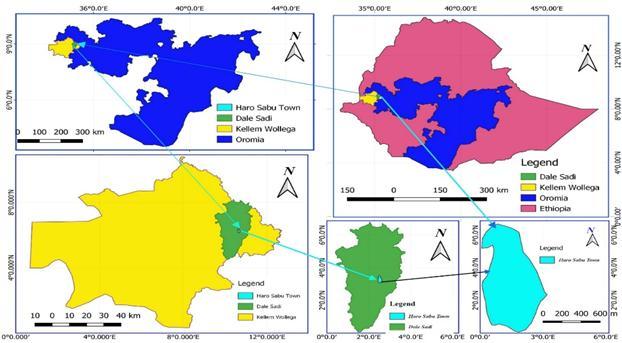
Fig-1: Mapofthestudyarea
This study adopted a cross-sectional mixed-methods research design to comprehensively assess water supply accessibility,reliability,andgovernanceinHaroSebuTown. Thecross-sectional approachallowedfor the collection of data at a single point in time, providing a snapshot of the currentstateofwaterservicesandrelatedchallenges.The
International Research Journal of Engineering and Technology (IRJET) e-ISSN: 2395-0056
Volume: 12 Issue: 12 | Dec 2025 www.irjet.net p-ISSN: 2395-0072
integration of both quantitative and qualitative methods enhanced the depth of analysis. Quantitative data from householdsurveysprovidedmeasurableandgeneralizable informationonwateraccesspatterns,whilequalitativedata from interviews and observations offered contextual understanding, including perceptions, governance issues, andsocio-culturalfactorsinfluencingwatercollectionand usage. By combining these approaches, the study ensured triangulation, which strengthens the reliability of findings and reduces biases that might arise from using a single method.
2.3.
Dataforthisstudywereobtainedfrombothprimaryand secondary sources to ensure a comprehensive and contextualizedanalysisofwateraccessinthetown.Primary data were collected directly from households and key stakeholders, ensuring the relevance and immediacy of information.Householdsurveysgatheredstandardizeddata onwateraccess,distancestowaterpoints,andperceptions of supply reliability, while key informant interviews with municipal officials, water utility staff, and community representatives provided insights into governance structures, decision-making processes, and operational challenges. In addition, field observations enabled an objective assessment of the physical condition and functionality of water infrastructure, helping to identify practicalconstraints,userexperiences,andgender-specific burdens related to water collection. Secondary data complemented these findings by providing broader contextualandinstitutionalperspectives.Municipalreports and water utility documents supplied official statistics, policyframeworks,andrecordsofserviceprovision,while academicandpolicypublicationsfacilitatedcomparisonwith similar urban contexts, highlighting common trends, challenges, and potential solutions. Together, these data sourcessupportedawell-roundedunderstandingofwater access issues by integrating empirical evidence with institutionalandpolicyanalysis.
The target population included all households in Haro SebuTown,totaling 20,986 individuals.Toensurethatthe sample size was statistically valid and representative, Cochran’s(1977)formulaforlargepopulationswasused.A 95%confidencelevelwasappliedtoreduceuncertaintyin theestimates,withanassumedproportionof0.5toaccount for maximum variability, and a 5% margin of error to balanceprecisionwithpracticality[25].AsoutlinedinEqs1 and2.


Wheren₀istheinitialsamplesizeforaninfinitepopulation, Z is the Z-score corresponding to the desired confidence level (e.g., 1.96 for a 95% confidence level), P is the estimated proportion of the attribute in the population (commonlysetat0.5whenthetrueproportionisunknown toensuremaximumvariability),andeisthemarginoferror (e.g.,0.05for±5%).Becausethetargetpopulationisfinite(N = 20,986), the sample size was adjusted using the finite populationcorrection(FPC).Inthiscontext,nrepresentsthe final sample size after applying the finite population correction,whileNdenotesthetotalpopulationsize(20,986 inthisstudy).
Thus,377householdswereselectedtoparticipate.
Thesamplewasdrawnusingacombinationofpurposive sampling (to target key informants and specific areas of interest) and simple random sampling (to ensure representativeness of households across the town). This approachminimizedselectionbiasandensuredthatfindings couldbegeneralizedtothewiderpopulation.
This study employed a mixed-methods approach comprising household surveys, key informant interviews, and field observations to collect both quantitative and qualitativedataonwateraccess,reliability,andgovernance. Structured questionnaires were administered to selected households to gather quantitative information on water sources, travel time and distance, frequency of service interruptions, and perceptions of water governance. Questionsaddressinggenderrolesandresponsibilitieswere includedtoidentifydisparitiesinwatercollectionburdens, enabling standardized and comparable data suitable for statisticalanalysis.
Inaddition,semi-structuredinterviewswereconducted with municipal officials, water utility staff, community representatives,andwatercommitteememberstoobtainindepth qualitative insights into water management challenges, decision-making processes, and institutional constraints.Theseinterviewscomplementedthehousehold surveybycapturinggovernanceandoperationalissuesnot easily quantified. Field observation was also employed to assess the physical condition, operational status, and accessibility of water sources. A structured observation checklistensuredsystematicdatacollection,whileGIStools were used to map water points and infrastructure. This methodprovidedvisual verificationoffacilities, identified potentialhazards,andhelpedvalidateinformationobtained fromsurveysandinterviews,therebyenhancingtheoverall reliabilityandcredibilityofthestudyfindings.
International Research Journal of Engineering and Technology (IRJET) e-ISSN: 2395-0056
Volume: 12 Issue: 12 | Dec 2025 www.irjet.net p-ISSN: 2395-0072
Quantitative data from household surveys were coded and analyzed using SPSS software. Descriptive statistics, including frequency distributions and percentages, were usedtosummarizepatternsofwateraccess,reliability,and governance perceptions. Results were presented in tables andgraphsforclarityandeaseofinterpretation.Qualitative datafrominterviewsandfieldobservationswereanalyzed thematically, focusing on recurring issues such as supply interruptions, institutional inefficiencies, and gendered responsibilities.Thematicanalysisallowedidentificationof underlyingcauses,trends,andcommunityperspectivesthat influencewateraccess.
Triangulation of quantitative and qualitative findings strengthened the overall analysis by validating trends, highlightingconsistenciesanddiscrepanciesbetweendata types,andprovidingacomprehensiveunderstandingofthe complexdynamicsofwatersupplyandgovernanceinHaro SebuTown
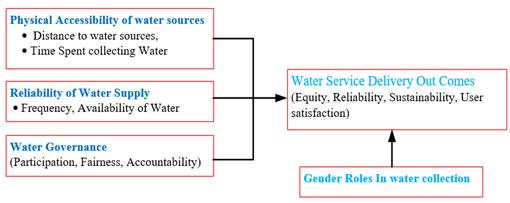
2.5. Water Supply Accessibility and Service Delivery Framework
The figure illustrates a framework for assessing water supplyaccessibilityandservicedelivery.Ithighlightsthree key components that influence water service outcomes: physical accessibilityofwatersources, reliabilityof water supply, and water governance. Physical accessibility considersthedistancetowatersourcesandthetimespent collectingwater,whilereliabilityfocusesonthefrequency and availability of water. Water governance emphasizes participation, fairness, and accountability. These three factorscollectivelyimpacttheoverallwaterservicedelivery outcomes, including equity, reliability, sustainability, and usersatisfaction.Additionally,theframeworkrecognizesthe role of gender in water collection, indicating that gender dynamics can affect water service outcomes. Women and girls often bear the primary responsibility for collecting water, which can influence both the time spent accessing water and their ability to participate in governance. By incorporating gender considerations, the framework underscores the importance of equitable and inclusive approaches to water management, ensuring that services meettheneedsofalluserseffectively
3.1. Access Levels, Distribution, and Socioeconomic Impacts of Water Sources
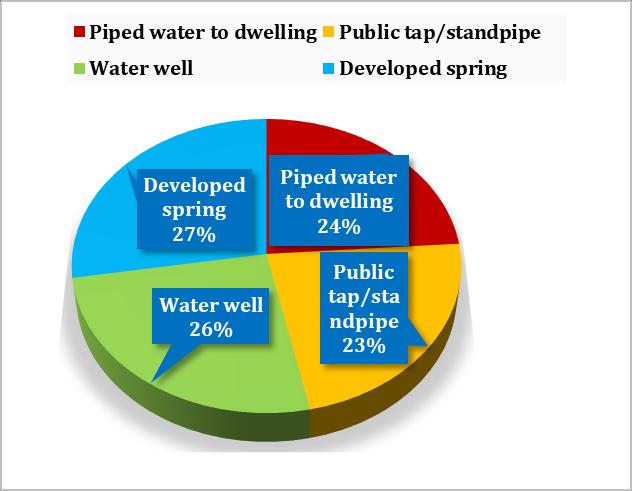
In Haro Sebu Town, household water access is largely dependentonnon-pipedsources.Only23.9%ofhouseholds havepipedwaterconnectionswithintheirdwellings,while 22.8%relyonpublictaps.Themajority(53.3%)dependon wells (25.7%) and developed springs (27.6%) (Figure 3). Thislimitedcoverageofhouseholdpipedconnectionsaligns with findings from small and medium-sized towns, where waterinfrastructureexpansionoftenlagsbehindpopulation growth[26].Pipedsystemsinsuchcontextstypicallyservea minorityofresidents,oftenconcentratedincentralorolder urbanareas,andHaroSebuTownexhibitsasimilarpattern ofpartialserviceprovision.
Public taps, which serve nearly one-quarter of households,aretraditionallyconsideredinterimsolutionsto supplementhouseholdconnections[27].However,evidence suggeststhatduetofinancialandinstitutionalconstraints, thesefacilitiesoftenpersistaslong-termcopingmechanisms [28].Thehighrelianceonwellsandspringsfurtherreflects structural weaknesses in the formal water supply system, with Haro Sebu Town exhibiting an even stronger dependence on communal and semi-improved sources comparedtootherrapidlyurbanizingEthiopiantown.The reliance on communal water sources has significant implications for household labor allocation and time use. Householdsdependentonwells,springs,orpublictapsincur substantialtimecostsforwalking,queuing,andtransporting water, consistent with findings in other low-connection contexts[14].Womenandchildrenpredominantlybearthis burden,reinforcinggendereddivisionsoflabor[29].Similar research from small towns in China indicates that lack of householdwaterconnectionslimitswomen’sparticipation inincome-generatingactivitiesand reducestimeavailable forhouseholdmanagement[30].Thepatternsobservedin Haro Sebu Town suggest that inadequate water infrastructure imposes comparable social and economic constraintsacrossdifferentregionalcontext
Volume: 12 Issue: 12 | Dec 2025 www.irjet.net p-ISSN: 2395-0072
Intra-urban disparities in water access are evident in HaroSebuTown.Researchshowsthathouseholdslocated fartherfrommaindistributionlinesandpublictapsaremore likelytorelyonwellsandsprings,particularlyinperipheral ornewlydevelopedareas[31].Thispatternisreflectedin the results presented in Fig 3, where non-piped sources dominate household water supply. Previous studies also indicate that households in such settings rarely rely on a single water source, instead adopting multiple-source strategies to cope with unreliable supply [32]. The distribution of water sources shown in Figure 3 explains why many households in Haro Sebu Town combine wells, springs, and public taps to meet daily needs, signaling chronicwaterinsecurityratherthantemporaryshortages. Seasonal variation further exacerbates these challenges. Declininggroundwaterlevelsduringdry seasonsincrease collection distance and waiting time, particularly for householdsdependentonwellsandsprings[33].Giventhe highrelianceonthesesourcesinHaroSebuTown,similar seasonal stress is likely to affect water availability and accessibility.
Studies on secondary and small-town urbanization emphasize that rapid population growth is often not matched by adequate investment in basic infrastructure [34]. The water source distribution shown in Figure 3 indicates that Haro Sebu Town reflects this broader developmentchallenge.Researchsuggeststhatsustainable urban water systems require a transition from communal waterpointstowardexpandedhousehold-levelconnections [35]. Compared with towns that have achieved higher householdconnectionrates,HaroSebuTownremainsatan early stage of service development, with fewer than onequarterofhouseholdsconnectedtopipedwater.Inadequate wateraccesshasalsobeenlinkedtonegativepublichealth outcomes and reduced economic productivity [36]. The findingsfromHaroSebuTownreinforcetheseconclusions and highlight the need for targeted investment in water supplyinfrastructure.Expandingpipednetworks,improving spatial equity, and strengthening system reliability are essential for reducing time burdens, addressing gender inequalities,andsupportingsustainableurbandevelopment.
Household travel distance to water sources reveals significant physical accessibility challenges in Haro Sebu Town. As illustrated in Figure 4, only 125 households (33.2%) access their primary water source within 500 meters of their homes, indicating that just one-third of residents enjoy relatively convenient physical access. In contrast,106households(28.1%)traveldistancesbetween 500metersand1km,while a substantial proportion,146
households (38.7%), must walk 1 km or more to obtain water.Mostnotably,55households(14.6%)traveldistances exceeding 2 km, reflecting severe access constraints for a considerablesegmentofthepopulation.
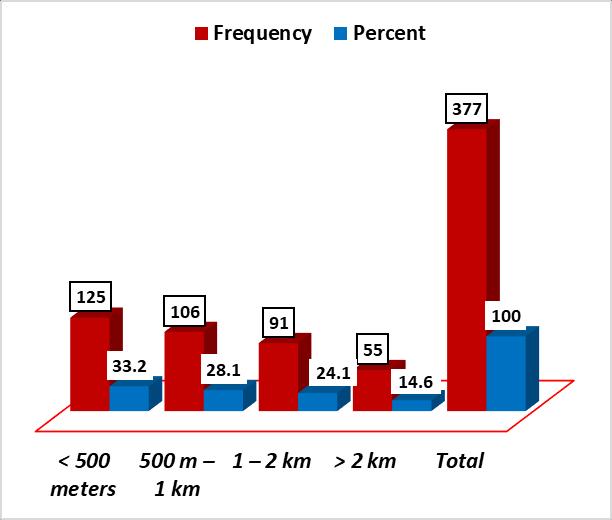
The distribution shown in Figure 4 demonstrates pronounceddisparitiesinthespatialaccessibilityofwater serviceswithinthetown.Similardistance-basedinequalities havebeenwidelydocumentedinsmallandrapidlygrowing towns,wherewaterinfrastructuredevelopmentfailstokeep pace with horizontal settlement expansion [37]. In Haro Sebu Town, the long travel distances suggest an uneven spatialdistributionofimprovedwatersources,particularly disadvantaging peripheral and newly developing neighborhoods. This pattern points to systemic shortcomingsinurbanplanningandhighlightsweaknesses intheallocationofwatersupplyfacilities.Previousstudies emphasizethatlongdistancestowatersourcessignificantly influencehouseholdwater-usebehavior[38].Whenwater pointsarelocatedfarfromresidences,householdstendto reducethenumberofcollectiontrips,therebylimitingthe quantity of water available for domestic use. The accessibilitypatternobservedinHaroSebuTownstrongly supportsthisfinding,ashouseholdstravelingmorethan1 kmarelikelytoprioritizewaterforessentialuses,oftenat the expense of hygiene and sanitation practices. Such behavioral adjustments can have direct implications for public health, particularly in densely populated urban environments.
Extended travel distances also impose substantial physical and time burdens on households. Research consistently shows that these burdens fall disproportionately on women and children, who are primarilyresponsibleforwatercollectionincontextslacking household connections [14]. The high proportion of householdstravelinglongdistancesinHaroSebuTown,as
International Research Journal of Engineering and Technology (IRJET) e-ISSN: 2395-0056
Volume: 12 Issue: 12 | Dec 2025 www.irjet.net p-ISSN: 2395-0072
shown in Figure 4, suggests persistent gendered labor inequalitiesandchronictimepoverty.Theseconditionscan limit educational opportunities for children, restrict women’sparticipationinincome-generatingactivities,and reinforce existing social and economic inequalities. In additiontotimeandlaborcosts,longwalkingdistancesto water sources may expose collectors to safety risks, particularly when water points are located in isolated or poorly monitored areas. Previous studies note increased risksofphysicalinjury,fatigue,andharassmentundersuch conditions[39].Giventhenumberofhouseholdstraveling over2kminHaroSebuTown,theseconcernsareespecially relevantforvulnerablegroups.
TheobservedaccessibilityconditionsinHaroSebuTown deviatefrominternationallyrecognizedservicebenchmarks, which recommend that water sources should be located withinadistancethatallowsaround-tripcollectiontimeof nomorethan30minutes,includingqueuing(WorldHealth Organization(WHO, 2017) )[40]. The high proportion of households exceeding this threshold indicates inadequate service accessibility and underscores persistent gaps in equitablewaterprovision.Comparedwithtownsthatmeet these standards, Haro Sebu Town exhibits clear spatial inefficienciesinwaterinfrastructureplacement.Addressing these challenges requires a strategic and equity-oriented approach to water service expansion. Previous research highlights the importance of prioritizing underserved neighborhoods,extendingpipeddistributionnetworks,and integrating water accessibility considerations into urban land-useplanning[41].ForHaroSebuTown,reducingtravel distanceswouldnotonlyalleviatephysicalandtimeburdens but also promote more consistent water use, improved hygiene,enhancedsafety,andgreatersocio-economicwellbeing.Suchinterventionsdirectlysupporttheobjective of ensuring universal and equitable access to safe and affordable drinking water, reinforcing the importance of spatiallyinclusiveandsustainableurbanwaterplanning.
The abbreviation Indicated that: WHO: World Health Organization
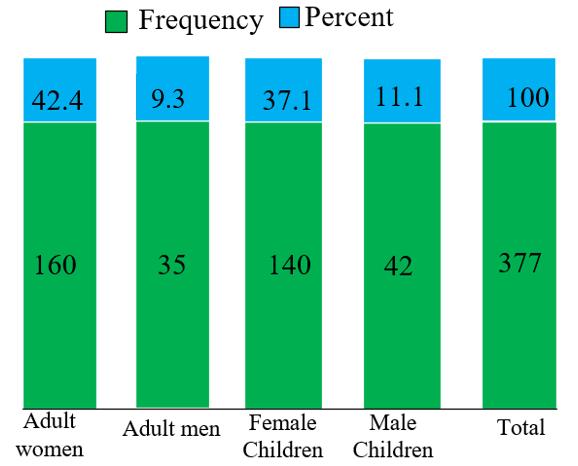
The analysis of household water collection responsibilities in Haro Sebu Town reveals a highly gendered pattern (Fig. 5). Adult women constitute the largest group of primary water collectors, responsible for 160households(42.4%),followedbyfemalechildrenat140 households (37.1%). Collectively, women and girls are responsiblefor300households(79.5%)ofwatercollection activities. Adult men (35 households, 9.3%) and male children(42households,11.1%)contributeminimally.The high involvement of female children indicates that water collection duties may interfere with schooling and educationalperformance.Thesefindingsareconsistentwith studies conducted in other Ethiopian regions, such as Oromia, Amhara, and Tigray, which also report a
predominance of women and girls in household water collection[42,43].
These findings indicate that water collection is predominantly undertaken by females, highlighting the persistenceofgenderedhouseholdresponsibilitiesinHaro SebuTown.Thehighproportionoffemaleparticipationin watercollectionunderscoresastructuralgenderimbalance indomesticlabor,whichmayhavelong-termconsequences ontheeducationandempowermentofgirls.Theburdenon femalechildren,inparticular,canreducetimeavailablefor schooling, skill development, and recreational activities, potentially affecting their academic performance and personalgrowth.Thepredominanceofwomenandgirlsin water collection has significant implications for health, education, and socio-economic well-being. The physical effort required to carry heavy water containers over long distances increases the risk of musculoskeletal strain, fatigue, and other health issues, particularly among adult women[39,44].Femalechildrenarealsoexposedtosimilar physical stress, alongside reduced time for schooling, recreation,andskilldevelopment.Theseburdenscontribute totimepoverty,limitingopportunitiesforwomenandgirls to engage in income-generating activities, community participation, and personal development. The persistent allocationofwatercollectiontofemalesreflectsentrenched culturalnormsandsocialexpectations,reinforcinggender inequalitiesacrossgenerations(UNICEF,2016)[45,46].
The gendered pattern of water collection aligns with studies from other Ethiopian regions, including Oromia, Amhara, and Tigray, which document the feminization of water-related labor [47, 48]. This imbalance reinforces entrenched social norms and cultural expectations, perpetuating gender inequalities in domestic responsibilities. The findings suggest that without intervention,thecycleoffemaleburdeninhouseholdwater collection will continue, affecting health, education, and socio-economicoutcomesforwomenandgirls.
Addressingthisissuerequiresbothinfrastructuraland social interventions. Reducing travel distances through strategic placement of new water points and expanding household-levelpipedconnectionscansignificantlyalleviate thelaborandtimeburdenonwomenandgirls[49,50].Such interventions directly support Sustainable Development Goal6.1,whichemphasizesuniversalandequitableaccessto safe and affordable drinking water, while simultaneously advancing SDG 5 by promoting gender equality, redistributingunpaiddomesticwork,andenablinggreater female participation in education and economic life. Complementary community-based strategies, such as awareness programs that encourage shared household responsibilities, are essential to challenge cultural norms and ensure more equitable distribution of water-related labor. Collectively, these measures can reduce physical strain,increasehouseholdwateravailability,improvehealth outcomes,enhanceeducationalopportunities,andpromote
International Research Journal of Engineering and Technology (IRJET) e-ISSN: 2395-0056
Volume: 12 Issue: 12 | Dec 2025 www.irjet.net p-ISSN: 2395-0072
socio-economicdevelopment,fosteringamoreequitableand sustainablehouseholdenvironment.
The abbreviation indicated that: UNICEF; United Nations Children’s Fund, SDG 5 stands for Sustainable Development Goal 5
HouseholdMembersResponsibleforFetching Water
3.4. Water Transportation
Atotalof377householdsweresurveyedinHaroSebu Towntoassesswatertransportationmethods(Table1).The majorityofhouseholds(63.7%)transportedwatermanually. 29.2% of households used donkeys, while only 7.2% employed animal-pulled carts, indicating that laborintensivehumantransportdominatesandalternativemodes arelimited.
Table-1: MethodsofTransportingWaterfromSourceto Home
cannegativelyaffectschoolattendance,workproductivity, andparticipationincommunityandsocialactivities.
The limited use of donkeys (29.2%) and carts (7.2%) indicates unequal access to assisted transport, often associated with differences in household income, asset ownership, or socio-economic status. Households without access to animal-assisted transport face greater time and energydemands,whichmayconstrainthevolumeofwater collected per day and reduce availability for drinking, hygiene, and other domestic uses. These results are consistentwithfindingsfromotherEthiopiansmalltowns, where manual water transport predominates and only a smallproportionofhouseholdsusedonkeys or carts[51]. Thispatternhighlightsthecriticalneedforinfrastructural improvements,suchashouseholdpipedwaterconnections, and community-based interventions, including affordable animal-assistedorsharedtransportsystems.Suchmeasures wouldreducethephysicalburden,promoteequitableaccess, and improve household water security, hygiene practices, andoverallwell-being.
TheassessmentofwatersupplyreliabilityinHaroSebu Town indicates considerable inconsistencies in service delivery (Table 2). Only 77 households (20.4%) receive waterdaily,while127households(33.7%)accesswater4–6 daysperweek,reflectingerraticandunpredictablesupply patterns.Afurther111households(29.4%)receivewater1–3daysperweek,and62households(16.4%)receivewater less than once per week, suggesting chronic shortages for someresidents.Regardingdailyavailability,95households (25.2%) experience intermittent supply within a day, 105 households(27.9%)receivewaterforlessthan6hours,100 households(26.5%)accesswaterfor6–12hours,andonly 77households(20.4%)reportthatwaterisavailableatall times.
Perceptions of water reliability mirror these findings: 147 respondents (39.0%) rate the supply as “unreliable,” and81respondents(21.5%)as“veryunreliable,”whileonly 46 respondents (12.2%) perceive the service as “very reliable,”and103respondents(27.3%)as“reliable.”These data indicate that both actual supply patterns and user experiencesreflectsignificantvariabilityanddissatisfaction withwaterservicequality.
Thefindingthatnearlytwo-thirdsofhouseholdsrelyon manual water transport underscores a substantial labor burden, particularly on women and children who are the primarywatercollectors.Thephysicaldemandsofcarrying heavy containers over long distances increase the risk of musculoskeletalinjuries,fatigue,andchronicstress,which
International Research Journal of Engineering and Technology (IRJET) e-ISSN: 2395-0056
Volume: 12 Issue: 12 | Dec 2025 www.irjet.net p-ISSN: 2395-0072
The abbreviation indicated that: UNICEF; United Nations Children’sFund
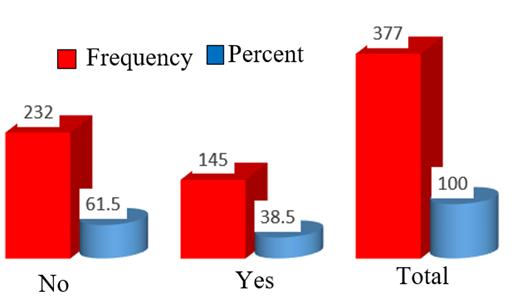
Communityperceptionsoffairnessinwaterdistribution indicateconsiderabledissatisfactionwiththecurrentsystem (Fig. 6). Out of 377 respondents, 232 households (61.5%) believe that water distribution is not fair, while only 145 households(38.5%)perceivethesystemasequitable.These perceptions suggest that many households experience barriers to reliable supply, which may result from preferential allocation to certain neighborhoods, inconsistentscheduling,orinadequatepressureparticularly inhigh-altitudeareaswherewaterflowtendstobeweaker.
The intermittent and unpredictable water supply has profound implications for household water security, daily routines,andpublichealth.Limitedavailabilityoftenforces householdstorationwater,reduceconsumption,orcollect water during inconvenient hours, which can compromise hygiene practices, food preparation, and other essential domestic activities. Unreliable supply also necessitates prolonged storage of water, increasing the risk of contamination due to improper containers or unhygienic handling.Thesefindingsalignwithnationalassessmentsof small towns in Ethiopia, which report frequent service interruptionsandinsufficientproductioncapacityasmajor barrierstoreliablewatersupply[7,52].Thecombinationof inconsistent availability, limited daily hours, and user dissatisfactionunderscoresthesystemicchallengesfacedby thetown’swaterinfrastructure.
Improving reliability is critical not only for daily convenience but also for broader health, social, and economic outcomes. Infrastructure upgrades such as increasing production capacity, rehabilitating distribution networks,improvingpressuremanagement,andexpanding storage facilities can significantly reduce service interruptions. Additionally, better scheduling, communication with users, and targeted maintenance programscanenhancehouseholdpreparednessandpublic trust in the water system. Addressing these reliability challenges is essential for ensuring that households can maintainsufficientwateraccessforconsumption,hygiene, andotherdailyneeds,therebysupportingthebroadergoals of Sustainable Development Goal 6.1 (universal and equitableaccesstosafeandaffordabledrinkingwater)and meeting international recommendations for safe water access as emphasized by UNICEF, which highlights the importanceofreliablewaterservicesforhealth,education, andoverallwell-being.
The high proportion of negative responses highlights both infrastructure constraints and concerns regarding service governance and communication. The widespread perception of unfairness (Fig. 6) reflects gaps in water supply management, which can undermine trust in local water authorities. Previous research indicates that when households perceive water distribution as inequitable, communitycooperationdeclines,makingitmoredifficultto implement service improvements and maintain systems effectively(WHO&UNICEF,2021).Inequitabledistribution alsoexacerbatessocio-economicdisparities,ashouseholds indisadvantagedorperipheralareasoftenexperiencemore severeshortagesorlimitedaccess.
Addressing these challenges requires improved transparencyindistributionschedules,equitableallocation across neighborhoods, and strengthened accountability mechanismssuchasresponsivecomplaint-handlingsystems. Effective governance interventions can rebuild public confidence,improveusersatisfaction,andpromoteequitable servicedelivery.Furthermore,fairdistributionisessential for achieving Sustainable Development Goal 6.1, which emphasizes universal and equitable access to safe and affordabledrinkingwater(WHO&UNICEF,2021).Ensuring reliable and fair access for all residents, regardless of locationorsocio-economic status,canenhance household well-being, reduce resource-related tensions, and support broadersocialandeconomicdevelopment.
The abbreviation indicated that: WHO: World Health Organization,UNICEF:UnitedNationsChildren’sFund
International Research Journal of Engineering and Technology (IRJET) e-ISSN: 2395-0056
Volume: 12 Issue: 12 | Dec 2025 www.irjet.net p-ISSN: 2395-0072
Household participation in local water governance structures, such as community meetings, water user committees,andconsultations,remainsrelativelylimitedin HaroSebuTown(Fig7).Outof377householdssurveyed, 182 households (48.3%) reported being involved in governance processes, while 195 households (51.7%) indicated no participation at all. This suggests that nearly half of the population is excluded from decision-making platforms that influence water allocation, tariff setting, serviceimprovements,andcomplainthandling.
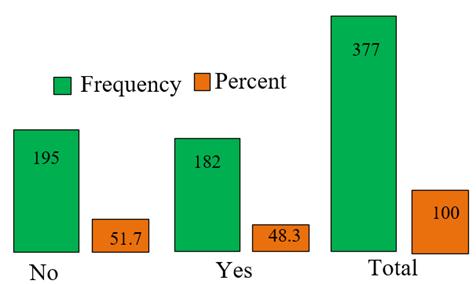
Limited household engagement in water governance restricts opportunities for oversight and accountability, therebyweakeningtheeffectivenessandresponsivenessof local water management systems. When households particularly women and marginalized groups are underrepresented in decision-making, their concerns and priorities may remain unaddressed, contributing to dissatisfactionandinequitableservicedistribution.Evidence fromotherregionssuggeststhatinclusiveparticipationin water governance improves responsiveness, ensures that communityneedsareaddressed,andfosterstransparency andfairnessinserviceprovision[53].
Strengthening participatory mechanisms can enhance trust between service providers and the community, improveservicedeliveryoutcomes,andensuregovernance structures align with the principles of equity and inclusiveness promoted under Sustainable Development Goal6.1,whichemphasizesuniversalandequitableaccessto safeandaffordabledrinkingwater.Empoweringwomen’s voices in particular is crucial, as they are often the most directlyaffectedbywateraccesschallengesandcollection burdens [54]. Ensuring their active involvement in governanceprocessescanleadtomoreresponsivesolutions, better resource allocation, and the design of services that reflecttheactualneedsofhouseholds.
Additionally, broader community participation fosters collective responsibility for water resources, encourages local problem-solving, and strengthens accountability mechanisms. When more households engage in planning,
monitoring, and decision-making, service providers are morelikelytorespondtooperationalchallenges,implement timely maintenance, and adopt policies that reflect communitypriorities.Overtime,inclusiveparticipationcan also contribute to social cohesion, reduce conflicts over wateraccess,andbuildlocalcapacityforsustainablewater management.
4.1
HaroSebuTowncontinuestofacesignificantchallenges in achieving the targets of Sustainable Development Goal (SDG)6.1,whichemphasizesuniversalandequitableaccess tosafeandaffordabledrinkingwater.Thestudy’sfindings indicate that household-level piped water coverage is limited, compelling most residents to rely on non-piped watersources.Thesesourcesarefrequentlyunreliable,timeconsumingtoaccess,andrequiremanualtransport,creating substantialphysicalandtemporalburdensforhouseholds. Theimpactoflimitedwateraccessisnotevenlydistributed across the population. Women and children bear a disproportionateshare of thelaborassociated with water collection, reflecting entrenched social and gender norms. The time and effort devoted to fetching water reduce opportunities for education, employment, and other productiveactivities,therebyperpetuatingcyclesofpoverty andsocialinequalitywithinthecommunity.
Inadditiontoaccesschallenges,thestudyhighlightsthe unreliability of the existing water supply system. Service interruptions, unpredictable availability, and inadequate infrastructure contribute to widespread household dissatisfaction. Furthermore, deficits in governance exacerbate these issues: perceptions of inequitable distribution, limited community participation, and weak accountabilitymechanismsunderminetrustinlocalwater authorities and hinder effective collaborative problemsolving.
Overall, these findings underscore the urgent need for comprehensive and integrated interventions. Addressing infrastructuregapsaloneisinsufficient;improvementsmust also target governance structures, social equity, gender considerations, and participatory management. Without substantial reforms, Haro Sebu Town will continue to struggletomeetthebasicwaterneedsofitspopulation,as wellasbroadersustainabilityandequitygoalsoutlinedin SDG6.1.
ToimprovewateraccessandmanagementinHaroSebu Town, a multi-faceted approach is necessary. First, expansion of household piped water networks should be prioritized, particularly in underserved areas. Increased piped water coverage would reduce dependence on non-
International Research Journal of Engineering and Technology (IRJET) e-ISSN: 2395-0056
Volume: 12 Issue: 12 | Dec 2025 www.irjet.net p-ISSN: 2395-0072
piped sources, alleviate the physical burden of water collection, and improve overall water security for households.
Second,theequitabledistributionofpublicwaterpoints isessential.Strategicallylocatingcommunalwatersources within accessible distances can minimize travel time, improve convenience, and enhance equitable access. Such planning should consider population density and vulnerability to ensure that resources are allocated effectively.
Third, enhancing supply reliability is critical. Regular infrastructuremaintenance,leakrepair,andtheprovisionof adequate storage capacity can reduce interruptions and unpredictabilityinwaterservice.Implementingmonitoring systems and early-warning mechanisms would further strengthenthecommunity’sconfidenceinthewatersupply.
Fourth, gender-sensitive strategies must be integrated intowatermanagementinterventions.Programsthatreduce the burden on women and children such as communitymanaged water transport systems or labor-saving technologies can help promote social equity and improve healthandeducationaloutcomesforaffectedpopulations.
Fifth, strengthening governance and accountability is vital for sustainable water management. Transparent allocation of water resources, clear communication of serviceschedules,andmechanismsforcitizenfeedbackcan enhance trust and ensure more efficient service delivery. Encouraginginclusivedecision-makingbyactivelyinvolving womenandmarginalizedgroupsinplanningandoversight processeswillfurtherenhancetheequityandsustainability ofwatermanagement.
Finally, a holistic and integrated approach is recommended. Combining infrastructure development, socialequity,environmentalsustainability,andinstitutional strengthening ensureslong-termresilienceandalignment with SDG 6.1 targets. Such a comprehensive strategy not onlyaddressesimmediatewateraccesschallengesbutalso contributestobroaderdevelopmentaloutcomes,including improvedhealth,education,andsocialequity.
TheauthoracknowledgestheGovernmentofChinaforits supportofhighereducationandTongjiUniversityIESDfor providingacademicresourcesandguidance.Appreciationis extendedtotheEthiopiangovernmentandtheauthoritiesof HaroSebuTownfortheircooperationduringdatacollection. TheauthorexpressessinceregratitudetoProfessorHongtao Wangforcontinuoussupervision,constructiveguidance,and invaluablefeedbackthroughoutthisstudy.Thanksarealso extended to Ebrahim Aman for his assistance. Sincere gratitudeisexpressedtofamily,friends,andcolleaguesfor theirsupport.TheauthorisalsothankfultoGodforguidance andblessingsthroughoutthisjourney.
[1] K. Eman and G. Mesko, "Access to Safe and Affordable Drinking Water as a Fundamental HumanRight:TheCaseoftheRepublicofSlovenia," 2020,pp.465-484.
[2] O.Ejiohuo etal.,"Ensuringwaterpurity:Mitigating environmental risks and safeguarding human health," Water Biology and Security, vol.4,no.2,p. 100341, 2025/04/01/ 2025, doi: https://doi.org/10.1016/j.watbs.2024.100341
[3] N. Kapucu, Y. Ge, E. Rott, and H. Isgandar, "Urban resilience: Multidimensional perspectives, challenges and prospects for future research," Urban Governance, vol. 4, no. 3, pp. 162-179, 2024/09/01/ 2024, doi: https://doi.org/10.1016/j.ugj.2024.09.003
[4] P.Gober,"Deserturbanizationandthechallengesof water sustainability," Current Opinion in Environmental Sustainability, vol.2,no.3,pp.144150, 2010/08/01/ 2010, doi: https://doi.org/10.1016/j.cosust.2010.06.006
[5] S. Rajendrakumar et al., "Drivers and barriers towards achieving SDG 6 on clean water and sanitation for all - an Indian perspective," World Development Sustainability, vol. 7, p. 100228, 2025/12/01/ 2025, doi: https://doi.org/10.1016/j.wds.2025.100228
[6] V. A. Beard and D. Mitlin, "Water access in global South cities: The challenges of intermittency and affordability," World Development, vol. 147, p. 105625, 2021/11/01/ 2021, doi: https://doi.org/10.1016/j.worlddev.2021.105625
[7] M. Adank, J. Butterworth, and M. Abera, "Looking beyond headline indicators: Water and sanitation services in small towns in Ethiopia," Journal of Water,SanitationandHygieneforDevelopment, vol. 6,08/182016,doi:10.2166/washdev.2016.034.
[8] D. Bose et al., "Overcoming water, sanitation, and hygienechallengesincriticalregionsoftheglobal community," Water-Energy Nexus, vol. 7, pp. 277296, 2024/12/01/ 2024, doi: https://doi.org/10.1016/j.wen.2024.11.003
[9] R. S. Kookana, P. Drechsel, P. Jamwal, and J. Vanderzalm, "Urbanisation and emerging economies:Issuesandpotentialsolutionsforwater and food security," Science of The Total Environment, vol. 732, p. 139057, 2020/08/25/ 2020, doi: https://doi.org/10.1016/j.scitotenv.2020.139057
International Research Journal of Engineering and Technology (IRJET) e-ISSN: 2395-0056
Volume: 12 Issue: 12 | Dec 2025 www.irjet.net p-ISSN: 2395-0072
[10] M. Rashid, M. Manzoor, and S. Mukhtar, "UrbanizationandItsEffectsonWaterResources: An Exploratory Analysis," Asian Journal of Water, EnvironmentandPollution, vol.15,pp.67-74,01/29 2018,doi:10.3233/AJW-180007.
[11] L. Mu, L. Fang, W. Dou, C. Wang, X. Qu, and Y. Yu, "Urbanization-inducedspatio-temporalvariationof waterresourcesutilizationinnorthwesternChina: Aspatialpanelmodelbasedapproach," Ecological Indicators, vol.125,p.107457,2021/06/01/2021, doi: https://doi.org/10.1016/j.ecolind.2021.107457
[12] P. Sharma, A. Ivanova, and B. Hassan, "Aging Infrastructure:Challengesandrisksassociatedwith agingpipelines,"09/252024.
[13] B.VanderBruggen,K.Borghgraef,andC.Vinckier, "Causes of Water Supply Problems in Urbanised Regions in Developing Countries," Water Resour. Manag., vol. 24, pp. 1885-1902, 07/01 2010, doi: 10.1007/s11269-009-9529-8.
[14] S. Sorenson, C. Morssink, and P. Campos, "Safe Access to Safe Water in Low Income Countries: WaterFetchinginCurrentTimes," Social science & medicine (1982), vol. 72, pp. 1522-6, 05/01 2011, doi:10.1016/j.socscimed.2011.03.010.
[15] Y. Crider and I. Ray, "Water and Development: A Gender Perspective," 05/19 2022, doi: 10.1093/acrefore/9780199389414.013.685.
[16] F. Arku, "Time savings from easy access to clean water Implications for rural men’s and women’s well-being," ProgressinDevelopmentStudies, vol.10, pp. 233-246, 07/01 2010, doi: 10.1177/146499340901000303.
[17] P.-R. Agénor and M. Agénor, "Access to infrastructure and women’s time allocation: Implications for growth and gender equality," Journal of Macroeconomics, vol. 75, p. 103472, 2023/03/01/ 2023, doi: https://doi.org/10.1016/j.jmacro.2022.103472
[18] S.DickinandS.Gabrielsson,"Inequalitiesinwater, sanitation and hygiene: Challenges and opportunities for measurement and monitoring," Water Security, vol. 20, p. 100143, 2023/12/01/ 2023, doi: https://doi.org/10.1016/j.wasec.2023.100143
[19] S.K.Abanyie,E.E.Y.Amuah,andD.B.Nang,"Water scarcity and its implications on sanitation: A perspectivestudyinanemergingcityinNorthern
Ghana," GreenTechnologiesandSustainability, vol.3, no. 2, p. 100138, 2025/04/01/ 2025, doi: https://doi.org/10.1016/j.grets.2024.100138
[20] A. Mohamed, H. Worku, and T. Lika, "Urban and regional planning approaches for sustainable governance: The case of Addis Ababa and the surrounding area changing landscape," City and Environment Interactions, vol. 8, p. 100050, 2020/11/01/ 2020, doi: https://doi.org/10.1016/j.cacint.2020.100050.
[21] A.Gasirabo etal.,"Householdsperceptiononwater scarcity, distribution, and accessibility in Nyanza district,Rwanda,"vol.Volume9,pp.16-46,01/01 2019.
[22] G.Kaushik et al.,"Chapter13-Harmonizingwater governance: Exploring governance structures, stakeholder engagement, and policy in water management," in Advances in Hydrology, S. Majumdar, M. Choudhury, and M. Sillanpää Eds.: Elsevier,2026,pp.225-246.
[23] S. Afiyah, "The Impact of E-Government Services, Citizen Participation, and Transparency on Public TrustinGovernment," Global International Journal ofInnovativeResearch, vol.2,pp.1246-1261,06/10 2024,doi:10.59613/global.v2i6.200.
[24] D. Mamidi, "Catalysing Water Governance: Empowering Communities for Sustainable Water Management," Indian Journal of Public Administration, vol. 0, pp. 1-18, 03/03 2025, doi: 10.1177/00195561241309140.
[25] J. E. Barlett, J. Kotrlik, and C. Higgins, "OrganizationalResearch:DeterminingAppropriate Sample Size in Survey Research," Information Technology,Learning,andPerformanceJournal, vol. 19,01/012001.
[26] S.S.Sinharoy,R.Pittluck,andT.Clasen,"Reviewof driversandbarriersofwaterandsanitationpolicies forurbaninformalsettlementsinlow-incomeand middle-incomecountries," UtilitiesPolicy, vol.60,p. 100957, 2019/10/01/ 2019, doi: https://doi.org/10.1016/j.jup.2019.100957
[27] D.Whittington,S.Pattanayak,J.-C.Yang,andB.Kc, "Household Demand for Improved Piped Water Services:EvidenceFromKathmandu,Nepal," Water Policy, vol. 4, pp. 531-556, 12/31 2002, doi: 10.1016/S1366-7017(02)00040-5.
[28] M.Miller etal.,"Theimpactofstaffingstructuresin long-term care homes on the quality of work-life and work outcomes of care-workers: A narrative
2025, IRJET | Impact Factor value: 8.315 | ISO 9001:2008
International Research Journal of Engineering and Technology (IRJET) e-ISSN: 2395-0056
Volume: 12 Issue: 12 | Dec 2025 www.irjet.net p-ISSN: 2395-0072
scoping review," International Journal of Nursing Studies, vol. 174, p. 105304, 2026/02/01/ 2026, doi: https://doi.org/10.1016/j.ijnurstu.2025.105304
[29] B.CrowandJ.McPike,"HowtheDrudgeryofGetting WaterShapesWomen’sLivesinLow-incomeUrban Communities," Gender, Technology and Development, vol. 13, pp. 43-68, 12/22 2009, doi: 10.1177/097185240901300103.
[30] G.LiuandF.Zhang,"Inequalityofhouseholdwater footprint consumption in China," Journal of Hydrology, vol. 612, p. 128241, 07/01 2022, doi: 10.1016/j.jhydrol.2022.128241.
[31] E. Adams, D. Sambu, and S. Smiley, "Urban water supply in Sub-Saharan Africa: historical and emergingpoliciesandinstitutionalarrangements," International Journal of Water Resources Development, vol. 35, pp. 1-24, 02/05 2018, doi: 10.1080/07900627.2017.1423282.
[32] B. Majuru, M. Suhrcke, and P. Hunter, "How Do HouseholdsRespondtoUnreliableWaterSupplies? A Systematic Review," International Journal of EnvironmentalResearchandPublicHealth, vol.13,p. 1222,12/092016,doi:10.3390/ijerph13121222.
[33] E. Thomas, D. Wilson, S. Kathuni, A. Libey, P. Chintalapati,andJ.Coyle,"Acontributiontodrought resilienceinEastAfricathroughgroundwaterpump monitoring informed by in-situ instrumentation, remote sensing and ensemble machine learning," Science of The Total Environment, vol. 780, p. 146486, 2021/08/01/ 2021, doi: https://doi.org/10.1016/j.scitotenv.2021.146486.
[34] A. Allen, J. Davila, and P. Hofmann, Governance of Water and Sanitation Services for the Peri-urban Poor A Framework for Understanding and Action in Metropolitan Regions Governance of Water and Sanitation Services for the Peri-urban Poor.2006.
[35] L.WhaleyandF.Cleaver,"Can‘functionality’save thecommunitymanagementmodelofruralwater supply?," Water Resources and Rural Development, vol. 9, pp. 56-66, 2017/06/01/ 2017, doi: https://doi.org/10.1016/j.wrr.2017.04.001
[36] D. C. Ferreira, I. Graziele, R. C. Marques, and J. Gonçalves, "Investment in drinking water and sanitation infrastructure and its impact on waterbornediseasesdissemination:TheBrazilian case," Science ofThe Total Environment, vol.779,p. 146279, 2021/07/20/ 2021, doi: https://doi.org/10.1016/j.scitotenv.2021.146279
[37] E.A.Adams,S.Byrns,S.Kumwenda,R.Quilliam,T. Mkandawire, and H. Price, "Water journeys: Household water insecurity, health risks, and embodiment in slums and informal settlements," Social Science & Medicine, vol. 313, p. 115394, 2022/11/01/ 2022, doi: https://doi.org/10.1016/j.socscimed.2022.115394
[38] R. I. McDonald et al., "Water on an urban planet: Urbanization and the reach of urban water infrastructure," Global Environmental Change, vol. 27, pp. 96-105, 2014/07/01/ 2014, doi: https://doi.org/10.1016/j.gloenvcha.2014.04.022.
[39] K. De Guzman et al., "Drinking water and the implicationsforgenderequityandempowerment: Asystematicreviewofqualitativeandquantitative evidence," International Journal of Hygiene and Environmental Health, vol. 247, p. 114044, 2023/01/01/ 2023, doi: https://doi.org/10.1016/j.ijheh.2022.114044
[40] A.Cassivi,E.Tilley,E.O.D.Waygood,andC.Dorea, "Evaluatingself-reportedmeasuresandalternatives tomonitoraccesstodrinkingwater:Acasestudyin Malawi," ScienceofTheTotalEnvironment, vol.750, p. 141516, 2021/01/01/ 2021, doi: https://doi.org/10.1016/j.scitotenv.2020.141516
[41] P.Hofmann,"Towardequitableurbanwatersupply and sanitation in Dar es Salaam: The dialectic relationship between policy-driven and everyday practices," Utilities Policy, vol. 78, p. 101395, 2022/10/01/ 2022, doi: https://doi.org/10.1016/j.jup.2022.101395
[42] G.Assefa et al.,"Assessingtheeffectsofmenstrual hygiene, water, and sanitation on girls’ academic performancesinpublicschools,Ethiopia," Journalof Water,SanitationandHygieneforDevelopment, vol. 15, pp. 192-205, 02/27 2025, doi: 10.2166/washdev.2025.233.
[43] K. Degefa, L. Schneider, F. Colombijn, and K. Teji Roba,"SocialandCulturalBarriersandFacilitators Affecting Mothers’ Dietary Practices in Eastern Ethiopia: A Qualitative Study," Current Developments inNutrition, vol.9,no.12,p.107602, 2025/12/01/ 2025, doi: https://doi.org/10.1016/j.cdnut.2025.107602.
[44] J.-M.MukieseNlunda,C.Sangana,andG.Kiyombo, "BurdenofMusculoskeletalPainsandInjuriesfrom Water-Carrying Among School-Going Adolescent GirlsinKinshasa’sPeri-UrbanSettings,Democratic Republic of Congo," European Journal of DevelopmentStudies, vol.4,pp.52-61,05/132024, doi:10.24018/ejdevelop.2024.4.3.341.
2025, IRJET | Impact Factor value: 8.315 | ISO 9001:2008
International Research Journal of Engineering and Technology (IRJET) e-ISSN: 2395-0056
Volume: 12 Issue: 12 | Dec 2025 www.irjet.net p-ISSN: 2395-0072
[45] E. A. Chance and I. Sardi Abdoul, "The roles and contributions of women to the health of their familiesandhouseholdeconomicsinruralareasin the district of Mbe, Cameroon," Social Sciences & Humanities Open, vol.11,p.101456,2025/01/01/ 2025, doi: https://doi.org/10.1016/j.ssaho.2025.101456.
[46] P.Michael et al.,"Canmenunburdenwomenfrom unpaid care work? Evidence from Burundi," CABI Agriculture and Bioscience, vol.6,02/112025,doi: 10.1079/ab.2025.0008.
[47] G. Assefa et al., "Gender Equality and Social Inclusion in Relation to Water, Sanitation and Hygiene in the Oromia Region of Ethiopia," InternationalJournalofEnvironmentalResearchand Public Health, vol. 18, p. 4281, 04/17 2021, doi: 10.3390/ijerph18084281.
[48] G.Villamor,"GenderandWater-Energy-FoodNexus intheRuralHighlandsofEthiopia:WhereArethe Trade-Offs?," Land, vol.12,p.585,02/282023,doi: 10.3390/land12030585.
[49] J.Winter,G.Darmdstadt,andJ.Davis,"Theroleof pipedwatersuppliesinadvancinghealth,economic development, and gender equality in rural communities," SocialScience&Medicine, vol.270,p. 113599, 01/14 2021, doi: 10.1016/j.socscimed.2020.113599.
[50] S.L.Young et al.,"Perspective:TheImportanceof Water Security for Ensuring Food Security, Good Nutrition, and Well-being," Advances in Nutrition, vol.12,no.4,pp.1058-1073,2021/07/01/2021, doi:https://doi.org/10.1093/advances/nmab003
[51] M. Addisie, T. Gelaye, and M. Dakarasha, "Households' reluctance to collect potable water fromimprovedsources,Ethiopia," JournalofWater Supply: Research and Technology-Aqua, vol. 70, 07/022021,doi:10.2166/aqua.2021.158.
[52] D.Adugna,"Challengesofsanitationindeveloping counties - Evidenced from a study of fourteen towns,Ethiopia," Heliyon, vol.9,p.e12932,01/20 2023,doi:10.1016/j.heliyon.2023.e12932.
[53] C. de Freitas and G. Martin, "Inclusive public participation in health: Policy, practice and theoretical contributions to promote the involvementofmarginalisedgroupsinhealthcare," SocialScience&Medicine, vol.135,06/302015,doi: 10.1016/j.socscimed.2015.04.019.
[54] J.Jia,A.Snider,A.Collishaw,P.E.McNamara,andE. Tumusiime, "Pathways linking WASH access and women'sempowerment:EvidencefromZambiaand Honduras," Journal of Rural Studies, vol. 116, p. 103602, 2025/05/01/ 2025, doi: https://doi.org/10.1016/j.jrurstud.2025.103602