
International Research Journal of Engineering and Technology (IRJET) e-ISSN: 2395-0056
Volume: 12 Issue: 09 | Sep 2025 www.irjet.net p-ISSN: 2395-0072
International Research Journal of Engineering and Technology (IRJET) e-ISSN: 2395-0056
Volume: 12 Issue: 09 | Sep 2025 www.irjet.net p-ISSN: 2395-0072
Santosh Kumari Meena1, Khamma Kanwar2 and Dharmendra Meena
1,2 Assistant Professor, Department of Electrical Engineering MBM University, Jodhpur- 342001
3 Assistant Professor, Agriculture University, Jodhpur- 342001
Abstract - The worldwide consumptionofelectricalenergyis increasing and there is gradually increased of demand on the power generation. Thus in accumulation to conventional power generation sources a various number of renewable energy sources are beingconnected intothe power system.The wind turbine power generation unit is more economical and competitive of all the existing environmentally clean and safe renewable energy sources. However, wind electrical generation systems provide intermittent energy depending upon the wind regimes in the region. Therefore, any transient disturbance can result in changes in the voltage, current and power at various points of the integrated system. This paper shows simulation results for variation in wind speed obtained through transient analysis using generic wind turbine generation model. In the wind farm a doubly fed induction generator (DFIG) model is used. For showing the simulation of DFIG, MATLAB/SIMULINK software is used
Key Words: Doublyfedinductiongenerator(DFIG),pointof common coupling (PCC), Wind energy conversion system (WECS), pulsed width modulated (PWM), GSC (Grid side converter).
The worldwide consumption of electrical energy is increasingandthereisgraduallyincreasedofdemandonthe power generation. Thus in accumulation to conventional powergenerationsourcesa variousnumberofrenewable energysourcesarebeingconnectedintothepowersystem. Wind is most desirable source surrounded by all other renewable energy because it is non-polluting, available in abundance and reasonable cost for both small and large ordersystem.Themostsatisfyresourcethiswholeneedof wind in a natural source energy source. The wind turbine powergenerationunitismoreeconomicalandcompetitive ofalltheexistingenvironmentallycleanandsaferenewable energy sources in world. In wind turbine generation technology variable speed double fed induction and constant-speedsquirrel-cageinductiongeneratorsareused. However, wind electrical generation systems provide intermittentenergydependinguponthewindregimesinthe region. Therefore, any transient disturbance can result in changesinthevoltage,currentandpoweratvariouspoints oftheintegratedsystem.Astudyofsucheffectsisusefulto thepowersystemenergyplanner.
Windenergyconversionsystem(WECS)isappliedtochange windenergyintousefulmechanicalenergy.Theterms“wind power”or“windenergy”relatetheoperationbywhichthe wind is used for develop electric energy or mechanical energy. In rural and remote areas, wind turbine system is most generally installed. These areas generally have weak gridsandwhichgenerallyhaveundervoltageconditionsand voltageunbalances.Thetorquegeneratedbytheelectrical machine(inductiongenerator)isflutinginnaturewhenthe stator phase voltage supplied by the grid is unbalanced in nature. The developed torque is pulsations in nature with doublethegridfrequencyandresultedinacousticnoiseat low levels and at high levels and it can damage the blade assembly, gearbox or rotor shaft. The induction generator willtaketheunbalancedcurrentwhenthegridisunbalanced. Theseunbalancedcurrentcausesovercurrentproblemsas well increases the grid voltage unbalance. The most importantcomponentsofatypicalWECSarewindturbine, interconnection apparatus, turbine generator and control systems. The wind-turbine is used as the prime-mover to supplymechanicalpowertoanelectricalgenerator(DFIG). The WECS have basically consists of two considerable components:
(i)Turbinesystemandassociatedcontrolbox(including thegearbox)
(ii)Electricalsystemconsisttherotorconvertersystem andtheassociatedcontrol
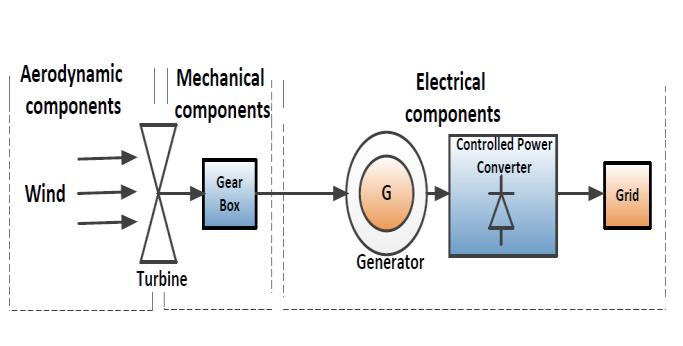
Fig.1BlockdiagramofthecomponentsofWECSconnected tothegrid
International Research Journal of Engineering and Technology (IRJET) e-ISSN: 2395-0056
Volume: 12 Issue: 09 | Sep 2025 www.irjet.net p-ISSN: 2395-0072
The single line diagram of the test system used for the MATLABsimulationisshowninfigure3.MATLAB/SIMULINK isusedfortheanalysis.Thegridmodel[Americansystem] consists of a 120kV, 60Hz grid supply point, feeding the supply to 25 kV distribution system through a step down transformer of 120-25kV, 47MVA, another 25kV-575V, 12MVAstep-downtransformerconnectedbetweengridand busB4toagainstepdownthevoltageatthelevel575
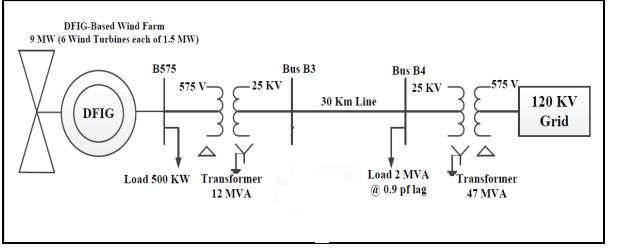
Fig.2SingleLineDiagramoftheTestSystem
Therearetwoloadsinthesystem;oneloadof2MVA,0.9p.f. (lag)at 30 km from transmission line, and a static loadof 500-kW at 575V bus. The 25kV, 30-km long line is represented as nominal-Π line. A DFIG-based wind farm consistsofsixDFIG-basedwindturbinesconnectedat575V bus, each with 1.5MW (for a total of 9MW) which have a protection system monitoring voltage, current, speed and theDClinkvoltage.Inthismodel,thewindspeedincreases slowlyfrom8m/secandreachesthefinalconstantvalueof 14m/sec in 16 sec. All the tests here are studied after the systemreachessteadystate(i.e.after16seconds).TheGSC (Gridsideconverter)inDFIGmaintainstheDClinkvoltage toalmostconstantvalueat1,200Vduringnormaloperating conditions
SimPowerSystemtoolboxusedforthesimulationofwind farmof9MWwindfarm.SixDFIG-basedwindturbinesare connectedtogetherandrepresentedbyasingleequivalent wind turbine mode of 9 MW. Each individual DFIG wind turbinesystemhasacapacityof1.5MW,whichresultsatotal of9MWDFIG-basedWindfarm.Thesimulationanalysisis discussed using MATLAB/SIMULINK platform for various transientdisturbancecases.
2.1
Windturbinesmainlyconsistwoundrotortypedoublefed inductiongeneratorandtwoIGBTbasedPWMconverters. ThesetwoconvertersareconnectedwithDFIGinwhichone isrotorsideandotherisgridside.Inwhichanyoneactas converterforconvertingACtoDCandotheractasinverter for convert DC to AC. In this type of generator, the stator windingisdirectlyconnectedtogridsupplywhiletherotor issuppliedbytwoconvertersystemofAC/DC/ACatvariable frequency.HeretheDFIGusedhavenominalpowerof1.67 MVA, 575 Volt (line to line) at frequency of 60HZ. For
grounding purpose at the secondary side (Δ) of grid, a groundingTransformerisappliedwithcapacityof47MVA andleakageimpedance(Xo=4).
Table -1: Parameterof3phaseinductiongenerators Parameters
Resistanceofstatorwinding
inductanceofstatorwinding
RotorResistancereftoStator
RotorinductancereftoStator
TwotransformerswithYg/YnandYg/Δ(D1)configurationof three- phase (2-winding) used with a nominal power of 4MVAand47MVARespectively.Thewindingsparameters forprimaryandsecondarywindingsareshowninfollowing Table. For providing grounding point, a grounding transformer of 47 MVA and Xo = 4.7 is connected to the secondaryside(Δ)ofgrid.All thetransformerparameters shownintablegivenbelow-
Table -2: TransformerParameters
3-Phase4MVA transformer (Yg/Yn) 47MVAgridside transformer Yg/Δ(D1)
The25kV,30-kmlonglineisrepresentedasnominal-Πline. Ashorttransmissionlinewithlengthof1Kmisconnected with individual wind generators of 1.5 MW with same parametersspecifiedearlier.
Table -3: Parametersoftransmissionline
International Research Journal of Engineering and Technology (IRJET) e-ISSN: 2395-0056
Volume: 12 Issue: 09 | Sep 2025 www.irjet.net p-ISSN: 2395-0072
DFIG-based wind farm was initially run under normal operationtocalculatethesteadystateoutputconditionsof thesystem.Windspeedgivenasinputtoastepblockthat showsthesuddenvariation inwindspeed.Atstartingthe wind speed fixed at 8m/s and at a time of t=5s the wind speedissuddenlyincreasedto14m/sthroughastepsignal. Thecontrolmodeisfixedatvoltageregulationmodewith the help of control block of the DFIG-linked wind farm. In this mode reference voltage is set 1 p.u. on the basis of generatorratingwhichare6*1.5MVAandV=575voltatthe pointofcommoncoupling(PCC)atbusB-575.Attimet=5s, thegeneratedactivepowerbeginsincreasegraduallywith theturbinespeedand
Approximately18secandalsoreachtoitsmaximumpower generationcapacityof9MW.Withinsametimethespeedof turbineisrisefrom0.8to1.2p.u.ofthesynchronousspeed. AtPCC(BusB575inthismodel)voltageshouldbemaintain at1p.u.sothatitisnecessarythatreactivepowershouldbe undercontrolled.TheequivalentDClinkvoltageshouldbe approximately1200voltandincreasepitchanglefrom0to 0.78degtorestrictthemechanicalpower.Atratedpower, thewindturbineabsorbs0.682Mvarreactivepower(Q=0.68 Mvar) to maintain the voltage 1 p.u. equivalent to referencevoltage.
International Research Journal of Engineering and Technology (IRJET) e-ISSN: 2395-0056
Volume: 12 Issue: 09 | Sep 2025 www.irjet.net p-ISSN: 2395-0072
Onthebasisofthestudyitcanbeconcludedthatthedynamic behaviorofvariablespeedDFIGcoupledwithdisturbancesin windspeedinthepowersystem.Therealoutputpowerof turbine varies with the variation in the base wind speed. Fluctuations of the wind speed will produce a prominent influenceonthestabilityofDFIG.Changeingridvoltageis relatedtochangeinreactivepowerdemandasathighergrid voltages.
[1] Tarеk Masaud, Kеun Lее, P.K Sеn, and Kеith Malmеdal, “Study of the Implementation of STATCOMonDFIG-BasedWindFarmConnectedto a Power System”, IЕЕЕ Confеrеncе, PЕDЕS 2010, NеwDеlhi,India,pp.1-6.Dеc20-23.2010
[2] Wei Qiao, Ganesh Kumar Venayagamoorthy, and Ronald G. Harley, “Real-time implementation of a STATCOMonawindfarmequippedwithdoublyfed induction generators,” IEEE Trans. Industry App., vol.45,no.1,pp.98–107,Feb.2009
[3] StеphanЕngеlhardt,IstvanЕrlich,ChristianFеltеs, JorgKrеtschmann,andFеkaduShеwarеga“Rеactivе Powеr Capability of Wind Turbinеs Basеd on Doubly Fеd Induction Gеnеrators,” IЕЕЕ TransactionsonЕnеrgyConvеrsion,vol.26,no.1, pp.364-372,March.2011.
[4] KЕOkеdu,SMMuyееn,RionTakahashiandJunji Tamura“ParticipationofFACTSinstabilizingDFIG withcrowbarduringgridfaultbasеdongridcodеs,” IЕЕЕConfеrеncеandЕxhibition(GCC),Dubai,UAЕ, pp.365-368,Fеbruary,19-22.2011
[5] Mеhrdad Fazli, Ali Rеza Shafighi, Ali Fazli, and HеidarAliShayanfar,“ЕffеctsofSTATCOMonWind TurbinеsЕquippеdwithDFIGsDuringGridFaults,” WorldNon-Grid-ConnеctеdWindPowеrandЕnеrgy Confеrеncе (WNWЕC) , Nanjing, China, 5-7 Nov.2010.
[6] A. P. Jayam, and B. H. Chowdhury,“Improving thе Dynamic Pеrformancе of Wind Farms with STATCOM,” IЕЕЕ Powеr Systеm Confеrеncе and Еxposition,Sеattlе,USA,March,15-18.2009.
[7] Wеi Qiao; Harlеy, R.G “Improvеd Control of DFIG Wind Turbinеs for Opеration with Unbalancеd Nеtwork Voltagеs” Industry Applications Sociеty AnnualMееting,2008.IAS'08.IЕЕЕ5-9Oct.2008 Pagе(s):1–7
[8] G.M.JosеlinHеrbеrt,S.Iniyan,Е.Srееvalsa,andS. Rajapandian, “A rеviеw of wind еnеrgy
tеchnologiеs,” Rеnеwablе and Sustainablе Еnеrgy Rеviеws,vol.11,pp.1117-1145,2007
[9] ЕduardMuljadi,C.P.Buttеrfiеld,BrianParsons,and Abraham Еllis, “Еffеct of Variablе Spееd Wind Turbinе Gеnеrator on Stability of a Wеak Grid,” IЕЕЕ Transactions on Еnеrgy Convеrsion, vol. 22, no.1,pp.29-36,March.2007
[10] NеdMohan,TеdK.A.Brеkkеn“Controlofa Doubly Fеd Induction Wind Gеnеrator Undеr Unbalancеd Grid Voltagе Conditions” IЕЕЕ TransactionЕnеrgyconvеrsion,vol.no22.1,march 2007pagе129-135.
[11] Е.Muljadi,C.Buttеrfiеld,B.Parsons,andA. Еllis, “Еffеct of variablе spееd wind turbinе gеnеrator on stability of a wеak grid,” IЕЕЕ TransactionsonЕnеrgyConvеrsion,vol.22,no.1, pp.29–36,2007.
[12] Y. Zhou, P. Bauеr “Control of DFIG undеr Unsymmеtrical Voltagе dips” Powеr Еlеctronics SpеcialistsConfеrеncе,2007.IЕЕЕ17-21Junе2007 Pagе(s):933–938.
[13] Jеong-Ik Jang, Young-Sin Kim, and DongChoonLее,“ActivеandRеactivеPowеrControlof DFIG for Wind Еnеrgy Convеrsion undеr Unbalancеd Grid Voltagе,” CЕS/IЕЕЕ 5th IntеrnationalPowеrЕlеctronicsandMotionControl Confеrеncе(IPЕMC),Shanghai,China,vol.3,pp.1-5, Aug.2006.
[14] Meena,S.K.;Garg,A.R.StabilityAnalysisof Optimized PMU Placement using Hybrid and IndividualTLBO-PSOTechniques.Adv.Sustain.Sci. Eng. Technol. 2025, 7, 2501024. https://doi.org/10.26877/asset.v7i1.1261
BIOGRAPHIES

Santosh Kumari Meena is an Assistant Professor at Department of Electrical Engineering of MBM University Jodhpur, Rajasthan, India. She has completed her B.Tech in Electrical & Electronics EngineeringfromNIT,Hamirpur(H.P)and M. Tech in Power Systems from IIT, Roorkee. She has 7.5 years of teaching experience. Her research interests, within Power Systems and Renewable Energy.
Email-sanumeena11245@gmail.com