
International Research Journal of Engineering and Technology (IRJET) e-ISSN: 2395-0056
Volume: 13 Issue: 03 | Mar 2026 www.irjet.net p-ISSN: 2395-0072
International Research Journal of Engineering and Technology (IRJET) e-ISSN: 2395-0056
Volume: 13 Issue: 03 | Mar 2026 www.irjet.net p-ISSN: 2395-0072
S.
Khadar Vali , S.Thouhid, C.R Niranjan Reddy , M.Mahaboob Basha , C.N Alowkika , S.Rajeswari
1,2,3,4,5,6 Electrical and Electronics Engineering Sanskriti School of Engineering Putaparthi, Andhra Pradesh
Abstract This paper presents the Artificial Intelligence Voice Assistant Robot capable of performing basic movement operations using wireless voice commands. The system is built around an Arduino microcontroller, which functions as the primary control unit. Voice commands are generated through a smartphone application and transmitted to the robot via a Bluetooth communication module. The received commands are processed by the Arduino, which controls the robot’s motion through DC motors driven by a motor driver circuit, enabling forward, backward, left, and right movements. To enhance operational safety, an ultrasonic sensor is integrated for obstacle detection, allowing the robot to prevent collisions by halting or restricting movement when an object is detected within a predefined range. Battery voltage is continuously monitored using a voltage sensor to ensure reliable power management. An LCD display and LED indicators provide real-time system status, command feedback, and battery information to the user. The proposed system offers a low-cost, hands-free, and user-friendly robotic solution that demonstrates effective integration of embedded systems and wireless communication technologies. Due to its simplicity, modular design, and reliable performance, the system is suitable for educational applications, smart automation, and assistive robotic systems.
Index Terms Voice-controlled robot, Arduino, Bluetooth com-munication, DC motor control, ultrasonic sensor, intelligent robotics
Recentadvancementsinrobotics,embeddedsystems,andwirelesscommunicationtechnologieshavesignificantlyin-creased interest in voice-controlled intelligent systems. Voice-controlled robots offer a natural and intuitive mode of interac-tion by allowinguserstocommunicatewithmachinesusingspokencommands,therebyeliminatingtheneedfortraditionalphysical controlinterfacessuchasswitches,joysticks,orkeyboards.Thishands-freeinteractionenhancesaccessibilityandeaseofuse, especially for elderly individuals and physi-cally challenged users. Voice-controlled robotic systems have found wide applications across various domains, including smart home automation, industrial control systems, assistive robotics, and educational platforms. In smart environments, such robots can perform tasks based on verbal instructions,while in industrial and assistive settings, they help reduce human effort and improve operational efficiency. In the ed-ucational domain, voice-controlled robots serve as effective learning tools for understanding concepts related to embedded systems, sensors, actuators, and wireless communication. This paper focuses on the design and development of a Voice Control AI RobotthatinterpretsvoicecommandstransmittedwirelesslythroughBluetoothcommunicationandexecutescorresponding movement actions. The system uses an Arduino microcontroller as the central control unit, which processes incoming commands and controls the robot’s motion accord-ingly. The robot is designed using low-cost, easily available, and widely supportedhardwarecomponents,makingitafford-ableandpracticalforstudents,hobbyists,andresearchers.Byintegrating motion control, obstacle detection, and real-time monitoring features into a single platform, the proposed sys-tem demonstrates the practical implementation of intelligent robotic control using simple yet effective technologies. The project providesastrongfoundationforfurtherresearchanddevelopmentinthefieldofintelligentandautonomousroboticsystems.
Voice-controlled robotic systems have attracted significant attention due to their ability to enhance human–machine interactionandautomation.Earlyroboticcontrolmethods primarily relied on physical interfaces such as switches, joysticks, and remote controllers. With advancements in wireless commu-nication technologies, researchers have explored Bluetooth-and Wi-Fi-based robotic control systems to improve flexi-bility and ease of use. Several studies have demonstrated the effectivenessofBluetooth-enabledrobotscontrolledusingsmartphoneapplications.Thesesystemsarewidelypreferreddue totheirlowcost,easeofimplementation,andcompatibil-itywithcommonlyavailablemobiledevices.Arduino-basedrobotic platforms have gained popularity in academic and research environments because of their open-source architec-ture, simplicity, and strong community support. Researchershavesuccessfullyimplementedvoice-controlledrobotsbyintegrating
International Research Journal of Engineering and Technology (IRJET) e-ISSN: 2395-0056
Volume: 13 Issue: 03 | Mar 2026 www.irjet.net
p-ISSN: 2395-0072
ArduinomicrocontrollerswithBluetoothmodulestointerpretvoicecommandsandcontrolmotoractions.Safetymechanisms have also been emphasized in previous research works. The use of ultrasonic sensors for obstacle detection has proven effective in minimizing collision risks and improving operational reliability. In addition, battery monitoring using voltage sensorshasbeenincorporatedinsomeroboticdesignstoensureefficientpowermanagementandpreventunexpectedsystem shutdowns. Although existing systems demonstrate reliable voice-based control, many lack integrated monitoring and realtimeuserfeedback.Theproposedsystemaddressestheselimitationsbycombiningvoicecontrol,obstacledetec-tion,battery monitoring, and display feedback into a single low-cost robotic platform suitable for educational, automation, and assistive applications.
The methodology of the proposed Voice Controlled AI Robot involves the systematic integration of hardware and software components to achieve reliable voice-based control and safe robotic operation. The overall working process is divided into multiple stages, including voice command genera-tion, wireless communication, command processing, actuation, and monitoring. Initially, the user provides voice commands through a smartphone application. The application converts the spoken commands into digital text-based instructions and transmits them wirelessly using Bluetooth communication. The Bluetooth module connected to the robot receives these commands and forwards them to the Arduino microcontroller. The Arduino functions as the central control unit and con-tinuously monitors incoming Bluetooth data. Upon receiv-ing a valid command, the microcontroller processes it using predefined control logic and determines the corresponding movement action. Control signals are then generated and sent to the motor driver circuit, which drives the DC motors to perform movements such as forward, backward, left, and right. Simultaneously, the ultrasonic sensor continuously measures the distance between the robot and nearby obstacles. If an obstacle is detected within a predefined threshold distance, the Arduino interrupts motor operation to prevent collision. The voltage sensor monitors battery levels in real time to ensure proper power management. An LCD display and LED indicators provide real-time feedback regarding system sta-tus, command execution, and battery voltage. This structured methodology ensures effective coordination between input, processing,andoutputmodules,resultinginareliable,safe,anduser-friendlyvoice-controlledroboticsystem.
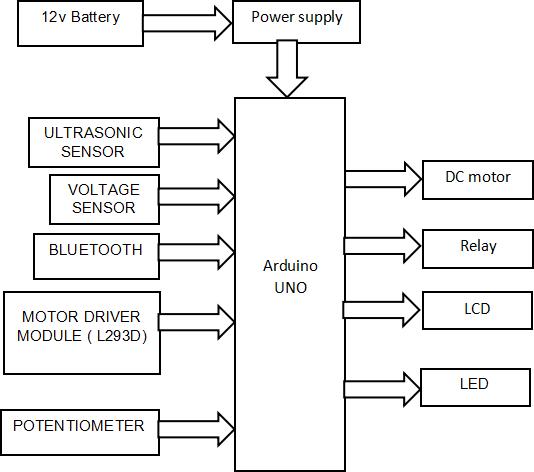
The system architecture of the proposed Voice Control AI Robot is designed to ensure efficient communication, accurate commandprocessing,andreliableexecutionofroboticactions.Theoverallsystemisdividedintothreemajorsubsystems: the Input and Communication System, the Control and Pro-cessing System, and the Actuation and Monitoring System.Each subsystemplaysacriticalroleinachievingsmoothandcoordinatedoperationoftherobot.
TheInputandCommunicationSystemisresponsibleforcapturinguservoicecommandsandtransmittingthemwire-lesslyto the robot. Voice commands are generated using a smartphone application, where spoken instructions are con-verted into digital text-based commands. These commands are then transmitted to the robot using a Bluetooth communication module. Bluetooth technology provides a simple, low-power, and reliable wireless interface suitable for short-range robotic control applications.
The Control and Processing System forms the core of the robot and is implemented using an Arduino microcontroller. The Arduino continuously receives command data from the Bluetooth module and processes it using predefined control logic. Based on the interpreted command, the microcontroller determines the appropriate action to be executed. In addition to motion control, the Arduino also processes data from various sensors such as the ultrasonic sensor and voltage sensor, enablingreal-timedecision-makingandsystemmonitoring.
TheActuationandMonitoringSystemexecutesthecom-mandsprocessedbythemicrocontrollerandprovidesfeedbacktothe user.DCmotorsdriventhroughamotordrivercircuitareusedtoperformdirectionalmovementssuchasforward,backward,
International Research Journal of Engineering and Technology (IRJET) e-ISSN: 2395-0056
Volume: 13 Issue: 03 | Mar 2026 www.irjet.net p-ISSN: 2395-0072
left, and right. An ultrasonic sensor is integrated to detect obstacles and enhance safety by preventing collisions. Monitoring components such as an LCD display and LED indicators provide real-time information regarding system sta-tus, received commands,andbatteryvoltage.Together,thesethreesubsystems work incoordinationtodelivera reliable, responsive, and user-friendlyvoice-controlledroboticsystem.
Themainhardwarecomponentsusedinthesysteminclude:
• Arduinomicrocontroller
• Bluetooth module
• DC motors with motor driver
• Ultrasonicsensor
• LCD display
• Voltagesensor
• Potentiometer
• Bluetooth speakerforAIvoiceresponse
• Smartphonewith GoogleGemini AIsupport
• 12Vrechargeablebattery
Thesecomponentsareinterconnectedusingconnectorsandsupportedbypropermechanicalarrangements.
The software design of the Voice Controlled AI Robot plays a crucial role in ensuring accurate interpretation of voice commandsandreliableexecutionofroboticmovements.ThecontrollogicisimplementedusingtheArduinoplatformand is responsible for handling communication, decision-making,andmotorcontrol.Thesoftwareisdesignedinamodularmanner toimprovereadability,flexibility,andeaseoffuturemodifications.
he voice command interface serves as the primary means of interaction between the user and the robot. A smartphone application is used to capture spoken voice commands from the user. These spoken commands are processed by the application and converted into text-based control signals. Once converted, the commands are transmitted wirelessly using Bluetoothcommunication.
The Bluetooth module connected to the Arduino receives these control signals and forwards them to the microcon-troller through serial communication. Bluetooth technology is chosen due to its low power consumption, ease of pairing, and reliability for short-range wireless communication. This interface enables hands-free and user-friendly control of the robot, eliminatingtheneedforphysicalinputdevices.
The Arduino microcontroller continuously monitors incom-ing data from the Bluetooth module using serial communica-tion protocols. Whena commandisreceived,themicrocon-trollercomparestheincomingdata withpredefinedcommandstrings suchasforward,backward,left,right,andstop.Thiscomparisonisperformedusingconditionallogicstructuresprogrammed withintheArduinosoftware.
Onceavalidcommandisidentified,theArduinoexecutesthecorrespondinglogicroutineassociatedwiththatcommand.Each routine defines a specific movement pattern or action to be performed bythe robot.Invalid or unrecognized commands are ignored to prevent unintended behavior. This approach en-sures reliable and accurate command interpretation, even in the presenceofcommunicationnoiseorpartialdatatransmission.
International Research Journal of Engineering and Technology (IRJET) e-ISSN: 2395-0056
Volume: 13 Issue: 03 | Mar 2026 www.irjet.net p-ISSN: 2395-0072
Themotorcontrolalgorithmisresponsiblefortranslatingprocessedcommandsintophysicalmotion.Basedontheout-putof the command processing stage, the Arduino generates digital control signals that are sent to the motor driver module. The motor driver acts as an interface between the low-power Arduino outputs and the higher power requirements of the DC motors.
Directional movement is achieved by varying the logic states of the motor driver input pins. By controlling the polarity and enable signals of the motor driver, the DC motors can be driven in forward or reverse directions. Different combinations of motoractivationallowtherobottomoveforward,backward,turnleft, orturnright.Thisstructuredmotorcontrolalgorithm ensuressmoothmovement,accuratedirectioncontrol,andsafeoperationoftheroboticsystem.
Based on the recognized command, the Arduino generates control signals to drive the DC motors through the motor driver circuit.
ToenhancetheintelligenceandinteractivityoftheproposedVoiceControlledAIRobot,anadditionalAIconversationalmodule using Google Gemini is integrated into the system.
Inthismodule,therobotisconnectedtoasmartphonethatrunstheGoogleGeminiAI assistant.Theusercommunicateswith therobotthroughvoiceinputusingthesmartphonemicrophone.
ThespokeninputisprocessedusingGemini’sadvancedNaturalLanguageProcessing(NLP)capabilities.Based on theuser’s query,theGeminiAIgeneratesanappropriateresponse.Thisresponseisthenconvertedintospeechusing thesmartphone’s text-to-speechfunctionality.
The generated audio output is transmitted to a Bluetooth speaker connected to the robot system. The speaker plays the response, allowing the robot to communicate with the userinrealtime.Thisfeatureenablestherobotnotonlytoexe-cute movementcommandsbutalsotoprovideconversationalresponsesandinformation.
The integration of Gemini AI significantly enhances the sys-tem functionality by enabling question answering, information retrieval,and interactive communication. This transformsthe robot from a simple voice-controlled device into an intelligent AIassistantcapableofhuman-likeinteraction.
Safety is a critical aspect of mobile robotic systems, par-ticularly when operating in dynamic environments. To ensure safe navigation, the proposed Voice Controlled AI Robot is equipped with an ultrasonic sensor for obstacle detection. The ultrasonicsensoroperatesbyemittinghigh-frequencyultrasonicpulsesandmeasuringthetimetakenforthereflectedsignals to return after striking an object. Using this time-of-flight information, the distance between the robot and the obstacle is calculated.
The Arduino microcontroller continuously monitors the distance data obtained from the ultrasonic sensor. If an ob-stacle is detected within a predefined threshold distance, the system automatically initiates a safety response. This response may include halting the robot’s movement or restricting fur-ther motion in the detected direction. By implementing this mechanism, the risk of collisions and potential damage to the robot or surrounding objects is significantly reduced. In additiontoobstacledetection,batterysafetyisensuredthroughcontinuousvoltagemonitoring.Avoltagesensormeasuresthe batterylevelinrealtimeandsendsthisdatatotheArduino.ThemeasuredvoltageisdisplayedontheLCD,enablingtheuser to monitor battery status and perform timely charging. This feature helps prevent deep discharge, extends battery life,and ensuresreliablesystemoperation.Batteryvoltageismonitoredusingavoltagesensor,andthemeasuredvaluesaredisplayed ontheLCDtopreventdeepdischarge.
International Research Journal of Engineering and Technology (IRJET) e-ISSN: 2395-0056
Volume: 13 Issue: 03 | Mar 2026 www.irjet.net p-ISSN: 2395-0072
The display and feedback system provides essential real-time information to the user, enhancing system usability and monitoring. An LCD display is integrated into the robot to present key operational parameters. The LCD displays the current system status, the most recently received voice command, and the battery voltage level. This visual feedbackallows userstoeasilyverifycorrectcommandexecutionandoverallsystemhealth.InadditiontotheLCD,redLEDsareusedasvisual indicators to represent different system states. These LEDs indicate power availability, command execution, and system activity,providingquickvisualconfirmationofrobotoperation.Apotentiometerisincludedtoallowuser-levelcustomization, such as adjusting the robot’s movement speed or modifying sensor sensitivity. This adjustability en-ables smoother control andadaptabilitytodifferentoperatingconditions
Thepowersupplysystemisdesignedtoprovidestableandreliableenergytoallelectroniccomponentsoftherobot.Therobot ispoweredusinga12Vrechargeablebattery,whichsup-pliessufficientcurrentfortheArduinomicrocontroller,motordriver, DCmotors,andsensors.Aslideswitchisincorporatedtoallowmanualcontrolofthepowersupply,enablingtheusertosafely turn the system ON or OFF. For charging purposes, a female power jack is provided, allowing the battery to be recharged using a 12V, 2A external adapter. Proper power regulation ensures that appropriate voltage levels are delivered to each component, preventing voltage fluctuations that could affect system performance. This power supply design ensures consistentoperation,enhancescomponentsafety,andsupportslong-termreliabilityoftheroboticsystem.
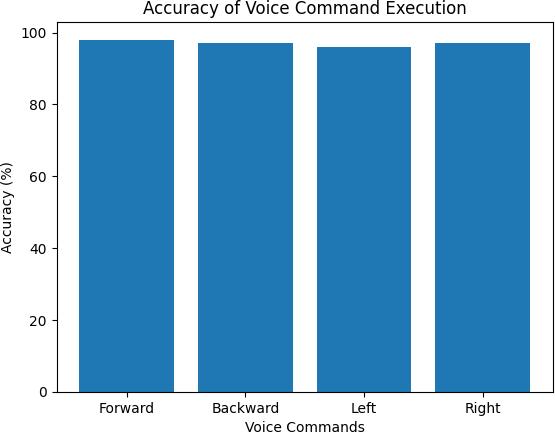
Fig.2illustratestheaccuracyofvoicecommandexecutionfordifferentmotioncommands,includingforward,backward,left, and right movements. The experimental results indicate that the proposed system achieved an accuracy ranging be-tween 96The consistent performance across different com-mands confirms that the Arduino-based processing and motor control algorithmsfunctionefficientlyundernormaloperatingconditions.Slightvariationsinaccuracywereobservedamongcertain commands,whichcanbeprimarilyattributedtoexter-nalfactorssuchasbackgroundenvironmentalnoise,variationsinuser speech pronunciation, and delays introduced during voice-to-text conversion in the smartphone application. Addi-tionally, minor latency in Bluetooth data transmission may also contribute to occasional command recognition errors. Despite these variations,theoverallresultsvalidatetherobustness andpracticalfeasibilityoftheproposedVoiceControlledAIRobot.The systemdemonstratesreliablecommand execution with minimal error rates, making itsuitable for real-worldapplicationsin educational,automation,andassistiveroboticsystems.
International Research Journal of Engineering and Technology (IRJET) e-ISSN: 2395-0056
Volume: 13 Issue: 03 | Mar 2026 www.irjet.net p-ISSN: 2395-0072
TheVoiceControlAIRobot canbeappliedin:
• Smarthome automation
• Assistiverobotics
• Educationalroboticslaboratories
• Hands-freenavigationsystems
• HealthcareandHospital Assistance
• AI-basedconversationalassistant
• EducationalAIinteractionplatform
This paper presented the design and implementation of a Voice Control AI Robot using Arduino and Bluetooth communication. The system offers reliable voice-based control,obstacle detection, and real-time monitoring in a cost-effective and expandable platform.The Voice Controlled AI Robot was successfully designed and implemented using Arduino and Bluetooth technology. The system effectively processes voice commands received from a smartphone application and performscorrespondingmovementoperationswithhighaccuracy.Theintegrationofanultrasonicsensorensuressafeoperation by preventing collisions, while battery voltage monitoring and real-timefeedbackthrough anLCDandLEDs enhancesystem reliability and usability. This project demonstrates the practical application of embedded systems, wireless communication, and basic robotics using low-cost components. Due to its simplicity, reliability, and expandability, the proposed system is suitableforeducationalpurposes,smartautomation,andas-sistiveroboticapplications,anditprovidesastrongfoundationfor futureenhancements.
Future enhancements may include IoT integration, onboard speech recognition, autonomous navigation, and camera-based visionsystems.TheproposedVoiceControlledAIRobotcanbeenhancedbyintegratingWi-FiandIoTtechnologiestoenable remote monitoring and control. Advanced AI-based voice recognition techniques can be implemented to improve command accuracy and support natural language interaction. In addition,autonomous navigation features may beintroduced to allow independent operation without continuous user input. The inclusion of camera-based vision systems can further extend the robot’s capabilities by enabling object detection and intelligent decision-making. These enhancements would broaden the system’sapplicabilityinsmartautomation,assis-tiverobotics,andadvancedresearchapplications.
International Research Journal of Engineering and Technology (IRJET) e-ISSN: 2395-0056
Volume: 13 Issue: 03 | Mar 2026 www.irjet.net p-ISSN: 2395-0072 © 2026, IRJET | Impact Factor value: 8.315 | ISO 9001:2008 Certified Journal | Page1031
[1]HC-05/HC-06 Bluetooth Module Datasheet, “Bluetooth Serial Commu-nication Module,” Electronics Manufacturer Documentation.
[2]S. Kumar, “Design and Implementation of an Arduino-Based Voice Controlled Robot,” International Journal of EngineeringResearch,vol. 9,no.4,pp.45–49,2021.
[3]M. Singh and R. Verma, “Bluetooth Controlled Robotic Systems Using Embedded Platforms,” Proceedings of the IEEE ConferenceonEmbedded Systems,pp.112–117,2020.
[4]J.J.Craig,IntroductiontoRobotics:MechanicsandControl,3rded., PearsonEducation,2019.
[5]R.Siegwart,I.R.Nourbakhsh,andD.Scaramuzza,Introductionto AutonomousMobileRobots,MITPress,2018.
[6]A.P.GodseandD.A.Godse,MicrocontrollersandApplications, TechnicalPublications,2017.
[7]UltrasonicSensorHC-SR04Datasheet,“UltrasonicDistanceMeasuring Sensor,”ElectronicsComponentDatasheet.
[8]L293DMotorDriverDatasheet,TexasInstruments,“QuadrupleHalf-H Driver,”2016.
[9]K.Ogata,ModernControlEngineering,5thed.,PrenticeHall,2016.