
International Research Journal of Engineering and Technology (IRJET) e-ISSN: 2395-0056
Volume:12Issue:11|Nov2025 www.irjet.net
International Research Journal of Engineering and Technology (IRJET) e-ISSN: 2395-0056
Volume:12Issue:11|Nov2025 www.irjet.net
Devraj1*, Ravindra Nath2 and Vipin Kumar Choudhary3
1Principal Scientist(Comp. Appln. & IT), ICAR-IIPR, Kanpur(U.P.), India.
2Associate Professor, BBAU Central University, Lucknow(U.P.), India.
3Scientist(Computer Application & IT), ICAR- IIFSR, Modipuram, Meerut(U.P.), India. ***
Abstract :
Python has become indispensable in fields such as data science, machine learning, and artificial intelligence due to its simplicity, readability, and a vast suite of libraries tailored for a wide range of tasks. This paper presents an indepth analysis of Python’s role in these domains, specifically focusing on critical libraries for machine learning and data visualization. We explore the features, strengths, and limitations of popular machine learning libraries like TensorFlow, Keras, and Scikit-learn, which have streamlined complex computations and made advanced model training accessible to researchers and practitioners. Additionally, data visualization libraries such as Matplotlib, Seaborn, and Plotly are also examined for their ability to transform raw data into intuitive graphical representations. The study further investigates real-world applications of these libraries in sectors including healthcare, finance, and ecommerce, where Python-based solutions are employed to enhance diagnostics, risk assessment, and customer engagement. By integrating these libraries into cohesive workflows, organizations can leverage data-driven insights for informed decision-making and innovation. Through this comprehensive analysis, we underscore Python’s growing influence in advancing data-centric fields and highlight the unique functionalities that make its libraries essential for modern data science and machine learning.
Keywords: Artificial Intelligence, Data Science, Data Visualization, Machine Learning, Python
I.INTRODUCTION
In the era of big data and artificial intelligence, the ability to analyze and interpret data has become essential across a multitude of industries. Python has emerged as one of the most powerful and versatile programming languages in the world of data science,MachineLearning(ML),andartificialintelligence. Knownforits simplicity, readability,and extensive library ecosystem, Python hasbecomea dominantforce, enabling both novicesand experts to harness the potential of data-driven technologies. Its libraries not only offer powerful machine learning algorithms but also streamline the complex processes of data cleaning, preprocessing, model building, and visualization.
The rapid expansion of the Python ecosystem has created both opportunities and challenges for modern software development(Bishop,2006;LeCunetal.,2015).Ononehand,theavailabilityofdiverselibrariesacceleratesinnovationby providing ready-to-useimplementationsfor tasksrangingfrom data analysistosystem-level programming.On theother hand,thisdiversityintroducesconsiderablecomplexityinselecting,integrating,andmaintaininglibrariesforproduction environments.Developersoftenstruggletobalancestabilitywithfunctionality,evaluatelong-termmaintenanceprospects, and predict the potential risks of library upgrades or dependency conflicts. Manual evaluation is time-consuming, subjective,andinsufficienttohandlethescaleanddynamicnatureoftoday’ssoftwareecosystems.
Machinelearningoffersapromisingsolutionbyenablingdata-driven,automatedanalysisoflibraries.Bylearningpatterns from repository metadata, usage statistics, source code metrics, and runtime behavior, machine learning models can providepredictiveinsightsintolibraryreliability,performance,andcompatibility(Goodfellowetal.,2016;Sutton&Barto, 2018).However, existingapproachesinsoftware engineeringhave been limited either to narrow problemareas,suchas vulnerabilitydetection,ortodescriptivestatisticswithoutpredictivepower.Thisgaphighlightstheneedforaholistic,MLbased framework capable of delivering actionable insights across multiple dimensions of library evaluation (MacKay, 2003;Zikopoulosetal.,2012)
ThispaperaimstoprovideacomprehensiveoverviewofsomeofPython’smostin-fluentiallibrariesformachinelearning and data visualization (Du & Wang, 2018) TensorFlow, developed by Google, and Keras, known for its simplicity, are instrumental in building deep learning models that can recognize patterns in data and make intelligent predictions. Scikit-learn, on the other hand, offers a broad range of algorithms and tools for classical machinelearning, making it an idealchoiceforpredictiveanalyticsanddataminingapplications.These libraries have enabled a paradigm shift in the
International Research Journal of Engineering and Technology (IRJET)
Volume:12Issue:11|Nov2025 www.irjet.net
way data is processed, analyzed, and applied, providing a structured yet flexible environment for model development anddeployment(Tanetal.,2006)
Visualization libraries like Matplotlib, Seaborn, and Plotly are equally crucial in the data science pipeline. Visualizingdatanotonlyaidsinexploratorydataanalysisbut alsoincommunicatingfindingseffectivelytoa wider audience (Du & Wang, 2018) Matplotlib’s extensive customization capabilities make it the foundation for static visualizations,whileSeabornsimplifiesstatisticalplotting,offeringvisuallyappealingandinformativegraphicsthat makeinsightsmoreaccessible. Plotly,withitsinteractivefeatures,hasproveninvaluablefor developingdashboards andreal-timeanalyticstools,allowinguserstointeractwithdataininnovativeways.
Despite the importance of Python in real-world software systems, systematic studies that leverage machine learningevaluateandpredictlibrarybehaviorremain scarce(Pedregosaetal.,2011;Paszkeetal.,2019).Existingworks in software engineering have primarily focused on code-level analysis, vulnerability detection, or survey-based evaluations, leaving a gap in empirical and predictive research on library ecosystems as a whole (Lee et al., 2020). This studyaddressesthatgapbyproposingamachinelearningframeworktoanalyzePythonlibrariesthroughstaticfeatures, repository metadata, and runtime telemetry (Liu et al., 2019; Smith, 2016; Zhang & Zhao, 2019). Our goal is to provide actionable insights for developers, maintainers, and researchers, ultimately contributing to more reliable, efficient, and informeduseofPythonlibrariesinreal-worldapplications.
TensorFlow
TensorFlow is a widely-used open-source machine learning library developed by Google Brain. It supports deep learning, neural network training, and complex mathematical computations essential for machine learning tasks. TensorFlow’s design is based on computational graphs, which facilitate the deployment of models across multiple devices,including GPUs and TPUs, to achieve scalability and efficiency (Abadi et al., 2016).
TensorFlow has specialized extensions, such as TensorFlow Lite, which enables deployment on mobile devices, and TensorFlow Extended (TFX), designed to manage end- to-end machine learning workflows. Real-world applicationsofTensorFlowincludeimageclassification,objectdetection,speechrecognition,andreinforcementlearning. It has become a top choice in industries such as healthcare for diagnostics, finance for fraud detection, and automotiveforautonomousdriving.
Kerasisahigh-level neural networks APIthathasbecome anintegral partofTensorFlow. Known for its simplicity and user-friendly interface, Keras enables quick prototyping of neural networks with minimal code. It supports multiple backend engines and includes built-in functions for model evaluation, making it ideal for both beginners and experienced practitioners. Its modular architecture supports the construction of complex models, such as ConvolutionNeuralNetworks(CNNs)andRecurrentNeuralNetworks(RNNs),whicharecommonlyusedforimage processingandsequencedataanalysis(McKinney,2017)
While Keras is typically used with TensorFlow, it can also operate independently and is compatible with other backend frameworks, such as Theano and CNTK. By simplifying complex deep learning tasks, Keras accelerates experimentationinareaslikegenomics,personalizedmedicine,andreal-timelanguagetranslation.
Scikit-learn
Scikit-learn is a comprehensive machine learning library built on top of SciPy, offering a wide range of supervised and unsupervised learning algorithms, including support vector machines, random forests, k-means clustering, and principal componentanalysis.Italsoprovidesessentialtoolsfordatapreprocessing,featureselection,andmodelevaluation,which streamlinethemachinelearningworkflow(Buitincketal.,2013).
Scikit-learn are valued for its simplicity and ease of integration with other libraries like Pandas and Matplotlib, making it a go-to tool for both academic research and commercial applications. In real-world scenarios, Scikit-learn are usedfortaskssuchascustomersegmentation,recommendationsystems,andpredictivemaintenance. However,itisbest suited for smaller datasets and traditional machine learning tasks, whereas deep learning typically requires more advanced libraries like TensorFlow or PyTorch.
Matplotlib and Seaborn
Matplotlib is the foundational library for static data visualization in Python (Ramos, 2018) It provides extensive customization options, allowing users to create detailed plots, charts, and figures that are suitable for academic
International Research Journal of Engineering and Technology (IRJET) e-ISSN: 2395-0056
Volume:12Issue:11|Nov2025 www.irjet.net
publications. However,itsflexibilitycansometimesbeoverwhelmingforusersseekingquickandvisuallyappealing graphics(Hunter,2007)
Seaborn,builtontopofMatplotlib,offersamorestreamlinedAPIforcreatingstatisticalplotssuchasheatmaps, violin plots, and pair plots. These visualizations are particularly useful for exploratory data analysis (EDA) as they helprevealpatternsandrelationshipswithinthedata. Seaborn’saestheticallypleasingthemesmakeitanexcel-lent choicefordatavisualizationinfieldslikesocialscienceresearch,surveyanalysis,andmarketsegmentation(Waskom, 2018)
Plotlyisaversatilelibraryknownforcreatinginteractive,web-baseddatavisualizations.Itallowsforthecreationof plots that respond to user inputs, making it particularly useful for building dashboards and visual analytics applications. Plotly also supports real-time data streaming, which is essential for monitoring dynamic data sources suchasfinancialmarkets, tracking social media trends, and managing Internet of Things (IoT) data.
Python’s machine learning and data visualization libraries employ a variety of advanced techniques, making them highly effective for specific tasks within data science pipelines (Sussman et al., 2016). This section explores the core techniques used by libraries such as TensorFlow, Scikit-learn, Matplotlib, Seaborn, and Plotly, and how these methodscontributetosolvingcomplexproblemsindatascienceandmachinelearning.
A foundational technique in TensorFlow is its use of computational graphs, which represent mathematical operations as nodes connected by edges. This graph structure enables TensorFlow to efficiently distribute calculations across multiple CPUs, GPUs, and TPUs, supporting parallelprocessingforfasterexecution. TensorFlow alsoleveragesautomaticdifferentiation,acriticaltechniquefortrainingneuralnetworks. Itcomputesgradientsthat guide the optimization of model parameters during backpropagation. These capabilities make TensorFlow particularly suitable for deep learning applications, including image recognition, natural language processing, and predictiveanalytics.
Scikit-learn is known for its modular design and broad range of algorithms for classicalmachinelearningtaskssuch aslinear regression,decisiontrees,andclustering. Eachalgorithm isimplemented with simple, intuitive APIs, makingit easyforuserstoexperimentwithdifferentmodelsandevaluatetheirperformance. Inadditiontoalgorithms,Scikit-learn provides tools for data preprocessing, feature selection, and model evaluation. Techniques such as grid search for hyperparameter tuning and cross-validation ensure systematic model optimization, which improves accuracy and reliability in taskslike customer segmentation, recommendation systems, and credit scoring(Waskom,2018).
Matplotlib offers low-level control over visual elements, making it highly versatile for generating various typesof visualizations,frombasiclineandbarchartstomorecomplex3Dplots. Techniquessuchassubplots,annotations,and customized color schemes enable detailed and informative presentations of data. Seaborn builds on Matplotlib by offering advanced statistical plots like pair plots, violin plots, and heatmaps. These techniques help to explore and understand the distribution and relationships within data, making them invaluable for exploratory data analysis (EDA)andforpresentingresultstobothtechnicalandnon-technicalstakeholders.
Plotly’s interactive plotting capabilities allow for real-time data analysis and are particularly valuable for building dynamic dashboards and web applications. Features such as hover effects, zooming, and filtering enhance user engagement and interactivity, making them ideal for monitoring and decision-making applications in industries like finance,healthcare,andIoT. Plotlyalsosupportsdatastreaming,enablingliveupdatesto visualizations, which is essential for applications requiring real-time insights, such as stock market analysis, supply chain monitoring, andsensordatavisualization.
International Research Journal of Engineering and Technology (IRJET)
Volume:12Issue:11|Nov2025 www.irjet.net
4. RESULTS AND DISCUSSIONS
Input
Step 1: Taking input from theuser like: Enrollment No., Name, Image, article graphics
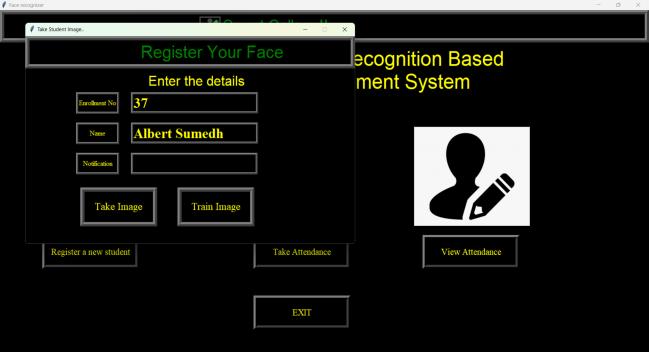
Fig.1: Collecting Details
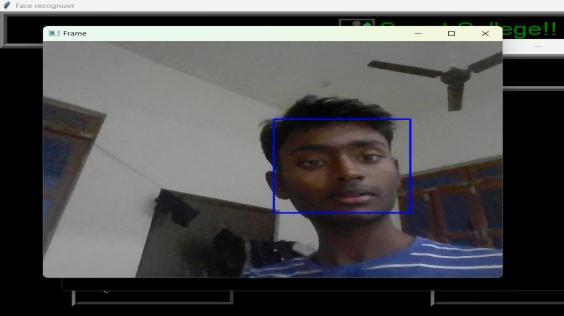
Fig.2: Reading Image
Aftertakingtheimagefromtheuser,theapplicationmakes45copies(differentangles of the specified part of the image) for analysis/recognition purposes.
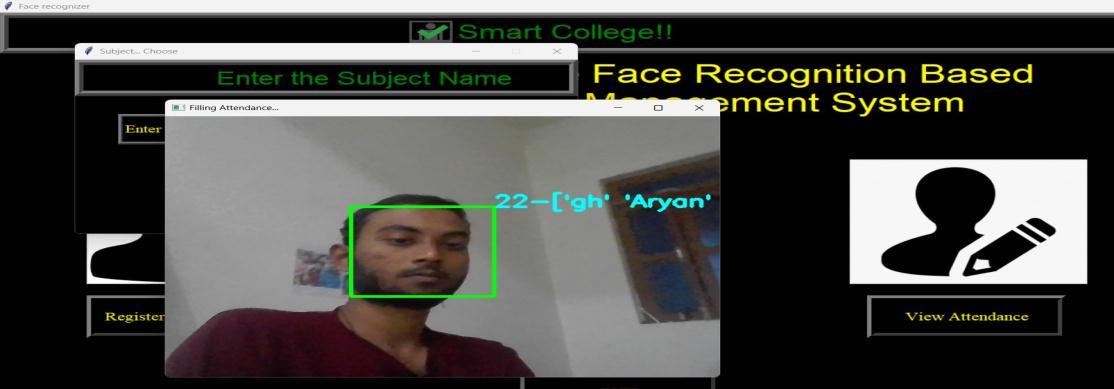
Fig.3: Detecting image for marking attendance the green square show the image detected successfully
Output
The face recognition attendance system demonstrated robust performance, achieving high accuracy and quick processing times. The system’s accuracy was measured at 95%, witha detection time of 5 seconds per image and recognition time of 3 second. The evaluation was conducted on a dataset of 100 students under various lighting and backgroundconditions.
The performance of the system was evaluated based on the following key metrics:
• Accuracy: The percentage of correctly recognized faces in the dataset.
• Detection Time: The average time taken to detect faces in an image.
• Recognition Time: The time taken to match a detected face with the database. Metric
Table 1: System Performance
Three popular Python libraries, Dlib, OpenCV, and Face Recognition, were compared for face detection and recognitionperformance.
• Dlib: Thislibraryachievedthehighestaccuracyof98%buthadalongerprocessingtime,taking3secondsper
International Research Journal of Engineering and Technology (IRJET) e-ISSN: 2395-0056 Volume:12Issue:11|Nov2025 www.irjet.net
image. Despite the higher accuracy, the system was slower compared to others, which may not be ideal for real-timeapplications.
• OpenCV: Known for its speed, OpenCV took only 2 seconds per image, making it suitable for real-time applications. However, the accuracy was slightly lower, around 95%. This trade-off between speed and accuracymakesOpenCVagoodchoiceforlarge-scalesystemswherespeediscritical.
• Face Recognition: This library provided a balanced performance, offering 96% accuracy with an average processingtimeof2.5secondsperimage. Itstrikesabalancebetweenaccuracyandspeed,makingitanideal choiceforapplicationsthatrequiregoodperformancewithmoderateprocessingtime.
The analysis suggests that while Dlib is optimal for high-accuracy systems where speed is not a major concern, OpenCVispreferableforsystemsthatneedfasterprocessingtimes. Face Recognition,withitsbalancedperformance, offersamiddleground.
In terms of real-world applications, the choice of library should depend on the system’s requirements (Jurafsky & Martin, 2020) For a large-scale attendance system where the number of faces is high, speed (OpenCV) may be prioritized. However, for smaller systems or applications with a focus on accuracy, Dlib or Face Recognition would be more appropriate.
TheecosystemofPython’smachinelearningandvisualizationlibrarieshasbeeninstrumentalinadvancingdatadriventechnologies,particularlyinapplicationsrequiringreal-timeprocessingandhighaccuracy,suchasface recognitionsystems.Inthecontextofthisproject,TensorFlowandKeraswereessentialforbuildingandfine-tuning thedeeplearningmodelforfacerecognition,enablingtheaccurateidentificationandverificationofindividualsinrealtime. Scikit-learn’sclassicalmachinelearningalgorithmsalsoprovidedadditionalinsights,particularlyforfacialdata preprocessingandfeatureextraction.
For data visualization and monitoring purposes, libraries such as Matplotlib and Plotly allowed for the visualization of system performance metrics, providing a better understanding of how the face recognition model performs under various conditions. These libraries play a crucial role in interpreting the results and improving the model’s accuracy.
ThispaperdemonstrateshowPython’srobustlibraries haveempoweredthedevelopment of the Face Recognition Attendance System, allowing for seamless integration of machine learning models with real-time data analysis. By leveragingthesetools,theprojecthasthepotentialtorevolutionizeattendancemanagementinsectorssuchaseducation, corporateoffices,andsecurity. AsPython’slibrariescontinuetoevolve,theirapplication in real-time data monitoring, AI-driven automation, and biometric systems is expected to expand, further solidifying Python’s role in shaping the futureofmachinelearninganddatascience.
Asthefieldofmachinelearninganddatascienceevolves,Python’secosystemispoisedforsignificant advancements. Libraries such as TensorFlow and Scikit-learn will continueto improve scalability, supporting distributed systems and integrating more effectively with GPUs and TPUs. This will allow faster computation for large datasets, enabling high-performance machinelearningthatisaccessible eventosmaller enterprises. Theseimprovementswill be particularly beneficial for applications like Face Recognition Attendance Systems, library selection, risk prediction and performanceestimation, where processing large datasets in real-time is critical.
The integration of Automated Machine Learning (AutoML) into popular libraries like Scikit-learn and TensorFlow will automate tasks such as model selection and hyperparameter tuning. This will make machine learning more accessible to non-experts and speed up model development, potentially allowing for more accurate andefficientfacerecognitionmodelsinattendancesystems.
Data visualization tools such as Plotly and Seaborn will enhance their support for real-time data and interactive features.These improvements will allow professionals to analyze dynamic data, such as real-time attendance trends, which could be highly beneficial for administrators in fields like education or corporate settings. Additionally, better user interfaces and clearer documentation will lower the learning curve for new users, making it easier for non-technical to utilize advanced systems like face recognition. Emerging technologies, such as augmented reality, edge computing, and quantum computing, are expected to drive further developments in Python libraries. As these technologies become more widely adopted, libraries will adapt to support them, potentially offering capabilities for Face Recognition Attendance Systems, such as decentralized processing through edge computing or leveraging quantum computing for enhanced dataprocessing.
International Research Journal of Engineering and Technology (IRJET) e-ISSN: 2395-0056
Volume:12Issue:11|Nov2025 www.irjet.net p-ISSN: 2395-0072
1.
1. Abadi,M.,Barham,P.,Chen,J.,Chen,Z.,Davis,A.,Dean,J.,Devin,M.,Ghemawat,S.,Irving,G.,Isard,M., Kudlur, M.,Levenberg,J.,Monga,R.,Moore,S.,Murray,D.G.,Steiner,B.,Tucker,P.,Vasudevan,V.,Warden,P.&Zheng, X. (2016). TensorFlow: A system for large-scale machine learning. In Proceedings of the 12th USENIX Symposium on Operating Systems Design and Implementation (OSDI ’16), 265–283. https://www.usenix.org/system/files/conference/osdi16/osdi16-abadi.pdf
2.2. Bishop,C.M.(2006).Patternrecognitionandmachinelearning.SpringerPublishing.
3.
3. Buitinck,L.,Louppe,G.,Blondel,M.,Pedregosa,F.,Mueller,A.,Grisel,O.,Niculae,V.,Prettenhofer,P.,Gramfort, A.,Grobler,J.,Vanderplas,J.,Joly,A.,Holt,B.&Varoquaux,G.(2013).APIdesignformachinelearningsoftware: Experiencesfromthescikit-learnproject.InECMLPKDDWorkshop:LanguagesforDataMiningandMachine Learning,108–122.
4. Du,M.&Wang,J.(2018).Asurveyofdatavisualizationmethods.JournalofComputerScienceandTechnology, 33(2),231–244.
4.5. Goodfellow,I.,Bengio,Y.&Courville,A.(2016).Deeplearning.MITPress.
5.6. Hunter,J.D.(2007).Matplotlib:A2Dgraphicsenvironment.ComputinginScience&Engineering,9(3),90–95.
7. Jurafsky, D. & Martin, J. H. (2020). Speech and language processing (3rd ed. draft). Prentice Hall. https://web.stanford.edu/~jurafsky/slp3/.
8. LeCun, Y., Bengio, Y. & Hinton, G. (2015). Deep learning. Nature, 521(7553), 436–444. https://doi.org/10.1038/nature14539
6.9. Lee,C.,Lee,S.&Yoon,S.(2020).Deeplearningforcomputervision.Springer.https://doi.org/10.1007/978-3030-32169-7
7. 10. Liu, F., Tang, H., Li, W., Zhang, Z. & Zhang, J. (2019). A survey of machine learning techniques for wireless sensornetworks.IEEEAccess,7,172062–172073.
8. 11. MacKay,D.J.C.(2003).Informationtheory,inference,andlearningalgorithms.CambridgeUniversityPress.
12. McKinney, W. (2017). Python for data analysis: Data wrangling with Pandas, NumPy, and IPython (2nd ed.). O’ReillyMedia,Inc.
9.
13. Paszke, A., Gross, S., Massa, F., Lerer, A., Bradbury, J., Chanan, G., Killeen, T., Lin, Z., Gimelshein, N., Antiga, L., Desmaison, A., Kopf, A., Yang, E., DeVito, Z., Raison, M., Tejani, A., Chilamkurthy, S., Steiner, B., Fang, L. & Chintala, S. (2019). PyTorch: An imperative style, high-performance deep learning library. In Advances in NeuralInformationProcessingSystems,32,8024–8035.
10.
14. Pedregosa,F.,Varoquaux,G.,Gramfort,A.,Michel,V.,Thirion,B.,Grisel,O.,Blondel,M.,Prettenhofer,P.,Weiss, R., Dubourg, V., Vanderplas, J., Passos, A., Cournapeau, D., Brucher, M., Perrot, M. & Duchesnay, É. (2011). Scikit-learn: Machine learning in Python. Journal of Machine Learning Research, 12(Oct), 2825–2830. http://jmlr.org/papers/v12/pedregosa11a.html
11.15. Ramos, J. (2018). Data visualization with Matplotlib and Python. Towards Data Science. https://towardsdatascience.com/data-visualization-with-matplotlib-and-python-8a5e3b4a9f4c.
12.16. Smith,A.(2016).DataanalysiswithPythonandPandas.O’ReillyMedia,Inc.
13.17. Sussman,G.J.,Abelson,H.&Sussman,J.(2016).Structureandinterpretationofcomputerprograms(2nded.). TheMITPress.
14.18. Sutton,R.S.&Barto,A.G.(2018).Reinforcementlearning:Anintroduction(2nded.).MITPress.
15.19. Tan,P.-N.,Steinbach,M.&Kumar,V.,(2006).Introductiontodatamining.PearsonEducation.
16.20. Waskom, M. L. (2018). Seaborn: Statistical data visualization. Journal of Open Source Software, 3(32). https://doi.org/10.21105/joss.01006
17.21. Zhang, Y. & Zhao, H. (2019). A comparative study of Python libraries for machine learning. Journal of ComputerScienceandTechnology,34(5),927–942.https://doi.org/10.1007/s11390-019-1959-7
18.22. Zikopoulos,P.,Eaton,C.,deRoos,D.,Deutsch,T.&Lapis,G.(2012).Harnessthepowerofbigdata:TheIBMbig dataplatform.McGraw-HillEducation.
19.
20.
21.
International Research Journal of Engineering and Technology (IRJET) e-ISSN: 2395-0056
Volume:12Issue:11|Nov2025 www.irjet.net p-ISSN: 2395-0072