
International Research Journal of Engineering and Technology (IRJET) e-ISSN:2395-0056
Volume:12Issue:04|Apr2025 www.irjet.net p-ISSN:2395-0072
International Research Journal of Engineering and Technology (IRJET) e-ISSN:2395-0056
Volume:12Issue:04|Apr2025 www.irjet.net p-ISSN:2395-0072
Manikandan C1 , Dr. P.Manibalan2
1PG Student, M.Tech Structural Engineering, SRM Institute of Science and Technology, Chennai, India
2Assistant Professor, Civil Department, SRM Institute of Science and Technology, Chennai, India
Abstract - The presence of soft storeys in multi-storey buildinghasbeenacriticalconcerninstructuralengineering, especially under seismic loading conditions. A soft storey, typicallycharacterizedbyasignificantreductioninstiffnessor strength compared to adjacent storeys, often occurs due to architectural requirements such as open ground floor for parking.Theseirregularitiescanleadtocatastrophicfailures during earthquakes. This project focuses on the detailed analysis of soft storey behavior in a 15-storey reinforced concrete building using ETABS software. Loads are applied according to IS 875 for gravity loads and IS 1893 for Earthquake forces. Various advanced structural configurations such as bracings, Blade columns are incorporated to mitigate the adverse effect of soft storey mechanisms. Comparative studies are performed between conventional and improved configurations to assess changes in parameters like inter-storey drift, base shear, lateral displacement. The study aims to understand how different designconfigurationscanimprovethestructuralperformance and overall stability of buildings with soft storeys. This research highlights the importance of early identification of soft storey vulnerabilities through computational modelling and analysis, ultimately contributing to safer building practices.
Key Words: Softstorey,Seismic,ETABS,Bracing,lateral Stiffness,Drift
Softstoreyfailuresinmulti-storeybuildingshavebecomea major concern in seismic-prone regions. A soft storey typicallyoccursatthegroundlevelduetoopenspacesfor parkingorcommercialuse,leadingtoreducedstiffnessand strength in that storey. This irregularity can cause severe structural damage or collapse during earthquakes. This project aims to analyze the behaviour of a 15-storey reinforcedconcretebuildingwithasoftstoreyusingETABS Software. According to the seismic code IS 1893 (Part 1): 2016, a soft storey is mentioned as one whose lateral stiffnessislessthan70%ofthatofthestoreyimmediately aboveitorlessthan80%ofaveragelateralstiffnessofthe threestoreysabove.
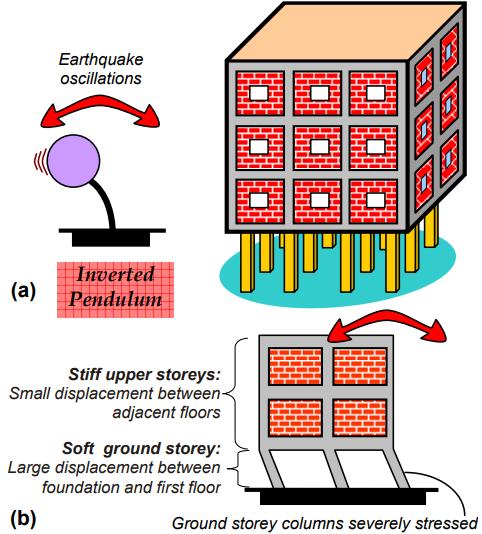
Inmanymulti-storeyedbuildings,thegroundfloorisoften designed with fewer partition walls or open spaces for parking or commercial use. This results in a significant difference in stiffness between the ground level and the upper floors, which typically have more infill walls. This stiffnessirregularitycausestheupperstoreystobehaveasa rigidunit,whilethegroundstoreyexperiencesmostofthe lateraldisplacementduringanearthquake.Suchacondition, commonly referred to as a “soft storey” leads to excessive movement atthe base of the structure,creatinga swaying effectsimilartothatofaninvertedpendulum.Thisamplifies the seismic force on the ground floor columns and beams, makingthemhighlyvulnerable.Toensurestructuralsafety,it is crucial that these elements are designed with sufficient strengthandductilitytoresistsuchdynamiceffects.
The primary purpose of this research is to conduct a comprehensive analysis of the seismic performance of reinforcedconcretebuildingsincorporatingasoftstoreyat the ground level. Soft storeys, typically characterized by
International Research Journal of Engineering and Technology (IRJET) e-ISSN:2395-0056
Volume:12Issue:04|Apr2025 www.irjet.net p-ISSN:2395-0072
significantlyreducedstiffnessduetoopenspacesorweaker lateral load resisting elements, are highly vulnerable to seismic forces and have been a major cause of structural failureinpastearthquakes.
This study utilizes ETABS Software to perform a Dynamic analysis of multi-storeyed RC Structures with soft storey, focusing primarily on two configurations one is concrete bracing and other one is with blade columns. These two design strategies are selected for their practicality and effectiveness in modifying the lateral stiffness. The research aims to assess and compare the seismic response of soft storey buildings in their original and modifiedforms,examiningcriticalparameterssuchasinter storey drift, base shear, displacement profiles and modal behavior.Throughthiscomparativestudy,theobjectiveisto determinewhichconfigurationprovidesbetterperformance under suitable structural recommendations for mitigating softstoreyeffectsinfuturedesigns.
Ultimately,thestudyaspirestocontributetosaferstructural practices in earthquake-prone regions by offering datadriven insights and practical solutions to the engineering challengesposedbysoftstoreyconfigurations.
Thebehaviourofsoftstoreystructuresunderseismicloads hasbeenasignificantfocusofrecentresearch.
[1] TebasalimIbrahim&HallaJasemMohammed(2024)
– Effect of soft storey locations on the Nonlinear Time History analysis of Multistoreyed Reinforced concrete Buildings, Civil and Environmental Engineering In this paper investigated the influence of soft storey locations on the non linear time history analysis of multistoreyed reinforced concrete buildings. Their work highlightshowtheplacementofasoftstoreycancritically affectthedynamicresponseandvulnerabilityofabuilding duringanearthquake.
[2] A.A. Mali&P.M.Mohite(2023)-Seismicbehaviorof buildingwithsoftstorey:Review,Internationaljournal for Research in Applied Science & Engineering Technology
In this research conducted a comprehensive review of the seismic behavior of buildings with soft storeys. They emphasizedtheneedforadeeperunderstandingoffailure mechanisms,suggestingthatthepresenceofasoftstoreycan severely compromise the overall seismic resilience of structures.
[3] Trishir Patel & Milli Shakhla (2024)- Seismic performance of soft storey Building with Dampers, International Research journal of Engineering and Technology.
Exploredtheperformanceofsoftstoreybuildingsenhanced with dampers. Their findings demonstrate that the
incorporationofdamperscansignificantlyimproveseismic performance by controlling displacement and reducing structuraldamage.
[4] Akshay Shaji etal.(2019) – Seismic Analysis ofSoft storey Buildings, International Journal of Scientific & Engineering Research. Analyzedtheseismicperformanceofsoftstoreybuildings, identifyingcriticalissuessuchasincreasedinterstoreydrift andvulnerabilitytocollapseunderseismicexcitation.Study reinforces the importance of robust design approaches to ensuresafety.
[5] PraveshGairola&SangeetaDhyani(2019) – Seismic analysisofopensoftstoreyBuildingforDifferentModels, International Journal of Engineering Research & Technology.
Study focused on the seismic analysis of open soft storey buildings for different models. Their results suggest that various design modifications can influence the dynamic characteristics and help in achieving better seismic performanceforsuchstructures.
Threedistinctmodelswereselectedfortheanalysis.
Model1:Structurewithsoftstorey
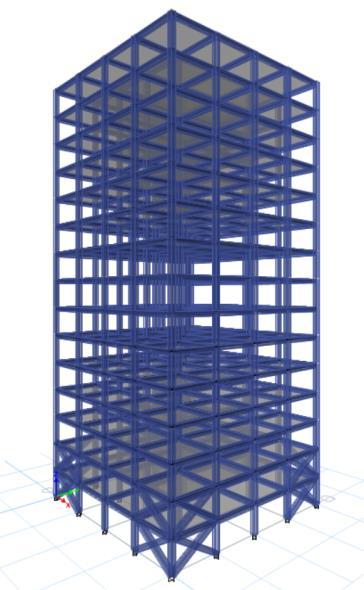
Model2:StructurewithConcretebraceatcorners
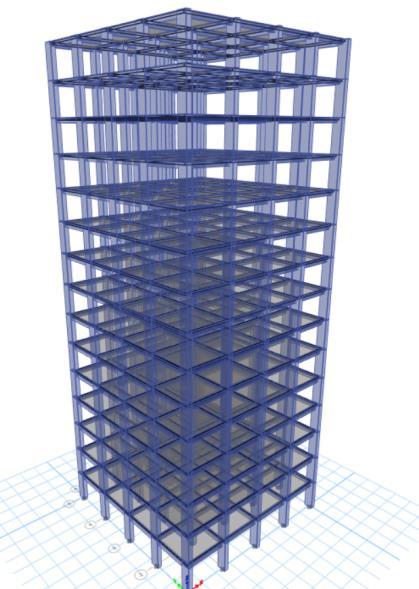
Model3:Structurewithbladecolumns
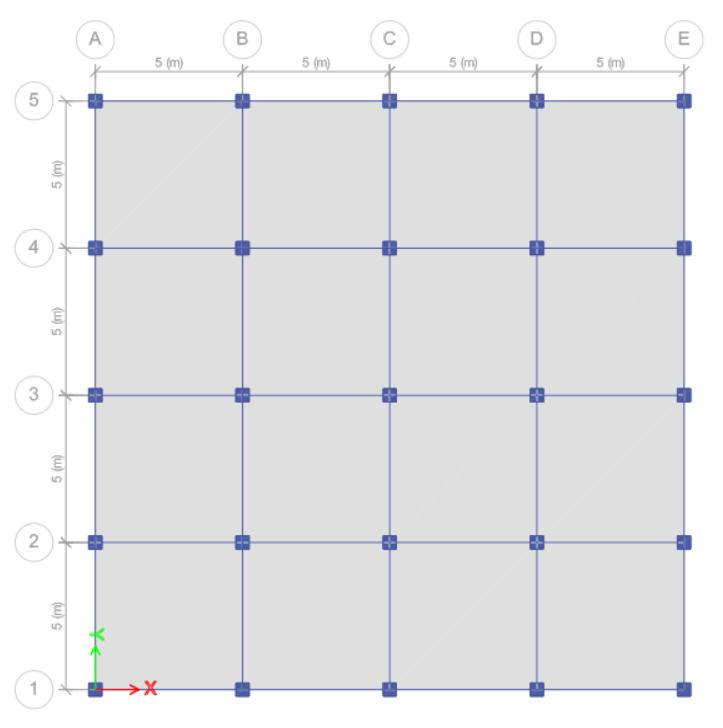
A structural model of a 15-storey building was modelled, featuringbaysspaced5m apartandanuniformfloorplan. Thebaseofthestructureconsideredasrigid.Modellingand analysis were done using the ETABS Program. The study focusedonevaluatingthestructuralbehaviorbyexamining inter-storeydisplacement,driftandbaseshearalongXandY axes.Designparameters,includingdimensionsandloading, weredeterminedbasedontheprovisionsofIS456:2000and IS875.
3.1 Model 1- Structure with soft storey:
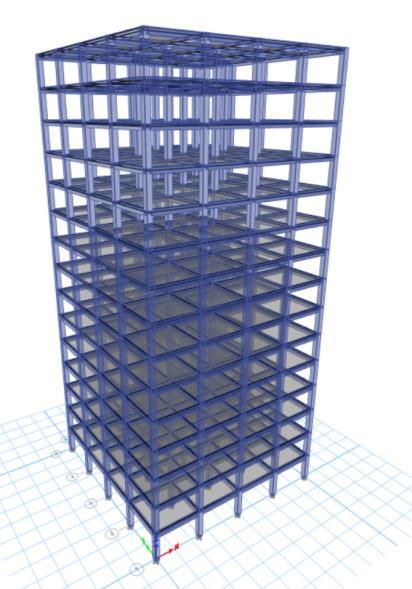
The ETABS model consists of a 15-storey reinforced concretemoment-resistingframebuildingwithasoftstorey at ground floor. Floor to Floor height is 3m, columns are modeled as 450mmx450mm sections and beams as 300mmx450mmsections DLandLLloadsareappliedasper IS875(Part1&2),andseismicloadsareassignedaccording to IS 1893 (Part 1) for seismic zone IV. Both static and Dynamicanalyses(ResponseSpectrum)areconducted.The base is considered as Rigid, and slabs are modeled as membraneelements.
3.2 Model 2-StructurewithConcretebraceatcorners:
Inthismodel,additionalconcretebracesareprovidedat thecornersofthesoftstoreytoenhancelateralstiffnessand improve seismic performance. The diagonal braces are modelledwithappropriatecrosssectionalproperties.These bracesareconnectedbetweenadjacentcolumnsandbeams atthesoftstoreycornersforfirsttwostoreys.Theinclusion of braces is expected to mitigate excessive lateral displacementsandinter-storeydriftsinthesoftstoreylevel. The diagonal braces act primarily in compression during seismic events, resisting lateral forces effectively and preventinglargedeformationsatsoftstoreylevel.
International Research Journal of Engineering and Technology (IRJET) e-ISSN:2395-0056
Volume:12Issue:04|Apr2025 www.irjet.net p-ISSN:2395-0072
Theconventionalsquarecolumnarereplacedwithblade columnstoenhancethelateralstiffnessandstrengthofthe structure. The blade columns, being elongated in one direction, are more effective in resisting lateral loads and thusimprovetheseismicperformance,particularlyatthesoft storey level. The blade columns are modelled with dimensions of 750mmx300mm, oriented to provide maximum resistance against the expected direction of seismicforces.
Adetailedcomparativeanalysisofthethreemodels–Model 1 (structure with soft storey), Model 2 (structure with concretediagonalbracesatcorners)andModel3(structure withBladeColumns)wasperformedusingETABSsoftware. StaticanddynamicanalysiswereperformedasperIS1893 (Part 1).Thefollowingkeyparameterswereevaluated:
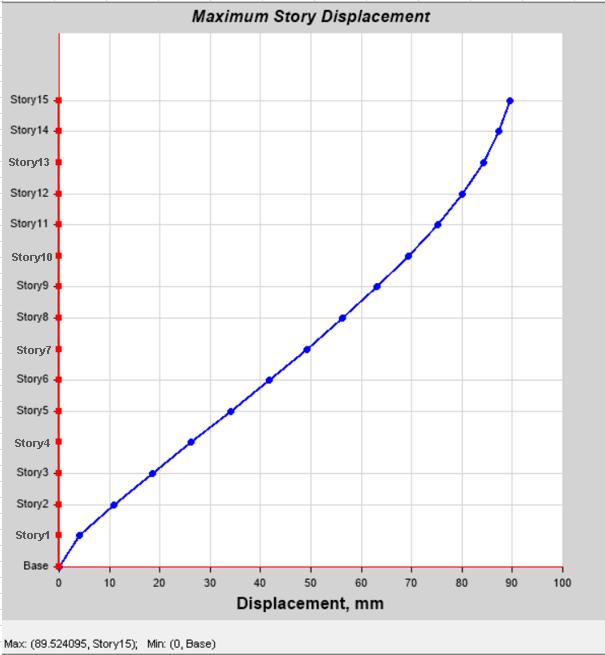
Model1: Exhibitedthemaximumlateraldisplacementdue totheflexibilityofsoftstorey.Thedisplacementprofilewas irregular,showingasuddenincreaseatthesoftstoreylevel.
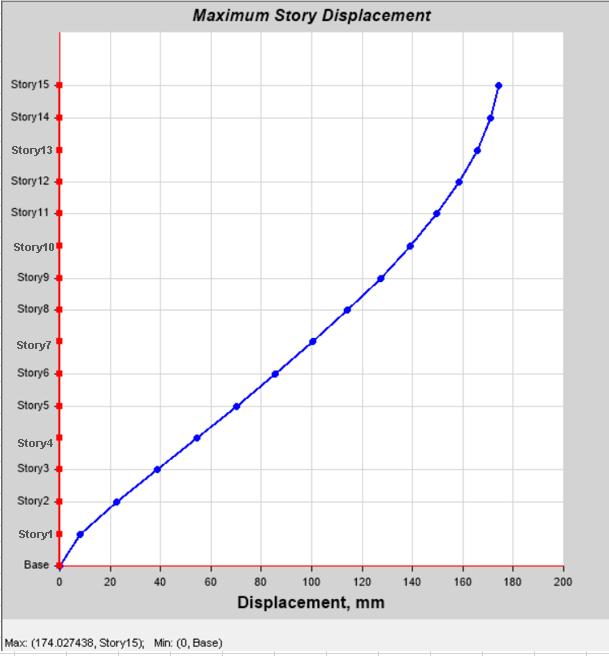
:Max.DisplacementofModel-1:Structurewith SoftStorey
Model 2: showed a significant reduction in lateral displacementduetoincreasedlateralstiffnessprovidedby the diagonal concrete braces. The displacement profile becamesmoother.
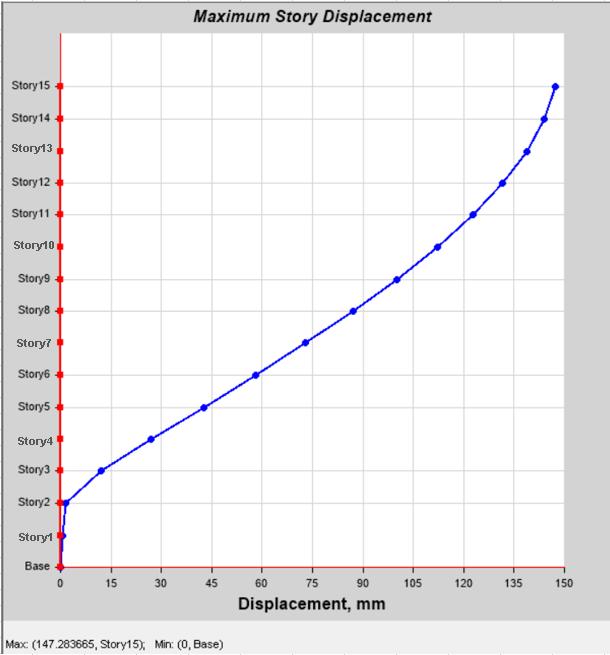
Chart-2:Max.DisplacementofModel-2withBracing
International Research Journal of Engineering and Technology (IRJET) e-ISSN:2395-0056
Volume:12Issue:04|Apr2025 www.irjet.net p-ISSN:2395-0072
Model 3 : Showedahighreductionofdisplacementinone directionduetoelongatedcolumnorientationcomparedto Model 1. The blade column enhanced the lateral stiffness, resultinginauniformdisplacementpattern,althoughslightly higher than Model 2 in minor axis of blade column Strengthening required to reduce displacement in other direction.
4.2 Storey Drift:
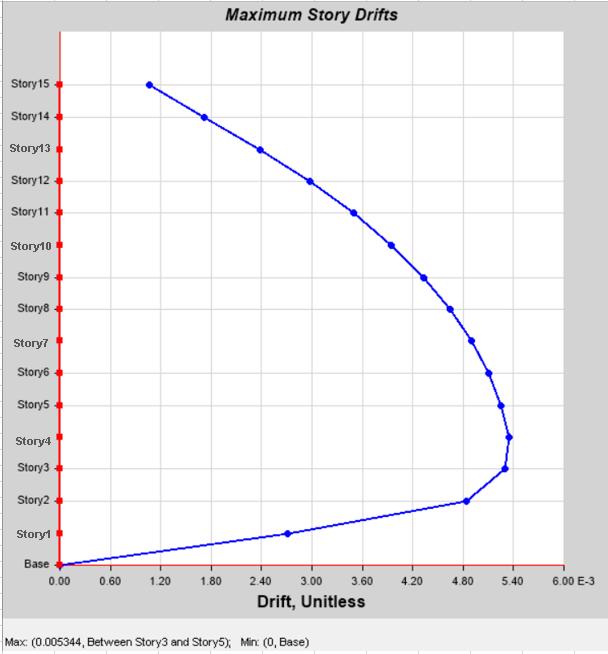
Model1: Experiencedexcessivestoreydriftatthesoftstorey level,exceedingpermissiblelimitprescribedbyIS1893.
Model2: Recordedtheloweststoreydriftamongthethree models due to the effective triangulation provided by the bracingsystem.
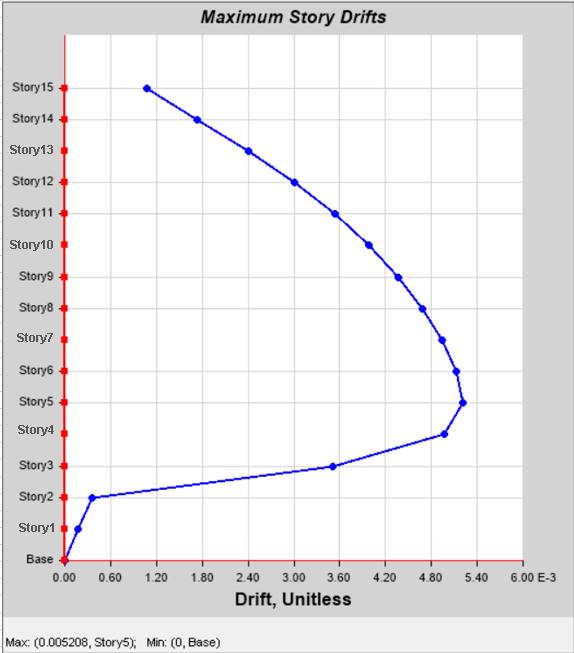
:Max.StoreyDriftofofModel-2with
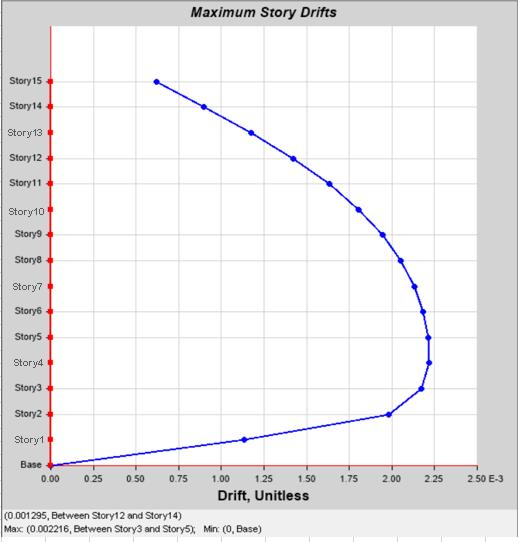
Model3: Achievedsubstantialdriftcontrolinonedirection attopstoreybutitwasslightlylesseffectivecomparedtothe braced configuration model, At soft storey level needs combinedconfigurationrequiredtoreducedrift.
:
International Research Journal of Engineering and Technology (IRJET) e-ISSN:2395-0056
Volume:12Issue:04|Apr2025 www.irjet.net p-ISSN:2395-0072
Model 1 : Displayedasignificantdropinstiffnessatasoft storey,causingasuddenchangeinlateralresistance.
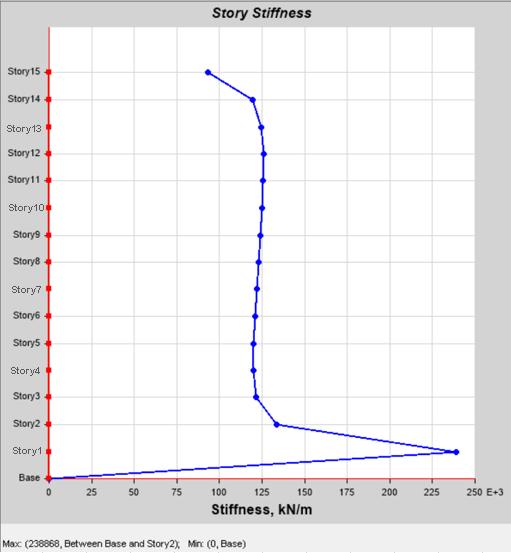
Chart-7:Max.StoreyStiffnessof Model-1:Structurewith SoftStorey
Model2: Demonstratedasubstantialincreaseinsoftstorey stiffnessatthegroundlevelduetothepresenceofdiagonal braces.
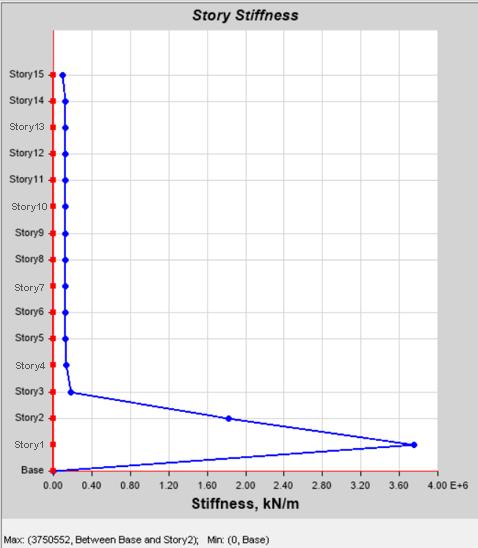
Chart-8:Max.StoreyStiffnessof Model-2:Structurewith Bracing
Model 3 : Ithadaimprovedsoftstoreystiffnessatstorey compared to model 1. The use of blade columns provided enhancedlateralstiffness,thoughnotashighasthebraced structure in model 2. But in other direction stiffness is improvedbyaddingotherconfigurations.
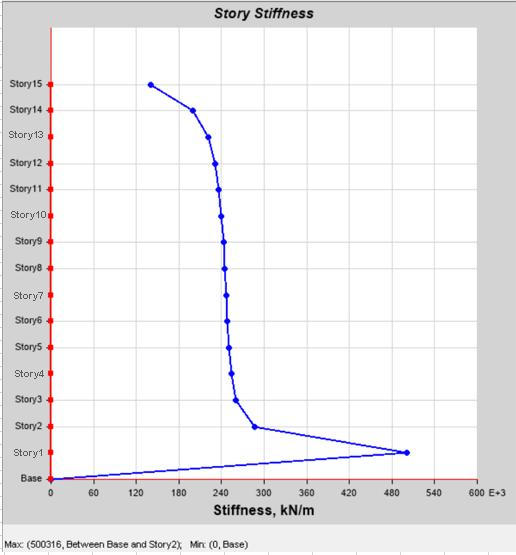
Chart-9:Max.StoreyStiffnessof Model-3:Structurewith BladeColumn
Table-2: Summary
Parameter
Model1(soft storey)
Model 2 (With Bracing)
Model 3 (With Blade Columns)
Storey Displacement Highest Lowest Moderate reduction
StoreyDrift Highest (Irregular) Lowest (Controlled) Reduced (Smooth)
Storey Stiffness Very Low at softstorey VeryHigh Improved
BaseShear Lowest Moderate Slightly Higher
International Research Journal of Engineering and Technology (IRJET) e-ISSN:2395-0056
Volume:12Issue:04|Apr2025 www.irjet.net p-ISSN:2395-0072
Basedonthecomparativeanalysisofthethreemodels,the followingconclusionsaredrawn:
The structure with a soft storey Model 1 exhibited poor seismic performance due to reduced storey stiffness, excessivelateraldisplacement,andhigherinter-storeydrift at the ground level, indicating the vulnerability of unstrengthensoftstoreybuildings.
Provision of diagonal concrete braces at the soft storey significantly enhanced the lateral stiffness and seismic performance. Braces worked efficiently by forming a triangulatedsystemthatresistedlateralforceseffectively, resultingintheloweststoreydisplacement,drift,andtime periodamongallmodels.
Replacement of conventional square column with blade columns at the soft storey also improved the lateral performance of structure in one direction and other direction required additional configuration The blade columnperformedmosteffectivelyalongtheirmajordepth (strongaxis),providinggreaterstiffnessandstrengthinthat direction.
Although both blade columns and diagonal bracing techniquesimprovedseismicperformance,diagonalbracing was found to be slightly more effective in controlling displacements and drifts. Bracing system or modified columns are essential for ensuring the seismic safety and stabilityofmultistoreyedreinforcedconcretestructuresin seismic-proneareas.
ACKNOWLEDGEMENT
I take this opportunity to express my sincere gratitude to Pro.Dr.P.Manibalan,DepartmentofCivilEngineering,SRM InstituteofScienceandTechnology,myprojectguide,forhis guidance, support, and encouragement throughout the duration of this project. I am deeply grateful to my family andfriendsfortheirconstantmotivation
[1] TebasalimIbrahim&HallaJasemMohammed(2024)–Effect of soft storey locations on the Nonlinear Time HistoryanalysisofMultistoreyedReinforcedconcrete Buildings, Civil and Environmental Engineering, Vol. 20,Issue1.
[2] A.A. Mali & P.M. Mohite (2023)- Seismic behavior of buildingwithsoftstorey:Review,Internationaljournal for Research in Applied Science & Engineering Technology,Vol.11,Issue1.
[3] Trishir Patel & Milli Shakhla (2024)- Seismic performance of soft storey Building with Dampers,
International Research journal of Engineering and Technology,Vol.11,Issue7.
[4] Akshay Shaji et al. (2019) – Seismic Analysis of Soft storey Buildings, International Journal of Scientific & EngineeringResearch,Vol.10,Issue5.
[5] Pravesh Gairola & Sangeeta Dhyani(2019) – Seismic analysisofopensoftstoreyBuildingofDifferentModels, International Journal of Engineering Research & Technology,Vol.8,Issue5.