
International Research Journal of Engineering and Technology (IRJET) e-ISSN: 2395-0056
Volume: 12 Issue: 11 | Nov 2025 www.irjet.net p-ISSN: 2395-0072
International Research Journal of Engineering and Technology (IRJET) e-ISSN: 2395-0056
Volume: 12 Issue: 11 | Nov 2025 www.irjet.net p-ISSN: 2395-0072
Gaurav Dewangan
U.G.Scholar
Karan Sahu
U.G.Scholar DepartmentofEEE DepartmentofEEE
ChoukseyEngineeringcollege
BilaspurChhattisgarh,India
Amisha Kumari
U.G.Scholar
ChoukseyEngineeringcollege
Bilaspur,Chhattisgarh,India
Suresh Kumar Ganesh Ram Ratnakar
U.G.Scholar Professor DepartmentofEEE DepartmentofEEE DepartmentofEEE
ChoukseyEngineeringcollege
Bilaspur,Chhattisgarh,India
ChoukseyEngineeringcollege
BilaspurChhattisgarh,India
Abstract – Smart grids have been a major research focus in power systems, aiming to create a more reliable and efficient infrastructure for the future. A key goal is to seamlessly integrate renewable energy sources, like solar PV, which has seen tremendous growth. This paper analyzes four scenarios for incorporating household solar PV systems into the grid, highlightingtheir characteristics, benefits, and drawbacks. By selecting the suitable scenario, an effective system layout can be designed to meet specific requirements.
KEY WORDS :Index term- Distributed generation, DC Micro-grids, Energy management system, Smart Grids, Solar home system
The world has seen a significant surge in energy demand due to population growth and rising living standards. However, conventional power generation resources are limited, depleting rapidly, and contributing to climate change. This has driven the development of renewable energy sources (RES), although they still face challenges in replacing traditional sources due to their unpredictability. One solutionis to create multiple buffers to compensate for this uncertainty. Smart Grids, which enable intelligent and flexible grid operation, offer a promising approach. By integrating advanced monitoring andcontrolsystems,SmartGridscanoptimizepowerflow and manage various components. This paper proposes a systemthatcombinessolarhomesystemswiththepower grid,utilizingeffectivecontrolsandinformationtransferto meet future energy needs. Advanced technologies are explored to enhance system performance and create a moreefficientpowerscheme.
Solar photovoltaic systems are the preferred renewable energy source for many consumers, especially
ChoukseyEngineeringcollege
Bilaspur,Chhattisgarh,India
in sunny regions, due to their ease of installation and low
maintenance. These systems enable local generation,
reducing transmission losses and allowing households to manage their energy usage. A typical Solar Home System (SHS) includes solar panels, batteries for energy storage, and controllers/converters for efficient use. Energy storage enhances system reliability and control, while demand side management helps match energy usage with generation, reducing grid stress. Excess energy can be stored or fed back into the grid, although this poses challenges like low feed-in tariffs and power quality standards.
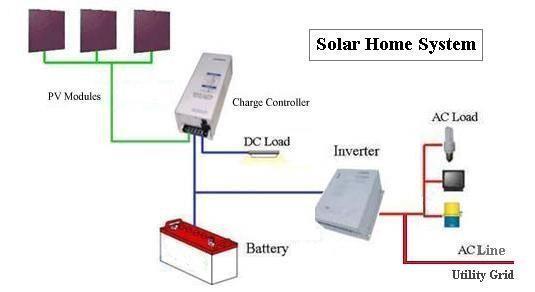
Decentralized generation makes the system more robust and reliable, but integrating SHS into the existing grid infrastructure requires careful consideration to ensure usercomfortandsatisfaction.
The power infrastructure needs a redesign to integrate new technologies in generation, storage, and efficient use of power. Smart Grids, a bi-directional electric and communication network, can improve reliability, security, and efficiency. It includes software and hardware
International Research Journal of Engineering and Technology (IRJET)
Volume: 12 Issue: 11 | Nov 2025 www.irjet.net
applications for dynamic optimization, distributed generation, and consumer feedback. Information Communication Technology (ICT) plays a crucial role in monitoring and controlling the system. A smart grid infrastructureensuresreliability,efficientpowerexchange, and seamless integration of distributed generation and renewable energy sources. It empowers users to
participateinthepowergridwithadeeperunderstanding ofthesystem.Thesystemfeaturesmultiplesensors,relays, andcommunication technologies for efficient operation. It can operate in island mode during disturbances, isolating affectedcomponentsandensuringlimiteddisruption.This paper focuses on designing a micro-grid with Solar Home Systems (SHS) as distributed generation, which can be combinedtocreatealarger,morestablenetwork.
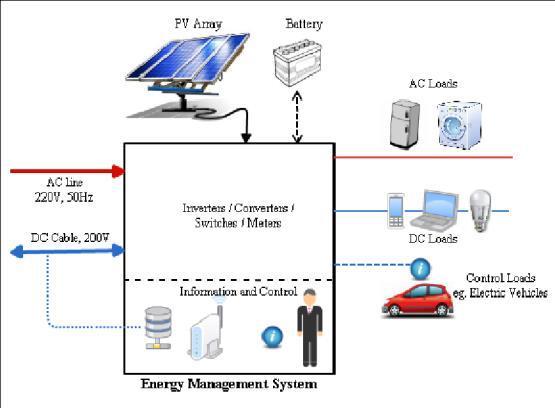
A Home Energy Management System (HEMS) is a crucial interface for controlling loads and grids, empowering users to manage power flows according to their needs. HEMS monitors and controls power usage, allowing users to prioritize demands, select preferred power sources, and customize energy consumption. By leveraging demand side management principles, HEMS optimizes power usage based on user instructions and environmentalconditions.Itcanoperateinvariousmodes and be programmed for different scenarios, acting as an intelligent hub that responds to grid and load signals. By givinguserscontrolovertheirenergyusage,HEMSplaysa vitalroleinenergymanagement.
Intelligentloadsaredesignedtointegrateseamlesslyinto theevolvinggridnetwork,leveragingadvancedtechnology to optimize performance and synchronize with network conditions. These loads can be controlled remotely throughtheHomeEnergy Management System(HEMS)or have individual controls, enabling automated operation under specific conditions. Some intelligent loads, like electricvehicles,canevenstoreenergy,actingasbuffersto enhancegridstability.
-0056
-ISSN: 2395-0072
6. PV inverter circuit and its analysis using MATLAB Simulink:
APVinverterisapowerelectronicdevicethatconvertsDC power from solar panels to AC power, suitable for grid integrationorloadsupply.Thecircuittypicallyconsistsof:
1.Solarpanel(DCsource)
2.Inverterbridge(IGBTsorMOSFETs)
3.Filter(LCLorLC)
4.Gridconnectionorload
In Simulink, we can create a model of the PV inverter circuitusingvariousblocks,suchas:
1. Solar panel: Modeled using the PV Array block 2. Inverter bridge:Modeledusingthe Universal Bridge block (IGBTorMOSFET)
3. Filter: Modeled using inductor and capacitor blocks 4. Grid connection: Modeled using a voltage source or a grid model
5.Controlsystem:Modeledusingcontrolblocks(e.g., PIcontrollers,PWMgenerators)
Analysis :
UsingSimulink,wecanperformvariousanalysesonthePV invertercircuit,suchas:
International Research Journal of Engineering and Technology (IRJET) e-ISSN: 2395-0056
Volume: 12 Issue: 11 | Nov 2025 www.irjet.net p-ISSN: 2395-0072
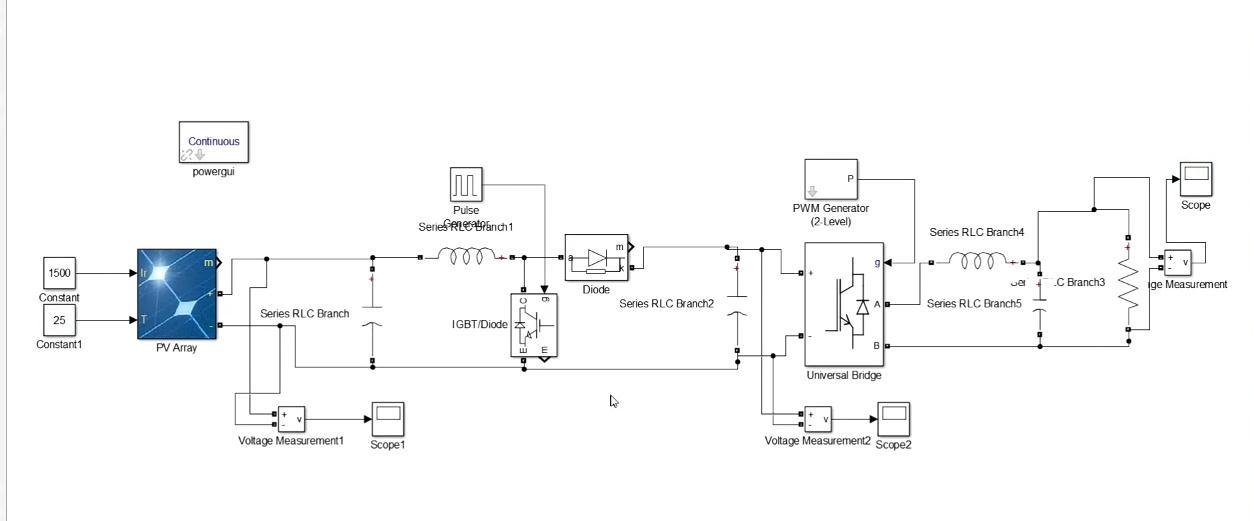
BlockdiagramofPVinverterusingsimulink
1. Power quality analysis: Evaluate the total harmonic distortion (THD) of the output current and voltage.
2. Efficiency analysis: Calculate the efficiency of the inverterundervariousoperatingconditions.
3. Stability analysis: Analyze the stability of the system under different grid conditions and control parameters.
4. Dynamicresponseanalysis: Evaluatetheresponse of the system to changes in solar irradiance, temperature, orload.
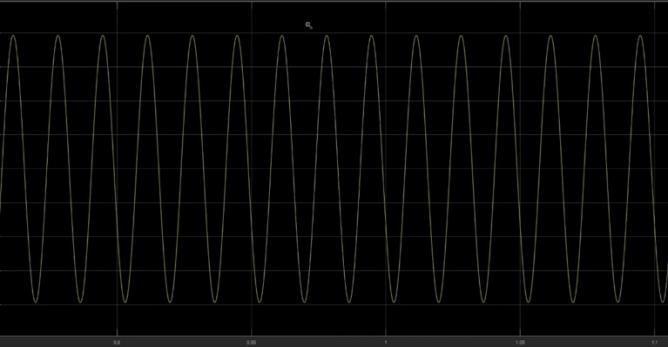
Fig.4 OutputofPCinverter
Simulationresultsmayinclude:
1.Outputcurrentandvoltagewaveforms
2.Powerqualitymetrics(THD,powerfactor)
3.Efficiencyplots
4.Dynamicresponseplots(e.g.,stepresponse)
Byanalyzingthesimulationresults,wecanoptimizethedesign and control of the PV inverter for improved performance, efficiency,andreliability.
The conclusion of the projector research appears to be that the Solar Home Energy Management System can be effectively integrated into a Smart Grid design, providing users with flexibility, reliability, and efficiency. The system enablesinformeddecisionmaking,optimizesenergyuse,and hasthepotentialtocreateamorerobustandversatilepower infrastructure.
[1] C. Hertzog, Smart Grid Dictionary, GreenSpring Marketing LLC,2009
[2]K.Moslehi,“Areliabilityperspectiveofthesmartgrid”,Smart Grid,IEEETransactions,vol.1.1,pp.57-64,June2010
[3]H.Dick,H.Eden,G.FischerandJ.Zietz,“Empoweringusersto Become designers: Using Metadesign environments to enable andMotivatesustainableenergydecisions”,ColoradoUniversity, 2012
[4] J. Gao, et al., “A survey of communication/networking in Smart Grids”, Future generation computer systems, vol. 28.2, February2012
[5]J.Shah,B.F.WollenbergandN.Mohan,”Decentralizedpower flow Control for smart microgrid”, IEEE – Power and Energy SimulinkSociety,Generalmeeting2011,pp.1-6,July2011
[6]B.Becker,etal.,“Decentralizedenergymanagementtocontrol smart-Home architectures”, Architecture of computing systems, vol.5974/2010,pp.150-161,2010