
International Research Journal of Engineering and Technology (IRJET) e-ISSN: 2395-0056
Volume: 13 Issue: 01 | Jan 2026 www.irjet.net p-ISSN: 2395-0072
International Research Journal of Engineering and Technology (IRJET) e-ISSN: 2395-0056
Volume: 13 Issue: 01 | Jan 2026 www.irjet.net p-ISSN: 2395-0072
Deenu Kumar Karsh1, Rupali Patel2, Rahul Manhar3, Prof . Vikas Chandra4 1,2,3,Dept of EEE Chouksey Engineering College Bilaspur (CG) 4 , Department of EEE, Chouksey engineering college bilaspur CG .India
Abstract- The voltage tracking of a de-de buck-boost converter is presented in this master report. The de-de Buck converter has three operating modes for tracking the output voltage. This master report includesDSpace-assistedopen and closed loop control. When compared to other types of DC converters, the Buck-Boost converter offers a few advantages. The nonlinearity of the de-de Buck-Boost converter features, however, makes it challenging to manage with traditional techniques, like an open loop control system. This primary issue is addressed by developing a close loop control system with DSpace . The MATLAB-Simulink application is utilized to construct a simulation model in order toverifytheefficiencyof the proposed strategy. According to the simulationresults, the suggested approach significantly improves control performancewhencompared toa con(Step-DownConverter) Visional converter.
Introduction
DC-DCconvertersareelectroniccircuitsthatconverta DC voltagelevelintoanother.Amongthem,theBuckandBoost convertersarethetwomostfundamentaltypes.
Buck Converter – Step down the input.
Boost Converter - Steps up the input voltage.
Bothareswitch-modepowersupplies(SMPS)thatusehighfrequencyswitching,energystorageelements(inductorand capacitor),andsemiconductorswitches(MOSFET,diode).
1. Buck converter-
WhentheswitchisON,currentflowsthroughtheinductor andloadenergyisstoredintheinductor.
When the switch is OFF, the inductor releases its stored energytotheloadviathediode.
OutputVoltage
Vo=D×Vin
So,outputvoltageisalwayslessthaninputvoltage.
Applications-regulationinmicrocontrollers,sensors,and battery-poweredsystems.
UsedinDCpowersupplies,LEDdrivers,andmotorcontrol circuits.
2. Boost Converter (Step-Up Converter)
WhentheswitchisON,theinductorstoresenergyfrom theinputsupply.
WhentheswitchisOFF,theinductorreleasesitsenergy, addingtothesupplyvoltage–resultinginhigheroutput voltage.
OutputVoltage- VoVin1-D
So,outputvoltageisgreaterthaninputvoltage.
Applications - Usedinrenewableenergysystems(solar PV),battery-powereddevices,andpowerfactor correctioncircuits.
3. Buck Boost Converter
ADCtoDCconverterwhichstepsuporstepsdowntheinput voltage level" is what a buck-boost converter is. The duty ratiodetermineswhethertheinputvoltagelevelisstepped upor down. Theratioofthecircuit's output voltage to its input voltage is known as the duty ratio or duty cycle. A controlledDCoutputisprovidedbyabuck-bustconverter.
Theoutputvoltagethatisobtainedwhileitisinbuckmode islowerthantheinputappliedvoltage.Theoutputcurrent exceeds the input current in this mode. Nonetheless, the inputandoutputpowersareequal.
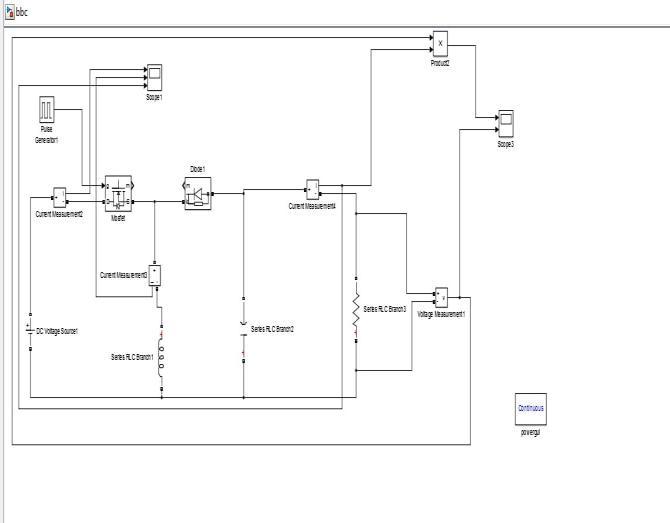
Simulation:-
International Research Journal of Engineering and Technology (IRJET) e-ISSN: 2395-0056
Volume: 13 Issue: 01 | Jan 2026 www.irjet.net p-ISSN: 2395-0072
We have successfully finished the design of a buck-boost convertorforthisproject,whichcanbeutilizedtoobtainthe outputthatisneededfortheloadtooperateasintended.
In the near future, the converter can be further enhanced anditsoutputvoltageadjustedtodeterminewhichloadsare most easily utilised. The converter is currently used to convert voltages between 5 and 18 volts. To make this projectsustainable and for furtheruse wecanutiliseit to adjusttherangeofconversionanduseitformorepractical usesandrealworldskills.
TheBuck-BoostconverterisatypeofDC-DCconverterthat canincreaseor decreasetheinputvoltageasneeded.It is usefulwhenweneedaconstantoutputvoltagethatmaybe higher or lower than the input. From the analysis, we see thattheoutputvoltagedependsonthedutycycleandthe circuitcomponents. Theconverter issimple,efficient,and cost-effective,butitgivesanoutputvoltagewithopposite polaritytotheinput.
Overall,theBuck-Boostconverterisveryusefulinbattery systems,solarpower,andotherelectronicdeviceswhere variablevoltageisrequired.
Iwouldliketoexpressmythankofgratitudetomyteacher Mr. Vikas Chandra Professor as well as our principal Dr. NitinJainsirwhonotonlygavemethegoldenopportunityto do this wonderful project on the topic "Analysis of Buck Boost Converter" but also guided me in completing this project.TheirguidancehelpedmeindoingalotofResearch andIcametoknowaboutsomanynewthingsforwhichIam reallythankfultothem
[1]BorRenLinandChienLanHuang.InterleavedZVSConverter withRipple-Current Cancellation", IEEE Transaction on IndustrialElectronics,55,(2008),4,pp.1576-1585
[2]High-EfficiencyModularHighStep-UpInterleavedBoost ConverterforDC-MicrogridApplications,"Ching-MingLai, Ching-TsaiPan,andMing-ChichCheng,IEEETransactionon IndustryApplications,Vol.48,No.1,January/February2012
[3]LabVIEWImplementationofanAutotumingPIregulator via Grey-predictor," by Chien-Ming Lee, Yao-Lan Liu, and Hong-WeiShielnIEEEInternationalProceedings
[4] Singh, S. N., "Performance Analysis of Buck-Boost Converter,"InternationalJournalofEngineeringResearch& Technology(IJERT),Vol.3,Issue5,May2014
[5]M.Iulian,"Topologyforapositivebuck-boostswitching regulator,"ed:GooglePatents,2010
[6]J.Ejury,"Buckconverterdesign,"InfineonTechnologies NorthAmerica(TFNA)CornDesionNote,vol.1,2013.