
International Research Journal of Engineering and Technology (IRJET) e-ISSN: 2395-0056
Volume: 12 Issue: 11 | Nov 2025 www.irjet.net p-ISSN: 2395-0072
International Research Journal of Engineering and Technology (IRJET) e-ISSN: 2395-0056
Volume: 12 Issue: 11 | Nov 2025 www.irjet.net p-ISSN: 2395-0072
Dr.S. Parthasarathy1, P. Naveen Raj2, R. Mohana Brintha3, V.G. Kishore Kumar4 , Dr.S. Miruna Joe Amali5, R. Thangasankaran6
1 Professor, EEE Dept, Director - KLN.IRP, K.L.N. College of Engineering, Sivagangai, Tamil Nadu, India 2,3,4 UG Scholar, CSE Dept, K.L.N. College of Engineering, Sivagangai, Tamil Nadu, India
5 Professor & Head of Department, CSE Dept, K.L.N. College of Engineering, Sivagangai, Tamil Nadu, India 6 AP/EEE Dept, KLN.IRP Coordinator, K.L.N. College of Engineering, Sivagangai, Tamil Nadu, India
Abstract: The Online Leave and On-Duty (OD) Management System is designed to overcome the inefficiencies of traditional paper-based leave applications in colleges, which often result in delays, lost records, and lack of transparency. The web-based system, integrated within the college intranet, allows students to submit structured online leave or OD requests through a userfriendly interface. Requests are automatically routed to the concerned authorities Class Coordinators, Heads of Departments(HODs), andWardens(for hostellers)based on predefined role-based access control (RBAC) workflows. Approvers can review and act on requests digitally, while students receive real-time notifications on their application status. The system ensures accurate digital record-keeping, reduces administrative workload, improves accountability, and enhances overall efficiency. By providing workflow automation, transparent processing, and effective data management, this solution delivers a reliable, efficient, and user-centricapproachforcollegeadministration.
Keywords: Role-Based Access Control (RBAC), Digital Approval Process, Record Keeping, Transparency, Efficiency, User-Centric System, Workflow Automation, Real-Time Notifications, Web-Based System
The need for automation in administrative operations, especially in leave and on-duty (OD) management, has grown due to the quick digitalization of educational institutions.Conventionalpaper-basedmethodscanresult in inefficiencies like permission delays, data loss, and communication breakdowns between instructors and students.Severalautomation-basedsolutionsthatimprove accountability, accessibility, and openness within institutional frameworks have been put forth by researchers to address these problems [1], [3], [8]. In order to reduce human labor and guarantee data consistency,automatedattendanceandleavemanagement systemsmakeuseofcontemporaryonlinetechnologiesto streamlinetheapplication,review,andapprovalprocesses [2],[4],[7].
By implementing a structured, multi-level approval workflow that replicates actual institutional hierarchies,
theproposedSmartLeaveandOn-DutyProcessingSystem with Hierarchical Approval Mechanism expands on previous developments. Students can apply for leave or OD via this system by logging into a special web applicationandprovidingnecessarydetailssuchdatesand reasons.Aftersubmission,theapplicationisautomatically sent to the Head of Department (HOD) for approval or disapproval after being approved by the Class Coordinator. To guarantee responsibility and clarity, reasons for disapproval are clearly documented. In educational automation frameworks, these hierarchical processing models have been shown to reduce administrative errors and improve decision-making transparency[4],[5],[9].
Additionally, using their login dashboard, students may monitor the current progress of their applications, guaranteeing real-time information and doing away with the necessity for laborious follow-ups. Fordayscholars,theHOD'spermissioninitiatesautomatic slip generation; however, for hostellers, the request is forwarded to the Warden for final authorization prior to slip generation. The suggested method saves paperwork, increases productivity, and promotes sustainable digital transformation in academic institutions by combining digital tracking, automated record management, and multi-levelauthorization[1],[2],[6],[9],and[10].
The objective of the proposed Smart Leave and On-Duty Processing System with Hierarchical Approval Mechanism is to automate and accelerate the approval processforleaveandODin educational establishments. It uses a methodical, role-based process that guarantees accuracy, openness, and responsibility at every turn. Secure and role-specific access is made possible by the system's distinct login interfaces for wardens, heads of departments(HODs),classcoordinators,andstudents.
Studentscanloginandsubmitarequestforleave or on-duty (OD). Important information including name, roll number, department, dates, purpose, and kind of
Volume: 12 Issue: 11 | Nov 2025 www.irjet.net
request are included in the form. The first stage of verification occurs when the application is immediately senttotheclasscoordinatoruponsubmission. Thisdigital submission technique reduces data loss, does away with the necessity for paper-based applications, and allows for effectivetrackingofallrequestsviaacentralizeddatabase. Additionally, students are always able to see the current statusoftheirapplications.
Based on attendance records, academic standing, andthelegitimacyofsupportingdocumentation,theclass coordinatorconfirmsthestudent'srequest.Therequestis accepted and sent to the HOD for the next round of permission if it satisfies all eligibility requirements. The coordinator may reject the request with suitable comments if inconsistencies or missing information are discovered,andthestudent willautomaticallybenotified. The HOD then performs a detailed evaluation considering institutional policiesandthestudent’s overall record. The HOD then performs a detailed evaluation considering institutional policies and the student’s overall record. For day scholars, an approval from the HOD directly triggers the automatic generation of the Leave/OD slip. For hostellers, the approved request proceeds to the Warden for the final round of approval. After the warden’s authorization,thesystemupdatesthestatusandgenerates the slip. All approvals, disapprovals, and comments are stored digitally, ensuring efficient record maintenance, reduced paperwork, and complete transparencyacross all hierarchicallevels.
TheorganizationalworkflowforleaveandODapplications is automated and digitized by the proposed Smart Leave and On-Duty Processing System with Hierarchical Approval Mechanism. The system runs on a systematic, role-based approval procedure that guarantees accuracy, accountability, and openness throughout. Students, class coordinators, directors of departments (HODs), and wardens all have their own login modules with distinct authorizationprivileges.Figure1:ProcessFlowshowsthe suggestedsystem'sprocessflow.
In order to begin the procedure, students must firstlogintotheiraccountsandsubmitadigitalLeave/OD Request Form that includes all necessary information, including name, roll number, department, dates, and reason. The request is automatically sent to the class coordinator for the initial verification after it is filed. In addition to preventing data loss and replacing traditional paper-based procedures, this digital workflow enables studentstomonitorthestatusoftheirapplicationsin real timeviathesite.
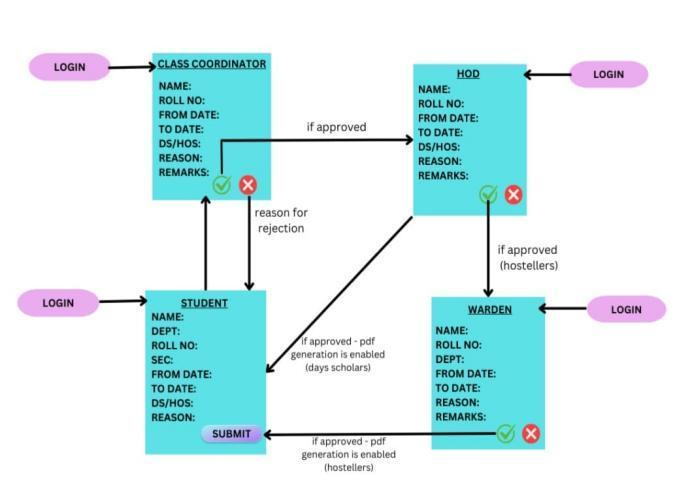
The request is assessed by the class coordinator using supporting documentation, academic performance, and attendance records. The request is automatically forwarded to the HOD for additional evaluation if it is deemed valid. In order to ensure timely contact without the need for manual follow-ups, the coordinator gives notes outlining the reason for rejection and notifies the studentviathesystemrightaway.
Taking into account both the student's overall recordandinstitutionalpolicies,theHODdoesathorough examination. The HOD's permission directly permits the automatic creation of PDF slips for day scholars. The request for hostellers is sent to the Warden for the last round of approval. The system creates the approved slip and modifies the application status upon authorization. Digital storage of all approvals, rejections, and comments guarantees effective record-keeping, less paperwork, and opendecision-makingatalllevelsofthehierarchy.
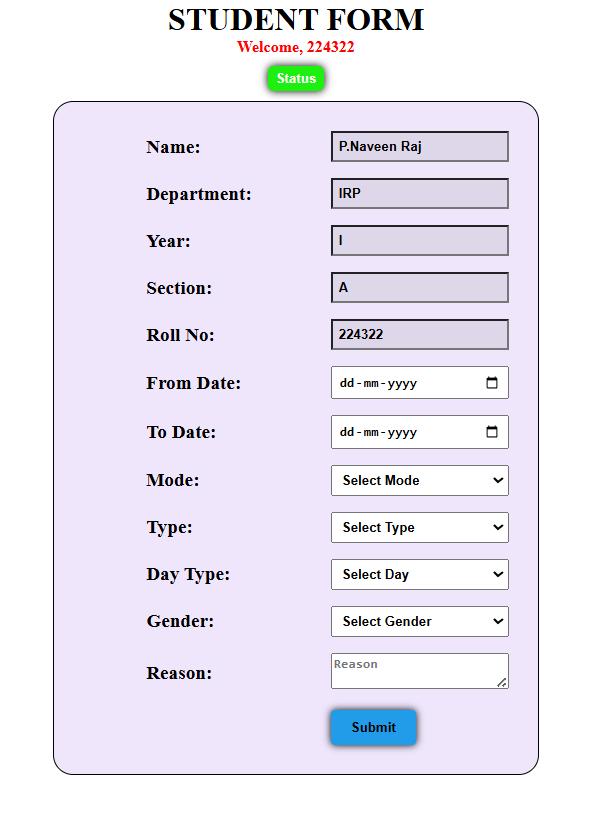
The Hierarchical Leave Approval Algorithm (HLAA), a hierarchical decision-based logic, powers the proposed Online Leave and On-Duty (OD) Management System. This algorithm controls the flow of each leave or OD request through the institution's various tiers of authority.Whenastudentusestheonlineportaltosubmit an application, the process starts. To guarantee the accuracy and completeness of the data, the HLAA first verifies the input fields, including student identification, duration, and cause. As shown in Figure 2, students enter the required details through the online leave/OD request form,ensuringastructuredsubmissionprocess.
International Research Journal of Engineering and Technology (IRJET) e-ISSN: 2395-0056
Volume: 12 Issue: 11 | Nov 2025 www.irjet.net p-ISSN: 2395-0072
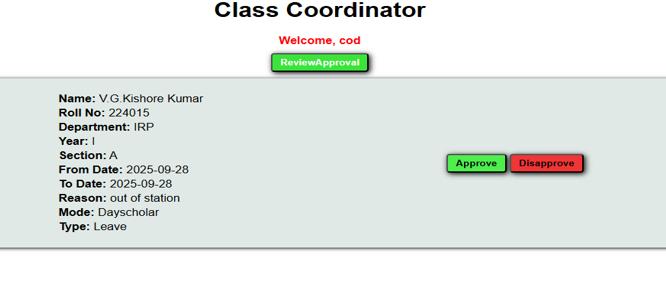
The request is automatically sent to the class coordinator for preliminary evaluation when it has been verified. At this point, the HLAA performs a conditional evaluationinwhichthe coordinator examines the request andeitherauthorizesitforthenextstageorrejectsitwith an explanation. Figure 3 shows the coordinator's dashboard,whichoffersan interfaceforswiftlyanalyzing, commentingon,andforwardingrequests.
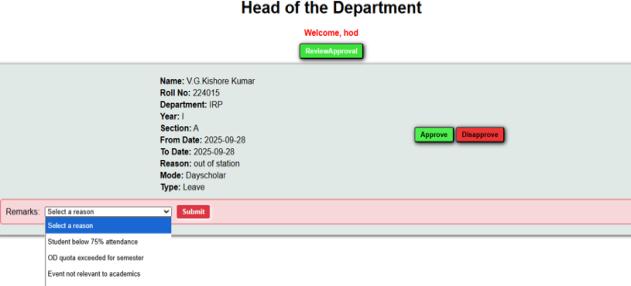
IfthecoordinatorapprovesaleaveorODrequest, it is dynamically forwarded to the Head of Department (HOD) for further verification. At this stage, the HOD examines the student’s attendance records, academic performance, and the validity of the leave request to ensure compliance with institutional policies. The HOD dashboard, illustrated in Figure 4, streamlines the review andapprovalprocess,maintainingaccountability,accurate
record-keeping, and transparency throughout the hierarchicalworkflow.
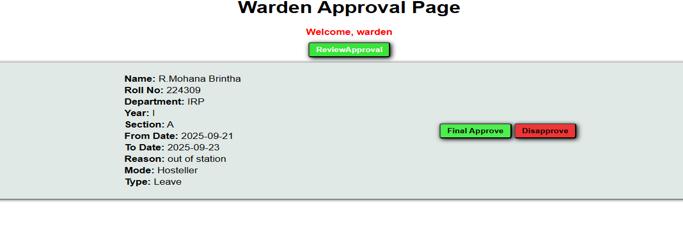
While day scholars' approvals are instantly entered in the system, accepted requests for students living in the hostel are sent to the Warden for the final approvalstage.Thehierarchicalworkflowiscompletedby the Warden dashboard, seen in Figure 5, which enables theWardentoexamineandapproveleaveorOD requests forhostellers.
The HLAA records each approval or rejection together with exact timestamps and user credentials to provide transparency and traceability throughout the process. The method minimizes manual involvement, speeds up processing, and closes typical communication gaps in paper-based systems by automating the steps of input validation, coordinator approval, HOD review, Warden authorization, status update, and notification dispatch. In the end, the HLAA ensures a system for leave and OD approval that is effective, responsible, and consistent.
The Smart Leave and On-Duty Processing System with Hierarchical Approval Mechanism's system architecture is set up to provide smooth communication, accountability, and scalability at all institutional management levels. It uses a modular structure with four mainuserinterfaces:Warden,HeadofDepartment(HOD), Class Coordinator, and Student. Different role-based permissions are used by each module to ensure safe and systematic data management. The central database of the system safely saves the information when a student files
Volume: 12 Issue: 11 | Nov 2025 www.irjet.net
an application for digital leave or OD, and it then starts automated routing according to preset access hierarchies. After the coordinator confirms the submission, the HOD reviews it, and the Warden gives hostellers a final approval. At every level of approval, this tiered design guarantees methodical procedure, reduces redundancy, andimprovestraceability.
Additionally, the system architecture unifies digital record maintenanceand real-time tracking. All modules' data updates are synchronised by a centralised database,guaranteeingthatstatusupdatesandcomments are immediately displayed in each user dashboard. By limiting access to only pertinent information for authorised users and upholding tight data confidentiality, the design encourages transparency. This rational design guarantees dependability, fault tolerance, and long-term flexibility for institutional governance in addition to streamlining workflow and cutting down on processing time.
The stated Online Leave and On-Duty (OD) Management System offers notable performance gains overtraditionalpaper-basedprocesses.Theautomationof workflow and approval routing is the most noteworthy improvement. Physical forms had to be moved between students, coordinators, HODs, and wardens throughout the manual procedure, which frequently resulted in delays, misplacements, or incomplete submissions. By digitallyprocessingallrequestsandautomaticallyrouting them in accordance with the predetermined Hierarchical Leave Approval Algorithm (HLAA), the system removes these inefficiencies. While digital validation at the submission stage lowers errors brought on by missing or inconsistentdata,increasingadministrativeefficiency,this guarantees transparency, real-time updates, and quicker decision-making.
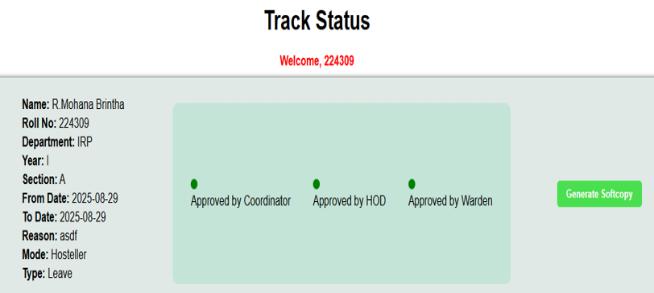
Another significant advancement is centralized andorganizedrecordmanagement.Staffandstudents can easily see all applications, approvals, and activities stored in the system's secure chronological order. Automatic timestamps and user logs further improve accountability. Transparency and interaction are enhanced with a userfriendly interface and real-time status tracking as shown inFigure5.
The system also encourages sustainability, robustness,andscalability.Itreducesphysicalpaperwork, facilitates clear communication with rapid notifications, manages several concurrent requests without degrading performance, and improves departmental cooperation. The system provides a dependable, durable, and efficient solution for institutional governance and digital leave management by simplifying procedures, enhancing record-keeping,andboostingefficiency.
The implementation of the Online Leave and OnDuty(OD)ManagementSystemhassignificantlyenhanced administrative transparency, operational efficiency, and user satisfaction within the institutional framework. The systemhasshortenedprocessingdelays,removedmanual dependencies, and decreased errors due to incomplete or missing applications when compared to conventional paper-based techniques. The average approval time has significantlydecreasedthankstotheautomatedworkflow, which makes sure that every request is methodically sent through the appropriate hierarchical channels, such as Class Coordinators, Heads of Departments (HODs), and Wardensforhostellers.
By preventing erroneous or redundant data during form submission, the system's digital validation enhances overall data correctness. Students receive realtime alerts regarding the status of their requests, which improves staff-student communication. Faster decisionmaking and monitoring are made possible by the centralized dashboard, which gives administrators a thorough picture of all requests approved, refused, and pending. HODs, Coordinators, and Wardens can easily access all approved requests, as shown in Figure 6, guaranteeingtransparencyatalllevelsofpower.
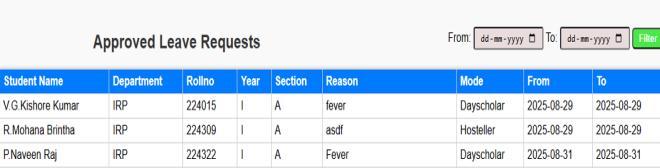
6 : Approvedleaverequests
International Research Journal of Engineering and Technology (IRJET) e-ISSN: 2395-0056
Volume: 12 Issue: 11 | Nov 2025 www.irjet.net p-ISSN: 2395-0072
Furthermore, as Figure 7 illustrates, the system automatically creates leave or OD slips for authorized requests, enabling students to download or print official paperwork. Digital record-keeping supports institutional reporting and attendance management by guaranteeing that all requests and approval records are safely kept, auditable, and readily available for future reference. Because of the platform's responsiveness, usability, and transparency, user polls show great satisfaction. Due to automatic routing, notifications, and status updates, facultymembersalsonoticedadecreaseinadministrative workload.
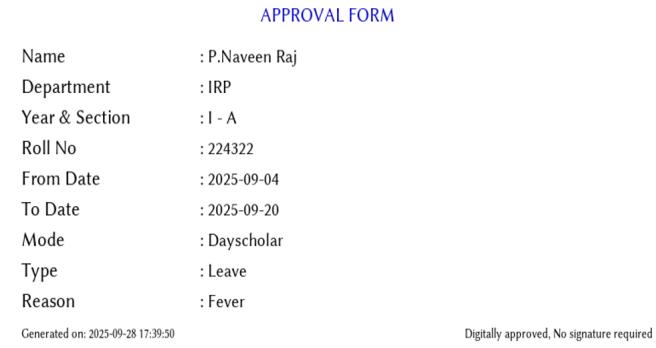
Figure 7 : ApprovedSlip
Thesystemexhibitsscalabilityanddependability, continuing to operate consistently even during busy. Overall, the findings show that the suggested method encourages sustainable digital practices in academic administration, increases efficiency, facilitates studentstaffcontact,andcultivates anaccountableadministrative culture.
The OnlineLeaveand On-Duty(OD)Management System offers academic institutions a thorough and organised way to address the problems with traditional manual leave processing techniques. The conventional method frequently included lengthy paperwork, approval hold-ups, and a breakdown in communication between coordinators, students, and higher-ups. The suggested approach ensures transparency, correctness, and traceability by streamlining the entire process, from applicationsubmissiontofinalapproval,byswitchingtoa digital framework. By methodically guiding each request through the proper approval structure, coordinators, department heads, and wardens are able to assess and respondtoapplicationsmorequicklyandresponsibly.
By automating tedious processes and keeping a centralised digital record of all leave and on-duty transactions, the technology also improves administrative
efficiency. This facilitates quicker decision-making, removes data redundancy, and lessens the manual workload. By integrating tracking and alerting systems, students are guaranteed timely updates, which enhances communicationandclearsupmisunderstandings.Because of the system's flexibility, organisations can also modify approvalprocessestofittheirowninternalguidelines. All things considered, the suggested model effectively illustrates how digital transformation may enhance staffstudent coordination, streamline institutional processes, and promote a more open administrative environment. The technology makes a substantial contribution to the efficient and sustainable governance of educational institutions by encouraging paperless management, cutting down on processing time, and guaranteeing dependabledatastorage.Thisprojectlaysasolidbasisfor academic administration's future growth and modernisation.
Roleandworkflowcustomizationcanimprovethe system by enabling administrators to create unique approval hierarchies and assign roles in accordance with institutionalordepartmentalstandards.Thiswillincrease the workflow's adaptability to various needs. Another significant enhancement is integration with institutional systems.Administrativeoperationscanbestreamlined by automating related procedures like faculty reporting and leave-linked attendance adjustments by connecting the leaveandODmanagementsystemwithacademic,payroll, andattendancesystems.
By automatically identifying discrepancies, duplicateapplications,orleave policyviolations,AI-Based Validation can increase data accuracy by lowering errors and guaranteeing adherence to institutional regulations. Additionally, an Enhanced Notification System that offers multi-channelupdatesbySMS,email,orpushalertscanbe implemented by the system. This enhances communication and cuts down on delays by guaranteeing that staff and students receive timely notifications regarding request status, approvals, or pending actions. Lastly, an Advanced Analytics Dashboard can help administrators make data-driven decisions and improve institutional process monitoring by giving them insights into departmental workloads, leave trends, and overall systemutilization.
[1] Babar, P. S., Kamble, S. V., Kamble, A.S., Kakmare, S. S., & Ghorpode, N. D. (2019). A survey paper on leave automation. Journal of Computer Aided Parallel Programming,4(1),8–18.
International Research Journal of Engineering and Technology (IRJET) e-ISSN: 2395-0056
Volume: 12 Issue: 11 | Nov 2025 www.irjet.net p-ISSN: 2395-0072
[2] Khan, A. A., Singh, A. K., & Sharma, N. (2024). Automation of college attendance system using Quick ResponseCode.
[3] Moshayedi,A.J.,Roy,A.S.,Liao,L.,Lan,H.,Gheisari,M., Abbasi, A., & Bamakan, S. M. (2021). Automation attendance systems approaches: A practical review. BOHR International Journal of Internet Things Artificial IntelligenceandMachineLearning,1,23–31.
[4] Iswarya, M., Saikarthick, C., & Sudarshan, K. (2022). Leave management portal. In 2022 1st International Conference on Computational Science and Technology (ICCST) (pp.211–214).IEEE.
[5] Jalakandeshwaran, M., Suddharshan, C. V., Yuvanraj, P. V.,&Bharathy,S.(2023).Studentrefinedreportportal. In 2023 Intelligent Computing and Control for Engineering and Business Systems (ICCEBS) (pp. 1–4). IEEE.
[6] Kamble, S. V., Kamble, A. S., Babar, P. S., Kakmare, S. S., &Ghorpode,N.D.Asurveypaperonleaveautomation.
[7] Rana, D. S. (2021). Smart attendance: An automated attendance management system using machine learning techniques. Mathematical Statistician and EngineeringApplications,70(2),1285–1294.
[8] Ali, N. S., Alhilali, A. H., Rjeib, H. D., Alsharqi, H., & AlSadawi,B.(2022).Automatedattendancemanagement systems: Systematic literature review. International JournalofTechnologyEnhancedLearning,14(1),37–65.
[9] Budiarto,M.,Audiah,S.,Astuti,E.D.,Sanjaya,Y.P.A.,& Firli, M. Z. (2024). Enhancing school and college attendance using advanced technology. In 2024 3rd International Conference on Creative Communication andInnovativeTechnology(ICCIT) (pp.1–6).IEEE.
[10] Tamilkodi, R. (2021). Automation system software assisting educational institutes for attendance, fee dues, report generation through email and mobile phone using face recognition. Wireless PersonalCommunications,119(2),1093–1110.
[11] Munawir, Ahmad, Gelard Untirtha Pratama, Sigit Auliana, Ali Rohman, and Miftahul Rizki. "Enhancing leave management through an online employee leave application system." ARRUS Journal of Engineering and Technology 4,no.1(2024):26-36.
[12] Cuarez, Ryan O., Christian Mar G. Pulido, Rosalyn Deligero, and Christian Novicio. "Streamlining Human Resource Leave Management System." In 2024 Global Conference on Communications and Information Technologies(GCCIT),pp.1-6.IEEE,2024.
[13] Fauzan,Rizky,KurniawanHarsono,RhaisaPradila Meisandy, Muhammad Barokah, and Muhammad Iqbal
Muhaimin. "Optimising Human Resource Management asanEfforttoImproveEmployeePerformancethrough Digital Attendance." Riwayat: Educational Journal of HistoryandHumanities 7,no.1(2024):16-25.
[14] Adamu, Abubakar. "Employee leave management system." FUDMAJournalofSciences 4,no.2(2020):8691.
[15] Destiana, Bonita, Priyanto Priyanto, Rahmatul Irfan, Muhammad Gus Khamim, Muhammad Yusuf Ridlo, and Muhammad Iqbal. "Development of a WebBased Information System for Student Leave PermissionatDarAl-RaudhahIslamicBoardingSchool: ISO Quality Standards Analysis." Elinvo (Electronics, Informatics, and Vocational Education) 8, no. 2 (2024): 275-289.
2025, IRJET | Impact Factor value: 8.315 | ISO 9001:2008