
International Research Journal of Engineering and Technology (IRJET) e-ISSN: 2395-0056
Volume: 12 Issue: 12 | Dec 2025 www.irjet.net p-ISSN: 2395-0072
International Research Journal of Engineering and Technology (IRJET) e-ISSN: 2395-0056
Volume: 12 Issue: 12 | Dec 2025 www.irjet.net p-ISSN: 2395-0072
Gopika Gopalakrishnan1 , Sreeja S C2 , Lloyd K L3
1Researcher, ER & DCIIT, CDAC, Trivandrum, Kerala, India
2Scientist E, Cyber Forensics Section, CDAC, Trivandrum, Kerala, India
3Scientist E, Cyber Forensics Section, CDAC, Trivandrum, Kerala, India
Abstract - The rise of sophisticated anti-forensic techniques, particularly file wiping tools and timestamp manipulation, poses significant challenges to modern digital investigations by hindering the recovery and validation of critical evidence. These techniques are deliberately employed to obscure user activity, erase digital traces, and disrupt forensic timelines. This paper presents the development of an advanced anti-forensic detection methodology aimed at identifying and monitoring suspicious activities such as File wiping and Timestamp Manipulation. The paper presents multiple forensic analysis modules capable of parsing core NTFS artifacts such as $MFT, $Log File, and $UsnJrnl extracted from disk images. In addition, it incorporates Prefetch file analysis to detect the execution of known anti- forensic utilities. By correlating evidence across these sources, the tool enhances the capability of investigators to detect and interpret attempts to tamper with or eliminate digital evidence, thereby strengthening the integrity of forensic examinations. Experimental results highlight the importance of artifact-driven approaches in countering evolving anti-forensic threats.
Key Words: Digital Forensics, File Wiping, Timestamp Ma- Manipulation, NTFS Analysis, Anti-Forensics, Prefetch,$UsnJrnl, $Log File
Nowadays, cyber-attacksarebecomingmorefrequentand sophisticated, so it is necessary to understand the techniques usedbyhackerstobeabletocarryoutacorrectforensicanalysisleadingtotheidentificationoftheperpetrators[1].Antiforensic techniques have evolved significantly over the past decade, posing major challenges to digital forensic practitioners[2].Amongthesetechniques,filewipinghasemergedasoneofthemosteffectivemethodsforpermanently destroying digital evidence. Unlike standard file deletion, file wiping overwrites the physical disk sectors that once containedthefile’scontents.Thisprocessmayinvolveoneormultipleoverwritepassesusingpredictablepatterns,making the recovery of residual magnetic traces extremely difficult, even with advanced hardware-based recovery technologies. As anti-forensic techniques or specific toolsaridevelopedovertime,theresultingassociatedtraceswillalsochange.While there normally appears to be a core group of relatively generic traces, signatures for anti- forensic techniques and programswillneedtobemaintainedovertime.Whilesignature-baseddetectionmethodsarelikeifasignaturedoesnot existforeachspecificanti-forensictechnique,thenthetechniquecannotbedetected.Moredatasources,suchasWindows Restore Points and log files, should be included in the analysis [3]. Timestamp manipulation is another deliberate and strategic anti-forensic tactic employed to alter the recorded time-related metadata of files or folders on a digital storage system.Mostmodernfilesystems suchasNTFS(Windows),ext4(Linux),orAPFS(macOS) maintainmultipletypesof timestamps for every file, including creation time, last modification time, last access time, and, in some systems, change time (i.e., when file metadata was last altered). These timestamps are critical for forensic investigators, as they help reconstructtimelinesofuseractivity,fileusage,systemevents,orpotentiallymaliciousbehavior
Anti-forensic methods have a great impact on the reliability and integrity of digital forensic processes, posing major challengestoevidencerecovery.Filewipingisahighlysecureandintentionalmethodofdatadeletion,designedtorender files completely unrecoverable even by advanced forensic recovery techniques. Unlike standard file deletion, which merelyremovesthepointerorreferencetothefileintheoperatingsystem’sfilesystem(suchastheMasterFileTableor $MFTinNTFS),filewipingtargetstheactualphysicallocationofthedataonthestoragemedium.Inatypicaldeletion,the datastillresidesonthedisk andcanoftenberecoveredusingforensictoolsbecausethesystemonlymarksthespaceas” available”withoutimmediatelyerasingthecontents.Wiping,ontheotherhand,goesfarbeyondthissuperficialdeletion.It directly overwrites the sectors where the file’s data was stored [4]. This can be done using single or multiple passes of
International Research Journal of Engineering and Technology (IRJET) e-ISSN: 2395-0056
Volume: 12 Issue: 12 | Dec 2025 www.irjet.net p-ISSN: 2395-0072
binary patterns (such as 0x00, 0xFF, or random values). The more overwrite passes that are performed, the harder it becomes even theoretically for any residual data to berecovered using sophisticated hardware analysis techniques. SomeofthecommonFileWipingtoolsusedareEraser,CCleaner,FileShredder,Delete(Sysinternals),BleachBit,WipeFile, andFilenuke.
Timestamp manipulation is a deliberate and strategic anti- forensic tactic employed to alter the recorded time-related metadataoffilesorfoldersonadigitalstoragesystem.Timestamptamperingisanactofanti-forensicsinwhichasuspect manipulatesthetimestampsofdatarelatedtoacrimetoconcealtraces,makingitdifficultforanalyststoreconstructthe situation of the incident. This can delay investigations or lead to the failure to obtain crucial digital evidence. Therefore, various techniques have been developed to detect timestamp tampering [5]. Most modern file systems such as NTFS (Windows),ext4(Linux),orAPFS(macOS) maintainmultipletypesoftimestampsforeveryfile,includingcreationtime, lastmodificationtime,lastaccesstime,and,insomesystems,changetime(i.e.,whenfilemetadatawaslastaltered).These timestamps are critical for forensic investigators, as they help reconstruct timelines of user activity, file usage, system events,orpotentiallymaliciousbehavior
Whenauserorattackermodifiesoneormoreofthesetimestamps,thegoalisoftentoobscurethetruenatureortimingof anaction.Forexample,amaliciousactormaybackdateamalwarefile’screationtimetomakeitappearasthoughitwas presenton thesystemlong beforetheactualintrusionoccurred.Similarly,someoneattemptingtoconceal the deletionof sensitive files may adjust the timestamps of remaining files to confuse or disrupt a forensic timeline analysis. Types of Timestamps:Inmostmodernfilesystems(likeNTFS,ext4,HFS+,etc.),fileshavemultipletimestamps:
● CreationTime–Whenthefilewasfirstcreated.
● Modification Time (Last Write) – When the file’s contentwaslastchanged.
● AccessTime–Whenthefilewaslastreadoropened.
● MetadataChangeTime(ChangeTime)–Whenthe file’s metadata (likenameor permissions)wasaltered.These timestampsarecrucialforbuildingtimelinesduringdigitalinvestigations. DifferentMethodsofTimestampManipulation:
● Using Anti-Forensics Tools like touch.exe, Time stomp (part of Meta sploit), Set MACE, or third-party programs allowsattackerstochangetimestampsselectively.
● Indirect Manipulation via File System Behavior: Copying a file to another location may change or reset some timestampsdependingonthesystem.
3.1 Detection of Wiped files
Step 1: Identifying File Wiping Tools from the Prefetch files
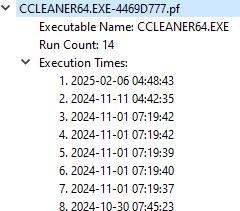
PrefectfilesinWindowsareanessentialpartoftheoperatingsystem’sperformanceoptimization.Thesefilesstoreallthe necessary information regarding the executable application [6]. Therefore, by parsing the prefetch files, we obtain the followingattributesasshowninFig.1.
o Executable Name:Theexecutablenamereferstothenameoftheapplicationthatwasrunonthesystem,anditisakey part of the Prefetch file. Each Prefetch file is named using a specific pattern that includes the executable’s name followed by a hash value. For example, if a user launches the tool named File Shredder, the system will create a Prefetch file named something like SHREDDER.EXE/-63FA1305.pf. This filename clearly identifies that the Prefetch file corresponds to the execution of SHREDDER.EXE. For forensic investigators, the executable name provides direct evidenceofwhichapplicationwasexecuted,anditservesasthestartingpointfordeeperanalysis,suchasdetermining thetimeofexecution,runcount,andassociatedfileaccess.
o Run count: The Run Count is a numeric value stored within a Prefetch file that indicates how many times a specific applicationhasbeenexecutedfromitscurrentlocationonthesystem.Thiscounterincreaseseachtimetheprogramis launchedanditismaintainedbytheWindowsoperatingsystemtohelpoptimizefuturelaunchesoftheapplication.
o Execution times: The Last Execution Time refers to the exact date and time when an application was most recently executedonthesystemfromitscurrentfilepath.ThistimestampisstoredinthePrefetchfileinWindowsFILETIME format,whichrecordsthenumberof100-nanosecondintervalssinceJanuary1,1601(UTC).Itcanbeconvertedintoa
International Research Journal of Engineering and Technology (IRJET) e-ISSN: 2395-0056
Volume: 12 Issue: 12 | Dec 2025 www.irjet.net p-ISSN: 2395-0072
standardhuman-readableformat(e.g.,YYYY-MM-DDHH:MM:SS)usingforensictoolsorscripts.
From a forensic standpoint, the Last Execution Time is critical for establishing temporal evidence it shows when a particularapplicationwasused.Thisisespeciallyusefulwheninvestigatingmalwareactivity,unauthorizedaccess,or the use of anti-forensic tools. For instance, if a wiping tool was last executed just before key files disappeared, it strongly suggests intentional data destruction. Additionally, this timestamp can be cross-referenced with other artifacts such as event logs, $MFT entries, or user login sessions to corroborate timelines and attribute activity to specificusers.InWindows8andabove,prefetchfilesalsostoremultiplepastexecutiontimes.
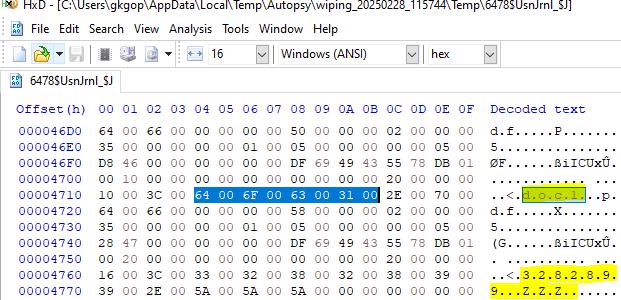
Ananalysisofthe$UsnJrnlrevealedthatwipedfilescouldbeidentifiedthroughdistinctivefile-renamepatterns.TheUSN Journal($UsnJrnl)isasystemfileusedbytheNTFSfilesysteminWindowstologchangesmadetofilesanddirectoriesona volume.The$UsnJrnlfileconsistsmainlyof two data streams, i.e., $Max and $J. Each record in the $J stream logs actions suchasfilecreation,modification,deletion,andrenaming,alongwithassociatedmetadataliketimestamps,reasoncodes, andfilenames.WiththehelpoftheNTFSlogtrackerv1.8tool,wewereabletoidentifythatthefileswipedusingtheFile shredder tool were renamed to a format such as 1278654.ZZZ.Also, by checking the $UsnJrnl files, we could see the originalfilenamesaswellastheirrenamedfilenames.Therefore,wewereabletoidentifyapatternforfilewipingdoneby the file shredder tool. From the $UsnJrnl structure, we can identify the reasonflags, which indicate the renaming of the files.0x1000 = RENAME OLD NAME: Indicates the file was renamed from this name. 0x2000 = RENAME NEW NAME: Indicatesthefilewasrenamedtothisname.
Hence, by checking the 1278654.ZZZ format in the RENAME NEW NAME andchecking their RE- NAME OLD NAME, we canidentifythatthefileiswipedbythefileshredder tool.Herewetakeanexampleofa filewhoseoldnameisdoc1.pdf andnewnameis3282899.ZZZafterthefileiswipedbythefileshreddertool,whichisshowninfig2.
3.2 Detection of Time stomped files
SimilartothatofStep1mentionedinthesectionondetectingwipedfiles,herealsowecanuseprefetchfilesforchecking theTimestompingTools.
International Research Journal of Engineering and Technology (IRJET) e-ISSN: 2395-0056
Volume: 12 Issue: 12 | Dec 2025 www.irjet.net p-ISSN: 2395-0072
InNTFS,the$LogFilemaintainsatransactionlogofchangesmadetometadatawithinthefilesystem,includingupdatesto the$MFT(MasterFileTable)[7]. Each logrecordin$Log- File contains operation codes (opcodes) that describe specific actionsperformedonfilemetadata.
0x07 – Update Resident Value This opcode indicates that a resident value within an $MFT record has been updated. Specifically,itoftenreferstomodificationsinthe$FILENAME(0x30)attribute,whichcontainstemporalinformationsuch ascreation,modification,access,andentrychangetimestamps.
Innormalfileoperations,whenalegitimatetimestampupdateoccurs(e.g.,duetoaccessingormodifyingafile),the0x07op code(describedinfig3)typicallyappearsonceintheassociated$LogFiletransaction.Intimestompingscenarios,where a tool is deliberately used to alter timestamps (e.g.,toevadedetection), thesame operation is carried out repeatedly or acrossmultipleattributes.Asaresult,the0x07opcodeappearsmultipletimesinasingleorcloselyrelatedsetof$LogFile entries.BycorrelatingentriesintheLog FilewithMFTrecordsandobservingthefrequencyofthe0x07opcode,forensic investigators can identify potential time stomping attempts. A normal file will show a single instance of this operation duringtimestampchanges,whereasatimestompedfilewilltypicallygeneratemultiple0x07operations,indicatingpossible manipulation by anti-forensic tools. After identifying files in the $Log File that have the 0x07 – Update Resident Value operation code flagged multiple times, the next step in confirming timestamp manipulation (time stomping) involves analyzingtheirmetadatawithinthe$MFT(MasterFileTable).
• $STANDARD INFORMATION ($SI): Contains originaltimestampssuchasfilecreation,lastmodification,lastaccess,andentrymodificationtimes.Thesearethesystemmaintainedtimestamps.
• $FILENAME($FN):Alsocontainstimestamps, but thesearesometimescopied from $SIand notalways updated thesameway.Theyreflectmetadataasseenfromtheparentdirectory’sperspective.
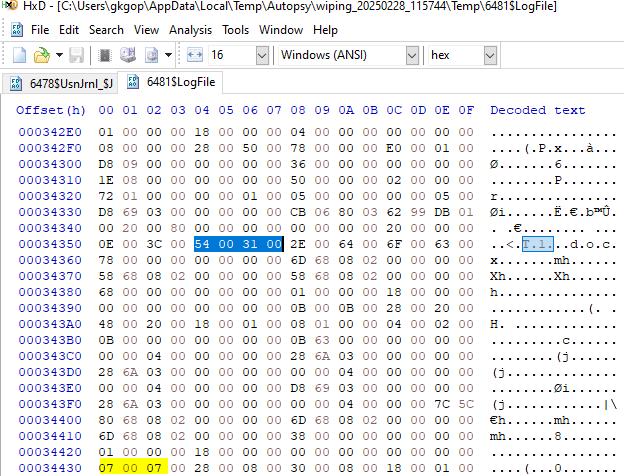
Fig. -3:Operationcode07identifiedforatimestompedfileT1.docx
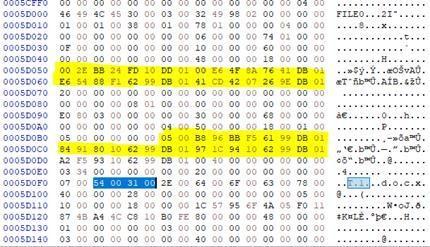
Under normal conditions, the timestamps in the $SI and $FN attributes are usually closely aligned, if not identical. However, when a file has been time stomped using an anti- forensic tool, only the $SI timestamps are typically altered, whilethe$FNtimestamps remainunchanged orreflectthe original values. By comparing the $SI and $FN timestamps of files that have multiple 0x07 operations in the $Log File, investigators can detect inconsistencies. A clear discrepancy between these timestamp sets strongly indicates that the file was subjected to manual timestamp manipulation (time stomping). This technique helps validate and strengthen the evidence of anti-forensic activity. The timestamp value comparedfromtheHXDeditorisshowninFig.4,andtheirconvertedtime,i.e,human-readabletimestamps,areshownin Fig.5.
International Research Journal of Engineering and Technology (IRJET) e-ISSN: 2395-0056
Volume: 12 Issue: 12 | Dec 2025 www.irjet.net p-ISSN: 2395-0072
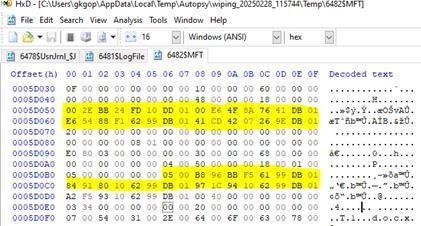
-4:Timestampscomparedfrom$MFTfile
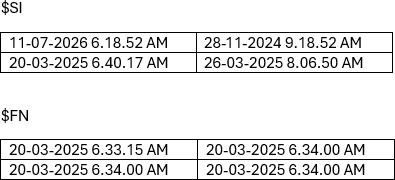
Fig. -5:Human-readabletimestampstakenfromHXDEditor
$UsnJrnl and $MFT file
TheUSNJournal($UsnJrnl)isasystemfileusedbytheNTFSfilesystemtologchangestofilesanddirectoriesonavolume. Itservesasachronologicalrecordoffilesystemactivities,includingcreation,modification,renaming,anddeletion.Froma forensic perspective, $UsnJrnl is highly valuable because it retains evidence of file operations even if the files have been deletedorrenamedandcanrevealsuspiciousoranti-forensicbehavior,suchastimestampmanipulationorfilewiping. One key field within each USN record is the “reason flag”, which identifiesthetypeofchangethatoccurredtothefile. Of particularinterestintimestompinginvestigationsistheflag:
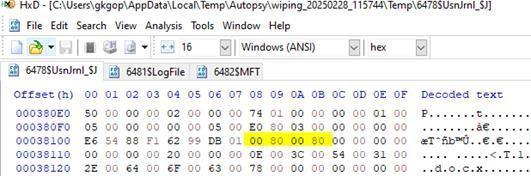
- 0x8000–BASICINFOCHANGEthisflagindicatesthata file’s attributes or timestamps have been modified, potentially pointingtodeliberatetampering.Thereasonflagishighlightedforafilein$UsnJrnlisshowninFig.6.
Foranormalfile,this0x8000flagtypicallyappearsonceduringregularattributeortimestampupdates.However,fortime stomped files, this flag tends to appear multiple times in the journal records for that file. This repeated presence of the 0x8000 flag for a single file is an anomaly and raises suspicion of time stomping. If a timestamp mismatch is found betweentheSIandFNattributesforthosefilesthathavemultiple0x8000flagsin $UsnJrnl,itprovidesstrongevidenceof timestamp manipulation. By identifying files that have the 0x8000 reason flag occurring multiple times in $UsnJrnl and thencomparingtheirSIandFNtimestampsfromthe$MFT,investigatorscandetecttime stompingwithhigh confidence. This method is effective even if other forensic artifacts (like Prefetch or event logs) have been cleared, making it a powerfulanti-anti-forensicstechnique.
International Research Journal of Engineering and Technology (IRJET) e-ISSN: 2395-0056
Volume: 12 Issue: 12 | Dec 2025 www.irjet.net p-ISSN: 2395-0072
In this study, five files representing different data formats were selected to systematically examine the effects of antiforensicwreakingtechniques.TheselectedartifactsincludedaMicrosoftWorddocument(Antforensics),aPDFfile(doc1), a PowerPoint presentation (Internship ppt), a plaintextdocument(P1)andaJPEGimage(Pi7toolphoto). Eachfilewas subjected to deliberate data destruction using different anti-forensic tools. Specifically, the Word document was wiped usingtheEraserutility,thePDFfilewasprocessedthroughFileShredder,andthePowerPointpresentationwassanitized usingWipeFile.Additionally,boththetextdocumentandtheJPEG image weretargetedand erasedusingFile Nuke.The selection of various file types was designed to replicate real-world scenarios in which multiple data structures coexist withinstoragemedia.Byapplyingdifferentanti-forensictoolsacrossvariedfileformats,theexperimentsoughttoevaluate tool-specificwipingpatterns,residualtraces,andtheirimpactonsubsequentforensicrecoveryefforts.
- Animageof thefolder that consisted of those fivefiles wastakenandloadedinto theautopsy tool,andthefollowing wasobtained.
- Weidentifiedthatthecontentsarenotwipedoffcompletelybythetoolsinstead,theywerefilledwithrandomvalues. Henc,eitwasunderstoodthatchancesofdetectingthefilesarepossibleandtheremightbeachanceofrecovery.
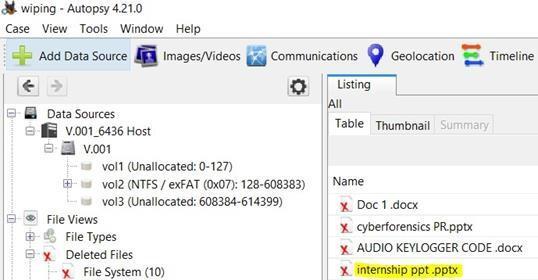
- Duringtheanalysisofthedeletedfileslist,onlythe”Internship PPT.pptx”filewasidentified- previouslywipedusing the WipeFile tool. This observation suggests that files erased with WipeFile can still be recovered, atleastpartially, usingforensictoolssuchasAutopsy.ThelistofdeletedfilestakenfromAutopsysoftwareisshowninFig7.However,it isimportant to notethatAutopsywasonlyabletorecognizethefileaspermanently deleted;nospecific metadata or indicatorswerefoundtosuggestthatthefilehadundergoneadeliberatewipingprocess.
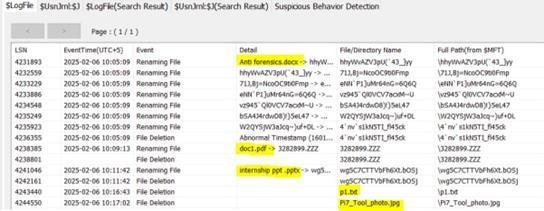
- To further investigate the presence and activity related to other files, the $LogFile extracted through the Autopsy forensic tool was analyzed using the NTFS LogFile Trackerv1.8 utility.The$LogFileloadedinside the NTFS LogFile Tracker v1.8 is shown in Fig 8.This analysis aimed to examine transactional records maintained by the NTFS journaling system, enabling the identification of file creation, modi- fication, deletion, and renaming operations that mightnotbeapparentfromtraditionalfilesystemviews.
International Research Journal of Engineering and Technology (IRJET) e-ISSN: 2395-0056
Volume: 12 Issue: 12 | Dec 2025 www.irjet.net p-ISSN: 2395-0072
Findings obtained are given as follows:
1) Anti forensics.docx:
- Thefile“AntiForensics.docx”whichisdeletedusingtheerasertoolhasundergonerenaming7timesandhencewecan consider this as one of the features of the eraser tool. (Note : Eraser renames the wiping file multiple times before deletingit.HereIhaveusedthe erasure methodas Gutman35 passes.Therefore, Erasermightrenamefilesmultiple timesaspartofitsoverwritingprocess,especiallywhenusingcomplexmethodslikeGutmann’s35-passoverwrite)
- Whilecheckingthe$LogFileinHXDeditorwecouldseethattherenamingfilesappearsaftertheanti-forensicfilename andsowhileanalyzingthe$LogFile,ifwefindanyfilehavingmultiplerenamingitcouldbeidentified thatsomesortof filewipinghasbeenundergoneforthatfile.Thestructureof$LogfileanalyzedthroughtheHXDeditorhasbeenshown inFig9.
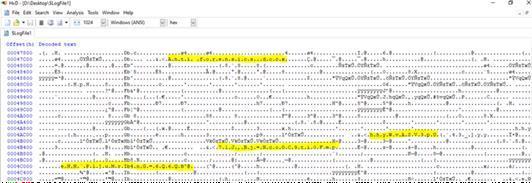
Fig -9:Structureof$logfilewhichdisplaystherenamednamesinHXDeditor
- Apartfromthe$LogFilerecordsthecopyofMFTrecordsarealsodisplayedinthe$LogFile.
- Also,wewereabletoidentifythelastrenamedfilenameinthedeletedfileslistwhichwasdisplayedintheAutopsybut identifyingthatnamealonewouldnothelptheforensicanalysttojumpintoaconclusionregardingthewipedfiles.
2) doc1.pdf:
- Theanalysis of the $LogFile usingNTFS LogFile Tracker clearly showed that the file was renamed to ”3282899.ZZZ” beforeitwasdeleted.
- ThisfilehadbeendeletedafterbeingwipedusingtheFileShreddertool.
- Further experiments were conducted by wiping additional files with File Shredder, and in every case, the files were renamedintoa”number.ZZZ”formatpriortodeletion.
- This consistent renaming behavior indicates that the ”number.ZZZ” naming pattern is a default feature of the File Shreddertool,ratherthananisolatedoccurrence.
- Basedontheseobservations,itcanbeconcludedthatfilesfoundwithanumericnameand”.ZZZ”extensionarestrong indicatorsofhavingbeenrenamedandwipedusingFileShredder.
3) Internship PPT.pptx:
Inthiscase,thefilewasrenamedtoarandomnewnameconsistingofarbitraryalphabeticchar-acters,abehaviorlike that observed with the Eraser tool. However, unlike the File Shredder tool which consistently renames files following a distinct ”number.ZZZ” pattern no consistent or recognizable naming pattern could be identified with Eraser. The renaming process appeared to be random, making it more challenging to associate the renamed files directlywithaspecificantiforensictoolbasedsolelyonthefilenamestructure.
4) p1.txt & pi7 Tool photo.jpg:
Itwasobservedthatthesetwofilesdidnotundergoanyrenamingpriortodeletionbythefilenuketoolcomparedto other file wiping tools Instead, they were directly deleted without any modification to their original filenames. The original filenamescould be retrieved fromthe$Log File byanalyzingthetransactional records,however nospecific metadatawasfoundwithinthe$LogFileentriestosuggestthatthesefileshadbeensubjectedtoa filewipingprocess. Asaresult,whilethedeletedfileswereidentifiable,theirdeletionappearedsimilartonormalfiledeletionratherthan antiforensicwipingactivities.
International Research Journal of Engineering and Technology (IRJET) e-ISSN: 2395-0056
Volume: 12 Issue: 12 | Dec 2025 www.irjet.net p-ISSN: 2395-0072
For studying timestamp manipulation, three files of different formats were selected and processed using three distinct timestamp modification tools. The selected artifacts were as follows: a Microsoft Word document (T1) was manipulated using the Bulk Extractor tool; a PowerPoint presentation (T2) was processed with New File Time; and a plain text document(T3),createdusingNotepad,wasmodifiedusingtheTouchutility.Eachtoolwasappliedindividuallytoalterthe metadata timestamps associated with the respective files. This approach was designed to assess how different timestamping utilities modify file system records and to evaluate the potential forensic challenges posed by such anti forensictechniques.
• During the analysis of the $MFT file extracted using the Autopsy tool, it was observed that each file entry contains threemainattributes:theStandardInformation(SI)attribute,theFileName(FN)attribute,andtheDataattribute.
• Among these, both the Standard Information and File Name attributes each store four timestamps (Creation Time, ModificationTime,MFTModificationTime,andAccessTime)asshowninFig10.
• Upon examining the manipulated files, it was identified that the timestamping tools altered only the timestamps presentintheStandardInformationattribute.
• Incontrast,thetimestampsrecordedintheFileNameattributeremainedintact,preservingtheoriginalcreationand modificationtimes.
• ThisdiscrepancybetweentheStandardInformationandFileNameattributescanbeeffectivelyusedasamethodto detectpotentialtimestampmanipulation(timestomp-ing)duringforensicinvestigations.
• However,relyingsolelyonthecomparisonbetweenthesetwoattributesmaynotbesufficientforcomprehensive detectionoftimestompedfiles,as sophisticated tools may alter both attributesand cause inconsistencies that are harder todetect.
3. CONCLUSIONS
Astheuseofanti-forensictechniquesbycybercriminalscontinuestoincrease,itisimportantforforensicinvestigatorsto have a range of countermeasures to mitigate their impact[8]. The increasing sophistication of Anti forensic techniques continues to undermine the reliability of digital investigations by obscuring user actions and corrupting the evidentiary timeline. Anti-forensics techniques and tools are ever-changing and therefore, a solid set of forensic tools is required combating them [9] . The data wiping tools can completely delete OS artifacts. To overcome this limitation, many researchershavetriedtousefilesystemartifactstoidentifydatawipingtraces.[10].Thisworkhasproposedamethodfor generally identifying whether anti-forensic tools exist, and – in some cases – to whatextentthosetoolshavebeenused [11.].By integrating forensic analysis modules capable of parsing key NTFS artifacts including $MFT, $Log File, and $UsnJrnl with Prefect-based execution tracing, the proposed methodology provides a comprehensive mechanism for identifying suspicious deletion patterns and temporal inconsistencies. The correlation of findings across these diverse sourcesenablesamoreaccuratereconstructionofeventsandexposesattemptstotamperwithoreliminatedigitaltraces. Experimental evaluations confirm that artifact-driven analysis remains a highly effective strategy in combating modern anti-forensic threats. Overall, this work contributes a robust and scalable framework that enhances the integrity, reliability,anddepthofdigitalforensicexaminationsinthepresenceofdeliberateevidence-manipulationtechniques.
International Research Journal of Engineering and Technology (IRJET) e-ISSN: 2395-0056
Volume: 12 Issue: 12 | Dec 2025 www.irjet.net p-ISSN: 2395-0072
[1] R.GonzálezArias,J.BermejoHiguera,J.J.RainerGranados,J.R.BermejoHiguera,andJ.A.SiciliaMontalvo,“Systematic Review:Anti-ForensicComputerTechniques,”
[2] JustinJacob1,Dr.SandhyaR2,“AStudyofAntiForensicTechniquesAndTheirMitigationStrategies”
[3] Jong-HwaSong1,Hyun-SeobLee2*”ADesignofTimestampManipulationDetectionMethodusingStoragePerformance inNTFS”
[4] AntonioSavoldi*,MarioPiccinelli,PaoloGubian,“Astatisticalmethodfordetectingondiskwipedareas”
[5] E.J.Lee,S.Y.Lee,H.Kwon,S.J.LeeandG.B.Kim,“IdentificationofdatawipingtoolsbasedondeletionpatternsinReFS $Logfile,”inProceedingsoftheDigitalForensicResearchConference(DFRWSAPAC)2023.
[6] YeonsooKim†,JewanBang††,JinkookKim†,SangjinLee†††,“AStudyofTraceforDataWipingTools”
[7] J. Oh, S. Lee, and H. Hwang, “Forensic Recovery of File System Metadata for Digital Forensic Investigation,” School of Cybersecurity,KoreaUniversity,Seoul,SouthKorea,andTheAffiliatedInstituteofETRI,Daejeon,SouthKorea.
[8] SatvikGurjar1,DhavalNaik2,AartiSardhara3,“Anti-ForensicTechniquesandItsImpactonDigitalForensic”
[9] EmreHosgor,”DetectionandMitigationofAnti-Forensics”
[10]DongBinOh,KyungHoPark,HuyKangKim,“De-Wipimization:DetectionofdatawipingtracesforinvestigatingNTFS filesystem”
[11]KyoungJeaPark,Jung-MinPark,Eun-jinKim,ChangGeun Cheon,JoshuaI.James“AntiForensicTraceDetectionin Digital ForensicTriageInvestigations”
© 2025, IRJET | Impact Factor value: 8.315 | ISO 9001:2008 Certified Journal | Page1109