
International Research Journal of Engineering and Technology (IRJET) e-ISSN: 2395-0056
Volume: 12 Issue: 06 | Jun 2025 www.irjet.net p-ISSN: 2395-0072
International Research Journal of Engineering and Technology (IRJET) e-ISSN: 2395-0056
Volume: 12 Issue: 06 | Jun 2025 www.irjet.net p-ISSN: 2395-0072
Yogesh J. Pawar, Adish S. Nair, Samrudhi L. Musale, Atharv R. Nalawade, Siddhi R. Naktode, Nachiket Girnar, Aditya A. Nadekar
Department of Engineering, Sciences and Humanities (DESH) Vishwakarma Institute of Technology, Pune, Maharashtra, India
Abstract With the surge of e-commerce in recent years, online scams exploiting product reviews have become a pressing concern. Fake ratings, manipulated feedback, and deceptive sellers undermine trust in platforms like Amazon. This paper proposes an end-to-end system combining a robust Amazon review scraper with a BERT-based legitimacy classifier deployed via a Flask web application. The scraper, based on Oxylabs' implementation, collects up-to-date product reviews. The backend uses a fine-tuned BERT model trained on both real and fake review datasets to classify reviews as malicious or unworthy. The integrated platform provides users with a legitimacy score, fake-review estimates, and additional metrics to evaluate online products effectively.
Keywords Online scam detection, Amazon reviews, fake reviews, BERT, sentiment analysis, transformer models, product legitimacy, e-commerce security, web scraping, text classification, cybersecurity in e-commerce, consumer protection, deep learning, multilabel classification
HE extensive use of online reviews has exposed sites such as Amazon to fake manipulation, compromising consumer confidence and product visibility. This paper introduces an integrated system for determining the authenticity of products from user reviews. Fundamentally, the system utilizes an effective and powerful scraping engine to gather actual-time reviews from Amazon product pages. Toward thisend,weintegrateandimprovetheopen-sourceAmazon Review Scraper developed by Oxylabs [1], which employs headless browser automation and stealth mechanisms to evadecontemporarywebdefenses.
The scraper is called by a Flask-based backend that accepts user input, initiates scraping, and processes the scraped output. The reviews are fed into a BERT-based classifiertrainedondatasetswithbothrealandfakereviews [2][3]. The model returns each review with a probability score indicating whether it is malicious or not worthy. The backend then aggregates these predictions into a final
legitimacy report, e.g., a fake-review percentage, along with confidence measures. All these elements scraping, classification, and result determination are orchestrated in a light-weight web application that enables real-time analysis. The modular design makes the system scalable, explainable,andabletoaddressevolvinge-commercethreat vectors
Several studies have explored the application of machine learning and web-based technologies to detect fraudulent activity in online shopping environments. Weng et al. [4] introduced CATS, a cross-platform machine learning system that detects counterfeit product ratings by analyzing review and rating patterns across multiple e-commerce platforms. Itsabilitytogeneralizetrendsmakesitparticularlyeffective atidentifyingwidespreadscambehaviors.
Azzuri and Sulaiman [5] proposed a scam website detection system that classifies e-commerce sites as either legitimate or fraudulent using a Random Forest classifier, achieving a notable 93% accuracy. However, their model primarily focuses on structural website features rather than user-generatedcontent.
Cao et al. [6] addressed the problem of fake reviews by detecting collusive groups of reviewers. They utilized an unsupervised graph neural network model combined with modularity-based clustering to identify coordinated review fraud a strategy that surpasses individual review analysis insophistication.
In another study, Ahmed et al. [7] benchmarked 11 classification algorithms on shopping behavior datasets and found that the Decision Table algorithm delivered the best performance (87.13% accuracy) using the WEKA platform, reinforcingthevalueofdataminingforfrauddetection.
Whiletheyshowpromisingoutcomes,thesemethodstend to address isolated scopes either web page-level metadata
International Research Journal of Engineering and Technology (IRJET) e-ISSN: 2395-0056
Volume: 12 Issue: 06 | Jun 2025 www.irjet.net p-ISSN: 2395-0072
or user behavior without providing a complete or usercentric solution. Our system, however, combines several layers: review scraping in real-time, review text classification, and lightweight web interface to provide an actionablelegitimacyanalysis.
Although other alternative approaches have higher independent accuracy, our choice of using BERT is based on its improved ability to detect subtle patterns of natural language in reviews. As a transformer-based model, BERT can detect context, sarcasm, and subtle shifts in sentiment thatbasicclassifierscannot. Itisthereforemostappropriate for high-end review text analysis, which is most frequently themostmanipulatedvariableine-commercefraud
III. METHODOLOGY/EXPERIMENTAL
III.A. Process diagram
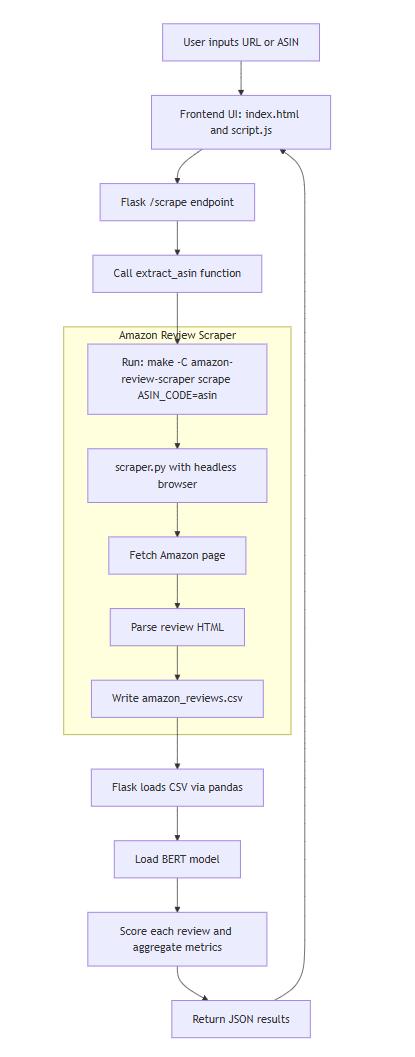
Fig.1: System architecture
This section outlines the architecture and internal logic of theproposedAmazonreviewlegitimacydetectionsystem.It comprisesfourprimarymodules:(A)reviewdata extraction, (B) dataset preparation and splitting, (C) transformer-based classification, and (D) result aggregation and web integration.
Review harvesting is powered by Oxylabs’ open-source Amazon Review Scraper [1], implemented using Selenium and headless Chrome automation. The scraper module, encapsulated in scraper.py, navigates to a product’s main Amazon listing and extracts visible reviews using XPath and class-based selectors. Key attributes extracted include reviewer name, review title, rating, and full text content. Extracted reviews are saved to a structured file (amazon_reviews.csv)inastandardizedschema.
While the scraper performs reliably for extracting content displayed on the first load of the product page, it does not currentlyhandlepaginationorinteractdynamicallywiththe "Seeallreviews"link.Asaresult,itislimitedtoreviewsthat are pre-rendered on the main listing. This trade-off ensures speed and simplicity but comes at the cost of completeness. The scraper is invoked modularly through a Makefile command, allowing its functionality to remain decoupled from the core Flask application and easily upgradable in futureversions.
III.B.B. Dataset preparation and train–test splitting
Theclassificationmodelistrainedonadatasetconstructed by merging two public sources: the “Amazon Sentianalysis” dataset [2] containing authentic customer reviews and the “Fake Reviews Dataset” [3] comprising synthetically generated and crowdsourced fraudulent content. Each review is annotated with three binary labels: malicious, unworthy, and fake_label, reflecting different dimensions of reviewqualityandintent.
Prior to training, the dataset undergoes cleaning and tokenization. A stratified 80/20 train–test split is applied to preservetheproportionofeachlabelacrossbothsubsets.
This stratification mitigates class imbalance and improves themodel'sgeneralizationperformanceacrosslabeltypes.
III.B.C. Transformer-based classification
A BERT-Base-Uncased model is fine-tuned for multi-label review classification using the HuggingFace Transformers
International Research Journal of Engineering and Technology (IRJET) e-ISSN: 2395-0056
Volume: 12 Issue: 06 | Jun 2025 www.irjet.net p-ISSN: 2395-0072
library [8]. Input reviews are truncated or padded to 256 tokens and tokenized using BERT's standard WordPiece tokenizer [8]. The model architecture outputs three logits corresponding to the three labels, and applies a sigmoid activationfunctiontoyieldindependentprobabilities[9].
BesthyperparametersforBERTmodeltrainingwerechosen to achieve its best performance as well as efficiency [10], [11].Formaintainingcontextofreviewsatminimalmemory cost,thesequencelength waslimitedto256tokens.Abatch sizeof16wasusedtoensurestabletrainingundercommon GPUavailabilityrestrictions [10].Themodel wastrainedfor 10epochstofacilitatemaximumlearningwithoutoverfitting [12].TheAdamWoptimizerwasusedwithalearningrateof 2e−5 to ensure consistent and best updates to gradients duringtraining[8].
Theclassifieristrainedusingbinarycross-entropyloss,with macroandweightedF1-scoresmonitoredforeachlabel[11]. Post-training,themodel achievesanF1-scoreof0.79forthe malicious label and 0.56 for unworthy, suggesting higher confidence in identifying overtly deceptive content (see Table1)[13].
TheAPIreturnsthisdataasaJSONpayload,whichincludes the ASIN, all computed metrics, and a sample of the top five reviews. On the frontend, JavaScript dynamically renders these results using visually distinct cards and color-coded indicators to communicate legitimacy and risk scores to the end-user.
This modular, decoupled architecture enables clear divisionofresponsibilitybetweencomponentsandfacilitates future integration with more advanced scrapers or model backends.
Toassessthesystem’sreliability,weconductedend-to-end testing under real-world conditions using diverse Amazon product pages. Users input product URLs via the web interface, which triggered a backend process combining scraping, classification, and frontend rendering. Correct generation of the CSV file confirmed scraper functionality, and the output legitimacy metrics were validated for logical consistencyandexpectedbehavior.
Performance benchmarking revealed that the full pipeline typically completes within 8–12 seconds. Of this, model inference takes less than 2 seconds when run on a CUDAenabledGPU,whilescrapingremainsthedominanttimesink duetonetworkdelaysandbrowserstartuptime.
Table 1: F1 scores for the BERT classifier, showing strong performance on malicious reviews and moderate accuracy for unworthy reviews.
Oncereviewscrapingiscomplete,theFlaskbackendreads the amazon_reviews.csv file into a Pandas DataFrame and runs each review text through the fine-tuned BERT model. BERT classifier output probabilities are employed to generate three product legitimacy measures. The legitimacy scoreistheaveragenon-maliciousreviewprobability,which reflects overall trustworthiness. The fake review estimate is 100 minus the score, which reflects estimated levels of unscrupulous feedback. The unworthy score is the probability of reviews being imprecise or uninformative, reflectingcustomerfeedbackquality.
2025, IRJET | Impact Factor value: 8.315 |
Model reliability was quantified by comparing classifier outputs against a labeled test set of 3,397 samples. Evaluation metrics including precision, recall, and F1-score were extracted for each label (see Fig. 1). The system performed well in detecting clearly fraudulent content (maliciouslabel),butlessstronglyonambiguousorcontextpoor content (unworthy label), which is consistent with the subjectivenatureofthelatter.
Informal usability testing was also conducted with a small group of users who assessed the UI for responsiveness and clarity. Feedback was largely positive, with participants noting the utility of visual scores and review excerpts in guiding purchase decisions. No critical bugs were reported during testing, although some cases with <10 reviews initially returned blank metrics. This limitation has since beenrelaxedtoensurepartialanalysisisstilldelivered.
Overall, the system exhibits good responsiveness, interpretability, and accuracy across a range of product types. It effectively bridges web automation and machine learning to assist users in making informed e-commerce decisions.
International Research Journal of Engineering and Technology (IRJET) e-ISSN: 2395-0056
Volume: 12 Issue: 06 | Jun 2025 www.irjet.net
The system was end-to-end tested with real Amazon product pages, which ranged across a range of product categories with varying review numbers and review structure. The integration of the Oxylabs-based scraper and BERT legitimacy classifier performed well within an integratedFlask webapp,whereuserscouldinputanyvalid Amazon URL or ASIN and receive review-based legitimacy scores in less than 10 seconds. The user interface output revealed a legitimacy score, percentage of fake reviews, and unworthyreviewdetection,andthetopfiveproductreviews foropenness.
TheBERTmodelthatwastrainedonlabeledrealandfake review datasets also performed well. As evident from the evaluation phase, the classifier had an F1-score of 0.79 in detecting malicious reviews and 0.56 in detecting unworthy reviews.Overall,themodel hadamacroaverageF1-scoreof 0.68 across classes. The findings indicate that malicious reviews are detected very well, although perhaps more tuning is required to make the model more sensitive to ambiguous, unhelpful, or context-insufficient reviews that arelabeledas"unworthy."
But the review scraper in its existing form is open to an inherent bottleneck. The scraper.py module, built with Selenium and a headless Chrome driver, scrapes only the firstpageofreviewsfromthecoreproductpage.Thisisseen inthefunction_get_reviews_from_product_page,whichloads the product page and scrapes all the elements with the .reviewclasspresentatloadtime.Itdoesnotloadthe"Seeall reviews" link or dynamically scroll to load the paginated review material. As a result, the system will most likely process fewer than ten reviews, especially on newly introducedorlow-volumeproducts,andpotentiallyskewthe analysis and metrics. This bottleneck arises from the lack of logic for JavaScript-driven navigation, lazy loading, or user simulationviaSeleniumactions(e.g.,reviewbuttonclicksor scrolling).
In commercial-grade scraper software, this limitation is typically avoided with premium tools such as Octoparse, BrightData, or ScrapeHero APIs. These are commercial tools with complete support for pagination, intelligent review scraping, IP rotation, and CAPTCHA solution, and hence enable more comprehensive data scraping. Although the currentarchitectureavoidsdependenceonexternalAPIsdue to financial and educational considerations, future work can involve modular integration of such APIs as add-ons, for increased coverage and legitimacy estimation accuracy. Despite such limitations, the present prototype robustly illustrates the feasibility of integrating light-weight scraping
p-ISSN: 2395-0072
with AI-based review classification towards identifying scamsininternetmarketplaces.Irrespectiveofthelimitation of restricted review visibility, the system is able to identify inauthentic patterns of writing tone, copying, and reviewer actions suggestive of manipulation. We would further optimize the review retrieval pipeline, multilingual support, andmetadataanalysis(e.g.,purchaseverificationsignals),in order to significantly improve model input diversity and predictionrobustness
Though the existing system shows good performance in scraping and analyzing Amazon reviews, there are a few areas of improvement. The most pressing improvement is extending the coverage of the scraper. Currently, the review extractor extracts only reviews presented on the first product page. Subsequent versions should make user interactionslikeclickingonthe"Seeallreviews"link,dealing with pagination, or dynamic scrolling to expose JavaScriptrenderedelementsa priority.Thismaybedonewiththeaid of more sophisticated Selenium methods or migrating to headless browser test automation frameworks such as Playwright.
Along with the enhancement of the scraper, model enhancement is another major avenue of investigation. The current classifier is only trained on English-language data sets. Supporting multilingual reviews would make the system more universal and relevant to international ecommerce. Another interesting direction is to include reviewer metadata, like verified purchase or review helpfulnessvotes,aspartofthemodelinputfeatures.
The system would also gain from an admin-oriented dashboard that records history of past inferences, monitors risk trends per category, and provides manual labeling or modelfeedback.Lastly,includingpaidAPIsinthebackendin pluggable modules would provide a big boost to scalability and real-time dependability for production-level deployments
ThisresearchpresentsanAI-drivensystemthatintegrates web scraping and BERT-based classification to detect potential scams on e-commerce platforms, using Amazon as a case study. The prototype demonstrates how natural language processing can be effectively applied to product reviews for legitimacy scoring, providing end users with actionable insights before making a purchase. The system’s modular architecture comprising a Selenium-based review scraper, a fine-tuned BERT model, and a Flask web
International Research Journal of Engineering and Technology (IRJET) e-ISSN: 2395-0056
Volume: 12 Issue: 06 | Jun 2025 www.irjet.net p-ISSN: 2395-0072
interface enables efficient end-to-end analysis with minimallatency.
Althoughthecurrentimplementationhaslimitations,such as restricted scraping depth and dataset coverage, the experimentalresultsvalidatetheapproachasapracticaland scalable solution. With improvements in data acquisition, multilingual support, and interface refinement, this framework hasthepotential toevolveintoa comprehensive scam detection tool for modern online shopping environments.
Theauthorswouldliketoextendtheirsinceregratitudeto Prof. Lokesh Khedekar, ASEP Coordinator, for his continued supportandusefulinputsthroughoutthisproject.Hisinputs have been instrumental in molding the development of this integrated emergency platform for standardized and affordableemergencymedicalservicesinIndia.
We also thank our internal guide, Prof. Yogesh Pawar, for his inputs and useful suggestions. His inputs have been instrumental in molding the project and ensuring its successfulcompletion.
We also thank the resources and infrastructure available at Vishwakarma Institute of Technology, Pune, which assisted in research, development, and testing of this platform. We also thank our peers and colleagues for their usefuldiscussionandcooperationthroughoutthisactivity.
[1] “Amazon Review Scraper,” Oxylabs GitHub Repository, https://github.com/oxylabs/amazon-review-scraper (accessedJune12,2025).
[2]Y.Charki,“AmazonReviewsforSentimentAnalysis(FineGrained),” Kaggle Dataset, https://www.kaggle.com/datasets/yacharki/amazonreviews-for-sentianalysis-finegrained-csv (accessed May 2025).
[3] M. Mexwell, “Fake Reviews Dataset,” Kaggle Dataset, https://www.kaggle.com/datasets/mexwell/fake-reviewsdataset(accessedMay2025).
[4]C.Weng,A.De,N.Yadav,M.Lin,C.R.Rivero,andB.Dong, “CATS:ACollaborativeandTransparentSystemforDetecting Counterfeit Product Ratings,” Proc. 31st ACM Conference on HypertextandSocialMedia,2020,pp.95–104
[5] M. Azzuri and R. Sulaiman, “Detection of Online Scam Websites in E-Commerce Using Random Forest Classifier,” Indonesian Journal of Electrical Engineering and Computer Science,vol.18,no.1,pp.356–362,April2020.
[6] Q. Cao, Y. Yang, J. Yu, and C. Pal, “Uncovering Collusive Spammers in Online Review Communities,” Proceedings of the 27th ACM International Conference on Information and KnowledgeManagement(CIKM),2018,pp.1033–1042.
[7] S. Ahmed, A. Pathan, and M. Zubair, “Comparative Analysis of Classification Techniques on Shopping Behavior Data for Scam Detection,” International Journal of Advanced Computer Science and Applications (IJACSA), vol. 10, no. 6, pp.123–128,2019.
[8] Devlin et al., BERT: Pre-training of Deep Bidirectional Transformers for Language Understanding, https://aclanthology.org/N19-1423/,NAACL2019.
[9] A. Q. Mir, F. Y. Khan, and M. A. Chishti, “Online Fake Review Detection Using Supervised Machine Learning and BERTModel,”CoRR,vol.abs/2301.03225,Jan.2023.
[10] S. Geetha, E. Elakiya, R. S. Kanmani, and M. K. Das, “High performance fake review detection using pretrained DeBERTa optimized with Monarch Butterfly paradigm,” Sci. Rep.,vol.15,no.1,Mar.2025,Art.no.89453.
[11] P. Phukon, P. Potikas, and K. Potika, “Detecting Fake Reviews Using Aspect‑Based Sentiment Analysis and Graph Convolutional Networks,” Appl. Sci., vol.15, no.7, 2025, Art.no.3771.
[12] Y. Tian, G. Chen, and Y. Song, “Aspect‑based Sentiment Analysis with Type‑aware Graph Convolutional Networks and Layer Ensemble,” in Proc. NAACL-HLT, Jun.2021, pp.2910–2922.
[13] C. Zhang, Q. Li, and D. Song, “Aspect‑based Sentiment Classification with Aspect‑specific Graph Convolutional Networks,”Proc.EMNLP‑IJCNLP,Nov.2019.
[14] C. Li, D. Cheng, and Y. Morimoto, “Leveraging Deep Neural NetworksforAspect‑BasedSentimentClassification,” CoRR,vol.abs/2503.12803,Mar.2025.
[15]H. Hanetal.,“Aspect‑BasedSentimentAnalysisThrough Graph Convolutional Networks and Joint Task Learning,” Information,vol.16,no.3,Art.no.201,2025.