
International Research Journal of Engineering and Technology (IRJET) e-ISSN: 2395-0056
Volume: 12 Issue: 11 | Nov 2025 www.irjet.net p-ISSN: 2395-0072
International Research Journal of Engineering and Technology (IRJET) e-ISSN: 2395-0056
Volume: 12 Issue: 11 | Nov 2025 www.irjet.net p-ISSN: 2395-0072
Vinutha D1 , Bhavana S Y2 , Chandana J3 , Dilshad Begum K L4, Varshitha K N5
1Asssistant Professor, Information Science and Engineering, Bapuji Institute of Engineering and Technology, Davangere, affiliated to VTU Belagavi, Karnataka, India.
2Bachelor of Engineering, Information Science and Engineering, Bapuji Institute of Engineering and Technology, Karnataka, India
3Bachelor of Engineering, Information Science and Engineering, Bapuji Institute of Engineering and Technology, Karnataka, India
4Bachelor of Engineering, Information Science and engineering, Bapuji Institute of Engineering and Technology, Karnataka, India
5Bachelor of Engineering, Information Science and Engineering, Bapuji Institute of Engineering and Technology, Karnataka, India ***
Abstract - Traditional interior design takes a lot of time, money and effort because it’s relies on manual drawing, creativity and multiple design revisions. Clients often find it difficult to imagine how their room will look after redesign, which leads to confusion and changes that increase cost and delay the process.
To solve these problems, an AI-powered virtual interior designer system is developed. Users can upload a room image and enter their preferred style, like modern, luxury, or minimal. The AI then automatically analyzes the image and generates a redesigned version that matches theuser’schoice. This makes interior designing faster, more creative, cost effective and easier for both designers and normal users.
Key Words: Artificial Intelligence, Automated Design System, Image-Based Redesign, User Prompt Processing, VirtualInteriorDesign,PersonalizedInteriorSolutions.
Interiordesigntraditionallydependson manual planning, creativity, and strong visualization abilities, making the processslow,costlyandchallengingforbothprofessionals and clients. Designers often create multiple sketches and digital layouts to satisfy expectations, while users find it difficulttoimaginehowaspacewilllookaftermodifications. Thisresultsinfrequentrevisions,communicationissues,and increased expenses, highlighting the limitations of conventionaldesignpractices.
Withtherisingdemandforquickcustomized,andvisually accurateinteriorsolutions,smarttechnologieshavestarted reshaping the design industry. Artificial intelligence (AI) offers automated, efficient, and user friendly methods for producing realistic visual outputs. AI driven tools are capable of analyzing room layouts, understanding styling preferences, and generating creative design variations withoutextensivemanualeffort.
The project introduces an AI-powered virtual interior designersystemthatrestylesexistingroomimagesbasedon userprompts.Userscanuploadanyinteriorphotographand specifypreferencessuchastheme,colorpalette,furniture arrangement,ordecorationstyle.Thesysteminterpretshe input and instantly produces a redesigned image that reflectsthegivenchoices.Thisinnovativesolutionenhances creativity,reducesthetimeandcost,andeffectivelybridges thegapbetweenimaginationandpracticalvisualization.
TheAI-PoweredVirtualInteriorDesignerisaninnovative solution developed to automate and enhance the design process usingArtificial Intelligence andMachineLearning. It’sobjectiveistohelpusersvisualizeandcustomizeindoor spaces with precision and convenience. Conventional methods require manual planning, multiple revisions, and considerableexpensetoteststyles,choosecolorschemes,or finalize decor concepts. To address these limitations, the proposed system offers an intelligent and automated platforms capable of generating design suggestions within seconds.
The system enables users to upload any room image, which is then processed through AI based algorithms to identify structural elements, existing furniture, lighting conditions, and color patterns. After analyses, it applies appropriate style preferences such as modern, classic, contemporary or minimalistic to produce realistic visual transformations. This provides users with multiple design variations, enabling better decision making without professionalassistance.
Developed using Python, the system incorporates computer vision and Deep learning models for image recognition and style transfer. It also includes a secure authenticationmoduleanddatabasesupportforcustomized access and saving previous designs. By reducing time, minimizingcostand enhancingcreativity,theAIpowered interiordesigningsystemdeliversasmart,efficientanduser friendlyapproachtointeriordesign.
International Research Journal of Engineering and Technology (IRJET) e-ISSN: 2395-0056
Volume: 12 Issue: 11 | Nov 2025 www.irjet.net p-ISSN: 2395-0072
Users experience less accessibility, lengthier design cycles,andrestrictedvisualizationpossibilitiesasaresultof theseconstraints.
•Interiordesignbyhandwithconventionaltools.
•Visualizationrequireshightime,effort,andcost.
•Existingautomatedtoolsrequirepaidsubscriptions
•Limitedreal-timedesigninteractionforusers.
Thesearethecurrentplatformsfeatures.
An AI powered system transforms interior images into newstylesusingdeeplearningandStableDiffusionmodel v1.5.
• AI uses deep learning to automatically restyle interiorphotos.
• StableDiffusionv1.5isusedtochangeimagesina realisticway.
• Usersprovidestylesuggestionsandpostpicturesof theirrooms.
• Createsupdatedimagesinstantly.
• Increasescreativityandsavestime.
• To develop an AI based system capable of redesigning and restyling interior images automaticallybasedontheuserprovidedprompts.
• To implement Stable Diffusion v.5 model using Hugging face diffusers and Py-Torch for highquality,realisticimagetoimagegeneration.
• Tocreateaneasytouseinterfacethatallowsusers to upload images, select styles, and visualize redesignedoutputefficiently.
• Toenhancetheoverall interiordesignprocessby reducing manual effort, improving creativity, and delivering instant, and realistic design visualizations.
A Literature Survey provides an overview of existing research, technologies and methods related to Artificial intelligence driven interior image redesign. It examines previous studies on deep learning, image to image generation,anddiffusionmodelstoidentifycurrenttrends, gapsandadvancementinautomatedinteriorstyling.Ithelps in understanding the foundation and supporting the developmentofproposedArtificialintelligencebasedsystem.
Table -1: LiteratureSurvey
Title Authors Methodology Gap
AI-Powered Interior Design Suggestion SystemUsing Deep Learning John Mathew (2018)
SmartHome DécorUsing ARAndAI
Priya Deshmukh (2021)
Usesdeep learningto generate personalized design suggestions fromroom imagesanduser preferences.
Didnot integrate3D model customization
Webbased roomlayout plannerwith AI suggestions
Augmented Realityin Interior Design
AmitVerma (2020)
CombinesAR andAIto visualizedécor inactualspace andmakedesign recommendatio nsbasedonstyle preference Prototype focused mainlyon object placement withoutAI basedspatial recognitionor autoscaling.
AIbasedroom plannerthat analyzes dimensionsand userpreferences tosuggest efficient furniturelayout
SinghP, DewariS, JainS (2019)
Discussed applicationsof ARininterior design,focusing onvisualization andcost/time benefits
TheAI modulewas basic,with limitedscene understandin gand interactivity.
Mostlya conceptual study;lacks technical implementati onor prototype
ThissectionhighlightsthegapsthatdrivetheproposedAI powered virtual interior design system and provides an overviewofsampleworkineachfield.
The system requires basic user operations such as registration,login,authentication,roomimageupload,design recommendationgeneration,datastorage,andsecurelogout. Italsodemandsasimpleanduserfriendlyinterfacewithfast response time, secure credential handling, modular and maintainable code, portability across operating systems supporting Python and Gradio, and scalability for adding futurefunctionalities.
The system is designed to run on Windows 10/11 using Python3.7orhigher,withessentiallibrariessuchasGradio, sqlite3,o,sys,PIL,andtorch,andusesSQLiteastheprimary database,developedwithinGoogleColab.Itrequiresatleasta dual-coreprocessor,4GBRAM,around1GBoffreestorage space, and optionally a GPU to enhance AI-based image processingperformance.
International Research Journal of Engineering and Technology (IRJET) e-ISSN: 2395-0056
Volume: 12 Issue: 11 | Nov 2025 www.irjet.net p-ISSN: 2395-0072
ThesystemisimplementedusingPythonwithGradioforuser interface and SQLite for data storage. Users upload room images,whichareprocessedusingAImodels(torchandPIL) togeneratedesignrecommendations.Themodularstructure ensureseasyintegrationofadditionalfeaturesandsmooth executionacrosssupportedoperatingsystems.
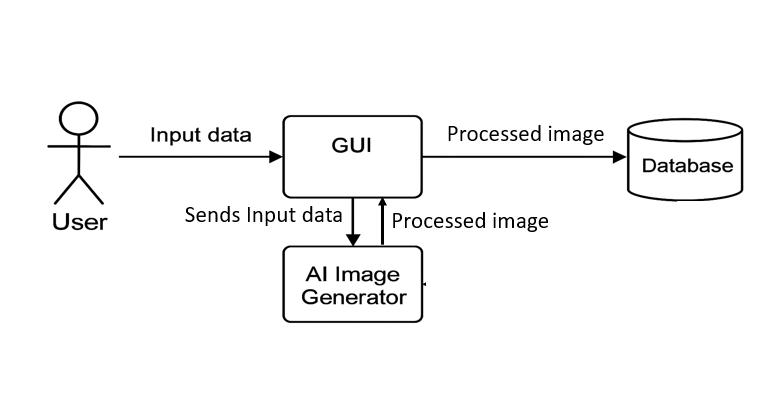
The system successfully generated interior design recommendation based on user uploaded room images, producing accurate and visually enhanced outputs. User interactionssuchaslogin,imageupload,anddesignretrieval performedsmoothlywithquickresponsetimes.Overall,the system delivered consistent and reliable results across multipletestcases.
Performanceevaluationshowedthatthesystemresponded withinsecondsforallmajoroperations,meetingthedefined non functional requirements. User testing indicated high satisfaction with interface simplicity, design clarity, and output quality. The system demonstrated good stability, portability and scalability during functional and stress testing.
ThedevelopedsystemdemonstratesthatAIbasedinterior design assistance can significantly simplify the design process for users by automating image analysis and generatingdesignrecommendationsefficiently.Theresults showthatthesystemiseasytouse,deliversquickresponses, and maintains stable performance across different test scenarios. Although the current model provides effective design suggestions, further improvements such as adding morestyleoptions,enhancingmodelaccuracy,andenabling realtimepreviewscanmakethesystemevenmorepowerful anduser-centric.
The project effectively illustrates how automation in technologymaymakeinteriordesignsimpler.Thesystem
provides a contemporary method for coming up with interiordesignconceptsbycombiningPython,Gradio,and image processing tools. The procedure is made more participatory and effective by the ease with which people canuploadaphotographofaroomandselecttheirfavourite designstyle.
Without the need for expert help, the system swiftly processes the input and creates a redesigned output that highlightsmanydesignoptions.Itisappropriateforregular customerswhoseekquickdesignrecommendationsbecause ofitsuser-friendlyinterfaceanddependablefunctionality. The entire design process is accelerated and less manual labourisrequiredthankstotheautomatedapproach.
Overall, the project's goals of increasing accessibility, reducingtime,andfosteringinnovationininteriordesignare met. It offers a useful, clever, and intuitive platform that makesiteasyforuserstoexperimentwithdesignconcepts.
This interactive desktop program demonstrates how AIpoweredtoolscanmakeinteriordesignmoreaccessibleand interestingforalargeraudience.
[1] E.Balagurusamy,ProgramminginANSIC,8th ed.New Delhi,India:McGrawHill,2019.
[2] “Tkinter-PythonInterfacetoTcl/Tk,“PythonSoftware Foundation,2024.
[3] “SQLiteDatabaseEngineOfficialDocumentation,”SQLite.org,2024.
[4] “Pillow(Pil Fork) Documentation,” Python Imaginary Library(PIL),2024
[5] “Interior Design With Artificial Intelligence :Concepts andtools”,AnalyticsVidhya,2024.
[6] “Artificial Intelligence in Interior Design: A Review” –International Advanced Computer Science and Applications(IJACSA),2022.
[7] “Implementation of Artificial Intelligence in Interior Design: Systematic Literature Review” (AlShkipi and Zahran, 2024) A SLR covering convergence of AI and interiordesign,challenges,opportunities,andgaps.
[8] IKEAPlace–AugmentedRealityApp
[9] HouzzInteriorDesignApp
[10] Roomstyler3DHomePlanner