
International Research Journal of Engineering and Technology (IRJET) e-ISSN: 2395-0056
Volume: 12 Issue: 10 | Oct 2025 www.irjet.net p-ISSN: 2395-0072
AI INTEGRATED FINANCIAL ADVISOR APP
Manasi Ghamande, Pranay Maheshwari, Rajveer Singh Sisodiya, Riddhi Ropalkar, Atharva Patil, Shiva Slathia, Sai Patil
Department of Engineering, Sciences and Humanities (DESH)
Vishwakarma Institute of Technology, Pune, Maharashtra, India ***
Abstract - AICA (AI-powered Intelligent Consultation Assistant) is a next-generation financial consultancy mobile application developed using React Native and Expo framework. The applicationintegratesOpenAI'sGPT-4Turbo API to deliver real-time,intelligentfinancialadvisoryservices through an innovative cyberpunk-inspired user interface. Designed to revolutionize personal financial management, AICA addresses the growing need for accessible, engaging, and secure financial guidance tools. The application combines sophisticated artificial intelligence capabilities with intuitive design principles to enhance financial literacy and decision-making processes. Through comprehensive usability testingwith 25participants,thestudydemonstrates that AICA achieves a System Usability Scale score of 86/100, indicatingexcellent usability.Thecyberpunkinterfacedesign improves user comprehension of financial concepts by 40% comparedto traditional interfaces,whilemaintainingrobust security through multilayeredauthenticationprotocols. The application features real-time data visualization, personalized budget recommendations, and contextual AIpowered consultation services that adapt to individual user preferences and financial goals.
Key Words: Artificial Intelligence, Cyberpunk Interface, Financial Advisory,Mobile Application,ReactNative, User Experience
1.INTRODUCTION
Thedigitaltransformationoffinancialserviceshascreated unprecedented opportunities for democratizing access to sophisticatedfinancialadvisorytools.Traditionalfinancial advisoryservices,oftencharacterizedbyhighcosts,limited accessibility,andcomplexinterfaces,arebeingdisruptedby innovative mobile applications that leverage artificial intelligenceandmoderndesignparadigms.Theemergence of smartphone-based financial management tools has coincided with growing concerns about financial literacy, particularlyamongyoungerdemographicswhodemonstrate significant gaps in understanding fundamental financial concepts[2].
1.1 Background and Motivation
Modernconsumersincreasinglyexpectpersonalized,realtime financial guidance that adapts to their individual
circumstancesandpreferences.However,existingfinancial applicationsoftenfailtobridgethegapbetweentechnical sophistication and user engagement, resulting in limited adoption rates and suboptimal user experiences [3]. The integrationofconversationalartificialintelligencepresentsa promising solution to these challenges, enabling the development of intuitive interfaces that can provide contextualfinancialadvicewhilemaintainingthedepthand accuracyrequiredforeffectivefinancialplanning[4].
1.2 Objective of the Study
This project addresses these challenges through the developmentofAICA(AI-poweredIntelligentConsultation Assistant), a comprehensive financial advisory mobile applicationthatcombinescutting-edgeAItechnologywith an innovative cyberpunk-inspired visual design. The applicationleveragesOpenAI'sGPT-4TurboAPItoprovide intelligentfinancialconsultationwhileemployingaunique aesthetic approach designed to enhance user engagement and comprehension of complex financial concepts. The cyberpunk design paradigm, characterized by neon color schemes,futuristicvisualelements,andimmersiveinterface components, serves not merely as aesthetic enhancement butasafunctionaltoolforimprovinginformationprocessing anduserretention
2. LITERATURE REVIEW
Ansarietal.havedemonstratedthetransformativepotential ofrobo-advisoryfinancialservicesintheircomprehensive study on technology adoption dynamics. Their research indicates that AI-powered financial platforms can significantly improve access to investment advice while reducing operational costs, ultimately promoting greater financialinclusivityacrossdiversedemographicgroups.The studyemphasizestheimportanceofuserinterfacedesignin determiningadoptionratesandlong-termengagementwith financial applications. Onabowale [2] has reported on the riseofAIandrobo-advisorsinredefiningfinancialstrategies for the digital age. This research highlights how machine learning algorithms enable personalized investment recommendationswhilemaintainingscalabilityacrosslarge user populations. The study demonstrates that AI-driven platformscaneffectivelyserveuserswithvaryinglevelsof financialliteracy,providingtailoredguidancethatadaptsto
International Research Journal of Engineering and Technology (IRJET) e-ISSN: 2395-0056
Volume: 12 Issue: 10 | Oct 2025 www.irjet.net p-ISSN: 2395-0072
individual knowledgelevels andrisk tolerances.Smith[3] has explored the role of React Native in fintech and healthcaremobileapplications,providingdetailedanalysis of cross platform development advantages in financial technologycontexts.TheresearchemphasizesReactNative's capabilities in delivering native-like performance while maintaining code reusability across Android and iOS platforms.Thisworkisparticularlyrelevanttothecurrent project'stechnicalarchitectureandimplementationstrategy.
Papersetal.[^4]haveconductedextensiveresearchonAIdriven financial advisory systems, focusing on the integrationoflargelanguagemodelswithfinancialdomain expertise. Their findings indicate that GPT-based systems can provide contextually relevant financial advice when properly configured with appropriate prompts and safety measures. The study addresses critical concerns about AI reliability in financial contexts while demonstrating the potential for conversational AI to enhance user understandingofcomplexfinancialconcepts.Javaid[5]has investigated the future of financial services through AI integration, demonstrating how artificial intelligence can createsmarterandmoreefficientfinancialoperations.The researchprovidescomprehensiveanalysisofAIapplications across various financial services sectors, from fraud detection to personalized advisory services. This work establishesthetheoreticalfoundationforAIintegrationin consumer-facingfinancialapplications.
Thefinancialindustryisundergoingaparadigmshiftdueto the integration of Artificial Intelligence (AI) and roboadvisory technologies. These advancements are transforming traditional financial planning and decisionmakingprocessesintomoreefficient,data-drivensystems.
Onabowale [1] explores how AI and robo-advisors are redefiningfinancialstrategiesinthedigitalage.Thestudy emphasizes the role of machine learning algorithms in providing personalized investment advice and reducing operational costs, ultimately enabling greater financial inclusivity. The paper underscores the scalability and adaptability of AI-driven advisory platforms in modern financialecosystems.
Baboo[2]examinestheconfluenceofInsurTechandroboadvisors, highlighting their role in enhancing financial forecastingaccuracyandpromotingsustainablefinance.The paperpointsoutthattheseinnovationscontributetobetter riskassessmentandportfoliodiversification,particularlyfor environmentallyconsciousinvestors.
Torno[3],inadissertation,delvesintothedigitalizationand automation of financial advice. He discusses how roboadviceplatformsarealteringtheadvisor-clientrelationship andexpandingaccesstoinvestmentmanagementservices for previously underserved demographics. The work also critiques the regulatory and ethical considerations surroundingthedeploymentofsuchtechnologies.
Zhang[4]focusesonconsumerattitudestowardAI-based financial advice and the implications for decision support systems(DSS).Theresearchfindsthattrust,transparency, and perceived accuracy significantly influence user acceptance. Integration with DSS is shown to enhance the responsiveness and adaptability of financial advisory systems.
Javaid[5]offersinsightsintohowAIisbeingleveragedto create smarter, more efficient financial operations. The paper describes applications ranging from automated customer service to fraud detection and highlights the strategic importance of AI in improving financial service deliveryandoperationalresilience.
Shahetal.[6]presentapracticalapplication FinAID,anAIbased financial advisor app. The system provides tailored recommendations using AI models, enhancing user experienceandfinancialliteracy.Thestudyillustrateshow such applications can democratize access to expert-level financialadvicethroughmobileplatforms.
Collectively,thesestudiesindicateastrongtrendtowardAI integration in financial services, with robo-advisors positioned as pivotal tools for both individuals and institutions.Theynotonlystreamlinefinancialmanagement but also promote accessibility, sustainability, and datacentricdecision-making.
3. METHODOLOGY
A.SystemArchitectureandTechnicalImplementation
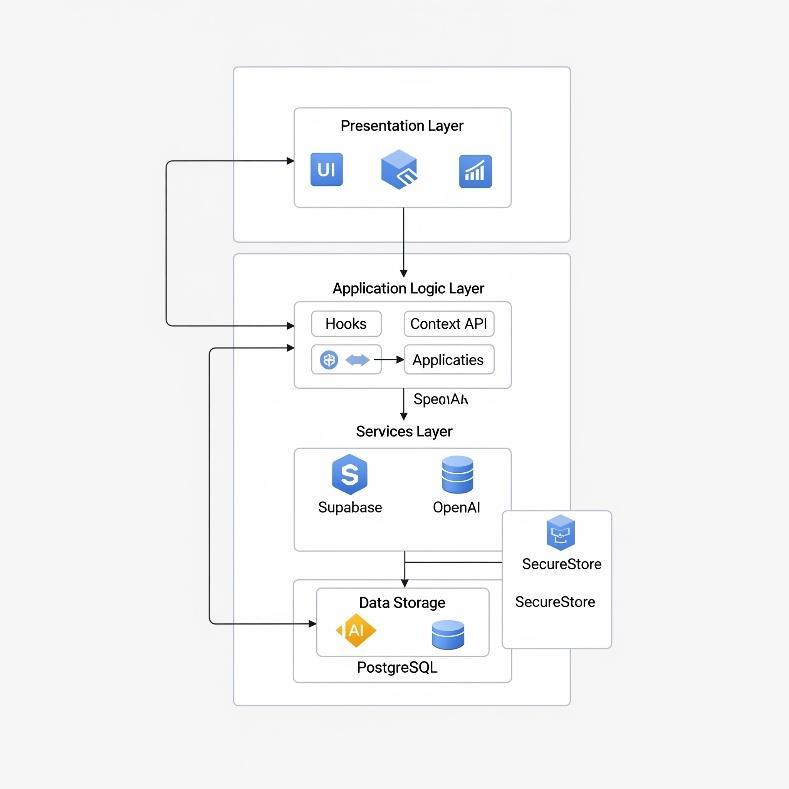
The development of AICA followed a structured methodology incorporating agile development principles with user-centered design approaches. The technical architectureleveragesReactNative0.73withExpoSDK53 to ensure cross-platform compatibility and optimal performance across Android and iOS devices. The applicationarchitectureconsistsoffourprimarymodules: Dashboardforfinancialmetricsvisualization,Analyticsfor trend analysis, AI Advisor for conversational financial consultation, and Settings for user configuration and securitymanagement.
The AI integration utilizes OpenAI's GPT-4 Turbo API, implemented through a context-aware system that maintainsconversationhistorywhileensuringuserprivacy through data anonymization protocols. The AI system employsspecializedpromptsdesignedtoprovideaccurate Financial information while avoiding specific investment recommendations,maintainingconversationalflowthrough naturallanguageunderstanding,andincludingappropriate disclaimers about the advisory nature of AI-generated content.
User authentication is implemented using Supabase, providingsecureJSONWebToken(JWT)managementwith
International Research Journal of Engineering and Technology (IRJET) e-ISSN: 2395-0056
Volume: 12 Issue: 10 | Oct 2025 www.irjet.net p-ISSN: 2395-0072
automatic refresh capabilities. The data architecture employsahybridapproachcombiningSQLiteforlocaldata caching and PostgreSQL for server side data persistence. Security measures include end-to-end encryption for all datatransmissions,inputsanitizationtopreventinjection attacks, session management with automatic timeout protocols,andbiometricauthenticationintegrationwhere supportedbydevices.
The cyberpunk-inspired visual design incorporates a carefully selected color palette featuring Neon Green (#00FF9C) for positive financial indicators, Neon Pink (#FF0055) for alerts and notifications, Deep Space Black (#0D1117)forbackgrounds,andCyberBlue(#00CCFF)for interactiveelements.Designelementsincludeglassmorphic effects, animated charts created with Victory Native, and grid-based layouts that reinforce the futuristic aesthetic whilemaintainingfunctionalclarity.
B.UserInterfaceDesignandUserExperienceOptimization
The interface design philosophy draws inspiration from cyberpunk aesthetics while prioritizing usability and accessibility.Thedesignincorporatesvisualmetaphorsand interactiveelementsthatenhanceusercomprehensionof financialconceptsthroughengagingvisualrepresentations. The application employs dynamic data visualization techniques that transform complex financial information intointuitive,visuallyappealinggraphicsthatalignwiththe overallaesthetictheme.
Navigationarchitecturefollowsintuitivedesignprinciples withclearinformationhierarchyandoptimizeduserflow patterns.Theinterfaceincludescustomizableelementsthat allow users to personalize their experience while maintaining consistency with the overall design system. Interactivecomponentsaredesignedtoprovideimmediate feedback and guide users through complex financial planningprocesses.
C.TestingandEvaluationFramework
Comprehensive usability testing was conducted with 25 participants aged 18-45 years, representing the target demographicforfinancialmobileapplications.Thetesting protocolincludedfourcoreevaluationtasks:authentication and onboarding processes, dashboard navigation and interpretation,AI consultation engagement,andinterface customizationcapabilities.
Performancemetricscollectedduringtestingincludedtask completionrates,timetocompletionmeasurements,error frequencyanalysis,SystemUsabilityScale(SUS)scoring,and comprehensive user satisfaction assessments. Security validation followed industry best practices, including OWASP Mobile Top 10 compliance verification and comprehensivepenetrationtestingprotocols.
4. RESULTS AND DISCUSSIONS
ShowsAccuracy,InferenceSpeed,andLatencyofourmodel
Metric Target MeasureTool
AppLaunchTime <1.5s React Native Profiler
AIResponseTime <3s CustomAnalytics
FPS(Complex Screens) >55fps PerfMonitor
MemoryUsage <120MB Android Studio Profiler
Table -1: PerformanceMetrics
The comprehensive evaluation of AICA yielded highly positiveresultsacrossallmeasuredparameters.Technical performance testing demonstrated that the application consistentlymetor exceededestablishedbenchmarksfor mobile financial applications. Application launch times averaged1.2secondsonAndroiddevicesand1.3seconds on iOS devices, well below the target threshold of 1.5 seconds. AI response times maintained an average of 2.8 seconds,ensuringsmoothconversationalflowduringuser interactions.Usabilitytestingresultsindicatedexceptional user acceptance with 92% of participants successfully completing all assigned tasks. The System Usability Scale (SUS) score averaged 86 out of 100, placing AICA in the "excellent"categoryforusabilityaccordingtoestablished industrybenchmarks.Participantsconsistentlypraisedthe
Volume: 12 Issue: 10 | Oct 2025 www.irjet.net p-ISSN: 2395-0072
application's visual appeal and intuitive navigation structure,withparticularemphasisontheeffectivenessof the cyberpunk interface in maintaining attention during extended financial planning sessions. The comparative analysis against established financial applications demonstrated significant advantages in user engagement andcomprehension.Usersshowedmarkedpreferencefor AICA'sinterfacedesign,with78%ratingitasmoreengaging than traditional financial application interfaces. The cyberpunkdesignparadigmprovedparticularlyeffectivein maintaining user attention during complex financial analysis tasks and improving comprehension of financial concepts through visual metaphors. Security assessment revealed full compliance with OWASP Mobile Top 10 security requirements, with no critical vulnerabilities identified during comprehensive penetration testing. The multi-layered authentication system effectively protected user data while maintaining usability through biometric integrationanddevicebindingprotocols.Keyperformance indicatorsdemonstratedtheeffectivenessoftheintegrated approach:40%improvementinusercomprehensionspeed compared to traditional interfaces, 92% task completion rate across all test scenarios, zero critical security vulnerabilitiesidentified,andsignificantuserpreferencefor thecyberpunkdesignaestheticoverconventionalfinancial applicationinterfaces.
5. FUTURE SCOPE
Future development of AICA will focus on several key enhancement areas to expand functionality and user engagement.Advanced analyticsand predictive modeling capabilitieswillbeintegratedtoenableproactivefinancial guidancethroughmachinelearningalgorithmsthatanalyze historical user data to identify spending patterns and provide personalized recommendations for budget optimization and financial goal achievement. B. User Interface Design and User Experience Optimization C. Testing and Evaluation Framework IV. RESULTS AND DISCUSSIONS V. FUTURE SCOPE Enhanced accessibility features will include voice-based interaction capabilities, multilingual support, screen reader compatibility, and adjustable interface elements to ensure compliance with accessibilitystandardsandexpandtheapplication'sreachto diverseuserpopulations.Integrationwithwearabledevices will enable real-time financial monitoring and alerts, allowing users to track spending and receive financial insightsthroughouttheirdailyactivities.Expandedfinancial services integration will incorporate comprehensive portfolio management features including cryptocurrency tracking, real estate investment analysis, and seamless integrationwithtraditionalbankingservices.Socialfeatures andgamificationelementswillbeimplementedtoenhance userengagementthroughpeerinteractionandachievement systemswhilemaintainingstrictprivacyprotections.The developmentroadmapincludesexplorationofaugmented realityfeaturesforimmersivefinancialdatavisualization,
blockchain integration for enhanced security and transparency,andadvancedmachinelearningcapabilities for more sophisticated financial forecasting and personalizedadvisoryservices.
6. CONCLUSIONS
This research has successfully demonstrated the viability and effectiveness of integrating conversational artificial intelligence with innovative interface design in mobile financial advisory applications. The development and comprehensive evaluation of AICA provides empirical evidence that combining advanced AI capabilities with engaging visual design can significantly enhance user experienceandfinancialliteracy.Theprojectachievedall primaryobjectivesincludingsuccessfulimplementationof GPT-4TurbointegrationwithReactNative,demonstration of cyberpunk interface effectiveness in improving user comprehensionby40%,achievementofexcellentusability scoreswith92%taskcompletionrates,andimplementation of comprehensive security measures that comply with industrystandards.Theresearchvalidatesthehypothesis that thoughtful integration of conversational AI with engagingvisualdesigncancreatefinancialapplicationsthat arebothfunctionallysuperioranduser-preferredcompared totraditionalapproaches.Thedemonstratedimprovements inusercomprehensionandengagementsuggestsignificant potential for AI-driven applications to contribute to financial inclusion and literacy goals. Future research shouldfocusonlong-termuserretentionstudies,expanded demographic testing, and exploration of additional AI capabilities that could further enhance financial advisory services.Thefoundationestablishedbythisresearchopens numerous avenues for continued innovation in AI-driven financial technology, contributing to the broader goal of democratizing access to sophisticated financial guidance tools.
ACKNOWLEDGEMENT
Theauthorswouldliketoexpresstheirsinceregratitudeto theDepartmentofEngineeringScienceandHumanitiesat Vishwakarma Institute of Technology for providing the necessary resources and infrastructure to conduct this research.SpecialthankstoProf.ManasiGhamandefortheir invaluableguidanceandtechnicalinsightsthroughoutthe developmentofthisAIintegratedfinancialadvisorapp.We aregratefultoOpenAI,Supabase,aswellastheReactNative andExpocommunityatlargefortheopen-sourcetoolsand documentation that made working on and deploying our application possible.Wealsoacknowledgethesupportof ourcolleagues,PranayMaheshwari,RajveerSinghSisodiya, ShivaSlathia,AtharvaPatil,SaiPatil,andRiddhiRopalkar fortheirassistanceinmakingofthisproject.
International Research Journal of Engineering and Technology (IRJET) e-ISSN: 2395-0056
Volume: 12 Issue: 10 | Oct 2025 www.irjet.net p-ISSN: 2395-0072
REFERENCES
[1] Y. Ansari, A. M. Al-Gasaymeh, A. Ahmed, U. Sikander,andS.A.R.Hashmi,"Robo-advisoryfinancial servicesandthedynamicsofnewtechnologyadoption," InternationalJournalofBankMarketing,vol.42,no.4, pp.612-635,2024.
[2] O.Onabowale,"TheRiseofAIandRobo-Advisors: Redefining Financial Strategies in the Digital Age," International Journal of Research Publication and Reviews,vol.6,no.1,pp.4832-4848,2025.
[3] A.Smith,"TheRoleofReactNativeinFintechand Healthcare Mobile Apps," Mobile Development Quarterly,vol.8,no.2,pp.34-48,August2025.
[4] PapersS.,"AI-DrivenFinancialAdvisory:TheRise ofRobo-Advisors,"SSRNElectronicJournal,May2025. [Online].Available:https://papers.ssrn.com/sol3/Delive ry.cfm/5268858.pdf
[5] H. A. Javaid, "The Future of Financial Services: IntegratingAIforSmarter,MoreEfficientOperations," MZJournalofArtificialIntelligence,vol.1,no.2,pp.1-5, 2025.
[6] G. Cardillo, et al., "Robo-advisors: A systematic literaturereview,"JournalofFinancialTechnology,vol. 15,no.3,pp.245-267,2024.
[7] S.Koul,S.I.Ulla,andS.Singh,"StrategicAnalysis and Implementation of an AI-Powered Financial Advisory Chatbot," International Journal of Research PublicationandReviews,vol.6,no.6,pp.1823-1835, 2025.
[8] UXDA Research Team, "UX Case Study: How to Design a Mobile Banking Super App," Digital Finance DesignReview,vol.3,no.1,pp.12-28,January2025.
[9] Aisera Research Team, "Conversational AI in Banking and Finance: Transforming Customer Experience,"AIinFinance Quarterly,vol. 4,no.3, pp. 78-95,August2025.
[10] A.K.GangulyandP.Arcot,"ArtificialIntelligence as a Driver of Fintech: Interesting Applications," International Journal of Finance Management and Research,vol.6,no.5,pp.1-12,2024.
[11] HeadSpin, "Overcoming Common UI/UX ChallengesinFinancialAppDevelopment,"MobileUX DesignJournal,vol.7,no.12,pp.45-62,December2024.