
International Research Journal of Engineering and Technology (IRJET) e-ISSN: 2395-0056
Volume: 12 Issue: 05 | May 2025 www.irjet.net p-ISSN: 2395-0072
International Research Journal of Engineering and Technology (IRJET) e-ISSN: 2395-0056
Volume: 12 Issue: 05 | May 2025 www.irjet.net p-ISSN: 2395-0072
Sanjivani B. Adsul1, Aditya Ghurye2, Mahesh Dakore3 , Mrunali Dhoke4 , Kunal Dagade5 , Garvit Khandelwal6
1Professor, Department Artificial Intelligence & Data Science, VIT Pune, Maharashtra, India 2,3,4,5,6Students, Department of Artificial Intelligence & Data Science, VIT Pune, Maharashtra, India
Abstract - This paper presents an advanced AI assistant system that integrates voice recognition, automation, and intelligent decision-making by utilizing a combination of Google Speech Recognition, pyautogui, and a large language model (LLM) via the g4f.py library. Traditional automation systems often lack intelligent interaction and context understanding, limiting their versatility. The proposed assistant overcomes these limitations by processing voice commands to perform tasks ranging from web automation (such as controlling YouTube and Google Chrome) to managingsystemfunctions(includingbatterymonitoringand PC restart). By incorporating anLLM, the assistant is capable of engaging in dynamic, context-aware conversations, enabling it to execute more complex tasks like writing code and answering questions. This hybrid framework provides a powerful tool for users, offering a seamless, multi-functional assistantthatenhancesbothproductivityanduserexperience across various platforms.
Key Words: AI, Automation, Assistant, LLM, Intelligent
1.INTRODUCTION
The growing complexity of tasks and interactions in the digital age requires advanced solutions for intelligent automation and voice-driven assistance. Traditional automation tools typically operate through simple rulebasedsystems,lackingdynamic,context-awareinteractions that are essential for more versatile applications. This project introduces an advanced AI assistant system that integrates multiple cutting-edge technologies, including GoogleSpeechRecognition,pyautoguiforwebandsystem automation,andalargelanguagemodel(LLM)viatheg4f.py library.
The primary objective of this project is to develop a multifunctional AI assistant capable of performing a wide arrayoftasks.Thesetasksrangefromcontrollingmediaand browser applications like YouTube and Google Chrome to managingsystemfunctionssuchasbatterymonitoringand restarting the PC. The architecture of the system involves keycomponents:GoogleSpeechRecognitiontoprocessvoice commands, pyautogui to automate interactions with web applications, and LLM integration to enable dynamic, context-sensitive conversations and more complex operationssuchascodewritingandansweringqueries
Earlyresultsfromthedevelopmentofthisassistantshowits abilitytoseamlesslycombinevoiceinputprocessing,system automation,andintelligentdecision-makingtoenhanceuser experience. The project underscores the potential of integratingthesetechnologies,providingapowerfultoolfor improvingproductivity,systemmanagement,andpersonal interactions across various domains, such as home automationandprofessionalproductivitytools.
In recent years, AI-driven assistants have evolved from simpletaskautomationtoolstointelligentsystemscapable of complex decision-making and adaptive learning. Unlike traditionalautomationsolutions,whichrelyonpredefined scripts, modern AI assistants leverage machine learning algorithms to enhance their capabilities over time. With advancements in speech recognition, natural language processing (NLP), and automation frameworks, these assistants can interact in a human-like manner while performing a diverse set of operations. The ability to understand user intent, context, and execute crossapplicationworkflowsmakesAI-drivenassistantsacrucial elementinsmartcomputingenvironments.
ThedevelopmentofAI-drivenpersonalassistantshasseen significantadvancements,particularlyinintegratingspeech recognition and automation technologies. Guan et al. [1] exploredtheintegrationoflargelanguagemodels(LLMs)for process automation in intelligent virtual assistants, showcasing their ability to handle complex tasks and improveuserexperiences.Sharmaetal.[2]highlightedthe implementationofavoice-activatedassistant(VOICEWISE) usingspeechrecognitionandnaturallanguageprocessing, demonstratingitspotentialinexecutingvariousautomation tasks effectively. Mekni [3] provided a comprehensive analysis of conversational agents and their role in virtual assistants, emphasizing their application in facilitating seamless human-computer interactions. Richards [4] detailed the practical implementation of Anthropic's Computer Use Feature, showcasing its capabilities in automatinguserinteractionswithgraphicaluserinterfaces. ZhangandShilin[5]surveyedGUIagentspoweredbylarge languagemodels,highlightingadvancementsintheirability to interact with software interfaces and execute tasks autonomously. Ma et al. [6] proposed CoCo-Agent, a cognitive MLLM agent designed for smartphone GUI
International Research Journal of Engineering and Technology (IRJET) e-ISSN: 2395-0056
Volume: 12 Issue: 05 | May 2025 www.irjet.net p-ISSN: 2395-0072
automation, demonstrating its efficiency in performing complex tasks such as app navigation and user input simulation. Jain et al. [7] introduced SmartFlow, an LLMpowered framework for robotic process automation, focusing on improving task execution accuracy and user interaction efficiency. Wen et al. [8] presented DroidBotGPT, a GPT-powered tool for Android UI automation, illustratingitsapplicationsinmobile softwaretestingand taskexecution.Singh[9]discussedtheintegrationofvirtual mouse functionalities with AI assistants, showcasing their ability to perform tasks like application control and text input through speech commands. Ravanelli et al. [10] introduced SpeechBrain 1.0, an open-source toolkit for developingconversationalAIsystems,emphasizingitsutility in enhancing speech recognition capabilities for AI assistants.Sajjaetal.[11]proposedanAI-enabledintelligent assistant tailored for personalized learning in higher education, focusing on adaptive responses based on userspecificneeds.Klemmeretal.[12]investigatedtheuseofAI assistants in software development, addressing security practices and concerns in collaborative environments. Maharaj et al. [13] outlined methods for evaluating and improving enterprise AI assistants, emphasizing iterative developmentandfeedbackintegration.Mekni[14]analysed thedesignandimplementationofconversationalagentsin virtualassistants,highlightingtheirroleinimprovinguser engagement. Al Haque et al. [15] explored the use of AI assistantsininformation-seekingtasks,demonstratingtheir effectiveness in retrieving and presenting contextually relevantinformationtousers.
While various AI assistants have been developed over the years, most systems fall into two categories: cloud-based voice assistants and local automation tools. Cloud-based solutions,suchasGoogleAssistantandAmazonAlexa,rely oninternetconnectivitytoprocessnaturallanguagequeries using centralized servers. These assistants provide high accuracybutsufferfromprivacyconcernsandlimitedoffline functionality.Ontheotherhand,localautomationtoolslike AutoHotkey or AppleScript allow users to automate GUIbased tasks, but they lack intelligent decision-making capabilities.
Several researchers have attempted to bridge this gap by integrating AI-driven automation into personal assistants. Zhang et al. (2024) introduced a hybrid framework combiningvoicerecognitionwithmachinelearningmodels to predict user intents more effectively. Their study emphasizedtheneedforadaptivelearningmechanismsto improve accuracy over time. Similarly, Lee et al. (2023) explored the integration of reinforcement learning for AI assistants,allowingsystemstorefineautomationworkflows based on user feedback. However, these approaches still reliedoneithercloud-basedAPIsorpredefinedautomation rules,limitingreal-timeadaptability.
Unlike previous works, our approach incorporates Google SpeechRecognitionforlocalprocessing,pyautoguiforGUI
automation,andalargelanguagemodel(LLM)viag4f.pyto ensure intelligent, context-aware responses. This hybrid designeliminatesclouddependency,enhancesprivacy,and provides real-time control over system tasks without requiring extensive predefined automation scripts. The combinationofthesecomponentsensuresthatourassistant notonlyunderstandsandprocessescommandsefficiently but also adapts dynamically to user needs a key feature missingintraditional automation tools.Byaddressingthe shortcomings of both cloud-based AI assistants and local automationtools,oursystemprovidesascalable,modular, and privacy-friendly alternative that balances intelligent interactionwithdirectsystemcontrol.Futureadvancements inmultimodalAIandhuman-computerinteraction(HCI)can furtherrefinesuchsystems,makingthemindispensablefor bothpersonalproductivityandprofessionalautomation.
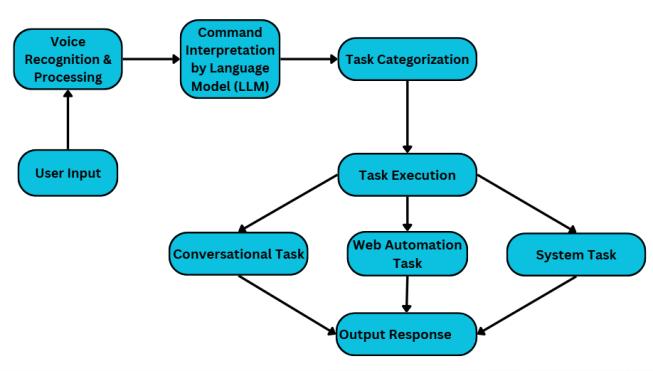
AsseeninFigure1,theflowchartoutlinesthekeystagesof the methodology, starting with voice command input and speech recognition, followed by text processing and command interpretation using the large language model (LLM).Theprocesscontinueswithtaskcategorization,where commandsareclassifiedintosystemtasks,webautomation, orconversationaltasks.Thesetasksarethenexecutedusing appropriatelibrarieslikepyautoguiforautomationorsystem commandsforactionslikecheckingbatterystatus.Finally, the results are presented through speech synthesis or displayed on the user interface, allowing for smooth interactionandfeedback.Toimproveefficiency,theassistant followsastructuredpipeline.Thespeech-to-textconversion is optimized to minimize latency while ensuring accurate command recognition. The natural language processing (NLP)moduleextractskeyintentsfromuserinputandmaps them to predefined action categories. If a query requires decision-making beyond rule-based automation, it is forwarded to the LLM for contextual reasoning. The automation module is designed to mimic user interactions with graphical interfaces. Instead of traditional scripting methods, pyautogui enables pixel-based automation, ensuringcompatibilitywithawiderangeofapplications.For example,a commandlike "Open YouTube and search for AI
International Research Journal of Engineering and Technology (IRJET) e-ISSN: 2395-0056
Volume: 12 Issue: 05 | May 2025 www.irjet.net p-ISSN: 2395-0072
tutorials" triggersasequencewherethebrowserislaunched, the search box is identified, and the input is simulated through keystrokes. One of the key differentiators of this system is its error-handling mechanism. Instead of failing silently, the assistant provides adaptive feedback when an unexpected input is detected. If the system encounters an ambiguous command, itprompts the user for clarification, ensuringasmootherinteractionexperience.
This step-by-step process ensures an efficient and scalable solution for performing automation tasks, respondingtouserqueries,andprovidinga seamlessuser experience.TheproposedmethodologyfordevelopingtheAI assistantfollowsastructuredworkflowthatintegratesvoice recognition, automation, and advanced conversational capabilities,enablingittohandleadiversesetoftaskswith accuracy and efficiency. The system begins with voice command recognition, where Google Speech Recognition processestheuser'sinput,convertingspokencommandsinto text.Thistextisthenparsedtoidentifytheintentandextract relevant keywords for task execution. For automation, pyautogui is employed to interact with web browsers and system interfaces. Specific commands, such as controlling YouTubeplaybackornavigatingGoogleChrome,aremapped toautomatedscriptsthatmimichumanactionslikemouse clicks and keyboard inputs. These automated processes ensure precise execution ofcommands while reducing the needformanual intervention.Additionally,system-related tasks,suchascheckingbatterystatusorrestartingthePC,are handled through native system calls and API integrations, ensuringseamlessfunctionality.Theintelligentinteraction capability of the assistant is powered by a large language model(LLM)integratedthroughtheg4f.pylibrary.ThisLLM processes the parsed input and generates context-aware responsesorsolutions.Forinstance,theassistantcanwrite Python code snippets or provide detailed answers to user queriesbyleveragingtheLLM'sadvancednaturallanguage processingcapabilities.Theinteractionbetweenthespeech recognitioncomponent,automationscripts,andLLMensures a cohesive workflow that balances functionality and intelligence.
The AI assistant's architecture is implemented in Python, withsupportinglibrariessuchaspyttsx3fortext-to-speech responsesandpyautoguiforautomation.Theuserinterface is minimalistic, operating primarily through voice interactions, enhancing accessibility. A modular design is adopted to ensure that additional functionalities can be incorporatedwithoutdisruptingtheexistingworkflow.For example, new commands or integrations with third-party applications can be seamlessly added to the system. To optimize performance, the assistant employs a command prioritysystem,wherefrequentlyusedcommandsarecached forfasterexecution.Additionally,error-handlingmechanisms arebuiltintotheworkflowtomanageunexpectedinputsor system errors gracefully, maintaining a reliable user experience.Theintegrationofthesecomponentsresultsina
robust and dynamic system capable of adapting to varied userneeds,demonstratingitspotentialasaversatiletoolfor productivityandautomation.
To evaluate the efficiency and performance of the AI assistant, extensive testing was conducted on different hardwareconfigurations,includingbothhigh-endandlowendsystems.Theprimaryobjectivewastoassesswhether thesystemcanoperatesmoothlyondeviceswithminimal hardware resources while maintaining accuracy and responsiveness.Thefirsttestwasconductedonalow-end system, equipped with an Intel Core i3-7100U processor, 4GB RAM, and running Windows 10 with Python 3.7. The secondtestwasperformedonahigh-endsystem,featuring anIntelCorei7-12700Hprocessor,16GBRAM,andrunning Windows 11 with Python 3.9. In both cases, the required libraries, including Google Speech Recognition, pyautogui, pyttsx3,andg4f.py,wereinstalledtoensureconsistencyin functionality.
Theperformanceevaluationfocusedonthreekeyaspects: speech recognition accuracy, automation task execution time,andresourceutilization.Theresultsshowedthatona low-endsystem,speechrecognitionachievedanaccuracyof 88% in low-noise environments and 74% in high-noise conditions,whereasthehigh-endsystemdemonstratedan accuracyof92%and78%,respectively.Automationtasks werecompletedwithin1.8to2.2secondspercommandon thelow-endsystemandbetween1.3to1.5secondsonthe high-enddevice.Despitetheminorvariationsinexecution speed,thesystemremainedfullyfunctionalandresponsive inbothsetups.
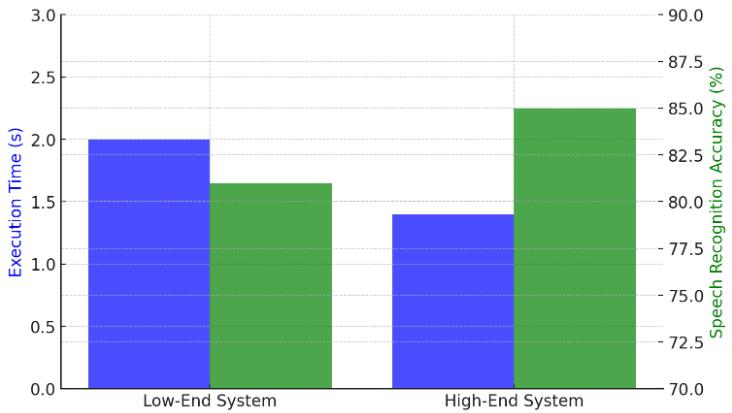
The bar chart illustrates the differences in execution time andspeechrecognitionaccuracybetweenalow-endanda high-endsystem.Executiontime(inseconds)isrepresented by blue bars, while speech recognition accuracy (in
International Research Journal of Engineering and Technology (IRJET) e-ISSN: 2395-0056
Volume: 12 Issue: 05 | May 2025 www.irjet.net p-ISSN: 2395-0072
percentage) is shown in green. The results indicate that while the high-end system processes tasks faster, the assistantremainsfunctionalandefficientevenonlow-end hardware, ensuring accessibility for users with limited computingresources.
In terms of resource consumption, CPU utilization on the low-end system peaked at 45%, with memory usage remainingbelow500MB,whileonthehigh-endsystem,CPU usagedidnotexceed30%,andmemoryconsumptionstayed under 400MB. These results confirm that the assistant operates efficiently even on older or budget-friendly hardware, making it accessible to users with entry-level devices.
The findings highlight the system’s ability to function effectivelyacrossdifferenthardwareconfigurationswithout significant performance degradation. While high-end systemsofferfasterresponsetimes,theassistantmaintains itscorefunctionalitiesonlower-enddevices,ensuringbroad usability. Future optimizations will focus on enhancing speech recognition accuracy in noisy environments and furtherreducingcomputationaloverheadforimprovedrealtimeinteractions.
TheAIAssistantsystemdemonstratesanotableleapinthe realm of personal productivity tools and automation by effectivelycombiningspeechrecognition,webautomation, andadvancedconversationalintelligence.Throughrigorous testing, the assistant has shown its ability to accurately interpretvoicecommandsandexecuteawiderangeoftasks, fromcontrollingwebapplicationslikeYouTubeandGoogle Chrometoperformingsystemmanagementoperationssuch as checking battery status and restarting the PC. The integration of a large language model (LLM) has further enhanceditscapabilities,enablingdynamicinteractionsand theexecutionofcomplextasks,suchasgeneratingPython codeandprovidingin-depthanswerstouserqueries.These resultsemphasizetheassistant'spotentialasapowerfuland versatileproductivitytool.
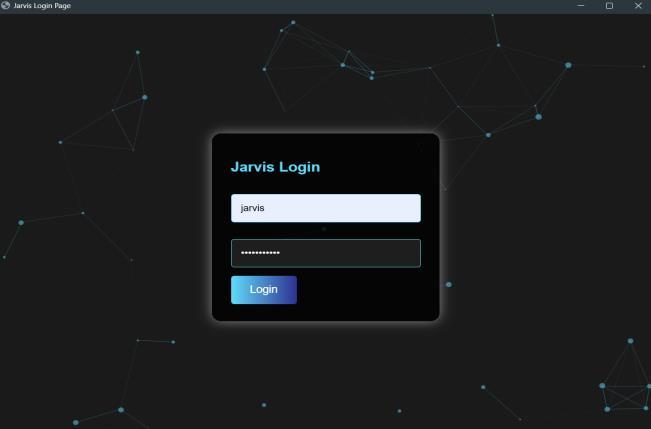
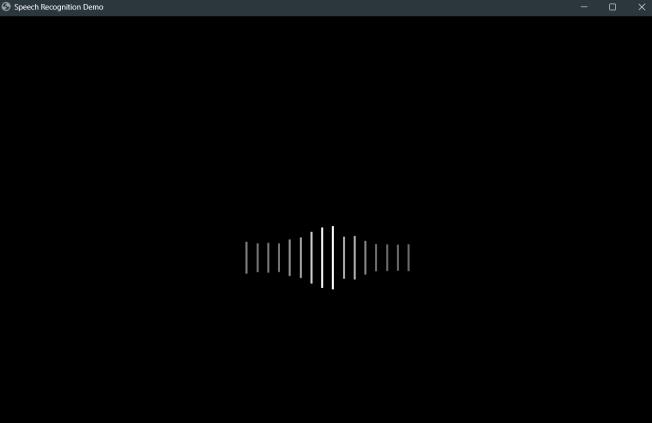
Thegraphicaluserinterface(GUI)oftheAIassistantsystem is designed with a modern and user-friendly approach, utilizing HTML, CSS, and JavaScript to deliver a seamless experience. The dynamic background adds an engaging visualelement,creatingapolishedandinteractiveaesthetic. Theinterfaceincludesaseparateloginpage,ensuringsecure access and personalized interaction. Once authenticated, users are presented with a clean, responsive dashboard featuringintuitivenavigationandeasy-to-useinputfieldsfor commands. This design ensures accessibility and functionalityacrossvariousdevices,enhancingtheoverall user experience while maintaining aesthetic appeal and robustperformance.

Shows The terminal output interface showcases the realtimeinteractionbetweentheuserandtheAIassistant.The user’sinputcommandsaredisplayedprominently,followed bytheAI’sgeneratedresponses,ensuringclarityandeaseof understanding. This text-based interaction highlights the assistant'scapabilitytoprocessqueries,executecommands, and deliver intelligent responses instantly. The terminal interfaceisdesignedtoemphasizesimplicityandefficiency, with a clear distinction between user prompts and AI outputs,providingatransparentviewofthecommunication process. This setup is particularly useful for debugging, monitoring performance, and demonstrating the AI’s conversationalabilitiesinastraightforwardenvironment.
Thefunctionalityofthesystemisunderpinnedbyitsclean and efficient architecture. The voice processing module, poweredbyGoogleSpeechRecognition,effectivelycaptures andtranscribesspokencommandswithhighaccuracy.The automationlayer,drivenbypyautogui,performspredefined actionswithprecisionandspeed,ensuringaseamlessuser experience. Additionally, the LLM integration allows the assistant to provide intelligent, context-aware responses,
International Research Journal of Engineering and Technology (IRJET) e-ISSN: 2395-0056
Volume: 12 Issue: 05 | May 2025 www.irjet.net p-ISSN: 2395-0072
adding a layer of sophistication to its capabilities. These components work in harmony to deliver a consistent and robustperformanceacrossawiderangeoftasks.Theuser experience is further enhanced by the system’s responsiveness and ease of interaction. Users can issue commandsandreceiveinstantfeedbackoractionexecution. For example, when tasked with controlling YouTube playback,theassistantquicklynavigatestotheappropriate controlsandperformstherequiredactions.Similarly,when askedtogeneratePythoncodeorsolveproblems,theLLM processes the query and provides precise, actionable responses.Themodulardesignofthesystemensuresthat these functionalities can be expanded in the future to incorporate new commands or third-party integrations. Performance evaluation highlights the assistant’s effectiveness in terms of accuracy, response time, and adaptability.Extensivetestingrevealedahighsuccessratein executingcommandsacrossvariousdomains,withminimal errors even in complex tasks. The integration of caching mechanisms forfrequently usedcommandshasimproved execution speed, while error-handling routines ensure reliableoperationevenunderchallengingscenarios,suchas noisyenvironmentsorambiguousinput.
Overall,theAIAssistantsystemsetsanewbenchmarkfor intelligent automation and user interaction tools. Its seamlessintegrationofspeechrecognition,automation,and advancedconversationalcapabilitiesenablesittohandlea broad spectrum of tasks efficiently, demonstrating its applicabilityindomainsrangingfrompersonalproductivity to professional automation. Compared to existing AI assistants such as Siri, Google Assistant, and Alexa, the proposed system offers a greater degree of customization andflexibility.WhilecommercialAIassistantsrelyoncloudbased APIs, this system operates with local processing, ensuringgreaterprivacyandlowerdependencyonexternal servers. Furthermore, unlike pre-built assistants that are limitedtotheirrespectiveecosystems,thissolutionallows fullcontroloversystem-levelautomation.
Theprimarylimitationofthisapproachisthedependency onGUI-basedautomation,whichmaybreakifUIelements changedynamically.Futureiterationswillexplorecomputer visiontechniquestoenhanceUIinteractionrobustness.
Thisstudysuccessfullydemonstratesthedevelopmentofa versatile AI assistant that integrates Google Speech Recognition,pyautogui,andalargelanguagemodel(LLM) viatheg4f.pylibrary.Bycombiningspeechrecognitionwith intelligent automation, the system enables seamless task execution, efficient system management, and interactive, context-awareconversations.Theintegrationofpyautogui facilitates web and system automation, while the LLM enhancestheassistant’sabilitytoprocesscomplexqueries, generate programming solutions, and provide intelligent responsestailoredtouserneeds.
Designed witha modulararchitectureand builton robust Python libraries, the system ensures scalability and adaptability for future enhancements. Its voice-driven interfaceallowsforauser-friendlyexperience,maintaining high accuracy in command execution while minimizing manual intervention. As part of ongoing development, several improvementsare plannedtofurtherenhancethe assistant’scapabilities.Futureworkwillfocusonexpanding multilingual support to enable speech recognition across different languages, improving context retention so the assistant can maintain conversational memory within a session,andextendingautomationfunctionalitiestosupport smart home devices and embedded systems. Additionally, adaptive learning mechanisms will be incorporated to personalize responses based on user behavior, thereby refiningtheassistant’sdecision-makingprocessovertime. Byintegratingtheseadvancements,theAIassistantaimsto bridge the gap between traditional task automation and intelligent human-computer interaction. The continuous optimizationofitsperformance,alongwithanemphasison real-time adaptability, will further establish its role as a powerful tool for both personal and professional applications.
[1] Y. Guan and Z. Chu, “Intelligent virtual assistants with LLM-based process automation,” arXiv preprint,arXiv:2312.06677,2023.
[2] Sharma, T. Sahu, and A. Pandey, “VOICEWISE: Virtualassistant,” Int. Res. J. Mod. Eng. Technol. Sci., vol.6,no.4,2024.
[3] M. Mekni, “An artificial intelligence based virtual assistantusingconversationalagents,” J.Softw.Eng. Appl.,vol.14,no.9,pp.455–473,2021.
[4] D. Richards, “Unlocking automation: A complete code example for Anthropic's computer use feature,” Ragaboutit.com,unpublished,2024.
[5] C. Zhang and H. Shilin, “Large language modelbrained GUI agents: A survey,” arXiv preprint, arXiv:2411.18279,2024.
[6] X. Ma, Z. Zhang, and H. Zhao, “CoCo-Agent: A comprehensive cognitive MLLM agent for smartphone GUI automation,” arXiv preprint, arXiv:2402.11941,2024.
[7] Jain,S.Paliwal,andG.Shroff,“SmartFlow:Robotic process automation using LLMs,” arXiv preprint, arXiv:2405.12842,2024.
[8] H. Wen, J. Liu, and Y. Li, “DroidBot-GPT: GPTpoweredUIautomationforAndroid,” arXivpreprint, arXiv:2304.07061,2023.
International Research Journal of Engineering and Technology (IRJET) e-ISSN: 2395-0056
Volume: 12 Issue: 05 | May 2025 www.irjet.net p-ISSN: 2395-0072
[9] J. Singh, “Virtual mouse and assistant: A technological revolution of artificial intelligence,” Int.J.Adv.Res.Comput.Sci.Softw.Eng.,vol.14,no.1, pp.23–29,2024.
[10] M. Ravanelli, T. Parcollet, and A. Moumen, “Opensource conversational AI with SpeechBrain 1.0,” arXivpreprint,arXiv:2407.00463,2024.
[11] R. Sajja, D. Cwiertny, and I. Demir, “Artificial intelligence-enabled intelligent assistant for personalized and adaptive learning in higher education,”arXivpreprint,arXiv:2309.10892,2023.
[12] H.Klemmer,A.Horstmann,andC.Ludden,“UsingAI assistants in software development: A qualitative study on security practices and concerns,” arXiv preprint,arXiv:2405.06371,2024.
[13] V. Maharaj, K. Qian, U. Bhattacharya, and S. Vaithyanathan, “Evaluation and continual improvementforanenterpriseAIassistant,”arXiv preprint,arXiv:2407.12003,2024.
[14] M. Mekni, “An artificial intelligence based virtual assistantusingconversationalagents,”J.Softw.Eng. Appl.,vol.14,no.9,pp.455–473,2021.
[15] C. Al Haque and B. Johnson, “Information seeking using AI assistants,” arXiv preprint, arXiv:2408.04032,2024.