
International Research Journal of Engineering and Technology (IRJET) e-ISSN: 2395-0056 p-ISSN: 2395-0072

Volume: 12 Issue: 11 | Nov 2025 www.irjet.net

International Research Journal of Engineering and Technology (IRJET) e-ISSN: 2395-0056 p-ISSN: 2395-0072
Volume: 12 Issue: 11 | Nov 2025 www.irjet.net
Jothi p1 , Mr Sathishkumar M2
1 PG student, Department Of Computer Applications, Jaya College Of Arts and Science,Thiruninravur, Tamilnadu,India
2 Assistant Professor, Department Of Computer Applications, Jaya College Of Arts and Science , Thiruninravur, Tamilnadu,India
Abstract Artificial Intelligence (AI) has revolutionized educational technology by enabling personalized learning experiences tailored to individual student needs, preferences, and learning styles. AI-powered tools analyze vast amounts of learner data to provide adaptive learning paths, real-time feedback, and customized content delivery. These technologies such as intelligent tutoring systems, adaptive assessment platforms, and AI-driven learning management systems help educators identify student strengths and weaknesses, offering targeted support to enhance academic performance. Furthermore, AI enables predictive analytics to anticipate learning outcomes and recommend appropriate interventions. The integration of AI in personalized learning fosters inclusivity, engagement, and efficiency in education, transforming traditional teaching into a more learner- centered approach. However, challenges such as data privacy, algorithmic bias, and equitable access remain critical considerations. Overall, AI-powered personalized learning tools hold immense potential to redefine modern education, making learning more dynamic, adaptive, and effective for diverse learners worldwide.
Keywords: ArtificialIntelligence(AI),PersonalizedLearning,EducationalTechnology,AdaptiveLearningSystems, Intelligent Tutoring, Machine Learning, Learning Analytics, Student Engagement, Predictive Analytics, Adaptive Assessment.
oneofthemosttransformativeforcesineducationaltechnology,reshapingthewaylearnersacquireknowledgeand educators deliver instruction. The integration of AI- powered tools in education has led to the development of personalized learning environments thatadapt to each learner’suniqueneeds,abilities,andpace.Unliketraditional one-size-fits-all teaching methods, AI-driven personalized learning provides customized learning paths, ensuring thatstudentsreceivecontentandsupportalignedwiththeirindividualprogressandlearningstyles.AItoolssuchas intelligent tutoring systems, adaptive learning platforms, and data-driven assessment tools utilize algorithms and machinelearning techniques to analyze student data and generate insightsthatguideinstruction.Thesesystems continuouslytracklearnerbehavior,performance,andengagementlevelstorecommendtargetedresourcesandrealtimefeedback.Asaresult,bothstudentsandeducatorsbenefit studentsgainamoreengagingandeffectivelearning experience,whileteacherscanfocusonfacilitatinghigher-orderthinkingandaddressingspecificlearninggaps.
TheintegrationofArtificialIntelligence(AI)intoeducationaltechnologyhasbeenasignificantareaofresearch,with numerous studies emphasizingits role in enhancing personalized learning experiences.Accordingto Holmes et al. (2019), AI has the capability to transform traditional education systems by enabling adaptive learning environments that adjust to individual learner profiles. These AI-driven systems utilize data analytics, natural language processing, and machine learning algorithms to understand students’ learning patterns and provide customized instructional content.Several researchers have exploredtheuseofIntelligentTutoringSystems(ITS)as oneofthemosteffectiveAIapplicationsineducation.Studiesby VanLehn(2011)highlightthatITScansimulatethe functions of a human tutor by providing step-by-step guidance, feedback, and assessment, resulting in improved student performance and engagement. Similarly, adaptive learning based on real-time data and performance metrics. These systems have shown positive outcomes in improving learner motivation and comprehension levels (Baker & Inventado, 2014). In addition, learning analytics has emerged as a key component of AI-powered personalized education. Siemens and Long (2011) describe learning analytics as the measurement, collection, and analysis of learner data for the environments in which it occurs. Through predictive analytics, AI can forecast
International Research Journal of Engineering and Technology (IRJET) e-ISSN: 2395-0056 p-ISSN: 2395-0072
Volume: 12 Issue: 11 | Nov 2025 www.irjet.net
students’ academic performance and identify those at risk of failure, enabling timely interventions by educators. Moreover, recent studies emphasizetheroleofAIinpromotinginclusiveeducation. AI toolsequipped withspeech recognition, text-to-speech, and language translation technologies support students with disabilities or linguistic barriers,ensuringequallearningopportunities(Luckinetal.,2016).
The methodology for studying AI-powered tools in personalized learning involves a systematic analysis existing ducational technologies, their implementation strategies, and the proposed enhancements using AI-driven approaches.
Inthetraditionaleducationsystem,teachingandlearninglargelyfollowauniformstructurewhereallstudentsare exposed to the same content, pace, and assessment methods regardless of individual differences. Even in digital learning platforms, personalization is often limited to basic features such as topic selection or progress tracking. Most existing systems rely on static content delivery without analyzing student behavior or adapting to their learning preferences. Consequently, students who require additional support may challenged. Teachers, too, face challengesinprovidingindividualizedattentionduetotimeconstraintsandlargeclassroomsizes.Thisone-size-fitsall approach often results in disengagement, uneven learning outcomes, and limited opportunities for skill-based growth.
The Proposed system introduces AI-powered personalized learning tools that dynamically adapt to each learner’s unique needs and learning style. Through the integration of machine learning algorithms, intelligent tutoring systems, and learning analytics, the system continuously analyzes data such as student performance, engagement patterns, and learning behaviors. Based on these insights, it customizes content delivery, recommends suitable resources, and provides real-time feedback to optimize learning outcomes. The AI-powered system also includes predictive analytics to identify students who may need additional support and suggests targeted interventions. Moreover, the proposed system promotes inclusivity by incorporating natural language processing and speech recognitiontoolsthatassistlearnerswithdisabilitiesorlanguagebarriers.Teachersareempoweredwithdata-driven dashboards that provide instructional decisions. Overall, this AI-enhanced system shifts education from a generalized approach to a personalized, adaptive, and learner-centric model, thereby improving efficiency, engagement,andacademicperformancewhilereducingthelearninggapamongdiversestudentgroups.
International Research Journal of Engineering and Technology (IRJET) e-ISSN: 2395-0056 p-ISSN: 2395-0072
Volume: 12 Issue: 11 | Nov 2025 www.irjet.net
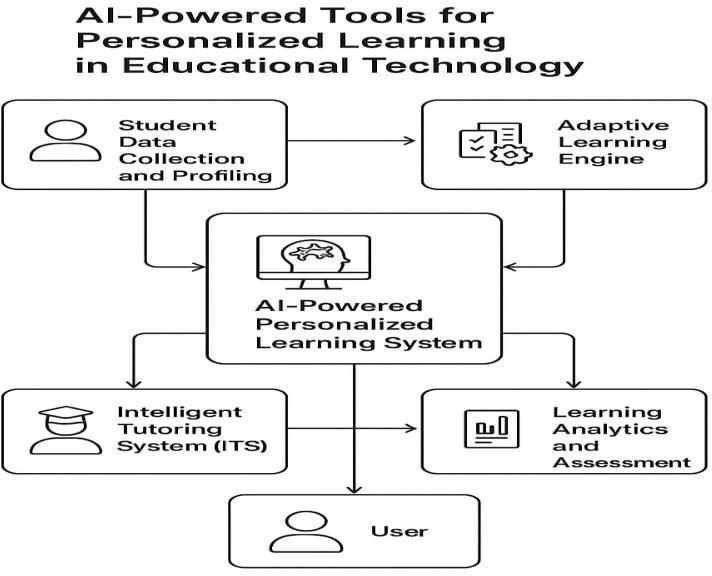
The proposed AI-powered personalized learning system is designed with several interrelated modules that work togetherto deliver adaptive,data-driven,andstudent- centeredlearningexperiences.Eachmoduleservesaspecific function,contributingtothesystem’soverallgoalofenhancingeducationaleffectivenessandpersonalization.
3.1Student
This module gathers and organizes data related to learners’ academic performance, behavior, preferences, and engagement levels. It collects information through quizzes, assignments, interaction logs, and feedback mechanisms. Using this data, the system builds a detailed learner profile that captures strengths, weaknesses, interests, and preferred learning styles. This profiling forms the foundation for adaptive content delivery and continuouspersonalizationthroughoutthelearningprocess.
It utilizes artificial intelligence and machine learning algorithmstoanalyzelearnerdatainrealtimeandadjustthe difficultylevel,pace,andtypeofcontentaccordingly.Thismoduleensuresthateachstudentfollowsapersonalized learning path. concept, the system automatically provid upplementarymaterialsorsimplerexplanations,whereas advancedlearnersreceivemorechallengingcontent.
3.3
This module acts as a virtual tutor, guiding learners step by step through the learning process. It provides hints, explanations, and corrective feedback based on the learner’s responses. The ITS leverages natural language processing (NLP) to engage in conversational interactions, making the learning experience more interactive and human-like.Thismoduleenhancesunderstandingandmotivation,especiallyforself-pacedlearners.
This modulecontinuously monitors learner progress using analytics tools that track performance metrics such as accuracy, completion time, and engagement levels. The system uses predictive analytics to identify learning gaps, forecastoutcomes,and recommendappropriateinterventions.Italsogeneratesreportsand visual dashboards for educators,helpingthemmakedata-driveninstructionaldecisionsandprovidetimelysupporttostudents
4. Implementation
The implementation of AI-powered tools for personalized learning in educational technology involves the systematic integration of artificial intelligence algorithms, data management systems, and interactive learning platformstocreateanadaptiveandstudent-centeredlearningenvironment.Theprocessbeginswiththecollection and analysis of learner data, which includes academic performance, behavioral patterns, and engagement levels. Thisdataisprocessedusingmachinelearningmodelstoidentifyeachlearner’sstrengths,weaknesses,andpreferred learningstyles.Oncetheprofilesareestablished,theAIsystemdynamicallycustomizesthelearningpathforevery student, ensuring that the content, difficulty level, and pace are aligned with individual learning needs. The next stage involves embedding adaptive learning engines and intelligent tutoring systems (ITS) within the educational platform. These components work together to deliver real- time feedback, interactive lessons, and step-by-step guidance.TheITSusesnaturallanguageprocessing(NLP)tosimulate human-like interactions, enabling students to ask questions and receive personalized responses. The adaptive learning engine, on the other hand, continuously updatesitsrecommendationsbasedonlearnerprogress,ensuringthattheeducationalexperienceremainsrelevant and effective. For practical deployment, cloud-based infrastructure is often used to ensure scalability, data security, andremoteaccessibility.EducationalinstitutionscanintegratetheseAImodulesintoexistingLearningManagement Systems (LMS) such as Moodle, Canvas, or Google Classroom. Through Application Programming Interfaces (APIs), AI services like analytics dashboards, recommendation engines, and virtual assistants can be seamlessly embedded. Teachers are trained to interpret AI-generated insights and adjust their instructional strategies accordingly, allowing technology and pedagogy to complement each other effectively. In addition, implementation includesrobustdataprivacyandsecuritymechanismstoprotectstudentinformation.
International Research Journal of Engineering and Technology (IRJET) e-ISSN: 2395-0056 p-ISSN: 2395-0072
Volume: 12 Issue: 11 | Nov 2025 www.irjet.net
5. CONCLUSIONS
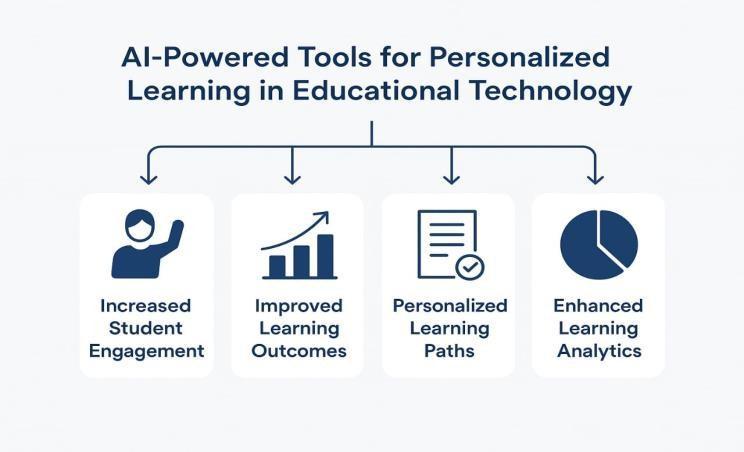
in modern education, particularly in the realm of personalized learning. By leveraging intelligent algorithms, machinelearning,anddata analytics,AI-poweredtoolsenableeducatorstocreateadaptivelearningenvironments tailored to individual student needs. These systems go beyond traditional teaching methods by continuously analyzing learner data and providing customized feedback, resources, and assessments. As a result, students experience more engaging, efficient, and self-paced learning journeys, while teachers gain deeper insights into student progress and performance. The integration of AI into educational technology has proven to enhance inclusivity and accessibility by supporting learners with different abilities, learning styles, and linguistic backgrounds.Toolssuchas intelligenttutoringsystems,adaptivelearningplatforms,andpredictiveanalyticsnotonly improvelearningoutcomesbutalsohelpidentifyandaddresslearninggapsearlyon.
6. Future Scope
The future of AI-powered tools for personalized learning in educational technology holds immense potential for transforming education into a more adaptive, intelligent, and inclusive system. As AI technologies continue to advance,futurelearningenvironmentswillbecomeevenmoreresponsivetoindividuallearnerneeds,preferences, andemotions.Throughadvanceddataanalytics,emotionalAI, andcognitivemodeling,educationalplatformswillbe abletounderstandnotonlywhatstudentslearnbutalso how theylearn,adaptingcontentinrealtimetomatchtheir cognitive and emotional states. This will create a truly dynamic and holistic learning experience. In the coming years,AIisexpectedtoplayacrucialroleinenhancinglifelongandcompetency-basedlearning.
[1]Baker, R. S., & Inventado, P. S. (2014). Educational data mining and learning analytics. In J. A. Larusson & B. White61–75).Springer.ThisworkhighlightshowAIanddataminingtechniquesareusedtoanalyzestudentdata forimprovingpersonalizedlearningexperiences.
[2] Holmes, W., Bialik, M., & Fadel, C. (2019). Artificial Intelligence in Education: Promises and Implications for Teaching and Learning. Center for Curriculum Redesign. The authors discuss the potential of AI in transforming educationandtheimportanceofusingintelligentsystemstoenhancepersonalizedlearning.
[3] Luckin,R.,Holmes, W.,Griffiths,M.,& Forcier, L.B.Education. PearsonEducation.Thisreport explores howAI cansupportlearnersbyprovidingadaptive,data-driven,andinclusivelearningenvironments.
[4] Selwyn, N. (2019). Should Robots Replace Teachers? AI and the Future of Education. Polity Press. Selwyn criticallyexaminestheroleofAIineducation,addressingbothopportunitiesandethicalchallengesassociatedwith personalizedlearningtechnologies.
[5] Siemens, G., & Long, P. (2011). Penetrating the Fog: Analytics in Learning and Education. EDUCAUSE Review, 46(5), 30–40. This paper introduces learning analytics as a foundation for data-driven decision-making in educationalsettings,pavingthewayforAI-basedpersonalizedlearningsystems.