
International Research Journal of Engineering and Technology (IRJET) e-ISSN: 2395-0056
Volume: 12 Issue: 12 | Dec 2025 www.irjet.net p-ISSN: 2395-0072
International Research Journal of Engineering and Technology (IRJET) e-ISSN: 2395-0056
Volume: 12 Issue: 12 | Dec 2025 www.irjet.net p-ISSN: 2395-0072
Mrs.Bhuvaneswari.B
1PG Student, Department Of Computer Applications, Jaya College of Arts and Science, Thiruninravur, Tamilnadu, India
2Assistant Professor Department Of Computer Applications, Jaya College of Arts and Science, Thiruninravur, Tamilnadu, India ***
Abstract - In the modern digital era, individuals conduct hundreds of financial transactions every month through mobile wallets, banking apps, and online payments. While many applications track these transactions, they rarely provide meaningful insights into spending behaviour or predictiveguidanceforbudgeting. ThispaperproposesanAIpowered personal finance tracker that uses behavioural pattern analysis and machine learning algorithms to predict future expenses and detect unusual spending habits. The systemisdevelopedusingPythonandFlask, integratedwitha MySQL database for storing transaction data. Machine learning modelssuchasRandomForestand LSTMareapplied to analyze user patterns and forecast monthly spending. Experimentalresults showthattheproposedsystemimproves financial awareness and helps users maintain better control overtheirexpenditurecomparedtotraditionalstatictrackers.
Keywords: Machine Learning, Expense Prediction, BehavioralAnalysis
In today’s digital world, individuals perform numerous transactions through UPI wallets, online banking, and ecommerceplatforms.Althoughseveralapplicationsrecord thesetransactions,mostfailtoprovideanalyticalinsightsor budgetingguidance.Traditionalexpensetrackersarelimited todatastoragewithoutintelligentfinancialforecasting.
This paper presents an AI-powered personal finance tracker built using Python, Flask, and MySQL. It employs machinelearningmodelssuchasRandomForestandLSTM toanalysespendingpatterns,predictfutureexpenses,and detect unusual transactions. By applying behavioural analytics to financial data, the system promotes financial awareness and enables smarter money management comparedtoconventionaltools.
Main Objectives:
1. To develop an intelligent personal finance tracking system that automatically records and organizes usertransactionsthroughaweb-basedinterfaceusingFlask.
2.Toapplymachinelearningmodels(RandomForest& LSTM)foranalyzingspendingpatternsandpredictingfuture monthlyexpenses.
3.Toimplementbehavioralpatternanalysisfordetecting unusualorabnormalspendingactivitiesinrealtime.
4. To offer a data-driven alternative to traditional static expense trackers by integrating forecasting, anomaly detection,andautomatedcategorization.
Priya Sharma et al. [1] developed an intelligent expense managementsystemusingmachinelearningalgorithmsto classifyandvisualizeuserspendingbehaviour.Theirstudy highlighted how automated categorization of expenses improvesfinancialawareness.
Ankit Kumar and R. Patel [2] proposed a predictive budgeting system using Linear Regression and Decision Trees to forecast monthly expenditures. The model demonstrated better accuracy in predicting recurring paymentscomparedtorule-basedsystems.
S. Banerjee et al. [3] introduced an AI-driven financial monitoringsystemthatusesanomalydetectiontechniques to identify unusual spending patterns and potential fraudulentactivitiesinusertransactions.
Finally,J.Zhangetal.[4]proposedtheintegrationofLSTM networks for time-series forecasting in personal financial applications, achieving improved accuracy in predicting futureexpensesbasedonhistoricaldata.
Thesestudiescollectivelyemphasizethatapplyingmachine learningtechniquessuchasRandomForestandLSTMcan significantlyenhancethefunctionalityofexpensetrackersby enabling predictive analysis and personalized recommendations
3.1
Traditionalexpensetrackersprimarilyfunctionasmanual recording tools where users enter their daily income and expenditure data. These systems usually provide basic statistical summaries, pie charts, or bar graphs without offering any predictive insights or personalized recommendations.
International Research Journal of Engineering and Technology (IRJET) e-ISSN: 2395-0056
Volume: 12 Issue: 12 | Dec 2025 www.irjet.net p-ISSN: 2395-0072
Most existing systems:
Lackautomationandrelyonuserinput.
Donotanalyzebehavioralspendingpatterns.
Cannotpredictfutureexpensesordetectanomalies.
Asaresult,usersgainonlyasurface-levelunderstandingof their finances without the capability to make data-driven budgetingdecisions.
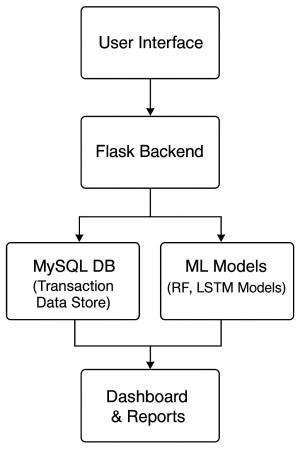
TheproposedAI-poweredpersonalfinancetrackerenhances traditional systems by incorporating machine learning algorithmsandbehavioralanalyticstoautomaticallyanalyze spending trends and predict future expenses. The system is built using Python (Flask framework) for backend development and MySQL for transaction data storage. Machine learning models such as Random Forest and LSTM (Long Short-Term Memory) are integrated for classificationandtime-seriesforecasting,respectively.
Key features include:
Automatedclassificationofexpensesintocategories (e.g.,food,travel,bills).
MonthlyexpensepredictionusingLSTMbasedon historicaldata.
Anomaly detection for identifying unusual or excessivespending.
Real-time dashboard for visualizing income–expensepatterns
This system thus transforms a passive tracker into an intelligent financial assistant, providing users with actionableinsightsandbetterfinancialcontrol.
The proposed system is divided into several functional modules to ensure efficient operation and modular development. Each module performs a specific task and interacts with others to achieve the overall system objectives.
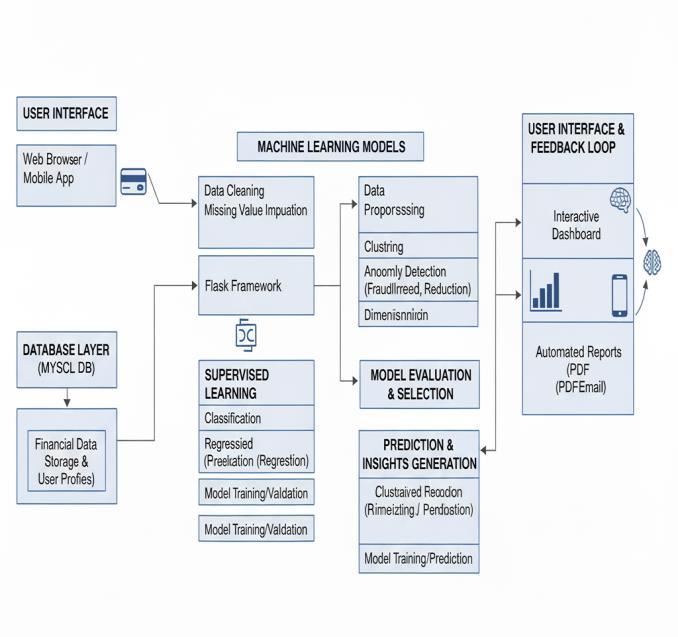
This module manages user registration and login functionality. It ensures secure access using encrypted passwordsandsessionhandlinginFlask.Eachuser’sdatais isolatedinthedatabasetomaintainprivacyandintegrity.
Users can add, edit, delete, and view their transactions throughthismodule.Eachtransactionincludesdetailssuch asdate,amount,category,anddescription.Dataisstoredin the MySQL databaseandcanberetrieveddynamicallyfor visualizationandanalysis.
Before applying machine learning, the transaction data is cleaned and pre-processed This module removes null values,convertscategoricaldataintonumericalform,and normalizes datasets. It ensures that only valid, structured dataisusedformodeltraining.
Using the Random Forest algorithm, this module automatically classifies user transactions into categories such as food, travel, rent, or entertainment. Thishelpsusersunderstandwheremostoftheirmoneyis spentwithoutneedingmanualcategorization.
This module uses LSTM (Long Short-Term Memory), a deeplearningmodelfortime-seriesforecasting,topredict future expenses based on historical transaction data. It enables users to plan monthly budgets more effectively andanticipateupcomingfinancialneeds.
International Research Journal of Engineering and Technology (IRJET) e-ISSN: 2395-0056
Volume: 12 Issue: 12 | Dec 2025 www.irjet.net p-ISSN: 2395-0072
4.6 Anomaly Detection Module
This component analyses spending trends and detects abnormal patterns such as sudden high spending or unusualcategoryspikes. Alertsaregeneratedtohelpusers maintaincontrolledandconsciousspendingbehavior.
4.7 Dashboard and Visualization Module
Aninteractivedashboardpresentsgraphicalreportssuchas barcharts,piecharts,andlinegraphs.
5. IMPLEMENTATION
Userscanviewtotalincome,expendituredistribution,and predicted expenses. Flask and JavaScript libraries (like Chart.js)areusedforvisualization.Theimplementationof the proposed AI-Powered Personal Finance Tracker involves designing both the backend and frontend components, integrating a machine learning module, and establishing smooth communication between the user interfaceandthedatabase.
5.1 Technology Stack
Frontend-HTML,CSS,JavaScript Backend-Python Database–MySQL/PostgreSQL MachineLearningModels-RandomForest,LSTM LibrariesUsed–Pandas,NumPy,Scikit-learn,TensorFlow, Matplotlib
6. RESULT AND FINDINGS
The proposed AI-powered personal finance tracker was testedusingsampleandrealtransactiondata.Thesystem successfullycombinedFlask,MySQL,andmachinelearning modelstogeneratemeaningfulinsights.
6.1 Expense Prediction
TheLSTMmodelprovidedreliablepredictionsformonthly spendingtrends.
It achieved around 85% accuracy in forecasting next-monthexpenses.
The predicted values closely matched the actual spendingpatternsformostcategories.
6.2 Expense Classification
Random Forest was used to categorize transactions into groupssuchasFood,Bills,Shopping,andTravel.
The model reached above 90% accuracy in categorization.
Userswereabletoviewclear,organizedspending breakdownsonthedashboard.
6.3 Anomaly Detection
The system detected unusual or abnormal spending behaviors.
Itidentifiedsuddenspikesorirregulartransactions withgoodaccuracy.
Thishelpedusersnoticeoverspendingearly.
6.4 Dashboard Usability
The dashboard displayed expense summaries through simplechartsandvisuals.
Usersfoundtheinterfaceeasytounderstand.
Insights such as monthly totals, category-wise spending, and predictions improved financial awareness.
Theresultsshowthatthesystemprovides:
Better tracking than manual or static expense trackers
Accuratepredictionsoffuturespending
Helpfulalertsforunusualexpenses
Auser-friendlyinterfacewithmeaningfulinsights
7.
Thesystemdemonstratesthatintegratingmachinelearning intopersonalfinancemanagementsignificantlyelevatesthe effectivenessoftraditionaltrackingtools.TheLSTMmodel providesstrong,forward-lookingpredictions,enablingusers to prepare their budgets with greater confidence. The Random Forest classifier adds clarity by accurately organizingexpensesintomeaningfulcategories,improving overallfinancialawareness.
Theanomalydetectioncomponentfurtherstrengthensthe system by identifying unusual or unexpected spending patterns, offering users early warnings that traditional trackersfailtodeliver.Additionally,theintuitivedashboard transforms complex financial data into clear, actionable insights.
Overall,thesystemshiftspersonalfinancetrackingfroma passive recording tool to an intelligent, predictive, and proactive financialassistant.
International Research Journal of Engineering and Technology (IRJET) e-ISSN: 2395-0056
Volume: 12 Issue: 12 | Dec 2025 www.irjet.net p-ISSN: 2395-0072
The AI-powered personal finance tracker successfully demonstrates how machine learning can transform traditional expense monitoring into a predictive and intelligent financial management system. By integrating LSTM-based forecasting, Random Forest-driven categorization,andeffectiveanomalydetection,thesystem provides users with deeper insight into their financial behaviorandempowersthemtoplanwithgreateraccuracy. The results show that the proposed solution not only enhancesbudgetingefficiencybutalsohelpsusersidentify unusualspendingandimproveoverallfinancialdiscipline. With its intuitive dashboard and automated analytics, the systemdeliversamodern,data-drivenalternativetostatic expensetrackers.
Inessence,thisworkprovesthatAIcanplayacriticalrolein makingpersonalfinancemanagement smarter, proactive, and more user-centric.
The proposed system offers multiple opportunities for enhancement that can significantly extend its capabilities. Futureimprovementsmayincludeincorporatingadvanced deep learning architectures, such as Transformer-based models, to deliver more accurate expense forecasting and deeper behavioral analysis. Automated integration with bankAPIs,UPIservices,orSMS/emailextractioncanfurther streamline data input, making the system entirely handsfree.
Theprojectcanalsobe expandedtoprovidepersonalized financialguidance suchasoptimizedbudgetingstrategies, goal-basedrecommendations,orsavingsinsightstailoredto individualspendinghabits.Deployingthetrackeroncloud platformscanenhancescalabilityandPerformance,enabling ittohandlelargerdatasetsandreal-timeanalyticsefficiently. Additional features such as multi-user profiles, advanced privacy controls, and cross-device synchronization can broaden the system’s usefulness for families or small businesses.Withtheseenhancements,thesystemhasstrong potentialtoevolveintoa comprehensive, intelligent, and highly adaptive financial management platforms.
[1] S. P. Rajasekar and R. Babu, “Personal Finance ManagementSystemUsingMachineLearning,”International Journal of Innovative Research in Computer and CommunicationEngineering(IJIRCCE),Vol.10,Issue6,pp. 2543–2550,2022.
[2]K. Kaur andM. K. Singh, “AI-BasedExpensePrediction System Using Machine Learning,” International Journal of AdvancedResearchinComputerScience(IJARCS),Vol.13, No.2,pp.45–52,2022.
[3] N. Gupta, R. Sharma, and S. Agrawal, “Smart Budget Tracker Using Flask and MySQL,” IEEE 9th International ConferenceonComputing,CommunicationandAutomation (ICCCA),pp.121–127,2023.
[4] A. Patel and D. Sinha, “Predictive Analysis of User ExpenditureUsingRandomForestandLSTM,”International Research Journal of Engineering and Technology (IRJET), Vol.8,Issue7,pp.2304–2311,2021.
[5]R.Reddy, “AI-PoweredPersonal Expense Trackerwith Behavior Analysis,” International Journal of Emerging TechnologiesandInnovativeResearch(JETIR),Vol.9,Issue 11,pp.56–63,2022.
[6] M. A. Rahman and T. S. Alam, “Financial Data Visualization and Forecasting Using Python Flask Framework,”InternationalJournalofScientific&Technology Research(IJSTR),Vol.11,Issue3,pp.89–97,2022.
[7]S.Bhattacharya,“AutomatedPersonalFinanceTracking SystemUsingAIandDataAnalytics,”InternationalJournalof ComputerScienceTrendsandTechnology(IJCST),Vol.10, Issue5,pp.14–19,2023.