
International Research Journal of Engineering and Technology (IRJET) e-ISSN: 2395-0056
Volume: 12 Issue: 12 | Dec 2025 www.irjet.net p-ISSN: 2395-0072
International Research Journal of Engineering and Technology (IRJET) e-ISSN: 2395-0056
Volume: 12 Issue: 12 | Dec 2025 www.irjet.net p-ISSN: 2395-0072
1Assistant Professor, Dept of Electronics & Telecommunication, KDK College of Engineering, Maharashtra, India 2,3,4,5,6,UG Student Dept of Electronics & Telecommunication, KDK College of Engineering, Maharashtra, India
Abstract - Urban areas are becoming increasingly noisy due to rapid growth in traffic, construction, and human activities. This rising noise pollution affects public health, comfort, and overall urban livability. To address this challenge, the project proposes an AI-powered Noise Pollution Mapper and Analyzer designed to monitor and understand noise conditions in real time. The system uses IoT-based sound sensors placed across different city locations to collect continuous noise data along with accurate GPS coordinates. This information is processed using artificial intelligence models that classify the type of noise and analyze patterns over time. The processed results are visualized on an interactive map, allowing users to see noise intensity and source distribution across urban spaces. By offering real-time monitoring, automatic noise identification, and predictive insights, the system provides city planners and authorities with valuable information to make informed decisions. This approach helps in creating effective noise management strategies, improving urban planning, and promoting healthier communities. The AIpowered mapper offers a modern, scalable, and data-driven solution to better understand and reduce noise pollution in growingcities.
Key Words: AI noise mapping, IoT sensors, noise analysis, urban pollution, GIS mapping, real-time monitoring.
Theproblemofnoisepollutionisamongthemostongoing and yet unnoticed environmental concerns in the current rapidly developing cities. With the ever-growing population in the urban areas, the number of buildings, andday-to-dayactivities,theamountofunwantednoiseis steadily growing. The high traffic, active construction activities, active markets, machines in industries and congested social places are all causes of increasing noise. Noise,asopposedtoairorwaterpollution,isinvisible,but its negative impact on a human life cannot be underestimated. Prolonged exposure to high or continuous noise would result in stress, inability to focus, sleeping difficulties, and cardiovascular issues and low productivity. Due to these effects, city planners and environmental departments have found it significant to
find out how noise changes over time, space and the activitiesofpeopletodevelophealthierenvironments.
Regrettably, majority of the noise monitoring systems employed currently are very old and not very effective. The conventional activities are based on limited monitoring devices, short measurements and manual noise readings. These techniques fail to record the real variation of noise over the day, or in different locations within a city. Consequently, police are not usually providedwithreal-timedata,comprehensivenoisetrends, and visual maps of noisy locations. There is no way one can meaningfully control or curb noise pollution without properandsustaineddata.
Moderntechnologies,suchastheInternetofThings(IoT), ArtificialIntelligence(AI),andGISmapping,canbeusedto solve these problems. The project, entitled AI-Powered Noise Pollution Mapper and Analyzer in Urban Spaces is developed based on the idea of creating a smart and automated platform that would be capable of counting noise in real-time, interpreting it intelligently, and displaying the findings in a simple and comprehensible manner. Sound sensors will be installed throughout the cityasIoTdevicesthatwillconstantlymonitorthedataon noise. These sensors can detect noise levels, record audio patterns and location data via GPS. The obtained data is analyzedwiththehelpofthestate-of-the-artAIalgorithms like Convolutional Neural Networks (CNNs) and Long Short-TermMemory(LSTM)networks.
These AI models assist the system to detect the nature of noise; whether it is traffic noise, construction noise, machinery noise, or human noise; and learn how noises vary over time. The system can also estimate what the noise will be in future based on this information, and hence authorities will be warned at an early stage to enablethemtomakenecessaryact.
Lastly, all the data derived is represented in interactive heat maps and maps in GIS. Such visuals assist users to findnoisyareaseasily,analyzedailyandlongtermtrends andmake improved decisions.These insightscan beused by city planners, transportation officials and environmental agencies to develop noise control strategies, design in consideration of quieter routes,
International Research Journal of Engineering and Technology (IRJET) e-ISSN: 2395-0056
Volume: 12 Issue: 12 | Dec 2025 www.irjet.net p-ISSN: 2395-0072
control when construction activities occur and to protect verysensitiveareassuchasschoolsandhospitals.
All in all, this project involves the combination of the IoT sensing, AI-based analysis, and GIS visualization to create a complete noise monitoring system. It seeks to enhance precision, growth, and growth of smarter, healthier, and smallercities.
a) 2015 – Karol Pic zak: ESC-50 Dataset Pic zak’s 2015 workiswidelyrecognizedasafoundationalcontributionto environmental sound classification research. By introducing the ESC-50 dataset consisting of 2,000 carefully labeled audio clips spanning 50 everyday sound classes Pic zak provided the field with a standardized benchmark that had been missing. The dataset covers a broad range of environmental categories, from animal sounds to human activities and natural phenomena, thereby enabling consistent comparison between models and facilitating reproducible experimentation. Since its release, ESC-50 has become one of the most frequently used benchmarks in acoustic research, helping catalyze advancements in machine learning-based environmental soundanalysis.
b) 2017–UrbanGISNoiseVulnerabilityStudy
The 2017 study in urban GIS noise vulnerability applied spatial analyticsto understand how noise pollutionaffects different parts of a city. By integrating measured noise levels with key spatial variables such as land use types, traffic intensity, and building structure distribution the authors created a model capable of identifying neighborhoodsmostatriskfromexcessivenoiseexposure. This work demonstrated the value of combining environmental data with GIS techniques to support municipalplanning,zoningdecisions,andthedevelopment of targeted noise mitigation strategies. It also highlighted how noise vulnerability is shaped by the interaction of physicalinfrastructureandhumanactivity.
c) 2018 – Z. Zhang: Deep CNN with Mix-up for Sound Classification
Zhang’s2018researchshowcasedthegrowingpotentialof deep learning for environmental sound classification. The study proposed a deep convolutional neural network enhanced by the mix-up data-augmentation technique, which blends pairs of audio samples to improve generalization. Evaluated on popular datasets like UrbanSound8K and ESC-50, the model achieved competitive performance, underscoring how combining CNN structures with advanced augmentation can reduce over fitting and improve robustness. This work is frequently cited for demonstrating that deep learning architectures, even without highly handcrafted features,
canexcelinenvironmentalaudiotaskswhensupportedby effectivedataaugmentation.
d) 2022 – Deep Learning-Based ESC Framework (Tech ScienceCMC)
The 2022 study published in CMC (Tech Science Press) proposed a feature-rich deep learning framework for environmentalsoundclassification.Ratherthanrelyingon a single representation, the model integrated multiple audio features including Mel-spectrograms, MFCCs, and other time–frequency descriptors to capture different acoustic properties. Through experiments on UrbanSound8K and ESC-50, the authors reported high accuracy, highlighting the advantage of combining complementary feature sets with modern neural architectures.Thestudyreinforcedtheunderstandingthat environmental sound classification benefits from multirepresentation input designs that allow models to learn both detailed spectral patterns and general temporal structures.
e) 2023 – J. Renaud et al.: Deep Learning & Gradient Boosting for Urban Noise Forecasting Renaud and colleaguesin2023exploredmodelstopredicturbannoise levels using time-series data from city sensor networks. Their research compared LSTM, CNN-LSTM, Transformer models, and gradient boosting methods to evaluate how different approaches handle temporal patterns in acoustic data. The findings revealed that advanced sequential models, particularly Transformers and hybrid architectures, were effective at capturing the complex fluctuations of urban noise. The study emphasized the importance of temporal modeling in noise forecasting and illustrated how machine learning can support real-time monitoring and decision-making for urban noise management.
f) 2024–IoT-BasedNoiseMonitoringwithMobileNodes
This 2024 study presented a novel IoT noise monitoring system that uses mobile sensing nodes to collect geo referenced acoustic data across large urban areas. The mobile nodes often mounted on vehicles or carried throughcitydistricts capturedynamicvariationsinnoise levels more effectively than static sensors alone. By integrating GPS, low-cost microphones, and wireless connectivity, the system produces continuous spatial and temporal noise maps that reflect real-world mobility patterns. Such approaches are particularly valuable for smart-city initiatives that require flexible, scalable, and cost-efficientmonitoringinfrastructures.
g) 2024 – GeoAI Noise-Prone Area Assessment (Tehran CaseStudy)
In 2024, a GeoAI-based study conducted in Tehran demonstrated how machine learning and geospatial methods can be combined to identify noise-prone areas withhighprecision.Usingspatialpredictorssuchastraffic
International Research Journal of Engineering and Technology (IRJET) e-ISSN: 2395-0056
Volume: 12 Issue: 12 | Dec 2025 www.irjet.net p-ISSN: 2395-0072
density, road networks, land-use types, and proximity to commercial zones, the researchers applied gradient boosting and explainable AI techniques to model noise exposure across the city. The resulting maps offered granular insights into urban noise distribution and revealed the underlying factors contributing to acoustic hotspots.Thisworkexemplifiesthegrowingtrendofusing interpretable GeoAI models for environmental planning andtargetednoise-mitigationpolicies.
h) 2024–IoTSensorsforSustainableSmartCities:Review
This comprehensive 2024 review surveyed the rapidly evolving landscape of IoT sensor technologies for environmental monitoring in smart cities. The authors examined various sensing platforms ranging from fixed monitoring stations to distributed wireless sensor networks focusing ontheirapplicationsin measuringair quality, noise, temperature, and other urban environmental variables. The section on noise monitoring highlightedhowIoTnetworksenablecontinuous,real-time acoustic observation at unprecedented scales, supporting public health policies, transportation planning, and early warning systems. The review provided a structured overview of the challenges and opportunities surrounding IoT-basedenvironmentalmanagement.
i) 2025–L.J.Chenetal.:EcoDecibelIoTNoiseMonitoring Device
Chen and collaborators in 2025 introduced Eco Decibel, a low-cost IoT device specifically designed for long-term noise monitoring in smart cities. The study included detailed analysis of sensor calibration, acoustic accuracy, and field performance across varying environmental conditions. Eco Decibel was engineered to maintain measurement reliability over extended deployments, making it suitable for dense urban sensor networks. The work addressed key limitations of low-cost sensing such as drift and environmental interference and demonstratedhowcarefulcalibrationandhardwaredesign canyielddependablenoise-monitoringsolutionsatscale.
The existing research shows that scientists and engineers have made meaningful progress in different areas of noise-pollution monitoring. Some studies have createdusefulaudiodatasets,othershavefocusedondeep learning models to recognize sounds, and many have exploredIoTsensorsorGIStechniquestounderstandhow noise spreads in cities. However, these efforts often work separately rather than together, with each study solving only a small part of the bigger challenge. Many works classify sounds using pre-recorded datasets but do not deal with live city data, while others collect noise levels through IoT sensors but do not analyse or interpret what thosenoisereadingsactuallymean.Similarly,projectsthat map noise patterns often lack real-time intelligence or
predictive capabilities, which limits their usefulness for fastdecision-makingindynamicurbansettings.
Because of these limitations, there is still no complete system that can continuously capture noise through IoT devices, analyse and classify it using AI, forecast future noise levels, and display all the information on an interactive GIS map. Real-time predictions and automatic identification of noise sources remain limited in current studies, and many existing solutions rely on expensive hardware or manual processes, making them difficult to scale across an entire city. This creates a clear research gap:the need foranintegrated,affordable,andintelligent platform that can bring sensing, analysis, and mapping together in one place. Our project addresses this gap directlybycombininglow-costIoTsensors,ahybridCNN–LSTM AI model, and dynamic GIS-based visualization to build a practical, real-time noise-monitoring system tailoredformodernsmartcities.
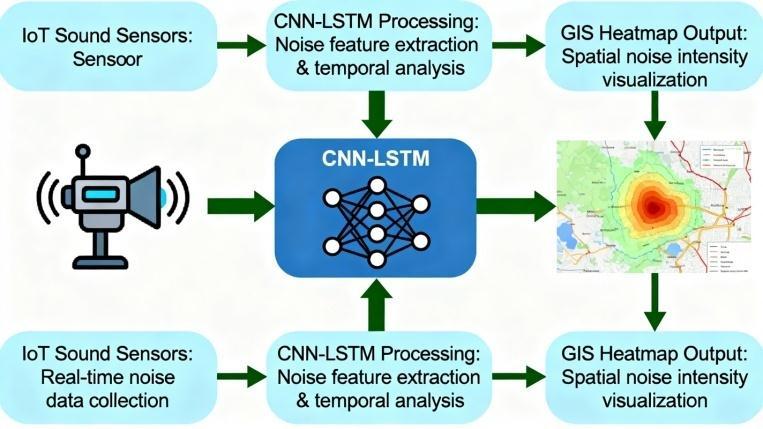
The methodology for the proposed AI-powered noise pollution mapping system begins with the careful design and deployment of distributed IoT-based sound sensing units across selected urban locations. At the core of each sensing node is the ESP32 microcontroller, chosen for its low power consumption, integrated Wi-Fi capability, and robust processing performance. This controller is paired with a high-sensitivity microphone module such as the MAX9814, which is capable of capturing subtle variations in ambient sound pressure levels. Alongside the microphone, a GPS receiver like the NEO-6M is integrated to provide real-time geo location data. Together, these components allow each node to measure environmental noise levels while accurately tagging them with location coordinates. As the sound sensor collects audio from the surroundings, it converts the detected vibrations into electricalsignalsthatarefedintotheESP32’sanaloginput pin (A0). Simultaneously, the GPS module communicates over the ESP32’s UART interface, embedding latitude and longitude values directly into each captured data frame. This dual stream of audio and spatial data establishes a
International Research Journal of Engineering and Technology (IRJET) e-ISSN: 2395-0056
Volume: 12 Issue: 12 | Dec 2025 www.irjet.net p-ISSN: 2395-0072
strong foundation for meaningful, location-aware noise analysis
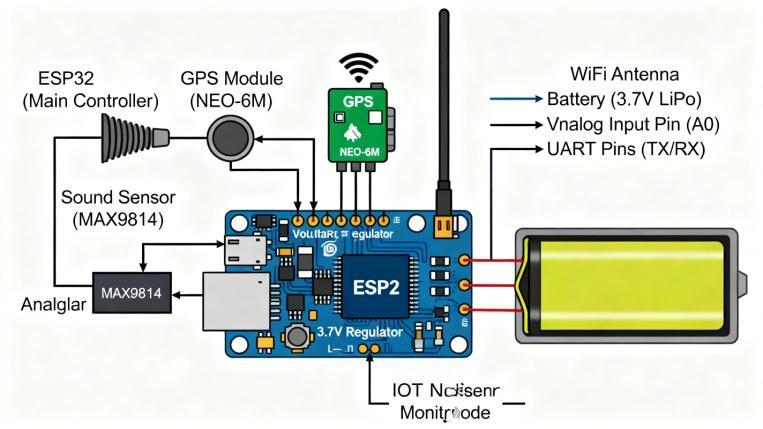
After acquiring the raw audio and GPS data, the ESP32 processes lightweight filtering operations and transmits thecollectedinformationtotheserverthroughitsbuilt-in Wi-Fi module. In scenarios requiring wider coverage or remotedeployment,theESP32caninterfacewithexternal GSM modules for cellular connectivity. Power is supplied by a 3.7V Li-Po battery, regulated to appropriate voltage levels using onboard converters, ensuring long-term autonomous operation in outdoor environments. This hardware configuration, reflected in the circuit diagram, createsacompact,energy-efficientsensingunitcapableof continuousnoisemonitoring.
Oncethestreamedaudiodata reachesthecloudserver or local processing unit, it undergoes a comprehensive preprocessing workflow. The incoming signals are first normalizedtostandardizeamplitudevariationscausedby environmental fluctuations. Noise reduction filters are then applied to remove electrical artifacts and unwanted distortionsintroducedbythehardware.Theaudioisthen segmented into appropriate time windows to preserve temporal structure while enabling efficient computation. From these refined audio segments, the system extracts essential acoustic features using advanced digital signal processing techniques. Features such as Mel-Frequency CampestralCoefficients,spectralroll-off,spectralcentroid, Chroma vectors, and Mel spectrograms capture both the frequency composition and time-varying behavior of the noise, forming a rich representation suitable for machine learning.
These extracted features are then fed into a CNN-LSTM hybriddeeplearningarchitecture,asdepictedinyourflow diagram. The convolutional layers identify localized spectral patterns from the input spectrograms, allowing thesystemtodifferentiatefine-grainednoisetypessuchas vehicular movement, construction machinery, honking, industrial processes, and human-generated sounds. Meanwhile, the LSTM layers analyze the temporal relationships within the audio signal, learning how noise
patterns persist, fluctuate, or evolve over time. This combination ofspatial andtemporal learningsignificantly enhances the model’s ability to classify complex urban noisesignatureswithhighaccuracy.
Followingclassification,anadditionaltemporalprediction model based on LSTM forecasting is employed to estimate future noise trends. By learning from historical acoustic data, the prediction module identifies recurring patterns such as peak traffic hours, construction schedules,orenvironmentalcycles.Asaresult,thesystem can provide early warnings for potential noise surges, enablingmoreproactivemanagementandinterventionby cityauthoritiesandurbanplanners.
All classified and predicted data is subsequently integrated into a geospatial visualization pipeline. Using GIS-based frameworks, the system plots noise intensity and noise type distribution onto digital maps. Heatmaps are generated to visually highlight high-noise zones, gradients, and spatial propagation patterns across the monitoredarea.TheseGISlayerstransformrawacoustics into intuitive visual structures, allowing users to observe real-time and historical noise behavior across different neighborhoods. The resulting interactive map enables dynamic zooming, area-wise filtering, and time-based playback, giving stakeholders detailed insights into the acoustichealthoftheenvironment.
Through thismulti-layered methodology beginning with IoT-based sensing, followed by AI-powered feature extraction and classification, noise prediction, and finally GIS-driven visualization the system provides a complete end-to-end solution for real-time noise pollution monitoring. The combination of robust hardware design and intelligent software processing ensures accurate, scalable, and actionable insights that support modern smart-cityapplications.
The literature review shows significant advances in variousmajorfieldsofnoise-pollutionstudies,suchasthe environmental sound data, deep-learning classification algorithms, IoT-based noise-monitoring solutions, and spatial analysis based on GIS. Both studies play a significant role in the overall problem of comprehending urban noise. Basic benchmarks like ESC-50 have allowed to have benchmark consistency and sophisticated CNN andhybridnetworkshaveenhancedenvironmentalsound classificationaccuracy.Onthesamenote,recentadvances inIoTsensingandGeoAIhaveshownhowlargescaleand real-timeenvironmentalmonitoringispossible.Inspiteof these achievements, there is still an obvious gap: the majority of research works concentrate on one of the aspects of the problem and do not consider it in its entirety. The classification-oriented systems are usually
International Research Journal of Engineering and Technology (IRJET) e-ISSN: 2395-0056
Volume: 12 Issue: 12 | Dec 2025 www.irjet.net p-ISSN: 2395-0072
basedonprepareddatasetsasopposedtocurrentacoustic scenes. The IoT solutions used to monitor noise usually gather the noise levels without analyzing the sources and patterns of the noise. Similarly, noise mapping that is based on GIS is generally static, not updated in real-time or having predictive intelligence. Due to this, the current solutionsarenotrobustenoughtoofferaunifiedplatform, which can continuously sense, analyze intelligently, predict,andprovidegeospatialvisualizationatanintuitive level.Itisthisgapthatallowsonetounderstandthatmore integratedapproachisrequired,thatis,theonethatwould incorporate sensing, analytics, and mapping into one, unified system. Our proposed system will fill this gap by linking the low-cost IoT nodes, the CNNLSTM hybrid model sound classification, temporal forecasting of predictingnoisepatternsorvariations,anda GISdynamic visualizationoftheresultsinterpretation.Thesystem will facilitate the real-time decision-making and long-term urban planning by integrating these technologies into a single workflow. In its summary, though some useful grounds have been made so far by the previous research, there is still a considerable amount of untapped possibilities in the field of combined, smart noisemonitoring solutions. The framework suggested in the proposal will further this direction as this approach will provide the city with a scalable and data-driven solution that will enable them to understand and manage noise pollutionandultimatelyreduceit.
Piczak, K. (2015). ESC-50: Dataset for Environmental Sound Classification. Proceedings of the 23rd ACM InternationalConferenceonMultimedia
Urban GIS Noise Vulnerability Study.(2017). Application of GIS-Based Spatial Analysis for Urban NoiseExposureAssessment.
Zhang, Z. (2018). Deep Convolutional Neural Networks with Mixup for Environmental Sound Classification. IEEE International Conference on Acoustics,SpeechandSignalProcessing(ICASSP).
TechScience Press. (2022). Deep Learning-Based Framework for Environmental Sound Classification. Computers,Materials&Continua(CMC).
Renaud, J., et al. (2023). Deep Learning and Gradient Boosting Models for Urban Noise Level Forecasting Using Sensor Networks. Journal of Environmental Informatics.
IoT-Based Mobile Noise Monitoring Study. (2024). Mobile Node-Based Environmental Noise Mapping UsingIoTSensors.SmartCitiesJournal.
GeoAI Noise-Prone Area Assessment – Tehran Case Study. (2024). Machine Learning and Geospatial Analytics for Urban Noise Hotspot Identification. EnvironmentalModelling&Software.
IoT Sensors for Sustainable Smart Cities: Review. (2024). Comprehensive Review of IoT Sensor Applications in Environmental Monitoring. SustainableCitiesandSociety.
Chen, L. J., et al. (2025). EcoDecibel: A Low-Cost IoT Device for Long-Term Urban Noise Monitoring. IEEE InternetofThingsJournal.
UrbanSound8K Dataset. (2014). Environmental SoundClassificationDataset. AvailableonKaggleand curatedbyJ.Salmon&J.P.Bello.
Tensor Flow Audio Classification Documentation. (2023). Tensor Flow Guides for Audio and Spectrogram-BasedMachineLearningModels
IEEE Research Papers on IoT-Based Noise Mapping. (VariousYears).IEEEXploreDigitalLibrary.