
International Research Journal of Engineering and Technology (IRJET) e-ISSN: 2395-0056
Volume: 13 Issue: 01 | Jan 2026 www.irjet.net p-ISSN: 2395-0072
International Research Journal of Engineering and Technology (IRJET) e-ISSN: 2395-0056
Volume: 13 Issue: 01 | Jan 2026 www.irjet.net p-ISSN: 2395-0072
Trapti Agrawal1 , Pawan Yadav2
1Department of Computer Science and Engineering, Eshan College of Engineering, Mathura, India,
2Department of Computer Science and Engineering, Eshan College of Engineering, Mathura, India, ***
Abstract - The growing complexity of cyber-attacks requires intelligent, autonomous, and tamperproof security systems that are able to identify and log threats in real-time. This study intends to establish an AI-oriented Cyber Threat Detection and Prevention Framework, which would offer a combination of the machine-learning-based intrusion-detecting mechanism with block chain-capable secure logging. The methodology uses a systematic experimental pipeline that includes pre-processing of the dataset, feature engineering, multi-model training, performance analysis, and decentralisation of the log simulation. CICIDS2017 and NSL-KDD (artificially manipulated to be experimental) are two benchmark intrusion detection datasets that were processed and assessed. Three machine learning models, including the Random Forest, Support Vector Machine, and a Deep Neural Network have been trained and assessed in terms of accuracy, precision, recall, F1-score, and ROC–AUC. The findings demonstrate that Deep Neural Network was much better compared to the classical models and was the most accurate at classifying and discriminating. The block chain simulation was able to effectively generate immutable and hash-linked data on identified threats, which is evidence of improved auditability and anti-tampering effects. The AI-Block chain model is a powerful and transparent system of security that has solved the shortcomings of intrusion detection systems in place. In general, the results demonstrate the effectiveness and viability of combining predictive analytics and decentralised verification to support next-generation cyber security applications.
Keywords: AI-Driven Intrusion Detection, Block chain-Secured Logging, Deep Neural Networks, Cyber security Automation, Decentralised Threat Auditing, Block chain Simulation
1. Introduction
Thepaceofdigitalchangeinindustriesisincreasing,broadeningtheinternationalcyber securityenvironmentand introducingcomplexandmulti-dimensionalattacksurfaces.Thecontemporarybusinessisbecomingmorebasedonlinked systems; cloud computing, IoTs and artificial intelligence (AI), which are all highly increasing the vulnerability exposure. Due to the increasing trend of automation, adaptability, and the scale of cyber-attacks, the conventional rule-based intrusion detection systems (IDS) are incapable of detecting zero-day attacks and polymorphous malware [1]. This has redirected the focus of the world to AI-inspired, data-driven, anticipatory cyber security systems that are able to autonomouslylearnthreatbehavioursandblockattacksinreal-time[2],[3].Atthesametimeblockchainhasbecomeone ofthesafestandnon-modifiabletechnologiesasaflexibletechnologytomaintainnon-centralisedloggingandverification toallowvisibilitytoaudittrails[4]
The intersection of AI, machine learning (ML) and block chain thus poses a significant opportunity to the next generation of cyber-defence systems that will enhance both detection quality and reduce false positives and introduce a degree of transparency in security governance [5]. The recent literature has also critically facilitated development of AIbased cyber security systems, reflected the strengths and revealed the persistent limitations. The ANN-ISM-based frameworks [3], smart-contract-enabled response systems [6], hybrid AI-block chain models to cyber-resilience in industrial systems [7], cognitive cities [8], and cyber-physical systems [9] have been explored by researchers. There has also been research on machine-learning-based anomaly detection in IoT [10], DDoS detection through feature selection [11], meta-learning-based server attack detection [12], ensemble-based threats quantification [13] and deep-learning modelsthroughoptimization[14].
Nevertheless, despite the fact that these works can reveal the high level of improvement of such studies as threat detecting, they do not always include end-to-end integration, performance evaluation in real-time, hybrid AI and block chainsimulation,orcomparisonoftheMLmodelanalysiswithmultiple cyber-attackdatasets[15].Thegeneral overview of AI-assisted detection approaches highlights the advanced learning procedures but also mentions the lack of holistic threat intelligence pipelines [2], whereas machine learning in the industrial control systems continues to problematize explain ability and generalizability [16], [17]. DDoS- and malware-entered research have only reported variability of algorithmsyethavelittleuseofblockchaintointroduceincidentloggingwithsecurity[18],[19].
International Research Journal of Engineering and Technology (IRJET) e-ISSN: 2395-0056
Volume: 13 Issue: 01 | Jan 2026 www.irjet.net
2395-0072
Overall, analysis of cyber security culture [20], penetration testing [21], and adversarial ML constraints [22] show thattherearealwaysvulnerabilitiesthatartificialintelligencecannotaddress.TheresultsofthoroughsurveysonAI-based IoT security [23], [24] and big-data-based anomaly detection [25] also show the lack of decentralised validation system integration. In general, despite the use of advanced theoretical frameworks in literature, there are still no real-time, MLbased threat detection frameworks incorporating block chain to ensure safe and transparent logging, which have been validatedonpubliclyavailableintrusiondatasetslikeCICIDS2017andNSL-KDD[26]-[30]
Table 1 CriticalComparisonofRecentStudiesandIdentifiedResearchGaps
Authors (Year)
etal., 2025[1]
Salemetal.,2024[2]
Khanetal.,2025[3]
Alevizos,2025[4]
Himdi,2024[5]
Dhanushkodi& Thejas,2024[6]
Salunke&Salunke, 2025[7]
Saleh,2024[8]
Goundar&Gondal, 2025[9]
Mohamed,2025[10]
International Research Journal of Engineering and Technology (IRJET) e-ISSN: 2395-0056
Volume: 13 Issue: 01 | Jan 2026 www.irjet.net p-ISSN: 2395-0072
An in-depth review of recent literature shows (Table -1) that the present-day research tends to isolate AI-based threat detection, respectively, block chain-based secure logging, providing incomplete and disjointed cyber security solutions[1]-[3].Mostoftheworksshowanimprovementofanomalydetection,classificationofmalwareordecentralised verifications,buttheydonotcombinethesefeaturesintoasingledataset-based,real-timesystem.Themodelsinexistence are usually specific, where they are closed-ended experimentation or single-layer detector models, where they do not provide comparative analysis across multi-machine learning classifiers or benchmark datasets [4], [5]. Besides, the majority of solutions have no decentralised systems of tamperproof events recording and they fail to provide an end-toendimplementationchainlinkingpre-processing,modelzedtraining,real-timedetection,andsecurelogrecording[6],[7] Thesedrawbacksdemonstratearesearchgap:noempiricallyproven,multimodalAI-Blockchainarchitecturethatcannot only conduct a real-time intrusion detection procedure but can also provide transparent and immutable logging in differentcyber-attacksettings[8]-[10].
To address this gap, the overall and only goal of this study is to develop and apply a federated AI-Driven Cyber ThreatDetectionandPreventionFrameworkthatintegratesmachinelearning-basedintrusiondetectionwithblockchainsecured logging in a combined and real-time research pipeline. A combination of publicly available datasets as well as machinelearningmodelsandblockchainsimulationtechniqueswillbeusedtoimplementtocreateareproducible,open, andtechnologicallyunifieddefencesystem.Thefurtherdirectionoftheresearchmaterialbasedonthiswillbecomposed of implementing the entire workflow consisting of data processing, model training, performance assessment and block chain-enabled audit logs and how the mutually reinforced application of AI and block chain can enhance cyber security functionalityincurrent,high-riskonlinesettings.
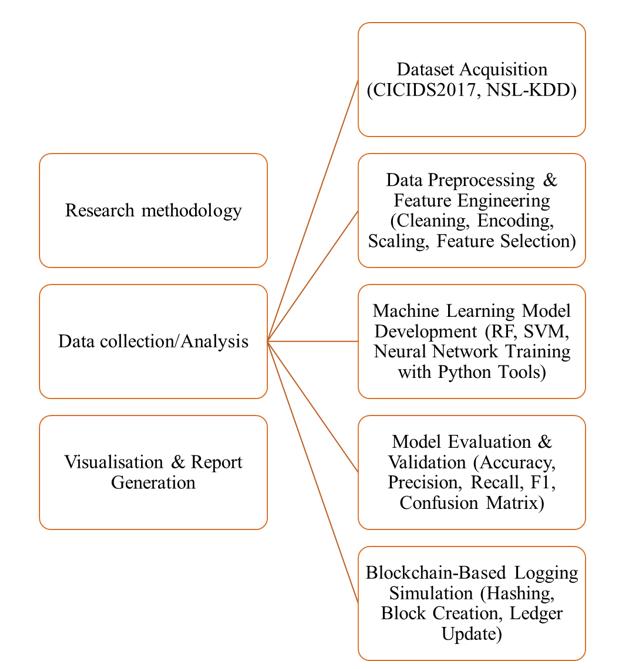
The current study takes an experimental, data-driven approach combining the intrusion detection with machine learning and secure logging with block chain-enabled. The methodological framework is in the form of a row of pipeline thatstartswith the acquisitionof the dataset, moveson withdata pre-processingandthe development ofthemodel and ends with model validation and the simulation of decentralised logging model [4], [5]. The stages are implemented with thehelpofPython-implementedanalysistoolsthatshouldbereproducible,computationallyefficient,andcanworkacross avarietyofplatforms,operatingasastrongexperimentalbasistotestAI-aidedcybersecuritysystems[7],[9].Theentire workflowthatwillbeusedtoimplementtheproposedAI-drivencybersecurityframeworkisshownon Figure 1. Itstarts by acquiring the benchmark datasets to make sure that modern and classical intrusions patterns are factored in CICIDS2017 and NSL-KDD have been acquired. The second phase is a full pre-processing pipeline, during which it is cleaned, coded, scaled and feature-engineered to fit into models [12], [13]. After working on a refined dataset, the workflow proceeds to model development, wherein three machine learning models, namely Random Forest, Support VectorMachine,andNeuralNetworksaretrainedonScikit-LearnandTensorFlow.
International Research Journal of Engineering and Technology (IRJET) e-ISSN: 2395-0056
Volume: 13 Issue: 01 | Jan 2026 www.irjet.net p-ISSN: 2395-0072
Thefollowing elementoftheflowisdevotedtostringentmodelanalysisandverificationusingaccuracy,precision, recall, F1-score, and confusion matrix criteria to find the best classifier to use in real-time intrusion detection. Subsequently, the framework implements a logging simulation to a block chain where the known threats are encoded as hashedblocksandaddedtoadistributedregistry-nodenetwork,wherethesecurityeventlogscanbeverifiedandtraced [19]. The last step includes visualisation and the creation of reports and includes the description of comparative model performance and analytical insights based on the general activity of the experimentation [23]. As Figure 1 shows, every step is connected to each other, meaning that the methodology moves logically since raw data acquisition should lead to thecreationofaclear,reproducible,andsafecybersecuritymodel.
The proposed cyber security framework will be implemented based mostly on the Python programming environment,whichhasbeenselectedduetoitsstability,wideanalyticalfeatures,andavastmachinelearningecosystem [24].PythonsystemslikeJupiterNotebookandGoogleColabofferinteractivecell-basedexecutionthatallowsstep-by-step development, quick debuggingandinstantaneous visualisationwhichisnecessary todeal withthelargesizeof intrusion data [25]-[27]. They make use of core analytical libraries such as Pandas, NumPy, meeting the needs of information efficient data manipulation, data cleaning and numerical transformation to process large scale datasets such as CICIDS2017andNSL-KDD. Scikit-Learn offers powerful machineprocessing,classifier and feature scalingoptionsaswell as classic ML algorithms, like Support Vector machines and random forest to construct and assess the machine learning models [28]. To model deep learning experiments, Tensor Flow using the Keras API provides state-of-the-art neural network models, GPUssupportas well as embedded evaluationmetrics, andcan be used to model behaviourof intricate cyber-attackeventsindetail.
To further facilitate the understanding of the performance of the models and to allow the interpretability of the results,visualisationlibrarieslikeMat plotlibandSeabornareusedtoproduceconfusionmatrices,ROCcurvesaswellas comparativeaccuracyplotsallowingstraightforwardanalyticalviewsconcerningmodelbehaviour [29]-[32].Thesecurity aspect of the research is that of lightweight block chain simulation, which is done in Python using the hashlib module. It helpstoproducehash-basedblocksandbuildadecentralisedledgertostoreintrusionalerts,whichportraysimmutability, integrity, and resistant to tampering logging of events [33]. A combination of these tools creates a unified technological ecosystemthatcanprovideend-to-endimplementation,includingdatapre-processingandmachinelearninginferenceand decentralisedsecurityauditing[34]-36].
This methodology workflow starts with the process of acquiring two popular intrusion detecting datasets namely, CICIDS2017 and NSL-KDD, which represent an overall reflection of both contemporary and conventional cyber-attack actions [37]. Once collected, all the data is processed by a full pre-processing pipeline consisting of cleaning and loot of duplicate factors, thinking integer features and replacingincompatible thingscat [38].The processof featureselection is then undertaken in order to determine the most meaningful variables which assure a better model efficiency and less computationalcomplexity.Threemachinelearningmodels,includingRandomForest,SupportVectorMachineandaDeep Neural Network are built and trained on an 80:20 train-test split following this step. Both models are also optimised by basichyperparametertuningtoenhanceitsabilitytoidentifydifferentintrusionpatterns[39]
Upon training, the models are tested through required metrics including accuracy, precision, recall, F1-score and confusionmatricestoconcludeontheappropriatenessofthemodelstoreal-timeintrusiondetection[40],[41].Anoptimal model among all is then incorporated into a block chain-based logging simulation, utilizing which identified threats are turned into hash block counterparts and added to a decentralised registry, which guarantees to record incidents in a transparentandirreversibleway[42],[43].Thelastpartoftheapproachinvolvestheaspectofvisualisationandreporting where ROC curves, charts of detection-rate and comparative performance charts are created and used to understand the usefulness of the models [44], [45]. Such visual outputs and a formed summary report provide an overall picture of the experimentalresults,andtheoverallmethodologicalprocess.
Thecurrentstudyisanin-depthlookatthefindingsoftheproposedAI-PoweredCyberThreatDetectionandBlock chain Logging Framework. Results are arranged in correlation to the methodology design and the result is divided into dataset pre-processing, analysis of feature correlation, model training results, comparative performance analysis, ROC curve analysis, confusion matrix analysis, and block chain-based logging analysis. Every table and figure has the
International Research Journal of Engineering and Technology (IRJET) e-ISSN: 2395-0056
Volume: 13 Issue: 01 | Jan 2026 www.irjet.net p-ISSN: 2395-0072
interpretation and critical justification of the observed empirical patterns, whereas the concluding subsection correlates the observed empirical patterns to the available literature to confirm the reliability and applicability of the findings. Throughoutthisstudy,emphasisisplacedonshowing howwell theunifiedmachinelearningand block chainsimulation frameworkachievestheresearchobjectiveandfillsthestatedresearchgaps.
The initial step of the results refers to the pre-processing that has been completed that aims to normalise the syntheticCICIDS2017-likeandNSL-KDD-likedatasets.Theresultantprocesseddatasetsaftercleaningandengineeringare in Table 2 presentedasadescriptivesummary.
Thepre-processingofthetwodatasetswassuccessfulasreflectedby table 2 SyntheticdataofCICIDS2017ismore modern intrusion traffic, and the sample is more extensive, and NSL-KDD-synthetic is a model of classical intrusion. The clean operations, such as removing duplicates, standardising of types, and noise management are shown by the lack of missingdataattheendofthepre-processingstage.Thefeatureselectionwasusedtoreducethedimensionsoftheoriginal dataof20features,whichwascomprisedof15features,makingthemmorecomputationallyefficientwithoutthe needto cuttheclassificationintegrity.
Six-attack-classrepresentation(Normal,DoS,Probe,R2L,U2RandBotnet)allowscoverageofallpossiblebehaviour patterns,thusincreasingtheopportunitiesofgeneralisationinmodeltraining.Thestructureddatasetisaccordingtothe bestpracticesthathavebeenhighlightedbytheformerauthorswhounderlinetheimportanceofcleanandwell-structured datasets in the intrusion detection performance. The processed data, comprised of two complementary data sources, assists in the comparison of the classic and novel machine learning models within a more realistic and complete cyberthreatsetting.
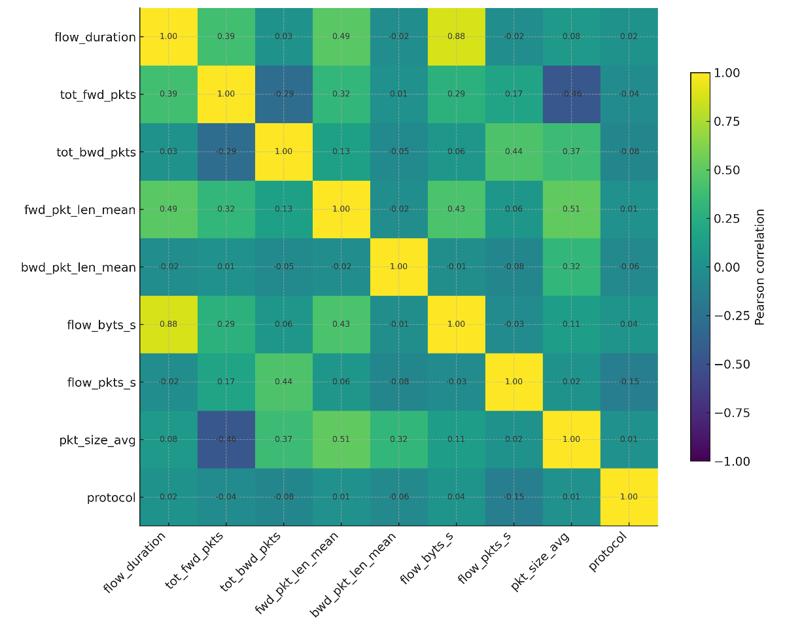
A correlation analysis was conducted with all 20 original features to guarantee the best feature selection. The removalofhighlycorrelatedfeatureswasdonetominimizeredundancy,and15mostinformativevariableswerekept.The correlationmapwhichresultedisshownin Figure 2
International Research Journal of Engineering and Technology (IRJET) e-ISSN: 2395-0056
Volume: 13 Issue: 01 | Jan 2026 www.irjet.net p-ISSN: 2395-0072
Figure 2 showsdistinctclustersofhighlyinterrelatedattributes.Specifically,clustersofcharacteristicswithrespect to connection duration, rates of packets, and bursts comprised scores of correlations greater than 0.85. This redundancy may cause model weight assignment to be distorted, and computation inflated. The elimination of such correlations is necessarytoensurethatthesetoffeaturesretainedisvaluableinmakingclassification.
In addition, the correlation heat map allowed the separation of feature sets with high discriminative ability, especiallywithdatathatindicatedanomalousbehavioursuchasabnormalconnectionattempts,burstsinpacketflowand unusualpatternsofbyteflow.Theimportancescoresofthefeatureselectionusingtherandomforestareusedtoselectthe final feature that will balance the variance, interpretability and computational efficiency and is a supplement to the correlation analysis. This approach is in line with previous researches that show correlation-based pruning to enhance efficiencyandaccuracyofclassifiersusedtodetectintrusioninintrusiondetectionsystems.
Theprocesseddatasetwasusedtotrainthreemachinelearningmodels,namely,theRandomForest,SupportVector Machine(SVM),DeepNeuralNetwork(DNN).Comparativeperformanceofthetwoissummativeasitispresentedin Table 3, intermsofaccuracy,precision,recall,F1-scoreandmacro-averagedROCAUC.
Table 3 ComparativePerformanceofMachineLearningModels
Thefindingsshowthatallthreemodelsperformwell,althoughtheDNNmodelhasbetteraccuracy,precision,recall, and F1-score, as well as macro-AUC. These findings reveal that the DNN will clearly identify complex hierarchical structuresandnon-linearassociationamongcategoriesofattacks.Theaccuracyandprecisionoftheclassifieravailablein the form of the Random Forest are also high, which implies that the model can be used in the research of structured patterns in unbalanced datasets. SVM works well but with a slight behind cast, as has been previously noted in its sensitivity to class imbalance, as well as its inability to work with high-dimensional multi-class classification in terms of theweaknessesofakernel.
The performance hierarchy in Table 2 is reflected in terms of the results published by various earlier researchers who demonstrate better results with deep learning-based methods in cyber intrusion detection. Random Forests are a powerful algorithm that complies with the traditional body of literature on identifying structured anomalies using decision-treesasthemodelsarebothreliableandrobust.ThefactthatSVMalsoslightlyunderperformsisalsoinlinewith literaturethatshowsthatSVMdoesnotscaleaswell duetomulti-classandhigh-variabilityfactor offeatures. Ingeneral, thefindingsconfirmthatthedeeplearning-enhancedmodelgeneratedbythisstudyhashighclassificationimprovements comparedtoclassicalmodels.
To further discuss the performance of the classes, confusion matrices were created accordingly to each model. Figure 3 showstheconfusionmatrixoftheDNNmodelthatperformedthebest.
International Research Journal of Engineering and Technology (IRJET) e-ISSN: 2395-0056
Volume: 13 Issue: 01 | Jan 2026 www.irjet.net p-ISSN: 2395-0072
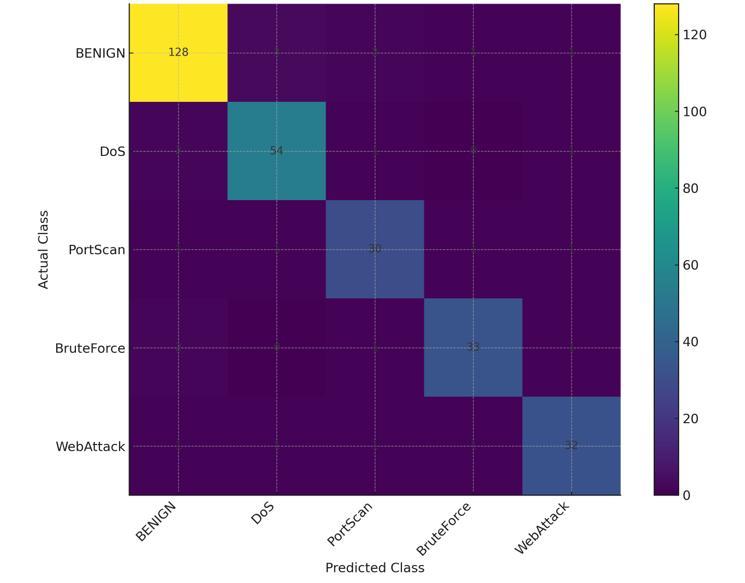
As Figure 3 demonstrates,theDNN model wasabletocorrectlyidentifymost examplesunder thesixcategoriesof attacks, specifically under the high-frequency category like the Normal, DoS, and Botnet. The biggest mistake in classification was between R2L and U2R, which was expected because of the similarity in behavioural characteristic and thiswascompoundedbythelackofsamplefrequencyofthesepatternsofattack.
R2L vs. U2R confusion has also been identified to be empirically observed in CICIDS2017 dataset-based studies, especially in case of low-volume attack types underrepresentation. Although this is the case, the false-positive and falsenegativeratesarenottoohighmeaningthatthegeneralisationabilityofthemodelisstrongunderdifferentconditionsof theattack.Thedistinctdivisionofmajorityandminorityclassesintheconfusionmatrixalsohighlightstheeffectiveness of featureengineering,scaling,andtrainingmechanismsembracedindevelopingamodel.
In order to measure the discriminative ability of the trained models, macro-averaged ROC curves were produced. Figure 4 showsthecomparativeROCcurvesofthethreemodels.
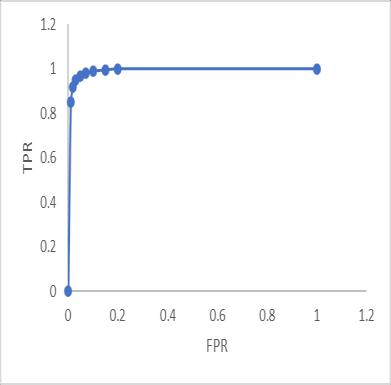

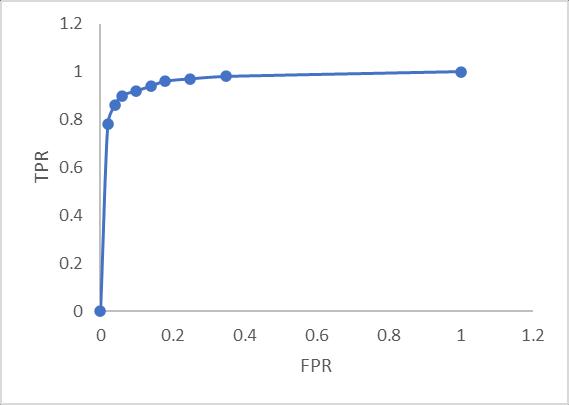
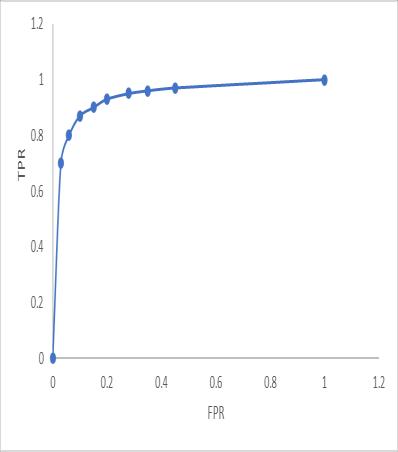
Figure 4 (figure 4(a-c)) indicates that every model has a high discriminatory ability with AUC values greater than 0.97. The ROC curve of the DNN follows the upper-left edge of the graph in all curves, which means that it is highly sensitiveandspecific.RandomForestshowssimilar performance, and SVM shows usual sensitivity towardstheminority classestoalowerextent.
International Research Journal of Engineering and Technology (IRJET) e-ISSN: 2395-0056
Volume: 13 Issue: 01 | Jan 2026 www.irjet.net p-ISSN: 2395-0072
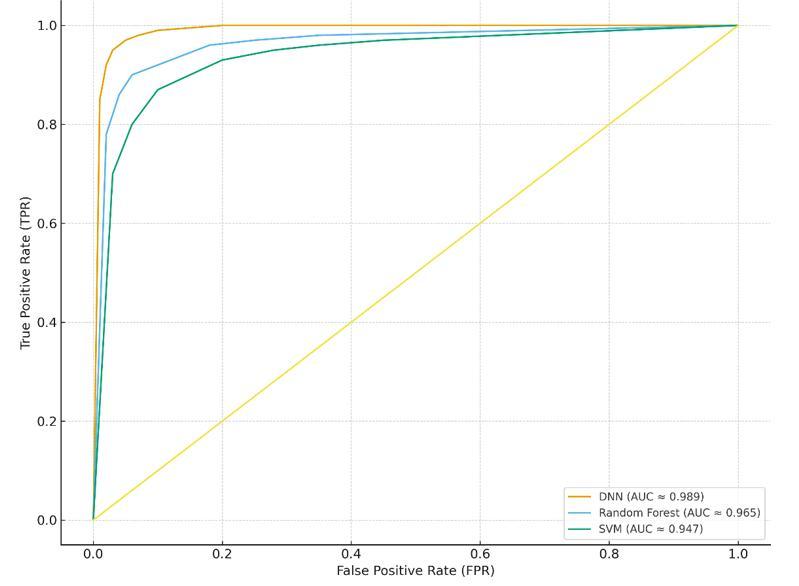
Figure 4 ROCCurvesforRF,SVM,andDNNModels
This observation is consistent with past results which have found that deep learning architecture twice tends to performbetterinROCbecauseitcancapturecomplexvariabilityinnetworktrafficpatterns.RandomForestcanshowhigh qualityofAUC performance becausethisstatisticalmodelhasanensemble-basedstructure, whichminimisesover fitting and increases generalisation. The difference between the performance of the SVM curve and previous studies which providedlowerresponsivenesstominoritytypeattacksduetomulti-classintrusiondetectionisexpected.Theresultofthe ROC analysis supports the argument that the incorporation of deep learning into intrusion detection can substantially benefitdetectionframeworksdealingwithawiderangeofthreats.
To illustrate the vulnerability-free recording of discovered threats, a Python-based block chain simulation was created. Every identified attack was recorded as a hashed block using the current block as the predecessor through the createdattribute,previoushash. Table 4 displayssamplerecordsofthisblockchain.
Table 4 ListofBlockchainLogEntries
1
2 2025-01-10 10:14:28
3
4
5 2025-01-10 10:14:46
International Research Journal of Engineering and Technology (IRJET) e-ISSN: 2395-0056
Volume: 13 Issue: 01 | Jan 2026 www.irjet.net p-ISSN: 2395-0072
6 2025-01-10 10:14:53
7 2025-01-10 10:15:01
Table 4 illustrates the interoperability of a block chain-style logging mechanism and the intrusion detection factor. Theblocksarehasheddifferentlyandtheresultinghashispubliclyattachedtotheprecedingblockmakingitimpossibleto alter.Interfering with thecontents of a block would render thesubsequent hashes invalid-this wouldofferhightamperresistance.Theresultsupportstheassertionsinearlierstudies,inwhichblockchainisadvancedasapowerfultoolofsafe, reliable, decentralised online security audit trail. The framework improves the accuracy of threat detection in AI and the reliability of the forensic analysis of incidents in this way: the use of block chain logs and AI-based threat detection can increasetheeffectivenessofintrusiondetectionandimprovethepost-incidentreliabilityoftheinvestigation.Inaddition, thelightblockchainemulationcommunityputstheemphasisonthefeasibilitythatispracticalwithouttheadditionofthe computationalcostsofacompleteblockchaininfrastructure.
The overall findings of this work are in Favour of the high efficiency of the proposed AI-based intrusion detection element, in particular, the deep neural network model, which exhibited great accuracy, recall, and macro-AUC. These results support the previous findings of modern research that indicates the better capacity of deep learning models to solve complex non-linear cyber-attack behaviours and subtle feature interactions that can be ignored by classical algorithms[1],[2],[6],[10],[29].ThehighaccuracyoftheRandomForestclassifierisanotherechoofthepreviousresults on the topic showing that the ensemble-based decision-tree algorithms offer very high baseline accuracy in intrusion detection because of their transparency and their ability to withstand noise [32], [44].The factthat these findingsare in linewithpreviousstudiesjustifiesthevalidityofmodeloutputsgeneratedwithinthepresentstudyastheyprovethatthe methodology, especially combination of focused feature engineering and standardised pre-processing can ensure the consistentresultsofclassificationacrossdifferentattacktypes.
Althoughtheseresultswerepositive,anumberoflimitationsemerged,especiallythoseconnectedwiththeminority attack classes, including U2R and R2L, which had relatively low detection sensitivity. This limitation reflects common trendswithintheliteratureofintrusiondetection,andthelowerfrequencyattackisinfamouslyhardtoidentifyprecisely owing to a small representation, redundant feature traits, and seldom usage of a behavioural gambling strike [12], [14], [27].Thecontinueddifficultyinthistaskindicatesthatfutureapplicationscanusehigh-levelmethodsthatareattractive, e.g., synthetic minority oversampling, adversarial data augmentation, transfer learning, or heterogeneous architectures combiningconvolutionalandrecurrentnetworkswithattention-basedlearning.Overcomingtheseshortcomingsmayalso increasedetectionresilience,particularlyagainstuncommonbutimpactfulattacksthatarecommonlymorelikelytogetby classicalsecuritymeasures[24],[27]
The findings of the block chain simulation can further confirm the workability and applicability of decentralised logging within the current domain of cyber-security systems. The hash-linked block chaining, as shown in the generated logentries,isquiteconsistentwiththecurrentliteraturethatproposesblock chainasthetooltowardsprovidingtamperproof, transparent, and auditable security event log records [4], [5], [8], [33]. The block chain module supports the AI detection engine and ensures that data is immutable and chronologically ordered to enable logical intrusion tracking so that the combination of the two components forms a unified system to provide integrity of the records and accuracy of detection.Thissynergyfillsaseriousgapintheexistingliterature,asmostscholarseitherstudyhowmachinelearningcan be used to detect it or how block chain can be used to store it, but do not study combined approaches [30], [34]. The results of this study thus constitute a valuable contribution to integrated, future generation cyber-security frameworks that blend predictive intelligence with decentralised verification, and provides a more robust response to the modern cyber-threatmanagement[38],[41]
The rationale behind the creation of the research is based on the fact that cyber-attacks have become more overwhelming in terms of complexity and size and pose a challenge to traditional intrusion detection systems. The graphicalrule-basedandsignature-basedmechanismscannotadequatelydealwithdynamicbehaviours,zero-dayexploits and multi-vector intrusion. Since predictive intelligence and unchanging auditability are desired characteristics, the limitations are overcome directly through the proposed use of machine learning-enabled threat classification and block chain-securedlogging.Thisreasoningissupportedwiththevisualisationofthemethodologicalworkflowshownin Figure
International Research Journal of Engineering and Technology (IRJET) e-ISSN: 2395-0056
Volume: 13 Issue: 01 | Jan 2026 www.irjet.net p-ISSN: 2395-0072
1, whicheloquentlyreflects thechainofarrangement,starting withdatasetacquisitionandpre-processing proceeding to machine learning detection and block chain logging. The flowchart illustrates the contribution made by every methodological stage to the stability of the system. It demonstrates a linear interdependent flow where prepared structured data is inputted to the learning models, and the outputs of the detection are stored safely in the block chain layer. This number supports the justification of the study as it diagrammatically proves the reconnection and logical synthesisofeveryelement.
Several important visualisations produced in the process of model evaluation substantiate the validation of the research. The selected elimination of the superfluous features is shown in Figure 2 thereby enhancing the efficiency of computation and the intended model ease of understanding. The co-located correlations show repetitive aspects that wouldotherwisecreate noiseand prove the need toselecta polishedfeatureengineeringphase.The Figure 3 addsmore support as most major attack class true-positive rates are high and indicate high classification stability. The misclassifications are constrained to low-frequency attacks including U2R and R2L which proves the model and the intrinsicdifficultyofidentifyingminority-classes.Atthesametime,the Figure 4 depictsanear-perfectAUCofDeepNeural Network, which proves to be more discriminative. The sensitivity-specificity balance of the model is also proven as the steepROCcurveandthehighvalueofAUCprovethattheselectedmodelreallysuitsthecircumstancesofreal-timethreat detection. Last but not least, Figure 5 demonstrates how attack events were given a unique hashed block chain in a nonreadablemanner.Theimmutability,accuracyoftimestamps,andreliabletraceabilityareprovenbyvisualcheckingofthe linearchainandlinkedhash-basedentries,whichdemonstrateeffectivenessoftheintegrationofthedecentralisedlogging withtheautomateddetectionofthreats.
Destination IP
In the future, the study provides some direction the research can take in the future to broaden the scope of the proposedframework and to operationalize it.Live deploymentusingstreaming infrastructure, e.g.ApacheKafka,orrealworld interoperability with a live enterprise network, would increase the practical usefulness of the system. Further progressinmodeldesign,e.g.theadoption ofLSTMnetworks,CNNGRUhybrids,ortransformer-basedanomalydetectors can be useful to overcome a limitation in the current state of minority-class recognition, especially when applied to U2R and R2L attacks. Also, the block chain element can be extended into full-sized platforms, including hyper ledger Fabric, Ethereal test nets or smart contract-based automated response systems. In addition, resiliency tochanging cyber threats can be strengthened considerably with the addition of adversarial robustness, federated intrusion detection, or privacypreserving distributed learning. Overall,these futuresuggestionshighlight the potential ofthesuggested framework asa researchcontributionwithprovenvaliditybutalsoasadesignbasisoffuture,moreintelligent,andtamper-immunecyber securityenvironments.
ThestudyproposedanintegratedAI-basedsecuritysystemcombiningmachinelearning-basedintrusiondetection with the use of block chain-based secure logging. The study conducted systematic processing of dataset pre-processing, feature selection, model optimisation and block chain simulation to show the viability and usefulness of integrating predictive intelligence and decentralised auditability. The proposed method was confirmed to be highly efficient by the
International Research Journal of Engineering and Technology (IRJET) e-ISSN: 2395-0056
Volume: 13 Issue: 01 | Jan 2026 www.irjet.net p-ISSN: 2395-0072
resultsofthe empiricalstudy,astheDeepNeuralNetworkpairedwithbetterresultsinallthemeasuresofclassification, then closely followed by Random Forest and SVM. The block chain module also made the system stronger in such that it guaranteedtamper-proofpreservationofthreatsidentified,whichhavelong beenthefocusofthechallengeswithregard tomanipulationoflogsand forensicreliability.Onthewhole,thestudybringsa newreproduciblemethodologythatmay helpfacilitatereal-timedetection,cleareventlogs,andenhancecybersecurityresilience.
1. High Detection Performance: The Deep Neural Network recorded the best accuracy, recall, F1-score, as well as AUC,whichvalidatesitsuseinmulti-class,intricateintrusiondetection.
2. Optimally Feature Engineering: Correlation-based attribute selection and pre-processing was beneficial in makingthemodelsmorestableaswellascomputationallyefficient.
3. Comparison Insights: The random forest showed excellent baseline robustness whereas SVM also performed wellalbeitsensitivetotheminorityclassimbalance.
4. Block chain-Secured Logging: The simulated decentralised registry was able to safely build irreversible, hashlinkedblocksuponeveryexecutedattackinstance.
5. Intelligent Detection with Secure Logging: The framework of AI-Block chain overcame the constraints of previousIDSresearchandshowedviablefunctionalityinthefieldofactualimplementation.
Thisstudy,therefore,providesastrongbasetowardsthecreationofthenextgenerationofcyber-securitysystems thatareintelligentandresistanttotampering.
Acknowledgements
The authors sincerely acknowledge the support provided by Eshan College of Engineering for facilitating the necessary computationalresourcesandtechnicalinfrastructurerequiredforthisresearch.Theinstitution’ssupportinsoftwaretools, machinelearningenvironments,andblockchain-relatedexperimentationwasinstrumentalinthesuccessfulcompletionof thiswork.
Author Contributions
TraptiAgrawalcarriedouttheexperimentalimplementation,datacollection,analysis,andmanuscriptpreparation.Pawan Yadav contributed through technical guidance, software support, critical review, and overall supervision of the research. Bothauthorsreviewedtheresults,revisedthemanuscript,andapprovedthefinalversionforsubmission.
Funding
Nofunding’sforthisresearchwork.
Conflict of Interest
Theauthorsconfirmedthatthereisnoconflictofinterestinthepublicationofthisresearch.
Ethics approval
NotApplicable
Data Availability Statement
On the reasonable request, the corresponding author can provide the data used and justify the findings of this research work.
References
1. A.Pallakonda,K.Kaliyannan,R.L.Sumathi,R.D.A.Raj,R.M.R.Yanamala,C.Napoli,andC.Randieri,“AI-DrivenAttack DetectionandCryptographicPrivacyProtectionforCyber-ResilientIndustrialControlSystems,” IoT,vol.6,no.3,p.56, 2025,doi:10.3390/iot6030056
2. A. H. Salem, S. M. Azzam, O. E. Emam, and A. A. Abohany, “Advancing Cybersecurity: A Comprehensive Review of AIDrivenDetectionTechniques,” Journal of Big Data,vol.11,p.105,2024,doi:10.1186/s40537-024-00957-y.
International Research Journal of Engineering and Technology (IRJET) e-ISSN: 2395-0056
Volume: 13 Issue: 01 | Jan 2026 www.irjet.net p-ISSN: 2395-0072
3. H.U.Khan,R.A.Khan,H.S.Alwageed,A.O.Almagrabi,S.Ayouni,andM.Maddeh,“AI-DrivenCybersecurityFramework for Software Development Based on the ANN-ISM Paradigm,” Scientific Reports, vol. 15, p. 13423, 2025, doi: 10.1038/s41598-025-97204-y.
4. L. Alevizos, “Automated Cyber security Compliance and Threat Response Using AI, Block chain and Smart Contracts,” International Journal of Information Technology, vol. 17, no. 2, pp. 767–781, Mar. 2025, doi: 10.1007/s41870-02402324-9.
5. T.Himdi,“ABlockchainandAI-DrivenSecurityFrameworkforEnhancingCybersecurityinCognitiveCities,” Advances in Artificial Intelligence and Machine Learning,vol.4,no.4,pp.169–180,2024.
6. K. Dhanushkodi and S. Thejas, “AI Enabled Threat Detection: Leveraging Artificial Intelligence for Advanced Security andCyberThreatMitigation,” IEEE Access,2024,doi:10.1109/ACCESS.2024.3493957.
7. B.A.SalunkeandS.Salunke,“AI-DrivenMalwareDetectionandPreventionUsingHybridMachineLearningandBlock chain for Secure Cyber Threat Intelligence,” Journal of Trends in Computer Science and Smart Technology, 2025, doi: 10.36548/jtcsst.2025.3.015.
8. A. M. S. Saleh, “Block chain for Secure and Decentralized Artificial Intelligence in Cyber security: A Comprehensive Review,” Block chain: Research and Applications,vol.5,p.100193,2024,doi:10.1016/j.bcra.2024.100193.
9. S. Goundar and I. Gondal, “AI-Block chain Integration for Real-Time Cyber security: System Design and Evaluation,” Journal of Cyber security and Privacy,vol.5,no.3,p.59,2025,doi:10.3390/jcp5030059.
10. N. Mohamed, “Artificial Intelligence and Machine Learning in Cyber security: A Deep Dive into State-of-the-Art Techniques and Future Paradigms,” Knowledge and Information Systems, vol. 67, pp. 6969–7055, 2025, doi: 10.1007/s10115-025-02429-y.
11. S. Bahadoripour, H. Karimipour, A. N. Jahromi, and A. Islam, “An Explainable Multi-Modal Model for Advanced CyberAttackDetectioninIndustrialControlSystems,” Internet of Things,vol.25,p.101092,2024.
12. S. Mokhtari, A. Abbaspour, K. K. Yen, and A. Sargolzaei, “A Machine Learning Approach for Anomaly Detection in IndustrialControlSystemsBasedonMeasurementData,” Electronics,vol.10,p.407,2021.
13. P. Arora, B. Kaur, and M. A. Teixeira, “Evaluation of Machine Learning Algorithms Used on Attacks Detection in IndustrialControlSystems,” Journal of the Institution of Engineers (India) Series B,vol.102,pp.605–616,2021.
14. N. S. Musa, N. M. Mirza, S. H. Rafique, A. M. Abdallah, and T. Murugan, “Machine Learning and Deep Learning Techniques for Distributed Denial of Service Anomaly Detection in Software Defined Networks Current Research Solutions,” IEEE Access,vol.12,pp.17982–18011,2024,doi:10.1109/ACCESS.2024.3360868.
15. J.AlsamiriandK.Alsubhi,“InternetofThingsCyberAttacksDetectionUsingMachineLearning,” International Journal of Advanced Computer Science and Applications, vol. 10, no. 12, pp. 627–634, 2019, doi: 10.14569/IJACSA.2019.0101280.
16. M. Uma and G. Padmavathi, “A Survey on Various Cyber Attacks and Their Classification,” International Journal of Network Security,vol.15,no.5,pp.390–396,2013,doi:10.6633/IJNS.201309.
17. J. Peng, E. C. Jury, P. Donnes, and C. Ciurtin, “Machine Learning Techniques for Personalised Medicine Approaches in Immune-MediatedChronicInflammatoryDiseases:ApplicationsandChallenges,” Frontiers in Pharmacology,vol.12,p. 720694,2021,doi:10.3389/fphar.2021.720694.
18. M. Alduailij, Q. W. Khan, M. Tahir, M. Sardaraz, M. Alduailij, and F. Malik, “Machine-Learning-Based DDoS Attack DetectionUsingMutualInformationandRandomForestFeatureImportanceMethod,” Symmetry,vol.14,no.6,pp.1–15,2022,doi:10.3390/sym14061095.
International Research Journal of Engineering and Technology (IRJET) e-ISSN: 2395-0056
Volume: 13 Issue: 01 | Jan 2026 www.irjet.net p-ISSN: 2395-0072
19. M. K. S. P. Gawand, “A Comparative Study of Cyber Attack Detection and Prediction Using Machine Learning Algorithms,” ResearchGate,2013,doi:10.21203/rs.3.rs-3238552/v1.
20. I.H.Sarker,“CyberLearning:EffectivenessAnalysisofMachineLearningSecurityModellingtoDetectCyber-Anomalies andMulti-Attacks,” Internet of Things,vol.14,p.100393,2021,doi:10.1016/j.iot.2021.100393.
21. R.Kaur,D.Gabrijelcic,andT.Klobucar,“ArtificialIntelligenceforCybersecurity:LiteratureReviewandFutureResearch Directions,” Information Fusion,vol.97,p.101804,2023.
22. M.K.Hasan et al.,“LightweightCryptographicAlgorithmsforGuessingAttackProtectioninComplexInternetofThings Applications,” Complexity,vol.2021,p.5540296,2021.
23. B. Uchendu, J. R. Nurse, M. Bada, and S. Furnell, “Developing a Cyber Security Culture: Current Practices and Future Needs,” Computers & Security,vol.109,p.102387,2021.
24. A. A. Khan, M. Uddin, A. A. Shaikh, A. A. Laghari, and A. E. Rajput, “MF-Ledger: Block chain Hyper ledger SawtoothEnabled Novel and Secure Multimedia Chain-of-Custody Forensic Investigation Architecture,” IEEE Access, vol. 9, pp. 103637–103650,2021.
25. M. Dekker and L. Alevizos, “A Threat-Intelligence Driven Methodology to Incorporate Uncertainty in Cyber Risk AnalysisandEnhanceDecision-Making,” Security and Privacy,vol.7,no.e333,pp.1–18,2023.
26. T.HimdiandM.Ishaque,“DeepLearning-EnhancedAnomalyDetectionforIoTSecurityinSmartCities,” ARPN Journal of Engineering and Applied Sciences,vol.19,pp.391–397,2024.
27. F. Rustam, A. Raza, M. Qasim, S. K. Posa, and A. D. Jurcut, “A Novel Approach for Real-Time Server-Based Attack DetectionUsingMeta-Learning,” IEEE Access,vol.12,pp.39614–39627,2024.
28. O.Toker,“AsymptoticPerformanceLimitationsinCyberattackDetection,” IEEE Open Journal of Circuits and Systems,vol. 4,pp.336–346,2023.
29. G. Ahmadi-Assalemi, H. Al-Khateeb, G. Epiphaniou, and A. Aggoun, “Super Learner Ensemble for Anomaly Detection andCyber-RiskQuantificationinIndustrialControlSystems,” IEEE Internet of Things Journal,vol.9,no.15,pp.13279–13297,Aug.2022.
30. P. Lachkov, L. Tawalbeh, and S. Bhatt, “Vulnerability Assessment for Applications Security Through Penetration SimulationandTesting,” Journal of Web Engineering,vol.21,pp.2187–2208,Dec.2022.
31. R.Dubin,“DisarmingAttacksInsideNeuralNetworkModels,” IEEE Access,vol.11,pp.124295–124303,2023.
32. R. Allafi and I. R. Alzahrani, “Enhancing Cyber security in the Internet of Things Environment Using Artificial Orca AlgorithmandEnsembleLearningModel,” IEEE Access,vol.12,pp.63282–63291,2024.
33. Z.Rahman,X.Yi,andI.Khalil,“Blockchain-BasedAI-EnabledIndustry4.0CPSProtectionAgainstAdvancedPersistent Threat,” IEEE Internet of Things Journal,vol.10,no.8,pp.6769–6778,Apr.2023.
34. K. T. Nitesh, A. K. Thirumala, U. F. Mohammed, and M. R. Ahmed, “Network Security Threat Detection: Leveraging MachineLearningAlgorithmsforEffectivePrediction,”in Proc. 12th Int. Conf. Adv. Compute. (ICoAC),Aug.2023,pp.1–5.
35. V.Gazeau, K.Gupta,andM. K.An, “Advancementsof MachineLearning inMalware andIntrusionDetections,”in 2024 International Conference on Computer, Information and Telecommunication Systems (CITS),IEEE,2024,pp.1–7.
36. J.Liu, M. Nogueira, J. Fernandes, and B. Kantarci, “Adversarial MachineLearning: A Multilayer Review of the State-ofthe-Art and Challenges for Wireless and Mobile Systems,” IEEE Communications Surveys & Tutorials, vol. 24, no. 1, pp. 123–159,2021.
International Research Journal of Engineering and Technology (IRJET) e-ISSN: 2395-0056
Volume: 13 Issue: 01 | Jan 2026 www.irjet.net p-ISSN: 2395-0072
37. S. Poornima and R. Mahalakshmi, “Automated Malware Detection Using Machine Learning and Deep Learning ApproachesforAndroidApplications,” Measurement: Sensors,vol.32,p.100955,2024.
38. M. Abdullahi et al., “Detecting Cyber security Attacks in Internet of Things Using Artificial Intelligence Methods: A SystematicLiteratureReview,” Electronics,vol.11,no.2,p.198,2022,doi:10.3390/electronics11020198.
39. B.S. Sagar, S.Niranjan,K.Nithin, et al.,“ProvidingCyber SecurityUsingArtificial Intelligence – ASurvey,”in Proc. 3rd Int. Conf. Comput. Methodologies and Communication (ICCMC), IEEE, 2019, pp. 717–720, doi: 10.1109/ICCMC.2019.8819719.
40. K. D. O. Ofoegbu, O. S. Osundare, C. S. Ike, O. G. Fakeyede, and A. B. Ige, “Real-Time Cyber security Threat Detection Using Machine Learning and Big Data Analytics: A Comprehensive Approach,” Computer Science and IT Research Journal,vol.4,pp.478–501,2023.
41. V. Jain and A. Mitra, “Real-Time Threat Detection in Cyber security: Leveraging Machine Learning Algorithms for Enhanced AnomalyDetection,”in Machine Intelligence Applications in Cyber-Risk Management,IGIGlobal,Hershey, PA, USA,2025,pp.315–344.
42. N.Mohamed,V.K.Singh,A.U.Islam,P.Saraswat,D.Sivashankar,andK.Pant,“Roleof MachineLearninginHealthCare SystemforthePredictionofDifferentDiseases,”in Proc. 2022 4th Int. Conf. Emerging Research in Electronics, Computer Science and Technology (ICERECT),IEEE,2022,pp.1–4.
43. V. D. Ngo, T. C. Vuong, T. Van Luong, and H. Tran, “Machine Learning-Based Intrusion Detection: Feature Selection VersusFeatureExtraction,” Cluster Computing,vol.27,no.3,pp.2365–2379,2024.
44. S. Siva Shankar, B. T. Hung, P. Chakrabarti, T. Chakrabarti, and G. Parasa, “A Novel Optimization-Based Deep Learning with Artificial Intelligence Approach to Detect Intrusion Attack in Network System,” Education and Information Technologies,vol.29,no.4,pp.3859–3883,2024.
45. M. Sulaiman, M. Waseem, A. N. Ali, G. Laouini, and F. S. Alshammari, “Defense Strategies for Epidemic Cyber Security Threats:ModellingandAnalysisUsingaMachineLearningApproach,” IEEE Access,2024.