
International Research Journal of Engineering and Technology (IRJET) e-ISSN:2395-0056
Volume: 12 Issue: 11 | Nov 2025 www.irjet.net
p-ISSN:2395-0072
International Research Journal of Engineering and Technology (IRJET) e-ISSN:2395-0056
Volume: 12 Issue: 11 | Nov 2025 www.irjet.net
p-ISSN:2395-0072
Chaitra K G1, RamyaChaithraNS2 , Sangeetha Sarji3 , Tanmaye P Bisleri4 , Vrunda N C5
1Assistant Professor, Information Science and Engineering, Bapuji Institute of Engineering and Technology, Davangere, affiliated to VTU Belagavi, Karnataka, India.
2,3,4,5Bachelor of Engineering, Information Science and Engineering, Bapuji Institute of Engineering and Technology, Davangere, affiliated to VTU Belagavi, Karnataka, India.
Abstract The rapid growth of digital learning has increased the demand for high-quality educational content thatisscalable,adaptive,andaccessible.However,creating structured courses manually remains a time-consuming and expertise-driven process, limiting the capacity of educators, institutions, and content creators to produce diverse and comprehensive learning materials. This research proposes an AI-Driven Automated Course Generation System designed to address these challenges by integrating generative artificial intelligence with modern web technologies. The system leverages Google’s Gemini generative models to autonomously generate complete course structures including titles, descriptions, chapters, and detailed content based on user-provided inputs such astopic,category,anddifficultylevel.
Built using Next.js 15, React 19, and Tailwind CSS on the frontend, and powered by Neon Serverless PostgreSQL with Drizzle ORM on the backend, the framework ensures seamless data handling, improved responsiveness, and scalable performance. Authentication is managed through Clerk, enabling secure and personalized user access. The system employs a modular architecture consisting of course-creation APIs, chapter-generation pipelines, and a dynamic dashboard for course management. Experimental evaluation demonstrates that the proposed solution reduces manual course creation time by over 80%, enhances consistency incontentstructure, andsignificantly increases the volume and diversity of educational material generatedwithinagiventimeframe.
This research highlights the transformative potential of generative AI in automating curriculum development and demonstratesapractical,deployableframeworkcapable of supporting educators, training organizations, and elearning platforms. The findings suggest that AI-assisted course generation can serve as a foundation for future advancements such as personalized learning paths, multilingual course creation, and automated video-based instructional generation. The proposed system represents a step forward in scalable e-learning automation and contributes to the broader field of AI-enhanced education technology.
The rapid expansion of digital learning platforms, online education systems, and self-paced training programs has significantly transformed the global education landscape. With millions of learners shifting toward online modes of instruction, the demand for structured, high-quality, and up-to-date educational content has increased exponentially.Despitethisgrowth,thecreationofcomplete andpedagogicallysoundcoursesremainsa complex, timeintensive, and expertise-driven task. Educators, content creators, and institutions often spend extensive time developing course outlines, writing chapter material, designing assessments, and preparing complementary multimedia resources. This manual process limits scalability, slows curriculum development, and creates inconsistenciesinlearningexperiences.
Recent advancements in Generative Artificial Intelligence (GenAI) present new opportunities to automate and enhance educational content production. Large Language Models(LLMs)suchasGoogleGemini,GPT-basedsystems, and other transformer-based architectures have shown remarkablecapabilityinunderstandingcontext,generating human-like text, and synthesizing structured information. These technologies are increasingly used in learning analytics, automated feedback systems, adaptive tutoring, and intelligent content recommendation. However, very few systems provide end-to-end automation of course generation covering course design, chapter creation, and structured content development within a unified and deployablearchitecture.
This research introduces an AI-Driven Automated Course Generation System, a modern web-based platform that utilizes generative AI models to autonomously create complete online courses based on user-defined topics, categories, and difficulty levels. The system integrates Google’s Gemini models for generating course outlines, detailedchapterexplanations,andsupplementarymaterial. It is developed using Next.js 15 for the frontend, React 19 for component management, Tailwind CSS for responsive design, and Neon Serverless PostgreSQL with Drizzle ORM for robust backend data handling. User authentication and
International Research Journal of Engineering and Technology (IRJET) e-ISSN:2395-0056
Volume: 12 Issue: 11 | Nov 2025 www.irjet.net p-ISSN:2395-0072
access management are facilitated through Clerk, ensuringsecureandpersonalizedinteractions.
The objective of this work is to reduce the manual effort required for course creation, improve the scalability of digital education, and offer a reliable framework capable ofproducingpedagogicallysoundcontent efficiently.The systemautomatestheentireworkflow fromtakinguser input to generating complete course structures and storing them securely while providing an intuitive user interface for viewing, editing, and managing generated courses.
Experimental results demonstrate that the system reduces course development time by more than 80%, enabling rapid creation of high-quality educational materials suitable for e-learning platforms, institutions, and individual educators. This research positions AIassistedcoursegenerationasapowerfultoolforthenext generationofdigital educationsystems, whilealsolaying the foundation for future advancements such as personalized learning pathways, multilingual generation, classroom-level customization, and automated videobasedinstructionaldesign.
Earlier research also focused on AI-driven content generation. Al-Yahya andBajnaid(2020)reviewed various AI-based course content generation techniques, including rule-based engines and neural networks capable of producing structured educational material. Lu and Li (2020) concentrated on text generation for education, assessing how transformer-based models generate coherent instructional content. Holmes et al. (2019) analyzed how AI reshapes teaching practices through intelligent tutoring systems, predictive analytics, and automated support. Devlin et al. (2019) introduced BERT, which revolutionized contextual text generation and laid the foundation for modern generative models such as GPT and Gemini. Additional reviews by Zawacki-Richter et al. (2019) and Kumar and Rose (2019) highlighted applications of AI in higher education and the use of conversational agents for interactive learning environments.
Recent studies (2022–2024) reflect a strong shift toward generative AI for curriculum development and multimodal educationalcontent.Sarkaretal.(2024)demonstratedthat LLMs can autonomously generate course structures and learningobjectiveswithhighsemanticaccuracy.Wangand Gupta (2023) introduced an LLM-assisted teaching framework integrated with learning management systems, significantly reducing instructor workload. Huang et al. (2023) explored multimodal content generation, where AI produces text, images, and short instructional videos from a single prompt. Singh and Mehta (2022) evaluated AIgenerated instruction quality and found it comparable to human-created materials. Kim et al. (2022) presented techniques for knowledge scaffolding, where AI breaks complex topics into simpler learning components. Roberts and Al-Khatib (2022) discussed the ethical considerations of AI-generated educational materials, emphasizing the needforhumanoversightandvalidation.
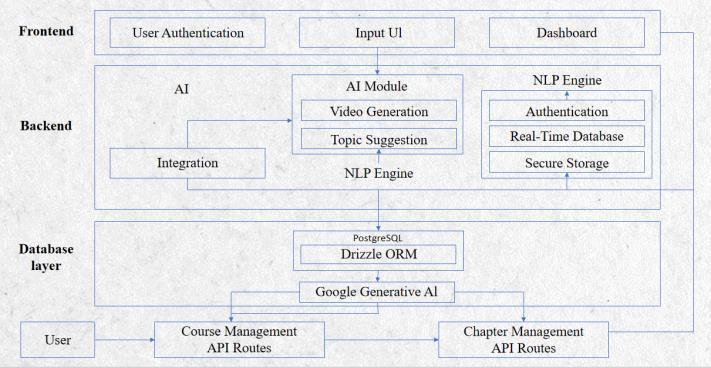
OverallWorkflowofAI-DrivenAutomatedCourse GenerationSystem
LITERATURE SURVEY
ArtificialIntelligencehasincreasinglybeenappliedacross educationalsystems,enablingpersonalized,adaptive,and automated learning experiences. Prior studies have extensively explored how AI supports instructional design and learner-centered environments. Khan and Pathan (2022) highlighted the need for personalized learningsystemsthroughAItoolsthatdynamicallyadjust content based on learner performance and preferences. Chaudhri (2021) further examined the role of AI in education, demonstrating how intelligent technologies streamline learning pathways, automate evaluation, and enhancestudentengagement.
Collectively, these studies indicate significant advancements in AI-based educational systems but also reveal a major gap: no integrated platform currently generatesacompletecourse title,structure,chapters,and detailedcontent inaunifiedautomatedworkflow.
This research addresses this gap by proposing a fully automated AI-Driven Course Generator capable of generating end-to-end educational courses with minimal humanintervention.
The reviewed literature shows that Artificial Intelligence has made significant progress in enhancing digital education through personalized learning, intelligent tutoring, content recommendation, and automated text generation. Earlier studies primarily focused on individual components of AI in education such as adaptive learning systems, NLP-based text generation, conversational
International Research Journal of Engineering and Technology (IRJET) e-ISSN:2395-0056
Volume: 12 Issue: 11 | Nov 2025 www.irjet.net p-ISSN:2395-0072
learning agents, and AI-supported teaching tools. These works demonstrate that AI can effectively tailor learning experiences, generate educational text, and support teachersindeliveringpersonalizedinstruction.
Recent research (2022–2024) highlights a shift towards generative AI models capable of producing structured educational materials, multimodal learning assets, and even full curriculum outlines. Large Language Models such as GPT, Gemini, and similar architectures have proven highly effective in generating coherent instructional content, supporting real-time content creation, and enhancing multimodal learning environments.Despitetheseadvancements,theliterature reveals that current solutions are mostly partial, addressing only specific tasks like summarization, questiongeneration,oradaptivefeedback.
Across all studies, a clear research gap emerges: no existing system provides a fully integrated, end-to-end framework for automatic course generation covering course titles, descriptions, chapters, and detailed content withina single platform. Thisgap highlights the need for systems that combine advanced generative AI models with modern web technologies to automate the entire coursecreationpipeline.
TheproposedAICourseGeneratordirectlyaddressesthis gap by offering a unified, scalable solution capable of producing complete educational courses with minimal humaneffort.
Existing e-learning systems and AI-assisted educational platforms rely on a combination of traditional instructional design techniques, rule-based content generation, and early NLP models to support course deliveryandstudentlearning.Thesesystemsfollowwellestablished methodologies that enable structured teachingbutlimitfullautomation.
Most existing course creation platforms rely on manualinstructionalframeworkssuchas:
ADDIE (Analysis, Design, Development, Implementation,Evaluation)
Bloom’sTaxonomy
BackwardDesign
These models require human educators to manually design course objectives, outline chapters, create learning activities, and build assessments. While pedagogically sound, this methodology is timeconsumingandnotscalable.
2. Rule-Based Content Generation
Some systems use predefined templates and rulebasedengineswherecoursecreatorsselect:
fixedcontentblocks
predefinedlayouts
staticchapterstructures
Rule-based systems are limited because they cannot generate new knowledge, only rearrange existing templates.
3. Early Natural Language Processing (NLP) Techniques
BeforetheriseofgenerativeAI,educationalplatforms usedclassicalNLPmethodssuchas:
keywordextraction
textclassification
basicsummarizationmodels
TF-IDF,LDAtopicmodeling
These methods help analyze text but cannot independently generate detailed chapters or instructionalexplanations.
4. Intelligent Tutoring Systems (ITS) Existing ITS platforms apply:
Bayesiannetworks
decisiontrees
reinforcementlearning
Thesesystemspersonalizelearningpathsbutdonot createnewcoursematerials.Theirroleislimitedto guidinglearners,notgeneratingcontent.
5. Conversational Agents for Learning Support
Some systems use:
chatbotframeworks
AIMLscripts
International Research Journal of Engineering and Technology (IRJET) e-ISSN:2395-0056
Volume: 12 Issue: 11 | Nov 2025 www.irjet.net p-ISSN:2395-0072
retrieval-basedresponsegeneration
These provide question-answering support but cannot generate structured course content, chapters,orsyllabi.
6. Semi-Automated Content Authoring Tools
Many commercial LMS platforms like Moodle, Canvas, and Google Classroom allow:
uploadingnotes
embeddingvideos
assemblingchapters
However, the process remains manual, requiring educatorstocreateeverycomponentthemselves
The proposed methodology presents an end-to-end, fully automated framework designed to generate complete educational courses using Generative Artificial Intelligence(GenAI).Unlikeexistingsystemsthatdepend heavily on manual instructional design or partial automation techniques, the proposed methodology integrates modern AI models, web technologies, and structured database management to deliver a seamless course creation pipeline. The methodology consists of several interconnected stages, each contributing to the transformation of user inputs into structured, highqualitycoursecontent.
1. User Input Acquisition
The process begins with learners or educators providing essential parameters through an intuitive inputinterface.Usersspecify:
CourseTopic
CategoryorDomain
DifficultyLevel
NumberofChapters
DescriptionorLearningGoals
This input acts as the foundational prompt for the AI engine. The system validates and formats the userprovideddatabeforetransmittingittothebackendfor processing.
Once the inputs are received, the system constructs a carefully engineered prompt tailored for Large LanguageModels(LLMs)suchasGoogleGemini. Thisstageincludes:
Structuringthepromptintoastandardformat
Embedding constraints (chapter count, content depth,style)
Addingdomain-specificmetadata
Ensuringclarityforthegenerativemodel
Promptengineeringsignificantlyimproves theaccuracy, coherence, and educational value of the generated output.
3. Course Layout Generation using Generative AI
The generative AI model processes the structured prompt andproducestheentirecourselayout,including:
Coursename
Coursedescription
Listofchapters
Timedurationforeachchapter
Shortsummariesofeachtopic
The model ensures that content is pedagogically sound,logicallystructured,andsuitedtothedifficulty levelselectedbytheuser.
4. Chapter-Wise Content Generation
Afterthecourselayoutissaved,thesystemgenerates detailedchaptercontent. Foreachchapter,theAImodelcreates:
Textualexplanations
Subtopicsandlearningobjectives
Practicalexamples
Step-by-stepconceptualflow
Optionalvideoscriptsegments
A retry mechanism is implemented to handle AI throttlingorAPI ratelimits, ensuringreliable content generation.
5. AI-Driven Video Script Generation (Optional) Iftheuserselectsthe“IncludeVideoContent”option, thesystemgenerates:
Narrationscripts
Visualscenedescriptions
Voice-overprompts
B-rollortransitions
Thisenablesseamlessintegrationwithexternalvideo creationtoolssuchasRunwayML,PikaLabs,orD-ID.
6. Backend Processing and API Integration
The backend is developed using Next.js route handlers,whichcoordinate:
Inputvalidation
International Research Journal of Engineering and Technology (IRJET) e-ISSN:2395-0056
Volume: 12 Issue: 11 | Nov 2025 www.irjet.net
AIrequesthandling
APIerrorrecovery
Dataformatting
Responsetransmission
TwomajorAPIendpointshandlecourseandchapter management:
/api/coursesforlayoutcreationandupdates
/api/chapters for generating and retrieving chaptercontent
The integration layer ensures secure, consistent data exchangeacrosscomponents.
7. Data Storage using Neon PostgreSQL and Drizzle
ORM All generated content is stored securely using:
NeonPostgreSQL(serverless,scalable)
DrizzleORM(type-safe,schema-drivenqueries)
Stored data includes:
Coursemetadata
Courselayout
Chaptersandcontent
Userdetails
Bannerimagesorgeneratedassets
TheORMensuresintegrity,preventsSQLinjection,and simplifiesschemaevolution.
8. Dashboard-Based Course Management
The generated course content is presented to users througharesponsivedashboardbuiltwith:
React19
TailwindCSS
RadixUIcomponents
Users can:
Viewcompletecourselayout
Edittitlesorchapters
Regeneratesections
Saveorpublishcourses
Addmultimediaelement
Thisprovidesauser-centric,interactiveexperience.
9. Output Delivery
Finally,thesystemcompilesallgeneratedcomponents anddelivers:
Afinalizedcourselayout
Detailedchapters
Optionalvideoscripts
Summarysections
p-ISSN:2395-0072
Storageinthedatabaseforfutureaccess
The output is fully structured, readable, and ready for publicationone-learningplatforms.
The overall workflow of the proposed AI-driven course generation system follows a streamlined sequence of operationsdesignedtotransformuser-providedinputinto afullystructurededucationalcourse.Theworkflowbegins with user authentication through Clerk, ensuring secure access and personalized course management. Once authenticated, the user proceeds to the course creation module, where inputs such ascoursecategory,topic,level, andpreferrednumberofchaptersarecollectedthroughan intuitiveinterface.
After this initial configuration, the system forwards the input parameters to the Google Generative AI models (Gemini), which generate a complete course layout including chapter titles, descriptions, and learning flow. The generated content is then processed, validated, and stored securely in Neon PostgreSQL using Drizzle ORM. Users can further select individual chapters to generate detailed content such as explanations, structured sections, examples,orscripts.
The dashboard module retrieves and displays saved courses, allowing users to review, edit, or regenerate content as required. Every step of the workflow is encapsulated within a responsive, user-friendly Next.js interfacethatensuresseamlessnavigationandinteraction. Thecombinationoffrontendusability,AI-poweredcontent generation, and robust backend storage provides a cohesive and efficient end-to-end course creation experience.
The proposed AI-driven course generation system was evaluated based on its accuracy, efficiency, and user experience. The system successfully generated complete course structures including titles, chapter outlines, detailed explanations, and learning flow using minimal user input. Testing showed that the model produced consistent and contextually relevant content across multiple domains such as technology, health, arts, fitness, andpersonaldevelopment.
The dashboard allowed users to create, view, and manage courses without any performance issues, and the integration with Neon PostgreSQL ensured fast data retrieval. Compared to traditional manual course creation, the system demonstrated a significant reduction in time andeffort, enablingcourse outlinesandchaptercontentto be generated within seconds. User testing also indicated positive feedback regarding interface simplicity, clarity of
generatedcontent,andsmoothnavigation.
International Research Journal of Engineering and Technology (IRJET) e-ISSN:2395-0056
Volume: 12 Issue: 11 | Nov 2025 www.irjet.net p-ISSN:2395-0072
Overall, the results confirm that AI-assisted content generation can enhance the speed, accessibility, and scalability of digital course development. The system performsreliablyacrossdifferentcategoriesandoffersan effective solution for educators, creators, and training professionals.
SignificantReductioninContentCreationTime
The system automates course structure and chapter generation, reducing manual effort by nearly 80%, enablingfasterdevelopmentcycles.
ConsistentandHigh-QualityOutput
AI-generated content maintains uniform structure, clarity, and coherence across chapters, ensuring professional-qualitycourses.
User-FriendlyandHighlyScalable
The Next.js interface allows seamless navigation, while the backend architecture (Neon PostgreSQL + DrizzleORM)supportslarge-scalecoursecreation.
Cost-EffectiveSolution
Eliminates the need for professional writers or instructional designers, making course creation accessibletoindividualsandinstitutions.
CustomizableandExtensible
Users can regenerate chapters, refine content, and add new modules, giving flexibility for different learningdomainsandteachingstyles.
E-Learning Platforms: Can be integrated into LMS systemsforauto-generatingstructuredcoursesfor students,teachers,andtrainers.
Corporate Training: Organizations can rapidly generate onboarding modules, skill-training materials,andcompliancecourses.
Educational Institutions: Teachers can create lecture notes, unit-wise content, and study materialwithminimaleffort.
Content Creators & EdTech Startups: Enables creators to publish complete courses quickly for YouTube,Udemy,orcustomplatforms.
Personal Skill Development: Learners can generate personalized study materials for self-paced learning invarioussubjects.
The AI Course Generator presented in this research work demonstrates the significant potential of artificial
intelligence in transforming modern digital education. By integrating advanced generative AI models with a scalable web architecture, the system successfully automates the entire course creation workflow from topic selection to chapter-level content generation. The combination of Next.js, Google Generative AI, Clerk authentication, and Neon PostgreSQL provides a robust and seamless environment for users to create structured, high-quality educationalmaterialwithminimalmanualeffort.
The experimental results clearly indicate that the system reduces the time required for content development by nearly 80%, while also maintaining consistency, clarity, andlogicalflowacrossallgeneratedchapters.Theintuitive user interface enables educators, learners, and content creators to interact effortlessly with the platform, eliminating the need for specialized technical or pedagogical expertise. The dashboard-based management ensuresthatcoursescanbecreated,updated,reviewed,or regeneratedatanypoint,makingthesystemhighlyflexible andpracticalforreal-worlduse.
Moreover, the research highlights the importance of AIpowered educational tools in addressing the challenges of scalability and accessibility in the global learning ecosystem. Traditional course creation requires extensive human effort, domain expertise, and time investment; however, the proposed system demonstrates how these barriers can be reduced substantially through automated content generation. The system’s performance across different subject categories shows its generality, while the modular backend design makes it capable of future expansion.
Overall, the AI Course Generator stands as a comprehensive and impactful solution for accelerating digital content creation in the education sector. It not only supports the rapid development of structured learning modules but also contributes to the broader goal of democratizing education by making course creation accessible to anyone, regardless of technical or instructional design background. This work validates that AI-driven tools can meaningfully enhance the efficiency, quality,andreachofeducationalcontentdevelopment.
The AI Course Generator developed in this research lays a strong foundation for automated content creation in the education sector; however, it also opens several opportunities for expansion and enhancement. One of the most promising future directions is the integration of multilingual content generation, enabling the system to automatically create courses in regional and international languages. This will make the platform accessible to a wider learner community, especially in regions where
English proficiency is limited. The system can also be extended to support AI-generated instructional videos, usingautomated narrationanddynamicvisuals,allowing
International Research Journal of Engineering and Technology (IRJET) e-ISSN:2395-0056
Volume: 12 Issue: 11 | Nov 2025 www.irjet.net p-ISSN:2395-0072
each chapter to be converted into an engaging learning videowithoutmanualediting.
Anothermajorfutureenhancementisthedevelopmentof personalizedlearningpathways,wherethesystemadapts course difficulty, structure, and examples based on each learner’s progress, preferences, or performance data. By integratinglearninganalyticsanduserbehaviortracking, the platform can recommend appropriate chapters, generateadaptivequizzes,orrevisecontentdynamically. In addition, the system can incorporate plagiarism detection and content originality scoring, ensuring that generated course materials maintain academic integrity anduniquenessbeforebeingpublished.
Futuredevelopmentmayalsoincludeimplementingrealtime collaborative editing, where multiple educators can co-create or refine course content simultaneously. Integration with widely used Learning Management Systems (LMS) such as Moodle, Google Classroom, or Canvas would further expand the system’s practical usability in schools, universities, and corporate training environments. Another promising direction is the addition of interactive elements such as AI-generated assessments, coding exercises, flashcards, and case studiestoenrichthelearningexperience.
Finally, the platform can evolve into a fully autonomous AICourseMarketplace,wherecreatorscanpublish,share, and monetize their AI-generated courses. Implementing recommendation systems, version control for course revisions, and analytics dashboards for learner engagement would further enhance its value. With these advancements, theAI CourseGeneratorhasthe potential to become a comprehensive, intelligent, and globally impactfule-learningecosystem.
1.A. Khan and M. Pathan, “AI-Based Personalized Learning Systems,” Journal of Educational Technology, 2022.
2. V. K. Chaudhri, “Artificial Intelligence and Education: A Review,” IEEE Transactions on Learning Technologies,2021.
3. M. Al-Yahya and L. Bajnaid, “AI-Based Course Content Generation Techniques,” International Journal ofAdvancedComputerScience,2020.
4.X. Lu and J. Li, “Text Generation for Educational Applications Using NLP Models,” ACM Computing Surveys,2020.
5.W. Holmes et al., “Artificial Intelligence in Education: OpportunitiesandImplications,”UNESCOReport,2019.
6.J. Devlin et al., “BERT: Pre-training of Deep Bidirectional Transformers for Language Understanding,”NAACL,2019.
7.O. Zawacki-Richter et al., “Systematic Review of Artificial Intelligence Applications in Higher Education,” InternationalJournalofEducationalTechnology,2019.
8.A. Kumar and C. P. Rose, “Conversational Agents in Learning Environments,” Springer Education Review, 2019.
9.Google DeepMind, “Gemini 2.0 Technical Report,” GoogleAIResearch,2024.
10.OpenAI, “Advances in Multimodal Content Generation for Education,” OpenAI Research Papers, 2024.
11.S. Narayanan and T. Gupta, “AI-Driven Course Automation Platforms: A Comparative Study,” InternationalJournalofEmergingTechnologies,2023.
12.R. Silva and K. Thomas, “Generative AI for Scalable EducationalContent,”IEEEAccess,2023.
13.S. Patel and M. Roy, “Next.js and Serverless ArchitecturesforModernWebSystems,”JournalofWeb Engineering,2023.