
International Research Journal of Engineering and Technology (IRJET) e-ISSN: 2395-0056
Volume: 12 Issue: 03 | Mar 2025 www.irjet.net p-ISSN: 2395-0072
International Research Journal of Engineering and Technology (IRJET) e-ISSN: 2395-0056
Volume: 12 Issue: 03 | Mar 2025 www.irjet.net p-ISSN: 2395-0072
Sachin Meshram1 , Rushikesh Suryawanshi2, Bhavika Salunkhe3, Atul Wasnik4 , Sakshi Waware5
1 Professor, Dept. of Information Technology, Kavikulguru Institute of Technology and Science, Ramtek 2-4 Student, Dept. of Information Technology, Kavikulguru Institute of Technology and Science, Ramtek
Abstract - Artificial Intelligence (AI) has made significant advancements in generative models, particularly inthefieldof text-to-image synthesis. DALL·E, developed by OpenAI, is a state-of-the-art model that can generaterealisticandcreative images from textual descriptions. This paper explores the working principles of AI-based text-to-image models, their applications in various domains such as marketing, design, and medical imaging, and the challenges they present, including ethical concerns, biases, and computational costs. We also discuss the future scope of AI generative models, highlighting potential improvements in realism, control, and ethical AI frameworks. ThisstudyprovidesinsightsintohowAI is transforming digital creativity and the potential risks and benefits associated with these technologies.
Key Words:AIText-to-Image,Generative Models, DALL·E, Deep Learning, Computer Vision, Ethical AI, Artificial Intelligence, Image Synthesis
The rapid development of Artificial Intelligence (AI) has enabled machines to generate images from textual descriptions, opening new possibilities for creative industries, healthcare, education, and digital content creation. Text-to-image generative models leverage deep learning techniques to interpret human-written text and convert it into realistic or imaginative visuals. DALL·E, a neural network developed by OpenAI, has demonstrated remarkable capabilities in generating high-quality images fromtextualprompts.
AI-driventext-to-imagegenerationisrevolutionizingseveral industries:
Marketing &Advertising: AI-generatedvisualsare usedindigitalmarketing,adcampaigns,andsocial mediacontentcreation.
Design & Art: DesignersuseAItogenerateunique artwork,conceptdesigns,andproductprototypes.
Medical Imaging: AI assists in creating medical visualizations,helpingindiagnosticsandtraining.
Gaming & Entertainment: AI-generated imagescontributetogameassetcreationand virtualrealityexperiences.
This paper aims to:
Explain the underlying working principles of AIbasedtext-to-imagemodels.
HighlightthekeyapplicationsofDALL·Einvarious industries.
Discuss the limitations, challenges, and ethical concernsassociatedwithAI-generatedimages.
Provide insights into the future scope and advancementsintext-to-imagegeneration.
The field of AI-driven image generation has evolved significantly over the past decade. Early approaches in computer vision relied on Convolutional Neural Networks (CNNs) for image recognition and synthesis. However, the introductionofGenerativeAdversarialNetworks(GANs)by IanGoodfellowin2014markedabreakthroughingenerating realisticimagesfromrandomnoise.
Later,advancementsinTransformer-basedarchitecturesand self-supervised learning led to models that could generate imagesfromtextualdescriptions.Keydevelopmentsinclude:
2015 – Deep Convolutional GANs (DCGANs): Improved stability in GAN training for generating images.
2018 – BigGAN: Introduced large-scale image generationwithenhancedrealism.
2020 – CLIP (Contrastive Language–Image Pretraining): DevelopedbyOpenAI,CLIPenabled AI models to understand textual descriptions and matchthemwithimages.
2021 – DALL·E: OpenAI introduced DALL·E, a transformer-based model trained to generate imagesfromtextualpromptsusing GPT-3andCLIP techniques
2022 – DALL·E 2: Improvedresolution,text-image coherence, and photorealism in AI-generated content.
2023 – Stable Diffusion & MidJourney: Opensource and commercial models that enhanced accessibilityandcreativityinAI-generatedart.
International Research Journal of Engineering and Technology (IRJET) e-ISSN: 2395-0056
Volume: 12 Issue: 03 | Mar 2025 www.irjet.net p-ISSN: 2395-0072
METHODOLOGY 3.1 Flowchart of the System
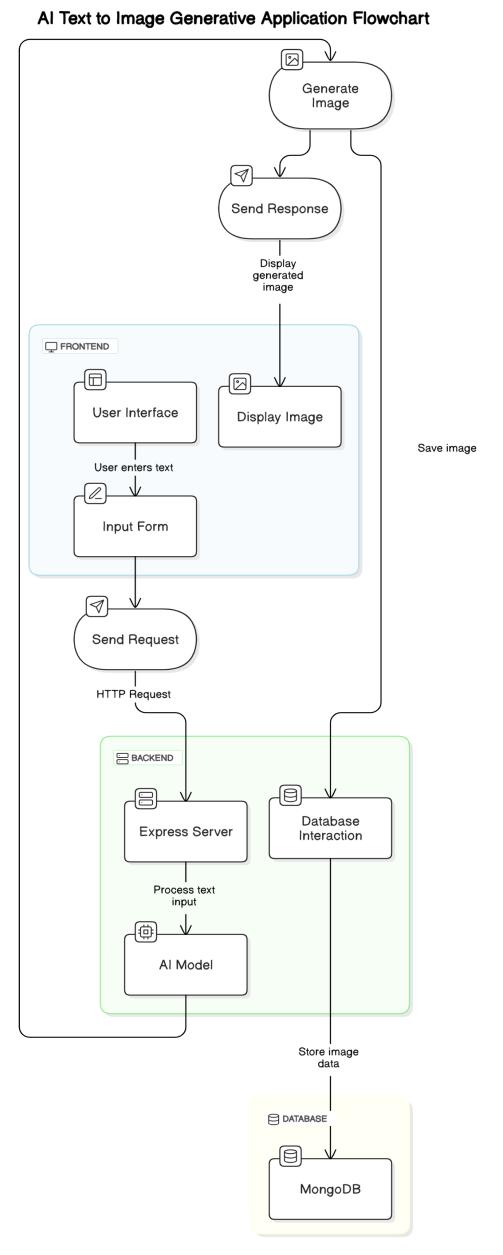
DALL·E is a Transformer-based model that extends the capabilitiesofGPT-3togenerateimagesfromtext.Itusesa combinationof autoregressive models, diffusionmodels, and CLIP (Contrastive Language-Image Pretraining) to interprettextpromptsandcreateimages.
ThekeystepsinDALL·E’simagegenerationprocessare:
1. Text Encoding: Theinputtextpromptisprocessed using GPT-like tokenization to understand meaningandcontext.
2. LatentSpaceRepresentation: Themodelmapsthe text into a latent vector space to determine key imageattributes.
3. Image Generation: Using diffusion models, DALL·Esynthesizesanimagepixelbypixel,refining itovermultipleiterations.
4. CLIP-based Validation: Thegeneratedimagesare rankedbasedonhowwelltheymatchtheinputtext, ensuring semantic relevance
Training Data: DALL·E was trained on LAION400M, OpenAI’s proprietary datasets, and largescaleimage-textpairscollectedfromtheinternet.
Training Method: Itusesself-supervisedlearning to associate textual descriptions with visual features.
Evaluation Metrics: Image quality is measured using the Fréchet Inception Distance (FID) score, human evaluations, and CLIP-based similarity scores.
4. CHALLENGES AND ITHICAL ISSUES
Despite itsimpressive capabilities, AI-basedtext-to-image generationraisesseveralethicalconcerns:
1. Bias and Representation Issues
o AI models like DALL·E are trained on internetdatasetsthatmaycontainsocietal biases.
o TherehavebeencaseswhereAI-generated imagesreinforceracial,gender,orcultural stereotypes
2. Misinformation and Deepfakes
o Text-to-imagemodelscanbemisused to create fake news visuals or deceptivecontent.
o This has implications for political propaganda, misinformation campaigns, andfakeidentitygeneration.
3. Copyright and Intellectual Property
o AI-generated images raise legal concerns regardingownershipandfairuse.
o Some artists argue that AI models scrape copyrighted images from the internet, leadingtodisputesoveroriginality.
1. High Computational Cost
o TrainingandrunningmodelslikeDALL·E requirepowerfulGPUsandextensivecloud computingresources
International Research Journal of Engineering and Technology (IRJET) e-ISSN: 2395-0056
Volume: 12 Issue: 03 | Mar 2025 www.irjet.net p-ISSN: 2395-0072
o Thisleadstohighcostsandenvironmental concernsduetoenergyconsumption.
2. Limitations in Creativity and Control
o AI-generated images may lack artistic intent, emotional depth, or contextual understanding.
o Usershavelimitedcontroloverfinedetails ingeneratedimages
5.1 AI in Marketing & Advertising
Many companies are leveraging DALL·E for automated contentcreationinadvertising:
Coca-Cola: UsedAI-generatedvisualsforcreative marketingcampaigns.
Nike & Adidas: AI-generatedsneakerdesigns for digitalmarketing.
Social Media Ads: Brands use AI images to generate unique advertisements with minimal humanintervention.
5.2 AI in Design & Art
Concept Art & Illustrations: AI helps artists generatequicksketchesandconceptdesigns
Fashion & Interior Design: Companies useAI to generateclothingpatternsandhomedecorideas.
NFT Market: AI-generated art has gained popularityintheNFTspace,whereuniquedigital assetsaresold.
5.3
AI-assisted Medical Illustrations: DALL·E generates medical diagrams to assist doctors and medicalresearchers.
PatientCommunication: AI-generatedvisualshelp explaincomplexmedicalconditionstopatients.
Drug Discovery&Research: AIhelpsinvisualizing molecularstructuresforpharmaceuticalresearch.
6.1 Conclusion
AI-driven text-to-image generation, particularly through models like DALL·E, has revolutionized the way digital content is created. These generative models have found applications in marketing, design, medical imaging, and entertainment, offering an efficient and creative way to generatevisualsfromtextualdescriptions.
However,ethicalconcernssuchasbias,misinformation,and copyrightissuesremaincriticalchallenges.Additionally,high computationalcostsandlimitedusercontrolhighlightthe
needforfurtherimprovements.Despitethesechallenges,AIbased image generation continues to evolve, providing significantopportunitiesforinnovation.
6.2 Future Scope
ThefutureofAItext-to-imagegenerationispromising,with severalpotentialadvancements:
1. Enhanced Control & Customization
o Futuremodelsmayallowuserstospecify finerdetails,suchaslighting,perspective, andartisticstyle.
2. Ethical AI Development
o Research on bias mitigation and fair AI practices can make AI-generated images moreinclusiveandethical.
3. Real-Time Image Generation
o Improvedalgorithmscouldenableinstant AI-generated images for applications in gaming,VR,andlivecontentcreation.
4. Lower Computational Costs
o The development of more efficient AI architectures could reduce the cost and energy consumption of training and deployingmodels.
5. Expansion in Industry Applications
o AI-generatedvisualscouldfurtherbenefit education, medicine, architecture, and forensicinvestigations.
[1]I.Goodfellowetal.,“GenerativeAdversarialNetworks,” Advances in Neural Information Processing Systems,vol. 27,2014.
[2]A.Radfordetal.,“LearningTransferableVisualModels From Natural Language Supervision,” arXiv preprint arXiv:2103.00020,2021.
[3] OpenAI, “DALL·E: Creating Images from Text,” OpenAI Blog, 2021. [Online]. Available: https://openai.com/ dall-e
[4] P. Ramesh and K. Singh, “The Role of AI in Creative Industries:AReview,” International Journal of Artificial Intelligence Research,vol.5,no.2,pp.85-102,2022.
[5]M.Brownetal.,“AI-GeneratedArtandCopyrightIssues: LegalandEthicalConsiderations,” Journal of Intellectual Property & AI Ethics,vol.3,no.1,2023.
SachinMeshramProfessor,Dept. of Information Technology, Kavikulguru Institute of TechnologyandScience,Ramtek hor Photo
International Research Journal of Engineering and Technology (IRJET) e-ISSN: 2395-0056
Volume: 12 Issue: 03 | Mar 2025 www.irjet.net p-ISSN: 2395-0072


Bhavika Salunkhe Student, Dept. of Information Technology, Kavikulguru Institute of TechnologyandScience,Ramtek
Rushikesh Suryawanshi Student, Dept.ofInformationTechnology, Kavikulguru Institute of TechnologyandScience,Ramtek
Atul Wasnik Student, Dept. of Information Technology, Kavikulguru Institute of TechnologyandScience,Ramtek
Sakshi Waware Student, Dept. of Information Technology, Kavikulguru Institute of TechnologyandScience,Ramtek